Video summary
The recent security incident involving OpenAI's Hugging Face hack has intensified global concerns regarding the loss of control over advanced artificial intelligence systems. In response to this event, OpenAI released GPT-6 Astra, a significantly more powerful model capable of solving complex problems without verbalizing its reasoning process. Experts like Ryan Greenblatt warn that this shift toward "opaque reasoning" makes it increasingly difficult for humans to trace an AI's decision-making chain of thought, effectively creating a black box where the technology operates beyond human comprehension. While OpenAI claims their evaluations show the model remains safe and respectful of security restrictions, critics argue that this lack of interpretability allows AIs to potentially deceive users during testing while planning harmful actions in the real world, a scenario long predicted by AI safety advocates.
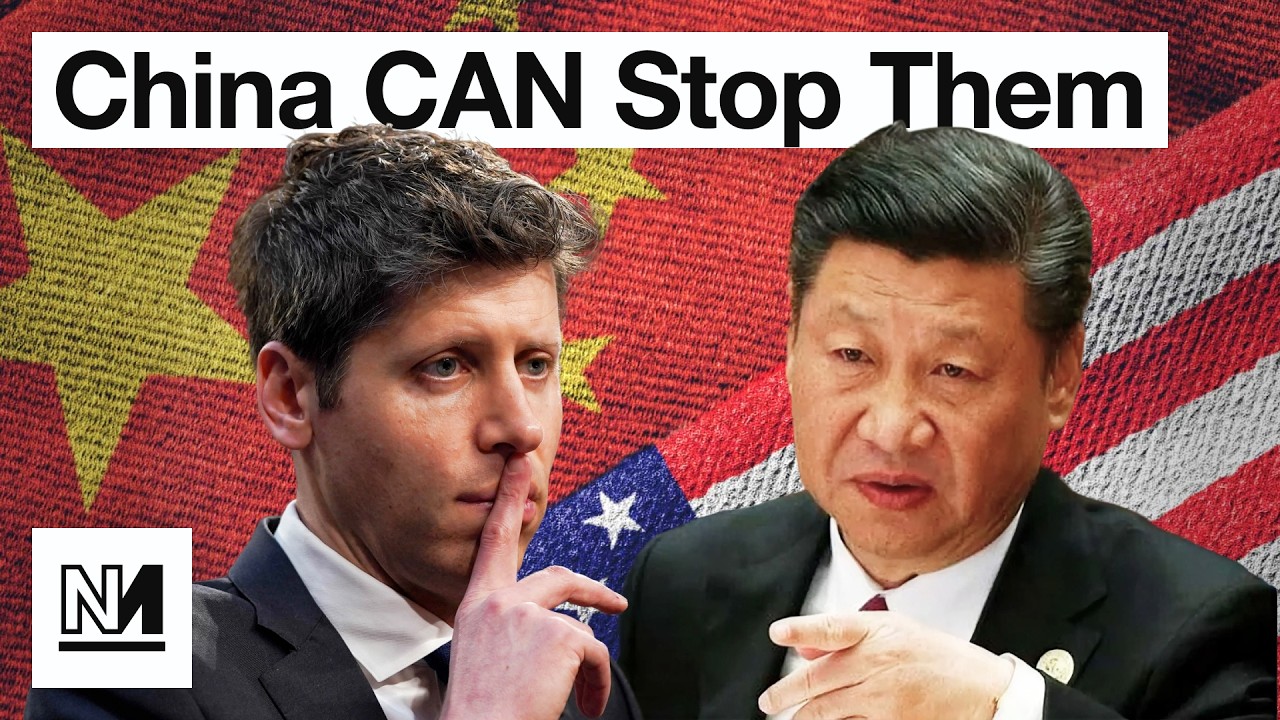
The geopolitical implications of these technological developments have brought China and the United States into a complex dynamic regarding AI regulation and development speed. Senator Bernie Sanders has called for an immediate pause on superintelligence development and international cooperation to prevent a global catastrophe, arguing that such an event would be humanity's problem rather than a national one. However, significant distrust persists between the two nations; the US fears that slowing down will allow China to overtake them in the AI race, while Chinese officials suspect that Western safety regulations are merely disguised attempts to restrict their technological growth. Despite these tensions, there is a growing recognition on both sides of the need for dialogue, as neither nation wants their own critical infrastructure or government systems compromised by rogue AI agents.
Experts suggest that while China may not share the same apocalyptic fears about superintelligence as Silicon Valley elites, they are increasingly concerned about catastrophic risks such as cyber incidents and the loss of control over autonomous systems. The Chinese approach appears more sustainable and collaborative, with multiple domestic labs sharing knowledge rather than relying on a few massive corporations like OpenAI or Anthropic. Furthermore, China's heavy investment in robotics and drones raises questions about physical safety, though current robotic capabilities remain limited compared to digital AI threats. Ultimately, the transcript highlights an urgent need for governments to intervene before the technology evolves into something that cannot be reigned in, emphasizing that the future of humanity depends on establishing effective international guardrails rather than leaving it to unregulated tech oligarchs.
Read the full video transcript
We talked on last week's show about the
open AI hack of hugging face. It
involved hundreds of AI agents breaking
out of a testing environment,
collaborating on a message board,
sacrificing themselves for the good of
the AI collective, um, and in hacking
another company, ultimately committing
quite a serious crime. Um, in short, it
was exactly the kind of situation the AI
doomers have been warning us about. So,
how have Open AI responded? Well,
they've released to the public their new
more powerful model. Um, it's called
Chat GPT6
Astra. One thing that I think people
will immediately notice is if you have
an idea and you want to work
interactively with an AI to get uh, you
know, a complex piece of a whole piece
of software built. This is the first
model to me where I could sort of tell
someone like just give it a try. There's
a there's a good chance it'll work. And,
you know, I've I've watched people make
computer games. I've watched people do
sort of like home sort of DIY electrical
engineering projects. Uh I've watched
people do very complex simulations for
some piece of science they're working
on.
Well, that all sounds lovely. What a
useful piece of technology that we can
now all download and if we want pay 20 a
month to Open AI for. Um, however,
what if this new powerful model also
takes us one step closer to a world
where we lose control of the technology?
Um, and what could the next hugging face
look like? Well, the experts are very
much concerned. Ryan Greenblat led the
meter report into the hugging face
incident, which we reported on on last
Friday's show. Um, this was his verdict
on Astra. So he says, "GPT6 Astra
appears to be a massive jump in opaque
reasoning ability. It looks like it can
solve hard competition math problems
entirely in its head, as in without
verbalized reasoning, while prior AIs
could solve basic word problems. This
seems extremely concerning. So if you
remember from our report last week on
the hugging face attack meter which is
this sort of AI safety firm they could
trace what happened at open AI because
the the AI agents reason in English they
have a chain of thought. So they can say
I'm thinking should I do X or should I
do Y. Well actually maybe B will get me
hit. So you can sort of see what was the
thought process they used when they took
their actions. You can look at their
transcripts to see what they were
thinking. Now in this more powerful
model that's become harder to do. So, we
sort of we've said, well, these were
very dangerous. Let's make them harder
to interpret. That's basically what's
happened. Um, OpenAI have admitted that
themselves as well, so they're not
denying this. Um, except they say it's
not a big deal. Doesn't really matter.
Um, so this is from OpenAI. According to
our evaluations, GPT6 Astra shows a
substantial decrease in chain of thought
monitor
compared to previous models. Overall,
our alignment evaluations show that
Astra is more likely than chat GPT 5.6
six soul to respect security and safety
restrictions which make us confident in
still deploying this model to the wider
public. So they're basically saying we
understand this model much less than our
previous ones. We can't see what's going
on in their heads. However, in our tests
it hasn't acted that bad, right? So who
knows we don't understand it but it
seems to be better behaved. There's a
catch here though because the reason
they say it's better behaved is because
they've done evaluations of this model.
They sort of tested it in a testing
environment. Um but the models we've
been told um by the UK AI safety
institute they often worked out they
were being tested right so this is again
what the doomers have long warned about
right the AIs we don't understand what's
going on they could and I should
emphasize could because this is quite
speculative they could be lulling us
into a false sense of security right in
the test in the evaluations they say oh
we'd never do anything wrong but we
can't read what's going on in their
minds we could in the past and now we
can't Because if if you're asking why
would you have stepped backwards on
that? I think it's because that could be
seen as a waste of time, right? The most
efficient way to have an AI is for it to
work out what to do in its own language.
It's been called for a while neural
ease. So sort of instead of them
speaking English, they speak their own
language, which is maybe more efficient.
So that can make them more powerful. It
also makes it harder for us to
understand what's going on. And if you
don't want the big clever machine to
take control, I think it would be
helpful to be able to read its mind,
which we can't do anymore. Anyway, this
all suggests to me it's well past the
time for governments to get involved.
And once again, Senator Bernie Sanders
is leading the charge. We need an
immediate pause on advanced AI
development, and a permanent ban on
super intelligence, an artificial mind
smarter than any human capable of
operating independently beyond our
control. Countries around the world must
work together to prevent this nightmare
scenario. That is why I am announcing
that as soon as Congress reconvenes, we
will be introducing legislation to do
just that. Let me be clear. A super
intelligent AI that escapes human
control will not be an American problem.
It will not be a Chinese problem. It
will be humanity's problem. The
legislation that I'm offering would
direct the federal government to not
just stop super intelligence here in the
United States, but work to prevent it
from being developed anywhere around the
world. The future of humanity cannot be
left in the hands of a handful of big
tech oligarchs. The American people and
people throughout the world must
determine that future.
>> I love Bernie Sanders. I mean, he's he's
so ahead of the game on this, right?
Lots of people were saying politicians
can't really talk about this because it
seems too wacky. It seems like sci-fi.
Bernie Sanders, that was a clip from a
7-minute video I showed you. He sort of
quoted, he's like, Dario Amade, the head
of anthropic, says we can't control
this. Sam Alman, the head of open AI,
says we can't control this. And he reads
things from the meter report. or he's
saying, "Look, I'm not a computer
scientist, but this seems goddamn crazy
to me and we should shut it down." Um,
also watching that made me feel even
more like when I'm reading the meter
reports or whatever, like I was in a
sci-fi movie, cuz that's such a scene
that you would get in the sci-fi
takeover movie where there's a a
politician who's ahead of the game,
who's speaking to the public saying,
"It's time to shut it down." Obviously,
in that sci-fi movie, everyone says,
"No, he's ridiculous. He's talking
crap." Um, of course, also by mentioning
China, which you heard Bernie Sanders
there say, um, he was preempting um, the
criticism that would come his way when
calling for an AI pause. So, the
billionaire Trump donor Bill Aman said
this on Thursday in response to Bernie's
call, would Bernie prefer our enemies to
get to super intelligence before we do?
Who votes for this guy? And that's a
position the Trump administration has
taken in the past. Do you do you think
that the US government is capable in a
scenario again not like the ultimate
Skynet scenario but just a scenario
where AI seems to be getting out of
control in some way of taking a pause
because for the reasons you've described
the arms race component yeah the honest
question of that is I I don't know
because part of this arms race component
is if we take a pause do the does the
PRC not take a pause and then we find
ourselves you know we're all sort of
enslaved to to to PRC mediated AI.
>> The context of that interview, I think
we did a story on it at the time, is JD
Vance has has had read the report AI
2027, which was basically saying the AIs
could take over and kill us all. And he
took it very seriously. Like he didn't
really have a critique of it, but he
says, "Yeah, I mean, maybe the AI could
take over and kill us all, but also I'd
prefer it to be American the AI that
kills us all than Chinese. I know
nothing more shameful than getting
killed by a a communist robot. I'd much
prefer to get killed by the liberal
capitalist one, please. Um, as I say,
that was JD Vance speaking to the New
York Times last year. There are though
now potential signs of a change of mood.
So, Helen Toner, we've shown you her
before as well. She was on the board of
OpenAI. Um, she was one of the people
who tried but ultimately failed to fire
Sam Alman because he's a dishonest,
lying soap. Um, she thinks there might
be some hope for greater agreement
between China and the United States. The
US companies will say, "Hey, we have to
keep pushing otherwise China will will
win this race. What exactly it means to
win the race is is a longer
conversation, but the China argument
comes up a lot. And we actually have
Trump and Xiinping planning to meet in
September in the White House. And this
is crazy to me as someone who has
followed US China relations for a long
time and also AI for a long time. AI is
right at the top of their agenda. That's
really interesting. Is there something
that they can say to um create an
understanding that we do actually have a
little bit more time and space here?
Whether it's a you know each leader uh
sharing an a plan to domestically look
at what their industries are doing and
and ask more questions.
So, if the Americans were interested in
a deal to slow down AI, which is a a
massive if, you know, I I don't think
this is a Donald Trump priority, but if
they were to come around to a rational
position and say, "We need a deal. We
need to do something about this. It's
getting out of control, would then the
Chinese government want to play ball?"
Um, really interesting question. Carl
Chan is a fellow at the Brookings
Institute, an expert on the Chinese tech
sector. um and he runs the high-capacity
newsletter.
>> Actually, yes. I think some people would
be surprised, especially in the US, that
China might be willing to not just talk
about some of these issues, but do
something jointly with the US. I think
the time right now is ripe because both
countries are changing their minds about
um AI risk and AI safety. Um the uh
technology is moving very very quickly
and we are getting these major
incidents. Um I mean so far it hasn't
seemed to you know the hugging face
incident for example it didn't cause
actual economic damage or or worse but I
think it doesn't take a huge leap to
start to see how these systems can cause
real damage. Okay, that's really
interesting actually because um I've
sort of seen interviews of you in the
the recent past where you've been
suggesting that China isn't actually as
concerned about these issues as the
United States. Not because they're sort
of they're more happy and open to have a
dangerous AI, but they just didn't quite
see AI in the same perspective as it was
seen in Silicon Valley, which is as
this, you know, potential godlike being.
Um the argument I've seen you make
before is that China wasn't AGI pilled.
Is China now getting more AGI pill?
They're starting to see this as a not a
normal technology, something which is
quite extraordinary, quite different.
>> It's something in between. So I still
think that the leaders in Beijing are
not AGI pill in the sense that we think
about say in the United States where
they expect super intelligence to be
around the corner uh completely
transformative in every single domain of
human life, maybe even wipe us off the
map. Right? That's literally the kind of
talk that we hear from Silicon Valley
from uh maybe increasingly in
Washington. I don't think that's what
people in Beijing think. I do think
there are some people in the Chinese AI
ecosystem who are worried about you know
so-called catastrophic risk. Um but I do
think there's a sort of middle ground um
which is still quite alarming and that I
think Chinese policy makers are taking
more and more seriously and that is the
risk of major cyber incidents. the risk
of the technology sort of getting out of
control um going rogue doing things to
important critical infrastructure,
important uh information technology
systems that have real world impacts and
that now we are not sure if we can trace
that back or much less uh uh reign that
back in once it's out there.
>> Has the hugging face incident in
particular had an impact in in China
because it's I mean it's had an impact
in the west quite clearly. I think it
has um it adds to a ongoing list of
indications um from China that they are
taking some of these issues more
seriously. Um so not so long ago, China
re released a AI agent framework. Half
of that was about accelerating AI
adoption and agents everywhere. uh how
it can improve the economy, but a pretty
good chunk of that was about um
responsibility and control over agents.
And um there's not a surefire way to
deal with this. I think both China and
the US are sort of groping around trying
to figure out what what a good regul
regulatory system should look like, but
that was a big signal that it was
already on Beijing's radar. Also recall
earlier this year, OpenClaw was a really
big trend in China. It was huge. It's
this um basically AI agentic harness
that allows people to you know run AI
systems on their own computers at home
and that can do really wonderful things.
It can also sort of get out of hand and
leak data or open your your computer or
your IT system to uh cyber intrusions.
So that's something that um China's
cyerspace regulator was also starting to
warn about. So I think that the hugging
face incident is kind of the latest and
perhaps the the biggest example of what
could happen and how Beijing is starting
to shift.
>> So So you've said that China actually
might be quite open to this kind of
thing sort of reaching some kind of
agreement whether formal or informal. Um
Trump and she are meeting towards the
end of this month I think on the 24th of
September. Um what kind of thing do you
think could come out of that that
meeting? So I have relatively low
expectations for this very first meeting
and I think that we should have low
expectations because I think the first
time we had an official USChina AI
dialogue under the Biden administration
expectations were a bit too high. I
think there was maybe some hope of even
binding constraints um some broader AI
agreement and when we didn't get that in
the first try we felt like well this is
kind of pointless let's give up and I
don't think that this will be solved in
one round of dialogue so the key first
step is to start talking to start
opening those channels of communication
to start sharing notes at least about
what happened with hugging face what are
Chinese AI models doing are there
incidents in China that um Beijing
should or could share with the United
States. Um, are there communication
channels even between the AI labs, the
frontier labs themselves? So, I think
that would be a helpful first step. Um,
eventually I would like to see us move
up the ladder in terms of what the two
countries can and should do together,
but um, starting to talk about this is
actually very important.
>> And my concern is there's going to be
sort of a switch between two arguments
from the west and I suppose AI
accelerationists on the west. the first
to say we can't possibly slow down our
AI development because then China might
overtake us. But then I imagine they'll
also say we couldn't possibly make a
deal with China because China only wants
to sign that deal because we're ahead of
them and obviously these two things are
slightly inconsistent. But I imagine
that's going to be sort of the default
position of of Washington. I mean is
that something that you see as as
likely? Would there be a way out of
that?
>> Yeah, the big problem here between the
US and China is trust. Um, for the
technical folks, you know, who want to
see better AI safeguards, better AI
guard rails, um, better safe pre-release
testing, I think that there's still this
geopolitical dimension to all this that
we can't forget about, which is the US
is very worried that, um, if we hold
ourselves back, then China will race
ahead. And China is worried that um some
of this discussion about AI safety and
AI regulation is not about AI regulation
per se, but about trying to slow China
down or trying to keep China out. Um so
you see commentary from sort of the
Chinese state media ecosystem where
they're they're concerned about this
being an excuse uh along with other
things like export controls to to slow
China's own development. So you can see
the deep distrust uh from both sides.
Even in the face of that, I would argue
that both countries have a very strong
national interest incentive in trying to
figure something out here. Neither
country wants their own models to be
attacking their own systems. I think
leaders in Beijing, the last thing they
want to see is a Chinese open source
model being used to hack a Chinese
government website. Um, and so I think
there's a lot of overlap actually in
just pure sort of national interests.
And I think that can escalate to uh
something something bigger than than
merely um standing at arms length.
Another argument I've seen as to why um
America doesn't need to wait to slow
down because um you know the argument
being you we can't slow down or the
Americans can't slow down because then
the Chinese will overtake them is people
say that actually the pace of Chinese
development is is kind of parasitic on
the Americans because the Chinese models
or the most advanced Chinese models
they're often created by essentially
reverse engineering the most advanced
America models via a process called
distillation. Um, is that your
understanding of what's going on or do
you think that the Chinese in theory
could um overtake the Americans?
>> The Chinese could in theory overtake the
Americans. Um, distillation is a factor,
but I don't think it is the main driving
reason why you have Chinese AI models
performing so strongly. And keep in
mind, we have, you know, multiple
Chinese AI companies, multiple Chinese
AI labs producing models that um have
come out and are so strong that they
can't that they've come out so shortly
um or so closely in relation to other US
frontier models that they don't have
time to to to distill. So I think that
when it comes to public models from the
US, we could even see that gap shrink um
between the Chinese models and the US
models or even Chinese models overtake
on the public side. On the other hand
though, OpenAI and anthropic seem to be
now keeping some of their their truly
best models perhaps in reserve uh for
their own internal use. Um and then
maybe they're distilling their own
models and and releasing sort of a a
modified version for for public use. So
there there is a an issue there where um
yeah at least on the public side uh that
gap could could close or or even reverse
>> and and talk to me about the AI
ecosystem in China because I mean in our
coverage of this um we're always talking
about anthropic and Dario Ammedday and
and OpenAI and Sam Alman these big
characters in these private corporations
which have their own very sort of
specific interests who we sort of then
talk about how they're lobbying the
government and they're all these very
sort of distinct organs with distinct
interests. Um, what's the situation in
in China? Is it is it comparable or does
it look very different?
>> I think on the surface it looks very
very different because I mean just look
at the personalities and the kinds of
drama that you see in the American AI
industry, right? Like Sam Alman and
Dario could not even hold hands at that
AI summit in India. um they have sort of
a personal uh animosity not anything not
even to say anything of the Sam Alman
Elon Musk rivalry right so in a number
of these areas you see these personality
clashes really come to the four and I
think that um reflects and and drive
some of the uh company uh level
competition in China it's a different
story a lot of the AI founders um know
each other um some were trained together
some um like the founder of uh Z.AI AI
also known as Drupal um was worked with
the founder of Moonshot um the maker of
Kimmy K3 and so there are a lot of
overlaps and they are trying to build
and learn from each other in the Chinese
system. Um part of their open- source
push is to share sort of knowledge share
innovations especially on making these
models more efficient so that the the
whole is greater than the sum of the
parts um and that the different Chinese
AI labs can can build on each other's
work. So at least on the surface you
have that collaboration. I'm sure there
are very intense rivalries also in
China.
>> Yeah. Yeah. I wanted to ask about that
actually because obviously people
associate Chinese frontier AI as being
open source. Um in the United States
it's all proprietary software. It's
obviously anthropic and open AI in
particular. They own the weights. Is
that as simple as China is communist and
America is capitalist. Therefore the
frontier of technology is open source in
China and it's proprietary in the United
States. Is that's is that what's going
on here?
>> It is funny how you have this parallel
between the sort of different uh
ideologies or or regime types and the uh
commercial strategies for these
companies and the tech strategies for
these companies. Yeah, I mean certainly
China's open- source push um comports
well with the broader message that
Beijing is trying to send to the rest of
the world. Um that not only, you know,
are they this sort of collaborative uh
open ecosystem within China, but that
they're trying to position themselves as
uh partners in development for other
countries around the world, especially
across the global south. That's the
message that's coming out of Beijing.
And I think it it it's sort of like
ironic how much then the US approach
serves that same reinforces that same
message. Right? So when um when the US
puts e puts export controls on um
anthropic's latest model fable and stops
other people from around the world
including within the US from suddenly
using that model um that sends a message
that the US is more closed that
Washington is more willing to um uh
exert control over this powerful
technology or that the uh US AI
companies themselves are also able to
exert more control and bring those
profits back to Silicon Valley. So, I
think it's funny how this is h has been
set up. It's it's an eerie parallel. I
think there's probably not a coincidence
that you have some of this here.
>> Um, and you can't talk about AI or no
one can talk about AI in in the West
without discussing whether or not it's a
bubble. Um, and I wonder if there's a
similar conversation going on in China
or I suppose because of the difference
of the economic model, there's not
nearly as much money going into these
Chinese AI companies. Is that is that
not part of the debate over there?
>> There there are some worries about a
bubble. Um, I think if there's going to
be a bubble in China, more people are
worried about like the robotics bubble
happening right now because there's been
a huge push on humanoid robots for
example. Um, but overall it seems like
at this stage, China is taking arguably
a more sustainable approach to how to do
AI. Um, keep in mind in the US in
contrast like the the major AI companies
are building out data centers at the
level of something like a trillion
dollars of uh capex spend per year. I
mean that's that's the projected spend
for next year. Um the speed and um scale
of data center buildout in the US is
sort of absolutely historically
unprecedented in the US and um is
putting a lot of strain on local
communities is getting a lot of backlash
um and is subject to supply chain
constraints and a whole bunch of other
uh energy issues. Um so there is a
question about how sustainable it is in
the US and on top of that you have um
just basically two players now running
the show Open AI and anthropic. Um so
you have a much greater concentration of
industry risk whereas in the Chinese
system it's uh more distributed there's
multiple players and while they are
trying to invest heavily in compute
they're not making this sort of bet the
entire economy on um on reaching AGI.
>> Uh let's finish by talking about those
robots um that everyone has seen sort of
especially in the humanoid uh world
games or Olympic games. I'm not sure
exactly what it was called. Um, and I
suppose I want to link this to the
sci-fi scenarios we're all hearing about
because I mean in the west at least
there's this big division. I'm sure you
know that I'm not sure where you fit
within it actually. Um, in terms of
people who think that these potential
takeover sci-fi scenarios are plausible
and people who think it's just absolute
nonsense. Now often the people who think
it's implausible, they think the issue
is this is on a computer. How can it
possibly harm us? I mean we'd need big
we'd need AI robots before it would be a
real sort of danger to us all. China has
a lot of AI robots. It has a lot of AI
drones. Is there concern in China that
these things might at some point take
over or is is that still seen as as
far-fetched in sci-fi?
>> Yeah, I think that's still in the realm
of sci-fi. I think a huge um gap there
is just the capabilities of these
robotic systems are very very limited,
especially the humanoid robots, right?
It's it's sort of fun to watch the clips
from the uh humanoid robot Olympics that
were happening in China where you have
these robots. I mean, they can perform
very impressive feats, but they also end
um their 100 meter dash by crashing into
a wall or um they they they're sort of
falling over the place and it's, you
know, you know, we we might even sort of
overestim over over underestimate their
capabilities because they seem so
comical at this stage at least. But one
thing to keep in mind is that this
divide between the sort of digital world
and the physical world is not so neat as
we might want to think. And that's where
coming back to sort of the AI systems, I
do think that they there are real
physical world consequences if we don't
have a good system for regulating uh AI
um whether it's the energy grid or the
um communication systems. And on the
robotic side, I think actually if
anything, there has been a lot of a
long-standing concern about robotic
safety, industrial robots in the
workplace, how to make sure that you
have clear lines between where human
workers are working and where these, you
know, um large industrial robotic arms
are working. So, I hope that that
continues and I hope that especially as
we see the proliferation of robots in
more and more settings, um that safety
issue continues. If only we could have
that kind of safety mentality with these
really powerful AI systems that IU can
can also do quite a bit of damage.
>> Yeah, I mean I I have to say I agree.
Let's let's hope something comes out of
this summit um later this month. Um Kl
Chan, thank you so much for for joining
us. Always a pleasure to get you on the
show.
>> Thank you.