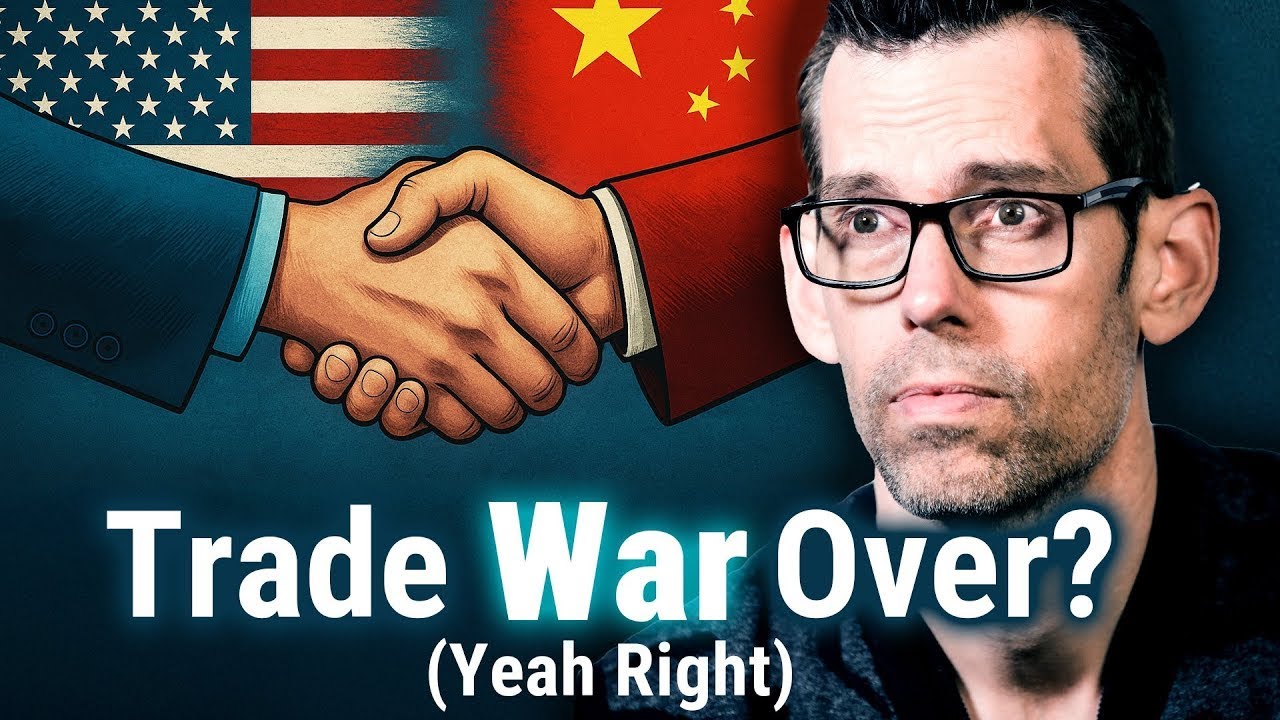
China 90 Day Tariff Pause: Strategic Move Or Stalling Tactic?! | Tom Bilyeu Show
Watch on YouTubeVideo summary
In this episode of *The Tom Bilyeu Show*, host Drew Blass analyzes President Trump's recent diplomatic and economic maneuvers, focusing on a 90-day pause in tariffs against China as a potential strategic victory or a stalling tactic by Beijing. While the agreement reduced reciprocal tariffs from 125% to 10%, Blass questions whether this move merely buys Chinese leadership time to stabilize their economy amidst its own housing crisis and global outreach efforts, such as meetings with Caribbean nations. He contrasts Trump's aggressive negotiation style—characterized by a willingness to flip tables and use leverage—with the perceived passivity of the previous administration under Joe Biden. The discussion also covers massive new deals struck in Saudi Arabia, including an estimated $600 billion investment package covering defense, AI data centers, tech investments from firms like Google and Oracle, and energy exports, which Blass views as significant indicators that other nations are eager to engage with Trump's approach despite the controversy surrounding his acceptance of a gold-plated sky yacht from Qatar. The conversation shifts critically to President Trump's Executive Order targeting Big Pharma to reduce drug costs, an action Blass supports politically but warns against regarding price fixing as a viable long-term economic solution. He argues that while lowering prices is popular, centrally controlled pricing mechanisms often lead to unintended consequences like reduced R&D investment and supply shortages, citing the inefficiencies of Price Spreads managed by Pharmacy Benefit Managers (PBMs). Drawing parallels between this situation and historical examples from World War II prisons where cigarettes became a static currency due to hyperinflation in other goods, Blass illustrates how free markets self-regulate through price signals that central planning disrupts. He suggests that the current system is so corrupt with regulatory capture that Trump's authoritarian-style intervention might be necessary to force transparency and collective bargaining among nations like the UK and Canada, potentially lowering US costs while risking supply chain disruptions if drug companies withdraw from a capped market. A significant portion of the dialogue addresses immigration, cultural assimilation, and the preservation of American identity against rising demographic shifts in Europe and Asia. Blass references recent British government plans to tighten immigration rules and extend settlement periods as evidence that Western nations are grappling with similar issues he predicts will soon affect the US. He emphasizes that culture is defined by biology, beliefs, and values, arguing that mass migration without assimilation leads to societal fragmentation rather than growth. The host touches on rumors regarding a proposed Muslim city in Texas involving HOA fees for mosques, using it as a case study for how communities might self-select or face legal challenges when their cultural practices conflict with national laws. He warns against the dangers of importing value systems that do not align with local traditions, citing historical conflicts and the potential for "Sharia law" disputes to escalate if immigrants refuse to integrate into the host country's civic framework. Throughout the episode, Blass maintains a complex mental model of Donald Trump as both a greedy capitalist driven by profit motives and an accidental patriot who inadvertently benefits America through his self-interested deals. He reconciles these traits by suggesting that Trump operates like a CEO treating "America" as his product, making concessions to secure favorable terms for the nation even if it involves accepting questionable gifts or engaging in controversial rhetoric. This perspective extends to his views on global finance and central banks, which he describes as sinister entities capable of printing money over decades to confiscate wealth from ordinary citizens through inflationary cycles. Blass concludes that while Trump's methods are often chaotic and morally ambiguous—exemplified by the Qatar jet controversy—the results so far show a shift toward manufacturing-focused economies and reduced reliance on foreign interventionism, though he remains wary of whether these gains will hold up against midterm election pressures or further Chinese maneuvering.
Read the full video transcript
Trump makes progress with China on the
trade war and signs a deal with Saudi
Arabia worth billions. Trump takes on
big pharma by signing an EO to reduce
drug costs. Qatar offers Trump a
goldplated sky yacht. The Russia Ukraine
ceasefire drama continues. Kir Stararma
warns about immigration getting out of
control. And a proposed Muslim city in
Texas comes under scrutiny as rumors
fly. Drew Trump moves fast, man. 100
days or not, like this guy is non-stop
getting things done, but I hate to say
some of the things that he's been
getting done lately, I'm not a big fan
of. Hey, well, he's taking a victory lap
around this China deal that he just
booked. So, it was a 90-day reduction in
all the tariffs. The 145 rate that we
levied on them has came down to 30. The
125% reciprocal tariff they put on us
has come down to 10 for 90 days. And
this happened over the weekend with
Switzerland. It seems like it's going in
the right direction, but again, my
question is, was the chaos worth it? So,
where do you think we stand with it?
Well, I think there's a far bigger
question, which is, are we being played
by China? Are we actually going to be
able to paper the deal? Honestly, I walk
away from this and I go, okay, this is a
step in the right direction in that
we've got them to the table. They were
saying that they were not negotiating
and made it sound like they had
absolutely no interest. Obviously, we're
now talking. Trump is saying he's going
to be speaking to Xi within the week.
We'll see if it if it transpires. He
also said in the meeting that they
revealed that they were um well aware
that Biden wasn't going to do any push
back and so as soon as Biden came into
office, they reiged on a bunch of the
commitments that they had made. So,
we'll see. Trump feels very uh
optimistic that they're going to get
something done. I certainly take it as
an optimistic sign that the conversation
has begun, that we've got the 90-day
pause. The big um or the secondary
question to all of this is does this
move buy China more time with their own
people? Because it's entirely possible
that things were rationing up, the pain
was getting to the point where they were
really going to be willing to play ball.
Admittedly, Trump being uh consiliatory,
being easy to negotiate with, if you
have a negotiating partner who's
negotiating in good faith, this is a
great thing. And it shows, hey, I'm here
to work. I'm not trying to cause maximum
damage. Obviously, don't play. If you
mess around, then I'm willing to strike.
But it is really possible that the
Chinese economy is very weakened right
now, that she was in a very weak
position given the Ever Grand housing
fiasco, which I likened to 2008. It's
not like I hear a lot of economists
running around saying that, but I don't
think I'm too far out of pocket to say
that. So, you've got them in their sort
of 2008 moment. You've got Trump now
putting effectively a trade embargo.
you've got um factories and warehouses
shutting down like crazy. This is the
moment of maximum leverage. And the
question is, did he just throw them a
lifeline that's going to make it so that
they can drag things out long enough
that this becomes problematic for him in
the midterms? Because remember, we've
only got like a year and change before
people start um really beginning to
campaign. And if he's not got something
cooking for a year, so look, I'm hoping
90 days doesn't set us back that far.
But you did buy them more time. And so
I'll be interested to see how that plays
out. I feel parallels between Xi and him
stringing us along and Putin stringing
the ceasefire talks there along. So it's
hard to know what exactly is real. You
want to be magnanimous. You want to be
the bigger man. You want to uh show a
willingness to get the deal done. But if
people are playing you,
then that's going to be the result. Do
you think that this is something that
will create an urgency for this deal to
get done? Cuz to me, 90-day pause, it
can be interpreted in two ways. One,
they're hitting the pause button to go
talk to their delegates and come back
with our these are our terms, yes or no.
But it also could be, all right, you you
gave me 90-day reprieve on this chicken.
Let me go sign some more countries and
see what I can do. because it was
released that China also met with the
Sealac nations, which is al the
Caribbean and Latin America nations. So,
they're still on their China for the
world tour. They're still organizing,
you know, the deals and stuff on their
side, too. Can this 90-day pause be I
don't want to say monetized in that way,
but is there holes in this agreement
that could lead to a China not using US
at all? Like worst case scenario, you're
not going to see a thing where China
doesn't use the US at all. Uh, if
Bessant can be believed, China and the
US both don't want to decouple. Now,
that's the right thing to say. Is it
really true? To your point, Scott
Bessant has this world of a big
beautiful rebalancing. And there is a
possibility that China and the youth can
both win from this. So, here's a video
of him talking about that. As Ray Dalio
might say, we could do a big beautiful
rebalancing.
President Trump wants to rebalance the
American economy back to a manufacturing
economy with high precision
manufacturing. I think everyone agrees
including Chinese leadership that they
need to rebalance towards more of a
consumption and consumer economy and the
dream scenario would be if somehow we
could do that together. This is pure gut
instinct based on personality type,
based on each country's perception of
themselves, uh based on just Trump's
personality. Xi's personality is you
probably have the following setup going.
Trump really wants to get this deal
done, is a dealmaker, is perfectly
willing to make concessions, perfectly
willing to use a stick. Xi thinks in
extraordinarily long time periods knows
that he still has a ton of dry powder
from a an ability to stimulate the
economy and print print. I think he's
got a lot of leeway to print his way out
of this or at least elongate it. The
more I learn about the way the banking
systems work, the more I'm convinced
that they are absolutely sinister.
Central banks are evil. Uh but that they
also boy one of the things that they're
really good at is buying you time. And
so I have a just gut instinct that Xi's
going to buy himself time. He's going to
try to trip Trump up in the midterms. He
knows that Trump is a very singular
character and that just about anybody
else coming into office is going to be
better for him than Trump. And if he can
cause Trump some problems at the
midterms, he will. And if he sees that
the tide is turning and that Trump is
very popular, then oh, we we're
negotiating all along, that's pure gut
instinct. I don't have anything to go on
other than just the mental map that I
have of the way that Xi moves through
the world and what he believes he's
going to be able to do. Um, it does not
behoove him to allow America to get
strong. It does not behoove us to let
China get strong. And so we're in a very
weird dance with the Houthies. I take
them at their word that they're not
going to keep attacking because he knows
he's got a huge sledgehammer and he can
bring it down if he has to. And I like
that not dragging it on and not needing
like endless like talks and talks and
talks all the while you're just like
nuking them into oblivion. So I like
that he does that. But it does create an
attack vector that people can and in the
case of Xi I think will use against him.
But we'll see. Again, I'm well aware
when I'm not basing something on facts
that I'm basing it on feeling. But like
any instinct, it is somewhat honed. And
so, um, that's my sense of how this is
going to play out. I think there's kind
of like a learning moment in this
scenario where he's kind of calling
Biden out and saying that they don't
think that he was going to make a move,
so we didn't really have to come
through. Where now with Trump, at the
very minimum, he's engaging them in a
way that they haven't been engaged in a
while. So, do you think that the chaos
was kind of the cure? Sometimes you have
to flip that table in order to rearrange
it um to the whole art of a deal. I
think that really is Trump's strategy.
Whether it's the only way to play at
this level, I don't know. Seeing how he
is trying to actually move things
forward uh is very interesting. And so
with the relationship between um Xi and
Biden, I could very much see that one,
Xi would never talk about Biden the way
that his
version of secretaries are talking about
it. You're getting Trump's retelling of
what they said, which I doubt is exactly
what they were saying. So, this is Trump
using this as an opportunity to dunk on
Biden, but in flipping the table over in
um trying to really be aggressive and
really get things done, unlike what it
certainly seemed like Biden was doing.
Um you get a lot of movement, you get
what feels like a lot of momentum. And
so, I really think it's a mistake to
call this before it ends. We have got to
see how this actually plays out. We do
not have a deal with China. We have a
temporary pause. We do not have a
ceasefire with Russia, Ukraine. We do
not have a ceasefire in Israel, Gaza. Uh
we have
not
brokered deals with we have now two
countries that have really started
signing some paper and that's the UK.
Okay, that felt good. You've got what is
going on now with Saudi Arabia. That
feels good. I don't know if they're
calling that um in the same bucket of
the trade relations, but that's
certainly how I'm doing. So, uh, looks
like it could be up to $600 billion of
investment, $142, uh, for military
expenditures.
So anyway, I mean there's a lot of good
signs, but I'm so conflicted about how
Trump is that um I'm
really trying to build a mental model of
him where I'm being accurate as to why
he both gets a lot of things done and
legitimately seems like even if he's
only doing it because his product is
America and he's just a greedy
capitalist, which is entirely possible
that that's the right frame. So if he's
just a greedy capitalist, America is his
product or his company, however you want
to think about it. And he's going to
make that perform well on the world
stage. Period. End of story. And that's
going to end up being good for me. And
so he's doing all this stuff to make
sure that America, the land of the free,
my home, the thing that I want to see
thrive, he's making thrive. But at the
same time, he's taking
what is rightly classified as a bribe.
you. It's a $400 million airplane.
That's crazy. Even if it's not meant to
be a bribe of Donald Trump, it is. I
mean, it's an outrageous gift. It's so
crazy. Okay, so let me let's start from
like I'm I'm taking from day one level
one. Was the Eiffel Tower a bribe? So,
the Eiffel Tower, I think you mean the
Statue of Liberty. Statue of Liberty.
I'm sorry. The the Statue of Liberty.
The funny thing is when I was thinking
through this, I was like, "Okay, but
what about the Statue of Liberty?" Okay.
The Statue of Liberty is a thing that
sits in the harbor and it's a
um it is a signal of hope. It is a
beacon of what America meant to the
world in that moment. This is a
literally
goldplated jet because Trump is fed up
of waiting in line to get the new Air
Force One. And honestly, I'd probably
feel a little bit I I would feel very
different if the following things
happened. If Trump said, "I'm going to
seek congressional approval and this
will be Air Force One and we're going to
go cancel our contract with Boeing."
Great. Then I actually wouldn't have any
beef with it whatsoever. This isn't
about Trump. This is about America. Uh
we'd have to like strip that thing down
though, man. You've got to assume this
is like Trojan horse territory all day,
every day. I mean these guys have been
isolated from other countries in the
Middle East that we have historically
looked at as like oh god like these guys
are a problem. They are like Qatar is a
real problem and so you're going to let
Qar give you the flying metal box that
you protect the most important person in
your country in like dude I've mentioned
this before but look up stuckset and how
not easy but it's easy enough for the
right people to bury a virus deep into
like the BIOS of an operating system.
something that is very very very
difficult to detect. And so it's
entirely possible that they embed on one
chip on like uh something that turns on
the mini fridge and like in that chip is
a virus that can work its way into the
system on a delay of like a year and so
you don't detect it at first. I mean
Jesus man. So it just everything about
this screams this is a terrible [ __ ]
idea. I can't imagine what he's thinking
other than like this is where I'm like
the mental model of him as greedy
capitalist is like oh that's actually
kind of interesting because on the one
hand the reason capitalism works is you
can always trust people to be selfish
and so as long as your selfish desires
are aligned everything works out and so
people talk about selfishness like it's
horrible they talk about capitalists
like they're horrible in being a greedy
capitalist they have given you the
modern world they've given you
life-saving drugs they've extended life
expectancy they've given you air
conditioning, uh, pulled you out of
poverty, like just on and on and on.
Food, agriculture, like all of these
things. We ride on the back of these
technological advances. And nobody whose
grandma was saved by antibiotics or
nobody whose grandmother lived an extra
5 years because there was a hospital
that took care of her when she had
pneumonia. Like nobody's complaining
about capitalism and innovation, all the
things that gave birth to all that kind
of stuff or riding in your car or roads
or I mean just
literally on and on and on. So all of
that is born out of you incentivize
people to do something and they'll do
it. And the easiest way to make a whole
lot of money I know because this is
exactly what I did is to create
something of value for people that they
really want more than they want their
money. And so now all of a sudden you're
like, "Oh, I'm gonna do this hard thing.
you get what you want and I'm able to
generate wealth for myself. Cool. It's
amazing. We're all enjoying the fruits
of that labor. So, him being a greedy
capitalist, I don't mean that as a way
to dismiss him. I mean that is I'm
trying to capture how this guy can both
be the person who is like out there
tipping over the table, fighting for
America, making sure that we're not
getting abused anymore. We're definitely
going to talk about the um drug the big
pharma attack where he signed the EEO to
lower drug prices. And you've got that
guy clearly like the big pharma gave him
$100 million. He's like, "Fuck you. I
don't care." Like this is what I promise
the American people I'm going to do. I'm
going to do it. So that makes sense. Not
when I think, "Oh, he's somebody with a
big heart." Nope. Because he does too
many wacky [ __ ] But when I think, oh,
oh, capitalist, he's like just trying to
win. He's trying to get a little bit of
alpha on everything. He's wheeling and
dealing and trading. And so that has
blinded him to the fact that this jet is
a terrible idea. Terrible. I hate
everything about it. This is full
[ __ ] He has gone full [ __ ] with a
jet. And you never, Drew, you never go
full [ __ ] So, uh, that's bad. But
like that mental map is like, "Oh, okay.
I get it." Okay. If he if he accepted
the jet and put it into the National
Aviation Museum in New Jersey,
everybody's fine with it. Get
congressional approval. I do not
understand why you wouldn't. The The
Constitution says, "Hey, people can give
you gifts. It's fine, but you must seek
congressional approval." Great. before
he said he just has to tell the
congressman no matter what he does with
it. That's not the use of the things
literally. And as far as I can tell,
he's not saying, "Oh, I want to keep
this." He's saying, "We would donate it
once we get the actual um Air Force One.
Then we donate this to the presidential
library and it be it's owned and
controlled by the government. Would have
nothing to do with Trump at that point.
He would have to like if he wanted to
use it for whatever reason, which they
probably wouldn't let him, but if they
did, he would have to seek permission
just like anybody else." And so, um,
making it property of the US government
certainly would make me feel a lot
better. But I'm saying, dude, this is
Trojan horse territory. This is Qatar.
We do not have the kind of warm fuzzies
with Qar that we have with like the UK.
And to be honest, the UK spies on us. We
spy on the UK. France spies on us. We
spy on France. Germany spies. We spy on
Germany. It's like, dude, there's Don't
take no gifts for nothing. Don't you
have not like that. Like let me tell
you, I once got a gift of um headphones.
Yeah. Like uh iPad Pro. Not iPad, but um
iPhone Pro. iPod. Yeah. iPod. Whatever
the hell the the headphones are called.
And the guy was like, "Oh, man. Enjoy.
Like, I hope you um you know, you love
them and uh just wanted to do something
nice for your birthday, Christmas,
whatever it was." I was like, "Oh, thank
you, man." And then my phone or the
headphones kept beeping and it's like
you're being followed by a device
connected to another
account. And so I went to him and I'm
like, "Hey, like super weird, but these
are beeping as if they're still on your
account." He's like, "No, I never opened
them." And I was just like, "Boy, this
is weird."
So yeah, I was like, it would get cuz
that was the thing. It was like it's
reporting your address to like whatever
or where you are to the other thing. So
finally I was just like I can't use
these anymore. So anyway, it is um this
one feels like somebody who is blind to
the fact somebody's giving you something
for $400 million and you've so gotten
used to like eking the benefit out of
every situation that you somehow can't
see that this is god awful. Yeah. We
talked briefly about President Trump's
trip to Saudi Arabia, but we got the
numbers of the $600 billion investment
that he got from them. It starts with a
$142 billion defense deal. This includes
advanced American military equipment and
training for Saudi forces. 20 billion in
AI and energy centers, Saudi investment
through data vault to build data centers
for AI and energy across the US. 80
billion in tech investments targeting
major US tech firms like Google, or
Oracle, Uber, AMD. two billion in
infrastructure projects. Saudi backed
infrastructure work executed by US firms
like AECOM and Parsons. 14.2 billion in
energy exports from GE Renova includes
gas turbines. $4.8 billion Boeing
aircraft deal involves a purchase of
Boeing 737 jets. $5.8 8 billion
healthcare investment through she make
the fourth IV solutions includes a new
facility in Michigan and 14 billion in
three investment funds focused on energy
defense and sports sectors within the
US. It's a great list man. Uh it's
always important to tease out promises
and versus things that are actually
getting done. Um but I mean this is
great. This is great. I I will be very
interested to see if the way that I'm
being spun right now by the Trump
administration is that the world loves
Trump on trade. They want to do deals
with him. Again, the whole idea we've
got 18 major trading partners. Set China
aside. You've got 17 remaining. Those 17
are all coming to the table. They want
to do something. Besson has categorized
them as coming with like really good um
opening salvos and that we'll negotiate
them from there. And so I mean if we can
actually get to the point where um drug
costs are lower um we're able to
actually compete in markets. I mean,
China is the holy grail, but even if we
compete better in um Europe, if we can
compete better in um China, I mean, it's
just the the win to
competing openly in the Chinese market,
dude. Like, one, the innovation that
will come as each of us tries to outdo
the other.
Peter Teal talks about how we hit this
point where we just stopped making
innovation in the world of atoms. So
there's only 66 years between the Wright
brothers proving that flight was even
possible to landing on the moon. 66
years. That's crazy. And now if you go
back 66 years from where we are now, uh
there's like no it's like the I mean
what year are we in the the 60s? Yeah.
So, um, all of the sudden you're like,
"Wait a second, the TVs got flatter."
Uh, the cars that we drive now, to some
extent, people look back at classic cars
and go, "Those are more plastic." Yeah.
So, it's like, well, wait a second. Now,
in the world of technology, we've done a
phenomenal job. And his thesis goes that
we regulated the world of atoms
so draconianly that we just ended up
getting stuck. But technology moved so
fast they couldn't keep up. And so
technology always ran away from
regulators who couldn't understand it
fast enough to do anything about it. But
that left them focusing on the world of
atoms. And so if we can get into a true
market competition with China, oh my
god, in the world of atoms. Yes. Then
it's like, man, like some of the stuff
they're doing in robotics, some of the
stuff they're doing with cars is
unbelievable. And some of the stuff
they're doing with like building
materials is crazy. So like I saw I
don't remember which of their cities it
was, but one of their cities where they
could control I mean there's like 30
buildings running skyscrapers running
like this simultaneous like light show
on like the buildings were themselves
like big LED walls.
Giant skyscrapers, 30 of them playing
something in unison. I was like whoa.
And then cut to New York and with the
exception of uh was it the Freedom
Tower? Yeah. Like with the exception of
that, that [ __ ] looks old as hell. So,
it's just I I want to compete. I want to
compete. And I partly because I want to
wake up American kids, man. like young
people, young Americans, hear me when I
say you've got an opportunity to do
something extraordinary, but you have to
have a crystal clear and thrilling
vision of the future. And right now,
they do not have a thrilling vision of
the future. Right now, there is
self-loathing, self-hatred. We are in a
downward spiral where we feel guilty for
conquering the United States, which we
[ __ ] did. And people need to stop
feeling guilty. It doesn't make any
sense. It It is so nonsensical. We've
got to celebrate excellence, winning.
We've got to push forward. Let's
colonize Mars. Let's bring honors
programs back. Man, it's crazy to me
that people are still cancering honors
programs. That is nuts. And as somebody
who couldn't get into the honors
program, at least not all of them, Drew,
I'm telling you, hey, fine. Leave me
out. Like, give me something to strive
for. I think this is crazy. I want to
see people go ham and opening up the
Chinese market and actually having to
compete would do that. We'll get back to
the show in a moment, but first I want
to talk about building wealth. Crypto
ownership surged by 40% last year, but
the real opportunity isn't just owning
crypto, it's putting it in your
retirement accounts. The problem is most
financial institutions are moving at a
glacial pace to offer this option.
That's where iTrust Capital comes in.
They've cracked the code on making
crypto investing simple, secure, and
most importantly, tax advantaged. Itrust
Capital has built a system that's
incredibly easy to use, backed by bank
level security, and designed
specifically for retirement accounts.
You don't need to be a tech wizard or
crypto expert to get started. Just
someone who wants to potentially
supercharge their retirement strategy.
Visit
irustcap.com/impact and use code impact
when you sign up to fund your account to
get a $100 bonus. Again, that's it
capital.com/impact and use code impact.
And for any financial professionals
listening, iTrust Capital is now
selectively partnering with
forward-thinking institutions to bring
this technology to your clients. If
that's you, email
partnerships capital.com to learn more.
This is a paid advertisement. And now,
let's get back to the show. That's
interesting that if we needed some type
of trade war, hot war in order to
motivate us to innovate again because I
think the last time we had like
industrial revolution, it was on the
back of a war or as we were ramping up
for war that like started our Well, so
the big mythology that America tells
itself, and I love this mythology very
much, is that World War II when the
Japanese dropped bombs on Pearl Harbor.
Um, I believe their line was, "We awoke
a sleeping giant or sleeping dragon." I
can't remember the word they used and I
think we're going to regret it. And so,
and of course they did and we win and ah
uh when I was a kid that was the ethos
of being an American. People [ __ ] with
us. We came together. They'd never seen
anything like it. And we turned on this
magical thing called the manufacturing
machinery and we pointed it at war and
we just tore through everybody. Now,
it's mythology. It's not actually real.
But it was based on something real. And
boy did that give me a sense of like I'm
an American. Yeah. I can do anything I
set my mind to. I'm the one you don't
[ __ ] with. And that is the exact
attitude that we need kids to have. For
sure. 100%. Now, I don't want it to come
at the cost of war, but opening up
markets and being able to compete on the
battlefield of commerce. Yes, please.
Yeah. But just that motivation sometimes
we need that external force in order to
awaken what we have. It works much to my
dismay. We're praying on that or you
know a comet or alien attack that will
get the world together. Yeah. For a
second. You gave me mad watchmen. So now
that's my uh that's my theory. Yeah.
Well to us phenomenal piece of fiction
Drew. I don't want to derail us on that.
Uh but here's one thing I will derail us
on.
Read read the creature from Jackal
Island. Dude, the the level of
conspiracy
is
terrifying. Trump signed a huge EO
taking on big pharma uh for RFK went up
there and started calling out other
senators about falling under big fararma
and accepting those donations. It seemed
like it's a win. What the EO states is
that the US will pay the same amount as
a favored nation rate. That is the
cheapest rate that it's being sold in
any country across the world. U
theoretically this should be a huge win
lowering cost. I hear estimates from 50%
to 70% in certain cases. Like this
should be a a win across the board.
What's your take on it? Uh it's going to
be fought legally. Uh big pharma is the
biggest lobbyer by far. The next biggest
one they outspend them three or four
times. Uh this will be fought. Here's
the really bad
news. I want to see drug prices come
down for sure. For sure. For sure. But
this one is really the way that this is
being done is really making me realize
that I have to update my mental model of
what kind of system I live in because we
this is price fixing. Price fixing is
bad.
It is bad not for even moral reasons.
It's just bad because of the law of
unintended consequences. And so you
think you're doing a good thing and
people are going to love this and this
is going to be very popular. And if I
were advising Trump, I'd be like, "Yeah,
this is very smart." But this is only
very smart politically and the meaning
people are going to love it. It's going
to be very popular and whatever negative
consequences come of it, nobody's ever
going to go, "Oh, this is because you
did price fixing." No one's ever going
to say that.
Um, this system is so
broken that, and when I say this system,
I mean the whole [ __ ] thing, the
whole American economy. We We have moved
so far from a free market that the more
I look at it, the more I'm like, you can
look these videos up. There is a fungus
for any Last of Us fans. Uh, but there's
a real life fungus that can find dead
insects. I don't know if they have to
implant themselves when they're living,
but by the time they're done, they're
literally a shell. Like the they don't
have guts. They're but they can move the
shell. A fungus can move the dead
bug like an exoskeleton like it's uh
Voltron or Gundam. It's crazy. Pickle
Rick in that one episode. Exactly. Uh
and this feels like our free market
system is that there is a fungus running
it. That fungus is known as the central
bank. And it creates this illusion that
we have a free market, but we really
don't. And so now people's temptation
is, and I think there are going to be
people on the right that are going to
embrace the life out of this because
they realize like, okay, wait, it isn't
a free market. And so I would feel
ridiculous saying don't smash big pharma
in the face or don't smash the PBMs and
you should push me because I to to like
get into the nitty-gritty of how this in
particular works. But you'll sound
unhinged if you push back on all of that
stuff because it's corrupt. So to stand
on your principles and say, "Okay, well
I don't want him to do this because this
is price fixing." But but wait, that
means I'm essentially defending a
corrupt system. So you're in this no-win
situation where it would be unprincipled
of me to not say this is price fixing.
This is going to have unintended
consequences and they are not going to
be
good. And at the same time, you're up
against a corrupt system. It never
should have been like this. um what Mark
Cuban, shout out to Mark Cuban, what
Mark Cuban has been doing is attacking
the same problem from the free market
perspective. And even he's like, "Yeah,
it's probably good that he's doing
this." So, uh what I really want the
principle is
stop overregulating everything. You've
created a dead carcass that you are
making mimic a free market. It's
creating distortions and second and
third order consequences that [ __ ]
people left, right, and center. Dude,
I'm telling you, if you want to be
filled with rage, read the creature from
Jackal Island. We are going to do a
[ __ ] book report on this. I am going
to do a 30 minute video just literally
breaking this thing down. It is so
terrifying and so just step by step,
this is how it works. This is how they
steal money from you. And uh they do
steal money from you. Oh my god. It It's
It's one of those books where it's like
between pages I just want to scream
until my vocal cords tear because it's
all there. It's just there. It's just
we're in it. We're in this horrific
manipulation. Horrific. There's no way
to get ahead. The people that are
punished the most, the people that are
punished the most, Drew, are people that
are frugal and save their money. That's
immoral. that that's the one group you
can't punish. And yet in our current
system, that is the group that gets hit
the hardest. So anyway, I won't
completely derail us, but we are going
to do a very lengthy video on that so
that I can hopefully not just elicit
emotion because I want people to
understand the way that the um economy
works, the way that finance works, the
way the quote unquote system works is
knowable. Mhm. But the system does not
want you to know about it. And this is
why things like um if you try to there's
one of the uh Rothschild children if you
type their name AI at least when it was
being tested. Maybe it's been fixed, but
it would literally start to type his
name and it would selfdelete. There's
videos of it. You can see it plain as
day. And here's the thing, like I don't
know anything about the modern
Rothschilds. Maybe they're all lovely,
lovely people, but the ones that kicked
off basically uh fractional reserve
banking, bad mojo. Bad mojo. Funding
both sides of wars, realizing that um
you either need to be in war or
preparing for war. And it just it gives
people the reason to print money. And
printing money is exactly how you take
you you're basically over a hundredyear
period, you confiscate 100% of the
wealth. It's like 99.9. It's crazy. It's
Drew. That's so outrageous. It's not.
And because most of us don't live for a
hundred years and we're not really
cognizant of money until we get to like
18 19 and then we're just trying to take
care of our families. So it's like
nobody really puts their finger on it
and goes, "Holy shit." Like there's this
whole system. And then look, we're
here's what I hope. We are living in the
social media age. Information travels
very quickly. Mhm. It is very difficult
to stop information from being
completely and totally explored. Um I
will do my best to present the facts
first. I will present the what I think
is correct emotional response as well.
But I want people to be armed with the
information about how you're being
robbed to, how how you're being robbed
from, how you're being lied to, uh why
it matters, what you can do about it,
which is not nearly as much as I would
like, but anyway, it collides in moments
like this where I look at Trump and I'm
like, this is price fixing. It's just as
dumb when you do it as it is when Kamla
does it. Uh but you are in a corrupt
system and it is politically expedient
to just do the thing, get people to
lower drug prices. Um and the way that
it works is because other countries are
socialist, they are already doing this
and they go to the drug companies and
they say, um you're not going to sell
into France unless you give us much
lower pricing. Period. that just is what
it is. And so people go, "Okay, I want
to go into France. I want to go into
England." Um, maybe even the EU gets
together and is like, "Hey, let's all
make sure that we get what we need here
because we're all we all have socialist
medicine."
Um, and so each country negotiates in a
centralized fashion. And so when you're
a country that sort of does a hyper
regulated version of decentralized
negotiation that completely [ __ ] you up
and denies you all transparency and all
that and makes it impossible to do it
effectively. But because of your free
market roots, um you don't have a
centralized negotiating
um tool, you get screwed six ways a
Sunday. And so, um, the way that the
PBMs operate is they sit in between the
insurance companies and thearmacies and
they print up a list of what drugs are
going to be insured. And then they use
something called price uh, spreads. And
so what they do, they go to the drug
companies and they say, "Give it to us
for $100." And then they go to the
pharmacy and they say, "It's $120." And
nobody ever knows. and they don't tell
anybody that they're making 20 bucks or
what I'm sure it's worse than that. Uh
and without the transparent ability to
see what is actually happening or to
just say you can't price spread is the
one thing you can't do charge fees fine
uh but you can't have
non-transparent price
spreads. So anyway, Trump is uh not at
all afraid to act like an emperor, a
dictator, whatever. Like he'd be if he's
the one in control, he just has the
personality. He's perfectly happy to act
like a socialist or whatever. Um so
that's what he's doing. So it's like
it's terrible. We shouldn't be doing
this, but we are in such a corrupt
system.
um that I understand why we're here.
Okay, let's take a step back because you
said that this is a corrupt system to
begin with. Yeah. So, to me, if there's
already some crony capitalism mixed in
there, it's not a free market anymore.
Price fixing won't hurt.
Um, what is the thing that uniquely is
dangerous about price fixing that the
other factors don't matter and this will
still be bad no matter what? The way the
price fixing works is you're saying to a
marketplace that has problems that you
couldn't possibly be aware of, you can
only charge this amount for it. And just
take Uber for a second. Um, when you say
you can't do surge pricing because
that's gouging, then drivers just go, "I
don't feel like going out tonight." And
the only way to get more drivers on the
road is to say, "Okay, we're going to
let the pricing surge and it'll just
keep going up up up up until drivers
like, whoa, I don't care that it's my
kid's first birthday. I'm making $100 a
mile. I'm going to go do this." Uh, and
so they jump in their car and now boom,
the supply meets the demand. But when
you say you can't do that, then the
supply never adjusts to meet the demand.
And so you think you're doing a good
thing, but you really strand me on the
street corner. So it's entirely possible
that um by putting these caps on the
drug prices that the companies say,
"Okay, then we're not going to invest in
new uh drugs." And so the rate of drug
discovery goes way down. it's possible
that they just won't be able to make the
drugs as frequently, that they'll run
out of supply. Um, so usually what ends
up happening is when you price fix, you
run into scarcity and people just can't
get the thing anymore because supply and
demand gets totally out of whack. Um,
so that's the problem. Centrally
controlled economies have proven
historically that they never work. Maybe
one day with AI, but without an all-
knowing eye that can perfectly judge
moment to moment like how to mitigate
all of those
fluctuations, it's just not
possible to. Yes. But there is a certain
level of thinking that that will then
deensivize the pharmaceutical companies
and then more new nimble pharmaceutical
companies will come in and kind of swoop
and take their spot. No, because they're
they're suffering from the same price
caps. So, if they could come in and they
weren't going to be beholden to the
price fixing, then yes, they could, but
they will be. Um, this there was a a
real estate guy that really made a great
point and he was like, I all of my
developer friends tell me to develop
anywhere other than these overregulated
areas like Southern California, but he
was like, I know you go into Southern
California. He didn't use the word, but
this is exactly what he's talking about.
You go to Southern California because of
regulatory capture. There's so much
regulatory issues that basically nobody
tries to enter the market. So if you're
the one person that's willing to do all
that obscene work, goes and like meets
the people and knows how to get this
done. He's like, once you get a building
built, he's like, no one's going to
build another building. No one's going
to drive your rents down. He was like,
man, when you look at Austin, so many
people moved there, prices boomed, but
there was no price fixing, no rent
control. And so, uh, and it was easy to
build another house. So as soon as
prices went up, people were just like,
"Oh, I'd rather build." And so they
built their own house. And then all the
prices came back down. And so that is
supply and demand. Another way that this
played out, there was a great study done
on I forget if this was during World War
II. Anyway, it was a prison somewhere
and um money was being hyperinflated so
money didn't matter. But what mattered
was cigarettes. And what they found was
that the value of a cigarette was so
static and people understood it so well
that they just used it as a medium of
exchange. And so they'd be like, oh,
this is worth five cigarettes. This is
worth 10. This is worth a cart and
whatever. But then because it was like,
oh [ __ ] like cigarettes really buy you
stuff in here. Then people would try to
smuggle more cigarettes in. And as soon
as they got more cigarettes inside, the
money would get out of whack. You would
get hyperinflation and the value of
anyone's cigarette would drop and once
the value of the cigarette dropped
because it has intrinsic value then
people started using it for the
intrinsic value and they'd start smoking
it and they would smoke the cigarettes
and then it would normalize again and as
they smoke them then the price would
start going back up and it's this is how
the free market works. But when you put
distortions in the free market, now
you're constantly in these boom and bust
cycles because you don't have that like
mechanism that just reregulates itself,
which there was I don't remember what
empire it was, but there was an empire I
think before the Roman Empire that used
gold for 800 years without there being a
debt cycle boom bust. 800 years. That
never happens now with central banks.
You get boom and bust every hundred to
250 years I think is like the max max
max.
But okay I can call because
pharmaceutical companies now are
artificially doing supply and demand
where they are minimizing prices
to move a minimal amount of supply in
order to take care of all the cost and a
major leeway so that way they can pay
for these price fixing in other places.
No, they're lying to you. It's not
supply and demand at all. What they're
doing is saying, "Okay, uh, you guys
have collective bargaining. The US
doesn't have collective bargaining. Um,
so this is very easy. We're going to
charge you whatever we're we think we
can get away with in your country to
make sure that we get every dollar that
we can out of you. And then we're going
to tell literally the uh Americans that
you guys are funding the R&D. If you
guys don't pay these prices, then we're
not able to make these drugs and we're
only able to give it to these other
countries that can't afford what you can
afford because you guys pay for that
drug discovery. If you didn't pay for
the drug discovery, these drugs just
simply wouldn't exist. Trump looked at
that and said that is stupid. And the
reality is that everybody is going to
pay a little bit more and we're going to
pay a lot less. And that is nonsensical
that we would carry the entire burden
for the entire world when you've got
countries like the UK which can
certainly afford to pay their share. Uh
Canada, I mean there's all kinds of
developed nations that can pay more for
the drugs. And the only reason that
they're they weren't doing that is
because we didn't have collective
bargaining and they did. And so again, I
hate that this is what it's come to,
but when you have a system this corrupt,
people just start going, "Well, maybe a
little bit of authoritarianism, maybe a
little bit of a dictator." This sounds
like the pharmaceutical version of tax
the rich. We just if we collectively
bargained and ask other people to pay
their chair, they would offset the cost
that we're experiencing and everybody
you'll pay a little bit more, we'll pay
a little bit more. Meaning that's what
they were doing before. No, it's the
same. sort of pitch in that same line of
we're going to take a little bit more
from other people who have a more
profitable agreement and we're going to
try to swallow up some of that um
revenue for ourselves. The irony is it's
the exact opposite. This is Trump
saying, "Hold on a second. Just do one
flat tax for everybody and the price is
what the price is. Set your price." And
I mean technically he's only saying
America gets most favored nations, but
everybody else is going to clamor. And
so now it's like they're going to have
to set one price that's fair across the
board. And then it's like, cool. Yeah,
maybe your profit margins take a hit,
maybe they don't. But at a minimum,
America is going to get whatever the
cheapest price is that you pay for other
people. Now again, hey, here's a
potential unintended consequence. the
drug companies realize that they have to
raise prices to a point where developing
nations really can't afford the drugs
now. And so, sorry, they don't get it
because we absolutely we are way better
off just cutting you guys off than we
are um letting America get away with
paying that. But America represents 4%
of the world's population and 72 or 74%
of pharma profits. That's
insanity. Insanity.
So, there was the drug that um Trump has
talked a lot about, which he never says,
but it sounds like Ozimpic. Yeah. Uh is
$88 in the UK, a developed nation, and
$1,300 in the US, made from the same
manufacturer, same plant. So, that's
crazy. And the thing that I haven't even
mentioned yet, which is that if they
isolated this to just
um Medicare and Medicaid, then I could
really get behind it because now you're
talking about fiscal responsibility,
lowering the cost of
um the taxpayer dollars, lowering
entitlements, so we have to pay less tax
to cover it. So, this could end up
having a major impact on the deficit. I
don't know the exact amount that we
spend on drugs uh for Medicare or
Medicaid, but I have to imagine it's not
a small number. So, that'll be
interesting to see. But it should make
the price go down then. It should make
the price go down. Yeah. Yeah. But I'm
saying like as somebody who Okay, I hate
price fixing. I think it's terrible, but
if we're at least lowering our debt,
then we're stealing from the people a
little bit less. So, um, that would be
lovely. But listen, in no uncertain
terms, price fixing is terrible. There
will be unintended consequences. People
are going to be like, "What the [ __ ]
Why can't we get this drug? Why does
that country not get it anymore?" And no
one, I hate to be cynical, but nobody's
going to be like, "You know what? We
should just go all the way to a free
market." they're never going to do it.
We'll get back to the show in a moment,
but first, the faster you can get your
idea to market, the better your chance
of success. And right now, there's a
window of opportunity that won't stay
open forever. Shopify's AI tools are
literally doing the work that used to
require entire teams. Need product
descriptions? The AI writes them for
you. Web design, choose from hundreds of
templates, and customize them instantly.
Product photos need enhancement.
Shopify's AI handles all of that as
well. Shopify is not just an e-commerce
platform anymore. It's like having a
marketing department, design team, an
operations expert, all working for you
24/7. And that's why Shopify now powers
10% of all e-commerce in the US. From
giants like Mattel and Gym Shark to solo
founders just getting started. to turn
your big business idea into reality with
Shopify on your side. Sign up for your
$1 per month trial and start selling
today at
shopify.com/impact. Again, go to
shopify.com/impact. And now, let's get
back to the show. Um, well, I know a
couple world leaders who have all the
drugs they need. Oh god.
uh going viral this past week was French
President Emanuel Mccron, German
Chancellor Frederick Mertz, and British
Prime Minister Kier Star Dharma were
caught taking what looked like cocaine
on a train to Kiev. Um I was looking at
this as oh boys being boys, a bunch of
world leaders linked up. It's the
weekend. We're on our way to do some
very important things. This is just the
European equivalent of a beer. But you
think they are way too excited for
ceasefire talks that it should be well.
So, okay, first of all, is this actually
cocaine? I don't know, man. That really
does look like a tissue to me. Uh, but
Macron looks so dodgy when he pulls that
off the table. I'm like, if if that is
just a tissue, why are you acting like
you've got something that you are not
supposed to have? It is the way he's
behaving that led everybody to be like,
"That's cocaine." If he had just left it
sitting on the table, nobody would have
said a thing. If he had just grabbed it,
like he wasn't trying to hide it and
like look for a trash can or put it in
his pocket, nobody would have said a
thing. But it is the way that he moves
it to one hand and then the other. He's
moving like somebody who's high. Dude,
it's crazy. So, do I think that they're
actually doing cocaine? I literally have
no idea. Would I be surprised that world
leaders do coke at these events? Yes, I
would. That just seems so weird to me.
But as somebody who's never done
cocaine, that could just be me as a tea
totler. Uh so I have no idea. But the
story that I don't feel like anybody's
talking about because everybody's caught
up in the was it cocaine, was it not
cocaine, is that these guys were
celebrate it. The PR around this, I
should say that was, in my opinion,
carefully manufactured to make it look
like these guys had already done
something. Yeah. So looking at like
people talking about, oh, it's the photo
of the year uh with the three of them
plus um Zinski. Zalinsky laughing and
looking like they're having a good time
and then this whole thing where they
they're laughing and they just look like
they're having a great time. I'm like,
what is going on? Like nothing happened.
Putin didn't agree to anything. Yeah.
And so the only thing that I can think
looking at all of this is that you have
a dynamic that's beginning to play out
in Europe where uh they're referring to
Ukraine I I don't remember if it was um
Kira Dharma that said this, but one one
of those guys called Ukraine the bread
basket of Europe. And you've got Trump
pulling back but giving his approval.
You've got them getting together,
starting to spend more on defense. Uh
you've got a new chancellor in Germany.
Kirstma's not exactly been in there
forever. So there's like a it feels like
this sense of these world leaders who
have found each other who seem to share
a vision. New energy. Yeah. like either
convinced that they were going to punch
in the nose and he was just going to do
it. I don't know. Zalinsky seems way
more sober than that. So I I'm not sure
what the vibe is, but in trying to build
a mental model from a distance, the
model that I'm building is um Europe
coming together, solidifying, feeling
like they were on the same page. Um not
just feeling like they were in Trump's
shadow, putting an ultimatum in front of
Putin that the US is agreeing to, but
they're doing it. So this felt like guys
that were stepping into the limelight,
feeling like this is my shot. I'm
powerful. I'm the big man here in
Europe. Uh, and so that was the energy
that I was getting far more than these
are guys that are doing Coke. But it
does feel like from a PR perspective,
they are trying to establish themselves
as a unit, as like a dynamic group
that's going to get something done. Mhm.
Uh but as we're recording this, Putin
looks like he's going to blow off
Turkey. Um whatever a day after they
proposed the um peace talks in Turkey,
he launched a drone strike on Ukraine.
So it's like I don't think Putin is
seriously considering this. Putin has
promised his people that he was going to
effectively
subjugate Ukraine. That certainly hasn't
happened. And if it's true that the
Russian economy is really struggling,
that the average person is now having
trouble keeping food on their table,
this is not a good time to say, "Yeah,
remember when I started this whole
fiasco in the first place and I said
that we were going to get Ukraine back.
Uh, we're not actually going to be able
to do that. Uh, we're doing peace
talks." I think that might be a tough
sell for him. So, we'll see. But he I
don't think he's going to show up in
Turkey. That seems like a long shot.
Yeah. And this is again they were
celebrating the hard line. This is going
to be a 30-day ceasefire. No more talks
with Russia unless he agrees to this.
And then Putin comes out and says, "All
right, let's meet in Turkey on
Thursday." And then he throw he launches
a drone attack on Tuesday. So it's like
it's I think Putin is definitely playing
games with them. He's kind of just Yeah,
it seemed a bit. Um, Zalinski had been
saying, "I'm not going to meet with
Putin unless it's for uh an
unconditional ceasefire." And Putin
wouldn't do it. So, Zullinsky was like,
"Then I'm not going to meet." And so, I
think Putin was trying to be like,
"Look, I'm the one willing to talk. He's
not willing to talk." So, according to
Trump, who knows? But according to
Trump, he said to Zillinsky, you need to
take the meeting. So, Zalinsky was like,
"Cool, I'll take the meeting." And then
uh Putin was like uh well I I have to
shower my cat. So uh yeah, I think
you're right. I just think he's
stringing them along. Yeah. Um
Kristarmmer bringing new energy to the
British people has also changed his tune
on immigration quite a bit and I know
that the culture war over there has been
coming to a head. So this is what he
said about securing Britain's future.
Migration is part of Britain's national
story. We talked last week about the
great rebuilding of this country after
the war. Migrants were part of that and
they make a massive contribution today
and you will never hear me denigrate
that. But when people come to our
country, they should also commit to
integration to learning our language and
our system should actively distinguish
between those that do and those that
don't. I think that's fair. Equally,
Britain must compete for the best talent
in the world in science, in technology,
in healthcare. You can't simply pull up
a drawbridge, let nobody in, and think
that's an economy that would work. That
would hurt the pay packets of working
people without question. But at the same
time, we do have to ask why parts of our
economy seem almost addicted to
importing cheap labor rather than
investing in the skills of people who
are here and want a good job in their
community. Sectors like engineering
where visas have rocketed while
apprenticeships have plummeted. Is that
fair to Britain? Is that fair to young
people weighing up their future to miss
out on those apprentices? to see
colleges in their community almost
entirely dedicated to one-year courses
for overseas students. No, I don't think
that it is. And truth be told, I don't
think anybody does. Yet, that is the
Britain this broken system has created.
So, as this white paper sets out, every
area of the immigration system, work,
family, and study will be tightened up
so we have more control. skill
requirements raised to degree level,
English language requirements across all
routes, including for dependent, the
time it takes to acquire settle status
extended from 5 years to 10, and
enforcement tougher than ever because
fair rules must be followed. Now, make
no mistake, this plan means migration
will fall. Without them, we risk
becoming an island of strangers, not a
nation that walks forward together.
So when you have an immigration system
that seems almost designed to permit
abuse, that encourages some businesses
to bring in lower paid workers rather
than invest in our young people or
simply one that is sold by politicians
to the British people on an entirely
false
premise, then you're not championing
growth. You're not championing justice
or however else people defend the status
quo. You're actually contributing to the
forces that are slowly pulling our
country
apart. So yes, I believe in this. I
believe we need to reduce
immigration significantly. Yeah, this
immigration is going to be a huge issue
in the coming 10 20 years. Uh Europe is
ahead of us by quite a bit, but we're
certainly going to be seeing it here in
the US and people are going to have to
get very comfortable that culture
matters. In fact, there's an awesome uh
clip from Trump, which it looks like
you're pulling up right now, where he
talking to the Middle East, specifically
in Saudi Arabia, talking about how their
culture mattered and the West trying to
enforce their culture upon them was a
losing proposition. But them rising up
on the back of their own culture uh is
very powerful. Let's play the clip and
then I really want to talk about this
because this is going to be this is this
is going to be spicy. The
transformations have been unbelievably
remarkable. Before our eyes, a new
generation of leaders is transcending
the ancient conflicts of tired divisions
of the past and forging a future where
the Middle East is defined by commerce,
not chaos. Where it exports technology,
not terrorism, and where people of
different nations, religions, and creeds
are building cities together, not
bombing each other out of existence. We
don't want that.
And it's crucial for the wider world to
note this great transformation has not
come from western
interventionalists or flying people in
beautiful planes giving you lectures on
how to live and how to govern your own
affairs. know the gleaming marvels of
Riad and Abu Dhabi were not created by
the so-called nation builders, neocons
or liberal nonprofits like those who
spent trillions and trillions of dollars
failing to develop Cabal, Baghdad, so
many other cities. Instead, the birth of
a modern Middle East has been brought by
the people of the region themselves. The
people that are right here, the people
that have lived here all their lives,
developing your own sovereign countries,
pursuing your own unique visions and
charting your own destinies in your own
way. It's really incredible what you've
done. In the end, the so-called nation
builders wrecked far more nations than
they built. And the
interventionalists were intervening in
complex societies that they did not even
understand themselves. They told you how
to do it, but they had no idea how to do
it themselves. Peace, prosperity, and
progress ultimately came not from a
radical rejection of your heritage, but
rather from embracing your national
traditions and embracing that same
heritage that you love so dearly.
Yeah, we we are all going to have to
come to grips with this. In fact,
there's an incredible quote from the
Dollaly Lama where somebody said like,
"Oh, shouldn't" I think they may have
even been speaking about Muslims. I
could be projecting, but I think it was.
And uh they were saying like, "Shouldn't
Muslims be able to come to the UK or
wherever they were talking about and
live here?" And he said, "A few." They
were like, "What do you mean, why
shouldn't anybody be able to come?" And
he's like, "Ah, it doesn't make sense.
Like, this is your own country. It It's
too much." We should probably find the
clip because I'm like I'm very much
paraphrasing, but that is so
directionally accurate. Yeah. If you put
Daly Lama immigration,
I spelled that horribly wrong. Yep,
there it is. From Afghanistan or the
Middle East want to stay in Europe,
shouldn't they be allowed to?
Limited number. Okay.
But whole Europe eventually become
Muslim country impossible or African
country also impossible.
There's nothing wrong with that is
there? I mean you're a refugee yourself.
They themselves I think better to their
own land
climatically. Oh much better. Europe too
cold. My parents moved from India to the
UK. That's now their home. That's okay
too, isn't it? If Indians or anyone else
wants to live in Europe,
uh I think England the small island
uh 90%
uh become Indian then I don't
know he's he's like laughing at her.
Yeah. I mean he look the what he
understands what everybody will need to
come to understand is that we're all
stuck inside of a frame of reference.
That frame of reference is built on your
biology, your beliefs, and your values.
That's a culture. And not saying that
the the biology part swings wildly
around the world. I'm just saying we all
are made of those three things. And once
you have beliefs and values locked in
place, um people see the world the way
that they want to see it. and getting
someone to accept that uh their country
goes from one religion to another.
That's what wars are fought over, man.
That is what wars are fought over and
that those are beliefs and values.
That's it. That's people will kill other
people over beliefs and values. So, let
us not think that those are minor
things. And let us also not confuse them
with truth.
It isn't true. Your beliefs aren't true.
Your values aren't true. They're yours.
They're important to you. A lot of
people would die for them. A lot of
people would kill for them, but they're
not objective truth. And so when you
start importing, importing, importing,
and they don't assimilate. That's my
thesis. They don't assimilate. So your
thing is not the immigration, it's the
assimilating into this. Beliefs and
values. Beliefs and values. Beliefs and
values. That's all that matters. But
holy Jesus, it matters a lot.
And so if you've got people coming in
specifically because they want to
recreate another value set here, you're
going to have problems. You are going to
have problems. UK just said that their
immigration is going down. Our border is
practically closed at this point. Um we
just got a bunch of white Africans from
South Africa. Um yeah, so you're okay
with that as long as they assimilate? Of
course. Copy. I mean, listen, you want
to get the best and the brightest. There
should always be a lean towards that. Uh
but yeah, if there's a sensible number
of people that you're going to bring in
for humanitarian reasons, I do
unfortunately think it needs to be a
sensible number. You can't just say,
"Yeah, anywhere." Like we tried that
with the southern border and people they
become incentivized to say that no
matter what. So they will say that in
the millions that doesn't work. So
unfortunately you do have to have some
way of vetting people. You need to keep
that number pretty tight. And then you
have to find some way, and I'm certainly
not saying this is going to be easy, but
you have to find some way for people to
assimilate to your culture. You do not
want to just bring people in and in in
in overwhelms the system and then there
is no sense of culture anymore. It's
just a bunch of people pulling in a
whole bunch of different directions.
We're seeing this play out in Texas with
the Epic City thing where all kinds of
crazy rumors flying. And listen, I I am
not a scholar on this issue. So, it's
entirely possible that hiding somewhere
they really do want to bring Sharia law.
Uh but that does not seem to be the
case. Uh they do want to build a
community. Um I've seen videos, God,
this is always so tough whether the
videos are accurate or whether they're
all actually talking about the same
thing. Um, but I have seen a series of
videos that paint it to be that what
they want to do is basically collect the
equivalent of HOA fees and put the fees
towards the mosque at the center of the
area and something like 75% of them. And
so that way they don't have to have
zoning restrictions to keep non-Muslims
out. Just people wouldn't want to donate
that much of their HOA fees to a
religious organization. And so they're
expecting them to self- select out. Now
look, I am definitely um extrapolating
on what I heard, but it was pretty close
to that. So anyway, I think people are
probably overreacting about that. But
this does put a flag on a very important
thing that we are going to have to
contend with, which is um man, research
the Mormon church if you want to know
like, oh, but Tom, we we already have it
in the Mormons. Yeah, there was like
bloodshed and slaughter. So, you don't
have to look very hard to find how nasty
and gnarly that got because it was
people trying to stand apart from where
we were as a country. Uh, and then same
thing here. It's like if this is people
they just want to assimilate and they
just want to do a dope town and it's
open to everybody. Yeah, cool. But,
um, if this is people who want to stand
outside of the American value system,
it's going to be a problem. Yeah.
They're claiming race religiousbased
discrimination um, and a constitution as
a constitution violation. Religious.
We'll see. Because I think when asked,
they said that isn't true. Uh, we plan
to adhere to every law. So, and we need
to remember we have freedom of religion
in this country. So, people get to be
whatever religion they want to be. And
so, the question becomes, what do you do
when you have one religion that's
incredibly successful? Uh they have a
lot of kids. Um they're whether through
birth or through um importing, like
they're just growing, growing, growing,
growing, growing. Uh and they can get
them in tight-knit groups. I call them
Jews. Dude, the the funny thing is
literally that's how the pograms end up
kicking off. Uh so it's like you've
really got to be you've got to be
thoughtful about how this stuff ends up
uh stacking up. Now the question of
Jewish people gets a lot more
complicated because they've tried
assimilation blah blah blah. There's a
whole episode to be done just on that.
Um
but this we will have to contend with
this whether we want to or not because
we become such a global world. The world
is so small now that every country is
going to experience. Japan is about to
get hammered by this. They are clamoring
for people to move to Japan because
they've got houses just sitting empty
because they're an inverted pyramid.
They have a ton of old people and
basically no young people. South Korea
is in trouble. I don't even know if
South Koreans are going to exist as a
discernable race in a hundred years.
Some something would have to change or
they won't.
That's wild. On here they're the reason
they're claiming it to your point of the
HOA fees that the state is saying that
there has to be equal proportion to
Christian, Jewish, Muslim, and other
nationality, other religions. It can't
just be giving to a mosque. Uh so that's
the argument to me. Is there actually a
law that says that it that that's
religious based discrimination because
you're not giving it equally to other
religions. You're forcing you're forcing
the resident to give to this specific
community. To your point, that was their
way of self- selecting, but that's the
same thing that they're also crying foul
on that it's a violation of the
constitution. Yeah. I mean, this is
where the laws are going to be where the
laws are going to be. And uh my thing is
you control this at the level of
immigration. Uh once they're in here, if
they're an American citizen, man, they
get to party how they want to party. And
as long as they're adhering to the laws,
it is what it is. And so, so if all of
those people are American citizens, they
all own the land about right. They want
to do it this way. Are you like, and
they adhere to the laws? They adhere to
the laws. Yeah. You you can't force them
to assimilate. You can write laws. You
can say, um, hey, everybody, as a matter
of policy, must meet these requirements.
All signs are going to be in English or
whatever. As long as it is a blanket
policy that applies to everyone equally,
yeah, go for it. But yeah, we have
freedom of religion. So if these guys
are American citizens and you let them
in the country and you let them become a
citizen, they are a full citizen. You do
not get to tell them what religion they
can practice. If they uh are abiding by
the laws, they get to do whatever the
[ __ ] they want. And I'm like, I'm here
for it. So my thing is control this at
the level of incentives. First of all,
make being American awesome. make people
want to be a part of it. Make it be
like, "This is the illst thing ever. Of
course, I want to be a part of this
culture." Certainly felt more like that
in my day. Uh and
then if you are worried that you're
overwhelming your own culture because
you've got so many people coming in and
they're just not assimilating fast
enough, then you need to slow
immigration way the hell down, which
obviously we've already done.
We'll keep playing it out. I'm
interested to see where it breaks
because as of right now they are it's a
citizen versus a citizen. So to your
point they should they be allowed to do
it but and can we get like really crazy
for a second?
Um this is a good playbook.
Yes. This is what um this is how Israel
became a state. Hey, World War II shakes
down. We got nowhere to go. uh going to
return to our ancestral homeland and
we're going to take this thing over by
becoming economically and politically
powerful. Uh but we need a lot of
bodies. So, we got to get a lot of
people here. They did it and they pulled
it off. And if I'm Native American, I'm
like, "Oh, hey, I've got a strategy. Uh
we're going to be like the Catholics. No
more birth control. We're going to we're
going to have kids. We're gonna use the
money that we raise from the casinos and
we are going to support families and we
are going to outpop populate these
[ __ ] and we're gonna take it
over. Hey, it that's the game. It I
don't want to see it. I want to see
everybody get along. I want to see
everybody be American regardless where
you grew up. Like if you've come here to
be an American, to embrace freedom and
our values, and you want to get on the
fight with me, to get rid of the Fed,
Drew, and you want a free market, you
want to see everybody thrive, hell yeah.
I literally don't give a [ __ ] where
you've come from. But you need to be
American, whether foreign born or
otherwise. But when you start talking
about Sharia law or kind of doing your
own thing, that's that's when it gets a
little dicey, bro. That's not Got it. I
think I see that the the left and right.
All right, guys. We do lives every week,
Wednesday and Friday, 6:00 a.m. Pacific
time. And here's a highlight from this
week's live. I'm going to face what
could be months at sea, potential death.
I may not even make it. Dude, the number
of people that went to Jamestown and
just died was like 80% of everybody uh
either died on the boat or died when
they got there. I mean, it's just like
crazy with oftentimes within weeks. So,
uh that's the American spirit. Like, we
got all the people that were like,
"Yeah, I'm going to roll the dice. I'm
way too in debt here in England,
Ireland, Scotland, wherever, wherever,
wherever. And so send me to America so I
can see if I can grow some tobacco and
make enough money to go back home. And I
will face that I might be hacked to
death by uh the Indians and uh [ __ ] it.
I'm going to roll the dice. And when you
get enough people that are wired like
that, you get America, regardless of
what they look like on the outside.
Doesn't mean that I'm right, but it does
mean I care. And it does mean that I
want to protect that. And it does mean
that I if I were having kids, I would
want them to grow up in that same vibe.
And since I plan to live forever anyway,
God, that would be cool. Um, I want to
continue to live in a country that has a
culture that I want to be a part of. You
are not used to the version of me that
is coming out right now. We are going to
grow this [ __ ] channel. It is going
to be [ __ ] massive. I I am in
fullblown like early days, day one
[ __ ] like I'm an intern and I'm
going to make this [ __ ] work. We are
going to be in the data. We are going to
rock this [ __ ] This is going to be the
best live show [ __ ] bar none. I am
not going to slip into team [ __ ] I
am going to get people to face the
realities of what the [ __ ] is going on.
I'm going to show people what it looks
like to be wrong and be like, "Cool. I'm
going to correct it. I'm going to say
wrong [ __ ] all the time and I will
adjust." The whole point of this [ __ ]
show, this is going to be a place that
people can go to for the nonbullshit in
a world full of [ __ ] [ __ ]
Everybody is a partisan hack.
Everybody's on a [ __ ] team. Nobody is
aimed at anything [ __ ] real. And so
as AI comes on board and [ __ ] changes
this world, it is going to terraform
planet Earth. And if you don't have a
community, you are [ __ ] dead. I am
here for this community. We are going to
build something real. Everything else
can [ __ ] right off. And every time you
try to wrap me before we're at time, I
am triggered to the core of my soul. We
are behind the [ __ ] eightball. We
have to build something great. and
getting off the field before the [ __ ]
fourth quarter. You're going to have to
drag me with my claws digging into the
[ __ ] turf, man. If I don't feel like
we've done what we came to do, I'm going
to be on this field until the last
[ __ ] second. And anybody trying to
build their channel off the back of me,
they can wait. We're doing our [ __ ]
thing, man. Th This is a different
[ __ ] era. So, everybody cook, Tom.
Cook. All right. I need more of that. I
need the applause button on my on my uh
Steam Deck. That should have been an
applause, Eric. You're leaving me
hanging right now. We need round of
applause in the chat. I love motivated
Tom. I love Let's [ __ ] go, Tom. This
is where we live. People don't know.
People People don't know. For real, for
real, for real. Uh I do what the moment
demands. Goals make demands. I meet the
demands of my goal. I can see the next
10 years of my life so [ __ ] clearly.
And it absolutely requires that I build
a [ __ ] gigantic community that is
engaged, that is getting value out of
what we do, whose lives are being made
better because we are facing the most
difficult problems. Whether it's [ __ ]
immigration and we have to deal with it
as a culture, whether it's um people are
trying to back people down with woke
nonsense, whether it's finance, which is
the thing I care the most about is the
economy, you're being [ __ ]
manipulated. Whether it's how often we
are lied to, and we are lied to often,
and it will manifest as real decisions
you're going to make in your life that
will make your lives better because you
will understand the game. There it is.
All right, everybody. If you haven't
already, be sure to subscribe. And until
next time, my friends, be legendary. If
you like this conversation, check out
this episode to learn more. Trump
announces a new trade deal with the UK.
Besson dodges congressional attacks on
his way to meet China in Switzerland.
India retaliates against Pakistan with
Operation Synindor. Culture continues
its horrifying anti-Semitic slide as Yay
drops his latest song and