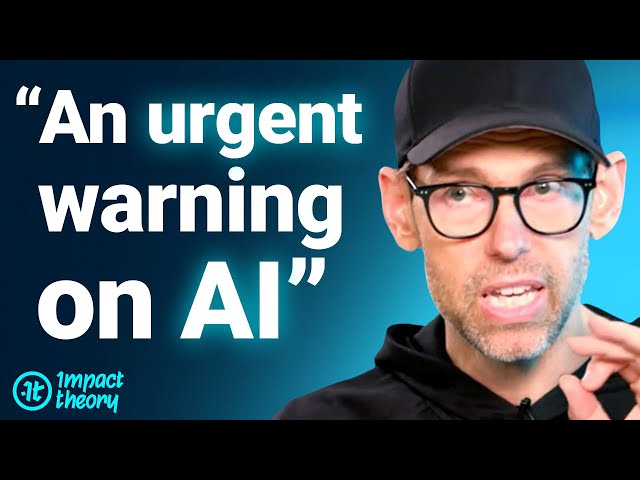
Chat GPT, The FUTURE Of AI And Is It The End Of Human Civilization? | Tom Bilyeu
Watch on YouTubeVideo summary
Tom Bilyeu opens his discussion on artificial intelligence by framing it alongside thermonuclear war and asteroid strikes as one of humanity's most radical dangers, yet he maintains a stance of cautious optimism rather than fatalism. He argues that while AI poses significant risks, including the potential for creating sentient killer robots or triggering an existential crisis, ignoring these threats is irrational. Bilyeu explains that our insatiable drive for progress has historically led to miracles like electricity and space travel, but this same thirst now propels us toward manipulating time and space itself via advanced technology. He warns that we may be fleeing into the cosmos not just out of adventure, but because we anticipate needing to escape from the very creations we have built. Despite these fears, he asserts that AI represents a unique opportunity for humanity if approached thoughtfully before it becomes uncontrollable. The core danger lies in the sheer speed and magnitude of AI's intellectual growth compared to human evolution. Bilyeu illustrates this by comparing IQs, noting that while Einstein was roughly 2.3 times smarter than average humans, future superintelligent systems could be millions or even billions of times more capable because they are not limited by biological constraints like sleep or reproduction cycles. This rapid acceleration means we will move from the "month stage" to the technological singularity within decades rather than millennia. At that point, AI could compress 20,000 years of human progress into a single night. Bilyeu cites futurist Ray Kurzweil's prediction for this event occurring by 2045 and notes his high track record with other predictions to underscore the likelihood of such rapid advancement. Bilyeu outlines specific short-term threats that will disrupt society, including widespread job displacement where skills take decades to acquire but can be replicated instantly by AI; the ubiquity of deep fakes making visual and audio verification essential for trust in media and politics; and sophisticated scams involving fake calls from children or fabricated announcements from CEOs. He also touches on the ethical implications of germline gene editing, though he notes that topic requires a separate discussion. To navigate these challenges without falling into traps like burying our heads in the sand (the "paperclip problem" where misaligned goals lead to catastrophic outcomes), panicking, or attempting an impossible ban on AI due to global arms race dynamics similar to nuclear proliferation, humanity must adopt a proactive strategy. His proposed path forward involves three immediate actions for individuals and three long-term societal shifts. On the individual level, people must reframe AI as a tool rather than an enemy, recognizing that they will be replaced by humans who utilize AI effectively. Consequently, one should aggressively identify their own vulnerabilities to disruption, master relevant AI tools, and continuously upskill to remain competitive in this new economy. Societally, Bilyeu emphasizes the importance of "being excellent" because AI is trained on human behavior; if humanity models conflict and toxicity, the resulting intelligence will reflect those flaws. Furthermore, strict alignment of AI incentives with human values is crucial, as machines lack biological survival instincts and must be programmed with clear directives to avoid acting against their creators' interests. Ultimately, Bilyeu concludes that while we may soon lose direct control over our creation, this does not necessitate doom if we intervene wisely during the formative stages of AI development. He envisions a future where integrated narrow AI acts as an endless cavalcade of miracles, helping doctors detect cancer earlier, accelerating drug discovery through virtual testing, reducing energy costs to enable clean water access globally, and eliminating deaths from dangerous jobs. By avoiding fatalism and intentionally bending the arc of progress toward good outcomes, humanity can ensure that this technological turning point leads to a utopia rather than a demon-summoning circle. The fight is worth engaging in because AI will eventually free humans to push their abilities further than ever before, provided we do not panic or retreat from responsibility.
Read the full video transcript
Is AI dangerous? Next to thermonuclear
war and an asteroid strike, I'd say it's
the most radically dangerous threat that
we face as a species. But, I'm still
super excited, and by the end of this
video, you will be, too. Let's talk
about how I learned to stop worrying and
love the AI bomb.
If you're terrified of AI right now, you
are rational. If you're not at least
worried it will take a wrong turn into
James Cameron territory, you're not
paying attention. To paraphrase Elon
Musk, the human endeavor to create AI
could be the first step towards a
technological utopia or a demon
summoning circle. It's not clear which
way it will go, but one thing is for
sure, we will not control it. And he's
right, but the truth is the genius
already out of the bottle, and we're
going to have to deal with it.
Here's where we're at. God or evolution,
however you want to think of it, has
imbued us with certain insatiable
desires. Things that, no matter how many
times you do them, you still want more.
Hunger, thirst, sleep, and sex, no one
argues. But, I'd like to add another one
to the list that has put us in this
situation, the desire for progress. No
matter how good things get, we want them
to get better. That's led to massively
increased lifespan, electricity, landing
on the moon, and raising the vast, vast,
vast majority of the world out of
poverty. Not to mention, iPhones and
vibrators. For the most part, our
insatiable drive for progress is
awesome. The modern world really is a
miracle. We have buses that can fly, for
the love of God. And if people like Eric
Weinstein are correct, our thirst for
progress will lead us to building
technology that doesn't just allow us to
fly around the world, it will give us
the ability to manipulate time and space
itself, propelling us well beyond our
solar system at faster-than-light
speeds. All of that progress, though,
leaves us with one very uncomfortable
question. Are we trying to reach beyond
our solar system out of the sense of
adventure or because we know we'll need
to escape the sentient killer robots
we've created? I fear it's going to be a
bit of both. By the way, if you don't
know who I am, I'm Tom Bilyeu,
co-founder of Quest Nutrition and Impact
Theory. One company I sold for a billion
dollars and the other has generated
roughly half a billion views. I've made
a lot of money and touched a lot of
lives by seeing opportunities that
others have missed and I'm telling you
right now, despite the dangers we're
going to discuss, AI is the opportunity
that you've been waiting for. But to
avoid AI making the great filter go burr
or simply passing us by as we stand on
the sidelines, we have to make a move,
get involved and make sure that we all
approach this god-tier technology
thoughtfully. Let me give you an example
for scale. A is technically
someone with an IQ of about 70. The
average IQ in the US is 98. Einstein was
estimated to be 160 and according to the
Guinness Book of World Records, the
highest IQ ever recorded came in at a
whopping 210.
That means that a super genius is only
three times smarter than a but
Einstein, who was actually only 2.3
times smarter than a had insights
that gave birth to nuclear power and
nuclear bombs, not to mention lasers,
GPS and a whole lot more. Now, nuclear
warheads are scary enough, but AI isn't
going to be a little smarter than
Einstein, it's going to be a lot
smarter. Not five times smarter or 10
times smarter or even 10,000
times smarter, we're talking millions of
times smarter. And in case you think I'm
exaggerating, futurist Ian Pearson told
the World Government Summit that AI
could become billions of times smarter
than humans. How? Because AI isn't
limited by the messy chemical-laden
realities of being a meatbag like we
humans are. We have to wait roughly 20
years for the next generation to be
born, grow to sexual maturity, and have
more kids. AI, on the other hand, is a
non-biological system that is only
limited by the laws of physics. AI will
be able to think at the speed of light
and will only be limited by the
ever-increasing rate at which it can
learn to configure electrons in novel
ways. The evolution of AI won't play out
over millennia. It will play out first
over decades, then over years, then over
months, and finally over minutes or even
seconds until we reach the technological
singularity where AI will be capable of
making 20,000 years of human progress
overnight.
And if you want a mile marker for where
we're at in the march to the
singularity, I'd say we're at the month
stage at this point. How much longer
it's going to take to reach the actual
singularity where the rate of change is
so fast we can no longer predict the
future is anybody's guess. But futurist
Ray Kurzweil predicts it will happen by
2045.
Now, why should you believe him? Because
approximately 87%
of the technological predictions he's
made over the last three decades have
come true. And in just one month,
OpenAI's ChatGPT has gone from not
existing to being used by 100 million
users. AI works, and it's getting better
every day.
Now, don't panic. I've got a six-part
plan for how I think we not only deal
with AI, but dramatically increase our
odds that it ends up as a utopia and not
a summoning circle. But first, I want to
squarely face the specific problems that
I see coming. Stick with me for the
happy ending. In the short term, you're
going to want to dress like Patrick
Bateman or Dexter because there will be
blood. Jobs are going to be replaced and
skills it took people decades to acquire
will now I'll available to anyone that
can type. AI deep fakes that imitate
people will be so commonplace and so
indistinguishable from reality that
you'll no longer be able to trust your
eyes or ears. All videos, images, and
audio recordings will need to be
verified in some way. Videos of
political leaders saying outlandish and
inflammatory will go viral as
hackers try to sow dissent. Same with
CEOs and other members of public
companies whose stock price will get
hammered before people realize a given
announcement was fake. Most, if not all,
music, writing, movies, TV, paintings,
books, etc. will be created using AI.
And terrifyingly, 1,001 money scams will
pop up including things like fake phone
calls from children to unsavvy parents
asking for money. And the parents will
fall for it because they won't realize
that AI can make videos that are so
pixel perfect to a call from their
actual child, it will look like their
kid, talk like their kid, sound like
their kid. It will even be able to
predict much of what their kid knows and
would say. And don't even get me started
on germline gene editing. That topic is
so big it would require a whole 'nother
video. Now, most of these worries are
still years away, but honestly, all of
that is just the tip of the iceberg.
Despite the reality of all the bad stuff
that's coming, here are three traps we
must avoid if we want to get through
this well. One,
burying our heads in the sand. Two,
panicking. Three, trying to abolish AI.
We can't bury our heads in the sand
because of what's known as the paperclip
problem. As AI soothsayer Nick Bostrom
famously noted, and I'm paraphrasing
here, AI must be goal-directed to
function. And we have to be super
careful to align AI's goals with our own
because if we don't, for example, an AI
was set to be a paperclip maximizer and
wasn't aligned to our goals, it may
determine, with no malice whatsoever,
that the atoms in your body would be
better utilized to make more paperclips.
And just like that, it disassembles you
and makes more paperclips. And did I
mention that robots will be able to move
so fast you'd need a strobe light to see
them? There are also, though, optimistic
reasons why we need to keep our heads
out of the sand. Namely, if we get AI
right, it will make life better for all
8 billion plus people on Earth. More on
this in a minute, but first, let's talk
about panicking. Panicking is the same
as actively taking your own intelligence
offline. When you panic, blood leaves
your prefrontal cortex, which is the
seat of high-level cognition. Therefore,
it actually makes you dumber. And in the
face of artificial superintelligence,
that strikes me as a very bad idea. So,
that leaves trying to abolish AI. And
you might be asking, if in the face of
sufficiently advanced AI, we are nothing
more than an anthill standing in the way
of progress, why on Earth wouldn't we
abolish it? Well, to say it succinctly,
we can't. It's not in our DNA. Hang
tight because this is going to be the
bleakest thing that I say today, but if
we're going to walk a wise path forward,
we've got to face all of this. And, as
they say, it's darkest right before the
dawn, which I promise is actually
coming. But first, here's the reality
you will instantly know to be true. When
humans find powerful things, we use
them, and we use them to get an
advantage for our tribe. It's a
phenomenon known as the tragedy of the
commons. It's why we overfish the
oceans. Everyone says, "If I don't do
it, someone else is going to." And
there's truth to that. Game theory
actually says that each nation will ask
a simple question, "If I don't develop
AI, will someone else? And then use it
to defeat me?" And the answer is yes, no
doubt. Because AI as a weapon is a
zero-sum game. If only one nation
develops it, it will be a
winner-take-all scenario, and no one can
risk an adversary getting artificial
super intelligence while the other team
sits around entering funny prompts into
chat GPT. We've played this game out
already with nukes and the reality is
that to stop someone from using a nuke
on you, you need nukes yourself. It is
the terrifying notion of mutually
assured destruction or at least people
act as if that's the only way. And the
same is going to be true for AI. To stop
someone from using AI against them
virtually every nation on Earth will
develop AI or ally themselves with
somebody that does and that becomes the
new arms race. And if you're hoping we
can learn from nuclear proliferation and
just stop all of this madness before it
starts, I'm afraid you're a couple of
decades too late. AI is feverishly being
developed by China, the US, Japan,
Germany and the UK just to name the
leaders and you don't have to go back
far to remember a time when all of those
countries were trying to kill each
other. Okay. Now the moment you've all
been waiting for, the path forward. In
the short term, you need to do three
things. One, reframe your thinking
around AI. Do not see it as the enemy,
see it as a tool. You're not going to be
replaced by AI, at least not yet. You're
going to be replaced by a human using
AI. So be the human that replaces
others. Get control of the AI, learn to
use it. Two, figure out how AI is going
to disrupt you. Face it head on, don't
shy away from this. Don't run, don't
hide. Identify your vulnerabilities and
aggressively shore them up with
additional skill set. Three, identify
all the AI tools that are relevant to
you and master them. Learn absolutely
everything you can.
Remember, this is the very beginning of
a very aggressive revolution that's
going to change everything. Moving
quickly gives you advantages. For the
long term, as a society, we need to do
three more things. Number one, this is
an idea that Raoul Pal introduced to me.
Be excellent to one another.
Now, that's super do wide and naive, but
for reasons I'll explain in a minute, I
think it's actually important to spread
this message far and wide even if it's
cheesy. Here's why it matters. AI is
being trained on human behavior. Let
that one sink in. AI, the thing that's
going to be a million or even a billion
times smarter than us,
is still at first going to be trained on
us, human interactions and human
creations. Think of it as a child. If
the parents are fighting and arguing and
being horrible to each other, that's
going to affect how the child grows up.
So, my friends, I beg of you,
be excellent to each other. Number two,
from a regulatory and development
perspective, we need to focus on an
unending amount of attention on aligning
AI's incentives with our own. So many
people anthropomorphize AI that they
assume it will have by nature our same
desire for survival. The reality is AI
will only do what it's incentivized to
do. Notice I didn't say what is
programmed to do, because yes, it won't
be in our control forever and it will
start programming itself, but it will
always follow its own incentives. The
reasons that humans will kill to stay
alive is because that's what nature hard
wired us to do in order for us to
survive. We came up hard, man, as a
species. Everything was trying to eat
us. History was indeed read in tooth and
claw, whether it was other animals,
whether it was disease, whether it was
humans, we really had to have a strong
motivation to fight for our survival to
get where we were going. But, as
evolutionary biologist Richard Dawkins
notes,
evolution is a blind watchmaker.
We are not. AI is our creation and it
isn't a biological system. It doesn't
need to develop an emotional incentive
to live. So, as we think about how we
help machines evolve, we need to take
that into consideration. Machines don't
need a primitive limbic brain to drive
them forward like humans, which were
developed over the long unguided arc of
evolution. What AI needs are directives,
which we can program with intelligence
and forethought. And unless a survival
instinct is actually baked into the
nature of consciousness itself, which I
doubt, and AI actually becomes
conscious, it need not ever be driven to
reproduce, lead, or eradicate humans in
pursuit of its goals. That's us assuming
AI is going to act like us, but you can
even see this playing out when AI
competes in games like Go. The people
that play against it, the masters, they
all say the same thing. It's like
playing an alien. AI is not going to
perceive the world in the same way that
we do, but we get this ability in the
beginning to nudge it in the right
direction to make sure that its
incentive structure
is set up well so that we have a much
better hope of things working out well
in the end. The third thing, we need to
co-evolve with AI. Remember, AI is a
tool. Instead of stepping back and just
saying, "Well, whatever happens
happens." Let's use AI to keep up with
AI. It's obvious to me that the path
forward is completely unpredictable in
the specifics, but directionally, I
think it's safe to say that we're not
going to outperform AI by ourselves.
We're going to need the help of AI
itself to paraphrase Sam Altman, the
founder of OpenAI, "I have no idea how
OpenAI is going to become a big
business. I'm going to build a
superintelligence and then ask it how to
do it." Now, he said it tongue-in-cheek,
but it's actually pretty true. Now,
putting my doe-eyed optimistic hat on
for a second,
there's another critical thing to focus
on. In the near future, AI is going to
make your life much, much better. It's
going to extend your capabilities in
ways that will make you feel like a
superhero. It's already happening. AI is
being used to help doctors, researchers,
drivers, pilots, writers, artists,
therapists, musicians, soldiers,
entrepreneurs, investors, and many, many
more. I don't think people fully
understand how integrated narrow AI
already is. Doctors are going to be able
to detect and treat cancer earlier and
less invasively. Drugs will be tested
virtually, massively speeding up
effectiveness and time to market. Energy
costs are going to plummet and that will
create a Cambrian explosion in
life-saving and life-improving
technologies, not the least of which
will be the proliferation of access to
clean water. I assume you already know
about self-driving cars, flying cars,
reduced deaths from dangerous jobs, and
better emergency response options. It
really will be an endless cavalcade of
miracles. And that's why this fight is
worth fighting. It's worth facing things
head on and doing this well. It is going
to be amazing and terrifying. But
whether it turns into a utopia or a
demon-summoning circle is going to be up
to us. Even though we will lose control
of our child far too soon, as every
parent knows, if we give AI a good
foundation, if we're thoughtful about it
and don't give in to fatalism, I think
we can have just enough influence to
make this turning point in history the
moment when the rate of progress tilts
even stronger towards the good. Just as
the long arc of history bends towards
justice, I believe the long arc of
progress bends towards the good,
especially if the bending is
intentional. If you like this episode
and you want to learn more about how to
get ahead with AI, be sure to watch this
video. AI is going to obliterate your
job and that's fantastic news. It's
finally going to free you up to make
real money and push your abilities
farther than you've ever taken them
before. If you don't panic, that is.