Video summary
The video explores the phenomenon of eclipses, beginning with an explanation of how they occur on Earth through the alignment of the Sun, Earth, and Moon. The speaker clarifies that while eclipses happen roughly two to five times a year, total solar eclipses are relatively rare for any specific location, occurring about once every 18 months. This infrequency is due to the Moon's orbit being tilted by approximately five degrees relative to Earth's orbit, meaning the three bodies do not align perfectly every month. When they do align, a solar eclipse occurs during a new moon when the Moon blocks the Sun, revealing the faint corona and prominences, while a lunar eclipse happens during a full moon when the Earth casts its shadow on the Moon. During a total lunar eclipse, the Moon turns a striking red color because Earth's atmosphere scatters blue light and allows red light to pass through and reflect off the lunar surface.
The presentation details the different types of solar eclipses, including partial, total, and annular events, which is often called the "ring of fire." This distinction arises from the Moon's elliptical orbit; when it is closer to Earth, its shadow fully covers the Sun creating a total eclipse, whereas when it is farther away, it appears too small to cover the Sun completely, resulting in an annular eclipse. The speaker also highlights unique viewing experiences, such as the 54-minute eclipse seen by the Artemis II crew near the Moon, and discusses upcoming partial solar eclipses visible from parts of Europe. Safety measures for observing these events are emphasized, with demonstrations of projection methods using pinholes or colanders, as well as the use of specialized eclipse glasses and filters for optical devices.
Beyond Earth, the video examines transits and eclipses observed from other planets and involving exoplanets. Using footage from NASA's Perseverance rover on Mars, the speaker shows how the Martian moons Phobos and Deimos transit across the Sun, an event that happens frequently for Phobos but is rarer for Deimos. The discussion extends to historical missions like Cassini at Saturn, which captured images of Saturn's rings being illuminated while Earth appeared as a tiny dot in the background. Finally, the talk explains how astronomers use the transit method to detect exoplanets orbiting other stars by measuring dips in stellar brightness. By analyzing the depth and duration of these dips, scientists can determine the size, distance, and orbital speed of the planet, and by studying the light that passes through the planet's atmosphere, they can identify specific gases, potentially finding biosignatures that indicate life.
Read the full video transcript
[applause]
Hello. Thank you so much. Thank you for
being patient and uh being here um on a
Saturday morning. Um so here is there we
go. Here is a a picture of a solar
eclipse. Um so I wanted to talk about
eclipses not just here on Earth but
elsewhere. Elsewhere in our solar
system, maybe even beyond our solar
system as well. But first up, how do we
get eclipses here on the Earth? So, um
it's all to do with the moon orbiting
around us. Uh so, I've got two videos up
on the screen there. Um on the right
side, uh we are looking down at the
Earth's north pole and you can see the
moon just going around uh the Earth and
the Sun
is uh in this direction here.
Can you see my you can't see las pointer
but it's it's it's it's that yellow it's
that yellow thing over there. Um so you
can sort of um figure out you know how
we get the uh phases as well uh because
different amounts of the moon uh from
our point of view gets lit up by the
sun. Um and so on the other side of the
screen we've got what the moon looks
like to us. Um, so you've got, you know,
like a a full moon, wax and gibbus, uh,
a new moon, um, and so on onto the two
types of eclipses we get here on the
earth then. So, first up, probably the
more spectacular ones, the one that
people really want to see, are the solar
eclipses. So, we get a solar eclipse
when the moon gets in between us and the
sun and blocks out the sun's light. And
then the other type is the lunar
eclipse. Uh when the moon gets in the
earth's shadow. Who here has seen a
lunar eclipse first? Awesome. Lots of
you. Who's seen a solar eclipse? Who
twice? You're just showing off now. Um
[laughter]
>> um did you see a total solar eclipse or
just a part? You saw some of you saw
total partial to cool. Amazing. Amazing
stuff. Um, so if you want to be fancy,
you can call it a A in
astronomy is just when three things line
up. Um, so here we've got the sun, the
earth, and the moon lining up. But we
get solar eclipses on Earth roughly, you
know, you know, two or five times a year
and a total solar eclipse somewhere on
Earth once every 18 months or so. And
likewise, you get maybe two to five
lunar eclipses um a year, but the moon
takes 29 and a half days uh to orbit the
uh the earth. Um so why don't we get
eclipses every single month? Well, it's
because the moon's uh orbit is slightly
tilted. It's tilted
at an angle of about 5°. So that is just
enough.
And this video is just going to move us
over so that we're going to look at the
earth's equator there. So that orange
line there uh is the earth's equator. So
you can see that sometimes the moon is
sort of above the earth and so it's not
in that perfect straight line between us
and the sun. Sometimes it's below the
earth and that's how we get the new
moons um or the full moons when the when
the moon is uh behind earth. Sometimes
you can see that the moon lies perfectly
straight in line between us and the sun
and that is when you get the solar or
the lunar eclipses. Um so you can think
of solar eclipses as a special type of
new moon and uh a lunar eclipse as a
special type of uh of uh of a full moon.
And this is what a lunar eclipse looks
like during the different parts of it.
Um, so when the moon gets in the shadow,
it gets darker and darker and darker.
And when it's a total lunar eclipse, it
doesn't just disappear. Uh, it actually
turns red just like this. I've got a
better uh photo of it here. Um, so you
can see the red moon. But why does it
turn red? So if if if something is in in
in the shadow of something else, um it
just turns black. Why does it turn red?
It's because of the Earth's atmosphere.
It's the same reason why we have blue
skies during the day if it's not cloudy.
Um and also red skies during sunrise and
sunset. So the Earth's atmosphere
scatters sunlight and sunlight is made
up of all the colors of the rainbow. The
red lights um get scattered the least.
Um, and so during a lunar eclipse, that
red light can sort of pass through the
Earth's atmosphere and then it reflects
off the moon and we see a red moon
during a total lunar eclipse. Um, so I
think there's supposed to be a lunar
eclipse sometime soonish in the next few
months. Um, a really good website to
actually check if you can see an
eclipse, whether they're solar or lunar,
uh, is time and date.com. So you can you
can actually pick which city you're in
and it tells you uh when you can see the
eclipse and what it will look like uh
from your lake as well. But onto solar
eclipses. So this is a quite a high-res
photo uh of a total solar eclipse um
taken by NASA. Um so the sun has this
outer atmosphere called the corona and
it's very very dim compared to what we
call the surface of the sun. Um, and
it's much much hotter. So, you can only
see the corona, this sort of wispy
feature there, um, when the moon blocks
out the sun's light or the majority of
the sun's light during a total solar
eclipse like this. And you can maybe
just about see on the edges, um,
prominences. So, um, bits of the sun
sort of, um, trying to escape the
surface of the sun there. Um, so we
mentioned slightly about the different
types of solar eclipses. We've talked
about total solar eclipses uh and also
partial solar eclipses. There's a third
called the annular solar eclipse. Um so
there was a partial was it last year
maybe the year before? So I took the one
the photo in the middle there. And
there's a really small uh sunspot right
at the top there. Um but this is what an
annular uh solar eclipse looks like. And
it's called the ring of fire. can maybe
guess why. But how do we get all of
these different types of eclipses? Well,
not only is the moon's orbit tilted,
it's also not perfectly circular. So,
sometimes it's closer to us, other times
it's a bit further away. So, during a
solar eclipse, the moon is the right
sort of distance away from us that uh
it's the darkest part of it shadow
called the umbra um actually falls on
Earth. Um and that's where we get the
total solar eclipses. If you are under
penumbra which is the sort of lighter
part the outer part of the moon shadow
that's where you get the partial solar
eclipses and when the moon is you know
at its furthest point away from us um
and uh in between us and the sun that's
where you get the annular eclipse. So
now the moon is slightly too small to
completely cover up the sun. So, here's
just a little comparison between uh the
two between a to eclipse and an annual
eclipse. Um, and
I've got this beach ball here. So, um it
it it's it's sort of um shrunk a little
bit, but that's supposed to represent
our sun. Our moon
is about this big. You can barely see
it. I like you can I'll be on the Q&A
channel later if you want to have a
look, but you can see just how big our
sun is compared to our moon. And it's
it's not it's not really a coincidence
to be honest. Uh the moon is about 400
times smaller than the sun in terms of
its diameter, but it's also 400 times
closer to us. Um and so that perspective
gives us uh this uh really sort of quite
unique um uh eclipses where we get the
total uh solar eclipse.
But
recently the uh Artimus 2 uh crew uh saw
their own type of solar eclipse. So
during their flyby of the moon, they
were in just the right spot for the moon
to completely cover up the sun. So this
was unique for them. Um, usually a total
solar eclipse during the maximum when
the moon is completely blocking out the
sun lasts for maybe a minute or two. Um,
they got to see this for about 54
minutes. So, it's a much much longer um,
eclipse. And you can see a sort of halo
around the uh, around the moon there.
And we don't really know why that is
yet. So, it could be uh, the the solar
corona. So that atmosphere that thin
atmosphere outer atmosphere of the sun
or it could be sodiacal light uh which
is sunlight reflecting off um
interplanetary dust or it can be a
combination of the two. So that is
currently um a topic of research at the
moment. Now we are going to have quite a
deep partial eclipse next month. So on
the 12th of August uh we are going to
see a partial eclipse. Um, so this dark
line here, that's where the total
eclipse is going to be. So it's going to
pass through Iceland and Spain. Um, and
for us, the moon is going to block out
about 90% of the sun. And it does depend
on where you are um, in the country, but
it's somewhere around 90%.
and it'll start at about 6:00 p.m. uh
and finish at about 8:00 p.m. Um so if
you want to go out and see it, make sure
you you're sort of somewhere up high,
maybe up on a hill um with a clear
horizon because the sun will be quite
low, you know, it will almost set um and
so you don't want, you know, tall trees
or buildings um in your way. and a an
eclipse talk wouldn't be uh complete
without a slide about safety. Um because
please don't just look up at the sun um
you get blinded. We don't want that. Um
so there are a few different ways that
you can look at the sun and eclipses uh
safely. The first is using this
projection method. So you can get two
pieces of card uh poke a pin hole
through one and then uh uh sort of lay
it over another piece of card. Um, and
you can just about see a projection of
the sun on the top there. Or if you
don't want to do that, um, just get a
colander. Colers have lots of little
holes, so you'll get some really nice
patterns, uh, through the, um, um, the
shadow that it creates. Um, you can also
kind of do it through, uh, leaves
actually on trees. They can also, um,
give you this sort of projection effect.
Um, you can use solar eclipse glasses.
Um, I'm pretty sure they're going to
sell out very soon. So, if you want to
get some, get some now. Um, or you can
use um, uh, filters that go over your
telescopes or your cameras, uh, or your
smartphones, uh, and things like that.
Um, so this was actually me and, uh,
some some colleagues and friends a few
years ago. We weren't looking at an
eclipse. We were actually looking at the
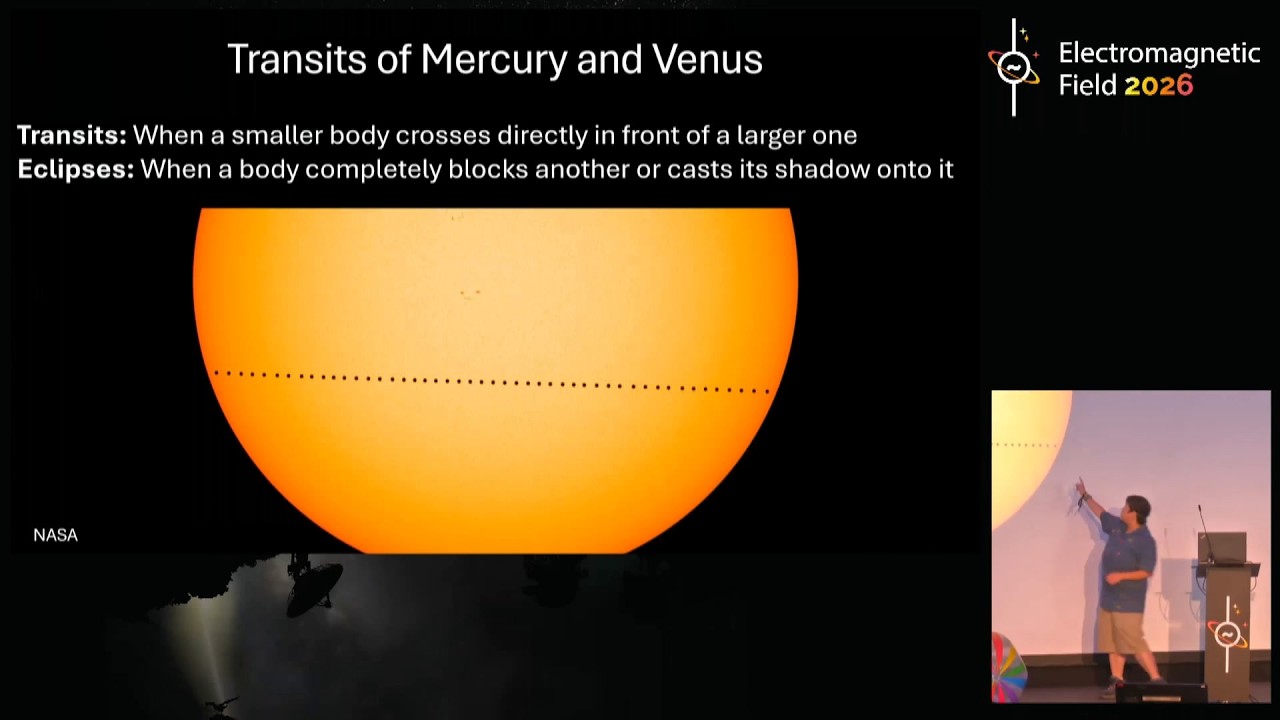
transit of Mercury. So the moon is not
the only thing that can get in between
us and the sun. We've got two planets
closer in Venus and Mercury. Um and this
particular picture here uh is of
Mercury. So those tiny dots uh is
Mercury uh making its way across the
sun. So this is a series of uh different
images. Um so the difference between a
transit and eclipse is that a transit
occurs when you've got a smaller body
crossing directly in front of a bigger
one. And then the eclipse is when one
object completely blocks another and
cast it shadow um onto it. So even
though Mercury is
a little bit bigger than the moonish
Venus is definitely bigger than the moon
um they are further away from us. So
they appear smaller to us um than the
moon. So the last time we had a transit
of Mercury was in 2019. Um the next one
will be in 2032. So, not too long to
wait uh for that. And a transit of
Mercury typically lasts 2 to 8 hours.
So, you can really make an event of it.
Um transits of Venus though are a bit
rarer um because it takes Venus longer
to go around the sun than Mercury. Um
so, the last time we had a transit of
Venus was in 2012.
The next one though will be in 2117.
So, make sure you put that in your
calendar if you want to see it. Um and
because well Venus is um you know closer
to us it will appear to move faster
across the sun. Transits of Venus last
typically about six uh six hours long.
So that's all the things you can see on
Earth and around the Earth around the
moon. But what about on other planets?
I I just can't believe that we've got
videos like these to be honest. Um so
the Perseverance rover um on Mars took
videos of these transits
of Mars moons. So on the right we've got
Phobos, the larger of the two moons, and
then we've got Damos here. So we're
looking up at the sun and the two sort
of dark blobs there are the two moons um
around Mars. So other planets totally
can have um transits and and eclipses.
And this is the first time what we that
we've seen a transit or an eclipse on
the surface of another body which is
incredible. So these were from 2024. Uh
Phobos transits last about 30 seconds
and they actually happen almost every
single Martian day because Phobos takes
you know um it takes um such a short
amount of time to go around Mars. Uh
Damos transits last about 2 minutes and
they're a bit more rare. They happen
maybe once or twice every uh every
Martian year. But not only that, we've
also got a video of a transit of Mercury
from Mars. So that little tiny dot at
the top of the picture there that's
moving across the yellow disc of the
sun, that is Mercury.
Um, so this gift, this video was sped up
about 400 times the real speed. Takes
takes a few hours.
Okay, let's think about transit a bit
differently now.
Let's look at actually a different
planet al together and see things moving
across it. Um so we've seen transits of
moons um at Jupiter and Saturn here. Uh
so we've got four of uh Saturn's moons u
moving across the face of the planet
there. And at the start of the video, I
think it's going to leave around uh
again, but you can you can just about
see actually the shadow of uh Dion Dion
uh and Enceladus there. So, if you could
um place yourself in that shadow, you
would see a transit. You would see those
moons block out a little bit of the
sun's light. But you can also do it sort
of the other way around. Uh we did have
a spacecraft orbit around uh Saturn. Uh
it was called Cassini. Um it ended at
mission about 10 years ago now. Um and
it's a very very very successful
mission. And one of the things it did
was it actually turned around and took
this picture of Saturn. Now usually um
Cassini isn't allowed to turn back
around and sort of face the inner solar
system because the sun is there because
it's so bright. it would just damage um
its cameras. But Saturn got in the way
and it took this amazing photo. So you
can see the uh the rings of Saturn
getting back lit. Um and there is a
little surprise
here because it's not just a photo of
Saturn.
We've got
us a teeny tiny little dot represents
the Earth and the Moon. So this photo
was actually called the day the earth
smiled because NASA knew that was going
to happen. So they told everyone, you
know, at this time look up at the sky
and wave and smile cuz we're going to
take a photo of every single one of you.
Let's leave our solar system now and go
elsewhere. Go way, way, way, way out. So
exoplanets are planets that orbit around
other stars. So far we found, I don't
know, 6,000 or something. They keep the
numbers keep going up and up and up and
up. Um and the sort of
most popular method to detect them is
this transit method. So we've got an
exoplanet going um across uh its star
blocking some of that star's light. And
this graph here um is a measure of of
the brightness of the star. Um so you
can see a little dip there where the
planet moves in front of the star. And
then if it's got another star or maybe
even um an X and Moon, uh we can um you
can also detect a slightly uh uh smaller
dip there as well.
So I think out of the 67,000 odd
exoplanets we've discovered,
something like 3/4 of them were
discovered this way. Um so it's a hugely
successful um way of finding exoplanets.
And what is the point then? What can we
do with these transits? So, actually
looking at the dip, looking at how deep
it is, looking at how wide the dip is,
we can figure out how far the exoplanet
is from the sun or from its star rather,
um how fast it's moving, how big it is,
and we can also see if it has an
atmosphere and also what kind of gases
is in in its atmosphere because we can
analyze the light. Um so the stars light
would uh get absorbed by the different
gases in the uh in the atmosphere of the
exoplanet and then we'll see dark lines
like this. So, they've been absorbed and
by looking at where those dark lines
are, we can figure out what gases there
are in that in that um atmosphere um and
potentially find you know signatures for
life um on exoplanets which is very very
exciting. Um so that's all I wanted to
sort of uh talk to you about today. Um
eclipses are really cool. Um, try and
and try and look for the uh the one in
in in in a few weeks time. Um, and I'll
be in the Q&A tent in a moment if you've
got any questions. And thank you so much
for coming. [applause]