Video summary
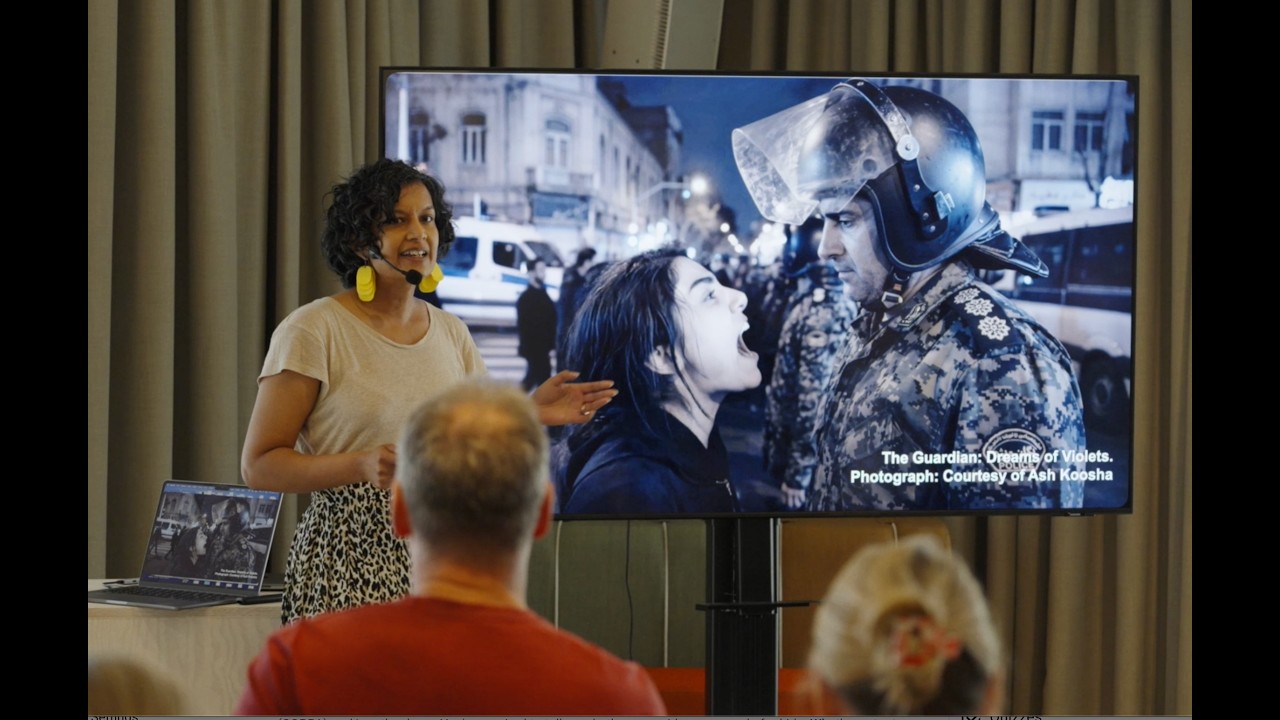
Charlotta Tönsgård, an entrepreneur working at the forefront of AI in healthcare, opens her talk by reflecting on a recent film called *Dreams of Violence*, which was entirely generated by artificial intelligence to document a massacre that regimes often seek to suppress. She notes that while many people cringe at the idea of AI-generated content due to concerns about low-quality "noise" flooding the internet, this specific project demonstrates how technology can amplify silenced voices rather than just creating slop. The film serves as proof that access to capital and traditional gatekeepers like publishers or studios is no longer a prerequisite for telling important stories; instead, the barrier has shifted from permission based on money to trust earned through human judgment.
The core of her argument revolves around the idea that while technology accelerates capabilities instantly, the adoption of AI moves at the speed of trust rather than technological release dates. She illustrates this with data showing that despite free and efficient AI tools being available in healthcare settings, 79% of clinicians refused to use them because they did not yet trust the machines enough to hand over critical tasks. This hesitation is not a failure of adoption but a necessary human process where professionals must gradually test tools, observe their failures, and understand what those errors mean before integrating them into high-stakes work, much like how doctors historically relied on secretaries for transcription only to find that workload simply shifted back onto themselves when the intermediaries were cut.
Tönsgård warns against a future dystopia where power concentrates in fewer hands and voices are silenced, emphasizing that this outcome is not inevitable but rather written by our collective small decisions every day. She argues that as traditional institutions fail or become less relevant, individuals now hold the gate of trust themselves, deciding what work to hand over to technology and who benefits from the resulting surplus. The future will be shaped by these fundamental questions: what tasks do we delegate, and how are the gains distributed? If society chooses wisely, AI can expand human potential rather than replace it, allowing skilled practitioners with trusted tools to help hundreds instead of dozens across fields like education, art, and journalism.
Ultimately, she concludes that history has always been about opportunity being gated by permission from those who held resources, but today we no longer need to ask for such permission because the gatekeepers are failing. The path forward requires us to be bold in our intentions while remaining worthy of trust, ensuring that AI serves as a force multiplier for human capability rather than an instrument of control or silence. By making conscious choices about which products to support and how we apply our skills, humanity can write its own story where technology amplifies diverse voices and allows more people to thrive without breaking the social contract.
Read the full video transcript
Okay, so two weeks ago or about two
weeks ago, a film called Dreams of
Violence premiered at the Tribeca Film
Festival.
It was a 75-minute feature about the
massacre of Iranian civilians in
January.
It was built from journalistic
journalistic reports and eyewitness
accounts.
A film that until very recently would
never have been made.
It was made by two brothers in three
months.
Costing about 20 sorry, $2,000.
And it was fully AI generated. Every
single frame in the movie is AI
generated.
I will come back to why that actually
matters.
So I lived through a couple of different
technology shifts. I was actually my
first part of my childhood was
pre-internet. It's hard to believe
today.
But then I became the part of generation
that actually ushered in the iPhone and
the smartphone. And these days I build
at the forefront of AI, specifically in
healthcare.
But what these shifts has taught taught
me is that it's almost never the
technology that is actually the
interesting part, even though that is my
background.
What is interesting is what that
technology what type of power shift it
actually ushered ushered in.
And that is actually what I wanted to
talk to you about today.
So I'm going to talk about one change I
see and one weak signal that I see and
then a little bit about the future that
I hope that we choose for ourselves.
So let's start where you actually
already been a bit. So I mean to many of
us today, if we hear AI generated
content,
maybe we cringe a bit. I mean, I know
that I do.
And of course, if we look at the origin
of this vast knowledge that AI and the
LLM holds today, if we look at the
origin of that,
I think uh,
it's a bit troubling. Maybe we should
say that.
And if we look at the flood of
low-quality content that floods
internet, floods social media, floods
investors,
uh, that is a problem. And yes, jobs are
changing. And even some jobs, they are
disappearing.
But for all of history, access to
capital and resources, it decided who
could wield power.
Whose voices actually get heard?
Whose idea get a chance to be proven?
You needed a publisher. You needed a
studio. You needed a rich parent. You
needed someone who was that vote of
confidence before you could even do
something.
Nobody said yes to Dreams of Violet.
Nobody needed to.
A story a regime would prefer to never
have been told
got told anyway.
And I think the director put it the
best. He said that an AI film about
people who actually died, it raises
serious questions. But the alternative,
silence and forgetting, that is worse.
So this is not slop. This is a voice
that would never have been raised
otherwise.
I noticed the mechanism because it
actually cuts two ways, right? AI
accelerates whatever we attach it to. So
if we attach it to noise,
that noise get louder.
If we attach it to a story a regime
wanted to be silenced, you get Dreams of
Violet.
And some of you, I guess, are sitting in
large organizations.
Uh,
but the reason you sit there is not
maybe because you loved the
organization,
it's because until now, you needed that
to actually get your value out.
The doula at the maternity clinic, the
psychiatrist, the, journalist,
the same gate that fall fell here, it's
falling for almost everyone.
They didn't need the institution for the
mission, they needed it for the machi-
machinery.
So, a large part of that machinery is
actually free now.
And I mean, this is already happening.
And uh
what it means is that the unit of
capability, the stuff you talked about
already, it's shifting from things that
have been gated from inside that
institution out to the individual.
But underneath
that failing gate, uh it's also a bigger
shift.
Some of you recognize it. Uh
I mean, it's the work itself that is
migrating from people to technology.
And this is not about jobs vanishing
overnight. This is about small things,
tasks that we hand over to technology
one by one.
But what I've learned about this shift
is that it doesn't actually move at the
speed of technology, it moves at the
speed of trust.
So, let me give you one weak signal from
my area, health care. One of the largest
studies was more than 8,500 clinicians.
They were offered an AI scribe but they
by from their employer to be used at
work.
It was fully approved, it was good
technology, and it was free. It's
somewhat free, someone else paid for it.
And it makes perfect se- sense from an
efficiency perspective.
79% said, "No, thanks."
I mean, most people read that as an
adoption, like a failure in adoption,
right?
But I read it as one of the most
important signals in AI right now.
Becau- because capability is not the
problem.
Trust is.
AI can deliver capabilities in an
afternoon, but trust it still needs to
be earned at a human pace.
A professional won't trust a tool with
important job, like a important things
from their job, because a benchmark
tells them that they can.
They will trust it the same way they
trust a colleague.
Gradually. by testing it, by seeing how
it fails and then understanding what
that failure means.
No model release will change that.
And has that hesitation in shifting our
work onto technology, it has a history.
The last time it happens at scale in my
own my own industry,
that was the doctors
I mean, at the time the doctors they
still did the recordings for their
notes, right? And then they handed them
over to a medical secretary who typed it
up for them.
And
as a saving in someone's spreadsheet,
those secretaries were cut.
But the work still remained. It was just
that the doctors had to do it themselves
instead.
So it landed on them and it spread into
their breaks and their evenings.
So what actually happened was that
someone else they decided what work was
going to be handed over and then in the
end someone else kept that surplus.
So when professionals hesitate now, it's
not that they're being slow, it's just
that they're remembering.
They distrust they dis don't trust
distrust technology, they distrust why
it was built and why it was distributed.
Which is why the labor shift from people
to technology, it will not be it will
not be decided by benchmarks or feature
releases or keynotes. It will be decided
by millions of small handovers of small
tasks, one professional one task at a
time.
And there are two
fundamental questions that sits in
inside every one of these decisions.
What do we hand over?
And who shares the surplus that we
actually create?
How we answer those two questions, they
will fundamentally shape the future for
every one of us.
The difference I see this time is that
the gates are failing.
That means that in many cases
that decision actually can fall to the
person who is doing the job.
The old gate were permission. They were
held by whoever had the money. The new
gate is trust.
And that's held by the person who hands
over the work.
Permission it could be bought. Trust it
needs to be earned.
So which future does this actually add
up to?
Well, I mean I'm a big science fiction
fan. And what science fiction have
taught me is that dystopia
it's a warning.
It's not a forecast.
The dark story of our future, I think it
writes itself.
Jobs lost, voices silenced,
the social contract in our society
broken,
power concentrating to fewer companies,
even individuals.
But the story of how AI shapes humanity
in our future, it is not written on yet.
It's written by us.
And it's written by small decisions and
big ones. It's written by our
intentions, how we apply our skills, how
we spend our time and our money, which
products we support.
And if we write this story well, the
future doesn't look like a faster work
version of today.
It looks like more.
More voices heard, more time spent on
the things that matter to us,
more people that is actually helped by
the skilled few we have because all of a
sudden
a trusted practitioner with trusted
tools can help hundreds instead of
dozens.
I mean, imagine that energy everywhere,
in school, in education, in art, in
journalism,
built anywhere. I mean, it's built here,
right?
For all of human history, opportunity
was gated. Someone needed to give you
permission to execute on your dreams.
We don't have to ask for permission
anymore.
There are just two things that I ask you
to for. Be bold and be worthy of our
trust.
Thank you.