Video summary
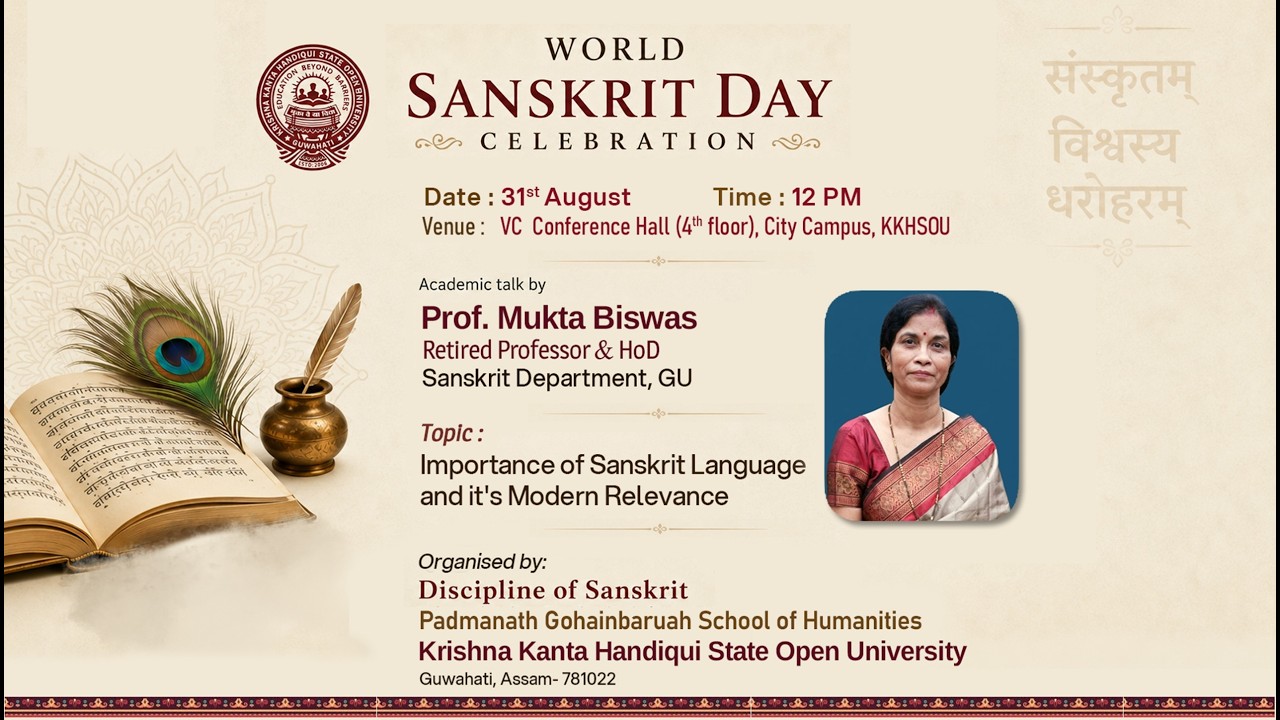
The celebration of World Sanskrit Day 2026 brought together distinguished scholars, faculty members, and researchers to honor Sanskrit as a living language rather than a relic of the past. Professor Mukta Vishwas delivered an inspiring address emphasizing that Sanskrit is not merely a medium of communication but a comprehensive repository of India's ancient intellectual, philosophical, scientific, and literary heritage. She argued that while other ancient civilizations have faded due to invasions and political pressures, Indian civilization has survived precisely because its core values and culture were preserved through Sanskrit. The event highlighted the responsibility of the current generation to understand, explore, and transmit this timeless wisdom to future generations, ensuring that the light of knowledge continues to illuminate the path of human progress.
A significant portion of the discourse focused on debunking the myth that Sanskrit is a "dead language." Professor Vishwas explained that a language only becomes dead when it ceases to exert organic influence on people and society, which is clearly not the case with Sanskrit. Evidence was presented showing its continued relevance in modern contexts, such as its phonetic precision making it an ideal candidate for computer algorithms and artificial intelligence, a conclusion supported by experts like APJ Abdul Kalam. Furthermore, the talk highlighted living communities in villages across India where people still speak Sanskrit daily, as well as its deep integration into contemporary Indian life through terms used in Hindi, religious practices like Yoga, and government policies that mandate the incorporation of Sanskrit vocabulary into official languages.
The presentation also showcased the remarkable scientific contributions recorded in ancient Sanskrit texts, demonstrating that India made significant advancements in science and technology thousands of years ago. Ancient works such as the Brihat Samhita by Varahamihira (circa 100 BC) contained detailed botanical classifications, descriptions of plant life, and even references to automatic devices and mechanical principles that predated modern discoveries by centuries. For instance, ancient texts described the cellular structure of plants and the concept of plant consciousness long before Western scientists like Robert Hooke confirmed these findings in the 17th century. These examples underscored that Sanskrit literature covers a vast array of subjects including medicine, astronomy, architecture, and warfare, proving its utility as a scientific language that can still contribute to modern research and education.
In conclusion, the event served as a powerful reminder that preserving and studying Sanskrit is essential for protecting India's cultural identity and accessing a vast repository of indigenous knowledge. The speakers urged attendees to move beyond viewing Sanskrit solely as a religious or historical artifact and instead recognize it as a dynamic tool for learning, research, and global communication. By integrating Sanskrit into modern education and policy, society can ensure that the rich traditions of the past continue to inspire innovation and wisdom in the future. The successful organization of this program by the university department reflected a collective commitment to revitalizing interest in the language and reaffirming its status as a vital component of India's enduring civilization.
Read the full video transcript
Very
[music]
very good afternoon to everyone.
With your kind permission, let us begin
today's program with a mangala shar. I'd
like to request our faculty member
professor to sing the mangadash.
childhood.
Fore!
Foreign! Foreign!
Fore!
Foreign! Foreign!
Shank.
for
Suka.
Thank you so much.
It gives me immense pleasure to welcome
our honorable person chair professor
Rajendas
and our distinct guest Dr. Surasa former
head of the department of Sanskrit Kon
College along with all the esteemed
faculty member research scholar
participant present her on this
auspicious occasion.
Sanskrit al often referred as dabani the
language of the gods is not merely a
language belonging to the past it is a
living respiratory of India's past first
intellectual philosophical scientific
literary and artistic heritage our
responsibility today is not merely to
remember this heritage but also to
understand explore and transmit it to
future generation we must ensure that
the light of sit continues to illuminate
the path of knowledge inspiring
generation with it loy beauty richness
and timeless wisdom.
On this special occasion we are
privileged to have with us professor
Muktish madam former professor and head
of the department of sanskhati
university as our distinguished guest
speaker. Madam will deliver an economic
term on importance of Sanskrit language
and its modern relevance. Now I would
like to request our honorable financer
sir professor Raj Rajendra Pashantas to
kindly welcome our guest
speaker professor Muttab Vishwas Madame
Fulam Kamusa and PL and book as a token
of love and respect.
>> [applause]
[applause]
>> Now I respectfully request our honorable
officer Rajendra to kindly for his
welcome to There's only
[clears throat]
>> uh thank you.
Uh good afternoon everybody.
Uh it's indeed a matter of great
pleasure for all of us that uh today our
Sanskrit department is has organized
this program of world sanskrit day.
On this occasion
we have a renowned scholar professor
retired professor department
of university. I welcome you madam to
this program. I also welcome professor
university to this program. I welcome
all the faculty members
uh and research
who are present here on this occasion.
The thing which uh has been identified
by
the organizers that importance of
Sanskrit language and its modern
relevance
is very interesting.
But uh I believe
that relance of sanskrit
uh in the present context
is has become so important
that uh we have never thought of
uh in our time we had considered that it
is a very difficult language
but still it was compulsory particularly
since I am from a state where sanskrit
It was compulsory for us. At least for 3
years we have read Sanskrit and because
of Sanskrit I could read Hindi letters
otherwise it would have been very
difficult for some of us to read Hindi
as well as Sanskrit. But when we come to
this uh importance of language
now it is not only important for us it
is for everyone in the world.
uh particularly as Indian
uh if we uh look at Sanskrit
[clears throat] and its contribution for
development of different literature
whether it is weather
or any other parita or
any other scripture which was developed
in the ancient days. It all came in
Sanskrit.
We do not know weather
or anything about our past because we do
not know such details. Those who know it
they they are aware of it and they are
uh they many of them because of that
awareness they feel perfect human being
because ultimately if you do not know
Sanskrit you are not perfect. But how do
we know suskrit from the childhood?
Many things which are there
uh in Veda for for example
different Vedas are so informative
so knowledgeable once you know it you
become so knowledgeable but it is only
valuable and today in the present
context
the particular the present government
the importance which has been given to
Sanskrit
and The way the things are happening
today in the at the government level at
NASPA and the same thing is happening as
uh more bodies in America the way the
companies going about the our culture
our ethos our value system our language
Sanskrit in particular it's something if
you watch those things if you read those
things you feel that had we being also
acquainted with Sanskrit like English,
English is not our mother tongue but we
became almost uh uh knowledgeable,
competent in English even if it is not
our own mother language
but we could not do that in case of
Sask.
So I wish that
Many of us could have been
knowledgeable, could have a deep
knowledge of Sanskrit from our
childhood. But now it is very difficult,
very difficult
uh to learn this language.
But at least I sometimes feel that when
we are getting old and hard times we
should because of our past training in
the class 8 9th and 10
we can try to read Sanskrit like puranas
and whatever is available in Sanskrit to
pass the retirement time
and to be knowledgeable And to because
you know we return people are required
to address the gathering like this
gathering like this. Whenever a person
speaks Sanskrit today, people feel he's
the most knowledgeable person and most
respectable person. And nowadays a
fashion has become with due respect to
madam a fashion has been seen among the
speakers that with every address with
every uh you know gathering like this
they in their uh address they make sit
as component of their address and people
think that is a very knowledgeable
person. Sometimes it is contextual,
sometimes it may not be contextual. But
people bring something from Sanskrit
and they say that because you know it
has so happened that we feel that
is
unknown to us and sometimes certain
things which they
moment you listen you feel
Perhaps
we know that we could have been perfect
human being. So as a team on this world
day I uh congratulate each one of you.
Even I also congratulate myself that we
are from a country where perhaps we
claim that Sanskrit was originated from
from our country that a different
opinion but it is a language
uh which must be known to everyone and
it is a language if it is perfectly
spoken [clears throat]
can understand at least you can guess
that what is the discussion going on and
on this great day we have with us
Professor Mis
and I'm sure that our deliberation will
be very insightful for each one of us.
Madam I welcome you to this. Thank you.
[applause]
Thank you so much for your insightful
and inspiring. You are always giving us
inspiration to work.
So now it is our privilege to introduce
our Distinguished day speaker professor
mutishwas
professor mutishwas former professor
head of the department of scans goachi
university completed her m and bd in
science from university and was awarded
three gold meds for securing the highest
marks in the this subject. Madame has an
extensive academic and research career.
She has al also been actively involved
in various research project and has
published around 70 research articles in
national and international journals. She
has authored several important books
including chanka yoga epistemology
Indian philosophical wisdom some
glimpses flora and fauna in indological
studies and uponish habador son of
manapatava
among others under her supervision
18 scholars have obtained PhD and degree
Professor Visas madam has participated
in various national and international
conference and conferences and has
visited countries including Thailand,
Canada and Bangladesh as a invited
speaker. She's also the recipient of the
prestigious Javahala Nehuru Memorial
Prize conquered by the Javahala Nehuru
Memorial Trust New Delhi in recognition
of her excellence in the field of
research in Indian philosophy. At
present madame is actively associated
with various academic and policym
activities of educational institution
across the state. Beyond her academic
contribution, Professor Madame has also
associated with Assam Sisuan Shadupari
Guhati an institution working for orphan
and underprivileged children. As its
president, she has been contributing to
the noble cause of supporting their
education and improving their lives.
With such an impressive academic career
and a deep commitment to education,
research and social work, we are truly
honored to have Madame.
Now I humbly request madame to kindly
give her
madame.
Honorable
Vice Chancellor
Rajendra
all the faculty members
not all many of the faculty members of
this university
the members of the department of
Sanskrit government univers sorry the KK
Hendrix state open University
Dr. Professor
Shueshwara
from Cotton University
and other
research scholars who are present here.
It's really a proud privilege and honor
for me to be here to say a few words or
share my views with you all. I am
thankful to the organizers especially
the Dr. Indi data for inviting me
and all other
or members of the organization.
So actually
professor what professor D has said on
this special day it inspires us. We the
people we are faculty members of
Sanskrit we are really inspired by you
sir
because I shall
tell in my delivery shell
what is the reason for downfall of sript
why it has come to this position that
people say that this is a dead language
so from s's speech we are really
inspired so today we have assembled here
to celebrate the world Sanskrit day.
This is the actually Sanskrit day is
celebrated
every year
in the month of Sraana that the full
moon day of the month of Sra.
The last Saturday uh Friday was the
sabra.
But there is a provision that we can
celebrate it within a week. So that's
why today the organizers have they have
selected this day for their convenience
and we are assembled here.
So it is customary
to say a few words on the
to say a few words in Sanskrit on this
special day. So I shall speak a few
words.
Many of you are not from Sanskrit
background. Even then it is customary.
So after that I shall tell
you. So
for
Sanskrit devotra.
for
devotion.
Chhatra
samaihatch.
Sanskrit.
able.
Sanskrit
I am sorry.
Japanese
[clears throat]
to
Hindi.
Sorry. Hindi.
foreign.
for
so
the Sanskrit the importance of Sanskrit
what I want to say that Sanskrit is not
a language only.
It was the
medium of learning and mode of
communication in our days. Nowadays you
will see that in engineering college in
engineering faculty in especially in
higher education you will see that all
communications are
happening or going on through the medium
of English. All books are written in
English. Though these are the technical
terms, these are used in the languages
in in earlier days. All these were
written in Sansk. So all medical
these were all written the medical
sciences were there. The other physics,
chemistry, all these things were written
in such. So that is not a just a
language. This is a ve this is a medium
of learning.
So everything
at that time everything was recorded in
suspect. So the important suspect as the
language of Indian literature is all the
more great because it is this language
this Indian cultural values are recorded
India's values that means there are in
ancient times there were four
civilization all of all of you know it
the past civilization there were the
four civilization one was the Mesopotan
civilization
near the cy Euphrates.
>> Euphrates.
>> Euphrates river just near by the then
the Mishian civilization near by the
river Nile. Then the Chinese
civilization by the river of the side of
the Yango and the last one is the Indian
civilization the industrial
civilization. So all these four among
those four civilizations these three are
already abolished only Indian
civilization is surviving.
What was the reason? The reason is that
they have invasion. So many invasion,
political because of some political
pressure and all those civilizations are
already demolished or abolished and on
that there is the new culture, new
civilization. But Indian civilization,
India civilizations also faced so many
problems. There were invasions. The sha
hoon bugals all of them they have
invaded India.
Even then Indian civilization is
salvaged.
In 1832
in British parliament
said that
if we cannot demolish the values and
culture of India we will not be able to
survive in this.
We cannot
uh capture them. We cannot rule in this
country unless and until we demolish
their values and culture because they
are very rich in their culture.
So after that they have introduced
English as the medium of instructions.
So gradually this the downfall of
Sanskrit has started. instead of susting
everything is at that time it was going
on in English and that was the downfall
started at that time. So later on some
impositions were there. I shall tell you
that it is a dead language we cannot. So
one German indologist he said that
Sanskrit has a claim to be ranked among
the great world literature with regard
to scope and variety of subject matter
accuracy and depth of thought and and
polish of expression. Noble laonar tagor
once said
the eternal soul of India has its refuse
only in sassy. People can penetrate the
supreme spirit of this land only through
the sacred path of sex. In Indian
constitution article number 351 it has
been said that most of the words used in
Hindi the official language
Hindi is not the rash bhasha it is the
raja bhasha
and the official language of our nation
should be taken from sans 60% words
should be incorporated in hindi language
taken from sans that that was the
verdict of the Supreme Court.
Many a time Sanskrit is spoken as the
dead language.
So it must be understood that I also
heard from my childhood that Sanskrit is
a dead language. Who said from since
when people say that it is a dead
language? A dead means which does not
have any existence which cannot function
anyway. But Sanskrit, how can you say
that Sanskrit is a dead language? It is
still functioning. A subject is said to
be dead when it ceases to exert organic
influence on the people on the language
of the land.
But still in all our regional languages
even your university
that
what is the use of these terms are used
all these terms
government is
terms words are using these are all sans
Why you have chosen
is a sanskrit term. We are maximum when
we are using our we do not we overlook
all these things but in a sentence you
will find two three four words are all
Sanskrit words. So
it's it's still functioning because
for
See this is the
this is uned
I uned's
comment. So when
regarding that language I'm telling you
that when there was the question of
talking computer arises at that time
there was the survey
all over the world that which language
should be the perfect language for
computer because computer is an
insensible
tool.
It will receive what you will tell.
So it will
all these things the phonetically and
grammatically everything should be
correct then it will receive.
So after surveying all the
languages
just see if you can use the English word
English language for computer you will
see that the color the term color the
what how the computer will receive it
whether it will write in C or in K color
can be K you can use A you can use C.
Then you are using the term
philosophy.
Philosophy not using if computer will
write F is not wrong. It is an
insensible
machine. So what you will say it will
receive and then you will write in that
way. So in but in Sanskrit language that
there is
particularly difference between
the
So such a scientific language
phonetically grammatically. So that's
why the after surveying all these things
all the expert of the phonetics expert
of the computer experts they have
just made the conclusion that Sanskrit
is the only scientific language which
can be incorporated in for using the
talking computer. So this is not my
version you will see in the in the
Google you will find it. So that this is
a even APJ Abdul Kalam he also said that
the for the computing mathematics
algorithm
hope no one is here from mathematics
department algorithm for using the
algorithm the Sanskrit is the most
effective subject by language.
So regarding the that language nowadays
even today daily newspaper is coming out
from Karnataka the name is Sudharma.
Sudharma is the paper.
One village is there in Andhra Pradesh
it name is Bur.
All the people of that village they
speak in Sanskrit language. And don't
underestimate that this village is a
very underprivileged
village. In each houses almost in every
houses you will find a software engineer
there. But their communication all the
farmers all the sellers the qualified
persons all of them speak in Sanskrit
language. So in that way this is a
living language.
Then in today itself that job many of
you you are doing joo and nowadays joo
is not a unknown to anyone. So joo is an
uh this movement. We can say joo is a
movement. Every day at early in the
morning we perform jo. So ja its root is
sastic. In Indian philosophy you will
get the six Indian schools of Indian
philosophy sanko yoga vangu. So that
potangjalist yoga philosophy where he
has mentioned all the psychological and
our mental for our
enrichment it is needed.
Jo is to partner. But after a long time
our eyes opened and from
2014 onwards when we have celebrated the
job as the international day of yoga
from
then onwards job's importance has come
and the Sanskrit. So this is that is the
reason why people they stay like this.
Many times Sanskrit is said as religious
language.
It's a very very common word. It's a
religious
performance
religious language. Why Sanskrit
is
Christian
home orphan home
only few days I gave one daughter
she was
born and brought up there she totally
orphan
So we marry of that god.
So at that time in Islamist culture
there is a shami.
So I actually
religious purp.
So maybe
Then why this is the
one dead language. It is the religious
language.
Government of India to Supreme Court
regarding the importance of Sanskrit.
Our values, our culture,
we are Sanskrit is very much needed. So
it is given there. So far as we the
people are concerned they have always
held it high as in the cultural heritage
of this ancient land and to forail our
views learning of Sanskrit is
undoubtedly necessary for protection of
this heritage. The stream of culture
would be dried if we were to discourage
the study of
So that was the at present national
education policy we take talk about
India knowledge system which encompass a
vast repository of indigenous wisdom
including sciences spirituality art
literature philosophy and play a
significant role in shaping Indian
society and culture. So these knowledge
traditions deeply rooted any Indian
knowledge system. It is deeply rooted in
Vedas, in the in the Ramayano,
Mahabharata and other scriptures.
Without going through it, you cannot be
able to
have any idea about our Indian knowledge
system. A number of nation.
So in western countries they are
pursuing. So Germany is called the
second
state of the second country of Sanskrit.
So in that way there are so many
countries they are even today they are
pursuing Sanskrit. Next slide please.
So that is a general impression.
a general impression that Sanskrit is
related with the Indian culture and
civilization. You know
so that Indians in ancient times made
tremendous progress in art, literature,
philosophy and all
we know it but however in the field of
science and technical knowledge India's
contribution was by no means negligible.
So in the there is a however in the
recent research has brought to light
that India made remarkable contribution
in the field of science and technology
in the rig in the Bajoshi Shamita it is
also connected with Vedas there are
references to me mechanical devices and
the Mahavarat also speaks of number of
gem thrust even in ashasto you will get
number of bagels, number of jundros
which were used at that time. Scotia's
autotoshasio speaks of two varieties of
junro. One is the static, [music]
another one is the candid and also other
kinds such as automatic do. Nowadays we
are using the automatic dose at that
time in ancient times 5,000 years back
at that time there was the automatic do
system was there at that time.
Then in the middle there is the
reference to the artificial thigh.
So at that time in the Oshin brothers
the this where the metal was so
powerful during that period early
period. The scientific literature in
Sanskrit available to us is quite
extensive and elaborate which underlies
the relevance of studying Sanskrit in
modern time.
This is the reason why we have I have
given the title that it's modern
relevance nowadays also if you many
things are unexplored.
So if we can keep into all these things.
So all these subjects this chemistry,
medical science, veterinary science,
burology, botani, chemistry, physics,
mathematics, all those the science of
warfare, archery, art and architecture
including structure, sculpture,
painting, iconography and so on. All
these subjects are covered by the you
will get everything there. Just for a uh
glimpse, I have just showing the
uh Sanskrit role of Sanskrit in whatever
the plant size
will only
s
of the slides. So the knowledge of plant
kingdom is reflected in the ancient
world. You will be surprised to know
that what our ancient botonist they have
said in 100 BC paraso
was the botonist and he wrote the
brisho.
So what you will get in 100 BC the next
in American scientist Dixon and all even
Jadesh Chandra he state that plant has
life and all the world was astonished at
that time that plant has got life but in
the Mahabharat in 7th century BC you
will see that in the Mahabarat there are
number of slogos are there I have not
cited here all these
number of slopes are there that
trees have life.
So I don't know sometimes my son my my
son asked me ma whether that at that
time also there was plarism
I don't know whether he has taken it or
from how it happens I don't know all all
these things so the knowledge of rich
plant kingdom is reflected in the
ancient parts like ringedu
right
next there are references that
agriculture horiculture
Sylvi culture were greatly developed in
India during the Vic period. The science
of botani on which all these applied
sciences were based was known as
Brishai. This is also called the vehic
and the brickshaya of shrial of 11th
century that that the brickshay weather
aon plants what I just now say a work on
plants by saints porasar who belong to
100 BC is one of the most significant
ancient works of
so another ancient works of it is
available nowadays
parash book is not available but
Shuropal's book Brickshai
it is written in 11th century AD so this
is available nowadays also the original
text is in the British museum but from
there the photocopies have been taken
and the books have been published one
Sag one lady she madame sadly has
written compiled it's not written she
has just edited [clears throat] The book
next
in a shastra plant size is referred in
the name of Gulmo.
So it is mentioned in the shastra that
officer designated as Gulmo biki
botonist was appointed to look after the
plantation of trees and bushes. So at
that time in coronous brickshai you will
find that the classification of the
trees are there. One is the physiology
on the basis of physiology on the basis
of ecology and on the basis of taxonomy.
The
trees are identified
in uh in modern class book of you will
find this class just this
classification. So in the riga also
categorized those morphological
characters on the basis of the
morphological characters all these are
uh written in the brick uh read that is
some are called the brick show some are
called the broommo allos are not the big
trees some are the broi
which are the creepers they are called
the broi
somei
Some creepers they climb the trees but
some creepers just in the surface of the
ground. So these are called the proton.
So in that way the classification is
systemic accounts of plants are found to
be mentioned in the Mahabharat in the
Gita
in the machano also the scondo the
mahashaka shaka on shaka the branches of
the trees are mentioned very elaborately
the
leaves leaves are also classified as
epopro BRO three
is the build is the three. So from there
you will get they have classified all
these things some are the in the
at the time of convocation. This is the
shaktapo. From the shaktaporo tree they
give one leaf to the snat. This is their
customs that the shaktaporo tree is that
five leaves uh seven leaves are there.
Rasho
regarding the kosho the cell the plant
cell
our
1665 just see in modern era Robert who
1665 AD revealed that plants contain
compartments that is sell
that was given by in 100 BC that rash in
that landset that Robert look
in modern books in 1665 AD. These are
all recorded things. Similar references
they are also found in the Mahabharat.
It is said that plants are endowed with
the sensibilities of hearing, seeing,
smelling, tasting, touching and feelings
of joys and sorrow.
So there are so many these locos are
there.
It may be mentioned here that scientist
Aaraju
in 20th century. I am telling you about
100 BC uh 200 BC sorry 2 century BC
Mahabharata Mahabharata is in 2nd
century BC. So at that time in
Mahabharat it has been said that plants
have life and
chandra in 20th century on the basis of
a scientific experiment revealed that
trees have life and the whole world was
astonished on knowing this because this
has not come out these were not revealed
the mahabharat's statements so it is
surprising to know that what jawadesh
chandra bushu said in the year 1900 100
was known to the seers of ancient times.
So in that way sir there are number of
things I shall not it will be I don't
want to extend more time your valuable
time you have given such a valuable time
for us so thank you so much sir for
hearing for
thank you all of you
[applause]
>> thank you madam professor
former of department
forly accepting our invitation and
delivering such an insightful talk on
importance of Sanskrit language and its
modern elements and madam your uh words
have uh enriched our understanding on of
significance and contemporary
releance of Sanskrit and then
before we continuing I I would like to
express my sincere gratitude to
for this guest and all the faculty
members for this presence here for your
valuable time and attention and uh also
I would like to express my gratitude to
Actis and Multimedia brands for
necessary uh technical and multimedia
support.
Finally, thank you. Thank you to all for
making this program truly faithful.
Thank you.
>> Thank you.