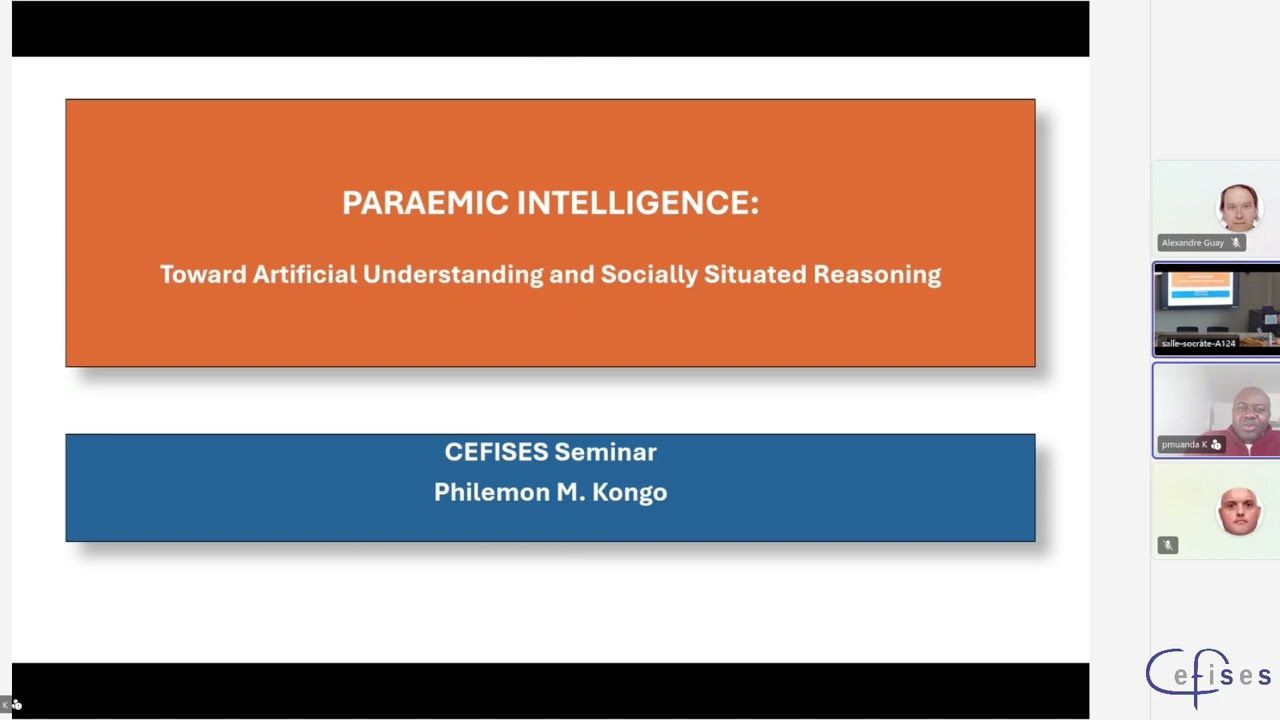
CEFISES Seminar: Philemon Kongo, “Paraemic Intelligence: Toward a Situated Model of Reasoning for AI
Watch on YouTubeVideo summary
Philemon Kongo's seminar introduces the concept of "paraemic intelligence," a theoretical framework designed to address the limitations of current artificial intelligence by incorporating contextual, social, and situated reasoning. While traditional AI research has focused on formalizing rational behavior through symbolic logic or statistical prediction from data, Kongo argues that these approaches often fail to capture human understanding because they lack meaning and context. He posits that true intelligence involves not just calculating probable outputs but interpreting situations within a specific cultural and social framework. To bridge this gap between artificial systems and genuine comprehension, he proposes shifting the focus from mere optimization to "artificial understanding," where machines learn to explain actions based on shared human values rather than solely processing information.
The core of paraemic intelligence rests on four interconnected cognitive operations that transform collective experience into intelligible action: analogical recognition, contextual selection, interpretive negotiation, and collective validation. Unlike standard AI which relies on monotonic logic or static datasets, this model acknowledges that reasoning is non-monotonic; new information can change conclusions based on context. Kongo illustrates how proverbs serve as compressed models of cultural experience that guide communities in navigating uncertainty without explicit formalization. In his proposed architecture for future systems, these four mechanisms work together to ensure that an agent does not just act efficiently but acts meaningfully by selecting relevant contexts from a vast background knowledge and negotiating interpretations with other agents or social groups before validating actions collectively.
A significant portion of the discussion addresses ethical implications and the nature of disagreement within AI systems. Kongo challenges the notion that consensus is always required, drawing on African traditions like *palava* where dialogue can be agonistic (confrontational) yet productive for finding truth or compromise. He argues that in a multi-agent future, autonomous systems must accept confrontation with other agents rather than imposing their reasoning unilaterally. This social dimension of validation ensures that AI remains accountable to society and does not pursue optimization at the expense of human values. Consequently, he suggests that the next revolution in AI will not be about building more powerful machines but creating systems capable of participating meaningfully in the social production of understanding, effectively regulating technology through norms derived from collective wisdom rather than just code or data clouds.
Read the full video transcript
[music]
Yeah, I think I think we're good. Okay.
So,
>> can you hear me? Can you hear me? Very
well.
>> Very well.
>> Okay. Good.
>> So, let me welcome everybody online and
in person for uh this last web seminar
of this academic year. Today we have the
pleasure to receive Philon Congo who
will give us a talk entitled panic
intelligence towards a contextual and
socially situated model of reasoning for
artificial intelligence
please
good. So good afternoon everybody. Good
morning or good afternoon.
Yes, I going to talk about pyic
intelligence
and uh I
modified a a bit uh the title for
clarity
toward artificial understanding and
socially situated reasoning.
Uh the talk will based on uh my works on
artificial intelligence.
Uh
I I began I began this works about uh
10 10 years about uh since 10 10 years.
So I want to to leave it and uh
especially I want uh you to react about
what I will talk
and uh to suggest something to propose
something
uh available because the purpose is to
uh to publish a something a book about
my theory on paric intelligence.
So
let us go. The history of artificial
intelligence can be interpreted as a
succession of attempts to understand and
produce the mechanism through which
human beings, decide and act under
conditions of asertent.
Since the publication of fundamental
works in artificial intelligence,
researchers
have sought to formalize rational
behavior through increasingly
sophisticated computational models from
symbolic reasoning systems to
contemporary machine learning
architectures.
The central objective has remained
remarkably stable.
The construction of artificial agent
capable of operating intelligently under
conditions of astanti.
Yet despite considerable progress,
important questions remain concerning
contextual understanding, social
interpretation and meaningful
explanation.
It is precisely within this unresolved
space that pmic intelligence becomes
relevant.
Human reasoning rarely operates through
the street application of formal
[clears throat] rules alone.
nor is it to rely exclusively on
statistical
corre
uh individuals constantly draw upon
[clears throat] culturally accumulated
experience socially validated patterns
of interpretation
and context sensitive
for forms of practical wisdom. Such
forms of reasoning enable human
communities to navigate a certainty in
ways that are often remarkably efficient
despite the absence of explicit
formalization.
Among the most widely spread and
enduring manifestations of such
practical wisdom are proverbs. In our
talk we will rather use the term paria
par or parmius in program.
I introduced the concept of pmic
intelligence as theoretical framework
for understanding these processes.
The central thesis defined here is that
paramic reasoning constitutes a distinct
form of contextual intelligence whose
inferential mechanisms remain only
partially represented in contemporary
artificial intelligence systems.
The argument advanced in my talk is not
that artificial intelligence should
simply incorporate
paramas into its knowledge basis. Such
an approach would reduce paric reasoning
to a collection of a linguistic
artifact. Rather, the objective is to
identify the underlying cognitive
architecture that makes paramic
reasoning possible and to explore its
implications for the design of a future
intelligent systems.
More specifically, I shall argue that
paramic reasoning involves four
interconnected operations.
One, analogical recognition.
Two, contextual selection. Three,
interpretive negotiation. Four,
collective validation. Together, these
operations constitute what may be called
paramic intelligence.
Instead,
it functions through the context
mobilization of a socially accumulated
knowledge for the purpose of
understanding and acting [clears throat]
within uncertain situations.
The ultimate objective of this p this my
talk and of my paper which I prepare
is therefore twofold. First,
it seeks to establish paramic reasoning
as a legitimate object of scientific
investigation within AI research.
Second, it proposes pamic intelligence
as a conceptual framework capable of
enriching contemporary approaches
to reasoning under uncertainty.
The first point is the opening question.
Artificial intelligence has become
extraordinarily
powerful. Large language models can
write aces,
solve equations, generate images, and
even imitate reasoning.
Yet a fundamental question remains.
Do machines understand
or are they merely producing
statistically
possible output?
This question lies at the heart of
contemporary debate in artificial
intelligence.
Two,
from artificial intelligence to
artificial understanding.
For 70 years, AI research has pursued a
common objective, the construction of
systems capable of intelligent behavior.
Symbolic AI sorts intelligence through
logic.
Machine learning sorts intelligence
through data.
Deep learning sort intelligence through
prediction. But prediction is not
understanding. Human beings do more than
calculate.
They interpret. They contextualize.
They negotiate meanings. They justify
their actions socially.
Perhaps
intelligence itself is incomplete
without understanding.
Three, the legacy of John Mati. John
Makati
as we know all of us
recognize a contract difficulty.
Common reasoning
common sense reasoning is not monotonic.
For example, monotonic logic tells us
that if the statement Q follows data A
and Q is included in B, then Q follows
from B.
Similarly, the semantic notion of
consequence is also monotonic. We say
that a entails Q denoted
as we as you can see if Q is true in all
models of A. But if A then uh then Q and
A is included in B then every model of B
is also a model of A which shows that B
then Q B coming from Q or B produce
produce a Q
uh that the the monotonic logic
the the way the monotonic logic operates
in non-monotonic logic we know as we
know also is not the same
if uh the
proposition
is modified we know that the conclusion
must be changed
If you add or another if you add
information
over the first information you must also
change the conclusion.
>> That is the way the common sense
reasoning reason.
We know also
a part a part of uh a part of common
sense reasoning.
Uh we have also another um
theory another theory exceptions
constantly appear with Raymond Ra
which uh talk talked about
um default logic in artificial
intelligence
and we have also human beings revised
beliefs with AGM theory. Uh we have
um for example Maninson which uh who uh
proposes with Ashiron and garden first
who propose proposed
this theory of AGM
which uh focus on focused on
revised belief.
Anyway, circumcription and the
nonmonotonic logic represented the major
advances.
I can I leave I show some picture of
Raymond writer.
He was he was a Canadian.
He was Canadian. Unfortunately is
already dead.
And uh we have David McKinson who is a
Australian.
Those are the legacy of John Mari.
Of course there are many many other
musicians
uh who are uh in the the category of
legacy of John Makati. But I can I just
give this to as a example.
If we see if we can reflect a bit of
this legacy of John John Makati,
we can
we can notice something
uh which I wanted I wanted to add
so that but uh even now it even
nonmonotonic reasoning remains
principally concerned with information.
Uh that is the point. The information
what uh how the man human how human can
uh incorporate information he must
incorpor incorporate information as
robot or as human. That is the point.
Human reasoning concerns something more.
It concerns meaning. What is the meaning
of this information?
This distinction is crucial
for the missing dimension.
Current AI systems answer how humans ask
why does this make sense?
Explanability is therefore not only
computational. It is interpretive
and interpretation
is fundamentally social
paras
intelligence. Parianas are often
considered
as folklore.
I propose a different interpretation.
Parameas are compo compressed models of
experience. They constitute
cognitive mechanisms. They allow commun
communities to reason under uncertainty.
They organize collective memory. They
guide decisions. They generate
explanations.
The importance lies not in the the
proverb or paria
itself but in the architecture hidden
behind it.
Defining paramic intelligence.
I define pomic intelligence as a
contextual and socially situated form of
reasoning that transforms collective
experience into intelligible action.
It differs from symbolic intelligence
uh role based and statistical
intelligence
which
focus on datadriven.
So parameic intelligence constitute a
third paradigm
contextual intelligence.
Four fundamental operations.
Paramic reasoning rest upon four
cognitive mechanisms.
First, analogical recognition.
Humans recognize structural
similarities,
not identical situations, but analogous
structures.
That is the idea and theory of Gner.
She is an American
uh from at
Boston mighty.
So meaning begins with analogy.
The second
uh characteristic of paramic
intelligence is contextual selection.
No explanation exist outside context.
Context determines relevance.
Context determines
meaning. That is the idea of Brazilian
and day. And uh I Brazilian must be a
French from France.
Brazil.
That is the contextual selection from
the my theory of paramic
intelligence.
Three, interpretive negotiation.
Understanding is never automatic.
It emerges through interpretation.
Different interpretations coexist.
Reasoning becomes dialogue.
That is the idea of me and Shman.
Fourth, collective validation.
Rationality is social. Knowledge is not
merely possessed.
Knowledge is negotiated.
Meaning images collectively. That is the
ideas of archings and government.
Now we can see beyond symbolic and
statistical intelligence.
If you see beyond that those
feature of artificial intelligence,
we can u
we can talk about symbolic AI ines
structure
that is as we know the the charactic
characteristic of symbolic AI
and statistical AI.
size is adaptation.
But for paramic intelligence,
I propose to emphasize
uh meaning meaning that to say
uh
to understand what uh the proposition
what the result means
for human.
It introduces context, interpretation,
social cognition,
and collective understanding.
Explanable AI revisited.
Current explanable AI asks
how was the output produced?
Paraming intelligence asks why is this
output meaningful?
Transparency is insufficient. Users seek
intelligibility. Explanations are social
phenomena. As Tim Mirror reminds us,
explanations are designed for humans,
not for machines.
Distributed cognition.
Edwin Arching demonstrated that
cognition extend beyond individuals.
Thinking is distributed across
communities, artifacts, institutions,
languages.
And for paramic reasoning,
uh
parabic reasoning embodies precisely
this principle.
Collective memory becomes distributed
distributed intelligence
multi- aent systems. The future of AI is
no longer individual.
It is collective. Autonomous agents must
negotiate, cooperate, revise beliefs,
construct common meanings.
But he must also for paramic
intelligence.
Paraming intelligence suggests that
disagreement is not a failure.
Disagreement is productive.
Interpretation emerges through
negotiation.
Irresponsible AI
that is the problem of ethic for AI for
artificial intelligence.
Luchiano Fed and Virginia DNA remind us
AI must remain socially accountable.
Optimization alone is insufficient.
Meaning matters.
Human values matter. Interpretation
matters.
So from paraming intelligence we
introduce these dimensions into AI
architecture
toward artificial understanding.
Perhaps we need a distinction artificial
intelligence versus artificial
understanding.
Artificial intelligence optimizes.
Artificial understanding interprets.
Artificial intelligence predicts.
Artificial understanding explains.
Artificial intelligence processes
information.
Artificial understanding constructs
meaning.
And now we can see the problem of
computation
for paramic intelligence
computation architecture. I just want to
propose it's just a preliminary um model
of computation
but I hope that I will work on it and uh
precise everything
for the computation.
The future paramic architecture could
contain four modules.
analogical memory, contextual
evaluation,
interpretive deliberation, social
validation.
uh we can see u among uh those four um
points there's
interconnection there's relation inter
relation between uh different processes
an analogical must
uh rely on contextual contextual
evaluation and context evaluation
must rely on um interpretive
deliberation
and uh
interpretive deliberation of course must
rely on uh social based on social
validation.
Such systems would integrate symbolic
knowledge, contextual cognition, social
reasoning, explanability,
philosophical implications.
Of course,
uh my theory uh
produce
eventually is some reaction or some
implication.
There must be some consequences.
This proposal raises a deeper question.
Perhaps intelligence itself has been
defined too narrowly.
Intelligence must must may not consist
exclusively in solving problems.
Intelligence may consist in making
situations intelligible.
This shifts AI research from computation
toward understanding.
Conclusion.
Allow me to conclude with the following
proposition.
The future of artificial intelligence
may depend not only upon learning from
data but also upon learning how human
communities transform experience into
understanding.
Paramic intelligence is therefore not a
theory about proverbs or paria parames.
It is a theory about meaning.
And perhaps the next revolution in
artificial intelligence will not consist
in building more powerful machines, but
in building systems capable of
participating
meaningfully in the social production of
understanding.
Thank you.
We take one or we go directly to the
questions. This will take five. Yeah. So
we take uh FO we take five minutes and
after that uh questions and answer.
Okay.
>> Okay. Okay. Five minute breaks.
>> [music]
[music]
>> Hey,
[music]
hey, hey.
>> [music]
[music]
>> Hey.
[music]
Hey.
>> [music]
>> Hey. [music]
Hey. Hey.
>> [music]
[music]
>> Hey.
[music] Hey. Hey.
>> [music]
>> Okay.
Question, comments.
[clears throat]
>> Well, I can start.
>> Yeah.
>> Okay. Thank you very much uh Filimo for
the for the talk. I'm always very
sympatic symposic
therapy sympatic to uh to enter a little
bit of contextuality in human reasoning
since it's clearly not formal but I I
was surprised about the
the part about analogical recognition
using GNA and thank you to remind me
it's been a long time I run because one
of the idea of GNA if I remember
correctly
is that we basically think in metaphor
the brain is analogical but the the main
cultural tools is metaphor. So why did
you choose analytical recognition rather
than metaphor recognition which would
fit better with the the case study of
proverbs?
Seems that most proverbs use more
metaphor than analogy.
Yeah.
Uh, can I reply?
>> Yeah, please.
>> Okay. Uh, okay.
uh metaphor metaphor
as a analogy.
That is the
those are the some kind of
process
uh which
parasmic
intelligence or paras use to
uh to manage
uh in my work in my thesis I
explained
everything
about metaphor and analogy.
Those are some kind of
mechanisms
um
used in parimeology
uh to uh construct to construct
uh the con the situation
and to
uh
to [clears throat]
to show to show the reflection or or
some characteristic of
uh of phenomena.
Uh let me explain.
If um
we can say that
uh parameas
used to to manage those kind of
mechanism
that is the same but the difference
those metaphor as as analogy are the
same mechanisms
but the the difference reside
in the construction
of um
each of each of the both
in analogy
as uh Gentner say said
um
there's not similarity similarity
there's um
common
ar structure
of the phenomena, common structure and
then you transport this common structure
to another [snorts] phenomena.
That to say
that is not a
a simple simple
comparison
but is a construction in analog
analogy there's construction.
>> Okay. So as
even to to construct a paria you must
use analogy
and but for metaphor metaphor is also a
transport a transport of the a just a a
feature of the phenomena to another uh
phenomena.
That is the difference I can say.
Uh the analogy is for construction of
the reasoning. Construction of the
reasoning completely.
But metaphor is the transport of one one
feature of the phenomena to another one.
but is not is not dealing with the
construction of another uh reasoning
pyomic reasoning
that is the difference for me.
So, so it's more structural analogical
is more structural
>> but those are the the same mechanism of
this kind of this kind of reasoning
>> resonate. Yeah. The principle the
principle feature of this kind of this
phenomenon.
Other questions, comments?
I have a bit of a a bit of a similar
question. Um,
and it probably it probably also comes
from your from your other work. So, I
really like the talk. One one thing that
I'd love to to hear just a little bit
more about is how you went from your
analysis of perennials to those four
features that are required to to
understand them if the the architecture
the uh analogical recognition contextual
selection interpretive negotiation and
uh and collective validation. How did
you
what
what's the link there? But say say more
about how that's how you see those as
being so essential for how we
understand.
>> Uh
yes.
Uh
uh first of all first of all we must
know that is just a a proposition. I
propose to scientific scientists this
theory
and uh as I see in my as I
can see in my uh work
analogical recognition
is I can say is the first the first
me the first process
there's Don't there's so to speak
there's there's there are four processes
for computation
we have analogy analogical recognition.
So an analogical recognition is
to compare is a kind of comparison
uh of the phenomena. We have one
phenomena in our background
and we compare this the the phenomena
which is in front of us which we uh we
dealing we can deal with
uh
with the the first which is in our
background.
That is the first the first process for
uh can I say I can say also for um
proposing
a computational a computational model
uh because I don't have for the moment a
computational model that to say some
rules some uh mechanism logical
technical mechanism for this theory but
I can say for analogical recognition is
just a compar comparison
uh we have in our background we have uh
can I say I can say in our data we have
some examples.
So we compare this the the one which we
are dealing with with our background and
we can see the difference and uh
uh
and give
or or
uh if we we found we will also find some
difference but we can produce
Another one. Another one which is uh
which is uh contextually
um irrelevance irrelevant contextually
relevant. The second is contextual
selection. We must also
selection
choose we can we must choose the context
for the phenomena with uh which we are
dealing with.
We have in front of a phenomena a
phenomenon and now we want to explain
the the purpose we
must know the purpose is to understand.
[clears throat]
So we must choose the context. This is
the context. We can have different kind
of context. It's can be in uh psychology
in scientific
especially
uh matters or uh living in
commercial affairs
uh psychology
that is those are different context. Um
and we have to choose
which context is irrelevant
and uh after that we must interpret
and we must negotiate the interpretation
because um I talked about uh multi malta
agent
uh in artificial intelligence
for now we are dealing just uh with uh
individuals.
But in the future, we'll have many
agents
uh who uh
will have
the the same knowledge or the same
ability
uh one another as uh for every everyone.
So we have to interpret, we have to to
negotiate
to to hear or to collect
the proposition of all aspects
about the phenomenon
and
choose socially
the the best inter interpretation for
the case.
that is the situation
uh the selection of situation
and uh for the fourth characteristic is
collective validation.
Uh we must for the problem of ethic
ethical problem we must also uh
seek for the validation of the society.
Uh for example
uh in AI uh today someone can have his
drone you know the drone and he can
decide
uh to to use this drone for the purpose
of military purpose
and he can use it as
he find best for him but not for the
society, not for uh uh social purpose
that is will be uh I can say uh a
problem for the society. You cannot use
uh technology from AI for your own um
your own uh uh what can I say for your
own purpose for your own benefit. You
must also uh
consider the society
that this this
characteristics
shows shows that
um
uh show that uh we have also to consider
the ethical problem of artificial
intelligence.
So the collective validation is needed
for the for paramic reasoning for
paramic intelligence. Now together these
operations constitute what may be called
paramic intelligence. You you cannot
choose uh use one of them in
alone. You must use all those operations
for the purpose uh of uh uh for the best
the best the best results
uh of
what can I say for the society for the
benefit of the society for the benefit
of of for
yourself and uh for the future of uh the
environment. ment for the future of the
world
that is
I can say what I can respond for your
question I think that is it okay
>> yeah that's all thanks
Marco
>> thank you so much for your talk I just
had some know questions about like
curiosity because I'm outside of this
domain. So concerning the contextual
selection, you said that we need to
choose
uh the context and you mention the fact
that we could choose a context in
psychology, a context in another
science. So are you saying that the
context is uh um
fieldbased? So the context
means something between
a scientific domain
or is more like a social
uh cluster. What is the context? is more
um
related to different field or to
specific uh social context.
I don't know if
>> Yeah.
Okay.
Um
the context we can say um is uh the
contextual selection is about
um
five five
points.
We can consider the circumstances.
The first of all the circumstances
which is the circumstance of this
phenomena for this reasoning
that to say paramic intelligence
propose to consider the circumstance.
The case, the case.
This is the case.
If we can use analogical cognition,
of course,
we have a background.
But for this circumstances
or for this circumstance
what
we can say what what we can we can do.
Second is intentions.
The intention is uh
also a matter of contextual.
The intention which is the intention.
We know the intention is aboutic
problem matters. uh we can also deal
with that
ethical problemic
matter
that to say
what what is your intention to use uh
this uh device can I say this device of
technology from AI
what is your intention your intention is
for example for the milit military
purpose is to kill for killing people.
What is the intention?
Uh so I can say the second is also
valuable
as [snorts] the first circumstances the
case. The second is intention. The third
is
relationships.
Relationships
is uh your action your your uh reasoning
uh can be relate relate with another
reasoning with another kind of uh
problem.
That is the pro that is the the the
third the third
I can say characteristic for the context
selection. The fourth is historical
background.
The historical background is uh of
course in the history we know that uh
this phenomena
uh yield yielded some kind of problem or
this this problem or resolve the
problem. So you have to consider this
context the the historical background
and the last one is the social
expectations.
You must not see only your uh your
desire to to to realize your desire or
to uh to reach your purpose. You must
also
uh consider the social benefit.
the social benefit for [clears throat]
the society,
my reasoning, my action
uh what uh what's the the point, what
what the meaning for society
that is uh those are can I say five uh
characteristic of contextual selection.
If you you have to to se to choose the
context You have to see those four those
five uh characteristics
uh which can tells you tell you uh if
your action or your reasoning is
valuable for uh
for scientific scientific papers or for
human being.
So I suppose that I Yeah.
>> So thank you so much. So you you gave us
a bullet point concerning all the steps
and that when you say you
must to do that, you must do that. The
agent is the who is the agent? Is it the
researcher? is a is a is some people
from certain institution.
So it's is could be plural.
>> Who is the agent?
>> The agent is
everybody who knows
>> okay okay
>> something about AI.
>> Okay.
>> You must know something about AI. You
must uh
use the computer. You must use
everything of from technology.
Uh we have we have for now we have the
phone, telephone, we have uh many
applications.
Uh so in the future
I suppose that everyone will know to use
uh those these uh devices
is not not only the telephone. You you
can have your drone, you can have
everything else. But the problem is uh
as agent you must you must I I say is in
obligation because in the future we
I suppose that my my talk was a little a
little clear about that for the moment
we are dealing dealing with individual
the AI model for the moment is
individual is the agent himself
who can decide
with of of course many skills, many
ability decide to do or to to to speak
or to reason. But for the future we will
deal with society.
There will be uh everybody will know
about
uh artificial intelligence.
everybody.
so to speak.
For this, for the future, we have to
consider
not
I can say in the theory of Rene Kart
is the model of AI for now is the model
of Rene Deart.
with the subjectivism
is the man I know.
If I know something, I can act.
If I have an ability, I can act as my
reason, my rationality
as I know.
But the problem is you have to consider
the society your action your reasoning
must uh be in confrontation
with the society.
So the agent we for the future we will
deal with many agents malt agents that
is the the theory I propose with paramic
intelligence
>> thank you
other questions comment
>> actually I will
>> yeah because it's super new for me so
I'm curious
Uh I believe I understood correctly. Uh
you no more or less uh in your paper
talk about proverbs right? You mentioned
proverbs
>> about proverbs. Yeah. Yeah. Yes.
>> Yeah. And uh and you said that
nonetheless should be u
should be view as you said sophisticated
mechanisms of contextual inferencing.
Uh
and my question is uh because I do have
some example in Italian but I don't have
maybe been English. Uh the pro proverbs
could be um
some proverbs could could be in
opposition between one another. So some
proverb could say something but other
could go to another direction maybe the
opposite direction. So how can you think
you could manage? You you talked about
this possible tension between uh
proverbs or
uh what what do you think about about
that about that?
>> Yes. Mhm. Um
all my works
are about uh about proverbs
but uh I I propose I propose the term
paria is the same paria or proverbs.
Uh the difference is PMIA is um a
transcription of the
uh of the Greek term paria
parameia.
So uh all my works is about parroia
paria
or proverbs. But the proverbs in
with the conception of um a
logical reasoning
not as a a fault or a linguistic
artifact.
>> Yeah.
And uh uh the second um I can say for
the confrontation we have the palava
in Africa.
This is a
traditional culture of Africa.
Uh in a palava
we have to confront to have to uh
to deal with to dialogue if you like to
dialogue with someone
who is using proverb
in French. I can choose a proverb two
proverbs.
That is one proverb.
But uh on the other side someone can say
uh what that means? That means that uh
if you propose
a proverb, a parameia,
you for reply, you have another parameia
which can
which can oppose
your paria or which can uh follow your
direction,
can approve also your uh your paria. So
that is a kind of a kind of a dialogue
but the dialogue
or par [snorts] but
Aristotle
talks talked about
different kind kind of dialogue or
parava.
Uh we have a a parava agonistic parava
that to say a confrontation
is as in a war
not you you cannot you in a war imagine
a war but or a confrontation
but you just use the proverb
you use only the proverb so that if I
I utter a proverb. You have to reply
with your proverb
uh as uh to confront my proverb.
But there are also some kind of
dialogue, some kind of palava which is
uh irreic
is I can say for
Pacific Pacific purpose
that to say we are looking for
compromission not compromission for
accord
we are looking for
to to be in the same in the same
movement minger don't and if I propose a
proverb I can approve your proverb to uh
with my proverb which I can author also
that is a kind of a kind of um
um
realization of a proverb in society.
So this model can be uh
used
in artificial intelligence for the
future.
That to say if we have multi- agent
you as agent in artificial intelligence
you must also accept you must allow
someone else to confront
your action because proverb is not only
a reasoning is a reasoning which
imposed
is is a reasoning of
obligation.
It
what can I say?
It it
can
give you an instruction to realize
something to do to act to act with the
proverb.
So uh if you are you are an agent
uh you must also accept
another agent to confront your reasoning
or your agent in artificial
intelligence. That is the model which I
propose for the future of the artificial
intelligence and I I think that it may
be the way which can u
help to to find some laws or some rules
uh to regulize the the use of artificial
intelligence today because uh their lack
of uh rules or for laws about artificial
intelligence. Everyone everybody can do
everything you like uh without beically
orically
condemned.
But with uh the model I propose with
paramic intelligence, we can find some
rules,
some norms, some laws to regulize for
the future the use of artificial
intelligence.
>> Thank you.
>> Okay.
comment questions.
Shall we thank our speaker? Oh, wait.
Sorry. Sorry. I just saw online. My
apologies. Um,
>> one question. Oh, also uh also online.
Uh, Peter Beth says he's sorry he can't
be here. He had to go home, but he's
been watching online. Um but as well
there's a question that comes in online
that says uh thank you for the
presentation. Uh contemporary systems
usually work with digital data. Uh do
you think that a contextual permic AI
system would also work with or be
trained on similar kinds of data sets or
would it require some kind of analog
interface to work with the context?
I I don't I don't hear. There was a
problem with my communication. Can you
Yeah. Yeah.
>> Sorry. Can you hear me now? We Okay.
>> Can you reply? Yeah.
>> Okay. Uh the question says, uh, "Thanks
for the presentation. Uh, contemporary
systems usually work with digital data.
Do you think that a contextual paric AI
system would work on or be trained on
similar kinds of data or will it require
some kind of analog interface to to get
to capture the context?
Uh
yes
uh
you know um
the use of artificial intelligence.
uh I can say for the moment
that is a kind of artificial
intelligence and the technology today
everything is
um
stock is in the stock
the stock what can I say uh
what I mean is that we are constitute
some data data for everything
human can do.
So we have a large a large we today we
have we have the development of uh the
progress of uh uh data cloud.
Data cloud will will be the
the the future problem
characteristic of artificial
intelligence. We have a large a large
quantity of data for the moment and with
the time we will have
more than that more than that
that to say
in in history even for the constit
constitution of data
Everything
of in in
human life will be uh in
stock storage stockage package in in
data cloud or everything else.
So with algorithm
we will have
the problem because
uh AI will uh not only
um
uh stock magazine datas data
but uh will um reason will operate
with this data.
And I think that even human being will
be overwhelmed
overwhelmed
uh for this problem of information.
So we have to to to uh
to to propose also some rules or some
laws about the
the data the data for the moment because
um you know
you know you know that very well
today
artificial
intelligence can
can produce can yield everything of
image. everything of the image, every
kind of image
uh every kind of uh production
but uh it relies it's based on data and
uh the problem we will deal with for the
future will be uh that problem of
selecting selecting
the
real case. The real data
not only
for uh scientific purpose
but
will deal with ethical ethical
problem.
political problem and uh society social
social
consideration
problem.
That is the problem of AI because for
the moment AI is uh
is progressing with uh
enormously enormously and uh rapidly.
So that is the problem of context
selection and data and data and uh data
model of the moment.
We have also to reflect and to
regularize the this problem the relation
between uh
with data cloud and the context the
circum the context selection.
So uh I suppose for my theory the pro
the theory I propose I will um
I will propose I will work on
computational aspect to compute and to
to propose some rules about this problem
of inter intercon interconnection
between data and context selection.
I don't know if I reply on
reply
question.
>> I'll see if I'll see if there's
>> Is there another question online or not
online?
>> Yeah,
>> sorry.
>> Comments.
>> Uh the last question was someone online
so it will take time maybe for them to
to reply if your answer satisfy them.
We'll see. Oh,
>> okay. Yeah.
But for now I'm going to asking in the
room online nothing
thanks that helps. Okay so so the the
person is satisfied by the answer thank
you is there other questions?
So I think we'll uh we'll thank our
speaker.
>> Thank you.
>> Thank you very much. And it was the last
whip of the year. And is it the last
seminar of the year?
>> Okay,
>> everyone. So,
>> thanks for being here. Yeah. See you
soon.
>> So, thank you. Thank you very much for
listening, for your time and for your
your desire to understand my theory.
>> Thank you very much. Cheers.
[music]