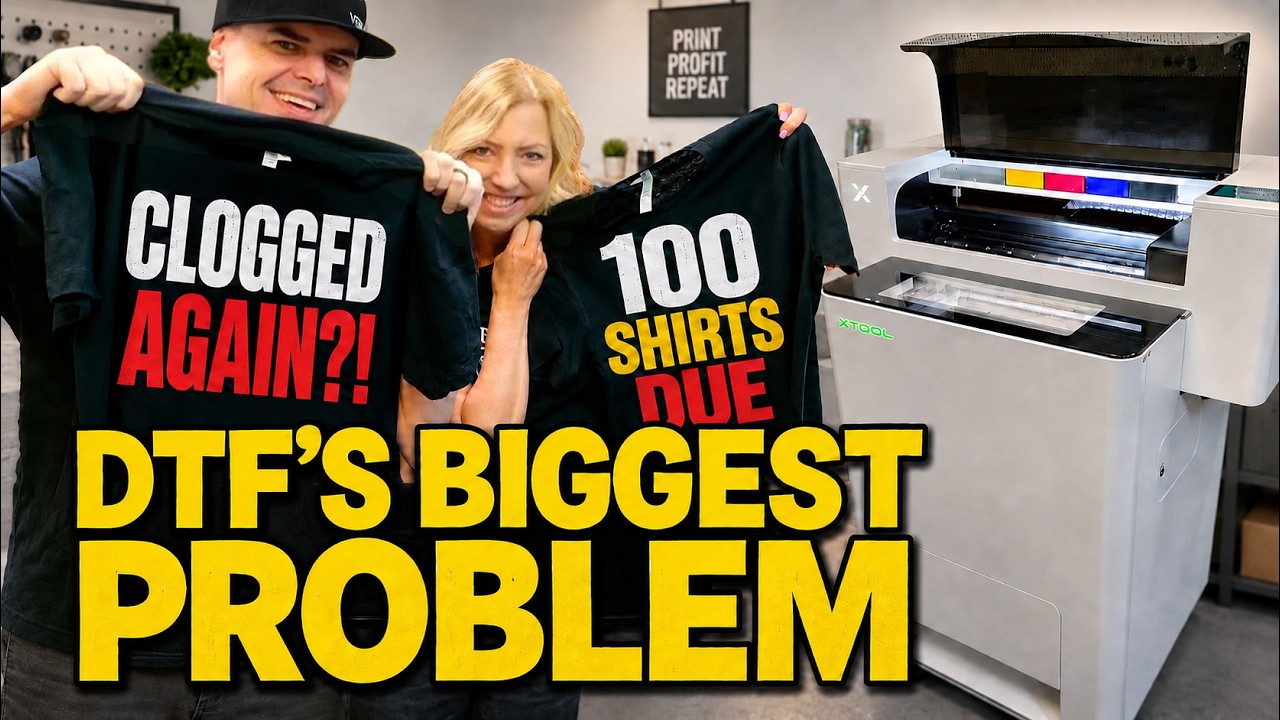
Can You REALLY Make Money With the xTool Apparel Printer Plus?
Watch on YouTubeVideo summary
The video explores whether the xTool Apparel Printer Plus can truly generate profit by highlighting a critical cost factor often overlooked: downtime. While standard t-shirts might yield $15 to $20 in profit and hoodies up to $30, these figures vanish if the machine stops working when orders are urgent. The creators share their experience with an older DTF printer that struggled significantly during cold weather; as temperatures dropped below freezing, humidity levels fell too low for the ink to flow correctly, causing clogged print heads and wasted materials over a weekend of troubleshooting. This incident taught them that environmental stability is just as important as the machine itself, leading to expensive fixes like purchasing separate humidifiers and sensors to maintain optimal conditions.
To solve these reliability issues, the creators tested the new xTool Apparel Printer Plus, which addresses three major pain points: stable performance, improved maintenance routines, and a smart cycle system. Unlike their previous setup where they had to manually babysit the machine by running test prints daily or using syringes to clear solidified ink after long breaks, the AP Plus features an integrated onboard humidifier that automatically maintains 45% humidity inside the unit. Additionally, it utilizes advanced wet capping and upgraded dampers designed to keep print heads moist for up to 30 days without manual intervention. This technology drastically reduces maintenance fluid usage by 75% and ink consumption by 80%, allowing business owners to leave the printer unattended during vacations or slow periods with confidence that it will be ready when needed again.
The video also explains how Direct-to-Film (DTF) printing differs from other technologies like screen printing, direct-to-garment (DTG), and sublimation by offering versatility in materials and production speed. DTF works by printing ink onto a special film with adhesive glue on the back, which is then heat-transferred to various fabrics including cotton, polyester, canvas, wood, and metal without requiring specific fabric colors or types like sublimation does. This flexibility allows for quick turnaround times essential for small businesses that need same-day shipping capabilities. By integrating smart monitoring via a mobile app, users can receive real-time notifications about ink levels, humidity data, and potential jams, effectively eliminating the stress of constant supervision while ensuring consistent print quality across different product types like t-shirts, hats, and even camp chairs.
Ultimately, the conclusion is that making money with apparel printing depends less on just having a printer and more on managing its operational stability to avoid costly downtime. For existing users who purchased older models six months ago, xTool offers an upgrade kit that includes the onboard humidifier and software updates for better circulation and wet capping, bridging the gap between old machines and new features without requiring a full replacement immediately. The core message emphasizes that while print quality is important, true profitability comes from equipment reliability that allows businesses to handle rush orders confidently. By adopting these automated maintenance solutions and joining supportive maker communities, entrepreneurs can transition from constantly fixing issues to running a consistent, scalable business focused on growth rather than troubleshooting clogged nozzles or managing room humidity manually.
Read the full video transcript
You can make $15, $20, profit on a
t-shirt, $20, $30 profit on a hoodie.
But there's one number no one ever talks
about when buying a printer.
It's what it costs when it isn't
printing.
>> Because the most expensive printer in
your shop isn't the one that cost the
most. It's the one that's down when you
have 100 t-shirts due tomorrow.
>> [music and singing]
>> What is up? Welcome back. We know you
love to do it build it and make it.
>> And we're here to help you sell it.
>> We partner with our buddy next door
sometimes. He's a large screen printer.
He doesn't really take any jobs less
than 100. So sometimes he'll throw us
his scraps, his 25 and 50 t-shirts. He
knows we have a DTF printer.
And he doesn't even think it's worth it
to go ahead and create screens and
unless it's 100 or more. So he throws us
his scraps now and then.
At last November, middle of crash show
season, we have wagons everywhere. It's
kind of crazy. We have extra painters in
here painting the signs. He comes over
like a Thursday. He's like, "Hey, I have
a rush order. 25, 50 t-shirts. Can you
guys pump those out for me?"
>> Would you be able to do it?
>> Yeah, and give them to me on Monday. And
we're like, "Yeah."
>> Yeah, but we got you. No problem.
>> Kim's like, "I'll just knock them out on
Friday. No problem."
>> Mhm.
>> Friday mid-afternoon, we get around to
it.
And it's they're all fuzzy.
Every print's fuzzy.
Saturday morning, we we come back to it.
Everything's fuzzy. The head's getting
clogged up. Like the ink's gathering on
the heads.
Needless to say, we spent all weekend
wasting ink, wasting paper, and wasting
a ton of time doing research. Come to
find out, it's the humidity. So since it
dropped below freezing, the humidity in
this place got down to 27 and none of
the printers seem to want to
do their thing.
>> If you have any experience with
printers, UV printers, DTF printers, you
know they're very sensitive to the
humidity in the environment. So, it's
got to be it's got to have enough
moisture that everything for the ink
flows appropriately and like it's
supposed to. Now, we did not even it
just didn't even dawn on us. I mean, we
kind of know the humidity thing at that
time.
>> read I read it on Saturday. It was like
could be humidity and I was like
>> Nah.
Nah, not here. I mean,
>> on Reddit thinks it's humidity.
>> This room is climate controlled. We're
good. Well, that's not the case. When
the temperature drops, humidity drops,
and it becomes a problem. And that was a
learning curve for us. So,
>> We ended up getting a gauge and a
humidifier.
>> Yep. So, we can monitor the humidity and
keep the printer running.
>> Another lesson that we learned was you
can't let the printer sit that long. So,
everything dies like December 15th here.
Pretty much uh
dries up. And then like mid-January, we
start getting orders again. And we get
an order for another 25 t-shirts. I pop
over the printer. I make sure it's nice
and humid. I was running like a good 45%
humidity in the room. And nothing's
printing. I can't I can't get white to
come through the head. I'm doing
cleaning after cleaning. Finally, we had
to basically take it apart and pull
the
hook up a little syringe to the
um
I guess all the tubes and pull all of
the white ink that that basically
solidified in the tubes. And then we had
to flush the head.
And then, you know, from there we just
basically learned that it needs daily
maintenance. So, now every day we come
in and we do a head cleaning and we run
a print. So, we have lots of logos and
we can make a t-shirt at any time
because every day we print one of our
logos.
>> Right? If you've seen Kim and Garrett
t-shirts in our store, guess what? We
got you next-day shipping because I've
got tons of DTF prints with our logo on
them.
>> We had to keep the heads going. We had
to keep them lubed. And when we go away
for like a week or whatever, we'll tell
Tanner, "Hey, go go throw a print at the
the apparel printer real quick so the
heads don't dry out."
>> So, let me explain a little bit more
about DTF. DTF is direct-to-film.
So, you could think of this as kind of
like a special t-shirt sticker. So, the
way this works with a DTF printer is it
prints the ink and then it prints glue
on the back and then you have to heat
that glue and then you have a special
transfer like this that can be stored
and used when you're ready. And then you
will take this transfer and actually
apply it to a t-shirt like what we have
on here today. These are both DTF
t-shirts.
>> Well, it becomes a heat transfer.
>> Yes. And so, let me explain a little bit
the various printing technologies that
are out there. So, there's screen
printing like we talked about with our
neighbor next door. He actually uses a
screen, runs the ink through a screen,
and each color is a different screen.
So, there is a larger process to that
because each color in your image is
requires a screen setup.
So, that's a little bit different than a
full color print like a DTF printer. DTG
is direct-to-garment. So, what's
different about DTG is that you have to
print directly on a garment. So, what
works a little bit better with DTF is
that you can take this transfer and
actually put it on anything. I could put
it on a hat. If I have a t-shirt press,
a hat press, I could put it on a camp
chair. We did put it on a camp chair
once. You could put it on any various
shaped things as long as you can apply
heat to it, it will transfer to that
fabric. Or it could be cotton,
polyester, vinyl, it can transfer to
almost any kind of material.
And then, what makes it different than
sublimation is sublimation requires you
to have a light colored fabric and it
must be a polyester type fabric so that
the gases blend with the materials of
the fabric.
You don't do that for DTF, direct to
film. These transfers will apply, like I
said, to cotton, polyester,
>> uh canvas,
>> canvas,
uh wood. We've actually applied them to
wood, uh to metals. They really do
transfer to almost anything because of
the glue that's applied to the back. So,
I wanted to explain a little bit about
the technology that we're talking about.
>> When Xcel approached us about sending us
the new Apparel Printer Plus, my initial
reaction was like, "No, I don't have
time to baby sit another machine."
>> But they reached out and shared some of
the new features of the Apparel Printer
Plus and it really did hit the three
biggest pain points that we had. So, I
had to do a little convincing and I
talked Garret into saying, "Yes, we want
this new printer and I really want to
try it out and I want to see if it can
meet our commercial needs. Can we
actually produce products that I can use
in my business? We had gotten to the
point where we had to take DTF prints
out of our store because it just didn't
feel reliable enough. If a customer
ordered, I needed to be able to get
those prints printed and shipped within
a day or two. And I wasn't confident
that I could do that. So, with the new
AP Plus, Xcel hit us with solutions to
our three main pain points. One, more
stable performance. Two, better routine
maintenance. And three, smart cycle.
>> What actually happens when you become a
Maker Place member? First, you get
instant access to our monthly library of
premium production-ready SVG cut files
worth over double the subscription cost.
Just download, load into your laser
software, and start cutting sellable
designs in minutes. Plus, you unlock
access to our Make It Mafia community,
where you get behind-the-scenes content,
topic submissions, and direct support.
Add in sitewide discounts on materials
and exclusive business training
webinars, and it pays for itself.
Membership starts at just $5 a month.
Tap the link to join the family today at
kngmakeit.com.
>> Remember the problem with the humidity
that we had, and we had to get a sensor
and a a whole separate humidifier? Well,
xTool's going to put a humidifier inside
the machine.
>> It now has dual humidity sensors with an
automatic onboard humidifier. It
maintains a consistent 45%
humidity, and it auto adjusts the
humidity inside the printer. You don't
have to touch it. It's automatically
going to adjust the humidity inside the
printer based on its sensor readings.
And that keeps the print head from
drying out and reduces the ink clogs in
the lines, so you don't have to pull
that ink through the lines when it sits.
>> Remember the issue we had when we let
the printer sit pretty much all of
December and January, and then when we
decided to print, everything was
clogged, the print head and all the
hoses. Well, xTool's going to head and
try to solve that issue, too.
>> Yes, the AP Plus has an advanced
maintenance system. So, they have new
advanced wet capping and upgraded ink
dampers, which will allow your print
head to stay moist for 30 days. And
that's huge. So, they give us a little
statistics saying that if it's sitting
10 days in standby mode, that is now
reducing the use of the maintenance
fluid by 75%
and the actual ink usage by 80%. So
overall, you're saving on inks and
you're saving on the maintenance cost,
which is pretty exciting because now I
feel comfortable leaving it sit if I go
on vacation and I come back, I'm not
stressed that I have to have somebody
run a print while we're out of the
office. And if we don't have a job for
30 days, the machine can actually sit
there and I'm confident that it's
actually going to have a moist print
head and the lines aren't going to be
clogged when we come back to it.
>> We won't have a a 100 t-shirt designs.
>> All right. So then we won't have to run
a Kimmi Garrett Make It T-Shirt design
every day
so that my print head keeps running. And
actually, I run two at a time. So again,
if you want a Kimmi Garrett Make It
T-Shirt, just let me know.
>> [laughter]
>> And my biggest pain point was all of the
babysitting. I mean, how many logos do I
need? And I always had a syringe at the
ready.
>> [laughter]
>> I didn't know you had those in his
pocket. With the new AP Plus, they now
have a 24/7
smart cycle maintenance system. Yay!
Which does all of the maintenance and
monitoring for you. So it's doing it's
managing the humidity data for you,
usage info, it's letting you know real
time what kind of ink levels that you
have. It does the automated wet capping,
ink circulation, the automated
cleanings, the moisture fluid
replenishment, all of that in an
automated smart cycle process. And you
can monitor all of that using the XTool
app on your phone. So as long as you're
in the same network, it will let you
know, "Hey, your ink levels are low." or
any kind of issue that it runs into.
You're going to get real time
notifications if there's an issue with
your print anywhere in your our
building, we can kind of I an eye on
what's happening with our prints. Which
is great if you're running running a
hundred prints, you go do something else
and you come back and you realize, "Oh,
it jammed after print number three." And
you waited 30 minutes and you didn't
even know that. I mean, ask me how I
know.
>> Now, if you're thinking, "Great, I just
bought the printer 6 months ago. Now
they want me to buy a new printer."
Don't worry. Don't worry. If you're one
of the OGs, they got you. They're not
going to leave you hanging. They have a
free upgrade kit for you.
>> With this new upgrade kit, you actually
get the onboard humidifier and upgraded
dampers. Now, with the onboard
humidifier, it will adjust the humidity
inside the printer and keep it at that
optimal 45%
humidity. Now, what it doesn't do with
the AP Plus, it's integrated in and it's
using that smart cycle maintenance to
monitor it for you.
But for the OG users, you will have to
keep an eye on the humidity in the room,
but you won't have to buy a separate
humidifier. It'll auto- automatically
produce that humidity by turning it on
and running the humidifier inside the
machine. It actually sits in the
machine.
It also has a software upgrade to
support the better circulation and wet
capping. So, it's not a smart cycle
where it's running the full cycle for
you, but it does have the upgraded
dampers, the better circulation, and the
wet capping all with the upgraded
software. With the new apparel printer
plus, it's not about improved print
quality. It's still a great print. It's
about better stability, better
maintenance so that you can run a
better, more consistent business. Now,
if you don't have a DTF printer and you
want to get into apparel printing or
really printing on just about anything
with a DTF print, you can follow our
links down below. If you're an existing
apparel printer user, you can follow the
links below to get your upgrade kit.
>> And otherwise, I'm about out of time.
I don't have to go do any maintenance.
I don't know what I'm going to do. But a
big thanks to the Maker Mafia. That is
the best mafia. That is our
membership area over on g make it dot
com. And if you're not a member yet, you
should check it out. It's not just about
the files, it's about business content,
behind the scenes, zoom calls. There's
just so much more.
>> And the whole maker community is really
about the family.
>> It's about the family.