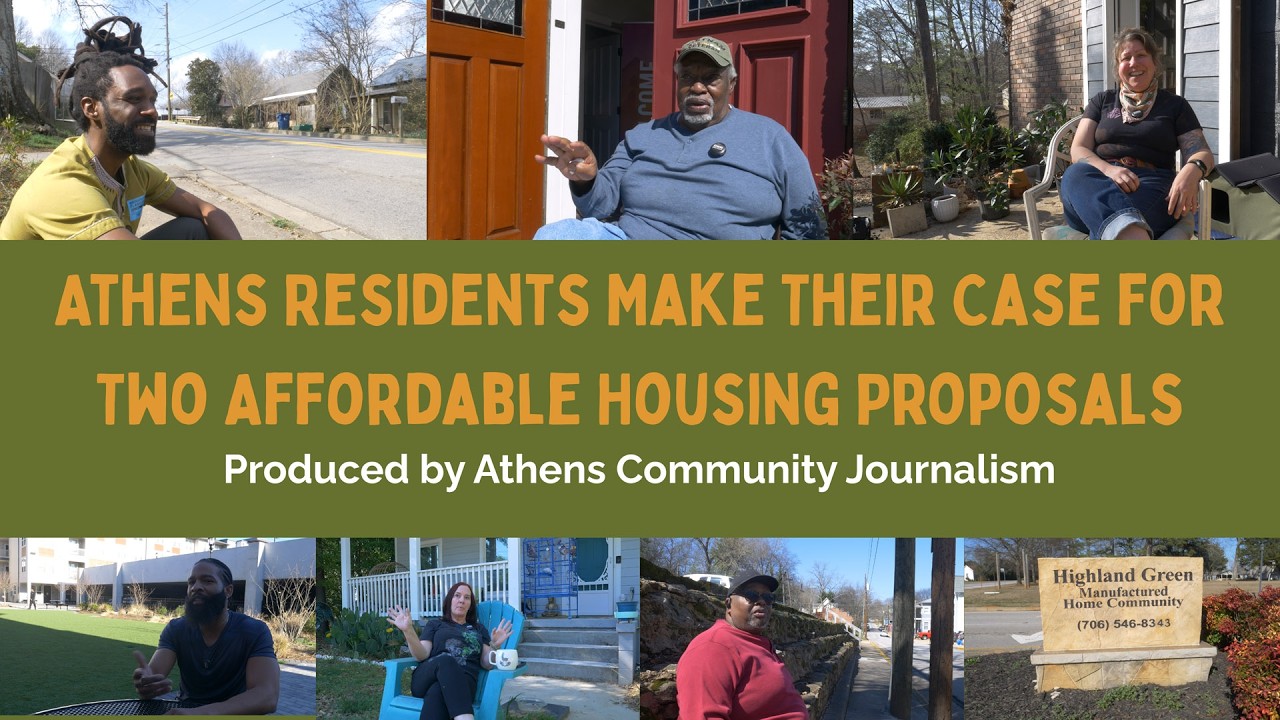
Can you imagine an Athens where everyone has an affordable place to live?
Watch on YouTubeVideo summary
The video explores the urgent housing crisis in Athens, Georgia, where many residents struggle to find affordable and stable homes while facing constant threats of displacement. For families like those of Broderick Flanagan and Danielle Gilmer, losing a home often means falling into precarious situations or relying on relatives for shelter. The narrative highlights how out-of-state investors and large corporations are driving up property values and rents, prioritizing luxury developments over local needs. This shift has led to a community where long-term residents feel forgotten by the city's priorities, which increasingly favor students from nearby universities and wealthy outsiders rather than working-class families who have built their lives in Athens for generations.
In response to these challenges, two dedicated activists are leading efforts to create an Athens where everyone can afford safe housing. Broderick Flanagan, a visual artist and community organizer, has spent years advocating against policies that displace Black communities and supporting residents affected by sudden rent hikes after property sales. Danielle Gilmer transitioned from struggling with her own homelessness due to eviction notices to becoming a real estate agent who now works specifically for first-time homebuyers. Together, they recognize that addressing the root causes of housing insecurity requires challenging unchecked capitalism and exploitation in the rental market. Their work emphasizes the importance of community support systems that once existed but have eroded over time, leaving vulnerable individuals without safety nets when their economic situations change.
To combat displacement and increase affordability, these advocates are pushing for specific policy changes including rent control measures, tenant protections, and expanded access to down payment assistance. A key strategy involves reforming zoning laws that historically excluded affordable housing types like townhouses and smaller homes by enforcing large minimum lot sizes and expensive construction standards. The Georgia Initiative for Community Housing has proposed reducing building costs through smaller home requirements and allowing accessory dwelling units, aiming to create diverse housing options without overwhelming neighborhoods with student rentals. Additionally, they are seeking state-level support to implement rent controls that prevent private landlords from arbitrarily raising rents or evicting families who cannot meet sudden financial demands.
The video concludes by emphasizing the need for bold political action and community engagement to transform Athens into a place where stability is accessible to all residents. Activists encourage citizens to attend city meetings, talk with neighbors, and support ordinances designed to protect vulnerable populations from displacement. By combining local advocacy with strategic legal tools like emergency rental assistance funds and second-chance programs for renters with past evictions, the community hopes to build an inclusive future where housing is treated as a fundamental right rather than just another investment asset. The ultimate vision is an Athens that balances growth with equity, ensuring that families can stay rooted in their communities regardless of economic fluctuations or external market pressures.
Read the full video transcript
In Athens, like many places around the
world, housing means different things
for different people.
For some, finding to get can seem
impossibly out of reach.
For others, it's a stable place to live.
Some, both people and corporations, use
housing as an investment to make money
off of.
And for many, housing is a reminder or a
fear of having to move, of being
displaced.
But one thing that everyone wants is a
safe place to lay their head at night,
and a place that feels like home, with
people that feel like a community.
Athens Community Journalism asked
around, "Can you imagine an Athens where
everyone has an affordable and stable
home, safe from displacement?"
>> I don't think they care.
I I can't I can't see it. You know, and
maybe again, I'm not paying attention to
all the right things, but the
progression that they've seen like
Just going back to my grandma. She's 93.
Like, who
Where are these people supposed to do?
They've been here
servicing the community
for my I think my grandma's been here my
entire life, for over 30 years, and you
know, her grandkids have to usher in and
help her with certain things because
they've increased the wages. I just
don't see it happening.
>> Can you imagine an Athens where
everybody has that access to affordable
housing?
>> No, but that would be nice. It would be
nice. I think a lot of Athens residents
feel like we're forgotten because of UGA
and the priority of the students and
their luxury housing and the resources
and the investors that are allowed to
come in and sully our beautiful city.
You know, things like that really make
me angry. I wish we could keep this more
local.
Athenians making money instead of, you
know, out-of-state investors
and big corporations.
>> Can you imagine an Athens where everyone
has an affordable and stable home, safe
from displacement?
>> I mean, I try.
I try to imagine it.
Um
I know it's I know it's going to be
tough. I know it's going to be a long
road. I know that I can be
naive sometimes. Um I like to consider
just being hopeful.
>> Um I I bet people were asked similar
similar questions during the Civil
Rights Movement or or pre-emancipation,
you know, before slavery was ended,
chattel slavery here in the US.
And so, uh there were people that came
together though that could imagine a
different type of future,
a different way of being, a different
way of existing. And it was those people
that moved the needle little by little
and kept chipping away chipping away
until those things uh came crumbling
down. And so, I imagine housing
affordability for everyone
being one of those similar type things,
you know, where we have to address
capitalism. We have to address the
horrors of capitalism, the exploitation,
the egregious things that happen under
capitalism, uh where people have this
unchecked and unfettered ability to make
as much money as possible when it
relates to housing.
>> But we do need good for affordable
houses.
We got people out there on the street
homeless and stuff like that. They need
somewhere to go.
And and and when I was growing up in the
community, we you you didn't have to see
too many people on the street like that.
We people in the neighborhood would take
them in.
But you don't have that now.
People don't look out after people like
they used to do when I was coming up.
You know, they they always told me it
take a village to raise kids and
>> [music]
>> stuff like that. It's not like that now.
>> Where do you start at? You start at the
top with with your with your with your
councilman.
You got to go down there to the meeting.
We got to go down there and sit down
with them and talk to them about it. And
get a good understanding with them. And
see see what what would it take.
You know, we can talk about it all day
long, but they're the ones who control
the zoning and how how you how how
everything got to be zoned and and this
and that cuz there's a lot going to
that, you know. There's a lot that
people don't know.
There's a lot. There's a lot.
>> ACJ wanted to look at possible avenues
to making this dream a reality. So we
talked with two Athens residents who
have been putting in work to research,
write, and advocate for proposals to
make housing in Athens more available
and affordable.
Broderick Flanagan is a visual artist
and community organizer and also enjoys
Latin dancing and hiking along rivers.
ACJ spoke with Broderick in Newtown,
where his grandmother, Teresa Flanagan,
used to own two properties on Cleveland
Avenue.
>> Uh but yeah, she was definitely the
matriarch of our family and and kept
everything together. We used to have a
lot of gatherings here at this home. We
had a lot of family gatherings during
the holidays, Thanksgiving, Christmas,
um birthdays, especially my
grandmother's birthday. Uh we would come
here and and you know, just celebrate
family and everybody would congregate
and and come to this house. And a lot of
people actually lived here, too. Uh
people that were in precarious
situations, struggling with certain
things. Uh they always had a safe haven
here at Grandma's house. Um I remember
my family lived here at one point. We
were being displaced. Um we lost our
house.
Um and then end up having to move to
public housing and then we lost our
apartment in public housing. And so we
had to end up living here with my
grandmother on a few different
occasions. And so it was like a family
house, you know, where people could come
when they were, you know, not in such
great situations so we wouldn't be out
on the streets.
But at an early age, I kind of heard the
adults around me talking about how
important property was and how important
it is to have ownership, how important
it is to have somewhere to live and how
you should value that land ownership.
And so that kind of shaped some of my
early foundations about how important
housing is and how crucial and sacred it
is.
>> Danielle Gilmer is a woodworker for a
small business and realtor for
first-time homebuyers. And also enjoys
cooking and growing vegetables.
As a kid, Danielle and her family moved
around from her grandfather's basement
to apartment to apartment. As an adult
working in the restaurant industry, she
continued to move around a lot. And at
one point, lived out of her car after
the house she was living in changed
ownership and she was given 30 days
notice to leave.
Danielle described what changed for her
when she moved to Athens in 2014 and was
able to purchase a home.
>> It's It's hard to describe if you don't
own your own home or didn't come from a
home that was owned in the family.
Um
it's really hard to just describe, but I
can say that for someone like me that
had moved around my entire life, I've
had 28 known addresses. Um
being able to
purchase my own home gave me this sense
of security, the sense of foundation,
this root in the community. Um
Just so much that I did not anticipate
being a thing from purchasing a home.
So, after that, I realized how important
it is, what a big piece it can be um to
just
build yourself up and to continue
building on yourself once you have that
safety um around you.
>> In 2020, Danielle became a real estate
agent to try to help other first-time
home buyers get that feeling of housing
stability.
But, she struggled to realize that goal
in the transaction-based industry.
Then, a colleague who saw Danielle's
passion invited her to fill in on an
affordable housing panel. And after
that, Danielle became more and more
engaged. She attended community events
to learn more and was later invited to
be a part of the Athens team of the
Georgia Initiative for Community
Housing, which we'll refer to as the Get
Committee.
>> It just kind of capped um
yeah, building on itself. And I I would
like to say because I'm I'm okay with
saying I don't know something. I'm okay
with being curious. I'm okay with asking
questions. So, I'm not afraid at this
point in my life to say, "Hey, I I would
like to know more. I would like to be a
part of this. Is this possible?"
>> Broderick started paying more attention
to local politics in 2014 when he
noticed that decisions were being made
about black communities without black
people being present in the
decision-making process.
Since then, he has been part of several
efforts related to housing, including
knocking on doors to encourage residents
of inner East Athens to form a
neighborhood association so they can
have more of a voice on proposed
developments.
In 2022, Broderick worked to support
residents of Hidden Pines, Lexington
Heights, and Rosemary Place after an
investment company from Florida
purchased resident homes, increased the
rent, and stopped accepting Section 8
vouchers.
>> We also had to help a few people move
though because after the investment
company bought properties, they stopped
taking Section 8 vouchers and other
vouchers. And so there were many people
who lived in the neighborhood for 20
years almost, at least two people
I can think of off the top of my head
that lived in the neighborhood for 15 to
20 years. They had to move because they
were no longer
accepting their vouchers that they had,
their subsidy government subsidies.
And so that's what those are the things
that led me to doing the housing work
and some of the ordinance local
ordinance work that I highlight some of
the things that I
>> Working with Athens Anti-Discrimination
Movement, Broderick helped to gather
community input in writing ordinance, a
law that they are pushing for
Athens-Clarke County Mayor and
Commission to vote on, approve, and
enact.
The ordinance includes proposals for ACC
to improve housing affordability for
renters and homeowners by doing the
following and more.
Establish a second chance rental
assistance program for renters with
prior evictions or criminal history
using money from the local housing fund.
Invest in building more affordable
housing by expanding use of the
acquisition strike fund, low-income
housing tax credit, and more.
Establish more protections for tenants.
Establish an emergency rental assistance
subfund within the local housing fund
for eviction prevention and wrap-around
services.
Provide more down payment assistance for
first-generation or income-eligible
homebuyers in historically underserved
neighborhoods.
Support community land trust and
advocate the state government to allow
local governments to use rent control to
limit big private landlords from raising
the rent too high.
>> I would probably say the the rent
control idea is one of the most
important because it covers all facets
of community.
There are renters from every racial
demographic, every gender, um you know,
every social economic status. There are
people who rent and some people, you
know, their their situation changes and
um
you know, it it it goes up and down
sometimes. And so, people who are
renting are always under threat of like
living
with the the idea that they may lose
their housing if their economic
situation changes and vice versa.
>> Or if they get bought out by somebody
else.
>> bought out by somebody else and they
raise the rent overnight. Um and so,
I think that is one of the biggest
ideas. Again, that can't happen
uh by right at a local level. And so, we
need a mayor commission to sign on to
advocate at the state level.
And so, I want us to be just as bold as
the people who are proposing to put
people in in cages and to rip families
apart. There are people literally
proposing policy that would allow
um you know, these these agents, the
unlicensed agents, you know, they're
giving they're deputizing them to
basically destroy families, displace
families, tear families apart, kidnap
people. And and policy is is some
policies are
behind that, you know.
Uh and so, we we want to of course stop
those policies, but we want to be just
as aggressive just as as aggressive in
terms of rectifying the harms that have
been done to people in those situations.
And so, that's what That's the Athens
that I want to see, you know, and that's
what we need. We need to to be more
aggressive with our policy that's going
to have a policy a positive impact, you
know?
That's going to challenge that status
quo. That's going to challenge that
billionaire millionaire capitalistic
mindset, you know?
>> In addition to the tools and strategies
outlined in ADM's affordable housing
ordinance, zoning is another tool that
can be used to create more affordable
housing.
But, what is zoning anyways?
>> So, at a basic level, zoning is how
government regulates land uses and
densities on private land in most US
cities and suburbs.
Um, that's to say that zoning controls
how big of a building you can build on a
particular lot and whether you can use
that building for any given residential,
commercial,
or industrial use.
The original
purpose of zoning was to promote the
health, safety, and welfare of residents
by separating residential uses from
industrial or other noxious uses.
>> But, throughout history, zoning was used
as a tool for segregation.
The 1948 Supreme Court case Shelley v.
Kraemer and the Fair Housing Act of 1968
made it illegal to segregate
neighborhoods based on race.
But, white majority local governments
across the country found that they could
still use race-neutral zoning laws to
keep neighborhoods segregated.
>> According to our citizens, Athens is a
hometown with beautiful subdivisions and
quiet shaded streets.
Homes with yards that give children room
to play.
It's a city that again and again
welcomes newcomers.
>> Zoning is pretty much has been used
since the early 1900s up until now
um
to segregate minorities and to segregate
uh lower-income families.
Um it's used in that way by
saying that you can only build a certain
size house on a certain size lot. And
what they started to exclude was
um
cottage courts, townhouses,
quadruplexes,
homes that were smaller than 1,200
square feet.
So, anything that was affordable became
excluded from a lot of cities and
suburbs in a way of
um
segregating it without segregating it.
>> We want to recognize that these are not
new ideas.
>> During the January 13th mayor and
commission work session, Danielle and
other members of the GIG committee
proposed six zoning changes intended to
make housing more affordable.
>> Right now, if you were to build on a
current the minimum lot size, the
minimum size house that is legal to
build here in Athens,
um
you're going to be spending any
developer, contractor, any local person
who's building is still going to need to
spend at least $200,000
that's just the scope and the size.
You're purchasing the land, you're
building the house. So, a a handful of
the proposals that we have are to reduce
the minimum size of the home to make it
legal to build smaller, to build um
starter homes, and to reduce the size of
the lot needed to build those homes on.
So, you're already taking away two of
the big top costs of building.
>> The GIG committee also proposed to allow
accessory dwelling units, infill town
homes,
manufactured homes,
lot subdivisions,
and reduced parking minimums.
The hope is that these changes will make
it easier to build affordable homes
primarily for the benefit of local
residents without creating an
opportunity for student housing to
overwhelm neighborhoods.
>> Because what we're trying to do with
these six, um,
ideas is to
make more housing, um, of every variety,
but more specifically of the type that
is smaller,
um,
and more of the type, uh, that folks
here in Athens are going to choose. When
we talk about this with the student
studentification of Athens, typically
they have more money to spend, typically
they live, you know, four or five to an
apartment or a house and want to live
close to downtown.
>> At the March 3rd Mayor and Commission
voting session, commissioners approved a
resolution to direct the planning
department to review each of the GEC
Committee's proposed zoning changes.
They are expected to turn each one into
an ordinance for Mayor and Commission to
vote on with votes expected to happen
sometime this summer.
You can access GEC's full proposal by
going to the January 13th work session
agenda starting on page 16 or read more
about it on Athens Politics Nerds
website.
AADM has launched a petition for people
to show their support for the affordable
housing ordinance.
AADM's ordinance is available in legal
language, plain English, plain Spanish,
and via audio.
There are many tools and strategies our
community can use to create more
affordable housing and protect people
from displacement and many people and
organizations working to make it happen.
For now, how can we get more people
organized and engaged?
>> Also, we can go out and and and and
voice our opinion
on what we'd like to see done.
I like to see all communities get behind
this program. You know,
and see can we make it work.
>> Okay.
>> Yeah, I mean again, as somebody who's
turning 50 this year and only getting
really engaged in the last couple of
years, um, it's hard to know where to
start. Um,
all I can say is if you're if you're
concerned about it, if you're worried
about it, if you want to do something
about it, um, talk to your neighbors,
uh, talk to your friends, talk to your
commissioners. Um,
there's so many amazing humans and
organizations here in Athens already
doing the work. Um, hopefully it doesn't
take long to just kind of plug into the
one that really kind of resonates with
you. Um,
and just show up and be curious. I think
the hardest thing for me for a long time
was just feeling like I didn't know what
to do or what or what to say. Um, it
doesn't matter. Just be in the room.
Just listen to just listening,
um, I think is the biggest step.
>> I think government, um, in its purest
form, I'm not saying it operates like
this today, but I'm saying in its pure
in its purest form, it is designed
in theory to balance things when they
get out of whack.
When things are disproportionately
affecting a certain community, that's
when policy is supposed to kick in. When
things are unequal or not fair to
certain communities, that's when policy
is supposed to kick in to rectify, to
redress, and to make sure that those
harms don't happen to anyone else.
And so, I can imagine a future where
housing is accessible, attainable,
sustainable, and stable for families.
And that's the the Athens that I want to
help to create.
>> Last question, since we're here at The
View at Noda,
um
I'm wondering, you know, is this the
type of place this the type of
development that you would want to see
more of?
>> Yeah, this is actually This is really
nice. Like, I can't remember the last
time I seen a space where the kids can
actually play and not get hurt, you
know? And um for it to be low I think
it's income-based.
Um
I was I was telling my brother that
helping him move in, like, bro, this is
nice. Like, this is somewhere I can see
people like staying in there.
You know, it's going to give them a
breath of fresh air. You know, they can
get their their finances in order if
they just take a little time to
get the time to relax. And this this
seems like this is I mean, look at it.
It seems like this is exactly what we
need. So, the progression is there. The
progression is there. Just, you know,
>> More of
>> takes a little time, a little longer
than some people got, you know?
>> Thank you so much.