Video summary
Humanity stands at a critical juncture as we prepare for an AI-driven utopia where energy and labor costs plummet toward zero, challenging the optimistic assumption that such abundance will automatically guarantee universal prosperity. While acknowledging perspectives like those of Joe Rogan regarding the freedom to choose meaningful work in a post-scarcity world, the speaker argues that human evolution has hardwired an imperative for effort, contribution, and hardship as essential mechanisms to prevent depression and maintain purpose. This danger is vividly illustrated by historical studies such as "Mouse Utopia," where mice provided with unlimited resources experienced social collapse, including population plateaus despite food availability, dissolved gender roles, increased female aggression leading to offspring neglect, and isolated individuals engaging in self-grooming rather than community interaction or mating. These findings serve as a stark warning that without artificial constraints forcing engagement with challenges—whether through personal disciplines like cold plunges or robust societal structures—a significant portion of humanity may opt out entirely, resulting in widespread psychological breakdowns akin to the "first death" observed when social bonds fracture and reproduction ceases within isolated colonies.
To navigate this future where meaning is no longer guaranteed by survival struggles, individuals must consciously pursue self-discipline to avoid spiraling into despair as they face an age of abundance. The speaker outlines four distinct paths people may take in response to these evolutionary pressures: becoming a "new Amish" who reject AI technology entirely; numbing out through drugs or excessive consumption; seeking extreme challenges such as colonizing Mars and the Moon to live on a self-imposed "hard mode"; or maximizing creative output within meaningful virtual worlds where deep connections with believable characters allow for unbounded creation. Life is metaphorically described as an open-world survival crafting game driven by dopamine loops, suggesting that while individuals may move between these paths, they represent fundamental responses to our evolutionary brain wiring designed to seek struggle and progress rather than ease. For those struggling to find purpose, the advice centers on setting goals aligned with this drive for hard work, balancing self-improvement with contributions to others, continuously acquiring skills to avoid social marginalization as one ages, and maintaining physical and sexual potency to feel that they matter in a changing world.
The speaker emphasizes that neglecting either oneself or society leads to inevitable problems, citing the proverb that if a child is shunned from a village, it will burn down merely to be near its warmth, illustrating how isolation destroys even those who try to survive alone. Consequently, solving this crisis regarding AI integration and human purpose requires individual responsibility rather than government mandates, urging society to thoughtfully integrate advanced technology while preserving the mechanisms that fulfill our evolutionary need for struggle and meaning. The discussion concludes with a specific warning against relying solely on traditional financial stability in an uncertain future, offering investment advice recommending against owning US stocks as part of a broader strategy to adapt to these profound societal shifts where external pressures vanish but internal needs remain constant.
Read the full video transcript
All of us are going to have to figure
out what our prognostication is about
where AI is going. Partly because you're
gonna have to decide how you're going to
raise your kids. When are you going to
let them interface with it? Where's this
all going? Part of it as an investor. Uh
part of it as a voter. What do you what
regulations do you want to see? How do
you want to see this treated? As you
saw, uh Ryan Drew and I do not agree on
um how we should be treating things like
AI created videos and all that. So, this
is something that we're all going to
have to think through. Now, one of the
most profound things that we're all
going to have to begin to create a
mental map of is what is going to happen
to society when AI is better than us at
everything. Does it create a utopia
where we all get universal high income
as Elon Musk has said? Uh where we can
have basically anything that we want and
that happens because energy costs go to
zero and labor costs go to zero because
of robots and now you can just quite
literally have virtually anything you
want for free. And so what does society
look like? That is going to be a heated
debate because we're going to be
thinking a lot about how do we tax AI?
Like if somebody brings on a robot, are
we going to tax that? If a robot um in
the form of a car replaces a driver, are
we going to have similar medallion sales
where okay, you're an AI car, but if you
want to be an AI taxi and drive people
around, you still have to pay this fee
and that we're going to get a tax
basically on every ride that you do.
Like how are we going to handle all
that? So, there going to be huge
consequences to the way that people
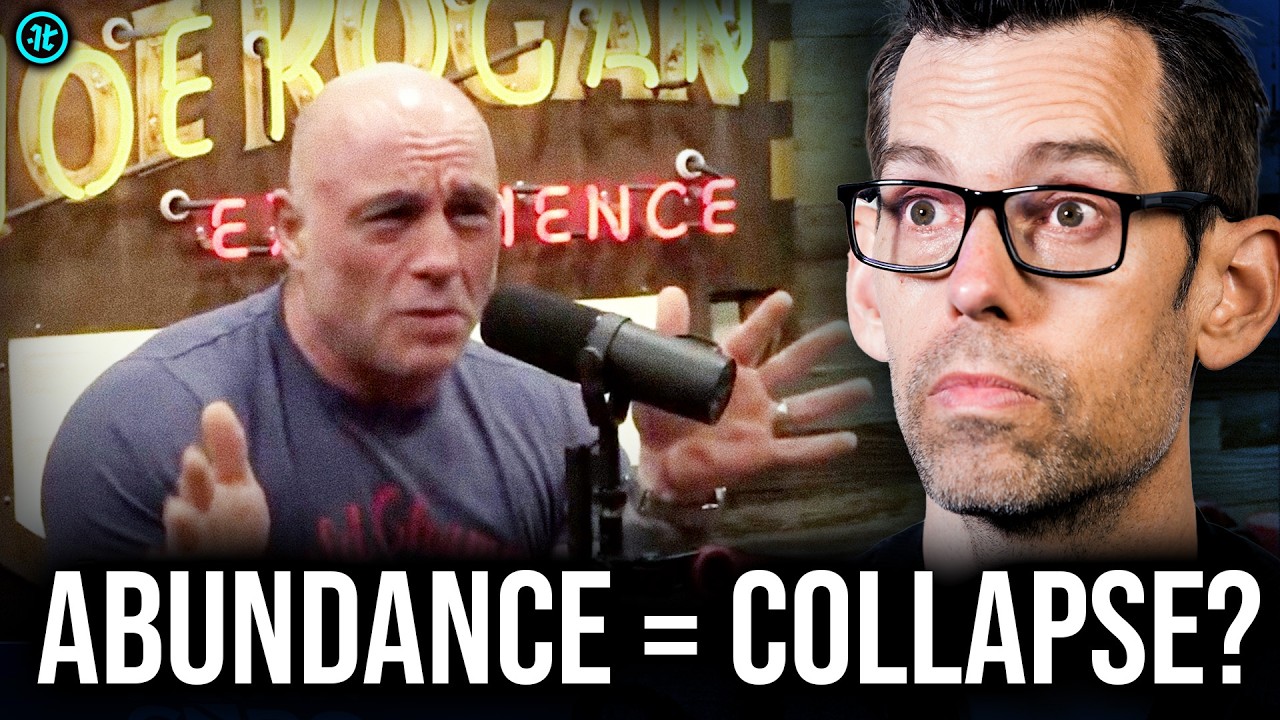
answer this question. Now, Joe Rogan,
who I think is amazing, and literally
when you do the history of podcasting,
you're going to have to put him on Mount
Rushmore. I don't think he's alone on
Mount Rushmore anymore, but man, for a
long time, it was like Mount Rushmore
was Joe Rogan. Uh, so this guy's
incredible
uh at what he does. But on this, I think
he's way the [ __ ] off. Uh, so let's play
it and then I'm going to uh give you a
breakdown of precisely how off he is and
how much it's going to matter. People
can't be this far off.
>> This is my position on work, too, cuz
everybody in their head is like, "What
happens when AI takes all the jobs?" And
I'm like, "Do you have to have a [ __ ]
job? Isn't that a human invention? Like,
why do you have to have a job? It seems
crazy that our main focus is on housing
and food and like most people are
basically just working for that. Most
people that are [snorts] most people
that are struggling check to check
basically housing and food is their
daily labor. If that's removed, wouldn't
enough people figure out what to do with
their time?
>> Yeah, I I think so. That
>> quite officially not. People would not
figure out what to do with their time.
So the thing that I think Joe is um
failing to understand is that from an
evolutionary perspective, evolution has
understood I must compel you to want to
go do work. Humans move towards pleasure
and they move away from pain. Now it
also had to restrict our use of calories
meaning we are motivated and
incentivized to go do something but to
not go do to do do too much. So we have
these competing like impulses. I want to
go work and contribute and do something
and I I want to work hard and working
hard actually feels good, but I also
want to lay on the couch and do nothing
and do bedrock as the kids would say
today. So you you have to find some way
to make those two things work. And what
ends up happening to the person who lays
in bed all the time, they end up getting
massively depressed. Why? Because
evolution needs you to get up. So
whether you actually need to get up to
create housing and food, you still have
the evolutionary impulse, bro, you
better be doing something. You better be
working hard. You better be contributing
to the group. You have an evolutionary
algorithm in your brain that will punish
you with a profound sense of depression.
If you don't do the following, if you
don't work hard to gain a set of skills,
so feel like a sense of progress in your
life. You're getting better. If you're
not doing that, you're going to be in
trouble. Uh, so you're gaining a set of
skills that allow you to make progress
towards a goal. That's what I call
honorable. Meaning that it doesn't just
help you, it helps you, but it also
helps other people because to keep you
alive long enough to have kids that have
kids, which is all that evolution cares
about, it's got to give you those
impulses. And all of us have that buried
inside of us. So now AI comes along. You
don't have to work to have a house. You
don't have to work for food. You're
going to lay in bed all day. Now, the re
because you actually have that impulse.
You have the impulse to lay in bed all
day and you now don't have a anything
that's forcing you to get out of bed
because when you're forced to get out of
bed and you've got to get your house
secured and you've got to work hard to
survive and you've got to be a part of a
group in order to make sure that you're
protected by the group for survival
purposes. When you do all of that, even
though it's hard, even though you didn't
want to get out of bed, when you do it,
you feel good. What do people always say
when they go to the gym or they work
hard and they get a reward for it? They
feel good. What does somebody think when
they work at a job that they care about
and they work hard and they see the
fruits of their labor? They feel good.
They have a sense of meaning and
purpose. Meaning and purpose are the
things that are going to protect you
from getting depressed. When AI comes
along, if it really does erode people's
meaning and purpose because there's
nothing that they must do and everything
becomes voluntary, a huge portion of
humanity is just going to opt out. Now,
the reason that Joe, I think, is
completely blind to this is he's mapping
himself and then assuming everybody is
like him, or at least the large majority
of people. And the problem is Joe Rogan
will get out of bed and ice plunge in
the morning. How many people are going
to do that? Virtually nobody. Joe Rogan,
who has a ton of money, never needs to
go put himself in physical hardship, but
he goes hunting and he puts himself out
there doing difficult things. The man
has a t-shirt that says sad face plus
deer hunting equals smiley face. So,
this is somebody that understands going
out, putting yourself in a difficult
environment, having to be quiet, having
to be focused, doing something that
required a ton of work, practice, and
discipline to get there, and now doing
it and having a relationship with
actually killing and taking something
else's life, like all of that stuff, all
of the intellectual framework that he's
built around that to make that suffering
and difficulty, which was all
discretionary. He didn't have to do any
of it. all of that intellectual
framework that he built around that to
make that a rewarding experience, he
thinks people just do by default. The
vast majority of humanity will get hit
by a bus of untold proportions. Now,
that's a pretty bold claim. How am I
making that claim? If you guys have
never heard of Mouse Utopia, then I'm
sure what I'm saying seems ungrounded.
If you know mouse utopia, then you know
that this study has been run. And when
you give a mouse colony, we can decide
if this extrapolates, but when you give
a mouse colony
all the space they could ever want, all
the resources that they could ever want,
things go horrifically
wrong. I actually think we're living
through some of early stage mouse utopia
right now. But let's take a closer look.
So shout out to the friend of the pod.
Uh this is what if alt hist ruard um
>> lynch
>> lynch thank you. Um he's a fascinating
thinker and he was the person that put
this on my radar. So check it out.
>> After learning about what I know here,
my life hasn't been the same. I think
about what I talk about in this video on
a daily basis. If you don't want to know
this, turn back now. That being said, I
know that by saying that, this is going
to make all of you watch this video. I
know this advertising tactic here is
shameless, but it doesn't stop it from
being true. To be honest, I want us all
to know about this, partly so that I can
share the weight of this and also so
that hopefully we can do something about
it. You'll understand why I say this by
the end of the video.
That only a very small percentage of the
people I talk to know about this. And
I'm already talking to people who are
much more aware, educated, and
intelligent than the general public. I
love this painting. The way it works is
that some people see an old lady, others
see a young woman. Life is like,
>> "Do you see old lady or young woman?"
>> I was going to ask you the same. I see
the young woman.
>> I see the young woman, too.
>> I can force myself to see the old lady
when you tell me that she's there. And
for people looking, uh, the necklace on
the young woman's neck is the mouth of
the old woman.
>> There it is. That helped. Okay. that
where we all inhabit the same world but
we all make out different patterns to
explain it in terms that are
comprehensible to us. My goal for what
if altist is to let people who are
looking at this painting see both images
at the same time and explain which one
of these interpretations I believe to be
the most correct. I try to share other
ways of looking at it even if I don't
agree. That's why I explain the
worldviews of each civilization and era
of history. By the end of this video,
you will start looking at the movie that
is our lives in a completely different
way. In my own personal life, this feels
like a plot twist at the end of a movie,
which changes its entire meaning.
[music]
>> All right, brace yourselves. What
happens?
>> Tune everything out for a bit and listen
to some good music. And today's sponsor,
Raycon.
>> So, just as a reminder, I am going to
let when we do these reacts videos, I'm
going to let their ads play. Uh, I want
to honor them for um us being able to
use the content that they work their ass
off to get to. Obviously, it will help
them with their advertisers. So, we're
going to let this play. Uh, and bear
with me.
>> Raycon is a quality product that I use
every day when I go on walks or just
want to jam out for a little bit.
They're half the price of the other
premium audio brands for amazing audio
quality. Raycon earbuds fit perfectly.
I'll sometimes forget I have them in.
And with 8 hours of play time and
32-hour battery life, I can use them
whenever I want.
>> Given my work, it's awesome to have high
quality earbuds that allow me to focus
on making quality content. Raycon is a
great product at a great price. And for
my viewers, Raycon is offering 15% off
your next set of earbuds. So support the
channel and click the link in the
description or go to
byracon.com/woodaltist
to get 15% off your Raycon purchase plus
free shipping.
>> I can't guarantee that code still lives
cuz this video uh is from a minute ago,
but there you have it. All right, back
>> part one, Universe 25. As a side note
before we start, I gave my word in this
poll that my next video would be about
the CIA discovering the spirit world.
I'm going to postpone that for one video
since I feel as if I need to read these
two books before I can do the topic
justice. I always have an intuitive
sense of when I can know enough about a
topic to make a video about it, and I
honestly just haven't hit it yet with
that topic, but you have my word that
it's going to be the next video coming
out after this. This video pulls on the
least source materials of almost any
video I've done. One of the recent
videos I've made is explaining modern
civilization. I pulled on 68 books as
sources, which is something like 25,000.
For this video, the main source I'm
using, although I reference many others,
which you'll see in the description, is
less than 10 pages. That being the Mouse
Utopia study itself. There's so much to
unpack in each page that it'll take me a
second to go through all the
interpretations possible. Mouse Utopia
was a study in the late 60s and early
70s in Maryland. This was the era of the
most rapid population growth ever. And
people were really worried about what
the implications for that might be. This
was the era Soilent Green was made in.
Thankfully, the 20th century has dodged
all the crises it expected to have,
whether nuclear war, overpopulation, oil
depletion, and more. I wish our society
was collectively more grateful that we
dodged so many bullets.
>> I think a big part of the reason that we
as a society struggle is things have
just been too good for too long. It is
too hard for people to um mentally
project to how difficult other eras are
when we are kids and we're growing up.
We don't realize that the world is
changing incredibly fast. We just assume
the world has always been this way.
That's why we look at our parents and
think they're crazy because we don't
realize that they were raised at a
different time in a different way. That
their parents were different, their
friends were different, the things that
mattered to the world were different.
The economic situation was different.
Everything was just different. And so
we're all products of our time, but none
of us, especially when we're young, even
have a concept of how much things change
over time.
This is the best argument for why this
won't happen. That we've had so many
crises before that just didn't occur.
The guy who ran this experiment,
Calhoun, did this thing in a bunch of
cases. The test which became famous was
universe 25. This universe was the
biggest and lasted for years. However,
all the previous experiments had similar
end results to this on a smaller scale.
What they did in Universe 25 was put
nine mice into a cage with infinite food
and no disease. It was cleaned
regularly, had no predators in a
perfectly temperate climate. These are
ideal conditions for population growth.
The test was designed to create the most
perfect optimal conditions for
increasing numbers. What happened
initially was exactly what you would
expect, that the population grew
incredibly rapidly. The population
doubled every 55 days. The mouse
population plateaued around 315 days.
>> That's crazy. The the fact that it it
blows up, nobody would question. But why
would it hit any sort of plateau given
that it's still they still have access
to resources. Uh they still have um all
the space that they need. They're not
they're not bumping up against that. The
reason that I think this kind of thing
is important to note is you're now in
the zone of there is an algorithm
running in my brain that I'm unaware of.
So it we I think would all assume well
each individual mouse or person would
just be making the decision that's
rational for them. I've fallen in love.
I want to get married. I want to have
kids. And all of a sudden you realize
actually no there's something else
running in the background that starts
making those choices when put into a
larger context they start changing. So
one thing if looking for the human
parallels here if you educate women then
birth rate falls off a cliff. Now is it
positive because women are getting
educated and they realize they have a
lot more options. Is it tied to
something else? Is it that um as a
country gets wealthier they have access
they are necessarily more liberal and
they have access to birth control and
it's the not having kids um early that
you know by accident that allows them to
then pursue other things. And so it
seems like that it's because they're
getting educated, but it's really not.
So, but that tells you that change says
there is an evolutionary algorithm at
work here that people don't understand
where the cage was designed to hold
something around 6,000. So, not even
close to total capacity. Upon that
point, birth rates went down and
stabilized. After this, things are going
to get very, very strange. The mouse
social structure started to break down
in every single level. both mouse sexes
converged. Male mice became a feminine.
They started secretreting feminine
hormones.
>> This this is how I felt looking at
what's going on with the um China buying
oil. So the war predicts, hey, this
thing is going to happen um when there's
a supply constraint, assuming that
demand is inelastic, then the price is
necessarily going to go up. It does, but
then it doesn't um rerise when the war
comes back on. So it goes up, drops with
theou, but doesn't come back up. China
stops buying even when the price is
down. And so you start seeing like wait
that this is not what is predicted by
the model. The model says that if these
guys have food and they have space then
given that we saw that early population
explosion why does it start slowing down
here? Um that's where this kind of thing
becomes very fascinating because what it
points out is your model of the world is
not yet complete and that there is a
pressure that you're not yet aware of.
And so when I was trying to identify,
okay, what's really going on in China,
you start looking for what is the
economic pressure that makes traders
believe that there's going to be a
deflationary period. So they're betting
on a lower cost of oil down. Is it just
that the war is going to end? And then
you try to square it with, okay, well,
wait a second. We've also got China not
having a buying pattern that matches the
cost. So there's a hidden force. And
when you look at mouse utopia through
what is that hidden force? Tie it back
to what Rogan was talking about. That's
my thesis is that there is a hidden
force which is evolution needs you. It
it it has to assume that there's no AI.
We didn't evolve in that world. So if
you're going to have food and shelter,
you're going to need to get out of that
comfy warm bed and go do a thing. So
there is a hidden pressure inside of all
of us that will manifest as depression
essentially just to round it. But it's
gonna it's actually, as you'll see in
Mouse Utopia, plays out in way weirder
ways. So the oversimplification is is
sort of a depressionary impulse. Um, but
you're trying to identify that hidden
pressure as you watch this. Mice who
showed no interest in mating, but would
groom themselves daily. The scientists
called these the beautiful ones. Male
mice lost any masculinity and kind of
stopped doing anything to maintain the
mouse social structure. The beautiful
ones don't really exist inside mouse
social relationships. rather their
entire lives were in what amounted to
isolation and just self-gruding.
>> The the whole idea of the beautiful ones
is very interesting. If you're looking
at this through an evolutionary lens,
evolution has all these different games
that it's running, but it only has two
levers, pleasure and pain. And so part
of the um mating strategy is you need to
create signals that a woman would pick
up on. Okay? So a guy is going to go do
those strategies. Now the problem
becomes if you are in a situation where
you have all the free time in the world
and there's nothing that is um pushing
you anymore to uh compete and try to
mate and there's that sense of like okay
I really need to get this forward
momentum going. The thing initially that
was getting you to do the things that
would attract a female become they take
up more and more time. So this is going
to be a crazy parallel to draw. Um there
is a hypothesis that the reason you
dream is that your visual system cannot
go offline for a full eight hours or
whatever while you're sleeping because
the brain is wired in such a way that
one area if it's not getting used it
immediately gets taken over by another
sense. So if you blindfold yourself you
notice that your ears begin to come
online. Now it will actually begin to
wire. The wiring will begin eating in.
It's not just that you're paying
attention to your hearing more. the
wiring of the auditory system will begin
leveraging the physical space of the
visual part of your brain. So, same idea
here. So, part of your um energy, your
focus, your attention is like, I need to
go make sure I secure housing. I need to
make sure that I'm contributing to the
group. I need to make sure that I'm
raising my family properly. Well, if AI
or anything else makes all of that go
away, then some other algorithm that's
online begins encroaching uh into that
that time, if you will. And so now your
need, I'll use that word lightly, but
your need to have an obsession, to have
a focus begins getting filled with some
[ __ ] And so now all of a sudden,
you're being one of the beautiful ones.
You're grooming yourself. You're leaning
into beauty. Um all of that stuff starts
to distort. Now, I actually want to go
back to something he said a second ago,
which very much speaks to the rise in
transgenderism that we're seeing now, I
think, which is that when you're not
having to focus on like, "Oh [ __ ] there
really are barbarians at the gate. I
really have to train these kids to be
masculine. [ __ ] it. I'm just going to be
like, you're a boy. I need you to be
tough." And so, you um inculcate them
with that thinking, with that ideology,
and now they're actually busy doing the
manly [ __ ] There's all this cultural
pressure for them to be manly. And so
now it's just they slot into that and
they go do the things that are expected
of the men. And there are very few
people that start sort of peeling off of
that and going elsewhere. There's just
too many demands both from just a pure
um intellectual way and from a yo
somebody's got to go dig that ditch
[ __ ] You were born with
testies. That's you. And so you get in
this like reinforce reinforce reinforce.
But when that breaks away because there
is in this case the robots are just
digging all the ditches and you don't
have to think about it. you don't have
to be tough and there's so much
prosperity and there are no barbarians
at the gate because we're the biggest,
strongest country in the world. And it's
like all of a sudden you start seeing
this
feminization. You have a pull towards
those things as well. And so that
interesting idea that both of those
energies live inside of one human, but
now you you get this imbalance that
evolution wasn't expecting and one
begins to take off. And you see, and
this was written about in Roman times,
that there just becomes this
effeminization of the culture. You had
similar push back in Greece. Could
really [ __ ] derail on that, but I'll
I'll leave it at that for now.
>> Greeted showed chemicals demonstrating
intense stress. The thing is that they
largely weren't in that they weren't
under too many actual external
pressures. The process of permanently
being hormonally stressed was taxing on
their bodies and thus they were unable
to really do anything else.
>> So think about that from an evolutionary
standpoint. Evolution is like, "Oh damn,
you're bedrotting. You're just grooming
yourself. You're not doing the things."
And so it's going to create this sense
of disease to get you moving again. Now,
in a world where you need to get moving,
great. It all works out perfectly. In a
world where you're like, I don't need to
do anything, so I'm just going to keep
bedrotting. It just keeps getting worse
and worse and worse. And so something
that isn't under any stress externally
is getting a stress impulse from the
internal evolutionary algorithm
>> through urine and scent. Thus, through
this, they were demonstrating their
immense inner pain and stress to the
other mice around them. Female mice
became very aggressive and very
masculine. They started raising the baby
mice incorrectly, kicking them out of
the nest too early. They became
incredibly aggressive to their young,
even attacking them. This created
generations of numb mice who were not
properly socialized. They were
completely unable to interact with the
world or socially. The female mice lost
interest in breeding and raising
families just like the males. Many
female mice started living in isolation
from the rest of the mouse community,
hiding away in far-off parts of the pen,
showing no interest in family or mating.
Calhoun liked to say that the mice
became autistic. This was in the 60s
before autism was a buzzword either. And
autism was much less common back then,
so if he said it, it really meant
something back then. They lost the
ability to interact socially. He called
this the first death or a spiritual
death. He saw that the mice had no de
viva or joy of life or reason to live.
We'll be right back to the show, but
right now let's talk about one rule when
traveling. Beef sticks go in the bag.
Plain and simple. Always airports,
[music] hotels, a day that runs long
with no food options in sight. I do not
leave that to chance. Paleo Valley beef
sticks go in my bag before I go
anywhere. I literally don't leave the
house without them. When the day goes
sideways and I need food right now, the
right choice for me is always on me. I
eat these because they're the real
thing. 100% grass-fed and grass-finished
beef, organic spices, naturally
fermented. There's no soy, no gluten, no
junk, 6 g of real protein per stick, and
they actually [music] taste incredible.
No chalky aftertaste, no weird chemical
bite, just food I'm glad that I'm able
to reach for. Most meat sticks are
garbage wrapped in a health label. Not
these. That's why they've earned a
permanent spot in my bag. Get 15% off
your entire order. Click the link in the
show notes to save right now. Nobody
ever tells you how lonely building a
business can be. Every question lands on
you. And when you don't know the answer,
especially when you're first starting,
there's no one to ask. Shopify helps you
fill that silence. I've trusted Shopify
to power our merch store for years. So,
it's an easy recommendation from me to
anyone serious about starting and
scaling an online business. Professional
templates, AI tools that get your
storefront looking credible fast. You
don't need to code. No designers
required. And when the questions start
coming up, which they will, Shopify's
built-in AI assistant, Sidekick, is
[music] ready. And when customers find
you, Shopify checkout, the best
converting checkout on the planet, make
sure that they actually buy. All you
need is the idea and then Shopify will
help you with the rest. Start your free
trial at shopify.com/impact.
[music]
All right, now let's get back to the
show. And I have a hypothesis on this.
Um, so I had a period in my life at the
basically the beginning of getting into
game development where I was working 120
hours a week. I did it for eight months.
And for the first time in my life, I was
what I would call emotionally
disregulated. And there was one week
where I didn't even want to sit on a
couch. I wanted to sit on the floor. And
I was like, I can't make this make
sense. This isn't logical. So, I'm
sitting on the floor because I don't
want to be on the couch, but I don't
know why I don't want to be on the
couch. And so, I was like, "Oh, wow. I'm
emotionally disregulated." Meaning, I
cannot make sense of my internal state.
My internal state is in such disarray
that um all of the things that I just
completely take for granted that I would
seek comfort. Um so, I'd want to sit on
a couch, that I would want to eat, that
I would eat at certain times. And so, my
hunger was all over the map. I would go
from not wanting to eat at all to being
like I'm starving. Uh sitting on the
floor like it was just thankfully
[clears throat]
I was like hold on this is so weird.
This behavior is bizarre. And so I could
fall back on I need to get into a
routine and so I need to reisolate. I
wake up at this time. I go to bed at
this time. And so after the 8-month
period I realized okay this was a failed
experiment. I just can't work this many
hours. I was getting vertigo. So, I was
having these physical like um negative
externalities where I would feel dizzy
and like I was going to fall over. I
thought I had a brain tumor at one
point. It was really crazy. And so, I
was like, "Wow, like there is just a
limit where even though there's not
necessarily an external thing that's
causing me a problem, I'm getting all
these problems from the inside. And if I
didn't have the ability to identify this
is emotional dysregulation that it is
caused by this thing. So forget that in
my case it was just working too many
hours.
>> Here it's it's caused by everything is
just going too well. It's too easy. I
don't have any meaning and purpose.
There's no hard thing that I'm focused
on. I have to go do. So you get what
starts as a specific this thing is
broken and it gets this response and it
becomes generalized. It was the same
thing that happened with my anxiety. I
never dealt with it when it was concrete
like oh I'm in a stressful situation. I
feel anxiety. That made sense. Once it
became generalized and turning left
instead of right gave me anxiety. Then I
was like we have a problem here. And if
you don't know what to do at that point,
it's like your brain is just sort of
giving up on trying to parse cause and
effect. So you're just like all over the
place. And that's I think what we're
seeing here.
>> But jumping in for a second, isn't that
what separates us from like mice in this
scenario? So where they are just kind of
now stressed and internal, so they just
peed and pooped everywhere. We would
have those friends in cells on the other
side of the world through our gaming
monitor. We would have the next door
neighbor who's email who like we would
have that ability to either one
internally diagnose it or two we have
communities of other bed rodders who we
can kind of group up together and then
I guess help undo a stress or at least
find community in our bedroddingness.
You know what I mean?
>> Yes. So to put it into um biological
language, we have a prefrontal cortex
which the mice do not. We have the
ability to assess, hey, I'm having a
problem. let me go find like-minded
people. Let me reconnect with a group.
Let me do the things that I know I need
to do.
>> And there will be some people that will
do that and it will be a scale. And so
you'll lose some people really early. I
mean, we're already losing people. The
um jobs market speaks to that. Our labor
force participation numbers are abysmal,
but still the vast majority of people
still work. It's like over 60%. So it's
like yeah we
most people are able to in the early
stages find a way to avoid some of the
you know problems that arise from this
but especially kids are super vulnerable
because their prefrontal cortex isn't
even finished developing. So now what
happens when you raise a generation
where their brain just legitimately
doesn't develop correctly because
evolution was expecting one impulse and
it didn't get it. And so now it's like
those kids are [ __ ] So the first
generation that was raised sort of with
the normal expected evolutionary
pressures, they'll be the most
resilient. But the weak ones among them
will be the first to fall. Then the
generation behind them, remember the I
forget how many generations they were
going through, but they doubled like
every 55 days or whatever. So this is
partly a generational problem where the
first generation is probably the most
resilient, second a little less, third
even less, fourth and it starts getting
like really unhinged and deranged
because and I think they cover this or
maybe they they just did with the mom
doesn't groom their pups properly. But
you start getting a breakdown of
parenting which then creates even more
problematic kids who will then be even
worse parents. And so you like get this
effect where all of the evolutionary
environmental inputs that are expected
end up not arriving. And so the brain
ends up um developing poorly. So for
instance, if you I still can't believe
this is true, but it's true. If you
don't hug and cuddle a baby, it will
die. It goes through what they call
failure to thrive. So, there's something
in the brain that says, "I can expect my
mom at a minimum to give me skin-to-skin
contact, to feed me, to nurture me, to
love me, to cuddle me." And my brain is
so expecting that that it cues its
development off that. And if it doesn't
get that, it just it it never needed to
have a workaround. And so, it just
breaks. And it it maybe the even the
better way to think of it, it just
doesn't develop. And so that kid that
was sort of a ball of mush that most
parents watch grow up and light up and
you see them sort of come online and
they like coup and want your attention
and they get it and so it's like it's
this incredible symbiotic relationship
that just never develops and so the kid
just dies
>> and that [ __ ] is crazy. So when you
think about okay we've got emotional
dysregulation there will be some that
are able to fend that off and they'll be
fine. This is why Joe Rogan is confused
cuz he's like, "Well, if everything is
easy, go force yourself to do something
hard. You work out really hard. You cold
plunge. You um go on austere hunting
trips." Yeah, obviously. But that's like
on a spectrum that's going to be way
pegged over here on the right. And so
you're going to lose a ton of people
even in generation one that aren't able
to do that. And then oh my god, the
kids.
>> He said this happened far before their
actual numbers started to collapse. Mice
live much like Andrew Tate with alpha
males keeping harums of females who
raise children. Thus, with all these
factors going on, what you're
effectively seeing was a breakdown of
the ability for mice to coordinate on a
group level or breed at any level. This
chart creates a useful breakdown of the
different kinds of mice you saw emerge
as society fell apart. You saw a group
of mice which were obsessed with social
approval. They wouldn't eat unless they
saw other mice eat. They would all
cluster together in the center of the
cage. Even though there was lots of
space on the outside, their gender roles
collapsed and they were constantly
driven by stimulation from other mice.
They basically became adrenaline junkies
through social approval. A second group
just went numb. They stopped interacting
with the society. They only went out at
night. They lost interest in interacting
with other mice socially. These mice
basically became zombies. They wandered
around like the homeless. They let
themselves get casually beaten up and
hurt by other mice as they just lost any
will to live. The third group of mice
became incredibly aggressive. They would
wander around in packs and randomly
attack and target other mice for what
they didn't really see as any reason.
They would torture and bite up other
mice for fun. They would attack any mice
that were still having children and
trying to maintain the mouse social
structure. They were sexually
hyperactive, but not for any reasons of
actual procreation. As the birth rate
collapsed, this group were really the
ones which destroyed the mouse colony,
killing any who tried to maintain social
norms or continue the species.
>> So, hey, trying to tear down social
norms, that sounds familiar. People that
want to see Western civilization
completely destroyed. Hopefully, that is
not an unfamiliar refrain. So, as I look
at the swing now to um socialism and
communism, this is exactly the kind of
thing that I think about is this is
people that have had a situation where
everything has gone so well for so long
they become overproduced elites. They
feel completely entitled and they just
have this impulse to want to burn
everything down. Um and also, by the
way, birth rates dropping through the
floor. And I am not the irony is not
lost on me that I don't have kids. Uh,
so it is um this is precisely what I see
when I look at the DSA.
>> Each of the 30 experiments, the mouse
colony completely collapsed. The mice
just stopped having children and this
crashed their numbers. The mice who did
try to keep going were killed by mobs of
evil mice. After day 1,700,
there were absolutely no mice left. A
couple outtakes before we move on to the
next section. First, I'm surprised at
how advanced the mouse social structure
was. As I read this, I'm frankly
surprised that mice of a society at all.
When you see these things scurrying
around your house, you don't really
think about them having a cultural
system with different expectations that
can experience social collapse in the
same manner we saw with the fall of Rome
or the Mayans. Authors like Joseph
Heinrich or Io Wilson talk about how
culture is fundamentally genetic and
dates back deep into our animal roots.
That's very clear to see here. Mice
aren't particularly smart. But except
for one thing, their neurological
structures aren't fundamentally that
different than ours. Except ours are
much, much larger. What we're going to
learn from Mouse Utopia, there's more.
And I definitely encourage you guys to
go watch the whole video. It is utterly
uh mind-blowing. But the core thesis
that I'm putting forward right now, and
the reason that when I saw Rogan
responding the way that he did, um I
thought, uh-oh. And by the way, shout
out, man, I wish I could remember who
sent that to me, but somebody sent me
that video on X, which I highly, highly,
highly encourage people to do. If you
want to see me react to something,
please send me the video. I don't know
if anybody has quick access to my
>> ZOS.
>> Uh, yes. [snorts] Is this the one? Yes.
Yes. So, Zegros Oscinrez_will_WIN,
shout out to you. Thank you so much for
sending this in. Um, more of that,
please. I'm always looking for um more
videos to do as reacts. So, I'm just so
grateful to people taking the time to
send that in. Okay. So, when I saw that
Rogan video, um it immediately got me
thinking about this idea that people do
not understand the biological component
of this. They do not understand that
evolution has imbued us with all of
these um deeply ingrained algorithms in
our brain that create these um pressures
on us to act and behave in certain ways.
And that when we don't do that, then
because evolution only has the pleasure
and pain principle, it uses pain. But
when we aren't forced by the realities
of I need shelter, um I need food, when
there's nothing that forces us out to
face those things to meet the challenges
that evolution is expecting us to have,
we begin getting disregulated and
everything just sort of goes haywire
because we're not getting the things
that we expect. And it it is that is
when I think about AI, that is one of
the things that I'm like, yo, if we ever
get to artificial super intelligence,
because I don't think we end up here
from just AI continuing to grow uh and
becoming a thing, but I do think we get
there with artificial super intelligence
where energy cost drops to zero and um
labor drops to zero and anybody can have
anything they want. I think at that
stage people really are gonna have to
force themselves to encounter hardship
to have structure to do things that are
all about progress in their own life
that they remain wanting to help the
group. If they don't do that we're going
to see the kind of derangement in um our
own culture that we saw in mouse utopia.
Uh and remember the reason the reason
that I think that you can extrapolate
from mouse utopia is that they have the
same kind of societal structures. They
are also um the output of evolution. And
so it's like they may not have the exact
same brain structures and stuff, though
they are similar. Um, but it's the same
forces that developed them and made them
a coherent species that can thrive in
the world are the same forces that made
us a coherent species that's
accomplished what we have. So, um, I
really think when you look at even this
moment in time, when you look at the
push towards socialism, when you
understand that socialism is driven by
resentment, um, when you think about
where AI is taking us all, you've got to
take all of this into consideration
because I think it actually explains
some of what we see today, and I think
it's certainly a worthwhile warning.
Nobody should panic or freak out. Uh but
it's a worthwhile warning that we will
need to be thoughtful about how we move
forward in adopting AI in our own lives
>> and like as we enter like the age of
abundance and things like that.
>> Yeah. That it's not going to be a free
ride. No way.
>> I was joking with some people in the
chat that you know if everybody becomes
a simp I'll take all you know I'll start
having more sex. Haha. So there were
people in that society that rose up and
became the herum. They had more women.
There were some that became more
aggressive. There were some that became
more grooming. And there were some that
became I'll call them emo. they were
bedrotting and things like that.
>> Um,
>> when we approach this age of abundance,
do you think that's where kind of like
what we were talking about earlier with
the prefrontal cortex, we'll be able to
kind of [snorts] gify or do something
that allows us to bounce off of those as
opposed to going to those segments and
kind of staying there.
>> It'll be very easy.
>> Is it only individualistic? I guess just
>> it's only individualistic is the
unfortunate answer. Otherwise, the only
other way to solve that would be
government denies you and says, "No, you
can't have those things." And good luck
with that when they're readily available
and the government is forcing you not to
do it. I don't want to live in a world
where the government is forcing me to do
a cold plunge or whatever. Like,
>> at that point, you're just somebody
else's slave. I'm not interested. So,
this is where it's at the individual
level. People have to take
responsibility for their own life and
say, "I've got to optimize my life in a
way that makes sense." Um, and
people often will ask me why I work as
hard as I work now when I, you know,
I've made just absolutely ton of money
and I obviously never need to work
again. And I think people were very
surprised that I left Quest on a Monday
and started impact theory literally the
next day on Tuesday. And I said, "No,
no, no. I learned a very long time ago
that meaning and purpose is the only
thing that will give you what I'll call
fulfillment, which is the only like
psycholog it's a combination of a
psychological and emotional state that
can survive even grief that's positive.
And so I was like, I must pursue meaning
and purpose all the time. And so that's
why I did it. Um, and so I'll
people that have a um, lucky draw on
self-discipline, self-awareness, and
stuff like that, they're going to be
fine. But there's a lot of people for
whom like they're really going to have
to start making this a conscious thing.
It isn't going to come easily to them.
Um, and if they don't do it, then
they're going to spiral. And that's why
I think that there's four paths that
people will take as we go into the age
of abundance. And some people are going
to become the new Amish. So, um, that
might be Rogan where it's like, okay,
I'm just going to go do hard things all
the time. I don't interface with AI,
period, full stop, end of story, and
they revert to technology that's
something like the 1990s. Um, then there
are going to be people who just numb the
[ __ ] out and they bedrock and they do
drugs and that's that. There going to be
people that want to play life on hard
mode. They're literally going to go to
the moon or to Mars. And it's it's like
to me that one is always like life
really is a survival crafting game, an
open world survival crafting game where
you need to go get resources to do the
things you want to do. And you be
self-directed and it's like what do you
want to build? What do you want to
create? You can do it, but you've got to
go get the resources in order to be able
to do it. That really is life. Those
games trade on the dopamine loops that
evolution gave us. It's why I think it's
ultimately the perfect uh game type
anyway. And so the people going to Mars
and the moon, they're saying I want to
start a new uh save file on like hard
mode. And so send me to Mars. I don't
want to be in the middle of all the
abundance and choosing to do hard
things. I literally want to be in a
place where it's just [ __ ] hard. And
you've got to tame Mars. Like that's
going to be some hard [ __ ] And then the
fourth group are the people that are
like,"I want to maximize my creative
experiences and my creative output, but
in a way that is just absolutely
drenched in meaning and purpose." And
those are the people like myself that
will live in virtual worlds, but where
those virtual worlds have goals,
difficult things you're trying to
achieve, that you're doing even if it's
with AI characters, but that are so
believable that you feel a true sense of
kinship and connection. And there you'll
be able to build and create in ways that
are completely unbound by um physics.
And so, but I've tried and I'm open,
man, if there's like a fifth or sixth
way. But those feel like they're the
blunt force trauma. Obviously, people
move back and forth between them and
it's like, oh, I'm going to take a a
weekend and I'm going to go [ __ ] do
drugs and just space out. Sure. But I'm
saying those will be sort of the four
bands of people trying to deal with the
evolutionary realities of how their
brain is wired. I have to ask you um if
somebody's struggling to find meaning
and purpose in their life, what are some
tips or advice you would give them?
>> Well, the first thing is you have to
know what your goal is. And your goal
needs to be in alignment with evolution.
So evolution wants you to work really
hard. Like everything that I'm about to
give you as a recipe, each beat is a
non-negotiable because of evolution.
It's going to sound like moralizing, but
I'm literally just trying to map what
the average human brain has running. um
when you're sort of in the default mode
>> and that's going to be you have to work
really hard
>> which is why I always rebel against
people that want a three-day week. They
want it to get easier and easier and
easier. You'll derange. So work really
hard to gain a set of skills
>> that allow you to make progress not
necessarily achieve but make progress
towards a goal that helps you and
others.
>> Each one of those beats is important. If
you do something only for others, you
neglect yourself, you're going to have a
problem. If you only do something for
yourself and neglect others, you're
going to have a problem. If things come
easily, you're going to have a problem.
If you're deploying your skills, but
you're not getting any better, you're
going to have a problem. Like, you need
to make progress. You need to be making
yourself better. Like, part of why I
think people really have a hard time at
the end of their life is as you get
older, it becomes just physically and
intellectually more difficult to gain
skills, to make progress, to actually
meaningfully contribute. And so, you
start getting pushed to the margins.
Like they say the first death a man
feels is when a woman looks at him and
considers him harmless. And that that
really resonates. Like I get it. And um
you want to feel uh physically potent,
sexually potent, like you want to
matter, like people are going to need to
contend with you and your ideas. Um that
you're a contributor, that the world is
different and better because of your
presence. Now, by the way, if you can't
make it different and better, people
will make it different and worse. Uh
there's that old adage that says um uh
if you shun a child uh from the village,
if you shun a child, they will burn the
village down merely to feel its warmth.
>> And I thought, damn. Uh so that all
feels true. If you like this
conversation, check out this episode to
learn more. This guy's about to destroy
everything you think you know about
investing in this economy. Let's take a
look.
>> Advice do you give for the average
person that's looking to invest their
salary or their wages? don't own US
stocks. That's a simple strategy that
you can act on.