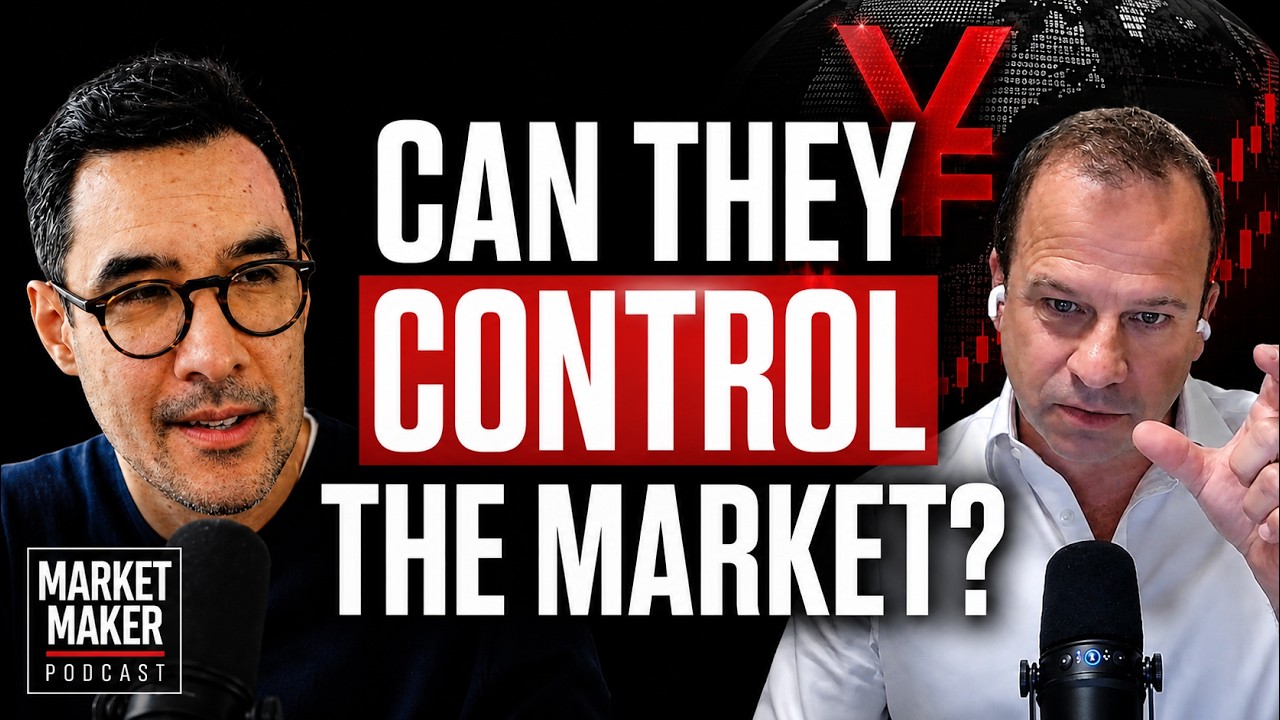
Can Governments Really Control Financial Markets? | FX Intervention Explained (JPY, CHF, USD)
Watch on YouTubeVideo summary
The video explores the complex reality that global financial markets are not solely driven by free supply and demand but are frequently influenced by direct government intervention, as illustrated by recent actions in Japan and historical events in Switzerland. In Japan, the significant weakening of the Yen against the US Dollar, exacerbated by a "carry trade" where investors borrow low-interest yen to buy higher-yielding assets, prompted the Japanese government to execute a record $96 billion intervention to stabilize the currency. This move temporarily shifted the exchange rate from 160 down to 156, yet experts argue it merely addressed the symptom rather than the underlying disease of interest rate differentials and fiscal pressures. Similarly, US Treasury Secretary Scott Bessent attempted to cap bond yields through unprecedented buybacks, signaling confidence while acknowledging the difficulty of altering natural market equilibrium without addressing fundamental economic issues.
Historical context is provided through Switzerland's dramatic 2015 decision by the Swiss National Bank to abruptly remove the Euro/Swiss Franc peg, causing the currency to surge and triggering massive market chaos that led to broker bankruptcies and significant losses for some traders. This event highlights how sudden policy shifts can create "black swan" scenarios where liquidity evaporates instantly, contrasting with the current US environment where fixed-rate mortgages and corporate debt provide a buffer against systemic collapse. While artificial support mechanisms like buying currencies or bonds can offer temporary relief, they are often unsustainable if the core economic fundamentals, such as high national debt levels and persistent inflation concerns, remain unaddressed. The sheer size of markets like US Treasuries makes it challenging for even government officials to move prices significantly without massive firepower, suggesting that interventions are ultimately limited in their ability to override persistent market forces.
Looking ahead, the stability of these markets hinges on upcoming critical meetings for the Federal Reserve and the Bank of Japan, alongside reduced liquidity during Japanese holidays which could allow for more aggressive but risky interventions. A key vulnerability remains the need for governments to roll over massive debt backlogs, such as the US's $10 trillion obligation, especially if wage growth stalls while inflation stays high, a scenario that could drag middle-income consumers into distress and trigger a recession despite productivity gains from the AI boom. The consensus is that long-term financial stability cannot be achieved through temporary fixes alone; instead, it requires aligning monetary policy with fiscal deficits to ensure that underlying economic health supports market equilibrium without relying on unsustainable state support.
Read the full video transcript
Welcome back to the Market Maker podcast
and really pleased to have the one and
only Pierers Curran back on the show.
How are you, Pierers?
>> I'm strong. Yeah. Uh I am refreshed. Uh
kind of a bit on holiday. Uh you know
what it's like when you get back from
holiday and then it's just bang. Uh you
know, straight back into it. So just
trying to catch up. But yeah, good to
get good to get out of the country
actually. Bit of time in Italy. Um, and
yeah, just trying to keep tabs. You
know, when you're on holiday, obviously
you're still kind of reading your FT and
then whatever. So, still trying to
obviously keep on top of what's going on
out there. Mark, it's just really
interesting. Um, and yeah, looking
forward to talking markets. Um, it's
been a sort of Anthony Steven takeover
for the last couple of weeks. We're
going to we're going to bump out the
banking stuff and uh back to back to the
really interesting uh content which is
markets. So yeah, looking forward to the
conversation.
>> Yeah. And anyone new to the show, the
market maker, we do a regular episodes,
two a week typically, one which is more
M&A deals, uh the IPO market, so big
listings, things of that nature. We
recently did the last episode with
Stephen and I about the Stripe takeover
of Open Routter. So go back and check
that one out if that's more of your, you
know, persuasion. However, this show
with peers is always about global
markets. And today we're going to talk
about one of the biggest illusions in
finance. And that is the idea, of
course, that we're all led to believe,
at least in the Western markets, that
global markets are purely driven by free
market, baby, supply and demand. But the
reality is when asset prices threaten
economic stability, central banks and
finance ministers step in and
intervention is really the main word and
topic we are going to discuss today.
>> Absolutely. And what's going on right
now if you've been uh keeping up to date
then authorities are basically trying to
fire every weapon in their arsenal to
try and manipulate markets. And so
basically Tokyo for example, and we're
going to talk a lot about the yen. The
yen weakness is really key. I've talked
about it on the podcast a few times in
recent months to flag that, you know,
this is going to be a really important
thing. Well, it it's becoming an
important thing. Tokyo dropped a record
$96 billion.
When I say Tokyo, I mean the government
of Japan basically directly intervened
into the FX market um by buying yen.
They bought $96 billion to try and prop
up the value of their own currency.
Bessant, that's the US Treasury
Secretary. He's even stepping in to that
same FX market alongside them. Um and
and you know, you got things like
Japan's 10-year bond yields hitting
levels not seen since 1996. We've got
some pretty alarming kind of price
points being reached in various
different markets, but definitely
currencies and bond yields that that's
where it's at. And so, yeah, they're
trying to intervene. Um, we're going to
discuss today.
Should they even bother trying? Is it
effective or not?
>> Yeah. And then over in Washington, as
you said, Bessent doubling down as well
here. So, not just a collaboration with
Japan and the FX market, but also on the
long long end bond buybacks to try and
cap US Treasury yields while the Fed
signals interest rates aren't done
rising. So, today, yeah, very much going
to do a bit of a deep dive on this idea
of intervention. And we'll also not only
break down Tokyo and what's going on in
Japan, but we'll dive into the classic
historical lesson of the 2015 Swiss
Frank collapse and bit of a spoiler.
That was our CEO Will Deucy's greatest
ever trading single day hole that he
made
>> on that one day, which actually was on
his birthday.
>> That's right. Little birthday.
>> Well, you were there with him side by
side on that fateful day and I was the
voice covering that. So, we'll get to
that story in a little bit. Um, but
perhaps then let's let's get into this
and start with Japan, as you said, which
is a topical uh talking point at the
moment.
>> Yeah. So, I mean,
look, the yen is really weak. If you
don't look at FX markets very much,
then, well, maybe you should start a bit
broader. If you don't look at FX markets
very much, well, then basically the
dollar's king. I'm I'm talking about
trading volumes. So, actually, I think
I'm right in saying it's still like
something like 85% of global FX trading
volume has the dollar on one side.
Remember, when you're doing an FX
transaction, of course, you need two
currencies. You're swapping one for the
other. You're selling one currency,
you're buying the other, and the rate
you pay for that conversion is obviously
what we call the exchange rate. Okay? So
we often talk about currencies being
expensive or weak, but that that's
relative to other currencies, right? So
the yen is now very weak. And if you
don't know what the rate of the yen is,
well, shame on you. Uh but it's been
banging up against the what we call the
160 handle for the whole year, right? So
that's 160 yen gets you $1. All right?
Now, the yen has been weakening. So when
that exchange rate goes up, that's the
yen weakening and the dollar
strengthening. And that exchange rate
has been going up and it's been going up
and up and up. And if you want to go all
the way back, it's been going up really
since postcoid.
All right. And it's gone actually if you
go back to wow, if you go back to the
end of 2020, it was trading at 103.
Now it's at yeah it briefly got above
160. why we're talking about it today.
It's had a big move overnight. That's
the yen strengthening, meaning the
exchange rate's gone back down. Okay,
we're currently trading at 156, but at
its worst point, you know, in this this
kind of general trend of yen weakness,
its worst point last week, uh, it got to
1. Yeah, just over 160. 160.37. Right.
So, weak yen, weak yen, weak yen, weak
yen, bang, big bout of yen strength
overnight. All right. And we've gone
down. And actually we're down at levels.
It's gone from 1. Yeah, as I said, 160
down to 156. We're testing a really key
technical level now after this overnight
strength. And that level was the May low
for the exchange rate around this sort
of 15650 or sorry 15. Yeah, 15650
basically is a key area. So it'll be
really interesting to see if it breaks
that level and allows more yen strength
or like every other time
this bout of yen strength driven by you
know external market forces as in the
government stepping in. We'll see
whether it's temporary and the longer
term trend of yen weakness continues. So
I guess let you know I I guess what's
important here is we want to talk
specifically about the intervention and
why and you know is it working but I
think before we get into that why is the
yen weak and who cares you know what
what difference does that make to anyone
and you know why is this important so
why is the yen weak well the yen has
been generally so you know the the kind
of funding currency in what we call the
carry trade
Okay. So, there's and this has been
going on. The Japanese had a
financial crisis in the '9s. They had
their bank, they had their great
financial crisis in the 1990s before
really the rest of the world had theirs
in ' 08 and '09. Um, but Japan's
interest rates have been at zero for
like 30 years. Inflation, they've had
zero inflation. So, basically, their
interest rates relative to the rest of
the world have generally been very low.
Okay. Now, postcoid, we've had this
inflation explosion and everyone's
hiking rates, including the Japanese,
but the Japanese have been hiking at a
slower rate from a much much lower base.
So, what's important is to look at the
yield differential, right? The interest
rate differential. So, right now, the
Bank of Japan have interest rates at 1%.
And they've been hiking and hiking, but
only got up to 1%, right? Um, when you
go and look at a 2-year Treasury yield,
that's at 4.3%. So, we're looking at the
differential between the two. So, what
traders will do, they will borrow money
where it's cheap to borrow. Where is it
cheap, where interest rates are
relatively low. So, you go and get your
yen, you borrow money in yen. You then
take that yen, you convert it to another
currency and buy a higher yielding
asset. For example, let's convert our
yen to dollars and let's buy US
treasuries where we might yield 4.3% on
a 2-year when we're paying 1% for our
loan. I
>> I just think they remember during 2008
there was when all of the public was
getting very annoyed with the city for
the risks that they had taken on the
subprime crisis. And I remember, you
know what the traders were like back in
the day? There was this one guy and he
all he traded was Aussie yen,
>> right?
>> And to make your point, I think the gap
or the differential at the time was like
zero to 7% or something like that.
>> And he remember him I remember him
driving around in his
>> uh super car with the registration
plate, the Aussie yen,
which didn't make a lot of people happy
at that time for obvious reason.
>> Was a name for people like him. Um,
yeah, but this is it, right? It's it's
it's
this kind of arbitrage. It's free. It's
free money in inverted commas, right? If
you can borrow cheap, convert to another
currency and buy something that yields a
lot higher, then it's free money. But
you, you know, and it's been such a huge
trade for the financial industry, right?
It's a really crowded trade. One of the
big risks down the line in the future is
this trade unwinds
where everyone suddenly panics and like
h right let's all get out at the same
time because people might start dumping
US treasuries
converting their dollars back to yen and
then paying their yen loan back right
and that's going to have all sorts of
kind of knock-on chaotic effects right
across the kind of global system so
that's not happening right this carry
trade is very much still on as I've the
yield differential is still large. Also,
we we look at something like real yields
whereas actually you take the yield of a
of a 10-year bond minus the rate of
inflation and actually that's your real
yield. So it's not just what's the
differential between the yields like for
light. You then got to factor in
inflation. And whilst Japan have now got
some inflation finally for the first
time in like three decades, their
inflation rates are well so their
inflation right now is 1.9%.
versus the US which is 3.4.
So not only are the yield differentials
still quite decent, the real yield
differential is even bigger because
inflation in Japan's lower than in the
US, right? So it's still nice. this
carry trade thing still there. Um the
problem is you know um if it unwinds
right so is it going to unwind? We'll
see. Now what you know why else is this
currency um weak? So let's talk about
the Japanese sort of domestic situation.
And remember
if your currency is really weak, this is
great news for a certain section of your
economy.
those companies that export
because they're selling goods in the US
for example in dollars they then convert
that dollars back to yen and they're
basically getting more yen their
revenues going up as the currency
weakens great for them the problem is
it's bad for everyone else so it's bad
for imports your imports get more
expensive the problem Japan have they
have no natural resources when it comes
to things like energy they got to import
all their oil so Think about what's gone
on with oil prices this year. It's like
a double whammy. Oil prices have spiked
in dollars whilst the yen's weakening.
So for them, the oil price has just gone
even more crazy to the upside. Super
expensive. Obviously, that's a real drag
on the economy at large, on the
government's ability to kind of fund
that energy agenda and so on, right? So
that's obviously really bad. It's also
it is inflationary. So if your currency
weakens, well then imports get more
expensive, which feeds into higher
inflation, which feeds into the need for
the central bank to potentially hike
rates to contain that inflation.
Problem being, domestically, Japan have
a ridiculous crazy amount of debt. So
we're getting into the realms of debt
sustainability concerns with Japan. Like
we are though with everyone to be fair,
it's not just Japan, right? We're
worried about the US debt
sustainability. We're worried about the
UK. We're particularly worried about
countries like France at the moment with
regards to their debt sustainability.
This is one reason why generally bond
yields have been climbing. Um top of all
of that, we've had a change of
leadership in Japan and there's a new
prime minister and her name is Taki and
she's come in with a really big bold
stimulative spending agenda. Okay, not
just spending, she also wants to help
out on the tax side. She's just put
through a really big kind of food uh
consumption tax rate cut. They're going
to cut the rate of consumption tax on
food from 8% down to 1%. Because the
other big issue, you know, from a
government point of view is the cost of
living crisis. So, she's trying to help
with that. Let's cut tax on food, but of
course that's great on one hand, but on
the other hand, that means less revenue
for the government whilst they want to
spend a whole ton of more money. So they
got to borrow more, right? So it just
feeds into the debt sustainability
concerns. So you've got all of that
going on in Japan whilst you got the big
carry trade and the yield differentials
kind of still in play. Can I ask well
that often over the years I've read
press culturally it seems like in the
Far East there's a lot more uh it's kind
of more normalized for retail
participation to be quite proactive in
the marketplace. You always see these
these pictures of like Japan and Hong
Kong where there's these like grandmarss
in their retail trading accounts just
almost day trading. But presumably if
I'm sat there and looking at a global
investment picture even as a retail
punter.
>> Yeah.
>> And you look at the AI narrative and
that's all concentrated really in the US
and the US stock market despite concerns
on AI bubble or the amount of debt and
interest rates higher for longer. We're
at record highs pretty much. So is there
also an FX impact where you've got
domestic people looking to buy US
orientated stock?
>> Exactly. Yeah. retail basically domestic
savers in in Japan are short their own
currency basically retail net purchases
of overseas equities you know through
things like it doesn't have to be a
specific company just buy an investment
trust and that investment trust is
invested in an international kind of
portfolio of stocks right that's running
at near a decade high the value of that
retail net purchases of overseas
equities is running up at like 9.4
trillion yen at the moment. So yes, the
domestic players are also helping to
force this currency lower because
they're ultimately selling yen to buy
these international stocks, right? You
can't buy SpaceX shares
using yen. That's the thing. Trading
internationally, there's always an FX
transaction first. To buy SpaceX, that's
denominated in US dollars. So you got to
take yen, do a FX conversion, sell yen,
driving it down, buy US dollars, driving
it up, right? Then you can buy your
SpaceX shares. So that's yeah, a really
another key factor in all of this. It's
like the perfect storm. All of these
very different mechanics are kind of all
coming together right now and all
forcing the yen lower. And it's got to
this point of 1.6, six, which is a
really kind of psychological kind of key
level and you know it's levels yeah we
haven't basically seen for for many many
years and that's why the government's
worried about it.
>> Yeah. So that brings us to the point
then of the intervention you mentioned
there at the top of the show the
Japanese authorities spent a record 15.4
trillion yen that equates to around 96.4
4 billion US dollars to to prop up the
yen. We also saw US Treasury Secretary
Scott Bessant took the unprecedented
step of joining in. Um so yeah, this is
quite rare. It's the first I think the
stat was the first joint US Japan yen
support to support that move since 1998.
>> Yeah, that's right. I mean, this is how
incredibly like all the way through
things like the great financial crisis
and COVID and yeah, nothing. There was
no interventions. Yeah. 1998 was the
last the last time. Um, but look what
happened overnight again. And this is
this definitely isn't the first
intervention this year, right? There's
been multiple but so they've spent like
in other another load of trillion yen
going into the market and they they have
managed to to move the the needle
marginally right so it was at 160 it's
now 156 just rounding okay so it's gone
400 pips you know how do you move a
market well in the end you know like the
kind of market micro structure you know
when you step into a if a big buyer
comes into the market well then you
actually have a market impact
and force the market higher which is
what happened right so I should say
lower here right because ultimately
they're they're kind of selling dollars
and buying yen so they're kind of
selling on if we talk about the exchange
rate 160 they've moved it lower they
moved it down to 156 by selling and
forcing it down right but this is of
course it's an unnatural market
participant
you know this isn't a market participant
that's swapping currency because they
operate a business like I don't know
Sony that's a a Japanese domestic
company generating international
revenues and changing FX. It's not a a
hedge fund who's making a bet on
directionally where this exchange rate
is going to go. It's not a constant
market participant. This is a a very
unusual, you know, very temporary
sporadic. It's not oneoff because
they've done it multiple times, but it's
not far off a one one time and done. And
so perhaps this is one of the reasons
why these market impacts, you know,
we'll get on to in a bit more detail,
but perhaps don't work so well.
>> Yeah. The the the phrase that comes to
mind that I think people always say here
is the FS intervention treats the
symptom, not the cause. What is it they
mean when they say that phrase?
>> Yeah. Well, the I mean the the symptom
is, oh my god, the yen's too weak.
Quick, let's do something about it.
Okay, let's force the FX market and make
it change. The the disease is all of
those economic
factors that I've just described, right?
It's the yield differential, it's the
domestic situation, that's the disease.
So that's why the yen has been trending
has had a weakening trend
for six years.
All of those underlying factors unless
you cure the disease.
Well then why wouldn't the yen just
continue to weaken? You get these
temporary banks where this massive giant
player, the government, steps in and
tries to make a difference, but but then
they step straight out again. And so
what are you going to do if you're a
hedge fund? Yeah, I mean I was going to
say to that point then do I not just run
some sort of mean reversion strategy and
I intervene and I just go okay great
I've just got another entry point to
just
>> go long dollar yen again
>> and that's what's been happening. So
whilst you got this blip down to 156 if
it's going to be a repeat of all the
other times we're now going to see it
grind back up to 160 and perhaps pick up
on that that upward trend that's been
ongoing for years. And presumably then
this is when traders
it's almost like a game of poker where
one of the things here is that
mechanically it makes sense, right? The
government can protect the hold the line
but you can only hold the line as long
as you've got reserves, right?
>> Yeah.
>> And so so the the hedge fund kind of
knows that
>> to that point. So from a timing
perspective, there's only so much the
government can do. And we'll come to the
Swiss story in in due course, but that
was probably the most obvious one.
>> Yeah. But it's not just you can do other
things, right? It's not just actually
directly stepping into the market,
having a direct market impact and
changing the exchange rate. You can do
other things which is like talk and
threaten. And actually this is where
Bessant because what we've had over
we've had the G20 there's been a G20
finance ministers meeting over the last
you know earlier this week right so
you've got you've had all these hot
shots you know Bessant and and even War
right they're there but all you know
you've got the central bankers and the
finance ministers from all over the
world from the 20 largest economies I
should say are convening and so
obviously they're talking and like
Bessant's obviously talking to the
Japanese finance minister and they're
trying to figure out what the hell are
we going to do here. It's not working
yet. It's the yen's still weakening.
It's a big problem. So, Bessant came out
and made some comments to try and make a
difference. And he said, and I quote, "I
can't affect the natural equilibrium of
the markets." He means, "But what I can
do is send a signal." and he said, "I
have information that the market doesn't
have, and it's my and it's my belief and
it's my belief the Japanese government
and the Bank of Japan will do the things
that will lead to a stronger yen."
>> That is the most unsophisticated forward
guidance I've ever heard in my career in
20 years.
>> Yeah, it's so bad, isn't it? I mean,
it's like school boy stuff. But um but
what he's trying to do well I mean this
was a couple of days ago that quote and
right now we did have intervention
overnight. All right. And we are getting
the Bank of Japan governor UEA. He is
trying to be more hawkish. Chances of
interest rate hikes in from Japan have
gone up and actually we're now pricing
50 basis points of hikes between now and
the end of the year which is ironically
or not ironically unco coincidentally
perhaps is now the same amount of hikes
that we're expecting from the Fed. So
there's no differential anymore. We're
not expecting the differential to widen.
Remember, it's that widening
differential that makes the yen weaken
more. So, at least they're trying to
say, "Well, at least it's not going to
widen." I mean, they'd have to do a lot
more hiking in Japan to make it narrow.
But you can kind of see what they're
trying to do.
>> Yeah. I actually don't think Besset is
so so silly here. I think he's not
speaking to the market at all. I think
he's just speaking directly to the Bank
of Japan's governor and
>> So, I think he's just basically bullying
them.
>> It's true. to take action.
>> If you're saying it out loud, they've
kind of got to do it. Otherwise, the
markets will punish them.
>> And that's just the the seat that the US
have, which is the power of influence,
as you said, is the the dominant pair of
>> That's the It's so interesting in the
US, you know, Bessant and Walsh are both
ex-hedge fund traders
and together trading together.
So you got these two exhedge fund
traders now in the two top seats in the
US. So it's just kind of interesting to
see. But yeah, Besson obviously showing
his market knowledge and how it all
works, I would say. Um but yeah, we're
coming up. I guess there's one thing to
say and why this might get even more
topical. We got a little bit of a
holiday approaching in Japan. Um
actually, can you tell me what week that
is? But they call it the silver week
holidays in Japan. When you get a
national holiday, one thing means that
you know trading floors empty out which
just means market participants kind of
go away on holiday. It means then we get
thinner order books. There's less volume
on the order books of markets which
means it's more illquid and more
volatile. So this is where markets can
be quite vulnerable. So sudden big giant
swings. Um,
>> funny funny you say that cuz so so just
as dates that's happening uh 19th of
September to the 23rd is the five full
five day silver week in Japan that's
happening. I remember when I used to run
my old desk doing the market
surveillance and obviously as you know
being the head of the desk I'd have some
time off over Christmas and New Year's
and be one of the only slots and the
reason why was because it would be
deathly quiet. Nothing would happen at
all in that period. But the one thing
that was always a tail risk that could
just flip the whole thing on its head
was actually Japan used to intervene.
Historically, there'd be a pattern
during the downtime,
>> right?
>> I'm assuming the strategy there on their
side is, well, look, if it's thin,
illquid market and we go in with some
huge firepower instead of moving it, as
you said, in dollar yen from 160 to 156,
perhaps we can bump it down to 150.
>> Exactly. Yep.
>> And just get more bang for your buck
because of the market conditions.
>> That's right. So yeah, if you're in the
no as a trader, then you're thinking
about that week that's coming in like
two weeks time and there's a real
genuine sort of timing risk that you may
well get more intervention from from the
Japanese. So yeah, do you want to do you
want to buy this dip that's happened
overnight? Maybe. But yeah, you just got
to think about that holiday week that's
approaching and be careful.
>> So let let's talk a little bit about the
the Swiss situation. So let me take you
back uh a few few years now. This was
January 15th of 2015, the Swiss National
Bank event. Perhaps you could give some
context when you were trading in and
around that time period of what was
going on more broadly in the European
sort of debt scene at that time as to
position why they were doing what they
were doing.
>> So the Euro zone debt crisis kicked off
in 2010. It was a kind of kind of the
the side effect or the one of the
impacts of the financial crisis. So we
had the Euro zone debt crisis, Greece
defaulting and all the rest of it,
right? That spilled into 2011,
2012, right? So Euro the Eurozone
banking system was really vulnerable.
The Eurozone economy was under a lot of
negative pressure. Switzerland isn't in
the Euro zone for those who aren't aware
of their European geography. In fact,
it's not even in the EU, right? However,
it's surrounded by it's basically
landlocked by the Euro zone. Okay? So,
geographically, even though it's not in
that, you know, economic club, it's
entirely surrounded by it. So, from an
export point of view, they're hugely
dependent on exports going, you know,
across their borders to countries that,
you know, are immediately surrounding
them. That's that's the kind of
backdrop. So the Swiss economy was doing
way way way way much you know better
than the Euro zone at that point because
of this Euro zone banking crisis. Okay.
As we went along 2014
um you know the euro was weakening and
weakening and weakening against the
Swiss Frank. Okay. So this just was
really hurting Swiss exports
because if you're exporting if you're a
Swiss company you're selling stuff in
France in euros but the euro is
weakening well then you're that directly
impacts your revenue when you convert it
back to Swiss Franks you're getting less
right so it was really really causing a
lot of problem and it actually got to
the point where you started to get Swiss
people and I knew some like living in
Geneva they would go and do their weekly
grocery shop across the border in France
because it's like a 40-minute drive.
I'll go to France. I'll do my weekly
shop in euros and I'll come back. It got
so extreme that it was impacting
internal consumption. Never mind. Bad
news for exporters, right? So, the Swiss
stepped in and said, "Enough. We can't
have this anymore. We're going to peg
the Euro Swiss Frank at 1.2."
Okay? And actually their comment at the
time was we will use unlimited amounts
of money to make that happen. So you
think about that unlimited. And back to
your point earlier, you know what do you
do as a trader here? Can they hold that?
Can they permanently intervene like
this? How much money have they got?
Well, of course in theory a central bank
has unlimited amounts of money. They can
just print new money, right? In theory.
Obviously, in the end, that's not
sustainable because print too much and
you get stuff crazy stuff like
hyperinflation. Go and ask the Germans
um in the Highark Republic in the 1920s,
for example. But this is this is what
they did, right? 1.2. And for a time, it
worked.
And actually, that time being I was
looking at a longer term chart this
morning. This was basically through from
kind of 2011 through till the fateful
day at the start of 2015. It worked. It
worked for about three years and they
didn't spend too much money on that to
start with
>> and just the threat was strong enough
that traders believed it
>> and the threat not only was strong
enough, it had validity because I was
just looking up. Do you remember the
famous phrase from Mario Draggy?
>> Whatever it takes.
>> Right? That was the tipping point that
saved the Euro zone debt crisis
>> because it was the belief that the
bazooka as it was called at the time
bazooka.
>> Yeah. That the the central bank in
Europe would buy un unlimited again that
word sovereign bonds to bail out
whomever basically it's too big to fail
we'll do whatever it takes. And then
that was the tipping point wasn't it at
the time and that was in
>> summer of 2012.
>> 2012. Yeah. August 2012. Absolutely.
I'll do whatever it takes. So, look, it
worked for a few years. The problem was
that the it was the symptom they were
solving. The disease
was ongoing and the disease being that
Euro zone debt crisis, the economic
problems, and actually it's all all fed
through to deflation.
Inflation dropped negative in the Euro
zone as we went into back end of 2014.
Okay, deflation means like like that's
even more weakening for your econ your
currency. So it just piled more and more
pressure on euro weakness to the point
where
traders started to think there's no way
the Swiss can hold this line and they
took it to 1.2 and they were trying to
get it below 1.2 2 and the Swiss were
having to step in with money and try and
prop it up. And the like final quarter
of 2024, they threw the kitchen sink at
this, the Swiss National Bank. They
bought hundreds of billions of euros.
Their reserves blew past 85% of Swiss
GDP
and they were trying to stop the
juggernaut, which is market forces
saying this can't work. Deflation, Euro
zone in crisis, it may collapse.
and they reached their
breaking point and they said, "Okay,
we've tried. We cannot prop this up
anymore."
>> Yeah. Expensive.
>> I think if you can think of it as a
price pattern, like think of a almost
like a a flag if you like. And it's like
the interventions even though they're of
the same magnitude in nominal terms, the
bounce gets smaller and smaller and gets
reversed faster and faster and it gets
more narrow. It's like tapping on some
ice. And every tap the floor gets a
little weaker.
>> Yeah.
>> Until that moment arrives.
>> And Yeah.
>> Well, yeah. And the moment was uh Will
Dooy's birthday. Uh he won't mind me
revealing January the 15th uh 2015,
10:30 a.m. to be exact. And the Swiss
National Bank abruptly announced, "We're
pulling our floor. We are no longer
going to be trying to prop this currency
exchange rate at 1.2. We're out.
What happened? Absolute carnage. And the
exchange rate dropped from 1.2
to 0.85
in seconds.
And the liquidity in the market that
means all the orders and it just
vanished. Suddenly the market wasn't
there. uh this thing just I cannot
describe it's impossible to describe in
words the magnitude of this move in in
such a short time frame to the point
where the market closed because you have
these mechanisms in markets where you
have limits to try and control the chaos
and liquidity and if your limit down and
it depends on the market as to what the
percentage change might be. So it could
be like 10%. If the market drops 10% or
goes up 10%. In a short time frame
within an intraday period, they close it
just in case the whole thing breaks and
they say, "All right, everyone calm
down. We're closing it. You can't trade
now." Well, Will shorted this currency
off the news. Shorted at like I think he
got in at I think I remember the entry
price was like 1.185
or something. So it was falling but he
he got it. Then the market closed and
then the problem with that is where's it
going to open?
>> Right. So I remember at the time because
I was on the other side of this on the
desk trying to cover it in real time and
you were getting noises that Yeah. It's
down at 0.85.
>> Yeah, that's right. So So this is it,
right? He was locked out of the market.
He couldn't trade. And so then you're
vulnerable. Where does it open? What
happens if it opens back above 1.2? I'm
going to lose a fortune. So he was like
really panicked for a bit for these few
minutes while the markets closed. But as
you said, we were getting news basically
through you getting through the back
channels to say actually this thing's
going to this thing's going to open way
way way down. So he was quietly
confident this was going to be a
phenomenal trade, but just a slight kind
of doubt and risk that this thing could
snap back and it might come back in my
face. But yeah, it opened at 0.85 85 and
um happy birthday
uh yeah his single best trade of his
career
>> and at that point I remember Alpari not
many people remember that name
>> but Alpari was like the IG markets or
the CMC markets of the retail trading
world and I remember Alpari very clearly
>> because
>> they went out of business
>> on that one single moment and they still
owe me
$30,000
What?
>> Very much serious.
>> Never paid their bill because they used
to they used to subscribe to our our
desk to have
>> Well, they went bankrupt,
>> right?
>> Yeah.
With all the credit.
>> Explain.
>> Well, they were I mean they because I
mean they're brokers, right? And they
were broking loads and loads of
different markets, by the way. Like hund
I don't know how many markets they were
brokering. Hundreds. And yet it was a
move in one singular market that
actually meant they went bankrupt
because they had exposure. They had
basically long you know Swiss Frank euro
exposure and then the markets closed and
then when it reopened they were so far
offside they couldn't afford to pay the
losses so they went bankrupt. So then
people like you where you're a business
supplying them a service like any
business going bankrupt you know they go
into chapter 11 if you like then you sit
in the queue with all the all the other
kind of people that erode money and
there's basically a hierarchy as to who
gets paid out first and it can take
years and years and years and I guess
here we are 11 years later and you still
haven't got any money so you can
probably kiss that 30 grandby I'm afraid
but yeah this is it that there are
casualties because if there are players
in the market that aren't aren't
riskmanaging
effectively enough to avoid getting
annihilated
in a black swan, you know, one, what
would you want to call it? One in a
million event,
you know, whilst it's almost certainly
never going to happen, when it does,
you're dead.
>> Well, you say you say you're dead.
Not unless your name is Cashia
Hilderbrand
and you're the wife of the Swiss
National Bank chief and you're a former
hedge fund trader.
>> Yeah. It's a bit like Besson. What did
he say? He said, "I have information
that the market doesn't have."
>> Exactly. who I need to track Besson's
wife's trading account. And I say this
for people for people who didn't know,
there was a big investigation at the
time because the Swiss National Bank
chief's wife
>> um apparently bought over $500,000 US
using family funds. And this was all in
and around when all of this was
happening. So lot obviously lots of
cries of insider dealing. And actually
Hilderbrand who was the SMB chief
stepped down denied any wrongdoing. So
>> it's shocking. It's absolutely shocking
um
you know what happened and the fact they
didn't get done for it. They they really
should have gone to jail for that I
would say but him stepping down was the
kind of deal that got done behind closed
doors and they tried to sweep. I think
she made 500 million was it off that
trade and she built this big position in
the 3-week runup to the Swiss National
Bank announcing they're removing the
floor. So obviously you know when
they're back at home over dinner um
discussions were happening. I
>> I think I think the actual what happened
here was actually this the so yeah she
made I think it was the transaction was
half a million US dollars but
>> okay Sorry. She didn't make that
announcement.
>> It was uh actually the two events were
independent.
The So the the floor was what 2015.
The insider dealing was happened in 2011
apparently.
>> Oh, well that was on the way up. That's
when the floor got put in place.
>> Yes.
>> Yes. Right. That's when they put the
floor in place for the first time.
>> Come on. What? You don't You don't keep
a trade log of your insider dealing.
Come on, Pier. I expected more of you
than this.
>> Anyway,
>> never keep a paper trail, peers.
>> Shocking. But look, it's I think it's
the best example of, you know, what
we're talking about here. Can
intervention from a government or a
central bank, can it work? The answer is
yes for a time, but it's all back to
that point. You can treat the symptom,
but unless you cure the disease, it's
not going to work. And right now it's I
was just checking Swiss I haven't looked
at this exchange rate for many years. It
was the one to be watching but I haven't
looked at it for years and years. It's
now trading at N4.
Um and it's been Yeah, it's been below
that 1.2 peg ever since they removed it
11 years ago.
>> So let's bring it on on home to close
and talk about the fixed income market
because that's the one that's dominating
a lot of the news this week which is
about uh the yield levels and US
treasuries. So longdated US Treasury
yields. So 30 years hovering near the
5.25 5.3% the 10year 4.8.
>> What happened then? So what's happened
with Bess? We said that there's two
there's two sides of his attack here.
One's on the FX with the
>> kind of forcing nature of his commentary
to Japan.
>> What's happening in the bond market that
he's trying to engineer? Well, so again
quickly the backdrop remember these bond
yields and certainly long duration bond
yields really dictate the cost of
borrowing for the whole system. Talking
about corporations that are issuing
corporate bonds and borrowing money. Um
I'm talking about the government issuing
bonds and borrowing money. I'm talking
about consumers
um you know with regards to mortgage
costs and that kind of thing. Right?
yields are climbing and climbing and
climbing and it's all around this
inflation and interest rate hiking cycle
postcoid and now
interest rates are relatively very high
compared to what we've been used to for
the last 20 years and now we're worried
about debt sustainability
especially at the government level
because the government has to carry on
borrowing and as yields have climbed the
cost of borrowing is going up and up and
up and it's getting ever more expensive
to service the interest costs on this
debt uh mountain that they've got. And
so generally we're worried about debt
sustainability. If creditworthiness
risk, you know, deteriorates, then
yields climb and climb. And that's
what's happening. Okay. Now, why is it
important right now? It's because the US
happen to have 10 trillion dollars worth
of debt that they've got to roll over in
the next 12 months.
And right now their average debt cost,
if you look across their all that the
whole $40 trillion
debt book, their average cost is 3.5%.
But if they're rolling it now, they're
going to be paying five if they're if
they're doing 30-year bonds, they're now
paying 5.3%.
So their interest costs are going to
jump on 10 trillion. Right? This is why
it's key. So Bessant is trying to get
these yields back down and he's trying
everything he can so that the government
can roll this debt at a cheaper interest
rate. Okay. And so what's happening is
you know the Treasury Secretary then he
executed a surprise move to at least
double the size of Treasury buybacks.
All right. So this is the Treasury
directly intervening in the bond market
by buying back bonds. If you buy back
bonds, how's that impacting things?
Well, you're driving up price. Okay,
that market impact thing. If you're a
big buyer that steps in, you drive up
price and yield is invoice inverse to
price. So, if you drive up the price,
you're driving down the yield. So,
they're trying to directly intervene
>> to ultimately make it cheaper for the
government to borrow.
>> And the there's a normally something
called uh quarterly refunding. And
quarterly refunding for a bond market
trader is just keeping tabs on
>> well what are these known schedules so
you have a fixed expectation of what's
the current rate and so when he comes in
and does something surprising like this
you can judge then as to what magnitude
it's over and above what's priced in as
to the underlying market impact it
should equate to. Is that is that the
way to look at it?
>> Absolutely. And like you look at I'm
just looking at like if you look at
things like the well let's look at the
30-year yield now. So I'm just getting
at the chart. So it's a 5.26%
right and again it's a bit like the yen
story in that these yields have been
trending higher for a long time right
you know ever since covid because of the
rate hiking cycle and inflation and so
on but the these yields are the the
highest we've seen for decades now. Okay
so 5.2% there was a big level in in 2023
just above 5%. we've broken it. Okay.
So, it's the most expensive for them to
borrow, you know, in decades. And whilst
yes, he's intervened, it's tiny amounts,
you know, that's the problem with US
Treasury market. Um, it's it's the
biggest market on the planet really. So,
to try and impact it, you got to have a
lot of firepower. And whilst he's been
trying, you know, same stuff. It just
kind of keeps snapping back. So, you're
not you're not curing the disease. So
some of the hedge funds have called this
a bluff that backfired.
Is is the market more at risk now in the
modern age from say I don't know 50
years ago
>> not just because the debt profile has
changed on a global level but because of
the market participants like hedge funds
>> are just so more prominent than they
were player. Yeah, both of those are
absolutely true and I think so look
there there's a you know it's not I
don't think so basically Walsh remember
Walsh and Bessant are all buddies
uh hedge fund traders right I don't
think it's a coincidence that at Jackson
Hole last week Walsh actually came out
pretty hawkishly
okay why would he do that well one of
the reasons that the long end of the
curve while yields are high is a wor not
it's not just about debt sustainability.
It's a worry that inflation
which has been above the Fed's target
for like four years and is creeping up
again. They're worried that the Fed
aren't going to do enough to contain it
and we're going to be back on a real
inflation problem. If inflation climbs,
long duration bond yields go up. So, one
of the one of the trends on that long
end of the curve is a worry the Fed
aren't going to do enough and inflation
is going to get out of control. So Walsh
was was quite hawkish
trying to say we've got this. Yes,
inflation's too high and we're going to
do something about it. So trying to ease
concerns and they're trying to then
allay those concerns and and try and
force those long duration bond yields to
go back down. is part of the problem the
fact that normally when yields get to
these types of levels something breaks
namely let's say equities drop
aggressively and the whole thing kind of
hits the reset button however at the
moment
>> I mean I was just reading about the
profile and how it's changed over the
last 50 years with the you know you
think of a 30-year mortgage in the US so
unlike in the 1980s
where when adjustable rates dominated.
Most US homeowners locked in 30-year
mortgage rates at 2.5 to 3.5% in 202021.
I I was one of those, right? I'm one of
those where my five-year resets in May
>> and I locked in the very first Bank of
England rate hike that happened postco.
So whilst my neighbor is paying same
might have the same level of debt,
they're paying like 4x what I'm paying
on a monthly mortgage payment.
>> Even with that though, equities keep
remaining up. Is that like part of the
problem here? because then you have this
orderly move higher rather than this uh
more disruptive move and that keeps the
the the longer for higher uh kind of
fear alive if you like.
>> I'd say there's two big forces that are
preventing the collapse
that are preventing a cost of borrowing
collapse of the whole system. two
things. One's exactly what you've said,
and actually those 30-year mortgages in
the US, they lock in rates for 30 years.
So, one of the problems with the UK,
>> one of the problems in the UK, you get
these fixed rate mortgages, but the
lenders will only allow it for two
years, three years, 5 years. I don't
think I've seen anything that's longer
than five years. Maybe there is, and I
haven't been looking. But as you said,
eventually you're going to have to start
paying up because once your fixed rate,
which might have been low based on rates
in the past, comes to an end. Well, then
fine, you got to start coughing up a
much higher interest rate in the US. And
certainly in the housing market, they're
protected. That's why the housing
market's dead in the US. No one's moving
because it's only when you move house do
you then have to remortgage. You would
never do that. You're never going to
give up your super low interest rate
mortgage.
um to move house. So that the the
housing market is kind of dead, right?
So that's one thing and also corporate
debt. A lot of corporate debt is also
fixed rate. Okay. So that that is
protecting. The other thing well is
economic growth. It's the AI boom baby.
And how do you ultimately how do you
solve a debt crisis? Grow out of it. And
so whilst you've got this AI boom thing
going on and you got a load of people on
fixed rate mortgages from years back,
it's kind of protecting the system from
this yield spike and surge that
ultimately but the the government is the
one that's most vulnerable because
they're they're rolling their debt all
the time. And this is why the next 12
months is particularly important for the
US because you got this10 trillion
dollar
backlog that they've got to roll. And so
I think as we go through the next 12
months, I'm not saying this is going to
happen tomorrow or next month, but if
we're here in 12 months time and
inflation is still 3 4% and interest
rates have had to be hiked by 1% or
more, then you know this is going to be
a different conversation. M and I guess
when everything's hinged on the AI
buildout or productivity boom occurring
but the cost of borrowing that's fueling
the growth that starts to increase
>> then the wheels come off.
>> Yeah.
And sorry last point about the economy.
You've heard this thing about a K-shaped
economy, which is like talking about
basically the economy is being propped
up by the the more wealthy portion of
society who are being less impacted by
the inflation crisis. Okay, they've just
got more surplus income to pay up when
food prices have gone up so much. Of
course, the lower income category have
been really really suffering. But of
course, the longer this goes on, the the
the bigger impact that lower income
portion has, but also you're getting
people other like the middle income
bracket get pulled in. You know, you can
only p pay higher food prices for so
long without wage growth. And what's
happening in the US, the the kind of red
flag in the labor market is wage growth
is dropping. It's been really solid and
powerful. It's now starting to decline.
And so that's another thing to monitor
in the months to come. Does the US wage
growth number continue to decline whilst
inflation stays high? And that's where
you start to see the middle income
bracket start to get pulled into this
problem. And then in the end, doesn't
really matter what's happening with AI.
You know, in the end, if the consumer is
on their knees, well then that's when
you're going to get a recession and then
the whole thing starts to unwind.
God, you've come back from holiday and
you are absolute misery. I mean, what is
that about? Uh, you need to go on
holiday earlier in the year when the
sun's coming down. It's a bit more
>> bright. I'll give you something positive
to end on. Snowflake shares, what's the
time now? It's like 11:20. They're going
to open about 25% higher when the New
York Stock Exchange opens in 3 hours
time. Snowflake have just guided to
they've just upped to massively increase
their forward-looking revenue targets.
Um, so the AI boom like we had Nvidia
numbers like last week that was super
strong and like who wa amazing. So the
AI boom is still doing lifting and it's
it's still there. So that's one thing.
>> You know, it's uh too big. I don't know
what I'm going to use. Too big to fail
or should I should say whatever it takes
to make AI. There's too many parties
invested in this trade now.
>> Yeah.
>> Really is the government's included
>> literally with the American Stargate
buildout, everything in between.
>> It better work.
>> All right. Well, to conclude then, so
interventions was the main theme.
Intervention buys time but not
solutions. So whether it's Japan
spending close to hundred billion
dollars of yen or US Treasury buying
back uh longdated bonds, it only works
long-term if the underlying fundamentals
i.e. monetary policy fiscal deficits all
align. Number two, looking forward then
September features both the FMC, the BOJ
policy meetings. If the BOJ doesn't
deliver a hawish hike or the Fed
>> stays hawish,
>> yeah,
>> this is obviously going to get
interesting in the coming weeks. Throw
in that Japanese holiday, the silver
week that we mentioned that's going to
sap some liquidity and perhaps make
moves more pronounced. So, it could even
get more interesting in the weeks to
come. And then yeah, keeping an eye on
that 30-year US Treasury yield and that
160 level as those red lines in the
sand, so to speak, which is going to be
interesting. All right. Well, look, lots
there. So, appreciate um might be quite
heavy going for anyone. if there's
anything that you want to uh leave a
question at all to clarify or you have
an opinion or thoughts uh maybe
something more half glass full than than
Pierce um then do let us know but
otherwise yeah we'll see you for the
next episode. Thanks, Pier.