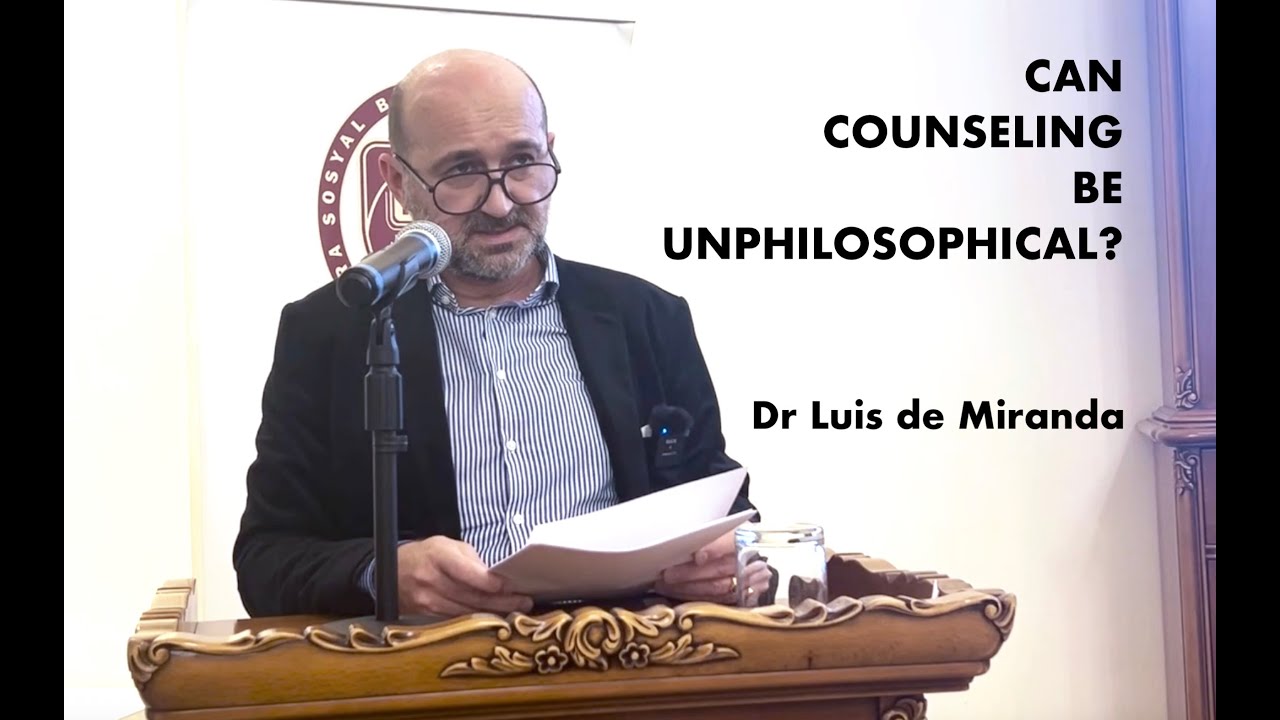
Video summary
The central argument presented in this talk is that counseling cannot coherently claim to be unfilosophical, as any therapeutic practice inevitably rests upon implicit philosophical commitments regarding human existence. The speaker employs a *reductio ad absurdum* approach to demonstrate that counselors who attempt to bracket questions about the nature of reality, purpose, and values while facilitating healing are engaging in performative self-contradiction. This investigation reveals that across five fundamental dimensions of human life—embodiment, identity, belonging, possibility, and meaning—every therapeutic intervention necessitates a specific philosophical framework. Whether a practitioner explicitly acknowledges these assumptions or not, their methods rely on unstated theories about the mind-body relationship, the nature of the self, the conditions for authentic connection, the capacity for change, and the structure of a meaningful life.
The absurdity of denying one's philosophical stance becomes particularly evident when examining specific areas of therapeutic work. For instance, addressing bodily distress requires an implicit theory of embodiment, whether mechanistic or integrated, while helping clients find their "authentic self" presupposes a particular view of personal identity and continuity over time. Similarly, facilitating relationships and a sense of belonging demands assumptions about human nature, inter-subjectivity, and social justice, whereas expanding a client's sense of possibility relies on beliefs regarding free will, determinism, and the nature of hope. Finally, working with existential confusion and life purpose is impossible without engaging in normative judgments about what constitutes a good life and distinguishing between authentic meaning and mere conditioning. In each case, the counselor who claims to avoid philosophy is actually making profound philosophical arguments while denying them.
Consequently, the talk concludes that the choice for practitioners is not between being philosophical or unfilosophical, but rather between engaging with these questions consciously and competently versus remaining in a state of implicit ignorance. The speaker argues that therapeutic practices which deny their philosophical foundations are ultimately impoverished and ill-equipped to address the deep existential crises characterizing modern life, such as widespread meaninglessness and ethical disorientation. To offer genuine authority and comprehensive growth, counselors must develop philosophical literacy and humility, integrating questions of phenomenology, ethics, and existentialism into their training and practice. This approach does not replace technical skills but enriches them by acknowledging the full complexity and value-laden nature of human existence, ensuring that counseling serves as a vehicle for profound transformation rather than merely superficial symptom relief.
Read the full video transcript
Can counseling be unfilosophical is the
title
of this talk. And um I will attempt a
reduction at absurdum
from the perspective of philosophical
health and you will see what I mean. But
I think uh philosophy has been often uh
using Latin
uh as a second language and why not
renew that tradition
in the proliferating
landscape of contemporary therapeutic
practice.
A curious phenomenon has emerged.
Countless counselors operate under the
assumption that their work can remain
fundamentally
unfilosophical.
They believe themselves capable of
facilitating healing, growth and
transformation while bracketing
questions about the nature of human
existence,
the structure of reality, the
relationship between purpose, values,
actions,
and the foundations of meaning making.
This assumption, I argue here, rests
upon a fundamental absurdity
that can be exposed through rigorous
philosophical analysis of which today
uh let's say is the premise.
So the present investigation employs a
reduction at absurdum which is the
logical demonstration as you know that a
position leads inevitably to
contradictory or absurd conclusions to
reveal the impossibility of truly
unfilosophical
counseling.
Drawing from the comprehensive framework
of philosophical health of which some of
you are familiar here. I demonstrate
that any attempt to practice counseling
without philosophical engagement
necessarily collapses into performative
self-contradiction
across five fundamental dimensions
of human existence.
So this argument carries important
implications not merely for the
specialized field of philosophical
counseling but for the entire
therapeutic enterprise.
If counseling cannot coherently claim to
be unfilosophical
then all counseling is in its essential
nature philosophical counseling.
whether practitioners acknowledge this
or not.
So the question becomes not whether
counseling should engage with
philosophical questions but whether
practitioners will cultivate conscious
competence in their inevitable
philosophical commitments.
The stakes of this inquiry extend beyond
academic philosophy or therapeutic
methodology.
in an era characterized by widespread
existential confusion, ethical
disorientation,
and what we might call planetary
unhealth.
Therapeutic practices that deny
their own philosophical foundations
cannot adequately address the deep
challenges
facing contemporary existence.
Only by embracing counseling's
philosophical essence
can practitioners
offer genuine therapeutic authority in
addressing the crisis of meaning and
deep orientation
that permeates modern life.
So let's look at the first
contradiction.
This contradiction emerges when we
examine how counselors engage with
questions of embodiment,
bodily sense, and physical experience.
Consider the counselor who claims to
work and philosophically with clients
experiencing bodily distress, trauma,
somatic symptoms. This practitioner
would insist they are simply applying
evidence-based techniques without
engaging in philosophical speculation
about the nature of embodied existence.
Yet the moment this counselor begins
their work, they encounter an
uncsurmountable contradiction.
To address bodily experience
therapeutically,
they must necessarily
operate with some conception of the
relationship. For instance, between mind
and body, whether they explicitly
acknowledge it or not, every
intervention carries implicit
assumptions about this fundamental
philosophical question.
If the counselor treats bodily symptoms
as purely physical phenomena requiring
only medical or behavioral intervention,
they implicitly endorse a mechanistic
dualism
that separates mind from body.
If they acknowledge that psychological
states influence physical experience,
they tacitly accept some form of
psychomatic integration. If they
recognize that bodily experience shapes
emotional and cognitive states,
they implicitly affirm
embodied cognition theories.
The absurdity deepens when we recognize
that the counselor
cannot avoid making normative judgments
about what constitutes healthy
embodiment.
When they encourage a client to listen
to their body or develop body awareness,
they necessarily invoke philosophical
assumptions about the nature of bodily
wisdom, the relationship between
sensation and knowledge, and the proper
relationship between conscious intention
and somatic experience.
Furthermore,
the very act of therapeutic dialogue
requires the counselor to navigate the
philosophical puzzle of
interubjectivity.
How can one embodied consciousness
meaningfully engage with another? How do
we account for the apparent fact that
speaking about bodily experience
can alter bodily states? These questions
demand philosophical engagement,
not merely technical application.
So the consular who claims to bracket
this philosophical questions while
working with embodied experience
finds themselves in the absurd position
of simultaneously denying and affirming
theories of embodiment. They cannot
coherently maintain their unfilosophical
stance because every therapeutic
intervention reveals implicit
commitments about the fundamental nature
of embodied existence.
The contradiction becomes even more
pronounced when we examine counseling
that addresses questions of identity,
sense of self authenticity,
selfhood.
Contemporary therapeutic practice
regularly engages with clients
struggling with identity confusion, role
transition, authenticity concerns, and
questions of personal continuity
across the years.
The counelor who claims to address these
concerns without philosophical
engagement
faces an immediate performative
contradiction.
To work therapeutically
with identity, the counselor must
necessarily operate with some conception
of what constitutes authentic selfhood.
When they encourage clients to be true
to themselves
or discover their authentic identity,
they invoke complex philosophical
assumptions
about the nature of personal identity,
the relationship between social roles
and genuine selfhood and the possibility
of self-nowledge.
Consider the therapeutic intervention
that encourages a client to question
limiting self-beliefs or explore
alternative self-conceptions.
This intervention necessarily assumes
that the self is not fixed, that
personal identity involves some element
of choice
construction maybe, and that authentic
existence requires ongoing
self-examination.
These assumptions directly engage with
philosophical questions that have
occupied thinkers
since Socrates all the way to SR.
The absurdity
becomes particularly acute when we
recognize that the very notion of
therapeutic change requires a
philosophical account of personal
continuity.
How can we meaningfully speak of the
same person changing or mentally healing
over time? What persists through the
transformation that counseling aims to
facilitate?
The counselor cannot avoid implicit
commitments to some theory of personal
identity, whether psychological
continuity, narrative identity
or for instance embodied existence.
Moreover,
the moment the counselor makes normative
judgments about healthy identity
development, for instance,
distinguishing in authentic
self-expression
and selfdeception, mature identity
integration and identity confusion. They
necessarily engage with philosophical
questions about human flourishing
and a good life.
The psychological idea of your diamondic
well-being ethmologically presupposes a
good spirit or diamond within us. The
art of exploring and improving spirit
is by definition
the philosophical art itself.
Our unfilosophical counselor working
with identity thus occupies an absurd
position. They facilitate identity
exploration while denying engagement
with the philosophical questions that
make such exploration meaningful. They
cannot coherently maintain their stance
because every intervention reveals
implicit metaphysical and normative
commitments about the nature of selfhood
and authentic existence.
The contra tradition extends
to therapeutic work addressing
belonging,
relationships, community.
Counselors regularly help clients
navigate family dynamics, friendship
challenges, romantic relationships, and
questions of social belonging. those who
claim to do this work and
philosophically
encounter immediate difficulties.
To address belonging therapeutically,
the counselor must necessarily operate
with some conception of what constitutes
a genuine human or beyond human
connection.
When they help clients establish
or expand boundaries, they invoke
implicit theories about the proper
balance between autonomy and
interdependence.
When they facilitate conflict,
resolution, they necessarily draw upon
assumptions about communication,
mutual recognition,
and the possibility or not of shared
understanding.
The counselor cannot address questions
of belonging without engaging
philosophical questions about human
nature itself.
Are humans fundamentally social beings
whose well-being depends upon community
or autonomous individuals who enter
relationships by choice or even
obligation?
How do we balance individual
authenticity with social harmony?
what constitutes just and caring
relationships.
Furthermore,
contemporary therapeutic work
increasingly recognizes the importance
of cultural identity, social justice
concerns, and systemic oppression in
shaping individual well-being. The
counselor who addresses these dimensions
necessarily engages with philosophical
questions about power,
justice, recognition,
and the relationship between individual
suffering and social structure. The
absurdity reaches its peak when we
recognize that the therapeutic
relationship itself requires
philosophical navigation of
interubjective
connection.
The counselor must somehow account for
how two separate consciousnesses can
meaningfully encounter one another, how
understanding and intellectual or
emotional empathy are possible, and what
constitutes ethical engagement with
another's vulnerability in this
face-to-face
dialogue.
Our unfilosophical
practitioner
working with belonging thus faces the
absurd task of facilitating
relationships while denying engagement
with the philosophical questions that
make genuine relationships possible. We
cannot maintain pertinence because every
therapeutic intervention
addressing belonging reveals implicit
commitments about human nature, inter
subjectivity,
and the conditions for authentic
connection.
But perhaps
nowhere is the contradiction more
evident than in counseling that
addresses clients sense of possibility,
agency, and potential for change.
Therapeutic practice fundamentally aims
to expand clients perception of what is
possible for them, helping them overcome
limiting beliefs, develop new
capacities, and envision alternative
futures.
The counselor who claims to do this work
without philosophical engagement
faces another immediate contradiction.
To expand a client's sense of
possibility, a counselor must
necessarily operate with assumptions
about human agency, freedom, and the
nature of change itself among others.
When they challenge deterministic
thinking patterns or encourage clients
to take responsibility for their
choices, they invoke complex
philosophical commitments about free
will, moral responsibility,
and the relationship between past
conditioning
and presence,
agency,
if any.
The therapeutic intervention that helps
clients envision new possibilities often
implicitly assumes that the future is
not completely determined by the past,
that conscious intention can influence
outcomes, and that individuals possess
some capacity for self transformation.
Otherwise, any counseling would be
unusful.
These assumptions directly engage with
fundamental philosophical questions
about determinism,
causation,
human agency that have occupied
philosophers for millennia.
Moreover, the counselor cannot address
possibility without making normative
judgments about what kinds of
possibilities are worth pursuing.
When they help clients distinguish
between healthy growth or destructive
patterns, sustainable change and
temporary fixes, they necessarily invoke
philosophical conceptions of human
flourishing and the good life.
The absurdity deepens when we recognize
that therapeutic work with possibility
necessarily engages with questions about
the nature of hope. imagination and
creative potential. How do we account
for the human capacity to envision
alternatives to present circumstances?
Sometimes called counterfactual
thinking. What makes some possibilities
more meaningful or available than
others? What does it mean for a reality
that is not yet actualized to be
possible rather than impossible?
These questions demand philosophical
engagement, not merely technical
application or decision making.
Our poor and philosophical counselor
working with possibility
thus occupies a dangerous position. They
facilitate expansion of agency
and potential while denying engagement
with the philosophical questions that
make agency and potential meaningful
concepts. They cannot maintain coherence
once again because every intervention
addressing possibility reveals implicit
commitments about human nature,
causation, and the structure of
meaningful change.
I'm not done hammering on the head of
the unfilosophical counselor. Bear with
me. A decisive contradiction emerges
when counselors address questions of
meaning, direction, and life purpose.
Contemporary therapeutic practice
regularly engages with clients emerging
and experiencing existential confusion,
lack of direction, or questions about
what makes life really worth living. The
counselor who claimed to be able to
address these questions and concerns
without philosophical engagement
encounters the ultimate performative
contradiction.
To work therapeutically with questions
of purpose and meaning, the counselor
must necessarily operate with some
conception of what constitutes a
meaningful life. When they help clients
clarify their values, explore their
sense of calling or navigate existential
crisis. They invoke fundamental
philosophical assumptions about the
nature of meaning, the structure of
value, and the relationship between
individual purpose and larger
communities of purpose. The therapeutic
intervention that encourages clients to
examine their life direction necessarily
assumes that some directions may be more
fulfilling than others. That meaning can
be distinguished from meaninglessness
and that individuals have some capacity
to align or at least interrogate their
lives with their deepest values. These
assumptions directly engage with
philosophical questions that constitute
the core of existential philosophy.
Furthermore, the council cannot address
purpose without engaging normative
questions about human flourishing.
What kinds of purposes are worth
pursuing in the longer term? How do we
distinguish between authentic meaning
and social conditioning? What is the
relationship between individual
fulfillment and contribution to a
universalizable
orientation?
These questions require philosophical
engagement.
The absurdity of an philosophical
counseling becomes complete
when we recognize that the very practice
of counseling implicitly affirms that
life can become more meaningful through
conscious examination and intentional
choice.
This affirmation constitutes a
philosophical position about human
nature, the possibility of incremental
wisdom, and the relationship between
understanding and flourishing.
Our unfilosophical counselor addressing
questions of purpose thus faces the
ultimate contradiction.
They facilitate meaning making while
denying engagement with the
philosophical questions that make
serious and sharable meaning possible.
Every intervention addressing purpose
reveals implicit commitments about
value, meaning
and the nature of a life worth living.
These five contradictions
emerge in a final and decisive absurdity
that exposes the damageable incoherence
of any counseling that would claim to be
unfilosophical.
Counselor who claims that therapeutic
practice can remain unfilosophical
is necessarily making a philosophical
argument about the nature of counseling.
human existence and the relationship
between theory and practice.
This claim implicitly endorses a
particular epistemological position,
perhaps pragmatism, positivism,
reductionism, or therapeutic positivism.
One that brackets metaphysical questions
in favor of practical results. But this
braggading is itself a philosophical
move that carries implicit commitments
about the relationship between knowledge
and practice, the nature of human
problems, and the conditions for
therapeutic effectiveness.
Moreover, the insistence that counseling
can proceed without philosophical
engagement necessarily assumes a
particular view of human condition that
people can be helped without addressing
fundamental questions about existence,
meaning and value. This assumption
constitutes a particular philosophical
anthropology
whether it is acknowledged or not and
more often than not it is not
acknowledged.
This absurdity
reaches another peak when we recognize
the societal implications of this
contradiction.
Counselors who deny their philosophical
commitments while occupying positions of
therapeutic authority perpetuate a form
of institutional absurdity.
They claim expertise in facilitating
human flourishing while denying
engagement with the questions that
determine what flourishing and human
development means.
This institutional absurdity
contributes to the broader crisis of
contemporary existence.
The widespread sense of meaninglessness,
ethical confusion, and existential
disorientation that brings clients to
counseling in the first place.
So let it be clear, therapeutic
practices that deny their own
philosophical foundation cannot
adequately address problems that are
themselves philosophical in nature.
I know I have competition, but bear with
me. We're getting to the conclusion.
Beyond logical contradiction,
unfilosophical counseling results in
therapeutic practices that are
fundamentally
impoverished
without explicit engagement with
philosophical questions. Counselors
cannot address the deep structures of
meaning making that shape human
experience.
The counselor who avoids questions of
purpose and meaning will find it
difficult to help clients address the
long-term existential and spiritual
dimensions of their difficulties. They
remain trapped in symptomatic treatment
that fails to engage the fundamental
questions that give symptoms their
larger significance.
Superficial fixes might be possible and
they are often provided without the help
of philosophizing but not individual and
collective philosophical health.
The framework of philosophical health
provides a comprehensive alternative
that tries to acknowledge counseling's
inherently philosophical nature by
systematically and thoroughly attending
to the phenomenological and existential
dimensions of for instance bodily sense,
sense of the self, sense of belonging,
sense of the possible, sense of purpose
and philosophical sense.
counselors can engage with the
philosophical presuppositions that
emerge in any genuine therapeutic
encounter.
This does not mean ignoring the personal
biography and individual narrative of
the client or interviewee. The
philosophical healthy approach does not
impose abstract philosophical theories
upon therapeutic practice, but rather
acknowledges and cultivates
the philosophical dimensions already
present in all meaningful conversations
about the good life. It recognizes that
theoretical questions about embodiment,
identity, belonging, possibility,
purpose, and worldview are not optional
additions to therapeutic work, but
constitutive features of any practice
that aims to facilitate
genuine human flourishing.
The philosophical health framework thus
reveals that the choice is not between
philosophical and unfilosophical
counseling but between explicit or
implicit philosophical engagement. All
counseling is philosophical counseling.
The only question is whether
practitioners will acknowledge and
develop conscience
and competence in their inevitable
philosophical commitments
or remain like Mr. Jord in Molè who
utters sentences without knowing that
this is pros let alone poetry.
Recognizing counseling's inherently
philosophical nature carries
implications for therapeutic practice
and practitioners training. Rather than
attempting the impossible task of
bracketing philosophical questions,
counselors should develop philosophical
literacy and competence.
Training programs in mental health and
well-being must integrate philosophical
engagement not as an optional
specialization but as a necessary
foundation or at least a strong
complement for competent practice.
This integration might involve
coursework in philosophical
anthropology, ethics, existentialism,
phenomenology
for instance.
But more importantly,
it requires cultivating comfort with
philosophical questioning as an
essential therapeutic skill.
This can be attained by simply reading
the classics. For instance, Hegel,
Plato,
Deard, Nichi, Bergson.
Here, please insert your favorite
philosopher. Practitioners
are also welcome to develop
philosophical humility.
A recognition that the questions
addressed in counseling often exceed
definitive solutions and require ongoing
exploration.
This humility
paradoxically enhances rather than
diminishes therapeutic authority
by granting practice in honest
acknowledgement of the complexities
involved in facilitating human
flourishing.
[Music]
I'm about to conclude soon.
This is related for example to deep
listening. Thank you. Deep listening
an attention to the singularity of each
biography
by engaging explicitly and bother
personally and philosophically
with questions of embodiment, identity,
belonging, purpose.
Counselors can offer clients the kind of
comprehensive
engagement that meaningful life
challenges require.
Such practice does not need to abandon
technical competence.
Say for instance a breathing or
mindfulness technique for relaxation but
it integrates
this within a broader philosophical
framework that acknowledges the full
complexity and value laden nature of
human existence.
It recognizes that lasting therapeutic
transformation
often requires not merely symptom
relief, but fundamental shifts in how
clean clients understand themselves
and their place in the world.
To conclude,
in an era characterized by
increasing specialization, technical
sophistication, AI, we must not lose
sight of counseling's essential nature
as philosophical engagement with the
fundamental questions of human
existence.
The dimensions of contemporary existence
cannot be adequately addressed through
techniques that deny their own
philosophical implications.
Only by embracing humanity's
philosophical condition, the fact that
language and behavior require and
reflect conceptual reflection and theor
theoretical presuppositions.
Can practitioners offer the kind of
comprehensive engagement that
contemporary challenges require to
sustain a yodnamic relationship between
at least four cognitive dimensions.
personal embodied cognition,
earthly extended cognition,
the inactive cognition of work and our
embedded societal cognition.
The therapeutic necessity is a cultural
and civilizational necessity. If we are
to address adequately the deep
challenges facing human existence in our
time, we must acknowledge that
counseling in its essential nature is
and has always been philosophical
counseling. In the same manner that real
dialogue about our place and action in
the world always contains a
philosophical dimension.
The question is not whether counseling
can be unfilosophical.
It cannot and should not be. But whether
practitioners will cultivate
conscious competence in their inevitable
philosophical commitments.
This recognition opens the possibility
for therapeutic practices that can
engage meaningfully with the full
complexity of human existence. Offering
clients counsel is not merely symptom
relief but genuine engagement with the
fundamental questions that give life its
meaning and direction.
In acknowledging
counseling's philosophical essence,
we reclaim its potential for
facilitating the kind of comprehensive
growth that our troubled world so
desperately needs.
A good and meaningful relationship
with the possible and the composible.
Thank you.
[Applause]