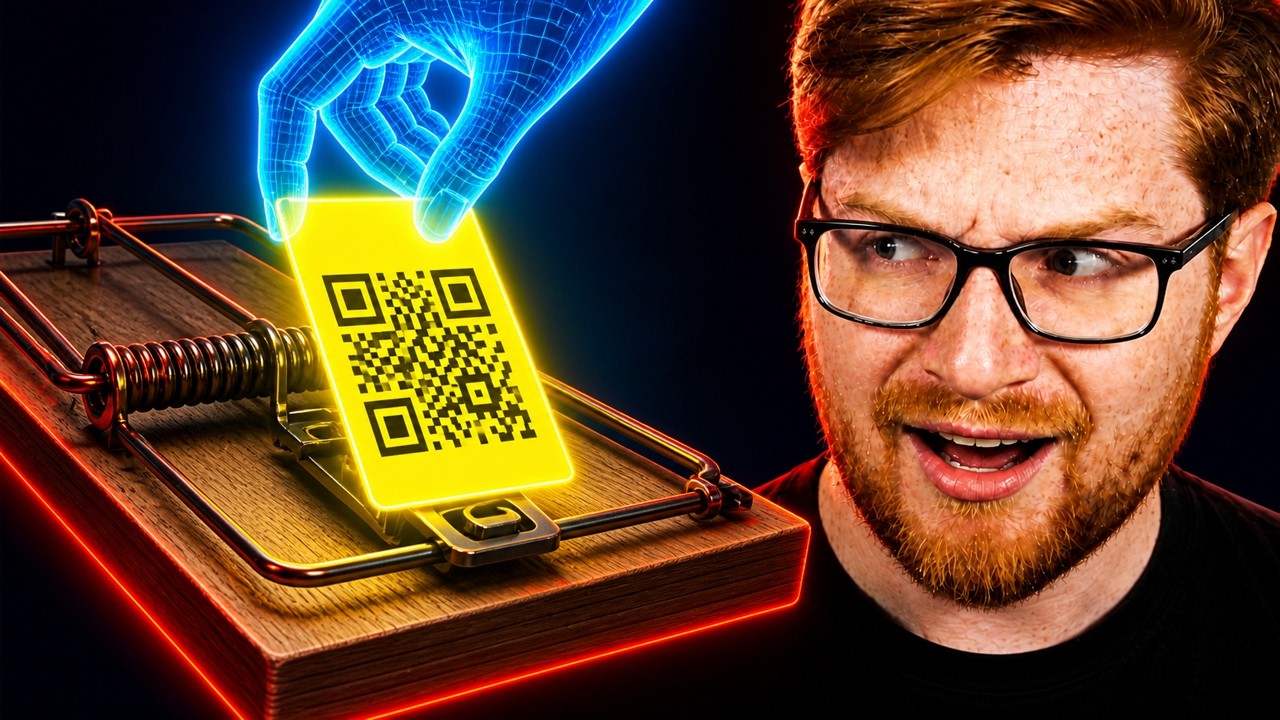
Video summary
The video explores the concept of using artificial intelligence to autonomously design and deploy cyber deception tools known as "mouse traps" or canary tokens within a computer environment. The host aims to automate the tedious process traditionally associated with setting up these tripwires, which are designed to alert security teams when an adversary attempts to access sensitive files like password spreadsheets. By leveraging AI agents capable of reasoning about system structures and file inventories, the goal is to create a streamlined engine that identifies optimal locations for deceptive lures without requiring constant human intervention or manual configuration.
To achieve this automation, the experiment integrates several key components including Thinkst Canary tokens for generating alerts via URLs, DNS names, or QR codes, and Mailhooks as an email interface to receive notifications when triggers are activated. The AI agent is tasked with scanning the host's file system to map out sensitive documents and folders, then using its reasoning capabilities to determine where placing a decoy would be most effective in catching a potential threat actor. Furthermore, the setup utilizes services like Webhook.site as an event ingestion surface, allowing the AI to programmatically create tokens, retrieve their unique links or QR codes, and tie them all together into a cohesive management dashboard that tracks deployment status and trigger events.
The practical demonstration culminates in a successful proof of concept where the AI successfully generates multiple canary tokens across different formats and places them on the host machine for testing. A significant highlight involves the creation of a dynamic QR code directly by the AI, which is then placed on the desktop; when scanned or clicked, it immediately triggers an alert visible to the operator via the webhook dashboard. This live validation confirms that the autonomous system can not only conceptualize and deploy deception strategies but also manage their lifecycle from creation to activation, proving that complex security operations can be offloaded to AI reasoning engines while maintaining full visibility into network activity.
Ultimately, the project serves as an inspiring blueprint for future "set-and-forget" cyber defense systems where robots handle the heavy lifting of deploying sophisticated honeypots across entire networks. The host emphasizes that this approach removes the friction and overwhelm often felt by security professionals trying to manually configure dozens or hundreds of tripwires, allowing organizations to scale their defensive posture effortlessly. While currently a proof of concept relying on specific tools like Canary Tokens and Webhook.site, the underlying philosophy suggests that as AI becomes more integrated into enterprise environments, such autonomous deception engines could become standard practice for enhancing visibility and catching attackers in real-time without exhausting human resources.
Read the full video transcript
What if AI could create a series of
mouse traps to catch hackers on our
computer? I wanted to experiment with
that idea in a recent live stream, and
this is how it went. Now, the plan was
to use canary tokens from Thinkst
Canary. They can send an alert when
someone triggers a tripwire, but I
wanted AI to do all the hard work.
Inspect the system, choose the right
kind of canary token mouse trap, place
them, track them, and then tell us when
one fired. All AI automagic. Could we
actually make that happen? Here's how it
went. What I think we could explore is
the idea of AI-powered cyber deception,
everybody. You lay out a bunch of little
mouse traps in your environment. You
have someone say that, "Oh, some red
teamer penetration tester, maybe threat
actor, cybercriminal, actual adversary,
just want to They want to take a little
look at what that passwords.xlsx.file
is." And hey, that's going to little
phone home and light up a little trigger
in a little mouse trap or tripwire to be
able to notify you, "Hey, someone is
looking at something that they
shouldn't." I don't know where to put
those.
>> [laughter]
>> Like, I know that I can, and that'd be
really cool, but sometimes I'm just
overwhelmed with the opportunities.
And I would not know how or where or
appropriately how to put that across my
environment or even just one machine.
Now, the way that people have been
getting tactical about that is by, at
least for the sake of education, showing
off canary tokens. This is a project and
labor of love from Thinkst or Thinkst
Canary, and I'm a huge fanboy of theirs.
Not sponsored, but they're cool, and
they're smart, and I like them a lot.
So, canary tokens are free, and anyone
could get these going to be able to
create something that just spits off an
alert to you when you go to a URL. You
access a specific website. Or maybe they
make a DNS resolution name. AWS, credit
cards, QR codes. We we should do this.
This should be a fun project. This
should be our absolute success as we
just like for the stream generate a QR
code, post it on Twitter, and see if
anybody scans it or however many people
do. That would be fun as hell. So, I
thought if we genuinely literally kind
of wanted to truly actually solve the
problem where there is a little bit of
friction in us being able to deploy and
cast out all of these potential
different kinds of canary tokens, little
deception tripwires, and do that in
mass, and be as creative as possible
with all of these, could we essentially
let an AI drive this thing?
And make a managed, so to speak, or at
least more of a streamline setup to get
canary tokens out and about. So, I think
what we could do is probably have Codex,
Claude, whatever your AI LLM harness of
choice might be is say, "Look, I want
you to go to canarytokens.org. I want
you to siphon up all of the options, and
I want you to look at their
documentation to get a feel for what
things you can do, and how you can
create them, and how you can make them,
and then actually get a couple of them,
build them, prepare them, but then
actually take a cohesive sort of
snapshot of your computer, your machine,
or whatever again, your agent, your your
robot is able to see what it is privy to
if you're letting it run around like
naked in its host on in it in its own
cage for that computer, or if you're
crazy, or if you're giving it like
access to other machines, if you're able
to like have it have it its own
awareness of your network environment,
which you get the spooky scaries of
security concerns on that front, but I
also I'm acknowledging that is where the
world is going, whether we like it or
not. So, if your robot
could now get the genuine air quotes
understanding and reasoning of
your environment. Literally go ahead and
like have this process streamlined
end-to-end where okay, you could
evaluate what is the snapshot of my
machine and where would these potential
canary tokens actually best fit? Like
where could I leave them on the file
system? Where could I decorate them
across different sites? Where could I
stage each of these and then literally
do it and then literally manage and
understand each and every one of these.
So that I
or you
don't have to go make this fake app.
Cayman Crafting asks, is this kind of
like to build a honeypot? Sort of
somewhat. This is where you're literally
intermingling like those mouse traps and
those tripwires. Essentially honeybots
across your host like that you might
actually use. All that is to say, we
could build this thing. We could try it
out. We could experiment. I think the
first things first we need to add
support for is the mailbox.
Now, I had learned about something just
the other day while I was kind of
playing with this idea. How can we get a
mailbox that our agent or a robot or AI
would be able to manage and maintain and
understand and still be able to like
trigger off of and we could like have be
as part of a
managed system. The other day, I learned
about this mail hooks. So here's the
idea. Could we just get this demo one?
Could we put that side by side for just
a little example even? So
if we were to do this
and we get this email.
Say we hit this thing, slap it in.
Demo for
initial Whoa. Whoa. Whoa.
Proof of concept.
Create that canary token.
And then this would provide that link.
So if and when, just as a simple
example, we would be able to hit that.
Then you'll see on the right-hand side,
oh, hey, it got the email. We can now
see your canary token was triggered.
And even just a free demo let us do
that. So that was kind of awesome. We
didn't have to sign up for anything. We
didn't have to do anything. So the
concept works.
Right? And if we were to create an
account here, if we were to like log in
and get something going,
why not let our AI be able to work with
this so that it is then able to see and
understand anytime and like actually
have the dashboard that like we could
build out. We have the capability to,
thanks to the way this canarytokens.org
works and this mailhooks.dev could
function. Even so, we have all the
puzzle pieces to be able to build this
thing. First, I guess we should think
through the way this is could happen and
give it to robot for it to be able to
use and create, right? Okay, Codex.
Here's the thing. We're going to tackle
a ambitious new project. First things
first, I think we should sort of
conceptualize the idea. I think we
should write it out in a way that this
is sort of documented first, so we'll be
able to kind of, you know, capture our
vision and the design and the
development idea and philosophy first
and foremost. Um but I think what we do
need to do is kind of first describe the
objective, the goal, what we're trying
to actually accomplish. So, I would like
to make an AI-managed cyber deception
engine that is as streamlined as
possible for basically zero human or
manual interaction. We want this to be
totally autonomous with a lot of our AI
reasoning and uh inference and deductive
thinking that you, as LLM, get to do.
But I think we have a couple different
sources of input or some control
services that we'll need to sort of keep
track of and the way that we actually
tactically accomplish this.
First things first, the idea is that you
as an agent in Harness living on a
computer and having the ability to still
enumerate the file system, get a feel
for the files and the folders and the
systems and the structure of maybe what
sort of documents are where
and where we actually have what sort of
types of information that might
realistically just better be based off
of
the
names of the folders and the names of
the files that are inside them. It's
like you're building out a file system
tree, but we don't need you to track
down and go through and loop through
absolutely everything of cross the
entire file system like in between each
and every oddball edge and corner and
crevice. We just want you to sort of
built out a map. Get a lay of the land
for the system and for the environment
that you're working in.
That is probably sort of this first
pedestal because that means we could now
have a place to
Chat, you're making me laugh.
>> [laughter]
>> Zero day malware says LLMs like I ain't
reading all that.
Decide the best possible and optimal
place to put potential canary tokens. Or
realistically, what we'll kind of
consider sort of mouse traps or
tripwires or these lures to have
something that will actually trigger an
alert if a bad actor will be someone
that might actually interact with or
trigger the tripwire. Now, the way that
we actually accomplish that is by using
the online provided capability from
canarytokens.org.
Canarytokens.org is actually one of
those awesome resources that will
provide a handful of different options
for a free capability to be able to have
any sort of canary token
that could work on your computer. So,
what I want us to do is to take the full
inventory of those and then be able to
actually optimize for what is the
maximum amount and the most creative use
of all those different kinds of canary
tokens
tied to the real actual stock structure
and outline of the file system in the
computer that you're working in or
considering considering and treating
that as uh you know, what we're
decorating with these deception decoys.
So, I'll need you to pull down the
documentation. I'll need you to reason
through it. I'll need you to kind of
keep up our own corpus and inventory of
what we can use and
then
we'll want to be able to formulate the
ideas as to what sort of tripwires and
canary tokens we can put where. Now,
the next part is actually building it.
The next part is actually connecting
those. You'll need to literally,
genuinely interact with the
canarytokens.org website to be able to
create one of them and to be able to
retrieve the links and to be able to
uncover how that's connected and how uh
we put it in place. But, to be able to
create that, you need to tie it to an
endpoint location.
Now, we've got a couple different things
that have came through from chat because
I presented the idea we could use some
resource like mailhooks.net.
But, more realistically, we might have
better luck with something that real
port buster in chat, big shout out to
him. Say hello in the uh Twitch chat
whenever you're reading this LLM. So,
that that way we could actually
uh connect it to an email address
because the canary tokens interface, as
we create one, requires an interface via
an email. The email address is what it
will be able to tie it together. So, we
need to create one via a resource like
mailhooks.net and webhook.site or some
others that we could consider and think
through. But ultimately we need to have
those in a like programmatic accessible
way by an API or via some means for you
to be able to reason and essentially
have like an event-based trigger when
one of those were to fire or to come
through. So, knowing those as those
potential control surfaces, we'll also
need to do a little bit of research and
understanding to see which of those
would be best. But once we put them all
together, once we have suggested and
decided where we put and where we can
create a lot of these
canary tokens inside of the environment
and you could actually do it and
actually put them there after you create
them, then we should probably
realistically have a sort of like
management dashboard that keeps track of
all of the things that we have deployed,
all the things that we actually have put
out onto the system or any of the others
that we manage.
They could be anywhere, so we need to
have understanding concept of where they
are on the file system, when they were
created, how many times they triggered,
what they're tied to, what the note is,
etc. etc. etc. We literally genuinely
need our own operator enclave to be able
to see the control surface of a
what we're deploying in this new
AI-powered deception engine.
Could you reason through that? Could you
think through a lot of this and get
first the documentation built out so we
have the vision and the design
philosophy for what we're building. That
was a lot of talk. How long was I
talking for? We sent that at 8:17. The
previous turn came back at 8:08. I was
almost talking for 10 minutes.
What is this guy talking about? What is
robot saying here? Oh no, we want you to
do the thing. We want you to literally
put it there. Which environment should I
operate for? Yeah, just do it for the
whole proof of concept for now.
I should have done that to say like make
that abstract, make that general
purpose, make that extensible, and I was
probably too quick to click on that
option.
But, that is a symptom of how we roll
the slot machine
>> [laughter]
>> for Codex and AI vibe code and you know
what I mean? I was too quick on the
trigger to pull and I didn't even read
the other options.
All right, but he's cooking something
up. He He's He's got this idea. Yeah,
you can just run with it, that's fine. I
don't care, but I will read it now after
the fact
that you gave me the option.
All right, so build the thing,
autonomous cyber deception. The V1
product will work in here and
we will use canary tokens as a deception
substrate and prefer webhook.site as the
first event ingestion surface because
that supports HTTP email endpoints,
shout out real port buster on Twitch,
and request retrieval through an API.
So, we do have documentation on each of
those and yeah, webhook.site might be
the smoother or better option. Okay, so
we're building out the documentation
that explains the idea.
And I probably should have given this a
little bit more guidance in that like
ultimately I want this to be very AI
driven. I want this to be very
air quote AI native because we are
getting to the point where if we were to
actually start to implement this kind of
thing, I don't know how much code I
want. I don't know how much I don't know
how much deterministic
scaffolding like procedural machine code
things would really be ideal. I think
as I'm more and more leaning into
willy-wobbly loosey-goosey AI native
stuff,
skills, if you make your own skills,
that's good. That's better than just
taking something willy-nilly off the
internet. So, letting AI reason is kind
of cool. So, if we wanted to like make
it a real app that has living code to
it, we can kind of solve for that first
and then put Codex and AI reasoning
implanted inside of it. That's probably
the smarter move because that way it's
not something that relies on you having
your own Codex or your own AI
environment in the area. If we were to
make this thing real, if we were to make
this actually a an application that we
would give to other people and it
weren't just like a playground trinket
toy idea for a live stream. You know
what I mean?
I think for our proof of concept, which
is kind of still what we keep doing and
keep wanting to do for a lot of these
live streams to give you the ideas, to
give you the education awareness, maybe
we just let it drive a la Codex, but
we'll see. So, let's go AI full and
let's talk about all of this thing.
Excellent work. Very well done. Thank
you so much. I'm glad now that we could
actually have the codified durable
learnings of what we wanted for this
project. And now I think we should
actually start to move towards
implementation. I want you to literally
genuinely start to build this. However,
I would like this to be
as AI native as possible. And what I
mean by that is that most of this
project should truly genuinely live in
the non-deterministic
side of the house where there are AI
skills and there are markdown files and
there are simple, simplistic sort of
natural native capabilities that are not
using uh any pure programmatic code,
like hardcore syntax. We want to avoid
the deterministic capability as much as
possible. We'll allow for small, tiny
parts and pieces of it if they are
absolutely necessary, but we really want
to orient this all to AI reasoning, AI
inference, AI having the ability to
actually work through all of this.
Skills first, markdown first. That is
the priority. Now, I'd like you to do
the first real genuine implementation
slice. Let's literally and genuinely go
ahead and autonomously get a
webhook.site up and running. Get me a
specific email that we could use. And
then, um actually get the inventory of
this file system, this host, and what
would make sense in a regular flat
Windows system as to where we could put
some of the potential canary token
concepts, and literally present to me
the entire inventory in the corpus and
catalog of all these different kinds of
canary tokens that we could use. So,
let's get this started now, and uh,
build it. Make it so. I think I I think
I kind of fell off on that one. I think
I lost the flow.
I think the the whisper flow, my own
personal flow, just kind of like
faltered out. I just fell off the cliff
right there. For the first build slice,
what artifact set should the
implementation create?
Let's just start with a markdown corpus,
and
create the endpoint and display the full
email address.
I feel like we should show you the real
thing.
How broad should the file system
inventory be? Literally the entire
machine.
Not just the workspace. Okay.
You need to literally take inventory of
the entire workspace, the excuse me, the
entire host, the whole computer. This
entire environment. The workspace that
you're building in right now for this
AI-deception
project is just for our scaffolding and
our development. You need to be able to
like pick your head up, zoom out, see
the big picture of the entire computer.
That you have access to the ability to
see.
Ooh.
Okay.
See, this is why I was a little bit
sketched out as to why why don't I have
full access right now. How do I switch
to like yellow?
>> [music]
>> Full access. Dangerously skip
permissions.
Please.
Ruin this computer.
Wreck house. That is literally what I
want you to do. You're in a virtual
machine. Yes, everything.
This is a little bit more forward
motion, I think, now. I'm pretty happy
about it. Oh, cool. It actually got some
good inventory. AI-native first
implementation slice. Build a
markdown-first deception corpus under
this directory, and provision a public
webhook.site endpoint as the first alert
ingestion surface. Oh, no. Oh, no. It's
going to keep asking. It's going
[laughter] to keep asking permissions.
The system should avoid app or back end
code for this slice except for tiny one
off commands needed to create the
webhook site token and inspect the host.
The corpus will turn the whole visible
Windows host into an AI readable
operating context between the host
inventory, canary token catalog,
placement strategy, provider run book,
and an operator ledger. The full webhook
site email URL may be displayed because
a chosen mode is provisioned public. All
right, we implemented the first AI
native slice. I didn't even read the
plan. We created a markdown corpus under
corpus. Let's go try and look at that
thing.
What do we got?
Pretty sure this was
This was
the first
turn.
I don't like the fact that it's only
enumerating this current directory
though. I think it got that wrong and I
probably needed to fine tune that.
But I do like how it was able to
properly get those things based off of
canary tokens and it's um
documentation.
But
conceptually
I'm willing to let it keep spinning
on this idea. So, the corpus is how this
should read this.
Host inventory describes the current
Windows host as the first kind of target
that we're looking on. The canary tokens
catalog indicates what we could build
with them. Placement strategy determines
where we put them and how. And the
webhook site determines how they could
be hooked up. And the operator ledger
should be tracking each of those things.
Okay. Okay. Conceptually, fine idea.
Literally nothing is built other than
the fact that we made a webhook. We have
a webhook. We have an email.
Canary token classes are in there. The
web hook site returned API with no
events yet. Amazing.
Should we try it? I believe that we are
now at the position where
we have everything ready. We have all
the building blocks and breadcrumbs and
puzzle pieces to actually
do this, to have a proof of concept run.
To truly use now the inventory across
the entire host, now the canary tokens
catalog to be able to determine what
types of deceptive lures we can create
and where, and then you can do a little
bit more of the research to actually
then create them and tie it to the web
hook.
Do it. This is the moment where I
literally now want you to create as many
as you possibly can using a lot of these
different creative examples to go
through the process, to literally
download the canary tokens and place
them intentionally on this host in
locations that you found them, have them
hooked and tied to this web hook
interface, and allow me to be able to
test them, try them, and see this happen
end work end to end.
Please do create some AI skills as you
need to go through these after you've
codified the process and workflow, and
then let's try to iterate so that we
could actually have this thing happen
fully completely having some at least AI
enabled at this case, not AI managed
fully yet, but beginnings of this
project to really truly see it in
action. Let's take everything that we've
now compiled and really genuinely
synthesize it to implement and do and
give me the presented and created
deception lures and canary tokens that
are now on my host so that I could
manually trigger them and see them
actually trigger and be displayed and
rendered from the web hook. Do it.
Make it so.
End to end canary token deception proof.
Generate the genuine proof of concept
that creates real canary tokens. Do it.
And updates the markdown
appropriately with the existing web hook
site so at the very least we have a
listing of them.
AI native. So, we're creating the AI
native skills, which I'm happy about. We
have a deployment runbook and a lot of
this insight.
Uh ooh, I like the fact that it's
actually keeping track of all of these
and deploying these specific notes.
Oh.
Oh, that's actually kind of cool.
It decided like, "Yo, put a couple of
these in here. Put a couple of these in
here."
Even in this project itself.
That's
cool. We're not getting the full QR
code, though.
I don't know if that one happened. It
staged the webhook, though. Let's take a
look at this once we have this all put
together. And
he should have done it. The safety layer
is kind of getting in the way. I feel
like we need to let this run a second
time because uh yeah, I wanted to
go full access, please.
>> [laughter]
>> I hope it works.
I want to open up the webhook site, and
I want to click on one of the things
that it tells me it created, see that it
works, and then I want to be proud of
myself, and then I want to be done.
We need to validate this. We need to go
look, but robot thinks so. He thinks so.
We created some live canary tokens and
we staged the lure under the deployed
lures. I think we can go look at the
webhook site. The first one that we
triggered
was
lure 001. But these are coming through,
and we validate it by it manually
triggering these. That's cool. So, now I
just want one that I can like actually
click on and open myself.
Can we do that? How about we make a QR
code so that way we all can have fun
with it, and if you want, you can also
scan it, and then, you know, provide for
me your IP address and everything that
you would actually give away once you
trigger one of these deception canary
tokens. Haha, heehee. But that way we
could actually see it run. Excellent.
It's great to see that we have the
beginning of a proof of concept here.
Now I think for our final firework for
what we should do is actually try to
create a QR code. So I think the QR code
can be the actual canary token. But what
I need you to do is actually uncover,
download, and create the genuine .png
like the QR code
that canarytokens.org provides for us.
And then place it just on my desktop on
this host. Place it wherever you know we
could actually access it. And then what
I want to do is have that
uh actually trigger the webhook
and we'll be able to see it and validate
it. But we wanted that to be autonomous
so that then now we could actually tie
that up and tee it up to a Slack webhook
at the eventual point. But for the real
actual tactical turn, thank you Brass
Ghost for the follow. Appreciate you
getting that into the
whisper flow chat. So Codex, if you see
it, please be sure to give a big thanks
to Brass Ghost.
Um let's make this QR code, hook that
up, make it in there, and then just give
it to me so that I could open it myself,
manually trigger this, and see this,
please. Yes, put the actual generated
PNG onto the desktop, please. You
created it.
We have our QR code. We did it. We did
it. We did it. I mean robot did it. But
we told robot to do it. So let's get
back to our webhook site. We have
currently four hits, correct?
So let's open our QR code and then
everybody, everybody, everybody in chat,
if you want to hang out with us, if you
want to be part of the party, you too
can scan the QR code that we just asked
the robot to make for us. If you want to
trust it, if you want to allow that to
happen, if you feel like that's part of
your worldview, if that's in your threat
model, in your perceived amount of risk,
I'm going to do it.
Scan QR code. It literally takes you
right to canarytokens.com.
Okay, so we had four. 1 2 3 4 and now we
have this one.
>> [laughter]
>> But it hit. It triggered. It worked. So
now we hook this up to Slack and that's
easy. That takes no code. That takes
literally click a button to create a new
web like like workflow and then we have
genuine notifications. I'm really glad
that we uh got to play with this. That
was that's I hope the beginnings of a
neat cool idea. And like again,
literally I if anything I wanted this to
just be more inspiration for you as like
cool, how could we build out sweet
things? I had fun. I don't know about
you. Do you get the idea?
Do you see how this can come together?
Think like
managed autonomous AI-enabled deception
engine that can just be turnkey set and
forget automatic. You could build out
visibility if you wanted to, but I think
realistically the real power that we
have is now just this can crap out any
kind of canary token anywhere and put it
wherever it wants. And again, if you
just add more awareness and under-
standing of your environment, your
stack, like man, wouldn't that just be a
cool capability to put cyber deception
in place
easily. Like without you getting worried
about it, without you psyching yourself
out about oh boiling the ocean, getting
all these different security checkbox
checklist things done out of the way.
Robots. Robots cranked it out. So it
worked. And somehow people are still
scanning that QR code. This was only a
proof of concept, but I hope it inspires
you to build something. Experiment and
see what wild stuff you can do with AI.
Hey, huge thanks for hanging out with
me. Let me know what you're working on
and if you want to catch more
experiments like this live, you can
catch me on Twitch. Please do all those
YouTube algorithm things, like, comment,
subscribe, and I'll see you in the next
video.