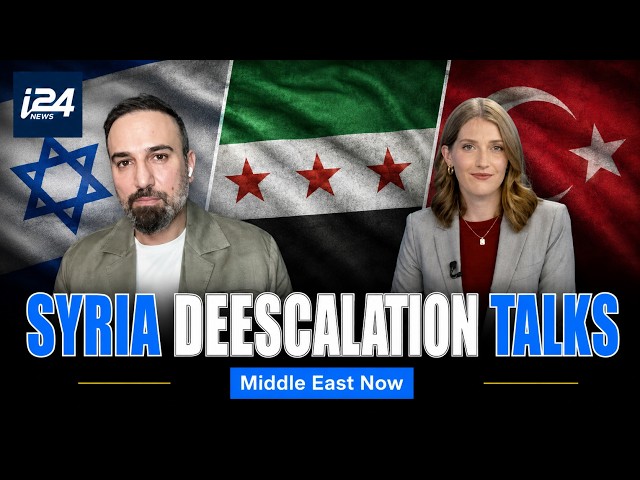
Can a new mechanism prevent a catastrophic miscalculation in Syria?
Watch on YouTubeVideo summary
Following a high-level meeting in Amman between Syrian Foreign Minister Assad al-Shehbani and Israeli Mossad chief Roman Goldman, reports indicate that Syria and Israel have agreed to establish a joint security deconfliction mechanism involving Turkey as well. This new arrangement is reportedly being supervised by American and Jordanian officials and was finalized while the Syrian minister was in the Jordanian capital. The primary goal of this mechanism is to prevent catastrophic miscalculations along the border, though its success hinges heavily on Israeli willingness to engage, given that Syria has repeatedly offered to adhere to a renewed version of the 1974 agreement since the beginning of the conflict. Despite these offers, trust remains low between the two nations, and recent Israeli strikes have complicated any hope for immediate peace talks or long-term diplomatic breakthroughs.
A significant point of contention regarding this mechanism is Israel's concern over Turkish influence in Syria, specifically the fear that Turkish forces or weapons could be positioned near its border. Syrian officials firmly reject these fears, emphasizing that Syria shares a 1,000-kilometer border with Turkey and views Ankara as a strategic ally essential for its national security and economic recovery. Over the past fourteen years, Turkey has hosted more than five million Syrian refugees and provided critical support for rebuilding Syria's economy and military infrastructure after the Assad regime bombed various towns and cities. Consequently, Syria's foreign policy is driven by its own national interests rather than Israeli anxieties, and the country maintains that it has no intention of using its territory as a base to threaten neighbors or engage in war with Israel.
The interviewee highlights a shift in Syrian doctrine under President Bashar al-Assad, which prioritizes avoiding conflict with all neighbors and resolving issues through diplomacy even with traditional adversaries like Hezbollah. This new approach aims to position Syria as an economic center in the region rather than a battlefield, a stance that explicitly welcomes Israeli participation in this peaceful framework. However, the speaker argues that instead of reaching out to offer help or negotiate directly, Israeli leaders have opted for military strikes, which undermines the potential for trust-building. The Syrian position remains clear: they are ready to address security concerns directly through negotiation to ensure both sovereignty and safety, a stance that is supported by their own officials and even advised upon by Turkey itself.
Ultimately, the viability of this new deconfliction mechanism depends on whether Israel can overcome its hesitation and engage with the Syrian government as proposed. While Syria insists that its relationship with Turkey is non-negotiable and essential for its survival, it remains open to including Israel in a broader diplomatic effort to stabilize the border region. The hope expressed by Syrian representatives is that if both sides sit down at the negotiation table, they can create a functional system to de-escalate tensions and protect lives on both sides of the border. Without this mutual willingness to cooperate, the mechanism risks remaining just another report without tangible impact on the ground, leaving the potential for future peace talks dependent on overcoming deep-seated mistrust and differing strategic calculations.
Read the full video transcript
Well, after a high-level meeting between
Syrian Foreign Minister Assad
al-Shehbani and Israeli Mossad chief
Roman Goldman, Syria and Israel have
reportedly agreed to establish a joint
Syrian-Turkish-Israeli
security deconfliction mechanism. The
mechanism will operate under
American-Jordanian supervision and was
agreed upon while al-Shehbani was in the
Jordanian capital of Amman. US
Ambassador to Turkey and Special Envoy
to Syria Tom Barrack, who heavily
criticized the Israeli strike on the Abu
al-Duhur airbase, he was also
participated in that meeting. Well, for
more we're joined now by Omar al-Mukdad,
a Syrian journalist and filmmaker.
Omar, I know this is still reports right
now, but let's talk about this
mechanism. Syria, Turkey, and Israel,
what would it actually change on the
ground?
>> Thanks for having me on. In fact,
everything depends on Israeli acceptance
of such mechanism because Syria has
offered uh multiple time in in the past
offered Israel
uh that
to stick with 1974 agreement or at least
a renewed version and uh that Syria
would abide uh by and called Israel the
same thing. But the Israeli leaders at
this point they they were shying away
from such an agreement because the trust
still not there between the two
countries. Unfortunately, the uh the the
Israeli attack is also has put at risk
any future uh talk about peace or
whatever that might result from such an
agreement because what Syria really
wanted from this agreement is to keep
Israel away from Syria's business and to
allow some time uh so a trust can be
built between two countries so that we
might move to the next step and start
talking about long-lasting peace between
the two countries.
But unfortunately, the Israeli leaders,
it seems to me that they have their own
um calculations when it comes to Syria,
and they they've been shying away from
uh such a move for a long time now, for
2 years.
>> Well, there's a lot of concerns. You say
trust on both sides. Right now, Israel's
concern is this Turkish influence. So,
when it comes to any sort of a
deconfliction mechanism, can Syria
actually promise that Turkish forces or
weapons will not be positioned near
Israel or pose a threat?
>> Well, first of all, let's put it this
way. Syria and Turkey share a border
front, a 1,000-km
border front, and Turkey represent a
strategic ally for Syria's strategic
depth. It's our land gate to Europe, and
Syria can't shy away from having the
best relationship available with Turkey.
Turkey has been backing Syria, uh Syria
revolution, for 14 years. It's provided
uh Syrian uh refugees with a safe haven,
hosted more than 5 million Syrians over
the last 14 years, when Assad regime was
bombing Syrian towns and cities. So,
yes, and also it has an economic
significance for Syria. It's helping uh
Syria rebuild itself and rebuild its
army, its economy, and everything. So,
yes, Syria foreign policy is determined
by uh Syria's national interest, not by
Israeli fears.
And regarding uh Israel, Syria has said
said multiple times, from the President
Bashar al-Assad to the foreign minister,
said multiple times, allow the
negotiation diplomacy on, let's sit down
on the negotiation table, address your
security concerns, and we are more than
happy to address it and to put it under
test. That's for Syria's official
position toward Israel. But, this ex-
rhetoric exchange between Turkey and
Israel, Syria has nothing to do with it.
And Syria has not interested to go into
war with Israel, is not interested to
make its land and territory as a base
for anyone from anywhere to go and
impose a threat to its neighbors. That's
the official position of Syria, and
Syria has been saying that for the last
2 years. And unfortunately, it seems to
me that the Israeli leaders are still
have something else to say in this
regard. But, for Syria, as I say that
keep saying can't shy away from that
relationship with Turkey. Turkey is a
strategic ally for Syria. This
relationship will remain in place. It
has nothing to do with Israel. If Israel
has any security concern at this point,
all they have to do sit down with the
Syrian delegations, address these
concerns directly, work a mechanism to
de-escalate to work on both sides of the
border, so Syria's sovereignty will be
protected and Israeli safety and
security will be ensured. Nobody has a
problem with that. Not the Syrian
officials, not me, not even the even the
Turks never interfere actually with
Syria and say, "Hey, don't go away and
don't sign an agreement with Israel."
Actually, Turkey is the one who's been
advising the Syrian officials to have
the best relationship with Israel and to
eliminate that that uh
>> What do you mean by that that Turkey was
the one advising Syria to have these
good relationships with Israel?
What more can you share?
>> It's It's simply that Syria uh is in a
situation right now that can't
uh and it won't be able to go into war
with anybody. Not now, not in the
future. I said this before on i 24 News
that I keep saying this. The new Syrian
doctrine right now is zero uh
problems with our neighbors. We don't
want problems. We don't want wars. Uh
try to allow diplomacy always to tackle
any of the issue even with people who's
known to be your enemy. Even Hezbollah
by the way, we tried
through diplomacy to push it away from
the Syrian border, not just by war. So,
this is the the new Syrian doctor. Syria
wants to rebuild itself. It's not
interested to go into war. Would want to
be an economic center in the region.
That's the doctrine that Ahmad al-Shara
came with. And by the way, Israel are
welcome to be part of that. But
unfortunately, the Israeli leader
instead of reaching out to the Syrian
government and offering help, they
decided to send their fighter jets to
start attacking Syria. And this is the
problem.
>> We'll have to wait and see what does
come from this reported new
deconfliction mechanism then. Omar
al-Mulki, great to have you with us and
and hear your insight on this.
Appreciate it.
>> Thank you.