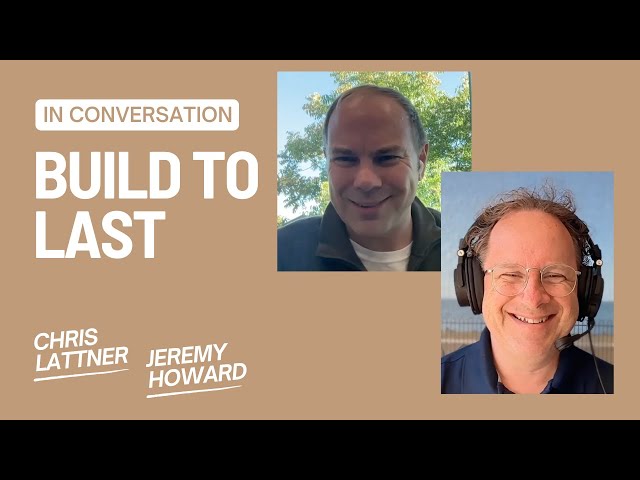
Video summary
Chris Lattner ve Jeremy Howard, yazılım geliştirme dünyasındaki mevcut baskıların hız ve hacim odaklı yaklaşımların (örneğin "günde 10 bin satır kod") yazılım zanaatkarlığı, mimari kalitesi ve uzun vadeli sürdürülebilirliği nasıl gölgede bıraktığı konusunda ortak bir endişe taşıyorlar. Her iki kurucu da yapay zeka araçlarının prototipleme ve keşif aşamalarında verimlilik kazandırdığını kabul etse de, derin bir anlayış olmadan bu araçlara bağımlı olmak teknik borçlanmaya, kırılgan sistemlere ve mühendislik ustalığının kaybına yol açabileceğini uyarıyor. Lattner'in LLVM, Swift ve MLIR gibi projelerindeki çalışmaların, iyi tasarlanmış sistemlerin yıllarca dayanıklılığını sağlayarak diller ve alanlar arasında evrimleşmeyi mümkün kıldığını gösterdiğini vurgularken, Howard da fast.ai üzerinden yapay zekayı uzman olmayanlara öğretme ve pratik uygulama yoluyla erişilebilir kılmaya odaklandığını belirtiyor.
Konuşmacılar, kod tabanlarına tam kontrolü elinde tutmanın, soyutlamaları sahiplenmenin ve sistemleri bilinçli bir şekilde evrimleştirmenin önemini vurgulayarak yapay zekayı tüm sorunları çözen sihirli bir değnek olarak görmemeleri gerektiğini savunuyorlar. Yapay zekanın keşif konusundaki güçlü yönlerini insanlığın tasarım ve bakım konusundaki uzmanlığıyla birleştirmek, kısa vadeli trendlerin veya AGI etrafındaki hype'ın ötesinde kalıcı yazılım inşa etmek için kritik olduğunu belirtiyorlar. Ayrıca, yapay zekanın insan bağlamına (örneğin önceki komutlar ve düzenleyici notları) tam erişimi olması gerektiğini, bunun için özel dosyalara ihtiyaç duymadan bir "Senior Expert" gibi davranmasını sağlayan Shell Sage gibi araçların örneğini vererek, otomasyonun boilerplate kodu ve API sorgulamalarını kaldırmak için değerli olduğunu ancak aşırı bağımlılığın beceri ayrışmasına ve öğrenilmiş çaresizliğine yol açabileceğini uyarıyorlar.
Her iki konuşmacı da teknoloji dalgalarının kaçınılmaz hype döngülerinden geçtiğini kabul ederken, işin sadece ticari gerekçelerle değil, kalite mimarisini koruyarak altı aydan uzun süre dayanacak yazılımlar inşa etmeye odaklanmanın önemini vurguluyorlar. Lattner, herkesin beğenisini aramanın ürünleri seyrelttiğini ve eleştirilere rağmen çekirdek bir vizyona sadık kalmanın zorunlu olduğunu belirtirken, Mojo gibi bazı çalışmalarını herkesin inanmayabileceğini ancak inananları karşılamayı ve diğerlerinin gitmesine izin vermeyi öneriyor. Sonuç olarak, zanaatlarına derin yatırım yapmak, sert sorular sormak ve fast.ai'nin 4 milyon öğreneni gibi destekleyici bir toplulukla çevrilmek, anlamlı büyüme ve etkiyi gerçekleştirmenin anahtarı olarak sunuluyor; bu yaklaşım hem teknolojik mirası korumayı hem de mühendislik ustalığını gelecek nesillere aktarmayı hedefliyor.
Read the full video transcript
Hi, Jeremy Howard here, with Chris
Lattner, a man who probably needs no
introduction, but I'll give you a bit of
intro to anyway. Good day, Chris.
Welcome. Thank you for joining us.
>> It's great to be able to spend time with
you and hang out and talk on this nice
Sunday. Yeah.
Um
Chris, how long have you known each
other? I think it was the very first
TensorFlow Dev Summit that we met.
>> Yeah, probably 2017. So, it's been uh
not long enough, but a good a good
amount of time.
We've been through a number of different
projects together, and so we uh
developed a mutual distaste for
TensorFlow pretty early on. I was trying
to [laughter] trying to fix it at the
time.
>> fixing it.
>> Yes. Yeah, and so I was making it better
or trying to. Um
But, the experience of those early days
of that first that first TensorFlow Dev
Summit, you were fresh new to to AI. A
large percentage of the people there
today are
>> [snorts]
>> running big labs or, you know, uh
world-known folks. And you brought in a
very different background to anybody
else that was there. Your your PhD
project turned into LLVM, which today is
at the heart of
most of the world's most successful
programming languages.
You built a C++ compiler on top of that,
which
is
very widely used, including Google. You
built an Objective-C compiler.
And then you thought, what the hell,
it's all too easy. So, you built a new
programming language called Swift, which
is
running all the stuff I'm using right
now to talk to you.
Um
And what I found interesting is when you
then
came into to AI.
You definitely didn't say, oh cool,
everyone's everybody did use TensorFlow,
and you went, everybody uses TensorFlow,
cool, I'll tweak TensorFlow.
You basically did the same thing. To
like, what is this
mission that you've been on for the last
you're a young man, what is that, two or
three years?
Um
that kind of has you
starting at the bottom, and and what did
that look like when you hit the AI
world?
Well, so so Jeremy, you and I have some
things in common. I think you know this,
but other people may not. We like to
build things, and we like to build
things from the fundamentals. We like to
understand them. We like to ask
questions, right? And so, for me, my
journey has always been this uh
like trying to understand the
fundamentals of what makes something
work. And then when you do that, you
start to realize that a lot of the
existing systems are actually not that
great.
Right? And so, for me, at least, you
then feel compelled to say, well, how
about we make it better? At least for
the ones that matter. And so, AI
systems, programming languages,
compilers, and systems, and tools,
there's a lot of things out there, and
none of them were really great. And so,
I have thrown myself into trying to make
this better. And through all of that,
I've been doing a lot of coding.
So, I've been a developer my whole
whole career.
>> you that your underlying mission here is
or your kind of quest is to create
higher-level ways of talking to
machines. Like, what why are you trying
to do that? And how on earth does
creating LLVM, the lowest possible layer
of talking to machines, help in that
mission?
Well, so I think that computing is a big
part of our lives, right? And we see it
through the products we use. We see it
even if you're not a programmer, in the
widgets, and the devices, and the
connected components that are all just
ticking over everything. AI is the most
recent manifestation of this, of course,
right? But but that doesn't happen
unless programmers, developers can
actually build these experiences. And
so, I'm curious about your background,
too, Jeremy. Like, so you've built a few
things. You built fast.ai and many other
things. So, what what threw you into
this, and and what makes you passionate
about building things?
I mean, I'm I'm not sure my quest is
that
different to yours. Um
You're interested in creating
higher-level ways of talking to
machines. I think I'm pretty interested
in the whole conversation of like also
higher-level ways of machines
talking to us.
Um
Unlike you, I don't have a fancy PhD,
and so I never had the tools in my
toolkit to go and
start at the bottom and build it from
from there. So, I think I've kind of
come in the opposite direction
of starting
at the top and gradually
going down. And
interestingly, we've
met in the middle.
Um
which is
So, we
worked together on a project called
Swift for Swift for TensorFlow, which
had nothing to do with TensorFlow, but
was actually
one part of you saying, okay, we have to
throw away everything and restart. So,
you built MLIR, which is kind of like
LLVM, but for the modern world, and then
you built
Swift for TensorFlow on that, but you
also built out
stuff for TPUs, and you also built out
the TensorFlow runtime, and you you did
the whole thing again. You built all
these layers of abstraction.
And
and I had kind of come from the opposite
direction, and we were both there saying
like, okay, we need a better way
>> Because you actually know AI, right? So,
you you know the the use case. You
understand the researcher pain points.
You understand what was beautiful about
PyTorch. I think you were one of the
first people and Andre We were the first
people on PyTorch, yeah. back in like
0.3 kind of time frames, and
back before PyTorch was inevitable and
obvious. And so,
um and so you brought a lot of the
domain expertise. And so, as a tool
builder myself, right, the thing that
you need is you need who's who's the
person that you're solving the problem
for, right? And so, finding experts like
yourself that actually understand
um not just what people are doing today,
but also the frontier sheer. And it was
the lack of that integrated end-to-end
system that was killing me, cuz I
remember when I first met you, I said
like, oh Chris, you're coming to work on
TensorFlow, are you?
Need to warn you, it's kind of And
I spent half an hour telling you all the
ways it was terrible. And then you
didn't yell at me. Instead, you said
that that sounds very interesting. Let's
fix it together.
Um
And cuz what I wanted for my students,
for myself, for my research, was to to
never
get stuck where I'd be like, how does
that work? How does that work? How does
that work? Until I get to the point
where it's like, okay, that's the thing
I need to fix.
And with like PyTorch or TensorFlow, you
don't get very far at all before it's
like, oh, this is inside,
you know, the flash attention three
kernel that was actually in Triton, but
it's actually then being converted to
this different language, and then it was
compiled, and then Or some binary CUDA
blob. Yeah, I don't know what just
happened. Um
>> Yeah. And that just felt absolutely
unacceptable to me. And even Swift for
TensorFlow,
I remember complaining to you about
that, cuz I was like, what about auto
diff?
What's that written in? You're like,
C++. I'm like, what am I meant to do
about that, Chris? Yeah. Yeah.
So,
>> Well, I think I I I think it's fair to
say that
I learned a lot from that project.
>> [laughter]
>> Um but, you know, interestingly, just
like LLVM,
how long ago was that, Chris, that you
wrote it? It was actually more than two
or three years.
>> 25 years ago. I started it over
Christmas break in 2000. 25 years. So,
there's a project that the world has
been using,
you know, and still uses
everywhere.
And interestingly, when you kind of
reinvented that with MLIR, you know,
which is like a
intermediate representation for massive
multi-core heterogeneous compute blah
blah blah processes and matrix
manipulations and all that,
it's it's
the same thing's happened, you know?
Everything today is now getting built
on
on MLIR, you know? Um so,
Well, so so the question of the day
is, how do you build a system that
actually can last more than six months?
Right? Because the reason that those
systems were fundamental and that they
became scalable and were enabled to be
successful and then grow, but then
didn't crumble under their own weight,
is because the architecture of those
systems actually worked well, right?
They were well designed. They were
scalable.
Uh the people that worked on them had an
engineering culture that they came
together, and they rallied
behind because they want to make them
technically excellent, right? And so, I
think that that's something that enables
systems to actually
be more than just, you know, a solution
to a today problem. In the case of LLVM,
for example, it was never designed to
support the Rust programming language or
Julia or something like this, or even
Swift, right? But, because it was
designed and architected for that, you
could build programming languages.
Snowflake could go build a database
optimizer, which was really cool, and a
whole bunch of other applications of the
technology came out of architecture,
right? And I think that's something that
today,
you know, architecture and
some of the craftsmanship that goes into
building things is
at risk. Like, it's under threat today.
Really?
I was I was
hearing I was thinking the same thing as
you said it. I was thinking like, okay,
the things you're describing
feel very different to the culture that
I feel is being pushed very hard by
the world around me. Like, I'm feeling
this pressure
to say, screw craftsmanship.
Screw caring.
You know, we hear VCs say, oh, my
founders are telling me I can they're
getting out 10,000 lines of code a day.
Are we crazy Chris are we are we are we
old man men yelling at the clouds being
like, back in my day, we cared about
craftsmanship, you know, or
>> No, no, it's I think it's a I mean, so
to me, I think that there's a thing
going on, and it's kind of driven by
sometimes VCs, but but moreover by the
world that's eager for progress. Let me
tell you a story. In In 2017, I was at
Tesla working on self-driving cars and I
was leading the autopilot software team.
>> So you were. And
I was convinced that in 2020
these cars would be everywhere and it
would be solved and it was this
desperate race to go solve autonomy.
Um in fact, my job, which I failed at by
the way, was to get a Tesla to drive
coast to coast from LA to New York.
Of course, here we are uh 8 years later.
Nobody else has solved that problem
either but not that I know.
>> to get that working?
Yeah, a little bit less than that. Okay.
But uh at the time nobody even knew how
hard that was. But what was going
around, what was in the air is
trillions of dollars are at stake.
Job replacement, farming,
transportation. Look at the TAM of all
of the uh human capital that is being
put in transportation and with one cute
trick that'll be replaced. And I think
that today exactly the same thing is
happening.
Today it's not about self-driving,
although yes, it's making progress. I
think a little bit less gloriously and
immediately than people thought but it
is making progress. But now it's about
programming, right? And so I think a lot
of people are saying, "Oh my gosh,
tomorrow all programmers are going to be
replaced by AGI and therefore we might
as well give up, go home.
Why are we doing any of this anymore?
Uh code is
like if you're learning how to code or
if you're
um you know, taking pride in what you're
building then you're not doing it right.
And I think that this is something that
I'm pretty concerned of.
Yeah, and and it's it's almost worse
than that, right? And the the analogy
there is actually really striking cuz I
remember when you were at Tesla, it
wasn't just like we're on the cusp. It
was very specifically all Tesla needs is
a bit more data
because data is the oil and you just
grab the data and instantly you have
yourself
a self-driving car. And that's now what
we're hearing, you know, that's the bit
of lesson which
Rich Sutton is now saying is being
totally misunderstood. Um is like, "Oh,
you just need more data and and
AGI is inevitable and it's around the
corner.
And if that was true
it's a whole question there about how
would one live one's life but
it hasn't been true in the past
[laughter]
and Yeah. it
it doesn't it doesn't feel I don't know.
I don't know. What do you think, Chris?
Yeah, it's like
>> Well well so so Jeremy, I'm I'm not the
AI researcher. So I'm going to spin this
phone around and ask you this, right?
But to me, I believe that progress looks
like S-curves, right? And pre-training
was a big deal. It seemed exponential
but actually it S-curved out and got
flat as things went on. I think that we
have a number of piled up S-curves that
are all driving forward amazing
progress. But I at least have not seen
that spark. And so I guess a a quick
question for you, an easy easy slowball
for you is like, "What is AGI made out
of? Is it just more layers in your
transformer? Is it just more parameters,
more experts in your MoE? Like or is it
something fundamentally different?"
And and another way to spin this is
like, "Is it actually next year or 5
years off or is it actually maybe
something we'll not actually get to
at least economically?"
So I mean, something I haven't talked
about much is that maybe I should here
is, you know, as you know, I I created
the first
LLM.
And you you melt it? Uh-huh. Yeah, and I
can tell you why I created it and I can
tell you what it's looked like since
then.
I didn't create it to create AGI.
And everything that's happened since
then is exactly what I
hoped and expected would happen
um
with
the LLMs.
Which is to say I was telling everybody
in 2017 you know, and 2018
this
approach and in fact I was talking in
academic conferences before that even.
This is an approach which
by learning the next word of a sentence
predictor, it must build internal
abstractions that would allow it to
solve a wide variety of problems quite
concisely and crisply with a smaller
amount of data and so fine-tuning is the
key thing.
Um and so nowadays we use exactly the
same three-step approach. We train a big
language model, we fine-tune it
on instruction tuning nowadays and then
you fine-tune it on a classifier which
is RLHF nowadays. Yeah, none of that
process was ever designed to
create AGI.
There's no reason to believe it would.
It's um it it it's a very big uh pattern
predictor machine and
it's funny for years I was the one
telling people you're deeply
underappreciating how important a big
pattern recognizing machine in natural
language is. It can actually solve all
kinds of problems and you can actually
talk to it and it will actually like the
amount of things which are just
which are interpolation.
Sorry?
Everything's a remix, right? Yeah,
exactly. The amount of To some extent
that's actually quite valuable for a lot
of different reasons. If you could
interpolate between everything in the
internet
that's a lot.
But like you and I both know that when
you're
literally on the cutting edge
of
anything. And some of those things I
find you hit very quickly cuz they're
very small things.
Suddenly GPT-5 or
Sonnet 4.5, whatever, become
incredibly stupid. Like they just start
saying things that
you're like
ah
you actually had no idea what you're
talking about the whole time. It was all
a big pretense.
Well, the big pretense was very helpful
actually when I Yeah. needed help but
Well so so as as not the AI researcher,
I'll say this, right? So I have I've
been surprised multiple times with AI. I
am a maximalist. I want AI into all of
all of our lives, all the products.
I am continuously delighted by what we
can do.
However, the thing I don't like is I
don't like the people that are making
decisions
as though AGI or ASI were here tomorrow.
Right? Because if you're going to live
your life in fear
and if it isn't actually coming or maybe
it's 20 years from now or it's 30 years
from now or something, who knows? And I
I'm not saying that. It's not my place
to speculate but but
being paranoid, being anxious, being
afraid of living your life and of
building a better world seems like a
very silly and not a very pragmatic
thing to do. And so again, I can't tell.
Maybe come back tomorrow. But but I
don't see it as a practical thing. A
really good point. So if I mean first
I'll say
people often ask me
you know, where where is AGI?
And I've been doing AI for a bit over 30
years
and I tell people
I I can't tell you with any more
certainty than I could 30 years ago or
20 years ago or 10 years ago.
Been fantastic.
Interest in a lot of investment, a lot
of improvements.
But there's nothing particularly about
that that makes me think oh AGI is
closer
you know, it's 5 years away now whereas
30 years ago I thought it wasn't. Like
it's
it's a different path.
>> It could be like fusion. Fusion's always
5 years or 50 years away.
>> very useful path but there's nothing
particularly about it that says like oh
this isn't AGI path. You know, so if we
had AGI in 5 years, I wouldn't be
shocked. 30 years ago if we had AGI in 5
years, I wouldn't have been that shocked
then either. Like it
you know, but I'm not going to live my
life differently cuz it doesn't feel any
different.
But it it it
in my heart it kind of does because
being able to
use a user interface with a computer
which is actually the language I speak
does feel really different.
And it feels even more different to
people that aren't AI researchers. And
so everybody else around the world is
doing this like
AGI's around the corner. If you're not
doing everything with AI, you're an
idiot.
And
honestly, Chris, it does
get to me. Like I I like I question
myself.
And I've seen that at my company. We we
had a few months there where we
I think we'd I'd have to say we we
struggled
to continue to believe in our vision.
But everybody was like
agents, agents, agents. And so a lot of
us just
did end up being like
we can't not do this. Everybody else is
doing this. They're writing 10,000s of
lines of code a day. It's ridiculous
that we're not. Are we doing Are we
doing something wrong because
we're not getting the 10x wins that
everybody else is claiming they're
getting? So we really invested in it.
You know, and
all of my team is amongst the best in
the world at
practical usage of AI.
And the results were just terrible.
We we our productivity fell off a cliff.
Our morale fell off a cliff. I was
unhappy.
How do you measure productivity? Is it
number of lines of code written? Or is
it product progress? Or is it something
else?
>> It's getting out the door that
people use.
Yeah. So that's how I measure
productivity, too, right? And so
>> seen this, Chris? Like I mean, you've
got lots of people working for you,
super smart, know a lot about AI.
Did Did they find the trick to writing
these 10,000s of lines of code a day
which transformed your company and
you're now
going twice as fast or a thousand times
as fast or Well so so no. No, I mean, I
I use AI coding. I think it's a very
important tool. Um I feel like I get a
10 to 20% improvement, some really fancy
code completion and auto complete and
it's amazing for learning uh a code base
you're not familiar with. So it's great
for discovery.
I do a lot of production code work but
it's I it probably is 5 or 10x
productivity for prototypes.
I think that's that's a place where it
can be a huge deal if you're just saying
crank out five different theories and
you can get to a working mock-up or air
quote working, but there I can see major
productivity wins, but for the kinds of
work that we do,
um it's not that great. And the reason
is is that I don't measure progress
based on number of lines of code
written.
In fact, I see code as
or verbose redundant code.
I mean, take take one example of this,
which is unit tests. So, AI is really
great at writing unit tests. This is one
of the things that nobody likes to write
tests. It feels super productive to say
just crank out a whole bunch of tests
and look, I've I've got all this code.
Amazing.
But there's a problem, right? Because
[clears throat] unit tests are their own
potential tech debt. Absolutely.
>> the test may not be testing the right
thing. Um if you're using mocking
>> a detail of the thing rather than the
real idea of the thing.
And if you're using mocking, now you get
all this like super tightly bound uh
implementation details in your tests,
which make it very difficult to change
the architecture of your product
as things evolve, right? And so tests
are just like the uh code in your main
application, where you should think
about them. Also, lots of tests take a
long time to run, and so they they
impact your future development velocity.
There's like all these things, and so um
so to me, the the question is not how do
you get to the most code? Like I'm not
uh CEO bragging about the number of
lines of code written by AI. That's I
think a completely useless metric. The
question is like how productive are
people at getting stuff done, at making
the product better. This is what I care
about.
And what have you seen? Like if you have
you seen I mean, there must be people
using these kind of trying out these
highly agentic workflows, vibe coding
style things in your company? Like
what how has that gone?
So, I'll give you some negative examples
first, right? So, I've seen somebody a
senior engineer who you know, a bug gets
reported and it's like let the agentic
loop rip, go spend some tokens and maybe
it'll come up with a bug fix and create
a PR and go.
Get this PR and it's completely wrong.
It made It made the symptom go away, so
it air quote fixed the bug, but it just
was so wrong that if it had been merged
and it didn't, uh but if it had been
merged, then it would have just made the
product way worse because now suddenly
you replace one one bug with a whole
bunch of other bugs that are harder to
understand, a ton of code that's just in
the wrong place doing the wrong thing,
and so that is deeply concerning. And to
me, the actual concern is not this
engineer because
fortunately, they're a senior engineer,
they're smart enough not to just say
like, "Okay, it passes tests, merge." Uh
we also do code review, which is also a
very important thing, by the way. Um
but the concern I have is that it's this
culture of, "Okay, well, I'm not even
going to try to understand what's going
on. I'm just going to like spend some
tokens and maybe it'll be great, and now
I can not have to think about it."
This is a huge concern because a lot of
evolving a product is not just about
getting the results, it's about the team
understanding the architecture of the
code. Yeah. Right? And so if you're
delegating knowledge to hopefully an AI,
uh but you're now just you know,
reviewing the code.
>> not thinking about
I think that's very very very
concerning.
Yeah, it's it's missing the whole point
of the
the the craft of software engineering,
isn't it? Cuz software engineering has
always been about
trying to get a product that gets better
and better, and your ability to work on
that product gets better and better, and
things get easier and easier, and things
get faster and faster.
And that's about
you building
better and better abstractions and
better and better understandings in your
head, and
I mean, to fundamentally what you're
trying to do
with
again, there's lots of different kinds
of software projects.
Uh software generally lives for more
than 6 months or a year, right? And so
the kinds of things I work on and I
think the kinds of systems that you like
to build also are things that you
continue to evolve. Right? You look at
the Linux kernel, right? The Linux
kernel has existed for decades now
with tons of different people working on
that.
made possible by an architect, Linus,
who is driving consistency, driving uh
abstractions, and driving improvement in
lots of different directions. And so
that longevity is made possible by that
architecture question. And
>> a high level of craft from everybody.
>> Yes. And sometimes being an
about it, but
I don't think that's because he cares so
much, you know.
I don't think that's required, but the
uh I mean, different different
>> I don't think it's required, but it's
>> Different tasks are fine, but
but the
but the thing that's required is for
people to actually give a damn. Like so
people that care about what they're
doing, people that be proud of their
work, and as you say, the craftsmanship.
Software craftsmanship, I think, is the
thing that AI code threatens, not
because it's impossible to use properly.
Again, I use it, I feel like I'm you
know, doing it well, and I care a lot
about the quality of the code, but
because it encourages folks to not take
the craftsmanship and the design and the
architecture seriously, instead just
evolve to get my bug queue to be
shallower and just make the symptoms go
away. And I think that's the thing that
I find concerning.
Yeah.
Yeah,
our focus
at
at Answer AI and fast.ai is all about
it's a you know, despite being
a very long-running
AI research lab, the focus has always
been the humans, you know. fast.ai's
original first goal was
can we make it so that people without a
PhD can use AI. And that was
absolutely unheard of. Absolutely
insane. You know. So Jeremy, let me that
we you and I have a lot in common, but
let me tell you one big difference
between two of us
is that I always am obsessed with
building things and chasing my interests
and like understanding the next the next
thing and and digging into things. You
actually take time to teach people
things.
This is one of the reasons you've had so
much impact on the world, particularly
with fast.ai, but with many of your
other projects, is that you don't just
do a thing and fill your head with
knowledge and build systems, you then
actually take it back and do the hard
work of trying to get other people to
understand it, which is a completely
next next level next level problem, by
the way, because humans are complicated.
And so I think that that that approach
is something that you've brought uh to
Answer AI, but also it's what enables
the tools, the technologies, the ideas
to actually get out. And I wish I had
spent more time doing that. I I disagree
with the implication you haven't, Chris.
I mean, with stuff like the VLM
foundation and the way you've built
these open source communities and you've
created you've I I actually think you're
much more patient with humans than I am.
But yeah, I mean, I I do think that you
know, that that idea of teaching
is important and and at
at Answer AI now,
you know, I I always tell my staff I'm
much more interested in
if you spent the day
learning a lot more about a thing or
getting much better at a thing than
producing one extra bug fix or one extra
feature because then tomorrow you'll be
twice as good at that thing.
And those things
uh just like gain this momentum, right?
And you get
better and better at doing stuff, and
you can do more and more as a human.
And the feeling is
magnificent
of
being good at something, like being
really good at something, and and being
able to branch out and be using that to
get good at other things. And I think
that was part of our mention, like we
had these kind of months where
we went off and doing stuff with the
agentic loops and whatever, and I was
miserable. I was not improving.
>> vibe coding things, and suddenly you're
what what I've seen another thing I've
seen is that people that say like,
"Okay, well, maybe it'll work." It's
almost like a test, and you go off maybe
the agentic thing will go crank out some
code and spend all this time waiting
>> a gambling machine, right?
>> coaching, and then and then it's like,
"Oh, it didn't."
>> [laughter]
>> It's like pull the lever again. Try
again.
>> Yeah, exactly. Exactly. And and again,
I'm not saying the tools are useless or
bad or something like this, right? But
when you take a step back and you look
at
where is it adding value and how, right?
I mean, I think that there's a little
bit too much enthusiasm, and they're
like, "Okay, well, when when AGI
happens, it's going to solve the
problem." Um
I'm waiting and seeing.
Um well, so here's here's another aspect
of it, right? So, the anxiety piece. So,
I see a lot of a lot of junior engineers
that are for example, coming out of
school, and they're very worried about,
"Will I be able to get a job?" And
I think a lot of things are changing,
and I don't really know what's going to
happen. Um but
uh to your point earlier, a lot of them
say, "Okay, well, I'm just going to vibe
code everything." Right? Because this is
productivity, this is air quotes
expected.
But I think that's also a significant
problem. Seems like a career killer to
me.
Absolutely. And so if I were coming out
of school, my advice is
don't pursue that path. Particularly if
everybody is zigging, it's time to zag.
Um what you want to get to, particularly
as your career evolves, is you want to
get to mastery, so you can be the senior
engineer, and so that you can actually
understand things to a depth that other
people don't, and that's how you kind of
escape out of that um the thing that
everybody can do to get more
differentiation. Which might require
finding the right company, you know, cuz
some CEOs are doing this like we're
going to judge people based on
how much AI they use, you know, and how
many lines of code they have AI create
and
you know, I guess there're going to be
some places to work that
maybe you just shouldn't.
Um, but Well, there's
outside of AI, there's a lot of reasons
why certain companies are career dead
ends. And so, I don't think that's
actually particularly new. It's just
that now it's some of the shinier tech
companies are trending towards some of
the other things that people were not to
do in a previous generation. What you
mean?
>> Chris.
Oh, also, I mean the I'm not going to
name names, but right, there it used to
be that the Google or the Microsoft or
the other meta, the big companies were
the shining stars and
career progression and then there's
other other like less
Silicon Valley companies that were in
the Midwest or something, they're not as
shiny and awesome and we're not seen as
as prestigious.
Um, and so, you know, you could
theoretically have a faster career
growth if you went to Silicon Valley or
something like that, but um, but I think
the the question is really about
progress. It's about you as an engineer,
what are you learning?
How are you getting better? How much
mastery do you develop? Why is it that
you're able to solve problems that other
people can't solve?
And if everybody's using the same tools,
you need to find a way to differentiate
yourself and figure out either domain
expertise or a portfolio of what you've
done or ideally the ability to build
things that actually are sustainable and
scalable and actually work well. Um, and
so, if everybody's, you know, just using
the same AI coding tool, like you need
to figure out how to like break past
that a little bit instead of just doing
the that wrote, you know, unfulfilling
button pushing.
>> to I'd love to tell you a bit I mean, I
know you know a bit about it, but I'd
love to tell you a bit about the, you
know, AI coding tool that we're building
because because you've been part of that
journey
for many years and
have been an inspiration for some of it.
Um, I remember when we were sitting next
to each other, working together, um,
that
we both had something in common,
which is we both had a very tight
iteration loop and we had different
ones. Uh, my one
>> important to me. Yeah. Um, yeah, I I
remember the first thing I said to you
and your team is like, okay guys, if
we're going to work together on this
Swift thing,
I'm going to need a notebook, you know,
and you immediately were like,
of course you do. You do. Right. We're
and like a week later, you're like,
here's a Swift kernel,
all the AI stuff works, you know, and I
was straight into it then cuz I could
like I can type, see the result, type,
see the result, and I'm manipulating
the data through a process step by step
and watching it.
And you know, very much that kind of,
um,
Bret Victor style, you know, his his
inventing on principle of like
you want to be close, you know, you want
to be crafting the the the thing through
the steps and watching it.
And you
had a
very different set of tools.
But I mean, you you say, how do you
create this tight tight iteration loop?
Because it's it in statically,
you know, compiled things and low-level
things, it's probably a bit different.
I'm not an expert on it. Yeah, so I work
on systems and systems are slightly
different, but
what I care about is I care about that
that that loop of edit the code,
compile, run it.
Get a get a test that fails and then
debug it and iterate on that loop. And
so, there's a number of things go into
that. One is
uh, just the build system. Make sure you
can incrementally build just the target
that you care about, just the executable
or just the set of
>> like seconds.
Yes, exactly. Um,
the next is running tests. Running tests
should take less than a minute, ideally
less than 30 seconds.
And so, you're not going to run all of
the tests in the modular mono repo in 30
seconds, let me tell you that, right?
But when you're working on a component,
you're not
you're running all of the tests, you're
working on one piece.
Now, what that means is that you
actually have to design your test suite.
You have to design the architecture. You
have to design and build uh,
testing specific tools. This is
something that I think LLVM has been
quite good at. And so, it's one of the
things that
was very unusual, it's very different
than what GCC, for example, did before,
where LLVM has a number of tools that
are not the C compiler, but they're just
the optimizer or they're just the uh,
the parser or they're a small piece of a
larger system, so you can write unit
tests
and actually investing into the test
harness, you can but write large-scale,
efficient run, reusable tests instead of
just doing like G tests for everything
is a is a big piece of that.
And so again, this comes back to the
software craftsmanship. Like thinking
about the big picture as things evolve,
as naturally codebases get bigger,
it's very rare that a production
codebase ever gets smaller, right?
Usually they just grow and grow and grow
until they start crumbling under their
own weight.
Um,
this this is quite important. And so, I
care a lot about that and
we've both really deeply invested in
our tools, you know, like we've written
you know, so now at Mojo, you know, I
know that's something else you've been
working on. It's like I was I was quite
surprised at how quickly you had
a full
VS Code development environment with all
the niceties, but then I kind of
thought, well, of course Chris would
focus on making, you know, having his
team do that
first
because without tools that let you
create quick
iterations,
Yeah. all of your work is going to be
slower and more annoying and more wrong.
Yeah, well, so in the case of Mojo, I
think there's two things going on. One
is fortunate to have an amazing team.
>> [laughter]
>> So, I'm not the only developer on Mojo,
trust me. I mostly an intern on the team
that's helping out with obscure things.
Um, but the second piece is the
experience of having done it before.
Right? And so, building Swift, I learned
tremendous number of lessons about what
to do that worked out well, but also
what not to do. And so, the the tooling
piece of this, the using your own
product piece of this is actually really
important. One of the big things that
caused, for example, the IDE features
and and many of the things we had
problems with Swift is that we didn't
really have a user.
We were building it and we but before we
launched, we had one test app that was
kind of air quotes dog fooded, but not
really. And so, we weren't actually
using it in production at all and by the
time it launched, it you could tell.
Like the tools didn't work, was slow to
compile, crashed all the time, lots of
missing features.
And so, with Mojo,
you know, we consider ourselves to be
the first customer. We have hundreds of
thousands of lines of Mojo code. It's
all open source.
>> It's amazing.
And so, that's a completely
>> half a million, isn't it? It's like
>> Yeah. Yes. Amazing.
>> large. We're going to be open sourcing a
lot more soon, too.
But the
but that approach is very different. And
so, this is a product of experience, but
it's also a product of like we're we're
building Mojo to solve problems and so,
we're learning from the past. We're
we're taking best principles and
if we're going to make a mistake, let's
make a new mistake. And so, this is this
is a big piece of it.
Yeah, it's interesting. So, you know, my
my background is
um,
so different, um,
but wanting to achieve the same tight
iteration loop is my number one goal as
well.
And
it's interesting, you know, when you
look at the history of the tools that I
admire, it's Smalltalk, it's APL, it's
Lisp, it's Mathematica.
They're all environments where you have
a a workspace, you know, or or
>> You're you're manipulating the code. You
have a symbol table. Yeah, and every
line of code you run
is manipulating objects inside that
workspace. So, like with APL,
you don't ship somebody the compiled
piece of code, you ship somebody the
state of the workspace when you're done.
You know, you're typing at the repl,
you're solving things, and then you're
like,
yeah, this is working nicely and you
just
that's what Emacs was, you know, Emacs
originally was a a piece of It's kind of
like your
You're like pickling it and you're
sending you're sending the pickle
almost. Yeah, you know, when you when
you start
it was basically just pulling out, you
know, what Richard Stallman's local
RAM looks like at the point when he was
like, okay, I'm happy with these sets of
manipulations.
And people don't realize Python
is is that, you know, it's not that far
from being a Lisp.
People have done everything they can in
the recent years to make it look like
Java,
you know, um,
but it's not. You know, that's that's
that's a fake. And actually, if you lean
into these kind of
Smalltalk Lisp roots,
there's an extraordinary thing there.
So, nowadays, for example, we have a
really cool AI bot, um, rather
unimaginatively called Discord Buddy,
that sits in Discord and it has access
to all of our GitHub repos and uh,
indexed versions of all our Discord
messages and our lawyers use it, our
accountants use it. We have a whole
professional services uh, subsidiary
actually called Virtual, they all use
it. And we just ask it questions about
like, hey, you know, how does this fit
into our strategy around that or can
tell me about this particular client's
most recent share of thing or whatever.
Um, that is
a piece of code we never deployed.
Um,
it's it's actually a live
symbol table living in this piece of
software we wrote called Solvent,
um, where um,
Eric, who who wrote Discord Buddy,
just one after a time typed commands to
like
edit that symbol table, you know, to say
like, okay, let's create a dictionary.
Let's put this in here. Let's do this."
And like, "Oh, that was a good set of
things. Let's wrap that up into a
function." That's And you just read it
top to bottom.
And when he wants to fix a bug or add a
feature,
he doesn't like
pull it out and go here and go here and
go here. He's just like, "Okay, I'm
going to manipulate that route or that
dictionary." And he does it and it's
it's just there, you know? And and
this
way of working that you were
you know, the
really the first notable Yeah, it's
going going. I was going to talk about
nbdev. I just want to say you were like
the first notable supporter of nbdev.
Like you
really understood this idea. Let me tell
you something that I see in your work.
Okay. So, because you you know, I do
have many commonalities, right? And so,
I'm
basically reinventing stuff I built 15
years ago, but for the modern AI and GPU
era.
Uh you, what I see, you're you're taking
lessons learned from Jupyter notebooks,
which then inspired nbdev.
nbdev is a really cool way of saying,
"Let's build a Jupyter first development
environment. Let's actually make it so
you could do production development in
notebooks and take advantage of all the
real-time
and steps.
Exactly. And so, all the things you're
talking about there.
But now, what you're doing is you bring
all those know- all that knowledge and
all that experience forward to solve it.
Where you're saying, "Let's actually
solve a couple of new problems. One is
take advantage of that category
technology. Let's bring in LLMs and AI
coding. And let's make it so people
actually can build products while
retaining mastery of their code. And
learning as they go. Learning more and
more. Exactly. And so, the work product
there is not just the outcome, but it's
also something you can work with, you
can manipulate, you can maintain, you
can evolve. I think this is what makes
it to me so exciting and so
fundamentally new. Because again, you
can go back
to the top of the discussion, there's so
many entrenched interests that want to
convince everybody in the world that
coding is done, we shouldn't think about
the same more. Like if you're not just
vibe coding, then then you're doing it
wrong. But in reality,
okay, you're making a lot of disposable
code. You don't know how anything works.
You're not developing and growing as an
engineer. You're not creating something
with durable value.
And I think to create something with
durable value, you need to both get the
benefit of AI coding. It's amazing for
discovering and finding new ideas. It's
amazing for uh teaching you new things.
Like what is that new API? What is that
that uh data structure I don't know?
What is
um
what are what are four different ways of
approaching this problem, right? But
then
get making sure that you own the result
and actually can evolve it and work with
it and be proud of it. Yeah, yeah. And
we discovered this amazing thing that um
when you when you you know, so
previously I've always I always felt
like I had a dialogue with the computer
where I'm
you know, so so supercharged REPL. I'm
you know, typing in things and seeing
results.
Now I've got a third-person
thing
in this dialogue, which is the AI. And
so, we've kind of developed this uh key
rule behind everything we do with AI,
which is
the AI should be able to see exactly
what the human sees. And the human
should be able to see exactly what the
AI sees at all times.
And so then um
Jeremy Reese has been writing his new
book
in Solve It.
And he's
the the the AI can see exactly you know,
he writes
of the book, but he's always asking the
AI you know, like, "Hey, does this
paragraph align with this
mission that we did in the last
paragraph? Or hey, have have we
discussed this case study before? Or
hey, can you go into my um
editor's notes and check whether we have
any comments on this thing?" And the AI
doesn't need any
claw.md file or whatever. Like it's it's
there with you, you know? It's in the
trenches doing doing the work and
watching the progress.
So, we've got this thing called um Shell
Sage, um built by one of our great team
members, Nate, who used to um
co-run the LLM stuff at Stability AI.
And he was like, "Okay, I'm going to
take this idea
and I'm going to put it into Bash
into the shell."
And it was like 100 lines of code.
He was like, "Wait, tmux already
shows everything that's happened. So, if
I just add a command which you can type
while you're using tmux that talks to an
LLM, the LLM can see all of my previous
commands, all of my previous questions,
all of my output.
This is amazing thing." He was like
100 lines of code and
by the next day, all of us were using it
all the time. Like so, we kind of found
this like key thing
behind how to work
with AI that just so happens to
perfectly fit
with the nbdev
kind of background now where
it's like, yeah, bringing in
a a co-worker
who
always is pairing with us cuz they'd
always can see everything we're doing
and why we're doing it.
We also end up with better artifacts
because
>> so that it sounds like what you're doing
is instead of bringing in a junior
engineer that can just crank out code,
you're bringing in a senior expert and
you're a senior engineer advisor
somebody that can actually help you make
better code
and teach you things.
Yeah, we exactly we you know, so we
still have some agentic pieces, you
know, for the stuff that you know it's
good at. So, sometimes we'll we'll you
know, the other day we were like,
"Okay, this is clearly a bug in Drupal
here. It hasn't sent this thing across."
And you just say like, "Hey,
use your tools to go in and have a look
to see what printed out this warning,
what called that, why it called that,
how you know?" And it came back and it
said like, "Okay,
>> [snorts]
>> here it all is." I could have done it
myself.
Would have taken 15 minutes. Would have
been boring and annoying.
So,
that was nice, you know? But then
>> the the automation features of AI are
super important, right? I mean, I think
this is something where uh getting us
out of writing boilerplate, getting us
out of memorizing APIs, getting us out
of uh
you know, looking up that thing from
Stack Overflow. I think it's
really quite profound. I think this is
this is a good use. Yeah. But the thing
that I get concerned about is if you go
so far to to not caring about
what you're looking up on Stack Overflow
and why it works that way and things
like this and not learning from it,
that's that's the concern. It it feels
like we're going to have a bifurcation
of skills because people who use AI the
wrong way are going to get
more and more
And the people who do use it to learn
more and learn faster are going to like
they're going to outpace the speed of
growth of AI capabilities because
they're a human with the benefit of
that.
It's going to be interesting. I feel
like there's going to be this group of
people that have got a learned
helplessness. And there's maybe a
smaller group of people
that everybody's like, "Oh, how is this
person know everything? How are they so
good?" you know?
So, so to me, just like as I reflect on
my my personality and how I work, um I
don't watch the evening news. I don't
you know, I I do doomscroll Twitter a
little bit, but I don't I don't really
uh
sink myself in the social media and
things like this. And so, there's so
much
of the noise of the world that's going
on that I'm completely unaware of. And
guess what? That makes me happier.
But what it does is it frees up brain
cell and brain capacity for other
things. I don't care who
who Elon's fighting with, trust me. Like
that's not something that I really want
to care about. Um but I think that AI
coding can be the same thing, right? If
if you get sucked into, "Okay, well, I
need to figure out how to make this
thing make me a 10x programmer."
It may be a path that doesn't bring you
to developing at all, right? It may
actually mean that you're throwing away
your own time cuz we only have so much
time to live on this Earth, right? And
so, what that can do is it can end up
retarding your development and
preventing you from growing and actually
getting stuff done. And so, I think to
your point earlier about the team and
losing productivity, I think that what
it would be great to do would be to
actually have some kind of objective
metric in terms of productivity and
like, can we actually look at, okay,
well, where where is this 10x benefit
that's theoretically there coming from
and who does it accrue to?
And I think that maybe what we'll find
out is that there's uh a very bimodal
distribution. Like the people building
prototypes, it is actually
transformative. I actually totally
believe that. Or the people who don't
know code being able to get something
done that they otherwise couldn't do,
that is actually transformative.
Completely convinced. But for other
other kinds of programming, maybe it's
not actually the thing that you should
be aspiring to.
And if we can actually define these
things as two different terms, define
these worlds,
get some of the BS and the overhype out
of the equation, and get people to be
more rational about this, maybe we can
find a better way to use the tools for
what they're good at. And I think that
could lead to a more productive and
happier world for people. And we've done
that before, right? Like I feel like
we've had the same conversation about
giant Excel spreadsheets and Microsoft
Access databases and
and VB scripts. And you know, folks in
business groups quite correctly say
like, "This has genuinely transformed
our department." And people in IT
genuinely say like,
"That's great, but we can't
run our whole company here on this."
Well, okay. So, technology waves like
cause massive hype cycles and over drama
and oversell. And whether it be like
object-oriented programming in the '80s,
everything's an object versus uh the
internet wave in
the 2000s. And now, everything has to be
online and otherwise,
you know, you can't buy a shirt or
something, right? Or dog food, right? I
mean, there's truth to the technology,
right? But what ends up happening as
things settle out and it's less dramatic
as as initially promised.
And so, the question is is that when
things settle out, like
if you as a programmer,
where do you stand? Like have you lost
time? Have you lost years of your own
development because you've been spending
it the wrong way and now suddenly a rail
is much further ahead of you in terms of
being able to create productive value
for the world. Right, I think that's the
question. And so I do do expect some
amount of correction. Also do expect the
tools get way better and I do I don't
think that we're done yet for sure.
Right, but
but the real question I think we all
weigh is like how do we actually add
value to the world? How do we actually
do something meaningful? How do we move
the world forward and and for me
personally it's about how am I proud and
happy and doing something that I feel
like it's contributing.
Yeah, and in the end like
you and I
enjoy the process of software
craftsmanship and so we enjoy putting
the time in and we enjoy
getting better at it.
I guess
I feel like a lot of folks can enjoy
that if they put in the time to get
good at it, but not everybody has to
for sure. I think Yeah, I respect people
that are not into that. I mean this tool
is reasonable to uh
think about programming as just a means
to an end. That's that's fine. And to
that I would say
if your end is building something that
lives more than 6 months then you do
care about the maintainability and the
evolution of the software architecture.
So there's a
air quote business reason to do that.
But I also admit that I don't program
because I have to. It's definitely not
my day job. You recently pointed out my
GitHub history.
It's like this is how you spell nights
and weekends cuz all the green dots are
on the weekends, right? But the
um
but
you know, there's lots of reasons that
different people can weigh these factors
in different and what's right for them.
Yeah, for sure. And I think your comment
about the news and Twitter and stuff is
pretty relevant here which is just you
know,
by choosing not to
put yourself in environment where you've
got all this sloshing over you all the
time.
You don't have to fight it,
you know, because it's not
being thrown at you.
That's right. I'm I'm very much focused
on taking the next hill.
So that's what I'm always looking at and
that's why I climb hills.
Yeah, well you've done an amazing job of
it Chris and I think uh
I think it's actually quite clear now
Mojo is going to be
hugely successful. You just just raised
how much money? I think other people are
starting to understand this too.
Yeah, we raised $250 million from some
folks that believe in us very strongly.
Yeah. So obviously I've believed in you
since before you did.
Um and it's great to see, you know, that
other people are now seeing how
successful this is going to be.
Um Well, so I mean I would I would say
that a couple of different ways. I mean
this is all to plan of course and so
raising money is an artifact of
being able to build things and being
able to be successful. And so it's a
great validation and I'm very excited to
work with these new folks. Um
but
honestly it's about building the right
thing. And to me what I struggle with
and again come back to software
craftsmanship is that when you build a
new programming language and I I agree
with you now Mojo is inevitable. Yes, it
will be open source. Yes, we're planning
all this stuff and it will do amazing
things for sure.
Um but
because of that I have a huge burden of
responsibility.
Like it will happen.
And so the question is is it actually
good or not?
And so this is where design matters,
architecture matters. This is where
tools matter. This is where things
fitting together and being able to
evolve quickly and be able to make
mistakes and fix them matters. And so
this is why I care about building these
things is because I do believe that the
things we build can have an impact, but
they can only have an impact if they're
built well. And they don't have to be
perfect of course. I'm sure Mojo will
have its own mistakes and its own bugs
and problems and that's guaranteed. But
if we care then we can get closer to the
mark and if we don't care then you're
probably never going to get there. Look,
it's built around a strategy and a
vision and that's been consistent and
that's you know, I think that's the key
thing, you know, it's it's channeling
where you you know, you've got an
amazing team, but it's channeling
the direction that you've
figured out, you know, that you've spent
years figuring out and so that's
actually something I should put in a
pitch for
Eric Reese's upcoming book. Like this is
kind of the key thesis of his is like
people who lead projects need to be
believed in, you know, and need to be
given the room to
keep at it and
he's
developed ways to make sure that
happens.
Um and I'm excited to read his book.
Yeah, well I mean you've got it sorted
out already, you know, you've you've
you've been able to stick with your
vision and it's clearly going to happen.
So I'm really excited.
Well, so I mean I think that that again
goes both ways, right? So on the one
hand um
this is my life's work, right? I mean
this is what I was put here to do and
Mojo and Max and solving AI compute and
making it so people can program all the
chips and people have choice. Like this
is this is what I'm about and I haven't
been too shy about that. Um
but on the other hand that doesn't mean
everybody believes.
And so
that's okay with me. Like a lot of
people haven't believed for various
reasons whether be the angry person on
Hacker News shaking their fist at
whatever. Why don't I just use Julia?
Oh, so much or or whether or whether be
an employee that's like yeah, actually
you know, I don't I don't believe in X
and Y and Z and whatever and it's like
okay, cool. This is the wrong place.
There are other people that would love
to join and so I'd love to work with
them. And if you're the such a right fit
then please leave because it's better
for both of us.
You know, it's about making sure that
you're working with the people that can
get to success and making sure they're
rewarded and people can be
a part of the success if they believe in
it, but not trying to have to make
everybody happy
because trying to make everybody happy
is how you get
watered down committee things and you
can't really make
you know, a big bold bet if you do that.
And so you have to actually as you say
have a hypothesis. Have have have a core
of belief and it may be directional. It
may not have all the digits of
precision, but you have to stick to it
otherwise you won't get to it. Yeah, for
sure. Well, thank you Chris. I think you
know, so before we wrap up I just want
to ask people watching that if
you're interested in seeing
the vision that I'm trying to create,
please come along to solve.it.com
and
have a look. It's kind of crazy. It's
very different, but it's really working.
We've got
so many people now that have literally
said their life has
changed dramatically for the better
thanks to it.
And definitely don't sleep on Mojo
because it's got it's what we're all
going to be using pretty soon. So Well,
so and and Jeremy one of the things that
I'm I'm fond of you for many reasons,
but the
your your generosity with your time.
Not many people particularly with your
background and your incredible talent
and capabilities would spend their time
building tools to teach people and allow
them to grow. You've taught me so much.
I feel very thankful to you for that. Um
but a lot of other people wouldn't do
that. And so I think that the the even
trying to move the world forward in this
place it can be very
um isolating sometimes and there's
always people that say you know, your
ideas are terrible. I'm going to eat you
blah blah blah. The world doesn't want X
Y or Z.
But that always happens.
You should definitely not listen to
those people because
those are the people that aren't
building anything themselves, right?
>> No, exactly. And thank God now we have
our community, you know, we've got
what's you know, 4 million people that
learned AI from fast.ai.
They're still with us. A lot of them are
running labs and stuff nowadays and
they're in our Discord and they're
you know, we support each other and we
have a this really
warm, encouraging,
deeply skillful
community and I think that's everybody
needs
people around them that
Yeah. are supporting what they're doing.
Um well, and and what I've seen across
my career is I've seen people that you
know, they might have been an intern for
me 20 years ago now. Somehow this
happens.
Um but what I see is the story arc of
different people's careers, their
passions, where they drive. And the
people that I see doing really well
uh in their careers and in their lives
and in their development are the people
that are pushing.
They're not complacent. They're not just
doing what everybody tells them to do.
They're actually asking hard questions
and they want to get better.
And so investing in yourself, investing
in your your tools and techniques and
really pushing hard so that you can
understand things at a deeper level I
think is really what enables people to
grow and and achieve things that they
maybe didn't think was possible a few
years before.
I couldn't agree more. Thank you Chris.
It's so inspiring and I hope everybody
takes it to heart. Thanks for your time
today.
Yeah, it's great to see you. All right.
Cool. Now you got it.