Breaking the trilemma: engineering serverless Spark that runs cheap and stays in your account
Watch on YouTubeVideo summary
The video addresses the classic trilemma in serverless data platforms, which dictates that one can typically only achieve two out of three desirable attributes: ease of use, high performance, or low cost. The speaker, Nilesh from Onehouse, argues that most current solutions force a trade-off where managed offerings like Databricks Serverless provide convenience and speed but at a premium price that excludes cloud discounts, while running workloads in your own account allows for cost savings through reserved instances and spot pricing but often requires significant operational overhead. He illustrates this with concrete examples showing that running a standard ETL job in a vendor's serverless environment can cost nearly double compared to running an optimized workload within your own cloud account, proving that the location of the compute engine is the primary driver of cost efficiency.
To overcome these limitations and achieve all three goals simultaneously, the presentation outlines a strategy for building a self-managed serverless data platform using open-source technologies like Apache Spark, Comet, or Gluten. The core of this architecture involves establishing a shared control plane that manages multiple independent data planes across different cloud accounts or regions. This setup relies on robust networking solutions like FRP to create secure tunnels between the control and data planes without exposing ports to the public internet, alongside a sophisticated IAM model using roles for administration, support, and workload isolation. By leveraging Kubernetes operators and resource schedulers like Unison, teams can dynamically allocate drivers to on-demand instances while placing executors on spot instances, ensuring high resource utilization and multi-tenant isolation without sacrificing security or performance.
The final component of this solution focuses on accurate chargeback and observability, which are essential for multi-team environments. The speaker recommends using open-source tools like OpenTelemetry and Prometheus to collect metrics from the data planes and store them in a centralized billing system, ensuring that cost attribution is reliable and reconciles with actual cloud bills. He concludes by suggesting that the value of fully managed services is diminishing as AI agents take over operational tasks like tuning and capacity planning, shifting the industry toward "operated SaaS" models where users retain control over their data and infrastructure while leveraging automation to handle the heavy lifting. Ultimately, the talk encourages organizations to build their own platforms or carefully evaluate vendors based on whether the compute runs in their account and if they can claim cloud savings, emphasizing that true efficiency comes from owning the stack rather than relying solely on managed offerings.
Read the full video transcript
Hello all. All right, my topic today is
about serverless data platforms.
Whenever you have any kind of a data
platform, typically you can either you
can only get two of the three things,
either ease ease, performance, or cost,
just like your CAP theorem. So, this is
going to be about that.
All right, before I go deep into the
topic, maybe let me just introduce
myself a little bit and then my history
with this problem. So, I'm Nilesh.
I've been the founding engineer and head
of infrastructure at Onehouse.
If you don't know about Onehouse,
Onehouse is
data platform as a service.
We work on the lakehouse platform.
I
have before that for a few years, about
five five and a half years, I was at
Uber, before that at eBay. So, all these
last 10 plus years, I've been working on
building something that's really really
high scale, managing, operating data
platforms.
So, yeah, all this comes all this talk
comes from my real experience in
building data platforms.
All right, so
in the data SaaS market, typically you
get a lot of serverless offerings, and
those serverless offering typically have
some trade-off. That is basically out of
the three things, ease, performance, and
cost, you can only get two of them. So,
I'll explain that more with an example,
but when you say ease, it ease means you
have a easier way of running your jobs,
you have easier way of managing CICD
upgrades, everything. When you say
performance, obviously you want all of
your resources being utilized
properly, auto scale to demand, and like
they can give a really high throughput.
And the third is cost. That's always the
main factor where you want to make sure
that you are running it at the cheapest
way and whatever discounts you get from
your cloud
you kind of can claim them.
So to give an example let's let's talk
about let's say serverless by vendor the
first row
EMR you have data proc or data brick
serverless right? So if you kind of high
level evaluate them they are much easy
to use but then there is like they are
quite expensive and they give you the
top notch performance. So they meet the
two of the three.
If you use EMR data proc like with a
BYOC model where they run in your
account
it's like it meets your cost because you
can use your cloud savings. You can get
good performance but it's kind of
tedious to manage them.
If you do your in-house stack then
you can have like you can build it in
the way that it is easier for you to
manage. You can make sure that you are
optimizing it for cost but then it's
very difficult to get that top
performance
through any house stack.
Same way in the world of like Spark you
have warehouse bundle compute also.
Again they are very easy to use but then
they are neither like cost efficient nor
they are like highly performant for
lakehouse workloads.
So the talk is about that last line that
how you can get all three. That's that's
what we are going to focus on.
So before I go into it I want to make
some real data and like I want to make
sure that we are not like we are
grounded with whatever we are talking.
So when I say cost I want to make a case
first. Let's say that you run a workload
which is daily 1 TB ETL.
Which runs on maybe an 11 node cluster
with one driver and executor. Let's for
the sake of like analysis, let's assume
that the speed of Spark is the same.
You have two options. You run Databricks
serverless or you run Databricks classic
Photon which runs in your account.
The first row tells you that if you run
in a serverless mode for that same one
daily 1 TB ETL cost, your monthly cost
comes out about $230. Uh you don't get
to use your EC2 cost or discounts. You
So you pay directly to the vendor.
If you do Databricks classic Photon,
your DBU cost will come out about $98.
On top of that, you will pay the cloud
cost of $17.
Let's say you have a good cloud
optimization. You've got discounts. You
can use reserved instances. You can save
about $10, 60% of your EC2 cost. The
final cost will come around like $105.
So for the same job that runs on let's
assume Databricks Photon is same
like speed-wise, performance-wise in
serverless and
classic mode, but then the cost
differentiation is huge. You You end up
paying like almost double the cost
in this manner. So
where you run your compute makes a huge
difference. Whether that engine runs in
the customer like in the in the vendor
account or in your account, that will
determine cost by large.
Now, let's talk about performance. So
here the context is we are more like
talking about Apache Spark. So a lot of
these slides content is geared towards
Spark, but we are generally talking
about all data platforms. Here let's
talk about let's say Spark performance.
Now, if you have OSS Spark on the TPC-DS
10 TB, it it does about like 12,000
seconds. And then you can see that the
These are the performance comparison of
the
like the four five engines. The top
three being Spark, Comet, Gluten, which
are the
like the open ones. And then Photon and
Quanton. Obviously, the lower is the
better. So, the Quanton is the fastest
engine here.
Now,
if you run the daily that Let's say you
run the same daily 1 TB ETL job
on let's say Quanton versus OSS Spark.
And Quanton runs in your account. And
same way, Spark OSS Spark you run in
your account. What happens is if you run
Quanton in your account like even after
like paying the vendor fee of some $1,
your monthly cost comes out about $44.
Okay? But if you do it in OSS Spark,
even in your own account, even with
discounts, everything, you will probably
get up to $91.
So, the point here we are trying to make
is
even when you are paying a vendor,
uh OSS Spark is quite expensive because
it is not as fast as the other engine.
So,
free doesn't mean cheap. That That's the
point we want to make that every time we
try to go for something that is free,
open, but that end end up being much
slower. And then
even after paying a vendor cost, it it
basically comes out quite expensive
compared to uh
other fast engine.
Now, third point is ease. Like a lot of
the uh
like managed
offerings, like the they solve the
problem of ease pretty well really well.
But if you have to build something of
your own
and at that point these like
if you operate a data platform with more
than like five data planes, let's say,
where you have staging production maybe
different environments, you have
different internal teams and customer,
it becomes very complex to run all these
by yourself. Your your multiple data
planes, multiple cloud accounts, they
need peering networking setup for it to
be able to talk with each other. You
need access control across all these
different
data sets that you have. Um
if you are managing internal platform,
you want to have cost attribution. And
then the last is like, yeah, you have to
maintain it, you have to do patches,
upgrades, everything. So, ease is
definitely like a factor that we have to
look into.
All right. So, we talked about the three
buckets of problem.
We made a case that your
running the data platform in your
account is cheaper.
If you get a faster Spark build, it's
actually even more cheaper for you. So,
let's see if you can build a serverless
data platform in your account all by
yourself.
So, before I go, I'm going to share some
uh like a high-level architecture so
that the terminology becomes clear.
By the way, this is all based on how we
built one out. So, we are sharing all
the learnings that we have. We are just
telling that hey, using open source, you
can all build by yourself.
So, our high-level architecture is,
let's say, the main thing you care is
data planes. You have a lot of like you
can have multiple data planes and our
jobs, pipelines, monitoring stack
running, and they are talking with
uh your data sources, catalogs,
everything.
Now, typically, if you have so many data
planes, you want something to manage
them. So, there is a shared control
plane, which is like the management
layer, where you take care of like
billing, access, security, everything.
And you ideally want your CI/CD,
everything to interact with the control
plane, and then pass on things to data
plane.
All right.
So,
the first problem I want to talk about
is networking.
You have so many data plane running in
different accounts. You have one control
plane. You have CI/CD that you want to
deploy jobs and everything at with ease.
The most important thing is you need
good connectivity between all these
different uh
uh components. How do you build that?
So, there is a OSS
software called FRP, fast reverse proxy.
It is something that we use. It's very
reliable, and that's what our experience
has been. So, how it works is you can
run a server in your control plane,
you can run a client in your data plane,
and the client talks with server and
establishes a tunnel.
The tunnel can go through private link,
internal network. It can go through like
you can put up an MTLS in between to
make it even more secure.
The point here is
in your data plane,
if you do this architecture, you are not
even opening a single port to the
internet. That's what makes it a bit
like makes it secure for you to be able
to operate them without having to do any
kind of uh like security, firewall kind
of complications. And then your control
your CI/CD and UI will just talk with
the FRP server whenever it wants to
interact with the any of the data plane.
This will make it easy for you in terms
of networking stack. Once you have that
substrate,
everything becomes like all all the new
things, all the observability
integrations can be built on top of
this.
Trade off? Yeah, you got to own this.
You're You're made it yourself, right?
But, it's not difficult to maintain.
It's just like few parts. And like I
think the hard part would be if you do
MTLS, you have to manage the
certificates.
All right. Second problem is I am
security model. Right? You have multiple
data planes, control plane, your CI/CD
operating something, administrative
task.
You have your support engineers trying
to debug pipelines, access data. You
want to make sure that
everything is kind of
secure. You give the least amount of
privileges to everything so that you can
scale this architecture pretty well and
make your data and everything secure.
So, again,
this is like a high-level I am model
that we built.
So, you basically on on control plane,
you can have some kind of a bridge roles
called admin role and support role.
Your CI/CD will use the admin role, your
support will use the support role.
Through these role, they can connect to
a specific data plane. They can assume
the role on the data plane with a
similar mapping as the admin role,
support role. And the last thing is you
can have something like a workload role,
which is which allows your different
clusters to only talk with specific
subset, subsystem, buckets, access
secrets. So, you have like a
well-managed
isolation of roles and layering so that
all use cases are properly handled.
How do you do that? You can write some
infrastructure as a code. You just have
to templatize it that for every data
plane, you will follow a consistent
pattern of building roles and security.
This is the most tricky part.
So,
you are talking about running multiple
data planes. You also want them
multi-tenant. You want the resource
utilization to be high. You want a
really good isolation between different
tenants that are running in your data
plane. You probably want to leverage
uh spot on demand kind of thing to like
optimize the cost. Maybe even you want
to do Intel arm kind of a fallback. So,
all these things are very
difficult.
But, there are There's already a lot of
open-source tech out there to help you
build this.
First is If you know a lot of you
probably know carpenter.
Uh it now comes pre-installed in EKS
actually. It's very good, but it it all
it does is node management. It can't
give you the most optimized compute. It
can't give you isolation. It just
is node management layer.
Now, you have unicorn. I don't know how
many of you know something called Apache
unicorn. It's a very good resource
scheduler.
It allows you to build queues on top of
your resources. But then, obviously,
it's a virtual resource scheduler. It
doesn't talk about underlying nodes or
resources. So, that's why it's like one
layer.
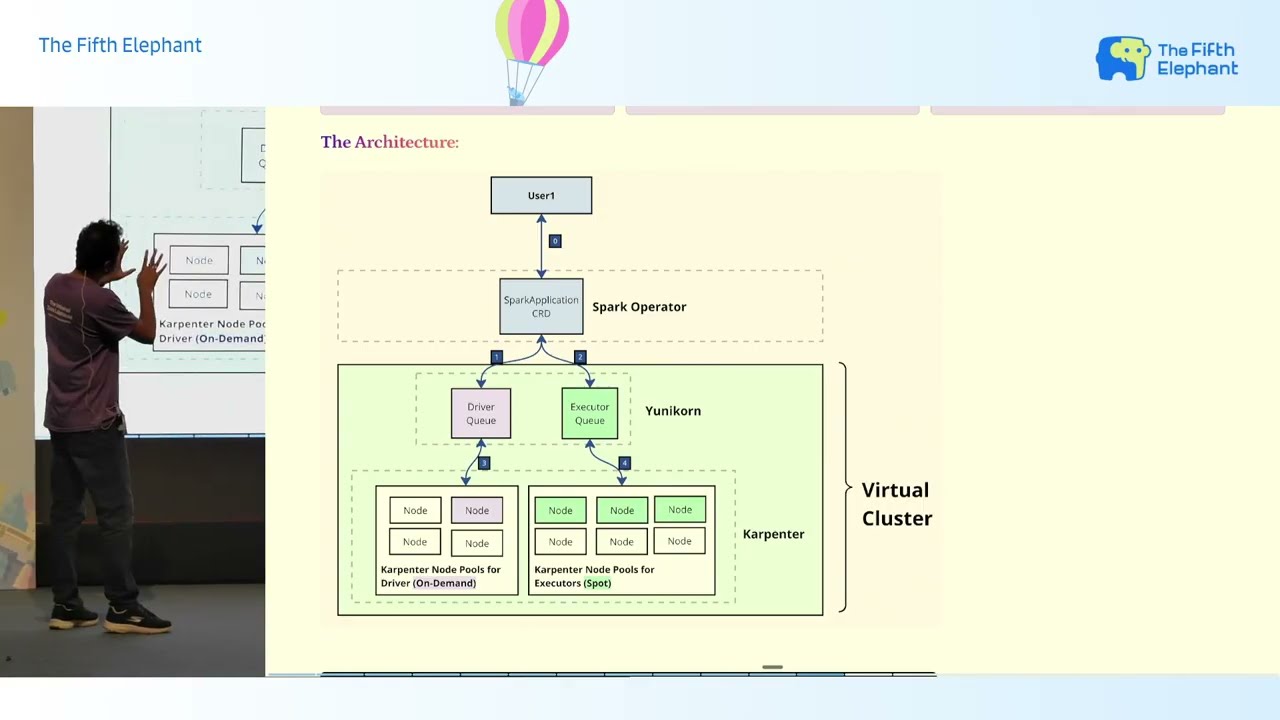
The third is Spark operator. If you're
running Spark job, the
operator is basically If you're
familiar, you can submit a job as a
YAML, and that makes it easy for you to
run a Spark job in any Kubernetes
environment.
So, if now we'll go a little bit more
into like how you can use all three to
do a like like a real optimized resource
management.
So, let's say you are a user.
The first step is you submit a Spark
job.
It goes to It's It's a CRD. It goes to
the operator.
Operator spins your driver and executor.
Behind the scene, what you will do is
you can have like a unicorn queue. You
can have one queue or you can have
multiple queue. You can put driver in a
driver queue, executor in a in its own
queues.
Now, all these pods now when they like
then you map the queue to particular
carpenter node pool. So, what happens is
the driver can get scheduled on an
on-demand instance versus the executors
can get scheduled on spot instances. So,
what did this what this do did is
basically give you a
nice multi-tenant system. You can have
different queues for different
customers.
There can be a different setup at the
carpenter level.
This instances with NVMe, non-NVMe,
uh EBS, whatever you configure, you can
make sure that the allocation is right
that. It's a much easier layer to
operate if you if you stack them well.
To give an example like this is how it
is today in one house.
We have a UI. So, user can go just say
that they want to create a cluster. So,
what we do is we created abstraction
going to a virtual cluster.
They specify the type is Spark.
They can specify min-max resources on
how many instances they want. They can
specify what kind of worker and drivers
they want like workers are maybe
executors are larger, driver is smaller,
whatever depending upon your workload.
And then you can have a some setting to
say is it on-demand or spot. So,
this that's it. This thing goes behind
the scene, sets up some queues, some
carpenter node pools properly. Now, from
there on, the user experience is very
simple. They submit a Spark job. The job
goes to the the via the CRD and it just
runs on the optimized infrastructure.
And you will get a full isolation of
resources.
Uh you can even do priority management
through it. So,
it runs pretty well.
The challenge in implementing this is
yeah, we got to own the integration. All
of these things you have to build
yourself, but they're pretty stable and
mature technologies at this point. We've
been running them for really long time
now. So, I can tell you that yeah,
wiring them is hard work, but the the
benefits are plenty.
The last problem I want to talk about is
chargeback. So,
obviously you are running a multi-tenant
multi-team setup and you want to have to
make sure that you know, you have
chargeback to the team that is utilizing
the resources. So,
challenges there is you want obviously
something that is trustable.
You want something that is like has good
observability for analysis and capacity
planning as well.
And it needs to be quite reliable,
right?
For you to make decisions on. So, it has
to be like a single source of truth. It
should reconcile with your cloud bills,
right? Because ultimately
you want to make sure that everything is
correct here.
So, how did we do this?
So, let me So, we use two standard open
source technology pieces. Cube state
metrics, which is which exposes a lot of
Kubernetes metrics very easily
accessible to you. And then there is
open telemetry which can collect
metrics.
So,
the implementation is simple. In each
data plane, you run an Otel scrapper. It
scraps the metrics from like from the
jobs, the state, unicorn, everything,
and then puts them into some kind of a
storage. You can use cloud storage cloud
metrics or you can use Prometheus.
I will suggest you prefer cloud metrics
instead of Prometheus because that's
more accurate. And then you use those
metrics to consume in your control
plane, store them in billing for like
long-term DB capacity prediction
analysis, all of all of sorts.
Trade-off, yeah, you got to you have to
build it again, same, but it's it's
pretty mature at this point.
All right. So, coming back to the
trilemma,
the
like we said, if you build a data
platform in your account with the steps
that we mentioned, you can achieve all
three.
And you can have ease of use, a nice
networking stack that works with CI/CD,
everything. You can have great
performance by choosing either you use
Comet or Gluten if you want open source,
or if you want like you're okay with
like a vendor, you go for Quanton, and
you get like a most fast Spark in your
account, in your settings. And then you
can save like you can claim your cloud
discounts that you have
with committed usage.
So, I'll just close this on like a last
point that
you know, till now all the data
platforms were talking about managed
offering.
But with AI, this thing is changing now.
Managed just mean that, you know, I'm
managed like some basic layer of
management, software patching,
everything.
But
the even after using a managed platform,
you still have to do the hard work of
like tuning the Spark jobs, right sizing
the cluster, capacity planning, handling
on-call pages, right? So,
the hard work is here, right? That's the
operated part. That's the operational
work that you have to do.
And we believe that
now with AI, the value or the the value
of the label managed is diminishing.
There's there's not much there. The
future is going to be more like operated
SAS, not a managed SAS, fully operated
SAS. And agents are going to play a huge
role in this operational work.
All right. So, what can you do?
Using all this information, you can go
build it yourself. It's definitely worth
the effort. If you're
evaluating some other vendor, then you
should ask these questions that where is
my computer running? What is vendor's
incentive to speed up? Right? It needs
to align, right? The skin in the game.
That they they need to align so that,
you know, both benefit from this. And
then third is who benefits from the
cloud provider discount. Are you Are you
getting your the discount for your
workloads?
Uh
you want more information on this,
please check Onehouse. We have We like
this is the working example of
everything we talked here.
Check onehouse.dev. This is
specifically about Spark and running
Spark and cost analysis and everything.
There's a lot of information there on
the site. And uh yeah, Onehouse uh lot
of the founding team at Onehouse is
contributor to Apache Hudi, Apache
Xtable. So, we are do check out our open
source projects.
Thank you.
Questions?
>> Hey English, thanks for the talk. Now,
can you elaborate on what kind of
complexities does AI [clears throat]
bring to the table? Because you
mentioned that there's a control block
and data layer, right?
Now,
uh
when it comes to deploying something
like agentic and control, it means that
I'm literally expecting anything to
happen in data. It can access any data.
So, there I feel like control block
would
would be the easiest way to lose control
if I start introducing agents there.
>> Uh we Okay.
Two different parts. Uh help me
understand the question. Are you talking
about running agents in control plane or
data plane?
>> Uh in control plane.
>> Okay. Uh to do what?
What kind of agents are these?
>> I I wanted some access some data, some
some user-specific data.
>> Generally, the the principle that you
should follow is
data should never leave data plane.
Okay? Only the metadata or some sort of
orchestration should happen between
control and data plane.
If you want to build agents that
accesses data, put them in the data
plane.
The
And then you can expose them to your
internal customers through internal
networks only. So, your data is never
exposed outside. So, let don't never let
your data go outside your data plane.
That that's fundamental.
>> Got it.
Thanks.