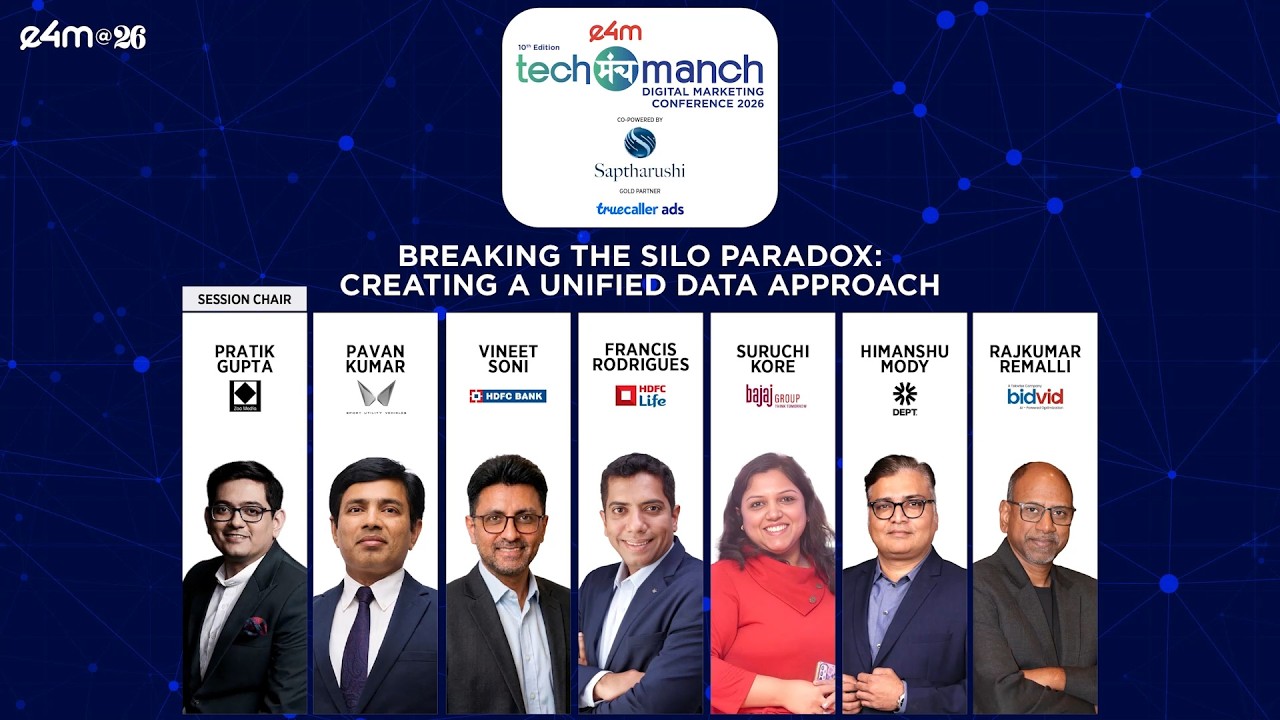
Breaking the Silo Paradox: Can Brands Build a Truly Unified Data Strategy? | e4m TechManch 2026
Watch on YouTubeVideo summary
The panel explores a fundamental shift in breaking data silos by moving beyond simple aggregation toward organizing data usage around internal human workflows and customer journeys, emphasizing that modern buyers are self-directed and require validation rather than traditional persuasion. To address this, organizations like Mahindra Auto have implemented unified platforms accessible in real-time across marketing, quality, and product development departments to integrate diverse sources such as sales teams and connected vehicles for hyper-personalization. Similarly, HDFC Bank counters internal resistance between offline and online divisions by prioritizing a holistic "customer experience" goal over attribution battles, utilizing tools like QR code logins to eliminate distinctions between sales channels while providing leadership with comprehensive insights into app issues rather than fragmented metrics.
Beyond technological implementation, the discussion highlights that true alignment must begin within corporate culture and brand identity before technology can succeed; Bajaj Group stresses that employees are key stakeholders whose internal belief in a product is essential for external communication success across diverse manufacturing units. Raj Kumar reinforces this by asserting that team alignment often breaks down due to conflicting objectives among buyers, implementers, and end-users unless requirement gathering considers the absolute needs of the final user from day one. Consequently, industries must transition toward hyper-personalization via AI-enabled continuity, ensuring customers do not start from scratch based on their specific context and emotional needs, a strategy exemplified by Virus Pains which rose to third place in market share after establishing such an integrated structure starting with a blank slate.
Ultimately, the consensus is that while artificial intelligence accelerates unification through applications like call auditing or WhatsApp channels for rural farmers, it cannot fix structural silos if the underlying data layer remains disconnected; therefore, organizations must redefine roles so that Customer Experience leads across the entire value chain while marketing and IT function as support units. This transformation requires a new key performance indicator focused on "unified understanding" rather than merely removing existing metrics, with responsibility resting ultimately at the CEO or boardroom level to drive value creation across marketing, IT, and compliance functions. Stakeholders recognize that failing to break these silos will hinder future outcomes, necessitating different hiring strategies for marketing and CX teams to deliver results in an era where data usage must align closely with emotional decision-making processes.
Read the full video transcript
Thank you. Uh
I think uh it was firstly great to see
that uh the the topic did not have AI
anywhere which meant that we're still
we're still having a conversation that's
that's relevant and not going to be
relevant not that AI is not but uh the
intent of the conversation is obviously
to break down where I mean 5 years ago
this conversation would have been all
about data and putting all the data
together. I think uh if we are now
having a conversation of putting data
together then it's absolutely the wrong
panel but now it's about how the data is
getting organized how the data is
getting used and how while we are
solving for the data journey have we
solved for you know internal human
interventions internal customer journeys
internal stakeholder journeys so that
we're able to use the data in the right
sort of a format for all of the
marketing activities or for any of the
other activities that we'd like to do.
So the intent uh the intent of the
conversation like I'm going to try and
make it as conversational as possible.
So please just jump in whenever you feel
like I have a whole host of questions in
case we want to do that boring route.
But uh but the intent is to just uh just
kick off a conversation and anybody who
has a point of view on that please
please jump in. I'll start with Pawan
because he's right to my left. Uh
because you're because he's in Mahindra
and Mahindra and for me the thinking of
it is that the customer journeys are now
becoming a lot more broader for you and
it's now becoming ecosystem journeys.
You're collecting data from your uh you
know from your sales your sales people.
You're collecting data from even the
cars that are coming through uh you're
collecting data from from the internet.
You're collecting data in all sorts of
forms and ways. How is that data coming
into a unified ecosystem that's
accessible
differently to different aspects of your
business and therefore what are the kind
of business metrics that you're able to
track or you're able to affect because
of this entire data journey hopefully
which has broken the silos already.
Thank you uh Pratip for having me. Uh I
come from Mahindra auto sector. So we
are into business of uh auto automotive
uh vehicles both uh ice and uh electric
vehicles. So the biggest shift which you
all know you have been buyers of uh cars
and SUVs for many years. Today's buyer
is a self-directed buyer [music] and he
has he or she has already made a choice
before they come to our showrooms or
they visit website. what all what they
need is validation whether their choice
is right and that's where the shift has
already happened for uh in last decade.
So what makes it interesting is to uh
find those insights and mine the data uh
in in what way they are actually
interacting with the brand uh whatever
may be the medium whether it's a website
or WhatsApp marketing or uh in the
showroom itself. So the journey customer
journey has multiple facets to it. Uh so
whatever data that is getting generated
we have made it as an unified source for
various functions to consume it uh on a
on on on a live basis. When I say
stakeholders even the stakeholder
spectrum has changed. Uh we sell our
vehicles to our dealer partners and in
turn they sell it to customers. So
dealer partners become our major
stakeholders in terms of understanding
these insights and consuming the data.
Uh so this unified platform what we have
has not just the lead uh phase when when
a customer walks in or uh he's uh
searching internet but it also has all
the previous informations of that
customer the previous ownership uh what
is he looking into uh and how do we make
a better sales pitch which is again uh a
various a platforms have come in giving
us models in which uh we can
hyperpersonalize what what needs to be
told uh in the sales pitch. Uh so this
data what I said is an unified data
right now and it is it is building every
every second that uh as we speak and
this is accessible to all the functions.
So in that way we have broke the silos
in last uh 3 four years time especially
postco [music]
uh we have been at it uh you know lot of
partners have joined in and uh we enrich
this platform on a daily basis uh this
is being primarily consumed by three
departments which I would like to
highlight first the marketing to
understand you know what the profile of
the customers today's customers uh is uh
secondly it is being used by quality uh
in terms of what customers are saying
once they bought brought into the brand.
Uh what's the product experience like
and the quality team is using every day
to improve the quality of the product.
Uh and thirdly, it is going back to the
uh uh drawing table in terms of product
development itself. Uh the design
department what we have they use these
insights in uh mining what is important
for the changing customer profile uh in
next 3 to four years to come. What
features they value? What is the
perceived value of the feature? how much
the customer is able to pay uh and what
are the strategies to retain how [music]
can be the forefront how can be at the
forefront in offering the features at
the right cost. So overall you know all
these who which were in silos have been
you know broken and it's an evolving
process um and
and this is how uh we at Mahindra are
approaching uh this breaking the silos
paradox.
>> Thanks. So I have lots of follow-up
questions but well we'll address them uh
as we go along. I think Venit to you uh
I'd be foolish to think that you guys
have not implemented marketing
technology and must have implemented
hundreds of those platforms already. Uh
but you know in my experience when what
what I've seen is the biggest reason of
mk not working is not because the
platforms don't work but because the the
organizational change does not happen
fast as fast as you like your data to
change. Right. uh and for you know for a
structure of HDFC Bank like yours where
that banking customer first to come into
your funnel and then to come into the
various different products that you
would provide. Uh while that
segmentation would hopefully exist
what is the biggest what is the biggest
resistance to change that you saw on the
organizational side that make the silos
a lot more prominent than products do?
So see ideally it's uh classic problem
in banking what we have seen uh
combination of multiple factors but if I
were to highlight uh let's say around
two to three bigger chunks of it
obviously the digital transformation the
technology at the base at which evolves
right and followed by technically the
attribution problem which is what you
see the newer brands these days the
likes of lens card the likes of Tomato
and all they don't care right uh one of
the biggest reasons with silos Because
if you would see I believe across the
entire list of all the brands [music]
which have been coming here and speaking
about what you could notice is that
there's a challenge between the offline
side the online in our BFSI world we
call it the assisted side the unassisted
that's one silo within the marketing
channel or the entire marketing
department itself there are multiple
channels which are operating that's
another silo right and then followed by
idly the transformation informationled
silo which is there as a part of the
entire organization right so these are
the silos which basically do exist and
which is what the brands do recognize
which is why you know I think all of us
are sitting here I've been personally
knowing Francis Manu that we that's what
I think all of us are trying to do we're
trying to break those silos personally
with HTFC bank if I were to give you
some glimpse of it what we are trying to
do is we're trying to [music] uh you
know address the area of the assisted
the unassisted battle right so if you
walk into the any branch of HDFC bank as
of today what you would notice is that
now we are no longer differentiating
between you know this is a customer
which is assisted this is unassisted
this is the business of this particular
uh you know teams XYZ and that's how
because the goal is very common right
the goal is about customer experience so
we've launched something called as an
expressway what it does is basically
irrespective of any channel a customer
walks into a branch they log in just
with the help of QR code. Nobody cares
about attribution anymore, right? None
of the brands are idally and I think
even if there are certain ones who are
still working in that traditional way, I
think it'll all evolve that you will see
that none neither the bank does that
because the common goal is experience.
They know that if they don't break this
silo, the customer experience is going
to get hampered. So that's the biggest
takeaway what I think that you know what
in the last two to three years what all
the brands are doing uh with HDFC bank
also with within marketing itself now
while we are talking about the upper
funnel within the silos itself which is
the unassisted assisted that's what we
have tried to attack and explicitly with
MK right and MK is now technically able
to leverage that fact it is sitting on
top of all the teams and it is actually
giving organization the direction right
so imagine the scope of Matek where
ideally the MD of the bank is
technically looking at the data which is
or the insights which are driven by
Matek right he is much more concerned
about what is going wrong with the app
and if there is anything if there's an
issue with the net banking that this is
all because it's all about the customer
experience right and that's what ideally
the technology is doing it's
automatically breaking the silos uh
while we are not talking much about AI
that's what even eventually AI will do
it will bloody break the silos, right?
Which is what is
making this industry run on a very
traditional model, right? So that'll
automatically happen. Uh let's see how
it further goes over the next few years.
>> Thanks, Venit. I think Francis, uh your
line of business is what most businesses
really would love for, right? You have a
customer relationship for minimum 20, 30
years, right, in life. uh but that
customer relationship in so many of the
cases is so long drawn and has so many
channels and back channels and
intermediaries over there that for you
from from the way that I look at it
right data is one part of it but to
manage that entire customer journey
through through all of the data
transitions that you are seeing must be
probably some of the hardest bits right
u and and for me the the question I want
to ask is that data has one side of the
story the emotion has another side of
the story and for you the marriage of
the data and emotion in your in your
line line of business becomes the most
important data continuum journey that
you must that you must take on how do
you manage that
so we try to that's the honest answer
but I think you know you touched upon a
very important thing you know while vin
spoke about you know sales attribution
and sales attribution as a big silo and
that's true across BFSI I think the big
one for insurance uh is also you know
something which is slightly
philosophical right what is the silo
between moment of sale and moment of
truth. Right. So it's a time [music]
when you've actually kind of sold the
product and the time at which as you
mentioned you know 40 years in terms of
term insurance 20 plus years in terms of
savings and ulips etc is it's a very
long sort of customer journey and each
point of the journey what is a uh what
is the moment of time at which the
customer really is you know in some
sense getting benefits of your product
using your product and what is he
feeling at that point of time. So that
basically is the key silo to build great
token and what happens is that you have
a lot of energy, time, attention in
terms of uh you know how do you kind of
improve uh you know sale. So whether it
is you know a lead propensity, customer
propensity, next best offer and so on
and so forth, right? You also have you
know a whole bunch of uh you know uh
traditional ML there's now even a lot of
AI in terms of sentiment analysis and
everything else around you know what are
customers feeling at a given point in
time uh who's likely to churn and so on
but there still exists that silo between
the two saying that you know how do you
kind of ensure that whatever you've been
kind of you know you've promised the
customer at a given point in time is
that promise playing out and playing out
over those 10 20 years right so I think
That basically is the key silo to be
broken.
>> That's a that's a very very difficult
one and I and I'll come back to you
because you need to know the emotional
changes that the customer is basically
going on and obviously relying on either
your relationship managers or your
agents and and to keep continuously
feeding back that information into your
data journey for me would be the most
tricky part of of your of your
ecosystem. But to to you Suruchi, I
think uh you're the only one over here
who comes from the corporate
communications background. So everyone
who wants that change to happen
internally uh is obviously going to look
at you for for all the help and support
to ensure that while they spend the cr
of rupees on getting the marketing
technology platform, the people who are
running the platforms are are also
looking at the change that that is
coming through it. U as a person who's
leading that charge and we'll talk about
the other stakeholders that you that you
obviously deal with. uh what do you
think is is the most important driver of
that cultural change within the
organization or the levers that you're
able to pull to be able to make this
change happen because uh the seauite
obviously wants it right but the seauite
can't do anything till the machinery
doesn't start to to flex its own muscle
so what's the what's the biggest changes
that you've been able to drive and how
have you been able to drive it um is is
[music] my first question to you
>> yeah thank Thank you Pratik and uh such
a valid point because uh uh we are all
working towards our specific department
and we are talking about silos. So uh
I've been fortunate to really uh be at
the top level and work uh at uh even in
my earlier jobs at network marketing
levels for media Z uh when I was with Z
network and now with Bajage group I'm
part of the uh corporate communications
piece. So we have two of our
manufacturing industries which is Bajach
power business, Bajach sugar ethanol and
Bajach consumer care. So here uh I'm
able to really see what different
cultures uh the uh employees are coming
from even the kind of business uh
strategy or communication that each of
the businesses are putting out and at uh
that at the same time how is it uh
really tying back to the Bajach culture.
I think that is something that uh has to
evolve for any organization if we are
building a brand and especially for
legacy brands. But uh of course uh when
uh you want to be uh having that
relationship with your consumers with
your stakeholders that is the kind of
communication that's really important
that uh you are true to your
organizational values and how it all
ties back to the uh brand perception
that's been there for all these years.
So when we are communicating I think uh
whenever a new business strategy is made
it's uh somehow needs to tie back uh to
your original uh brand identity and that
is when uh your customers will really
relate to your brand and that is when
they will really have the trust that's
uh uh going to be uh an important factor
for any brand uh uh lead generation or
uh loyalty of consumers that we keep
talking about. So I think uh at [music]
that level when we are talking about
silos I think how things are changing in
all these years and uh when uh Pavan was
talking about the uh the the departments
that are using that data set. I think
every department today should have uh or
rather does have but they are not using
that kind of uh access to the data
that's available uh in today's time. So
somewhere it's really important that we
realize that uh all our strategies
because we are all ultimately working
towards having that brand uh loyalty
from our [music] customers. So how
that's going to make a difference uh
from the starting point making a
business uh pitch uh may it be a a new
product launch or a new uh corporate
brand campaign uh anything for that
matter how it's going to tie back uh to
your identity. I think that's a very
important point uh that we uh need to
realize and today when uh uh we are
talking about content that's being made
uh on the go how uh Jenz's are working
out uh with uh content creation on their
phones and everybody is a content
creator today. So our employees uh are
really our uh most important
stakeholders. if they don't believe in
what we are going to sell to the
consumers, I think it's never going to
translate uh to the outside stakeholder.
So that is a uh take that I realiz being
at this.
>> Thank you Imanu. We're done with the
brand guys.
Uh my clear question to you is what
breaks first the technology, the process
or the alignment between teams? It's
still truths. Personally I think the
alignment breaks first and everything
else then crashes along with it. Right?
So um start things start building with
alignment and things break with uh end
of alignment. So that would be uh the
answer specific answer to your question
but uh you know underlying why do
alignments break something that I would
share from my experience that uh one of
the things and we are into technology
services and we implement enterprise
solutions for brands and what I've
usually seen is the team that decide to
purchase a particular way of sol solving
a problem the team that is involved in
implementing the solution and team that
eventually is going to use the solution
right is are are like completely
different people in an organization with
different objectives and u so when
rubber meets the road you know uh if you
have not really taken the necessary
steps
u you know uh in it typically what I
have seen and that's where we we end up
being more successful uh in in uh
delivering value in the [music] first
version itself. We have this option of
telling clients we as in in general the
industry like next phase [music] plan
right so so this whole next phase thing
comes out because no one really thought
through u you know uh the need of the
end [music] user who is going to
actually use the solution. So I think
alignment has to start even before the
first write of line of code is written
or even before anything is thought
[music] through. I think the uh
requirement gathering needs to happen in
a way which keeps in mind the needs of
the absolute end user uh and then evolve
from there. So if that happens and then
obviously things keep changing but uh if
if things are aligned at from that
perspective it gets built and if that
alignment breaks starts breaking.
Thanks. I think uh Rajumar I think I'm
going to ask you a a very very simple
question which has I'm hoping a very
complicated answer. Uh but what's
happened is that data silos are building
uh individual channels right whether
it's a particular team or whether it's a
particular outcome. I have personally
seen lots of organizations being able to
win at individual channels but yet lose
the customer.
Why do you think that that sort of an
ecosystem with the complexity of
technology that we have access to today
with the filteration downwards of data
that we are seeing today is still not
the complete answer for customer
success. And I'm broadly using that term
because customer success could be
defined in multiple ways. uh I've
usually seen that best S so over here,
best S so over there, best number of
calls, best number of sales, best number
of intent. But when it comes down to the
last layer, um I've usually seen these
data silos or data paradoxes exist in
almost every ecosystem. And why do you
think that that that actually happens?
the fact that you know it's a fact that
these exist [music] and uh the answer is
actually very simple it's not very
complicated because different channels
collecting data from different places u
I think the one single place to um
accumulate all that is missing and it'll
be hard it it's not fair because we're
all humans and each of us is protecting
our share of data and there has to be
[music] someone at the top knitting I
mean orchestrating all this together so
um the answer is quite simple example
human behavior I mean everybody is
protecting their data and everybody's
holding on to their stuff uh
well till humans exist uh you know that
will continue to be in some way till
till we find some channel that can
really go through this and uh hold all
of this together and give one single
picture and
>> how have you been able to navigate your
clients through these through these
times
>> uh it's not been easy it is not going to
be easy uh well in in my case uh uh you
know different people have to buy the
idea that you know this can do this for
them uh but it's not easy it's not easy
it's the same struggle that any [music]
any one of us faces whether with so for
me that the consumer is the corporate
consumer so uh it's actually even
tougher [music] so it's not as simple as
the
>> thanks uh pan I want to I want to bring
in the aspect of of emotion right like
we're still we're still India buying a
car for lots of people is still a highly
emotional emotional decision and I'm
trying to get in the the absolute
structure of data and the you know data
doesn't discriminate kind of a kind of a
philosophy with a deep rooted emotional
truth emotional reason for a person to
actually buy and this must be a data
input and this must also be a data
output right like what you get from your
dealers and what you get from in your
showrooms as to why most people are
making a decision and how some are able
to tug the emotional cord a lot more
than they are able to tug tug a data
cord in a in a place where you're trying
to create that balance between emotion
and data. How have you your sector your
company been able to manage this
balance?
Very very interesting question and uh
this is this is one differentiating
factor in breaking the silos. uh
especially when emotion travels across
the departments uh traditional
departments that's the unifying force
you know to think uh giving an unified
experience which is [music] consistent
both in showrooms and workshops and I
have to break this journey between
showroom and workshops it's very
important uh for a product which is you
know average price uh of which is about
20 22 lakhs today uh uh in the SUV space
that we are And uh emotion plays an
important role. Uh it's not uh utility
vehicle that they are buying you know
which is low priced. Uh this is very
very close to our customers and hence
how they experience the product. What
emotions do they display after buying
the product that's where the story
starts because that's where the word of
mouth uh influences the other buyers to
come into the into the showrooms. Uh so
we track those emotions uh on a daily
basis. So the cycle starts there. I'm
going back to what I said earlier to the
first question. This emotion gets
translated obviously in form of data
insights. Uh and uh I have to bring in
AI here. We have deployed various AI
models across the touch points starting
with out sales experience. We capture
every element of uh how the customer is
interacting with the machine, the
product, the SUV. uh for example
the customer while driving the vehicle
he can give a voice input to Alexa which
is integrated into the infotainment
system of a problem that he is
experiencing then
if if he experiences some noise from
door I'm taking an example uh he can
give an voice input and that gets
recorded into the main data platform
unified data platform that we have and
that is being consumed by the quality
the product planning and also the
customer experience [music] teams. What
do we do with the customer and what do
we do with the vehicle with with the
product? What do we do with the vehicle
when it comes to the next service? This
is reactive but we are using AI in lot
of proactive stuff and most of the
connected cars uh have uh lot of data
being generated every second. We use the
data to predict lot of models are
available and we have deployed the best
uh they predict what can go wrong in the
vehicle and we call the customer uh and
tell that you know this might go wrong
so please come and uh get this repaired.
So it we are touching the emotional
[music] emotional space of the customer
and which is interest building uh lot of
trust resilience uh towards the brand
and the affinity is going up. So that's
an after sales experience. I'm moving to
the uh sales experience. I'm starting
with the showroom journey and uh and in
in [music] showroom you know we we have
deployed uh we have envisioned a lot of
design thinking there but our partners
normally himu they come up with the same
phrase next phase okay so our
aspirations are high uh but whatever we
have deployed we have deployed similar
to you know scanning a simple QR code in
identifying the need what what their
need is because it's no more about
engine power or uh the speed or the
acceleration or the features. It's about
the experience of the product, right?
Especially in electric vehicle space.
It's all about experience. You know that
that that vehicle can do anything for
you. Uh and we have seen a huge success
with our new products XCV 9S and 9E6
B6. So there the customer profile is
completely different. They are
completely emotionally attached to the
vehicle. uh and first of all they are
buying into a new technology uh with lot
of aspirations and uh and they come to
the showrooms with so much of uh
information that no consultant can
actually you know understand those
emotions and there we have deployed AI
it is in pilot phase uh again there we
capture a lot of emotions why that
vehicle is important to them beyond
[music] specifications and features uh
use case range how how much they drive
where do they go how do they interact
because electric vehicles have a lot of
tech stuff built into that. So emotion
sorry I'm keeping it short I can go on
and on. Uh emotion plays an important
role. Uh one thing which I would like to
highlight is that the AI is not just
breaking the silos actually it is
breaking the structures within the
organization. Uh because the data is
available to everybody to consume. Uh
like a design engineer need not go to
somebody to ask how the customer is
exper experiencing the product. he knows
it and he can do something about it live
right so so so I think uh we are just
starting lot of interesting stuff
fascinating stuff is going to come our
way
>> thanks thanks Francis I think for you uh
unless somebody wants to chime in uh you
are you are at the extreme end of the
emotion ecosystem and in your case you
actually don't even control it most of
the times right like when you're dealing
with agents and when you're dealing with
people who are well they they pseudo
belong to your organization but really
don't belong to your organization. How
does that that emotion out and data in
of the customer actually work on this
customer journey for you?
>> So I think u you know customer emotions
are there across different elements of
the cycle and there are certain things
which are absolutely controllable. the
kind of experience that you're giving
the customer uh the kind of quality of
sale that has been done what has been
promised has NVM is selling or not uh
the kind of products that you're
releasing in the market the charges on
some of those products and a lot of this
has has you know kind of improved
significantly from a customer's
perspective uh over a period of time I
think we uh can thank the regulator for
a lot more sort of u customer specific
products which are being launched uh the
whole uh you know missale thing which
used to exist as as a huge you know sort
of black spot on the industry is is is
more or less not there right now. But
having said that there is still a bunch
of things where customers get emotion
because uh you know most of the times
buying an insurance whether it's an
endowment plan or an investment plan or
a term insurance is a long long-term
sort of plan. uh in the case of uh you
know uh investment [music] plans you
know you might have invested in uh say
an index fund the index fund or the
index itself is not doing well since
you're tracking that that itself is not
how do you separate that emotion saying
oh you lost my money from the kind of
experience that you can give as an
organization
so I think some of these things are uh
you know critical to manage uh again uh
you know a lot of times uh you know the
principle
uh sort of payer in in India is
basically the uh the male patriarch
usually
but uh the knowledge about the insurance
policy and where it is etc is not very
well kind of communicated to the rest of
the country. So the average time between
say a a death occurring and somebody
coming to claim an insurance is
basically usually around 3 to four
months as big as that because a lot of
times you did not know this existed how
things are and so what we're trying to
do in a lot of these cases is you know
get a lot of data get basically help
people prepare their you know little
book of legacy so to speak the
equivalent of say a will
help people and all these things such
that you know there is a lot of data
which is coming in at different points
in time the nominee the beneficiary
what's happening and so on and so forth
which takes you know which which while
you know being cognizant of the emotion
in place here there is you know usually
a loss a big loss right still ensures
that data comes in and you're able to
kind of at least give a great experience
on things you can control
thanks I think uh you know with with
with Vinit with Himmanu and with Raj
Kumar I think I want to get one answer
to this question. Right.
Everybody is moving into this unified
siloed ecosystem. I'm going to take a
leap of faith and say AI will break
those structures. Like you say, not only
accelerated it, but like in any
ecosystem, if the structures don't
exist, AI is not going to be the magic
pill [music] that that that any that
will change anything. U for me, it's
clear sitting on the inside or the
outside that the silos are still there,
right? like everybody's trying to unify
that entire ecosystem. Uh if I had to
open out a broad question of if I had to
remove one KPI, remove one KPI that you
think will destroy these silos,
what would that one KPI be both from the
brand side and both from the product and
agency side and why will that KPI
resultant break the silos that you guys
that that internally may exist?
So see uh as I said even while you know
we begin this discussion there is not
just one uh ideally one section which is
you know resulting into a silo but if I
were to say that and the example which I
even said about for example a lens card
right the channel attribution the
assisted the unassisted I'm dead sure is
across all of these guys were sitting
across all organizations it exists even
today so till the time you don't take
care of that attribution issue which is
a subset of multiple KPIs within the
company I think that silo will still
remain and the customer experience will
obviously take a backseat so that's one
big which I see if I if I may add I
can't find KPI to be killed but there
needs to be a new KPI which will unify
you know all all all all the silos silo
functions or departments. I think we
should approach from that point of view
>> and and and and whose responsibility is
that and I don't I don't I don't try to
try to like you know make it sound like
a small problem right but because when
when we are discussing this from a from
a technology partner agency partner
point of view our biggest conversation
is who's my stakeholder is it the CMO is
it the CIO right and in today's day and
age with AI coming into the ecosystem is
it the CEO right and therefore whose job
is for that unification parameter to
exist hopefully for a longish period of
time before that total deployment of
stage two stage three as as as he said
actually happens right and if that
unification has to be held together by
somebody who's holding it together
I think see what's happening is the
CMO's job is changing right in today's
world it's no longer about just running
brand campaigns or marketing it is also
about focusing on [music] the business
aspect So from a marketing side while
there will be tech teams while there
will be IT teams and there'll be
compliance and everything in the
background but forefront of it will be
basically value creation right and which
is where I believe that all of us are
gunning for so it will be technically
from it will be sort of overlapped with
multiple departments but the core job
will still be focused on those five to
six guys who are sitting in the
boardroom and they're discussing on the
value aspect which
technically giving you value for the
company right so that is eventually what
you will see in the next four five years
everybody will ideally follow in that
direction
>> yeah so I just wanted to add that uh for
every organization I think at the
business level the that KPI will have to
be set uh uh for your what is the vision
of that particular business and that is
when I think all this information all
the data is going to be utilized in the
right way by all the departments uh uh
that are sitting there to achieve that
vision of the uh brand because otherwise
all the data is available, AI tools are
available but how are we utilizing that
is uh still uh not uh unified at the
brand level. Everybody is interpreting
it in their uh fragmented manner for
their particular department. marketing
wants to get uh the brand uh uh uh
availability or visibility and uh sales
is has a different targets. Corporate
communications has a different target.
So yeah, I think the business team will
have to set that KPI for every uh
organization.
>> I really like the idea that you know
instead of removing the metric add the
metric of you know how many unified uh
understanding you have. I just want to
expand a bit on how do you define this
unification of data, right? I mean um
one thing one thing is that your CRM
keeps capturing what you know about the
customer. You know they inquired with
you, you have their phone number, you
know what product they showed interest
[music] in and things like that. But if
you are really an omni channel
experience, right? Um you know or for
that matter sometimes even digital
experience, right? What does a unified
profile really mean? you know, I'm
coming through a device to your website.
I'm coming through a uh another
different devices to your website and I
can't be a new customer to you uh every
time I change my device, right? Or every
time I change this thing and the the
patience level of people have gone
really down. If I've already expressed
myself to you uh uh to a brand and if
I'm interacting irrespective of which
channel I'm interacting with, don't make
me feel as if you don't know me. Right?
So that is the expectation of the
customer that I've already expressed
myself to you. Maybe on Facebook, maybe
on uh in my in your showroom, maybe on a
call center, maybe on an online website,
you know, but once I've [music]
expressed myself to you, please retain
that information about you and use it in
my advantage. Right? So from a
unification point of view, one is what
do you uh the what is of the customer
and and and the [music] other things are
the events related to how they have
interacted with you. But like for
example in case of life insurance, you
know, before buying the policy,
generating the code, interacting,
understanding the policy, these are all
touch points and then eventually making
a purchase and then they renew every
year and stuff like that, right? So not
just knowing um you know the uh the what
do you call it the demographics or the
the records or profile of a customer but
every touch point and what does it mean
for them and giving that meaning and
context [music] and then utilizing that
to make the customer experience better
is is something that brands need to st
define as what unification means.
>> Yeah. simple actually
I think
but uh it's I think it's a failure of
the CEO or or whoever is the guy at the
top to it should be his KPI that all of
this comes together it's not the fault
of any one department because
okay I won't do justice to this panel if
I don't ask an AI question But uh uh
how has this silo been
broken, enhanced, made faster, unified,
whatever could be the parameter that uh
I already got an applause. uh [laughter]
what would be the parameter for uh that
or what would be the implementation for
any of the parameters of success that
you have seen with the small
implementation of AI and how is it
different from the mk that you have
deployed previously
this for everyone
so maybe I'll start I think u one of the
things that we recently started
deploying is uh basically ly call
auditing using AI. So it's simple we we
I mean in life insurance most sales are
assisted sales. So there is a contact
center and uh people uh call up the
contact center. The contact center
reaches out for certain set of things.
Uh most of these conversations were not
sort of they recorded but nothing else
was happening. There was some 1% 3% 5%
auditing etc that used to happen. So the
idea was let's take all of this
information let's basically transcript
it let's diize it and then let's learn
from the conversations is what what's
happening and what can happen uh the
number of things or uh that that really
changed as a result of that. So one was
you know just within the contact center
efficiency right so each agent had a
specific [music] feedback of what he's
doing well what he's not doing well in
terms of various aspects of the sales
process right which is basically
generating rapper doing need
identification pitching the product well
managing any sort of objections and
creating a sense of urgency [music] and
so on and so forth. At the same time a
lot of conversation of what the customer
is talking about became very good inputs
for the marketing team to go and build
you know uh bottomfunnel creatives
around.
So that basically was a feedback loop to
kind of go back and say hey these are
the kind of creatives which should work
and then you know this same loop can
actually kind of close both ends because
now you have the creative the
conversation and everything else kind of
looping into the same place super
basically uh what's happening now is
while we are trying to say that you know
we don't need AI and all but we have to
understand the relevance of what is
happening 5 years 7 years back or 10
years back you were looking at digital
marketing per se which was in itself a
silo right so you had a digital
marketing within channels across all
brands now what is happening is
basically you if you want AI to
technically work you need to have a mate
layer which is basically spread across
so that's the idea so if your mate is
basically not connected which is what
even I think in a way what Himmanu was
also highlighting the omni channel the
true omni channel will not happen unless
you don't have your mk bit in piece you
know it if it is not connected then you
are done because again AI will run in
silos so until unless the middle layer
is not sorted which is basically your
core which is driven by mate then your
silo problem will still continue to
exist even going down the line even in
the next 5 years right so that's a
challenge
>> yeah so uh I think you asked about how
uh it has helped uh us uh one uh example
if I may just share like we have around
five lakh [music] sugar cane farmers
that are associated with Bajandustan
sugar so uh with EI coming into picture
we've started our WhatsApp channels and
how we are reaching out to these
communities and we have 14 sugar mills
so every mill has a WhatsApp channel
attached to it so uh for that kind of a
rural audience this is really a
pathbreaking uh uh communication that's
coming in from the uh from an
organization who they are uh really
dependent on like pro uh share like
they're working on an entire if uh you
know uh sugar production is a six-month
business like uh the sugar mills only
run for [music] 6 months and the other
six months they are producing they are
sewing the crops they are uh harvesting
the crops so this is a channel that has
given them uh u like they can really
reach out to us and ask anytime the cane
manager measures in their regions uh on
how uh we can make the crop better, how
we can make the yield better, if the
climate is changing, if things are
changing, they are aware of this
information. So I think that way uh data
and uh AI is really helping us move uh
forward. But then of course uh what
we're talking about how we can utilize
this data in the right way [music] and
make it uh a point to really serve to
our consumers uh and solve their
problems. I think that's going to make a
difference for all uh of us uh this
level.
>> I if I may add uh to the views already
expressed uh I think AI will play a
major role in hyperpersonalization
because AI at large is available to
every consumer [music] sometimes free of
cost uh sometimes on on subscription
basis. This hyperpersonalization I think
is going to drive how the new models
will get deployed adopted uh across uh
across the channel
across the omni channel. I mean uh I I I
was stuck with your earlier question who
should be responsible for you know
bringing this unification. I think there
is no straight answer there. It's food
for thought and it I think it will also
depend [music] on the industry right for
for manufacturing industry it will vary
for IT it would vary right uh what will
work across the across the sectors is a
cross functional approach because people
have to understand the emotional part of
it right how data is going to uh get
used for taking emotional emotional
decisions uh which are in in sync with
the real time based customer
expectations you Customers are real
time, media is real time, consumption is
real time but the organizations are not
real time they are old-fashioned. You
know they are still working uh you know
with particular structure which I
referred to last time. So a can play a
significant role in breaking these
structures and bringing this uniform
approach and there is no single owner.
It's a joint responsibility.
Personally I think the way the aug
structure needs to be defined um has to
be reorged in a way that leads to the
[music] success. I mean to give you an
example that we interact with many
brands and we've worked with many years
we've been working with SDFC life we've
been working with SDFC bank. One of our
recent experiences of success was Virus
Pains, right? So the way the org I mean
they had the opportunity of starting
with a blank slate, right? Uh so they
they had the opportunity to define the
[music] org in a way which aligns to
their mission and stuff like that.
Right? Now in that one of the key things
that I observed was on day one they had
a customer experience uh uh division
right and they were they the customer
experience division was not limited to
defining experience for uh D2C customer
experience was for across the entire
value chain and and you know everything
else the marketing the IT or anything
everything else were more of a support
function to ensure that the customer
experience objectives are met. I think
it does not happen easily in all the
other organizations u u you know and
that takes time but I think to to his
point it would vary from industry to
industry but you know wherever a clean
slate is there having a customer
experience department defined which is
across the value chain you know I think
u will make a huge difference and just
to put the outcome in place when they
started they were number nine in terms
of market share today they are number
three so you So it it shows the the
outcome also shows that it really works.
>> Okay. I think I think we're we're we're
out of time. Uh but uh you know for me I
think the few takeaways is that
different industries like you say have
have different needs or are at even
different levels of maturity. Uh the
data unification away from silos will
get into hyperpersonalization. But I'm
I'm a big fan of the concept of hyper
continuation. Right? Basically exactly
what he was saying about the ability for
the customer to not start from scratch.
Patience is dwindling today. My context,
who I am, where I'm calling from, what I
have interacted with you previously,
right? Like I mean it's great that we
have somebody from HDFC Bank and HDFC
Life. They may see themselves as two
different organizations, but for the
person sitting on the outside, they're
dealing with with HDFC. Um and apart
from the legal problems that this this
may throw up uh but but the intent of
the personalization now going two steps
further right which is what I think um
AI will enable right beyond the
structures of the marketing tech that a
lot a large part of the mature
marketeers like you guys have [music]
already started to implement. Um and I
think that will be a fun conversation to
have probably you know a year or two
later where a large part of this has
started to get deployed um with AI. I
also personally feel that the context of
data and the context of emotion that gap
is going to grow further and the
simplification that the customer is
going to demand from you is going to
become bigger. Right? So you may have a
lot more context but to simplify that
context to something that you may want
to buy whether it's because of a data
ecosystem from their end or it's a
functional need at their end or it's an
emotional need at their end will happen.
Uh but anybody who's not made this
transition of breaking the silos will
not fare very well over the next few
years. I mean that's that's what my take
away from it was and and all
stakeholders have to come to understand
that this is the core of the business
and hence also hire differently. I think
marketing teams will get stacked
differently or customer experience teams
will get stacked differently and and
that's the change that will deliver the
outcomes that we all hope for. Thank you
so much everyone for being here. Um like
we discussed previously we could have
gone on for hours but uh I think we're
stopping them from something for sure.
Thank you.