Video summary
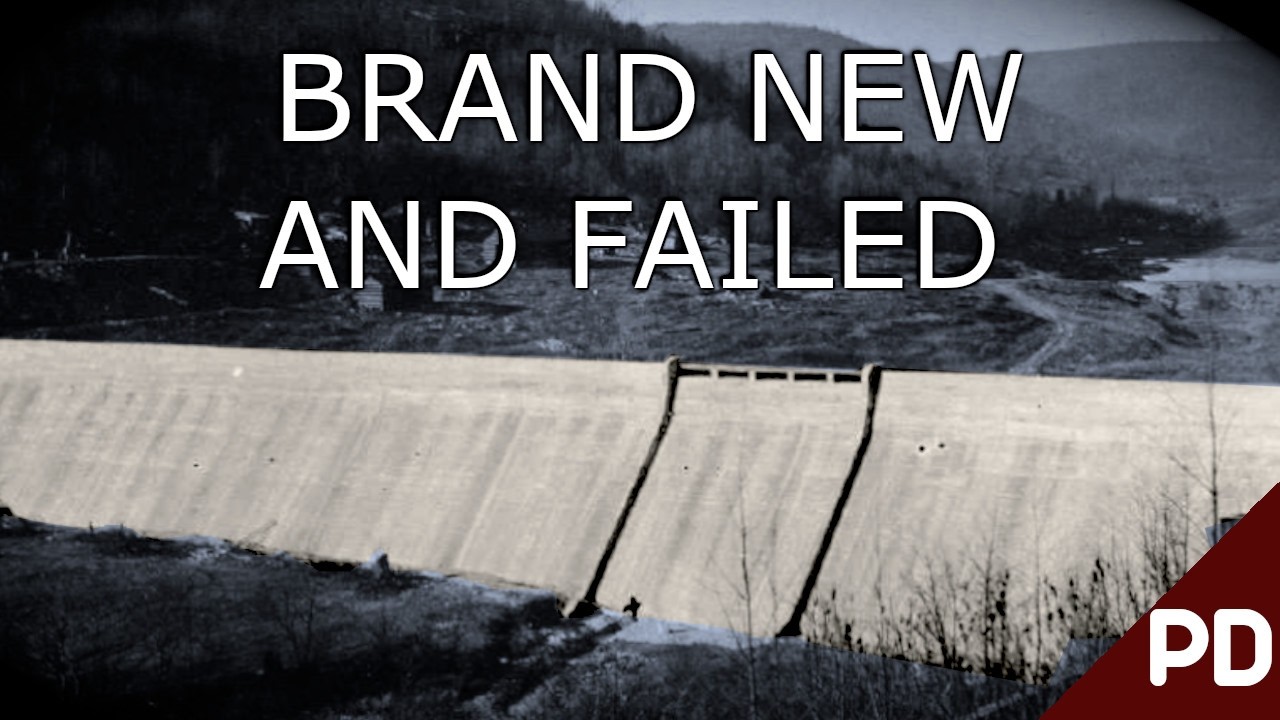
The video explores the tragic history of the Austin Dam in Pennsylvania, a structure built around 1909 to supply water for a local paper mill. Initially conceived as a concrete gravity dam designed to hold twenty million gallons of water, the project quickly spiraled out of control due to aggressive cost-cutting measures imposed by the mill's owner, George C. Bayless. Despite the original engineer, T. Chalkley Hatton, specifying a deeper foundation cutoff and specific construction details, Bayless repeatedly forced design changes to save money, including reducing the depth of the rock anchor from eleven feet to just four feet and simplifying the gatehouse system. These compromises, combined with unauthorized modifications to the spillway height and valve systems made without the engineer's knowledge, fundamentally weakened the dam's structural integrity before it was even completed.
The catastrophic failure began almost immediately after the reservoir was filled in early 1910, when rapid snowmelt caused severe seepage and deflection at the base of the structure. Instead of addressing these critical issues with proper engineering solutions, the owners resorted to dangerous temporary fixes, such as using dynamite to blast notches into the dam's crest to relieve pressure and constructing a leaky wooden diversion dam. Throughout 1910 and into the summer of 1911, the situation deteriorated further as heavy rains raised water levels dangerously close to the crest. By September 30, 1911, significant leakage was occurring through and under the dam, yet the mill superintendent refused to lower the reservoir to protect production, leaving the structure vulnerable to an impending storm that pushed the water level just inches from overtopping.
On the afternoon of September 30, 1911, the dam finally gave way in a sudden and violent collapse. A large section slid down approximately fifty feet, splitting the concrete structure into multiple pieces and releasing the entire reservoir volume down the valley with little warning. The floodwaters completely destroyed the towns of Austin and Costello below, resulting in seventy-eight fatalities despite some lucky warnings from a brothel owner nearby. While the financial loss was estimated at millions of dollars equivalent to hundreds of millions today, the human toll and the destruction of the community were devastating. Professor Frank P. McKibben later investigated the disaster, concluding that the failure was caused by a combination of faulty foundation design, inadequate construction, and poor operation, specifically noting that the dam could be lifted and pushed away by the sheer mass of the water due to its insufficient anchoring into the bedrock.
Ultimately, the collapse of the Austin Dam stands as a stark reminder of the dangers inherent in prioritizing short-term financial savings over structural safety and professional engineering advice. The engineer who designed it admitted his own fault for failing to stop the owners from making dangerous amendments, while the owners ignored expert recommendations to reinforce the structure with rock-fill buttresses because they were deemed too expensive. Although the paper mill was eventually rebuilt, the business venture ultimately failed after a second dam in a different location also breached, and the town of Austin never truly recovered, its population plummeting from around 3,000 residents at the time of the disaster to just a few hundred today. The ruins of the dam remain as a somber monument to this engineering failure, serving as a permanent lesson on the consequences of negligence and the refusal to listen to expert counsel in critical infrastructure projects.
Read the full video transcript
Dams are very fascinating and vital
structures for many regions across the
world. Humankind's emulation of the
humble beaver has gone back for
millennia, but time and time again
history has proven that dam building
isn't
an exact science.
This is the Austin Dam. It would prove
to be a concern for the entirety of its
short life
where bulging and leaks were discovered
shortly after its filling. And bizarrely
engineers had the unique idea to fix its
issues by setting off dynamite attached
to the dam.
Bold moves aside, today we look at the
Austin Dam and its ultimate failure. My
name is John and welcome to Plainer
Difficult. This video wouldn't have been
possible if it wasn't for my YouTube,
Patreon, and Coffee members. If you want
to have early access to the channel's
videos, you can join for just £1 per
month. And as always, the links will be
in the pinned comment below.
>> [music]
>> A new dam for Pennsylvania.
So, not long after the turn of the
century, not this century but the last
century, our story will begin
with the building of a paper mill. The
company head of the mill, George C.
Bayless, discovered shortly after
building their factory that the area was
subject to rather dry spells. I should
say the mill was powered by the flow of
water down off the Freeman water run.
The mill was opened in 1900, but issues
with low flow in certain periods of the
year became unavoidable by the start of
1909.
In order to balance out the flow along
the run, a dam was envisioned.
You see a dam creates a reservoir during
periods of heavy rainfall, which can
supply the run with a a flow of water
during the dry periods. Initially, a
small earthen dam was constructed, but
it quickly became apparent it was not
good enough.
Next, they decided a much more
substantial and greater water holding
back means.
This would be a concrete gravity fed
dam, which would be 50 ft tall and 540
ft long.
Aimed to hold a whopping
200 million gallons of reservoir water.
One of a budget of $85,000
in 1909 dollars, it was penned by
architect T. Chalkley Hatton.
The dam would go over budget, which led
to pressure from Bayliss down onto
Hatton to try and create some cost
reductions.
The project would call for a 7,925
cubic yards of foundation excavation,
6,360
cubic yards of embankment, and 15,780
cubic yards of
cyclopean concrete with large rock
inclusions into the matrix to create a
massive block structure. The upstream
face was partially covered by stones and
boulders covered with a clay blanket,
and the downstream face also has stones
and boulders covering up the lower 10 ft
of the dam's concrete work.
The dam's concrete cutoff wall was only
4 ft into the underlying rock.
Here in my diagram, we can see this.
This was a rather small depth
and was again due to Bayliss cost
cutting.
The engineer had actually called for a
11-ft cutoff into the underlying rock.
Although twisted rods were installed in
addition to help anchor the dam to the
bedrock. Now, the cross-section of the
dam shows us that the base was far wider
than the top. This is normal for this
type of dam, being roughly 31 ft wide at
the base, tapering to just 2.5 ft wide
at the highest point. Construction began
in May 1909 and was completed in
December 1909. Built by contractor C.J.
Bricknall, Binghamton, New York.
However, all through this period Bayless
constantly tried to change Hatton's
design, in some cases without the
engineer's knowledge, for example,
messing around with the height of the
spillway and pushing for much simpler
than designed gatehouse and valve
system. Just the next month after the
dam's completion
in mid-January 1910, it was proving to
be a much warmer than usual month.
This, combined with rain, caused snow in
the region to melt.
In doing so, filling up the reservoir
over a relatively short period of 3
days, resulting in the first use of the
spillway.
This would be the beginnings of the
dam's issues, with seepage discovered
around the toe of the structure. At
around the same time, a large flow of
water appeared around the left abutment.
The day after the dam began deflecting
18 in at the toe and 31 in at the crest,
which caused cracking in several places.
Pressure was building up behind the dam
beyond what the spillway could relieve.
In order to create more methods for
water release, dynamite, yes, dynamite
was used to blow notches in the dam's
crest.
The dam was still showing signs of
deflection. It was then decided to blow
the cap of the outlet pipe and
completely drain the reservoir and
repair the dam. As a temporary measure,
a smaller wooden dam was constructed to
keep a reservoir for the paper mill.
10 months of repairs would then be
undertaken. Not before the temporary dam
also proved to be leaky.
By the summer of 1911
the dam's reservoir had been refilled to
around 40 ft short of the crest to help
boost the now failing wooden dam.
But
some heavy rains on the horizon would
raise that level even further.
The disaster, by the 15th to 17th of
September,
1911, the water level behind the dam had
reached just a few inches short of
overtopping. This was caused by that
very heavy rainfall that I mentioned
slightly earlier. The following days
would result in every increasing water
levels. On the 30th of September, it was
within half an inch of the spillway
crest, and leakage was noticed through
and under the dam.
The seepage was getting worse and worse.
As lunchtime came round on the 30th of
September, a decent amount of water was
leaking through the dam. The mill
superintendent would not open the outlet
to lower the reservoir level. This was
due to not wanting to affect production
in the paper mill below.
The dire situation was getting worse by
the minute. At around 2:00 p.m., the dam
catastrophically failed. A section slid
down around 50 ft, and it split into
multiple sections, releasing the full
reservoir down the valley. There were
not many witnesses to the failure,
meaning that there was little in the way
of warning of the water release.
And the towns of Austin and Costello
below
would be the victims.
Luckily, a brothel owner just outside of
Austin managed to warn many
as the water flowed down, saving quite a
few lives. Both towns would be
completely destroyed by the water, but
miraculously, with a population in
Austin at the time being around 3,000
people, only 78 people would actually
lose their lives.
The disaster created an estimated cost
of 3 to 6 million dollars in 1911 money,
which is like 270 million dollars in
today's money.
The mill would be rebuilt eventually,
but a fire would burn it down in the
1940s. Another dam in a different
location would be built, but, albeit
less dramatic, it would also breach,
which would completely kill the business
venture off for good.
Austin would never really truly recover
from the disaster, although it would be
rebuilt, the 1910 population number
being the town's highlight.
Afterwards, it was just a downhill
tumble with 450 people calling the place
home today.
Funnily enough, the town's slogan is the
best town by a dam site.
But what we're wondering is what was the
cause of the sudden dam failure, but we
probably all know that it was somehow
linked to cost-cutting.
The cause.
So the cause would be initially
investigated by Lehigh University
Professor Frank P. McKibben,
which would be published in the
Architect & Six Engineer of California
edition. He would conclude, "The failure
of the dam is due to sliding as a result
of faulty foundation, faulty design,
faulty construction, and faulty
operation." Further saying, "Faulty
construction in the dam is shown in many
places, especially near the western end,
where large fairly smooth joints passed
horizontally through the structure."
But let's look a little bit deeper into
this. So the dam was incorrectly
anchored into the bedrock, mainly due to
inadequacies
in the cutoff wall,
and less ties than really needed into
the bedrock.
The result of this was rather literally
allowing the dam to be lifted and pushed
away by the sheer mass of the water.
Hatton would blame himself for the
failure of the dam's design, which is
kind of understandable. However, it was
mainly his failure to stop the dam's
owners from making the dangerous
amendments to the project as it went
along. The owners should have made much
more significant improvements during the
10-month downtime. Hatton, the engineer,
had actually sought advice from another
engineer, E.
Wegmann, a consulting engineer based out
of New York City. The second engineer
suggested adding a rock-fill buttress to
the downstream face to beef up the
structure.
These recommendations were passed along
to Bayless, who, not surprisingly,
decided not to implement them
on the excuse of being too expensive.
The fate of the dam was sealed when it
was allowed up its reservoir towards the
end of 1910. Sadly,
the recklessness of the dam's owners
resulted in 78 innocent lives lost.
You can still see the remains of the dam
today,
acting as a kind of tombstone and
reminder of the stupidity that went
behind the project.
So, that's my video on the 1911 Austin
Dam collapse. It's going to be a four my
scale.
And this is what I've got with my root
cause analysis card. Do you agree? Let
me know in the comments below. This is a
Plateful Production. All videos in the
channel Creative Commons
Attribution-ShareAlike licensed.
Plateful videos are produced by me,
John, in a very warm corner of South
London, UK. And all that is left to say
is thank you very much for watching. And
Mr. Music, play us out, please.
>> [music]
[music]