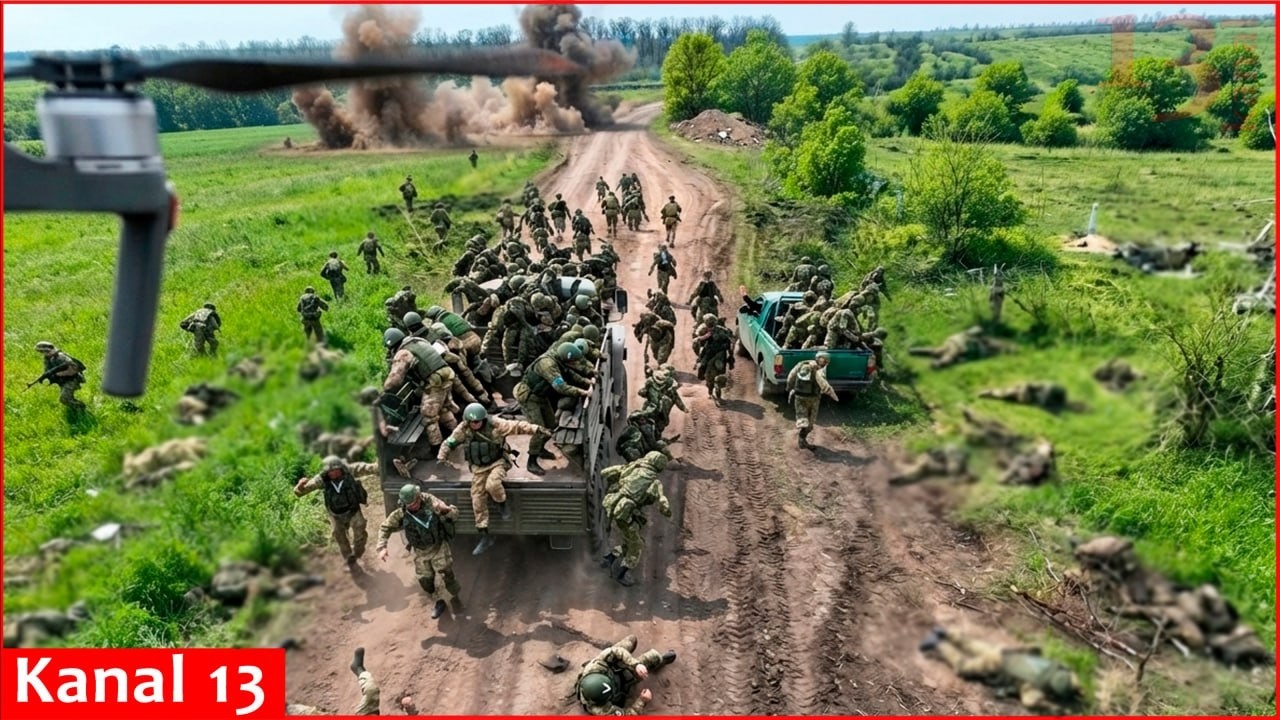
Bloody battles in Slavyansk-Kramatorsk: Putin's soldiers are massively destroyed, but they attack
Watch on YouTubeVideo summary
Russian forces are currently intensifying their multi-pronged advance toward Sloviansk and Kramatorsk, utilizing small assault groups that move covertly through forest belts to attempt outflanking Ukrainian defenses. While these incursions occur simultaneously in several areas, reports indicate that the overwhelming majority of these groups are destroyed by Ukrainian defenders before they can reach the front lines, with estimates suggesting that approximately 99% of such assault units never make it past initial resistance. To counter this threat, Ukrainian armed forces are effectively employing drones and smart mines while actively disrupting Russian logistics to prevent the enemy from establishing deep operational coverage within the agglomeration.
Significant territorial gains have been reported by Russian units moving from the east toward Kramatorsk, where they have bypassed and crossed a wide section of the Siverskyi Donets-Donbas Canal to enter villages such as Malynivka and Tykhonivka. These forces have reached the eastern outskirts of Vasyatynsk while avoiding Kostyantynivka and Druzhkivka, with some advance groups positioning themselves just 6.8 to 7 kilometers from the Kramatorsk airfield. Despite these movements, Ukrainian troops continue to hold critical positions near Yakovlivka, Mykolaivka, and along the Vasylievskyi Pastush-Vasyatynsk line, successfully preventing Russian units from completing their entire offensive operation by the end of the year.
A major factor complicating the Russian advance is a severe shortage of fuel and lubricants within the Kramatorsk area, which has forced some military equipment to remain unused and compelled assault teams to move on foot without armored vehicle support. According to the ATESH partisan movement, this crisis stems from the systematic sale of military fuel by the command of the 70th Motorized Rifle Division to local residents in rear areas like Donetsk, Luhansk, and Rostov-on-Don for personal profit. Even at a high price of 300 rubles per liter, the fuel is in high demand among the population facing a national crisis, leaving Russian units unable to refuel their cars, armored vehicles, and motorcycles effectively.
The logistical collapse caused by this fuel theft has directly contributed to increased Russian casualties and operational difficulties on the battlefield. The inability to quickly evacuate wounded soldiers from the front lines due to a lack of serviceable transport has exacerbated losses within the unit, as injured personnel cannot be moved efficiently under fire. Consequently, the combination of insufficient equipment, forced infantry assaults without proper cover, and the failure to manage medical evacuations has led to a sharp rise in troop losses, undermining the effectiveness of the Russian offensive despite their continued attempts to push forward toward key strategic locations.
Read the full video transcript
Russian troops are intensifying their
advance in the Sloviansk-Kramatorsk
direction in several areas at once. The
occupiers are operating in small assault
groups using forest belts for covert
advances and attempting to outflank
Ukrainian positions. This was reported
by Stanislav Krasnov, a serviceman with
the 81st separate airmobile brigade and
military expert Konstantin Mashovets.
According to Stanislav Krasnov, several
Russian groups can advance
simultaneously, but the overwhelming
majority are destroyed by Ukrainian
defenders before they reach the front
lines. About 99% of assault groups never
reach Ukrainian infantry. To destroy
them, the Ukrainian armed forces use
drones and smart mines, as well as
disrupt Russian logistics. This week,
soldiers from the 81st separate
airmobile brigade hit a target
approximately 140 km from the front
line. Krasnov did not specify which
target was destroyed. Military expert
Konstantin Mashovets reported on
Russia's advance from the east toward
Kramatorsk. According to him, Russian
units have bypassed and crossed a wide
section of the Siverskyi Donets-Donbas
Canal, entered Malynivka and Tykhonivka,
and reached the eastern outskirts of
Vasyatynsk, bypassing Kostyantynivka and
Druzhkivka. Some Russian advance groups
are approximately 6.8 to 7 km from the
Kramatorsk airfield. The Ukrainian armed
forces are holding positions near
Yakovlivka, Mykolaivka, and along the
Vasylievskyi Pastush-Vasyatynsk line.
>> [music]
>> At the same time, the Russian army is
attempting to outflank Ukrainian
defenses west of Chasiv Yar and advance
toward Druzhkivka. Mashovets believes
this creates the preconditions for the
occupiers to advance to the near
approaches to Sloviansk and Kramatorsk
in the fall. However, it will be
difficult for Russia to complete the
entire operation by the end of the year,
as Russian troops have not yet been able
to establish deep operational coverage
of the Sloviansk-Kramatorsk
agglomeration.
According to the ATESH partisan
movement, Russian troop losses in the
Kramatorsk [music]
area have sharply increased. Russian
troops in the Kramatorsk area are
experiencing a shortage of fuel and
lubricants, which is why some equipment
is not being used, and assault teams are
forced to move on foot. According to the
ATESH movement, the command of the 70th
Motorized Rifle Division systematically
sells military fuel to local residents
for its own profit. This is the main
reason for the aforementioned problems
facing the Russian Armed Forces.
According to the movement's agents, fuel
is sold in rear areas, particularly in
Donetsk, Luhansk, and Rostov-on-Don. The
price of a liter starts at 300 rubles,
but even at this price, the fuel is in
demand among the population amid the
fuel crisis gripping the country. As a
result, according to ATESH, the unit
experienced [music]
a severe fuel shortage. Problems arose
with refueling the cars, armored
vehicles, and motorcycles used [music]
by the Russian military. Against this
backdrop, soldiers are allegedly forced
to conduct assault operations on foot
without the necessary armored vehicle
cover. Furthermore, the lack of
serviceable transport complicates the
evacuation of the wounded from the front
lines. ATESH claims that this situation
is already impacting the unit's losses.
The lack of equipment and the inability
to quickly evacuate the wounded,
according to the movement, have led to
an increase in losses.
>> Meow.
>> [music]