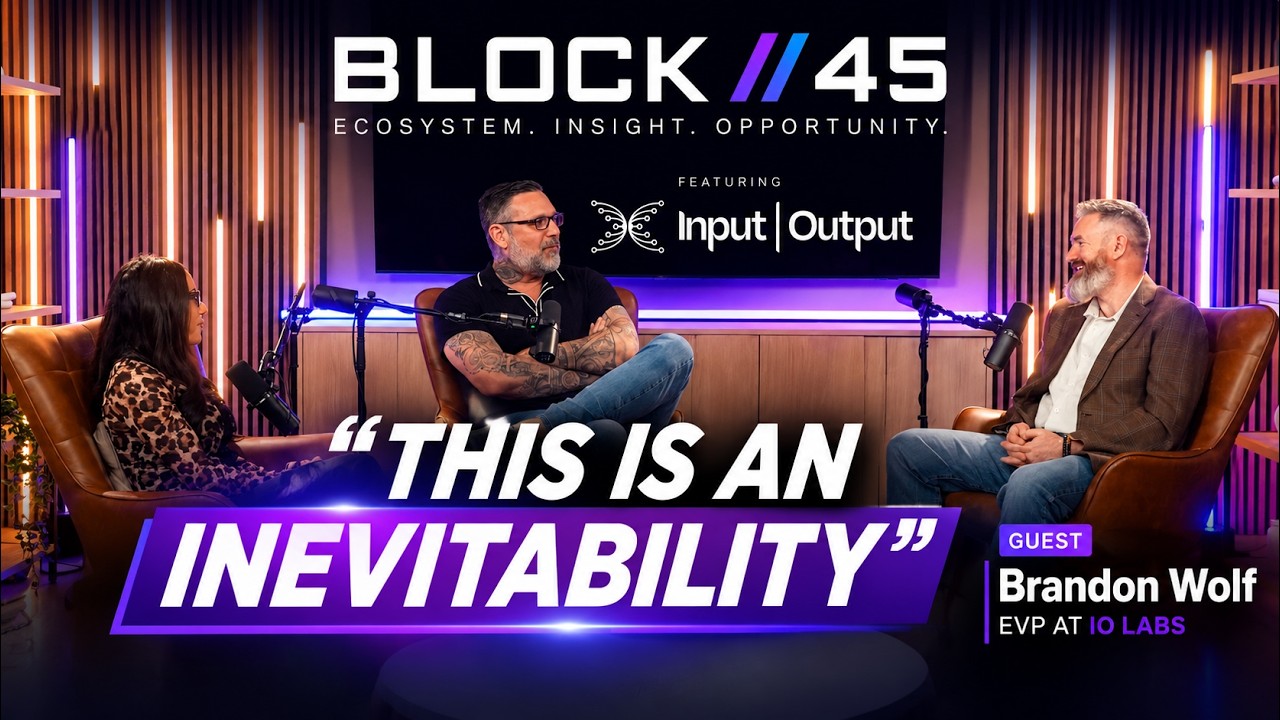
Video summary
In this interview, Brandon Wolf, General Manager of IO Labs, outlines a significant strategic pivot toward ecosystem decentralization where core technologies like Plutus, Hydra, and node consensus mechanisms will transition from being developed under the Input Output umbrella to autonomous partners. This initiative aims to foster genuine collaboration rather than centralization while significantly reducing annual funding requests; however, it acknowledges that retaining 60% of NCL annually contradicts this message unless those funds directly justify fundamental improvements to the chain. The discussion emphasizes maintaining IO Labs' research strengths in cryptography and peer-reviewed science even as these components evolve into independent entities, ensuring that the foundation remains robust while encouraging broader community involvement before proposing on-chain changes.
The conversation addresses technical narratives by dismissing "TPS wars" as vanity metrics compared to real-world utility and finality, explaining how Cardano's architecture bundles multiple data points for efficiency rather than optimizing solely for high volume. Wolf highlights upcoming developments such as the hard fork (Cardano 10.x) which will integrate features like Plutus V3 and Hydra's Layer 2 scaling solutions, alongside privacy-focused simulations through Midnight City. To overcome traditional barriers in Haskell development, IO Labs is exploring "agentic engineering" involving specialized sub-agents and QA agents that create natural tension within development pipelines to improve quality returns and speed, utilizing a Model Context Protocol integrated into the node or as an add-on for enhanced documentation access via RAG techniques.
Looking toward future opportunities, Wolf identifies AI models competing for market share as a major avenue for enhancing Cardano's security and throughput, advocating for enabling engineers with these tools rather than enforcing top-down policies to keep pace with rapid advancements. The strategy includes measuring outcomes through an "AI maturity model" focused on metrics like speed, quality returns, and security while considering the potential development of a Cardano-specific AI super app or harmonized SDKs. To ensure transparency as projects transition to different partners such as Midgard Labs for Hydra, IO Labs plans to launch a new website that will provide clear progress tracking on milestones including Laos, Hydro, and Plutus, reflecting an adaptive approach where bundled omnibus packages are replaced by individual components based on community feedback regarding adoption needs.
Read the full video transcript
IO served its mission of what it set set
out to do. I think it's an inevitability
that we become more decentralized. We
are working with a number of different
partners. They just wouldn't be under
the input output umbrella and that way
they become much more autonomous in
their own way now decentralized to the
ecosystem. We're doing that for the
consensus piece of the node. We're doing
that for the ledger portion of the node.
We're going to be doing that for Plutus,
Laos, Paris, the or uh consensus
mechanism, Hydra. All of these are going
to be now decentralized. This is
something that we have been building for
all along.
Welcome ladies and gentlemen and welcome
to this edition of Block 45. I am your
host Crypto Crow with my co-host Crypto
Wendyo and IO Labs Brandon Wolf. Tell us
a little bit more about your role, your
position at IO. Like who are you? What
do you do? And why has nobody seen you
before?
>> I I hide mostly. I'm not I'm not a
public figure and I like to work behind
the scenes. I think I do my best work uh
you know in in the quiet corners of of
the world. I started with input output
about two and a half years ago. I came
in as the GM of Lace. So I was the
general manager of the Lace wallet and I
ran that for about a year and about a
year a little maybe over a year and then
got an opportunity to run the Cardano
business unit which is a much bigger
endeavor because this is effectively
everything that uh that we had done in
terms of our engineering side. So a lot
of our R&D work the D's part is done by
the uh Cardano business unit. Now, we're
evolving into what's called the IO labs.
We're moving into more of an innovation
engine uh component of the ecosystem,
and that's really where I'm I'm going to
be leading hopefully uh in the future on
that part.
>> Is is IO labs a result of a lot of the
DREP funding and some of the
restrictions and kind of chopping things
down a little bit or is this just a new
extension, a new arm that serves a very
specific purpose to kind of keep things
a little tighter? I think we looked at
it kind of like a DARPA or Bell Labs or
Sequoia, you know, this kind of
component, this this again this this
think tank, this um building out smaller
components and testing them out and
doing a lot more on the research side
that to the to the engineering pipeline.
That was something that we were trying
to build out a little bit more
predictively. Right now we are doing it
in a uh ecosystem supported way. I think
we, you know, we talk about
decentralization within Cardono and we
got a large number of people pushing
back on the amount that we're taking
from the NCL every year. Well, that
that's something inevitability. If you
go back to reading why Cardano from
2017, decentralization plays a big role
of that. So, this is something that has
led to that point. So, we're actually
now taking a step uh in a different
direction. not taking a step back but we
are taking the teams that are building
out Plutus Laos Paris the Oraos uh
consensus mechanism uh pl uh hydra all
of these are going to be now
decentralized so there's the same teams
but they're not going to be necessarily
working within IO we're going to be
supporting more of a collaborative uh uh
cohort of companies that are going to be
doing this work
>> who initially created Blog Frost because
I don't know and I it it popped up a
while back and I kind of ignored it and
then once I started getting into agentic
workflows and building applications.
It's like one of the first things that
like claude or any of the main agents or
models suggest, hey, you've got an open
API you can use to do this and that on
chain. Who created that and like how do
we get more of it? Because there's it's
it's been extremely helpful to me in
trying to build anything using AI on
Cardono.
>> Yeah, Block Frost is I think um one of
the we used it in Lace quite
extensively. you know, when you want to
interact with the with the back end,
it's either you can build all of this
yourself or leverage something that's
already been built. So, Block Frost was
actually built by a gentleman named
Merrick and Merrick is the general
manager CEO of BlockFrost, which is a
company, a venture within input output.
>> I never knew that. Yeah,
>> I never knew that. It's been extremely
helpful. We need more.
>> He's a solid engineer and he's got a
very small team. They're very efficient.
They're very pragmatic. They work
diligently. I mean, we love working with
them. Are there any other like I don't
know what you can talk about but are
there any more plans in building new
elements that will allow more agentic
workflows to operate either on Cardano
or Midnight or anything that's going on
out there? Well,
>> I think you're seeing it with Midnight
City. Midnight City is kind of taking
that um it's more it's expressed more as
a simulation as a as a game type of
approach to I think attract more people
so they can see it. And it's just
getting started. A lot of people are
looking at it and not quite getting what
it is and what it does and where it's
going. But
>> the more you hear uh Charles and the
team talk about like where where it's
going with an agentic civilization and
all the possibilities that can be
unlocked as a result of that and the
need for privacy to be said on the back
end with midnight. You it becomes a
little more apparent like why this is
going to be. So I think that's probably
the best expression of that uh in in the
environment. Now we do a lot of agentic
workflows with with within input output
from our engineering side. So we're
doing a lot of I don't like to call it
vibe coding, but we do a lot of agentic
coding. We have a lot of teams that are
doing much more on the AI side. It's
more of an accelerant and also as a
quality control gate. We don't we always
keep humans in the loop. It's not
infallible. It's how to use it. It's
it's not that the fact that you if you
are or aren't using it, it's how to use
it correctly. That's become Yeah. It's
become like the core central tenant of
how we do our engineering.
>> But I also feel like it's moving so fast
too. And like I feel like with crypto
companies, it's like crypto is so
immersed with AI, but it's all like
because a lot of the AI that we have
now, it's all super centralized and
crypto is trying to keep a decentralized
aspect to it to where people get to have
access to open source and get privacy
and everything in between. So, I feel
like it's going to take a little bit
more time for us, not necessarily for us
to catch up because everybody in crypto
is super smart, especially our
developers, but at the same time, make
it to where we still have our liberty
and we can still have our privacy and
the aspect of decentralization.
>> Yeah, totally agree. Yeah. I mean, I
think AI is it's transformational in
many ways. I I go I go back to the web
one days. I remember when the internet
first came around. I remember then why
>> I was a geocoder. Okay.
>> If that's if you can even call it that.
>> I I go back before that. And it it's it
was back in before that. Yeah. The HTML
one days like having to learn the off
the W3C website. There was no like
tutorials. There's no videos. None of
that. No geio cities. No AOL. None of
that existed.
>> Bulletin board days.
>> I didn't realize you were that old.
>> I know. Me either.
>> You've been around a while.
>> That's why he's got a beard.
>> But yeah, but his beard's not even as
gray as mine. So, you know, I guess the
benefit of me getting into crypto in
2017. I didn't have gray hair.
>> Aed you aged me. Well, [laughter]
>> but this is feeling like that kind of
like that emergent um you know kind of
transformational technological
transformation from when the web first
took off and it became commercialized.
You started seeing dotcoms everywhere
like what is this and then web two it
became more you know interactive and you
saw social media start to come out. This
feels a lot like that next kind of phase
in in it and uh
>> swallow those phases that already has
begun. It's intimidating but exciting at
the same time because now you know you
mentioned vibe coding and how it's
almost becoming kind of a a negative
term and it is in a sense because now
it's it's really excelled at at
>> I don't even want to see say vibe
engineering but like AI engineering
because there's a big difference from
like where I started where I'm like
build me a calculator right and that's
vibe coding but engineering I've I've
been diving a lot deeper into that
because it's really how you structure
the prompts I mean now my prompts are 12
pages long, you know, just to build
something and then I'm more fine-tuning
things. So, and and a lot I I'm really
excited about the idea of seeing more
tool sets that empower guys like me who
actively want to build and are building
things on the Cardano uh in the Cardano
ecosystem, which is why I touched on uh
BlockFrost because it it has been
enormously helpful. And I didn't really
understand I mean, I've been in Cardano
since 2017. I didn't know anything about
it until I actually started building
>> Yeah. So yeah,
>> I actually like but I like how easy it
is to to vibe code and do stuff because
again I don't come from a tech
background like I had to teach a lot of
the stuff in crypto myself and it was a
little bit complex and for a long time
it was like oh if you're if you're not a
developer you shouldn't be in crypto
because you don't understand how it
works but I feel like with AI and being
able to vibe code people that are more
verbal like myself it's easier for us to
actually build something and it makes
more sense and then you can kind of dive
into the crypto aspect of it in whatever
type of niche you want and be able to
build something that makes sense for you
or like a trading bot or just something
that monitors you know different aspects
of you know like with Cardono for
example there's so many different
entities kind of to monitor that so you
stay up to date create your own newsfeed
just anything in general but I so got to
disagree with you on that I like I like
>> disagree with me on what
>> that I like that it's that it's that
it's not the vibe coding isn't
necessarily like I don't think it's a
bad term I like it because it makes it
easier to do technology yeah
>> yeah I I mean I understand in essence
though what you're talking about is
almost like reverse engineering the
technology through AI,
>> I guess, because like
>> and you're learning the process.
>> Yeah, cuz for me, like I would never be
able to to code something on my own like
Well, but I can vibe code now.
>> Well, yeah, but you're going to be vibe
engineering before long. What can you
tell us about kind of the next phase?
You know, here we are. Um, you know,
we're in July. You know, the market
cycle is what it is. And you know, we
see the ecosystem, the DREPs, everybody
is just kind of, you know, in a crazy
situation. Um, and and I feel like so
many people are looking for something to
lock on to for like this next quote
unquote term, right? What can you tell
us about uh like what's in the pipeline
that's that's like hard like the hard
pipeline that's coming um that that's
going to help facilitate a lot of the
way the ecosystem in the world is
changing around it.
>> So we have a hard fork going on right
now as we speak and it should be done by
the time this is out should be should be
down and live and then we're going to be
immediately moving to a next one. Hard
forks are not easy within the within the
Cardano chain.
>> Explain the hard fork a little. So this
is where uh the entire Cardano ecosystem
is comprised of multiple different
components and those components have
multiple different libraries. It's a
coordination effort across multiple
teams as you said it's a it's a very
diverse ecosystem. We have to have
somebody that is driving that in the
driver's seat for that and bringing
these all together so that we can
release the next features on chain and
it becomes part of the new Cardano
ecosystem. How does Cardano get
upgraded? It's through this hard fork
process. So, it's this coordination and
culmination of all the work that's been
done over months and some of in some
cases years and it's now reached
fruition to where we say, "Okay, now
we're drawing a line in the sand. We're
saying now Cardano 10.63 is coming out
and we're going to be launching that um
with the new features in it." So, it's
just like any software, but this
software because it's decentralized, it
spans multiple different people,
individuals, individual contributors,
companies, and everyone's kind of
clamoring to get their piece of it into
it so that they can build more or next
onto the
>> just like the banks with clarity act
>> pretty much. Yeah, [laughter]
fair enough.
>> Well, that's a whole that's a whole
another topic that we have to touch on
later because
>> why later? We could do it right now.
>> Well, because I want I want to hear him
finish.
>> Oh, okay. So the the hard fork is is
effectively when you see the next
iteration of our Cardono and it doesn't
really finish until all of the stake
poolool operators dreps the the node
operators adopt
>> ds they're
>> well yeah I love
>> oh my gosh [laughter]
>> once the uh node operators adopt that
that becomes now the new version of
Cardano so to speak
>> you know real quick real real quick
there's one thing that I would just love
to see I would love to see
>> because I see all of this
>> [laughter]
>> What's he gonna say next? What's he
gonna say next?
>> No, I'm I'm I'm beh I'm beh I'm behaved.
No. Um, no. So, I I would just I would
love to see I I'm so tired of seeing
these narratives about Cardano's TPS and
and and just all of the nonsense, right?
>> TPS is stupid.
>> It is so stupid. It's so stupid. Well,
because you know, even when I was I was
doing my vibe coding yesterday and, you
know, and I'm and I'm doing some deeper
dive research into the the blockchain
and and a lot of the systems because I'm
I'm building a whole bunch of stuff,
right? And and even Claude tells me, you
know, well, one of the key differences
in Cardono and this is, you know, you're
talking about TPS, but there's so many
data points. There's so much information
in one transaction as compared to
because honestly, I vibe coded. How do I
what can I build to increase the
transactional volume on chain, right?
And it's like, well, it's more difficult
on Cardono because it's not a one for
one like all the other chains.
Everything is collected into one
transaction. And so one transaction can
be, you know, hundreds of data points
and things where other chains are one
for one makes them look bigger. And I'm
like, of course, I wish the whole world
knew that. How can we educate people in
a real way outside of just, you know, us
talking heads on YouTube or whatever? Is
there any more official way that we can
break some of this stuff down in an
easily digestible manner so that we so
that people can genuinely see and
understand
the the differences and why Cardono was
designed to be the way it is rather than
trying to work backwards.
>> Do you mean like the benefits of having
uh higher TPS and fast finality uh in
terms of a use case or
>> Okay, so let's just say one chain is a
one for one transaction per second,
right? And then Cardano is doing similar
work, but it's able to bundle these
these we can call them data points
instead of transactions or endpoints or
whatever you want to call them. And how
they're bundled into that one
transaction. If you compare them on
chain, it looks like this chain is much
bigger, much more active because Cardano
basically moves everything into a U-Haul
and then ships it. Whereas these other
chains are taking, okay, well, here's
your couch, here's your chair, here's
your, you know what I'm saying? So it
looks like a busier chain and that's
also more easily manipulated in a lot of
ways. Not that anyone in crypto does
that, right? But and I'm tired of these
narratives and so and and when we're I
feel like in so many cases even Claude
wants me to work backwards in a way say
well if you want to improve the
appearance of transactions you know you
have to do it the way the other chains
do it not the way Cardano was designed
to be. So, one, I would love if you
could maybe explain a little bit more
about why it's designed that way. I
know. I'm sure Wendy knows, but how many
people out there
>> don't understand?
>> Explain it to me like I'm somebody that
doesn't know.
>> Yeah.
>> Of what the TPS why TPS matters.
>> Why it matters and why the difference in
in how Cardono does it compared to the
other chains.
>> I feel like TPS is just so silly. I feel
like
>> it is silly, but it's the same thing I
see on X every time.
>> But but that's because you're on X. Like
nobody nobody cares about TPS. Just as
long as the thing works, just as long as
it doesn't break, just as long as it
allows an experience like you would use
for Fiat or for just any type of tech in
general, it doesn't really matter. Like
the TPS wars, it's like a it's like a
sword fight with the TPS wars. Like who
cares?
>> Well, the reason why is I think that
comes from the credit card industry.
They look at that and go, "Okay, in
order for us to compete, if we want to
become the next MX or Visa or
Mastercard, you know, the the
cryptocurrency, whatever the chain may
be, insert chain here, has to perform at
that at least that level. So that you
have that adoption so that you can do
more uh commercial uh you can have it in
every storefront you can have it in your
pocket in your phone. So those
transactions no longer become a thing
that you think about. You don't think
about it when you do a credit card
transaction. But when you do a crypto
transaction, you have to think, okay,
well, when is this going to finish? When
is this going to actually I send from
here to there, it could take minutes.
You know, I sent to here to you on
another chain, it could take a couple
hours in some cases. And that's just not
acceptable. So for the commercial
adoption of that to become at scale, the
TPS have to matter for it to uh to
penetrate because that's what the
adopters are going to ask about. They're
gonna, well, how many transactions per
second can I have? If I'm going to open
up a web store, how many can I if I can
only if I can only sell you one t-shirt
a day? Kind of limits me.
>> I think my point isn't clear. I think
that's my problem. So, okay. So, um,
let's say we've got a competing chain,
right? And let's say I want to use my
credit card or whatever, and I go to
this this store that runs both chains,
okay? They want to ring up my candy bar,
my soda pop, and my bag of Doritos as
three separate transactions, right? So,
and they're using this other this
competing chain. Boom. I just gave them
three transactions, but I also have my
Cardano card hypothetically, right? And
instead of ringing up each item
separately, they're all one transaction,
right? And then I ring that up and well,
there's only one transaction here.
There's an obvious benefit to being able
to bundle these items into one
transaction, but on chain it looks less
than
>> looks like one transaction.
>> It looks like one transaction compared.
So, and even and I understand, you know,
Wendy say, "Well, it doesn't really
matter." It doesn't on a tech level, it
kind of doesn't um because as long as it
goes through and it works, fine. But
unfortunately, so many people use this
as a metric for success, right? And so,
and that narrative is used against
Cardono so often. And I'm and I'm I'm
I'm waiting for the day when it clicks
with people because I still feel like it
hasn't, which is why I feel like Cardono
suffers a lot in the grand narratives
that are being put out by media or
anybody that you know, I'm not going to
go down a rabbit hole in this, but you
get what I'm saying, right? But even
though but listen but even though like
with credit card transactions for
example there's one place that I always
go to that I have to that I have to
spend a lot of money for appliances and
whatnot. My credit card never goes
through ever. Never goes through ever.
So I always have to call the bank
>> bill Wendy.
>> Well it it's [laughter]
>> No, but it never goes through because
there's always a problem because it
always blocks it because of the bank. My
point is is I actually have to call the
bank. I have to spend like 30 40 minutes
on whatever. By the way, I had to buy a
brand new refrigerator. It was a
nightmare for a month. We can talk about
that another time. But my point being, I
already was stressed out about the
refrigerator, but the credit card
transaction wouldn't go through. My
point is is like with Cardono, you know,
it's going to get there. But I feel like
like with traditional finance, we don't
get to see what happens behind the
scenes. With crypto, it's unique because
everything's on chain and everything is
public and you can track it. So all
these people are going to be like, "Oh,
this took forever because blah blah
blah." And they're going to make this
big dramatic narrative about it. And I
just that's why TPS to me is like just
as long as it goes through great because
the normal the average person we don't
care. We don't care how fast it is. Just
as long as it goes through and it's
we're done.
>> And that's fair. I think from an
individual use case that is perfectly
fair and it can be a vanity metric
depending on who's using it.
>> It is a vanity metric to
>> but TPS I think matters from a scale
standpoint. So how many how many
products can we support on chain at one
time and are we limited by that
architecture and that's what Laos is
meant to provide and the finality like
the Paris is going to solve the finality
of how long a block actually becomes
final. It doesn't sit in you know a
pending state and have to go through the
consensus mechanism and it takes a lot
of time for that. So I think these
pieces when you piece when you put them
together I mean it forms a very clear
strategy what Charles has been saying
all along. It's like we've got to get
Cardono to be able to scale up to meet
the the demands of what people are
asking of not just Cardano but crypto in
general.
>> So, and in in that I think my grand
point is is that with Laos and then
Hydra with the way that TPS is actually
structured on Cardono, you're almost
talking about a grand expansion of TPS
that should far surpass that of any
competing chain.
>> Yeah. And I I think TPS also from that
angle is maybe not the right way to look
at it. We look at it as u it's
throughput. It's really
>> throughput is a better way of saying
>> yeah it's it's transaction bytes per
second is really when you get down to
the technicality. So it goes back to
your point about block density. How much
data can it can it actually hold? How
much data can be transferred not one
transaction versus a bundled transaction
like it's about the the density of it.
>> It's always evolving and especially as
things are changing and moving fast
because AI is kind of making things move
fast. It's always challenging to get
that message out there and but it sounds
like you guys are working on being able
to articulate that message out across a
very social so people understand what
Cardano is actually building.
>> That's right. Yeah. I think getting rid
of the technocratic jargon and all of
the um you know it it's just about this
the kids who know and who who don't
know. And I think that's that's all
changing. It's been changing for a
number of years now. I think once we're
starting to see the adoption cycle
become like well how do we bring in more
people? How do we build the base of
this? Which is why I was so heavy on our
developer experience and our developer
relations u proposal to make sure that
we are building that base not just
cultivating what we have in the system.
Now I think we have to put a message out
there that's going to be much more uh
adoptive by by just the general general
public and you know and so they
understand why it's important. Obviously
the first thing that is coming to mind
is companies going to be security. So we
always have to lean on that as kind of
like our third rail item. We can't ever
you know violate anything around
security. transparency is going to be
very important so people know that you
know it's building that trust with it
because we're talking about finances
we're talking about real world assets
we're talking about you know money and
uh that's that's going to be the
cornerstone of anything that we build up
but then it's like why it matters like
what benefit does this bring it's got to
be more than I come from an older
generation I never really got in on the
meme coins never really got it on the
whole uh you know the DGEN culture was
not just never my thing I'm a
technologist by trade so I think
bridging that gap between technologist
and just layman is going to be super
critical that's exactly What took Web2o
to It took Web 2 to say like, "Oh, you
can buy things online now. Oh, okay. I
see the benefit of that. It's just got
to be that simple."
>> How do you guys plan to do that though?
How do you plan to execute that and get
the message out?
>> Again, I think it's taking more of a
productled approach within the labs. So,
uh we're we're going to be looking for
um efficacy of anything that we build.
So, while we're we're coming up with
these great theories around zero
knowledge proofs and you know um all of
the cryptography that goes into it and
and the technology, the architecture,
etc., It's got to be a value ad to
somebody that's going to adopt this and
like perpetuate that growth. That's got
to be key.
>> Who is that somebody?
>> That depends on the It depends on the
technology. So something we'll be doing
in the very beginning will be what's the
total addressable market. Anytime you're
starting a business, you do the same
thing. What's the total addressable
market for this? Like who are my
customers going to be? What's the growth
trajectory look like for this? What's
the revenue potential, the upside going
to be? We're going to be doing that same
thing. We're going to be taking that
same kind of lens through uh through
anything that we're going to be
adopting. like can there be something
that can be realized either by us or by
somebody or the community in general?
Meaning can this affect the the price of
Cardono, the price of midnight, can this
affect, you know, we have to look at
those things because it can adverse or
uh it can be a benefit or an adverse
effect.
>> There there's obviously an end goal,
right? And and I'm [clears throat] not
quite sure I or or anyone else fully
understands what that is. If I look at
the other chains and I see what their
claim to fame is or their their previous
historical narratives have been to drive
adoption and all of that,
given that where we're at, you've got
the hard fork, you've got Laos, you've
got Hydra, you've got all of these
different systems being put into place
in the Cardano ecosystem and then
Midnight in adjacent to that, right?
What is the grand narrative for Cardano
moving out of well for concluding 2026
into 2027? What is the grand narrative
that Cardano's building and preparing
for to compete with everyone else in the
in the space?
>> I don't know we have one for the
remainder of the year. I mean our
proposals I I would hope that they form
a very good um vision of what we're
trying to build out. And a lot of these
are carry forwards from the previous
years. we're finishing things that we
started and I I don't think we did a
good job of articulating that when we
proposed them. It's like why is this
showing up again? Didn't we didn't we
already pay for this last year? Didn't
the community already fund this last
year? This is the continuation and some
place in some cases the finality of it.
So 2026 there's no grand vision for
that. It's actually looking ahead. So
we're trying to look at a five-year type
of term like we want long-term road
mapaps um that are that are playing out.
Um and that is going to be what we're
going to be leveraging and that's going
to be about growth and adoption. It's
going to be about usage. is going to be
about um building up new um
decentralization uh techniques on top of
that. Midnight came as a result of this.
We saw a need. We addressed the need for
privacy and so midnight was kind of
spawned from that. So I I don't think we
have a like a grand vision for the
remainder of the year on this other than
finishing what we started and getting
these things done because a lot of them
do end at the end of the year. I also
think that like the end of 2026, it's
too shortsighted, especially when you're
talking about technology because this is
the thing, it takes like even when I've
seen other other projects that they
have, they have hard forks and they have
different things they have to finish by
or they say they're going to finish by,
if it doesn't get finished on time, the
community gets so upset. But I feel like
people don't understand how hard
technology actually is and you can't
force developers to consistently ship
things if there's underlying issues that
need to be fixed or if they want to go
back because something might have
changed or technology might have
changed. So, I feel like that's very
important that it's okay to put out a
five-year plan. It's okay to be a little
bit late on your on your deadlines and
and whatnot because if you're just
pushing things out, then you're going to
then there might be a vulnerability and
you're going to have to go back and fix
it.
>> That's right.
>> Yeah. But who who who are you building
for in that interim? Like, you know, a
five-year plan, cool. But as these
products are being released, who are
they being released for? To what end? as
these things are happening, I guess, is
what I'm looking for. Yeah, it's a good
question. What is everybody gonna sink
their teeth into as we go through each
phase of of growth?
>> We have multiple different personas that
we we target. Um, some of it is tech-
ccentric, but a lot of this abil and by
techcentric I mean builders, you know,
so I think having uh the ability for
builders to create on the chain. It is a
platform after all. That's really what
we're talking about. um we're not we're
not producing the products themselves
unless we find that there's a gap or
somewhere that we think we could add
some strength and value to it to
demonstrate it. Lace was that way. You
know, we were not the first wallet. We
were we're not the only wallet, but we
wanted to build a wallet in a different
way and we wanted to show uh we wanted
to be able to have the um lace lace
brings the ability for us to uh build on
chain improvements as they're being done
instead of a wait and see because we
could fund that through through IO. So
that's where we're trying to push the
envelope a little bit harder on that
around the builder side and we're and
it's open source so you can extrapolate
from that what you will and show that we
can show that it works and you can take
it and build from it from there. It is
meant to be collaborative. We've got to
leave some room for the business the
earners on that the makers that are in
the market too. So I think this is where
scalability comes into play. the more
scale that's there, the more builders
that can come in. You have the the fees
and transactions are one thing, but then
L2s with Hydra. How do we how do we get
operate in a world where there's vending
machines where you can pay for it with
Cardano?
>> I already have one.
>> Yeah, exactly.
>> So, how do we how do we make them all
that way? You know,
>> that's up to the Hydra team. Yeah. I I
don't have a lot of visibility.
>> I'm coming for you, Hydra team.
[laughter]
>> Yeah. And uh so, I mean I mean there's
multiple personas. Again, it's the
builders, it's investors, it's, you
know, we want to look at all of them and
make sure that we're satisfying all of
them equally. Um, I think the traders
are one of the biggest untapped markets
that are um that are out there.
>> As decentralization really takes a hold,
it's almost like things are kind of
leaving IO and going on their own
journey, but you guys are still going to
have involvement.
>> Absolutely.
>> Can you discuss that because I feel like
it might be hard for people to
understand like why do we need IO if
this is going to be more decentralized
and it's going to run for it run on its
own? But
>> I think IO served its mission of what it
set set out to do. I think it's an
inevitability that we become more
decentralized. We heard a lot. I'm sure
everybody heard that. Why why is um uh
why is input output taking such a large
majority of the Treasury funding this
year and we we have then this year and
last year and that that is that is a
fair assessment. Uh you don't want to be
the fattest hog at the trough. So what
we're looking to do is I was thinking
about myself on that one, not you. Um
what we're looking to do is um truly
like it's it's built for you know this
is built by many but it's it's a chain
for all and we want to make sure that
everyone has a piece of that. So we are
next year not going to be coming back
with the amount of ask for our coverage
of that. In fact we're taking the teams
that we have now and we are working with
a number of different partners. We're
looking work we're working
collaboratively with our own ecosystem.
Uh so that the people who have been
building these things which is really
where the strength lies and that's what
input output was providing was a lot of
these smart technical savvy people
making sure that they continue on with
that work they just wouldn't be under
the input output umbrella and that way
they become much more autonomous in
their own way. So when you think about
the we just did it with myithil that has
now gone to teragon systems and teragon
systems will now take the piece of that
for fast bootstrapping the node and they
will run with that. It's not an input
output. Um, it's not centralized within
input output. It is now decentralized to
the ecosystem. We're doing that for the
consensus piece of the node. We're doing
that for the ledger portion of the node.
We're going to be doing that for Plutus.
Just about all of the um all of the
proposals that we have right now will in
some form become the um carry forward of
another entity. And so we will go from a
roughly 30 million um ask each year to
about five. And that's really where
we're trying to get to so that we can be
good stewards of our own ecosystem. This
is an inevitability, by the way. This is
something that we have been building for
all along. This is not something that we
just saw some feedback and decided to
make a change. This is going to come
anyway. In fact, it was hard for me to
bite my tongue when I'm hearing all
these people talking about. I'm like,
you only knew what's coming now. We can
finally
>> Why bite your tongue? Just jump in, man.
>> Just say it. You got jump into the bar.
>> I'm so not a Twitter I'm still not a
Twitter person at all. I don't I don't I
follow people and I read and I but I
yeah I I know better than to get
involved in social media.
>> It's important to communicate so people
actually know what's going on because
unfortunately there's so much
misinformation and because the market is
the way it is right now. It doesn't
matter if I mean anytime number goes
down people
>> like they forget about the technology.
They forget about why they're here. They
don't they forget about what the next
five years holds. And we're in such a
pivotal point of technology right now.
So they're like missing I feel like
they're really missing the point to what
as to what to look forward to long term.
>> That's that's fair. It's frustration.
Anytime you see this when the stock goes
down, stockholders become naturally
upset about and they want to understand
like give us answers. What are you doing
about this? How are you correcting this?
Now look, we cannot control those
prices. That's not what we're we're not
the company that you're investing in
when you when you buy a Cardono.
>> So many jokes I want to make about other
chains.
>> Yeah,
>> some chains can control it to some
extent.
>> Some can. Yeah, some can. But our
philosophy has been like we really don't
talk about it that often because it's
not something that we can directly
influence. It's kind of like blaming the
president for the stock market, you
know, going up or down. It doesn't have
any direct control over that influence.
Yes. So we have to re reassess what our
influence is and where we're going. We
think we feel like this is the way to do
it. Uh we no longer become the core
component of this. We want mo node
diversity. We've been a Haskell node
forever. We want to see Rust nodes and
go nodes. We want to see these start to
come up, start to compete. The
competition is always going to be good.
And if we're even if we're competing
against our own in a friendly way,
competing against our own ecosystem, I
think that's productive. It's healthy.
>> How much do you think uh in terms of the
um the the changes and improvements in
Cardono? How much of that do you think
has gone to the wayside because just
where we've been in the market now for
the past year? Because I feel like
Cardono, if it's if it's known for
anything, it's coming to the market with
amazing new upgrades or new technologies
when the market's down. when when the
least number of people are paying
attention, you know what I mean? I mean,
we saw it in 2021. It's like the market
just peaked and then oh, Cardono has
smart contracts, you know what I mean?
It's just like what why is it backwards?
And and like it seems like now that
that's changing um now we're starting to
see a lot of these improvements and
expansions happening in the bare market
leading into the next bull market cycle.
Yeah. So that's a big boon, but like how
how do we really make sure that
everybody knows about these things in a
real way? I mean, obviously we're doing
this right now. That's a part of it, a
block 45. Uh so that's a that hopefully
filters into everybody, you know what I
mean? Um but like are there other
planned uh mechanics
to to make sure that everybody's in the
know?
>> I I think we have to be a lot more
transparent with the work that we're
doing. I mean, we couldn't we couldn't
really talk about the decentralization
play because it was still wasn't figured
out yet. Like, who are we going to
engage and who's even interested in
doing this? Who's going to who wants to
carry this forward? We didn't want to
start announcing things before they
really had legs because then it would
have been would have backfired on us, I
think, um, in terms of response.
>> But don't you think it's going to
backfire anyways? Like, don't you think,
especially with the market being the way
it is, people are going to find
something to be mad about regardless?
>> Well, they'll make it up. That's
typically what I see.
>> That's different. I mean, if they make
it up, they make it up. But I'm looking
at it from a what are we actually doing?
what can we commit to and what can we
what can we verbalize and vocalize
publicly to people. I mean we have to be
a bit a bit measured in that. We can't
just say we have this idea that we're
going to do this and then it becomes the
talking point the narrative when it may
not go anywhere. A lot of that happens
by the way we do have a lot of like
vaporized ideas. I think back to your
original point about this is like where
is IO really going to play in the role
in this and that's going to be on the
research side. That's always been the
strength of something from of Cardano's
backing. It's peer-reviewed. The science
is there. We have very smart people
working in universities academics. and I
don't understand their world. They live
in a completely different it's a lot of
math and chalkboard, more letters than
numbers and um that is going to continue
to persist. So that will be the main
stay of labs and like that is one of the
pipelines by which new innovations will
come about then it but it will always be
um tempered against a product mindset. I
think if you don't have somebody that's
there saying okay well this is great
math this is great theory but who's
actually going to adopt this? Who's
going to buy this? Who's going to take
this to the next level? Who's going to
build on this? that's going to be
tempered against um the research and
then once we have that we can start
communicating those a little bit more I
think transparently than we have been in
the past and bringing people into it.
Another thing we're going to do for for
transparency next year is we're going to
um do our outreach before we start to
launch our um our proposals on chain. We
want to bring people in dreps. We want
to bring in uh the community. We want
them to see what we're we're proposing
why this matters. Let's have the
discussion and the debate before it gets
on chain.
>> Brilliant. And you can still have it
while it's on chain. We're not changing
that. We're just moving it up a little
bit to say when come January time,
everybody should know what the plan is.
We're all kind of aligned on that. I
think having that coordinated effort is
going to be it's going to be a huge
lift.
>> I feel like we have all of the
infighting of the regular government
politics. Let's let's also, you know,
have these discussions prior to a bill
hitting Congress for votes. You know, it
makes the most sense to do it that way.
And honestly, I feel like in a lot of
ways, it alleviates some of the initial
shock in some instances. uh especially
if everybody can kind of understand the
purpose of things before they're
proposed. So yeah, that's that'll be a
big help.
>> And I want to see what Cryptocrow thinks
about our proposals online. What he's
you you would have had time to review
it. We can talk about it and all of its
greatness all we want, but it's going to
fall on deaf ears unless we have some
coordinated, you know, some other people
who are supporting it and why they
support it. Not just paring what we say,
but you have your own particular spin on
that. That's going to be important. You
know what? I I mean, as a DREP, I mean,
I would love to see proposals
uh be met with
adoption partners because, you know, I
think one of the biggest criticisms that
we have as DREPs when we're looking at a
lot of these proposals is they're
typically high ask um but there's no um
necessarily, you know, these are the
these are the people that are going to
utilize this or these are the people
that this is directly going to change.
You know, a lot of it is built on the
research and the ideas which we're used
to. I'm genuinely uh interested in
seeing how some of those changes come
about and the you made a key point um
that because I have seen a lot of these
narratives kind of come across the table
right on on social media about oh well
you know IIO's getting so much flack for
all the money that they're asking for
and now they're shrinking right and
you're like no this has been the the
idea from from jump. We've never planned
on being
>> what we've been for so long, ultimately
you guys are the farmers, you know,
planting all of the seeds and then
you're teaching everyone else how to
water them and moving on.
>> That's right. We have to live by the
word that we say. So when we say, uh,
you know, decentralization is the way.
Um, and then if we come in and take 60%
of the NCL every year, doesn't really
set a good message. Now, we had to to in
order to get these basic fundamental
things across the line that we thought
were important for the chain. And it is
a bit of an adaptive process. So you
look at the first year we did our
treasury proposal. It was one big
omnibus package. You know, it was just
this is it. You get everything. It's in
one vote for this or it fails. And a lot
of people didn't like that. So we came
back this year and said, "Okay, we're
going to break it apart into multiple
different components." And we still got
one wrong. The um uh the the hydro
proposal, we had hydra, we had Midgard
bundled together, and that was still too
bundled for most people. So we've broke
those apart. Okay, we'll make them stand
on their own. And that's the really the
way it should be. So we're doing a lot
of this adaptive like feedback from the
community of how this because this
process is relatively new. It's not what
the constitution is what two years
oldish you know and uh so we're kind of
we're kind of you know adapting as we go
as well. We we put together the the plan
for this but now we have to live in that
world.
>> How much is Midgard kind of an unsung
hero in the ecosystem?
>> Midgard Labs I think they're doing a lot
more than people realize. I think they
are too. Yeah.
>> Yeah. I want to kind of go back a little
bit more to like the AI systems because
I think that that
>> as we continue moving forward, these new
models are competing with each other for
market share. We've got these IPOs. I
mean, this is going to be the big bread
and butter, I think. and anyone that's
able to truly capitalize on that. I see
such a huge opportunity for Cardano when
both its security um it's expansive
throughput right that that's just
continuing to be built upon and the tool
sets associated with being able to do
some of this agentic engineering. I'm
I'm curious if there are any models or
tool sets on the back end that allow uh
you or anyone in the ecosystem to be
able to to say hey you know we can tell
who is building you know using aentic
workflows in the Cardano ecosystem and
if not when do we get that I would love
that to be a new metric
>> because I can really see that becoming a
thing you know where you know it's like
you know one chain has the meme coins
another one had like the ICOs I really
would love to see Cardano be able to cap
capitalize on because one of the biggest
arguments back in the day was well
there's not there aren't as many
builders on Cardano because it's Haskell
and I don't want to learn Haskell
because I know C++ or I know whatever
right and and so now that that argument
is kind of being dissipated by AI and
vibe coding or Gentic I like to call it
engineering but I'm a snob um you know I
would love to I just I feel like there's
so much opportunity and I'm very curious
to what you have to say about like where
where we're going and leading leaning
into that if we are leaning into that
>> we are we are definitely so we are uh we
have teams that are looking into an MCP
a model context protocol for Cardano
specifically maybe baking it into the
node at some point so it's directly
there or as an add-on uh we've got a lot
of people that are using um rag against
the documentation so that they have a
retrieval augmented generation of the
the idea the documents yeah so that they
can immediately query that from within
their IDs and doing it I'm a huge
proponent of agentic harnesses like
Hermes and Open Claw, you know, a lot of
these things. I'm a big I'm a big
believer in the orchestration model,
meaning I have one agent that I'm
talking to and it has sub agents that
does specific specialized tasks,
>> right?
>> I'm very checkoriented. So even when I
build my organizations out with people,
I want to make sure there's a natural
tension that exists between them. So
product engineering, delivery, they all
have a pressure on one another. I do
that with my agents as well. So that we
have QA a QA agent that's checking the
work that's being done that passes over
to the DevOps agents to make sure it
follows the pipeline. Forget the
development, forget the coding itself.
Just the fact of deploying software and
going through a quality check. It it
takes a lot of effort to do that. That's
usually the the the longest part of any
type of is deploying it.
>> Man, you just gave me some crazy ideas
on Well, I'm just thinking like why why
why don't we have like an open- source
harness of our own that's specific to
Cardano development?
>> Maybe they're doing it. Are you doing
it?
>> Don't know.
>> We are not doing it. No, I I wish I wish
[laughter] we were.
>> They will know.
>> We are we are not building our own
hardness. No, we're using the ones. Now,
I don't want to make it policy driven
like I I have uh enabled the engineers
in my team to use AI in their own way. I
think when you come with a top- down
policy of you must do it this way and
you must follow this pattern. I think
you start to break it immediately
because as you said earlier, it's moving
too quickly and you can't keep up with
that with a policy. A policy of an AI
policy will not keep up with that. But
to your point about measuring that, we
have what's called an AI maturity model
that we are looking into. So new
ventures that are being built up within
IO or engineering teams that we have,
we're dog fooding it ourselves. How is
the AI, how has it been reached? Like
you have to measure it on the back end
to see like well what is the throughput
for this? We started doing agentic um
coding with lace two years ago and
Charles was asking me almost every
month, how fast have you made it go? How
much what's the quality returns from
these things? Does the things that need
to be measured? It's not about how
they're using it or the the constructs
that are involved. It's like what's the
actual net result. Are you faster? Is
your quality better? Are you more
secure? These are important pieces.
That's what we got to measure.
>> So, I need to build my own harness for
Cardono.
>> You can I mean I I I genuinely like the
ones that are out there right now. They
they need to improve it. Memory is the
worst part of right now. I'm thinking
about it more in terms of like um you
know like you can go out and you can
build uh an app you know if you kind of
already know what you're doing or you
can buy a kit
>> and that kit can just you can say I want
to build this app and it just already
knows kind of what to do right it's the
same as like um like super app right
it's specific to building mobile
applications using AI and it's amazing
it's amazing you can do the same thing
just using claude right But it's a lot
more simplistic and and more intuitive
to do it on super app. So I'm thinking
if we had like a super app version for
the Cardano ecosystem and then we could
just hand people away to say here just
take this and build cool stuff.
>> Yeah.
>> You know what I mean? Maybe maybe that's
something.
>> So we do have an SDK software
development kit uh as you were talking
about. I think there's actually a number
of them that are out there. Uh there's
wallet SDKs. There's all of these
things. I think harmonizing those and
make them more I don't know reachable by
people right so that when you it's more
plugandplay. So that way when you are
when you are ready to develop it just
knows where to go, where to find it, how
to use it, how they work. Uh and then it
can do all of its testing.
>> I've got two weeks to do this before
this show airs and everyone else out
there tries it.
>> And then we'll do another one about what
you built in those two weeks.
>> Right. That sounds like a good idea.
>> All right, Brandon. There's so many
moving parts. There's so many things
that are starting that are coming to a
close, things are in progress. Like
>> for people to stay up to date on what's
happening with IO, where should they go?
Because it's a lot. I know it is. I know
it is. And we want to try to be mindful
of that. So, we are launching a website.
It will be coming out roughly the time
this will be launched uh on on the web.
So, that we'll put the uh all of the
links uh available on this video as well
as you can follow our social media from
input output and I'm sure you guys will
be uh graciously shing that out as well.
But we'll have a website that will cover
mainly [clears throat]
our progress against the um the work
that we're doing right now. We want to
be as openly transparent as we can like
what's being made. We have milestones
that we have to reach, when they're
being reached, are they being reached.
Um, you know, whether it's Laos or Hydro
or Plutus, all of those, if you want to
keep uh tabs on our progress on those,
that will be on the website. And also,
as we move into the decentralization, as
we start to move a lot of these projects
to different entities, different
partners, like how that's going, who
that is, when that's happening, who's
how that's being carried forward, what
their proposals are going to be for the
for the next and subsequent years.
>> Perfect. Yeah,
>> that'll be easier to understand or at
least follow because I feel like again
there's so many different moving parts,
but it's nice to see everything kind of
coming together and being pushed out to
the proper partners for people to be
able to track.
>> We want to keep it simple. Yeah, we want
to keep it simple. Absolutely.
>> Thank you so much to Brandon for joining
us on Block 45 and of course Crow. I
hope you all enjoyed the show.