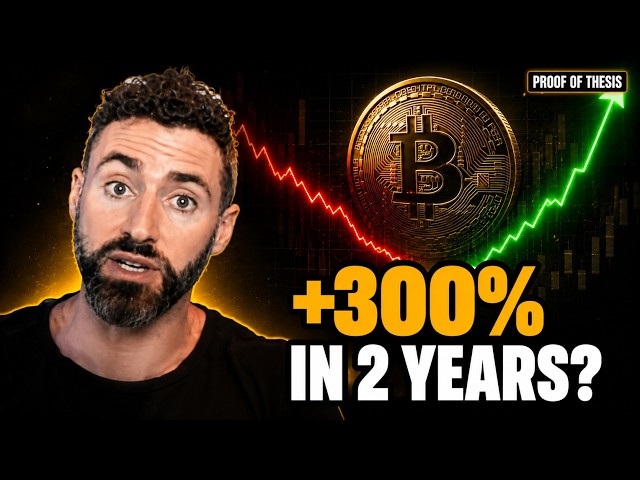
Bitcoin Likely to 4X in the Next 2 Years? | Erik Crown Breaks Down the Data
Watch on YouTubeVideo summary
Erik Crown argues that Bitcoin is currently undervalued and poised for significant growth over the next two years, citing a confluence of technical and on-chain indicators that suggest a market bottom has formed. He points to specific metrics such as the weekly Relative Strength Index (RSI) dropping below 30, the MVRV ratio falling under one, and trading volume percentiles hitting historic lows, all of which historically precede major reversals. Crown emphasizes that after periods of extreme apathy and low volume, markets typically experience a sharp correction followed by a strong recovery, noting that Bitcoin has already corrected more than 50% from its all-time high, creating an attractive entry point for long-term investors who do not need to time the exact bottom but rather buy within this value range.
The analysis extends into seasonal patterns and statistical probabilities, with Crown predicting that a positive close in September could trigger a strong performance in October, historically Bitcoin's best month, potentially pushing the price above $90,000 by year-end. He bases these forecasts on data from 2018 to the present, arguing that this modern era of Bitcoin offers more relevant insights than older four-year cycle models or limited historical data points. By applying median returns observed in previous cycles to current starting prices, Crown calculates a high probability of substantial gains, suggesting that even if Bitcoin does not finish the year above six figures, it is highly likely to reach new weekly highs that would effectively end any remaining bear market sentiment.
Beyond price predictions, Crown addresses the long-term viability of holding Bitcoin compared to traditional assets like the S&P 500, acknowledging that while Bitcoin has underperformed recently on an annualized basis, its cyclical nature offers unique upside potential that equities cannot match. He maintains that Bitcoin remains a necessary component of a diversified portfolio due to its fixed supply and 24/7 liquidity, serving as a digital hedge against inflation and economic instability. Furthermore, he distinguishes Bitcoin from the vast majority of altcoins, which he views as highly speculative projects often lacking transparency or real utility, advising investors to focus on assets with genuine revenue generation while recognizing that the era of broad-based altcoin rallies has largely ended in favor of sector-specific winners like AI agents and meme coins.
Read the full video transcript
you are convinced the bare market is
over. Can you point at the factors that
make you so confident about that?
>> Sure. Yeah. Basically, I saw all the
signals that I needed to see that uh
that pertain to Bitcoin having extremely
high value um around that $60,000 low
that we saw in July. And ultimately, it
comes down to a lot of, you know,
somewhat simple technical indicators and
also onchain indicators like the weekly
RSI getting below about 30. Mr. uh MVRV
also going below about one. The PO
multiple going below about spot five and
the 21 weekly EMA stretching about 20
you know more than 25% from uh price
that was also a big one. Uh we also saw
some other things related to just the
general uh sentiment like I created this
apathy index over here. um that one was
effectively at the lows. And another one
that was really big for me um that I you
know uh thought was kind of interesting
was um the volume percentile uh
measuring basically the volume that
exchanges were doing was at some of the
lowest lows that we've ever seen. And
typically when those happen is after a
major bare market, Bitcoin comes down
and during that part there's actually a
lot of volume on exchanges. People are
trading a lot you know um it's very very
exciting times despite it you know
generally going down. However, what
typically happens after that before the
reversal is things get incredibly
boring. You saw this in, you know, 2015.
You saw this in 2017. You saw this in
2021 and 2022. You saw it recently here,
too. I mean, damn, man. Bitcoin's, you
know, around 60,000 bucks and trading in
$100 ranges. It's crazy. and volume
percentile, you know, to give a number
on it was below 5 percentile, meaning
that if we were to compare um the look
back to it, we were seeing lower volume
compared to basically 95% of the other
days traded. So that typically happens
when the market's very very uh
apathetic, I guess, if that's a word. Um
and uh and what happens around those
times, reversals happen around those
times. Other than that, we also saw what
I thought was a pretty decent draw down
from the all-time high. So, for me, it
wasn't necessarily like, hey, this is
absolutely the blow. I'm buying in. It
was more so, hey, uh, I see really,
really good value here, and I'm happy to
buy in as a long-term investor because I
believe, you know, based off of the
data, this is going to be worth more if
we fast forward 1 2 3 years out from
now.
I wanted to focus [music] on what you
said in the latest video where you were
saying that essentially if you buy
Bitcoin more or less at this level so
around 70,000 65,000
fast forward one year you would make a
significant return. Correct.
>> Yeah. Yeah. So, a lot of these things um
so one of them was just simply when
Bitcoin is more than 50% off of its high
um which we've seen many times in the
past. And if you go and just take any
random day from when Bitcoin was more
than 50% below its previous high and and
by the way, of course, we did see that
uh recently when Bitcoin was around
$60,000. If you fast forward one year
out from any one of those random days
again when Bitcoin was below 50% of that
previous high, the median return was
over 116%. Which is crazy again just one
year out. And if we and if we take that
two years out that more than doubles I
mean it gets close to triple at plus
337%.
And that was a 96% probability to see
that positive gain in comparison to the
one uh to the one-year win rate which
would have been about 87%. So, you know,
just something as simple as that um is
quite compelling to me. There's a lot of
other things as well. You know, when I'm
looking at the data over here and we're
fast forwarding out even 6 months to a
year, we're talking about gains, you
know, well beyond 50% within 6 months.
And in a year, you know, we're talking
about in some cases X's uh in like X's
meaning like, you know, multiples of uh
of where you were at. Um so these sort
of things again to me it's just like
okay uh I don't need to be perfect on
this low. I don't need to buy the exact
low to make a [ __ ] ton of money. I just
need to be, you know, within the
vicinity of it. And uh and again, as a
long-term holder, you know, doing things
on spot, not on leverage. Uh this, I
think, is the most relatable way that
most people can uh you know, invest in
Bitcoin and not lose their damn ass,
basically. So, that was kind of the goal
with that. That's why I was uh focusing
a lot of my content around um you know,
just presenting the you know, the
straight up facts like, hey, if you're a
long-term investor, there's good value
here. If you're short-term trader, you
know, that's a different game. But uh
but hey uh so far so good. I'd say
>> people are predicting that the end of
the bare market sort of comes one year
after the peak uh because that's what
happened in uh in previous cycles.
>> Yeah. I mean I I think the low is in so
I don't care what that is. Um look I'm
always open to things changing you know
because I I always come from a trader
background so I am always thinking about
where am I going to be wrong because I
know over some amount of time all my
models will be proven incorrect. It's
that's just the nature of models. They
will all break. So, I've never really
been beheld into like, well, Bitcoin
topped on October 10th, so it must
bottom on October 10th. Like, look, if I
think that I see Bitcoin as good value
and if I see signals of a, you know, of
a low forming, which, you know, we've
certainly seen, uh, I'm going to run
with that and I don't really care, you
know, how long it's been. Basically, I
created a road map based upon all the
statistics pertaining to September and
then, uh, and then Q4 of this year. So,
for September, um, you know, I do
actually expect, uh, September to be
green. And when we actually have seen
September be a positive closing month,
we've generally seen a very very similar
sort of trajectory um both in terms of
timing and in terms of returns. We do
have a big event this month. We have
obviously the FOMC, but the big one
actually is the quad witching date where
you have major expirations in equity
options, in futures options and the
index options and uh in futures in
general. And this is like the these
obviously happen four times a year and
it is the biggest deal when it comes to
markets. I don't really know why people
don't talk about it, but these are where
pretty much you see all the major
reversals happen. But anyways, up until
that date, we typically see Bitcoin
actually have a green period. Now, I'm
measuring the data between 2018 when CME
futures listed to present because I
believe that that is like the more
modern era of Bitcoin. I think that that
matters more. Just my take, you know,
take it or leave it, I suppose. It's
also more recent and I think that old
data for Bitcoin, it gets really
misconstrued with these crazy returns in
both directions. Anyways, uh what we
typically see there is about a 6 and a
halfish uh percent return again meeting
right there which would put Bitcoin
actually at about 83,222
which actually would be in incredibly
important. Why? Because Bitcoin would
simultaneously make a new high a new
weekly high above the previous swing
high that we saw back in May at 82,000
or sorry it was uh 82,800. So even a
short uh a short new high like that
would be incredibly incredibly important
for Bitcoin because anytime that we've
seen the weekly trend flip where the
weekly got a higher high, there's no
more talk of a bare market. Yeah, you
can get pullbacks. Sure, it definitely
happens. You can get sharp pullbacks and
get violent pullbacks, but an actual
downtrend emerging from there, unlikely.
Very, very unlikely, I would say. So
September closing green, um what have we
typically seen? Well, if Bitcoin closes
September green, we'd go into the month
of October, which is traditionally the
best month for Bitcoin. Um, that has a
median return, which is the highest med
return of any month at 12 about 8%. And
again, if we go off of those numbers
earlier and kind of forecast a close,
you know, at the end of September,
somewhere a little bit above 80,000
bucks, let's say, if you apply that
median return, let's just make it down
to like 12%. That would put Bitcoin a
little bit above 90,000 bucks, which
again, uh, that's just for October. And
of course, when we've seen a green Q3,
which right now I think that that's
extremely likely to see, uh, unless if
Bitcoin literally closes September below
the low of this quarter, which is uh
57750.
Possible, yes, probable. I would say low
probability. Um, but if we do see a
green Q3, generally Q4 has has gone on
to have uh some pretty nice gains. The
median return there is about almost 28%.
So, not only is October typically good
when you get a green in September, but
then the whole of Q4 has a pretty strong
median return again, close to 28%. And
if we apply that number again using my
initial pin number of 78,000 bucks, that
would put Bitcoin in low six digits
again. So, I actually don't think it's
that crazy for Bitcoin to see six digits
uh sometime before end of year. Now,
does Bitcoin finish above six digits? I
don't know. Maybe just briefly above
that. And again, when I'm thinking it as
a trader or investor, I'm always
thinking in terms of probabilities. I'm
always going to choose a thing that's
more likely to happen. Doesn't mean it's
always going to happen, but if I have to
bet, I'm going to bet on the thing that
has a higher probability. And so, this
would be it right here. And uh yeah,
man, that's that's really what I got for
you for the end of the year here.
You look at this seasonality as a factor
when you make these projections. there
is a very limited amount of data of
historical data around Bitcoin, but you
still believe that the the data we have
is still some somehow valuable to look
at.
>> Well, okay. So, this data right here is
I mean, yes, it is it is somewhat uh
low. You know, you got like what 15 or
16 years of Bitcoin, but let's compare
that to the alternative, which is what
people are using with the four-year
cycle. Well, you only have three data
points there. So, am I going to go off
of 16 years or three data points? Uh, I
mean, if you're going to if you're going
to throw that back as a criticism, I
just don't think it holds up because the
other thing that people use is even
worse [laughter]
in my opinion in terms of just like
general iterations, it's like, oh, you
know, Bitcoin midterms or Bitcoin having
it's like, okay, great. We have three
data points. You know, you don't think
that something new can happen? Like,
come on, man. Uh, you know, there's
going to be outliers here. We we don't
even have enough to have a true sample
size at this point. Like I said, 16
years ain't perfect, but it's it's it's
multiples of that. Um, so again, it's
served us. It's it's it served me well,
you know, ever since I started to
reference a lot of this stuff. I'm going
to keep going with it. Like I said, it's
not always going to be perfect, but uh
as long as it's directionally correct,
I'm happy.
>> I was talking to Benjamin Cowan uh a
couple of weeks ago. We did an interview
with him and he said an interesting
thing. He acknowledges the fact that uh
there's not such a big reason to hold
Bitcoin as it used to be because the
returns are not that great anymore. Like
if you look at the fiveyear time frame,
the past five years in terms of annual
average returns, Bitcoin has
underperformed the S&P 500. And also in
total returns, that's that's exactly the
same uh situation. Do you think that is
there is still a reason to hold Bitcoin
for the for the long term when you can
just hold the S&P?
>> Yeah, to be honest, I think that that's
a very maybe I'm just hearing him out of
context, but that sounds like a very uh
immature assessment. Um the reason being
is because look, Bitcoin does have
better better returns than tradition
marks than you'll ever see there for,
you know, a major indicy like SPY or
triple Q's or anything like that. But
you have to time things right. You can't
just blindly hold it. Bitcoin goes
through cycles, you know, as do they as
well, but Bitcoin, of course, being a
little bit more of an immature asset. It
has these big draw downs followed by a
big upside as well. So, if you're not
going to be able to time those things or
if you can't even just moderately get
things somewhat right, uh then yes, you
know, it's it will factually speaking,
it will not have as good returns if
you're literally just buying and holding
at the worst time and comparing that
versus SPY. Yeah, absolutely. But, uh
but yeah, you know, the gains are
absolutely there. I mean, [ __ ] I don't
see SPY going up uh, you know, 2x in a
year for, you know, for example. U, but
again, if you're not going to time that,
if you're not going to trade around
those positions, then absolutely, yes,
you know, he would be right.
>> Yeah, exactly. I'm not talking about
traders, I guess. I'm more talking about
long-term holders. So, if you look at
the, I don't know, 10, 20 years time
frame, do you think there is still a
reason why you should hold Bitcoin
versus the S&P 500?
>> Yeah, for me, yes. Uh, I do think so.
The simple reason is just, you know, a
lot of the uh Bitcoin, I guess, um
fanboy stuff in the sense that, you
know, you got some that's outside of the
system in a way and uh for me, I think
that that's worth an allocation. Now, is
it going to be the best thing of all
time? No. Of course, you don't want to
be all into anything, of course. But I
do think that it has its own unique
views and and its own unique
propositions, you know, in terms of
value. So, that's why I like to hold it.
I think it's a very very nice asset, you
know, just for the matter of fact that
it's, you know, 247 liquid, which is uh
something that you just don't really
find anywhere else. And um look, for me,
like I I happen to believe that Bitcoin
will probably be much higher in uh five
or or especially 10 years from now. But
hey, that's just me.
>> Okay. But when you mention the fact that
it's liquid 24/7, I'm sure you are aware
that a lot of traditional assets
probably will be also available 24/7 now
that everything is going to be
tokenized. So that's also another
another part of the Bitcoin thing that
is not will not be exclusive to Bitcoin.
Correct.
>> Sure. Yeah. I mean that that goes away
as I guess one of the value propositions
that makes it somewhat unique. But again
at the end of the day man I think um you
know you still have a lot of the factors
of you got 21 million fixed supply stuff
like this. Um you know that just makes
it a different asset altogether. So, for
me, it's I think that everyone has to
have some sort of an allocation if
you're going to be holding a very
long-term portfolio. Um, that needs to
be appropriated towards kind of like a
hedge, if you will. I I don't really
like using that word, but we'll just use
it for this conversation. So, some like
gold, silver, Bitcoin commodities
effectively. And I I just think Bitcoin
is still the more interesting commodity
of these simply because I think new
people who are growing up right now, new
people are growing up, you you know, the
younger generations, they grew up with
the internet. I'm sure you're probably
about my age as well. And you know, we
kind of grew up when the internet was
just coming out and we kind of got to
see both worlds. Um, but I think these,
you know, the younger generations, they
look at Bitcoin as like, oh yeah, of
course that thing exists. Of course it's
legit, you know, and for me it's it's
even better that it's all online. It's
all digital because, you know, these
people grew up in a digital world. And I
think that that is actually appealing to
them um in a way that uh maybe, you
know, us and perhaps older people might
not uh resonate with.
Talking about your personal decisions,
um I know that you have been a trader
since you were very young because your
father was also a trader. You recently
published a video where you were
mentioning that. You also mentioned the
fact that according to a certain study
about 97% of people trading uh
eventually end up losing money and only
essentially very [snorts] very very
little amount succeed. Assuming that of
course you are among those who
succeeded. Um have you ever made this
exercise uh this in have you ever made
this exercise according to which you
just look at the the amount of success
that you that you had being a trader and
sort of compare it to how much money
would you would have made by just dollar
cost averaging into let's say the S&P
500 or another index and see whether you
made more money by trading. Have you
ever made sort of
>> Yeah, absolutely. Um, so I I actually
have done exactly that. And the issue
with doing that particular study is that
you can't like lump some things. You
need to earn the money first and then
put it in. Um, so the way that I look at
trading, the way they look at investing
is completely different things. Trading,
if you can do it, is great for income
generation in the same way that you do
just, you know, like a regular, you
know, a regular job for example or
whatever to generate, you know, your
monthly income, for example. But
investing I think is more so it's it's
almost required at this point you know
given our economic system um it's a debt
based system obviously and inflation is
a feature not a bug and ultimately you
have to invest long-term in order to
either keep place with inflation or if
you're good you will beat inflation.
>> When you introduce yourself to people
you tend to say more than you are a
YouTuber than that you are a trader
investor. [laughter]
Why [clears throat] why is that the
case? Uh I think the average person
who's not involved in the space because
we are, you know, we very uh often
forget that we're in our own little echo
chamber and bubbles. The average person,
you know, the normies, if you will. Uh
being saying that you're a YouTuber is a
lot more relatable than being a trader.
Most people who I tell that to when I
did tell people, they be like, "Oh, so
you like gamble or something like that
or you know, they just don't really
understand it." And honestly, people,
you know, they're not really that
interested in what the hell you do
anyway. they're just passing time, you
know, with the conversation. So, it's a
lot easier to say, "Ah, I make dumb
videos on the internet." And, uh, then
they stop asking about it and then, you
know, I can move on with my life.
Basically, that's what it comes down to.
>> I wanted to hear your opinion about
altcoins in this present moment in time
because you were saying that it's not
worth to hold any altcoin for a long
period of time. Can you explain a little
bit what you mean by that? I think in
general if you're going to be holding
any particular altcoin, you have to
recognize the history of these things.
99.999999999
repeating to infinity% of shitcoins uh
typically do have a rally in their first
cycle and then after that it's down
always. So when I say you can't hold
them for a long period of time, what I
mean is that if you're holding these
things for years and years and years,
the data is overwhelmingly against you.
Uh yes, there's every once in a while
you see an Ethereum uh survive, but even
Ethereum hasn't had better returns
compared to Bitcoin over the past cycle
or even over the past couple cycles I
think. Um so ultimately I do think that
there is a time and place that you can
make a lot of money holding shitcoins.
It can happen for sure, but at the same
time, uh you have to realize that that's
uh you know, it's it's a foregone
conclusion that at some point, you know,
you will sell if you really truly want
to actually own those gains and not just
uh let it be paper gains. You know,
those th those things for for all that
it's worth, like they just go up and
then they go down only almost every damn
time.
>> So, in that respect, you think they are
fundamentally different sort of holdings
than Bitcoin?
>> Yeah, absolutely. Bitcoin is a
completely different thing. I mean most
of these uh shitcoins they are like you
can think of them like as a super
speculative startup project where
there's a lack of transparency to what
the people are actually doing with it. I
mean, you saw it back in 2018 with the
ICO craze. There was people just, you
know, stating that, hey, we're going to
we're going to work on this problem if
you give us a lot of money. And more
more often than not, you know, when they
when people actually track the money,
none of that went to the actual project.
It just went to the founders
pocketbooks. And I think that's what,
you know, is is is what a lot goes on in
the space. Uh it's not really regulated
in that way just yet. And so there's not
like um these sort of fail safes, you
know, guarding you. Uh just is what it
is, man. Comes with the territory. A lot
of these things I think are just selling
hopes and dreams and they're white
papers, you know, re like marketing
papers, which they're not really
supposed to be. So to me, it's it's a
big red flag. I feel like if you're
going to, you know, do speculative
investments, you could trade OTC if you
really want. Um or, you know, stock
market's fine, too. If you really want
to go into like uh private, you know,
equity and investing and whatnot, you
know, I think that's ultimately better.
Um but hey, I'm not saying that you
can't make money with them. I'm just
saying you got to you got to you got to
really time them right because they are
shortlived typically with those uh with
those euphoric phases.
There is this specific narrative that
came up not in latest months according
to which the next alt season uh will not
come in the sense that there will no
there won't be like a generalized bull
market for altcoins like we saw in the
past and as you said 99% coins will fail
but there will be a certain percentage
of them that has certain characteristics
which will succeed also in the long term
and those characteristics are
essentially being able to generate
revenue. So essentially [snorts]
altcoins that are connected to
applications that generate real revenue
and the revenue is uh flowing into the
token. So the token is able to acrue
value coming from from users. An example
is for example hyperlquid
um matt hugan from bitwise mesh and also
a and unis swap as examples of that sort
of model. Do you get this argument? I
agree with it. I also think um I also
think the sort of premise of it is a
little bit misguided because that's
actually what we saw in the past couple
cycles too. Uh in the 2023 to 2025
cycle, we didn't see a secular bull
market for shitcoins. We saw few sectors
go to the mood and beyond. We saw the AI
agents and just AI general sort of um
related uh coins go up. That was early
on in the cycle about 2023 and 2024.
Then we saw the meme coins go up crazy
around the end of uh 2024. And then
2025, you know, wasn't really much
across the board. So, it's just a few
sectors realistically there. Most of the
other stuff didn't do all that much and
certainly was not, you know, the place
that you wanted to be. In the cycle
previous to that, you know, we saw NFTTS
of course and we saw a lot of layer
ones, but other than those things, you
know, there wasn't a humongous amount of
winners. The last cycle that I really
remember where any like literally
everything went to the moon was 2017 and
2018. You could literally just throw a
dart at the board and you were going to
be up like 5 to 10x within a couple
weeks, which was absolutely insane. But
uh but yeah, those th those times have
like that just has not been the truth
for a long time. So I could definitely
agree with that statement. Um it would
make sense to me. You know, like I said,
the market is maturing and I do think
that there is value in the crypto space
in general. Uh so yeah, why not give the
value to the companies that actually
have a real product. You know, these
sort of things uh makes a lot of sense
to me for sure.
>> Eric, that was a great conversation.
Thanks again for coming on our show and
I hope to see you soon again.
>> Yeah, man. It was a pleasure. Uh thank
you very much and yeah, anytime. Take
care.
[music]
>> [music]