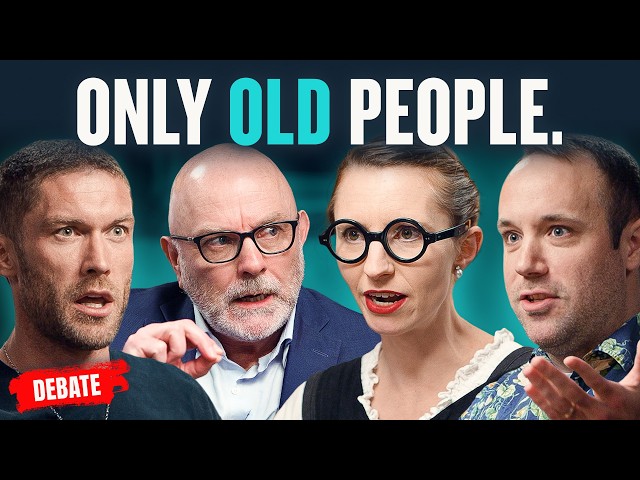
Video summary
The podcast features a high-profile discussion on falling global fertility rates, led by demographers and effective altruists who frame demographic collapse as an existential threat to humanity's long-term future. The speakers highlight that while many assume overpopulation is the primary concern, industrialized nations are facing rapid population decline; for instance, US births dropped significantly in 2024 compared to their peak in 2007, and by 2100, only six countries are projected to maintain replacement-level fertility. The conversation emphasizes that this trend affects everyone economically and socially, as current pension systems like Social Security operate on a Ponzi scheme model requiring a growing young workforce to support an aging population. Without sufficient new entrants into the labor force, essential services such as healthcare, fire departments, and public schools face severe funding crises, leading to the hollowing out of communities where municipalities disband due to lack of taxpayers. A central theme is the profound shift in women's identity and career trajectories that contributes to low fertility. The speakers argue that modern society has created an "anti-natal" system by formalizing a path for professional success that often requires sacrificing family life, leading many women to fear losing their identities if they become mothers. This sentiment is illustrated through personal anecdotes of stay-at-home parents who manage complex household finances and community roles but are undervalued compared to corporate workers. The discussion critiques the societal tendency to view parenting as a demotion rather than a promotion that builds civilization, noting that unpaid domestic labor like elder care and child-rearing goes unmeasured in GDP despite its immense value. Consequently, women often face a choice between maintaining their professional status or raising children, with few structural supports allowing them to pursue both simultaneously without penalty. The dialogue also addresses the biological realities of reproduction versus cultural barriers, challenging common misconceptions about fertility decline being solely due to birth control usage. Data presented indicates that US fertility rates fell below replacement levels in the 1920s even before modern contraception was widely available, suggesting deeper structural causes like delayed marriage and partnership instability are primary drivers. The speakers share personal stories regarding medical interventions for recurrent miscarriages and debunk myths about C-section limits, arguing that risk-averse doctors often deny women their reproductive potential despite manageable risks with proper care. Furthermore, they discuss how lifestyle factors such as obesity or extreme thinness impact fertility, noting that weight loss medications like GLP-1s can inadvertently improve conception rates by restoring hormonal balance, yet these are marginal solutions compared to the need for societal shifts toward earlier family formation. To counteract regret and demographic decline, the hosts advocate for an "information shock" regarding reproductive biology and relationship dynamics. They present startling statistics, such as that 90% of people who express regret about their family size wish they had more children rather than fewer, and warn that fertility drops linearly after age twenty-five for women while sperm mutations rise in men starting at eighteen. The speakers urge individuals to have hard conversations early in relationships regarding views on divorce, religion, and parenting styles before investing deeply in a partnership, comparing marriage to locking in an interest rate where waiting too long results in worse outcomes due to biological constraints. Ultimately, the group concludes that while they respect individual autonomy, society must engineer environments that support dual identities for parents and provide accurate information so fewer people reach mid-life feeling they have missed out on family life or failed their potential as contributors to future generations.
Read the full video transcript
Why should anyone listen to anything
that you guys have to say? I mean you
you've brought in an interesting group,
right? I mean, whenever people like
don't want to read something and they
just want to like watch something to
understand falling fertility, inevitably
I'm like, well, there's there's this
movie you can watch online um about how
fertility is falling, why, what's going
on? And I reference your work and I pass
them basically to you. Um I mean I'm I'm
a demographer. I'm uh at some point
today I will during this conversation I
will probably try to draw a graph in the
air with my hands. Um you can you can
you can like lunge and slap my hand down
when I do it. Um but uh so I mean for me
I'm there's that. And then of course the
Collinses uh are like practically the
people who've like made this an issue
for a lot of people.
>> We're the punchable face of pronatalism.
>> [laughter]
>> So I guess I'm kind of answering for
like multiple people here.
And then you're like you know
>> It's so true. It's [laughter] so
true. I don't want to punch you, but
it's uh yeah. Yeah, Simone, have you got
Is this just a passing interest, a
passion for you? What is this? We are
we're hard effective altruists. We care
about the long-term future of humanity.
And you can actually see this among many
people who are famous pronatalists, like
Elon Musk, right? Like his interests
track with what appear to be existential
threats to humanity. He's concerned
about the environment. He he works on
Tesla, right? He sees these things. Now
he's trying to get humans to space.
Um so people who are very interested in
long-term human flourishing are
naturally likely to care about
demographic collapse because it is one
of those things that is a civilizational
level threat. I mean when when Stephen
mentioned for example that this does
affect everyone, yeah, boomers who are
like like not my problem, they're still
in just a few years going to be
receiving only like under 80% of their
expected social security payments, which
are being paid for by Gen Z who's not
expecting anything. So everyone is
affected by this. And yeah, this is
something where
basically even if you don't care about
the long-term future, you're affected.
But because we do care about it, we care
about humanity in 100 and 1,000 years,
we're we're at the precipice of a
tipping point that could either take
things in a very cool direction or a
very bad direction. So we care about it
from that perspective. And you've been
working on this for
two decades flying around the world. Um
it's just over one decade. It feels like
two. You know, I come from a very
different perspective. I came out of the
commercial world uh where I ran a data
science company doing advanced data
modeling for 20 years.
And I I could have and maybe should have
continued in that line, but once I saw
in January 2016 that the birth rate
issue wasn't just limited as I thought
at that time to Japan and Italy,
that effectively it was spreading
globally and had been spreading for 50
years and I didn't know about it. And
for sure I was bringing up my kids at
that time as teenagers as they were for
a world where birth rate decline was not
going to be a factor for their the
entirety of their future. I got scared
that why do we not know about this? And
then going to research to find out well
what's a common factor because we can't
have independent factors alone
explaining why this happened in Italy
and Japan and Germany and Spain and
Austria et cetera at effectively the
same time. And I find that no one was
looking at it from that way. So I you
know, I really have devoted
uh 10 years into what I would call you
reproductive dynamics. What are the
patterns? So rather than looking at
demography from the point of view of
how do we explain changes or rather what
levers can change things? Is it linked
to salaries? Is it linked to housing uh
prices?
I come at it from a different point of
view is what's the same? What are the
underlying structures across societies
and over time that are really locked in
or mostly locked in? And so it it's an
interesting I would describe it really
as yeah, reproductive dynamics or
structural demography.
>> One thing that I think is worth
noting is that for all three of us,
your backstory, I know your all's
backstory, none of us like grew up as
kids and were like, I hope someday that
I study low fertility.
Um like
And and also like none of us are
actually coming out of the tradition of
academic demography, okay? I started
writing on low fertility and then went
and got a PhD because it was like a like
a a neces- a necessity of the job,
right? The reality is on the question of
low fertility, by and large academic
demography has
to a considerable extent been missing in
action.
Um
>> Yes. that you kind of noticed this was a
thing and then got into it from a very
different background. You all you all
were like living in Korea, right? And
kind of freaked out by no one having
kids. Um for me, I was working on
totally different like regional economic
development stuff and then I kept
bumping into fertility and being like,
this is this weird super powerful
slow-moving force in the background of
everything I'm writing about. Maybe I
should just write about that. Um and I
think that that's the story for a lot of
people who are concerned about falling
fertility is that none of us just woke
up and said, I'm deeply concerned about
falling fertility. There were other
things we loved in the world and we
gradually woke up to the fact that if no
one's having kids, the other things we
love don't last. Global fertility is
projected to keep falling reaching
around 1.8 by 2050 and 1.6 by 2100. By
2100 only six countries are expected to
still be at or above replacement level.
The US recorded its lowest ever
fertility rate of 1.6 births per woman
in 2024. Around 710,000
fewer children were born in the US last
year compared to the nation's peak in
2007. Since 2007 the general fertility
rate has declined by 23% and in the UK
being childless at age 30 is now the
norm rising from 48% to 58%.
Yeah, and I think those numbers really
don't even do a justice to the reality
of what that means for a society.
Um you know, people often still think,
many still do, that there are too many
people on the planet and having fewer
people is a good thing. But when you
look at the dynamics of this, I like to
talk in the periods of time in which
births will half Mhm. and then half
again and half again and half again. A
curious one I was looking at the other
day is if you have a fertility rate of
1.0, that's very low,
but it's above what we're seeing right
now in Korea and Taiwan, Hong Kong, et
cetera. If you take 1.0
and if that doesn't change,
the total births in a given generation
is equal to the total future births of
all future generations
because you keep halfing and halfing and
halfing and halfing. And you add up all
those halves of halves of halves
and you get no more than the total of
the current generation.
Mhm.
And that's 1.0.
>> That's a fun homework math problem.
>> Right. You're like intro to demography
students.
>> Well, let me give you another one. Can
I? I've only got two of these and I
haven't shared these before. But you
take a fertility rate of 2.0, almost
replacement level.
And 1.0 and I were to ask you, what's
the halfway point between 2.0 and 1.0?
Well, there's actually two answers to
this question.
If you're talking about well, today's
generation, you know, the number of
average children people have, of course
it's 1.5. But if you're looking at the
the future,
the halfway point between 2.0 and 1.0
is 1.92. Yep.
Because at 2.0, births are going to half
every 800 years.
You get down to about 1.92 and they're
going to half every 400 years. You've
halfed the length time for births to
half already. When you get down to that
1.5 point, 1.6 point like the US and
Europe and
yeah, well, and yeah, frankly, um
I think we're all on the path to South
Korea. May- maybe we'll get to that at
some point in the conversation, but
where we are right now, births are
halfing in the industrialized world
every 50 to 60 years. What happens if
the population declines? I think a lot
of the time people ask the question, why
should I care? They maybe got some
defenses, we're worried about climate
change or overpopulation or this or that
or the other trying to get women out and
we'll get into that. But like what
happens to the world? Forget
individuals, forget the happiness and
connection and stuff like that. Like
what just happens to what what's the
impact of having fewer people next
generation than now?
Well, I I think there's so many answers
to that. I mean economics and the social
side. I mean I spent seven years in
Detroit, Michigan
uh around the time of its bankruptcy in
2013. And there was a city built for 2
million people with only 700,000 living
in it.
Very different reasons.
But you have the same issue of a a
society, the city in this case, built
for a certain number of people. And you
look over a period of decades
what it's like for a city, a community
to be hollowed out. I remember as
filming for the documentary driving
around and you see some clips of this,
but there was one moment driving down
this street of what would have been very
fancy houses
in then a very scary area not far from
the center of Detroit.
And there's just decay everywhere except
towards the end of this one-way street,
there was a family having a picnic on
the garden outside. Young kids running
around.
And for me that was just the image of
this is the future. That's a book
chapter opening, right? Yeah, yeah.
Right. You know, you've got this
joyous moment for a young family
surrounded by decay. And you know what?
I bet you now that family isn't living
there. I bet you that. Well, Detroit has
kind of re- re-energized itself. It's
come back, but that's that's not going
to happen while fertility is low.
>> So I say I I hope we come back to the
question of what will happen in terms of
people's individual experiences of
happiness cuz personally that's what I
care about most but
there is one area of this that I think
is dramatically under appreciated in
terms of the effects of falling
fertility.
Fertility doesn't fall evenly everywhere
and as we just heard um
it is the case that small differences in
fertility once you're below replacement
small differences in fertility quote and
quote small differences can create
radically compounding differences in
military age recruitable populations.
The result is
in the 20th century we worried about how
large groups of young men would impact
internal stability of countries.
Too many young men they start a civil
war you get communist revolutions and
the US built a whole foreign policy
apparatus around managing communist
revolutions and civil wars in other
countries.
The 21st century we already know is not
like that. Civil wars are not the
problem. Interstate conflict is okay.
We're seeing an explosion in conflicts
between states. Why?
Well
one very plausible reason is that when
fertility decline becomes very rapid and
becomes very differential
you get a lot of countries that realize
one this is their last chance to make go
at it before they don't have a fieldable
army anymore and two that the guy beside
them declined way before them that
they're a generation farther down the
path. And so a lot of countries in the
next few decades are going to be at a
place where they realize that they will
literally never ever have a better time
to strike ever again.
That being the case 21st century
fertility decline I mean you can think
about this North and South Korea. North
Korea's fertility rate is something like
two times that of South Korea. China has
low fertility but still has this this
big
uh
age bump that Taiwan does not have.
Taiwan's already smaller.
Now you can say well you know automated
weapons will fill the gap and all these
things and and that is happening in
Ukraine. I mean Ukraine's trying but
Ukraine's also showing how hard it is.
Um that even with the full support of
lots of industrialized technological
societies helping them innovate and
develop it's still taking a brutal
ghastly cost for their entire society
just to barely cling to their turf. So I
would say that one of the real
realities of low fertility will be the
resumption of zero-sum interstate
conflict and we know that because stable
population societies or even declining
population societies have existed many
times in the past. Most of human history
was a situation where there was no
long-run population growth.
And it wasn't peaceful.
The idea that as countries decline
they'll get so freaked out about war
that they stop fighting is nonsense.
Instead they will realize
now's our moment.
But it's even more local than that
because I mean basically we our
government and most developed countries
governments are set up like a Ponzi
scheme and you're you're not you're
bought into it. Like this is a problem
cuz you're bought into a Ponzi scheme
and even if you're trying not to. Like
let's assume that you're like well I
know I'm not going to get my social
security. Well I know I'm not going to
get Medicare or Medicaid if anything's
hard for me. It's still matters because
hospitals are going to start shutting
down when the government stops
reimbursing them. Your 401k yeah you're
bought into the stock market if you have
a 401k if you have a state-based pension
fund. Also keep in mind that as cities
start to spend more and more of their
budgets just paying for pension funds
where is the money to pay for their
existing police forces for their fire
departments? Who's going to come to your
house when it's burning down? A lot of
these things that we've come to depend
upon that we're like well obviously I'm
going to get this. These are relatively
new inventions. United States is a
socialist utopia and people don't even
realize it. You're like oh you know
China's social No they're not. We're way
more socialist than China.
Well you have to pay for school in
China. All the all the health coverage
that you get in China yeah it is it's
it's not you don't get like if you're
poor in the United States if you're at
or near the poverty line especially if
you're a parent you typically have child
care paid for. You typically have health
care totally paid for for your kid. You
have food assistance for your kid. That
doesn't exist in China. That exists here
and it's not going to exist much longer
if demographic collapse keeps playing
out without serious intervention.
>> Why? What we already see this in a lot
of towns. I mean
I'm from Kentucky Eastern Kentucky has
massive population decline over the last
few decades and whole communities
municipalities that just disband and
they say okay we're just done as a
municipality. There's not enough
taxpayers. What really does is you get
to point they'll abandon the school
they'll abandon the roads. The town
disbands when there's not enough
taxpayers to pay for the salaries of the
bureaucrats. Okay? And at that point
they're like well we'll disband and I'm
like
I think most people would preferred if
you fired yourselves and kept the school
a little longer but um I mean you can
buy towns in Kentucky school fire
station everything. Now they're grown
over with weeds and vines and all that
but um it's great great place to start
communes right? But uh um
but ultimately you can you can see this
all over the country. I mean Chicago
where Illinois where teacher pensions
okay this like a micro microcosm of
what's going on.
Teacher pensions are driving this
massive constant run-up in educational
spending even as actual money spent on
instruction
is not rising. And surprise surprise
people are like well all this education
money is not getting better outcome for
kids. Yeah cuz the education money is
just pension money. We just file pension
funding as education funding and I'm
like no pension funding is welfare.
Yeah. Okay? There's a classification
issue here
but
so like ultimately localities are
already have this having states
localities are having this problem where
the needs of the old are cannibalizing
the futures of the young.
And just I mean to put a point on it now
you you see more and more older property
owners then saying well we shouldn't
have to pay property taxes once we've
paid off our mortgage because we don't
have kids in the school system.
And I'm like first of all you went to
that school system you can pay it back.
Second of all you did have kids in it
and your property taxes didn't pay their
full cost. And third of all
we discovered during COVID when you shut
the schools down the youths burn your
city down so pay your protection racket.
I remember we had a conversation and I
said what happens if you have a
country's population decline? What does
that look like? Is it just that towns
are half the size? That's not the case.
It's that small towns that are less
desirable to be in just disappear
entirely and become abandoned. New York
will be the last bastion of wherever the
population decline goes to. Is Tokyo
suffering? You're right. I mean you look
at Japan right now and you look at the
forecast for population movement within
Japan
um and the rural areas are absolutely
dying but the growth within Tokyo is
continuing and will continue for a
generation more more I call these magnet
towns or magnet cities. Young people
will gravitate to where there are jobs
where there are supermarkets and the
older people will be left sadly in these
rural dying communities. You call it
population triage? Right? People look
and they realize this town has no
future. So they move to the places that
will survive. Which are more expensive.
Which are more expensive. And which have
lower birth rates. And lower birth rates
and then they
and then they move again and again and
again. And so you get it's actually and
you can see this every it's not
it's not just Japan. I mean in Bulgaria
Sofia's doing fine. Um I mean in England
London does okay. Um around the world
once you see it you can't not see it
that low fertility societies often have
thriving primate cities because what's
happening is all the people who can get
out there's this incredible filtering
effect that everybody who has the
ability to look ahead at the future
everybody who's kind of a long-term
planner an investor a builder looks and
goes I don't want to be here when when
the you know the stuff hits the fan and
they move to the big city. Why is it the
case that declining fertility impacts
the economy negatively? Like what what's
the reason for that? Cuz you said 401ks
we don't have the money to be able to
put into the system. Like people might
not naturally just understand why that's
the case.
I mean when when you have growing
fertility you have growing population
growing demand you have more people
paying into a system. Also we didn't set
up things like our social services in a
way where you know you you you actually
pay money to social security and it
stays there. No we we we first created
social security and we paid people out
immediately and we're like we'll just
keep funding it as we go along. And what
could possibly go wrong?
Um so when you stop that again because
it's a Ponzi scheme just like the basic
design is you have to pay people in and
then you pay someone out and then
whoever's last holding the bill is going
So you need to feed more young people in
the bottom in order to be able to pay
for the old people at the top because
we've got aging population this
inversion means that there are fewer and
fewer young people with more and more
old people and that is going to be the
problem. So the point here you
So
but so I mean that's 100% true. But when
I think about the real economic problem
of low fertility you know I benefit so
much from the existence of Albert
Einstein.
Okay? He invented things that everyone
in the world benefits from. Ideas
concepts or
um
or we could say Elon Musk okay? Or any
of these high productivity geniuses who
have done things that have
revolutionized the world. Innovation is
non-rivalrous. Everybody benefits. The
odds you get a genius
are just a function of population times
education times you know some latent
genetic difference but times capital
density. Okay? So if a super genius is
born in a country with no education no
capital density they don't live up to
their potential. So basically as
fertility is falling particularly in
industrialized societies that have deep
capital markets education where a genius
could rise to their potential
everyone loses. A bigger population
particularly in those countries yields
innovators for the entire world. The
fundamental engine of economic growth is
not population structure it's just
ideas. It's productivity. It's it's
division of labor. It's innovation, and
that stuff slows down Um even on the
consumption side.
When a new
What are we drinking here? Neutonic.
>> Neutonic, a productivity drink. Um, and
this is a relatively new product. It's
only been around for A couple of years.
A couple of years. Okay. Um,
I would bet if you did a marketing
survey on your consumers, most of them
aren't 65. They're probably relatively
young, partly because your market is
young, but also because the market for
every new product skews young.
Demand for innovation skews young. Older
people are fine with what they have. So,
it is not just that a higher fertility
population makes more innovators, it's
that a higher fertility population wants
more innovation, demands more
innovation, can absorb more innovation.
As fertility falls, we will simply not
have as much innovation. I know Robin
Hanson, an economist, uh who writes on
this, argues that we're basically facing
the end of innovation, that we're going
to see essentially the end of human
progress Or at least a dramatic
foreshortening in pace. Maybe AI
revolutionizes that, but when I think
about the economic costs, yeah, there's
there's the wasted consumption of
reallocating young people's savings
towards old people's uh consumption.
That that's that's a a real burden on
the economy, but
you just you need those innovators, and
you need people who buy their products.
>> [snorts]
>> I think there's several ways to try and
to me crystallize this.
Um
>> [snorts]
>> national debts.
We've all got them.
National debts are there to be paid off
somehow, or their interest to be paid
off.
If you if you have fewer people in the
future, those debts don't just
disappear.
You're going to have your national
debts, as they stand now, paid off by
fewer and fewer and fewer people. So,
it's not just
pensions. A lot of this skews to the
problems that we're going to have when
people get older.
But the tax system
is there to support the entirety of how
societies operate. And national debts
are a very real tangible thing I think
that everybody should be focused on.
Now,
you're right, we're going to lose human
capital talent. I'm less concerned about
that because I think the problems are,
you know,
>> [snorts and crying]
>> if you're a young person today
thinking of setting up a business,
any business, whether it be a cafe or a
spaceship company,
and you're looking at business plan, and
you're looking for investors,
and if your a cafe or your drinks
company is dependent on
a certain number of people and growth,
and you're actually looking at let's
take a cafe in a town
with falling birth rates,
the investor's going to be much less
likely to say, I want to invest in that.
I'll keep my money in my pocket. I think
you're going to have a a massive
move away from entrepreneurialism,
the investment in time and and funding
to create innovation.
And then we haven't even touched on
capital markets, the whole entire bond
market, Mhm. which most people are
unaware of. We don't go around thinking
about what the bond market's going to do
today. But the bond markets are what
drives economies.
And governments issue bonds, they issue
bonds for new projects to support their
national debts, etc.
There's a cost to that.
And those bonds can be today 20 years
out, even 50 years out.
And those bonds get traded.
So, you can go today, and you can buy
probably a 20-year bond that's got 15
years remaining on the city of wherever
in Kentucky,
or the country of Japan.
The cost of those bonds, the interest of
those bonds, is effectively going to be
negatively impacted massively in the
decades ahead. And what does that mean?
It's going to be harder and harder and
harder for governments to raise more
money,
which means again less investment. And
this goes back to my passion for this
project. We haven't even even if you
were to think
there's too many people on the planet,
and if you were to think you don't want
kids,
this is going to impact you, it's going
to impact societies in ways that we
aren't yet talking about.
>> We'll get back to talking in just 1
second, but first, tell me if this
sounds familiar. You train regularly,
you eat reasonably well, maybe you even
supplement, you feel fine, but you're
just kind of going off vibes. Most
people have absolutely no idea what's
going on inside of their body, which is
why I partnered with Function. Function
gives you access to more than 160
advanced lab tests spanning hormones,
heart health, metabolic markers,
inflammation, thyroid, nutrients, liver
and kidney function. It even detects
early signals linked to more than 50
types of cancer. To put that in
perspective, your typical annual
physical might test about 20 markers,
and Function runs over 160. And this
isn't just numbers dumped into your
inbox. Every result is reviewed by
clinicians, abnormal markers get
flagged, and you get clear explanations
and a personalized protocol with
actionable next steps, so you can
actually do something about what you
learn. Best of all, you test twice a
year, and everything lives in a simple
dashboard. You can just track trends
over time, make sure that you're moving
in the right direction. Normally, this
level of testing would cost thousands
through private clinics. With Function,
it is $365
a year. That's $1 a day to know what's
actually happening inside of your body.
And right now, you can get $25 off,
bringing it down to 340. Get the exact
same blood panels that I get, and save
that additional $25 by going to the link
in the description below, heading to
functionhealth.com/modernwisdom,
and using the code modernwisdom at
checkout. That's
functionhealth.com/modernwisdom
and modernwisdom at checkout. This
sounds like quite a left-leaning idea,
that we're worried about the welfare of
people, we're worried about especially
helping people who are more
disadvantaged, that it's really
important to ensure that there is enough
in the pot to be able to support the
people who really need it, including the
old and the poor and the people that are
injured, etc. etc. If you ever wanted a
nationalized health service, you're
going to need to have money to be able
to fund that, as opposed to just relying
on the wages that people can put in, so
that they can pay their insurance, so
that everybody else can get it
redistributed like that.
Why is it the case that having this
conversation is so unpopular on the
internet, and immediately gets thrown
the right-wing conservative
misogyny, the fascism, why do those
arguments get thrown around so quickly?
I think people
understand correctly that there can be
there certainly can be, and often in
fact there is, a tension between
sustainable fertility rates
and the gender egalitarianism that I
think most of us cherish, right? That
like
I'm I'm not like a radical left
feminist, but like I do want my wife to
be able to vote and own property, and
have the right to like the police hear
her out if I'm beating her or something.
Like, I'm, you know, like little e
egalitarian in that sense.
Um, and a lot of people fear, very
sincerely, they say, well, I would I do
worry about low fertility,
but I would never say so publicly
because,
you know, I stand with women, and the
pronatalists want to force women to stay
barefoot and pregnant in the kitchen. Um
and and I I mean, I'm sympathetic to
that. And and unfortunately, some
fringes of pronatalism have tended to
play into that.
Um the reality is and and there's and
there's genuine tension. I mean, it is
true that a lot of the most sexist
countries in the world have the highest
birth rates. It is true that within
society, people with more traditional
gender attitudes have higher birth
rates. Um these are all true things.
There's real tension between certain
gender models and high fertility. Now,
does it have to be intrinsic tension?
Can we find a way through it to the
other side? I hope so, and I think
that's what what you all have talked
about as well, is that you want your
progressive friends to be having kids,
so that their values can survive in the
future, too.
Um
and so,
I think there's a lot of people who
feel, rightly or wrongly, feel trapped
between two things they want. Okay? They
they don't love the idea of a low
fertility future, but they also feel
like they don't have an option other
than to like, well, if a low fertility
future is the only way to protect the
fact that like I'm a woman, and I
basically want to have rights,
then like screw fertility. Who cares? Um
or, you know, trust that it'll get
solved somehow, and just don't think
about it. So,
and and I think on some level,
pronatalists have not always done a
great job, and and I probably I would
count myself in this to some extent, of
uh
of trying to communicate that um yes,
right now,
feminism, broadly construed, is pretty
strongly negatively correlated with
fertility. It is, on almost any metric.
But we don't know that it has to be. We
don't know that there's not a future
version of feminism that's pronatal. We
don't know that such an ideology
couldn't be invented. The problem is
most of the people who self-identify as
feminists won't even try.
So, they won't even try to come up with
a version of the ideology that's
pronatal. So, uh and there are people
who are like uh Leia Sargent has a great
book on this, um where she's trying. Um
but
uh
um so, I I would say I I agree with what
you're saying, but I'm a little I'm a
little more sympathetic to people who
feel between a rock and a hard place on
this. Well, I think the other the other
point here is that it's obvious what you
need to give up now, and it's not
obvious what the costs will be in
future. Sure.
>> And for the most part, you're not going
to pay them, right? And if you're not
intending on having kids, or if fewer
people around you are intending on
having kids, then you're not even
attached to people who might be having
to pay them. So, it's having to give up
something that you want in order for
something that you're being told that
future people need. Like, we're not good
at in a society of doing that at the
moment at the the old staving off of
delayed gratification.
>> egalitarianism and then you have
daughters and then you learn that the
future is going to be one where like all
the crazy far-right people had all the
babies and they're going to outvote you
and now your daughters live without
Handmaid's Tale. Okay, like this as
silly as that sounds to like my rational
brain,
I personally know people who really
think that's what's going to happen.
That any kid they have is just going to
be like governed by zealots. And so,
they're like, "Well, I don't want that
for my kid. I'm not going to have
>> Yeah, but if feminists stop having kids,
>> there will be no feminists left.
>> This is what I'm like,
"Be the change you wish or be it you can
prevent forest fires."
>> the gap, the mean change the mean
children by ideology. Conservatives at
1.67,
which has actually gone up since the
1980s.
>> Yeah. And liberals from 1.29, which was
nearly the same, 1.44 to 1.29, 1980
conservative to liberal, to now 1.67
to 0.87. So, yeah.
>> It seems to be the case
from
well-put-together
of people
at some point in life either have or
want kids. Yeah.
That's not all right-wingers. 90% is
pretty much everybody.
I think the issue here is that
the left have found it more challenging
because of the frictions
uh with some of their traditional
beliefs to come up with a narrative here
that enables them to come up with some
form of voice and I think people on the
right uh and I will say also, I'm not
pronatalist. That surprises a lot of
people. I'm a researcher. I call myself
pan-natalist.
And a pan-natalist is someone uh who
supports people to have the kids they
they want to have but also respects
people who choose not to.
>> Well, we do, too. It's great.
>> Okay, I think that's pan-natalism.
Oh, yeah, SURE. NO, WE ONLY WANT PEOPLE
who like kids to have kids.
>> I I I think pronatalism to me is
interpreted rightly or wrongly as people
who would encourage
others to have kids.
And I would encourage people to think
about it. I don't know if that's a new
>> That is a fetish on the left. That is
all these women who like, "Oh, Mr.
Trump, don't send me to the Mar-a-Lago
breeding pens.
Why are they wearing those Handmaid's
Tale costumes?" Because it is it's hot.
When you look at what women read in
romance novels, "Don't breed me, sir."
This is it's not real. No one is asking
progressive women to have kids. When you
look at like far-right conservative men
who are marrying women, they're marrying
women from Latin America. They're
marrying women from Eastern Europe. They
are not wearing marrying progressive
white women. There's that return to land
colony in the Ozarks. It's for whites
only and they have to keep saying to the
men, "Sorry, like you have to actually
marry a white woman if you want to come
here." And they can't get any men who
are far-right conservative white
nationalists who have married white
women because they're they're not there.
I I'm just saying this is fake. This
whole like pronatalism where we want you
to have kids. No. Don't have kids. So,
If you want kids, have them. But
otherwise, you can just not inherit the
future. All right? Because they they've
screwed it. They've screwed it. This is
a toxic culture. We have to wash our
hands of it. We have to take to the
stars and leave them behind. That's it.
So, I think it
I would So, I would what you call
pan-natalism. Yeah, I would That's how I
would describe pronatalism, okay? I
don't think pronatalism means forcing
people to have unwanted children. I
think it means um
pronatalism, pro meaning in favor of and
natal meaning births. It means you're in
favor of births.
In practice, I would say you're a
pronatalist if you support actually
doing things that helps people actually
have more kids.
>> [clears throat]
>> I think the problem with that, Simone,
is that there's
it's all well and good kind of
victim-blaming people and saying, "You
believe in ideology that's
self-defeating because of your belief in
it, you have been sci-opped or gaslit
into not wanting something or
having a life that doesn't permit you to
have this thing despite the fact that
90%
of women have or want kids. So, it seems
to me that
I understand if you've been in the
trenches as you and your husband have
for a long time that you go, "All right,
I'm [ __ ] done. I can't the the the
project to like try and change hearts
and minds." I've kind of lost faith in
that. I get it. I understand why you
might be exhausted at doing that. But
that is condemning a huge swath of women
who are left of center And men. And men.
Yeah, of course. Who because for each,
you know,
the two to tango. Like,
you are condemning those people to kind
of be at the mercy of an ideology that
you think is bad. And I don't know. I I
would like to think that we can try and
sort of stir the pot to bring some of
the silt up and go, "Hey,
maybe what you believe is good in many
ways for the world. But also, perhaps
it's got some side effects that
even the people that are espousing it
aren't going to embody. Like, these
people are endorsing beliefs that they
don't embody and they're leaving you
behind and
it would be important to get you on
side. One of the things I worry about if
you say like, "Hey, if you're on the
left and you don't think that kids are
good,
go [ __ ] yourself cuz my kids are going
to inherit the earth." Like, I get it.
But that's not actually what would be
true if you were to continue to try and
do the hearts and minds change thing.
And again, for every step that you take
forward, there's 10 people saying you're
trying to take rights away, force
Handmaid's Tale, etc. etc. etc. And I
get why that would be exhausting. But I
think
trying to work out how to bring people
into this because if you really care
about birth rates overall, you should be
trying to get as big of a bucket as
possible to scoop everybody up in.
>> Market forces are going to bring them
in. You can already see this. Um the the
the rates of women who are who are like
supportive of the concept of a girl boss
have gone way down. A lot of more women
are interested in becoming a tradwife.
Uh we're seeing because of AI this
bottoming out of email jobs,
bureaucratic jobs that were
disproportionately staffed by women. Um
and I think women are going to
>> That's really uncomfortable. People
don't People don't realize This is like
cutting-edge normie realization that
>> happening. It's tipping. The first jobs
It's called the lanyard class. Mhm. The
lanyard class are the first ones that
are going to lose their jobs to AI. And
unfortunately, this is the exact sort of
job that women who have got soft skills,
e.g. HR, marketing stuff that they've
worked hard. They've done the career
thing. They've done the
socioeconomic thing. They've done the
education thing.
And now, five guys and a lot of code has
come and taken over.
>> be the opposite, though. I mean, Claude
can replace your hard skills. Claude
can't replace the human touch, right? I
mean, I say this as an avid
I say this as an avid Claude user. Like,
I can I am hiring people now. We're
staffing up at IFS. We don't need to
think about their hard skills as much.
Right? Because Claude will do it or
Claude will train them.
But their soft skills really matter
because if I'm going to put them on
camera, if I'm going to put them in
front of a journalist, if I'm going to
do like that stuff matters. So, I'm not
We don't know exactly what's going to
happen with AI. And there's some things
AI will replace soft skills on. I mean,
apparently AI is like replacing a lot of
people's girlfriends and boyfriends. So,
there's some soft
>> like art and maybe also writing and
you know, you know, therapy. Just like
all the soft skills that even if you
would ask an AI now,
>> it would be disruptive in a lot of
industries. But I think there's a reason
that programmers in particular are
freaked out.
Because it definitely replaces It's not
programmers, it's women. And they and
and their sentiment is already shifting.
And what's going to happen is women are
just going to be driven by simple
economics. There is less opportunity for
me in the job market. Maybe I will start
treating homemaking as a career. Um
they're going to they're going to jump
off the sinking ship that is our current
economy and start moving back into
family-oriented businesses. And that's
not bad. I mean, history for the past
2,000-plus years has been families
working together. And this isn't women
barefoot and pregnant in the kitchen.
This is women, you know, the husband's
out there like, you know, butchering
pigs and women are, you know, in the
front selling the meat, right? These are
businesses that families work on
together. And I think we're going to see
a return to that. And I think it's
really cool. And I think women are
already leading that direction. And this
isn't about saying, "Women, screw you. I
don't care about you. We're leaving you
behind." They're going to come to this
on our own. But I think this is not
about me trying to proactively go out
and change their minds. It is about me
being like, "It's okay for you to do
this. It's okay for you to like this."
And just letting market forces play out.
I was one of those women who were like,
"I'm never going to have kids. I'm going
to live alone forever. I'm not going to
get married." Um I the most progressive
you could possibly imagine. Um and when
I discovered like, "Oh, I'm allowed to
have different feelings. I'm allowed to
want this." And there are ways that I
can do it that allow me to still be very
intellectually engaged and
high-achieving um but also have a whole
lot of this whole other thing unlocked
in my life. Like, it's super doable. I
just It's a tactical thing. So, I asked
Grok to scrub the most common reasons
given on X
to explain why birth rates are
declining. Economic pressures and
affordability was by far the most cited.
People repeatedly argue that raising
children has become financially
impractical due to high costs of
housing, child care, inflation, stagnant
wages, and the need for dual incomes.
Single salary no longer supports a
family, making kids a luxury many can't
afford. Variants include asset price
inflation favoring the wealthy, good job
prospects for young people, and wealth
inequality like billionaires driving up
the cost. Around 25 to 30% of people in
the UK cite money as a reason for not
having children. And lower-income
individuals are twice as likely to
intend to remain childless. So, economic
pressures and affordability. Is it the
cost of housing? Is it the cost of
living that's stopping people from
having kids? For every one of those
examples, true as it may appear
wherever you're living at,
you can find counterexamples around the
the
I mean, housing for one, for sure. I
understand housing is a major challenge.
It's a challenge for for for my growing
up kids now.
You look at Tokyo with birth rates as
low or lower than
most places in the world.
You've had mortgage rates of less than
1% for over 30 years. You have a society
that doesn't necessarily crave more
space.
I have never met any Japanese person.
I've been to Japan 9 years now.
I've never met any young Japanese person
who said that the barrier to them having
kids is housing or income. They say,
"No, it's gender imbalance. It's
life-work imbalance."
So, I I think it's easy for societies to
become programmed and assume that, "Oh,
yes, life is expensive here." Or there's
some other imbalance, or there's too
much youth unemployment in, say, Italy.
That that must be the reason. That
that's my reason. But, what I've noticed
in these surveys often is that you ask
those same people, the 20 whatever
percent who blame finances, do they have
a partner?
And the answer is, "Well, no."
So, would the answer to the question be
different if they did have a partner?
I'm really How much more expensive is it
for two people living independently
to live together and have a small
infant?
>> Well, why is it the case then that so
many people on the internet and so many
people when we talk about this one,
"It's obvious. It's obvious. It's
impossible to afford and raise a child
in this economy." Yeah. Why is that
response given if you're saying that
it's not the case? Costs do matter. So,
and I think there's there's two ways to
help think about this. The first is,
let's say you have bad eyesight, okay?
And the reason you have bad eyesight,
you know, ophthalmological traits are
overwhelmingly genetic, right? The
reason you have bad eyesight is cuz your
parents have bad eyesight.
We could We What we would say is you
have bad eyesight because of your genes.
There's a lot of people who would say,
"Okay, so if genes are causing bad
eyesight, you have to fix it by changing
your genes."
I'd say, "No, you could get LASIK or
wear glasses, okay?"
Costs are not the
the the root underlying cause of low
fertility. It's not like It's not like
in societies where costs are a bit
better that like they just have no
fertility decline, cuz fertility decline
is happening all over for cultural
reasons and technological reasons, all
kinds of things.
But, they are locally a cost. They are
locally a factor everywhere. And we see
that there's ludicrous amounts of
evidence that costs matter. Um a lot of
times people say, "Well, if costs are
such a factor, why do higher income
people have lower fertility?" They
don't. That's an error That's a
statistical error caused by looking at
women's income instead of household or
husband's income. Um fertility is
positively correlated with income and
has been forever.
Um even in non-human primates and
non-primate mammals like social status
predicts higher fertility everywhere. Um
so,
costs do matter. The eyesight analogy is
a nice way of understanding
causes and responses, causes and how you
fix a problem are just not always the
same thing. Second way to understand
costs is what I call the blueberry
problem, okay? When I was growing up, if
I said, "Hey, Mom, I want some fruit."
She would go into the cabinet and she
would pull out these plastic cylinders
that inside them had some kind of chunks
of I don't know, maybe it was peach or
pear or some kind of fruit in in like a
liquid, like a sugary liquid. I don't
even really know what this stuff was. It
was probably plastic rolling off a a
thing, but it was like 15 cents for a
little cup of fruit. You can still buy
them at the store. They're still there.
I see them. I don't buy them for my
kids. My kids get fresh blueberries.
They'll knock back like $10 of
blueberries in like 5 minutes. Why do I
do that? Because social norms changed.
Okay? Because the social norm now is if
you're the parent of the bargain, you're
not giving your kids real berries. I
mean, man, what are you? And also, it's
not just social pressure. I like the
idea of my kids eating fresh blueberries
or fresh blackberries, whatever. I like
that.
>> of knowledge in that way? Yeah, okay.
But, when you think about it, is that
cost or culture? Well, they're the same
damn thing. There's no difference
between cost and culture. The demand
curve is shaped by culture and also uh
culture itself shapes the demand curve.
If you ask, "What's the price of a
prostitute?" It's going to matter what
people
>> It's going to
It's going to matter what people think
the appropriateness of using a
prostitute is, okay? Any price contains
in it both material supply and demand
factors and culturally normative
judgments. And so, when we think about
the cost of of kids, people say, "Well,
it's not that having kids got more
expensive. It's that your social norm of
raising kids changed." But, look, if all
people want is to have kids, you can
donate to a sperm bank. Your genes will
get out there. But, people don't want to
have kids. People want to have a family,
a partner who loves them, children that
they get to share their life projects
with, a house of a certain type. They
want to have a package of goods that go
together, and that package is defined by
prevailing cultural norms. And it is the
case that the prevailing cultural norm
of what a middle-class family wants to
have is really freaking expensive. And
you see it on Twitter.
>> Comparatively. Yeah, and you see it on
Twitter. Like just yesterday there was
this thing about people sharing this
like farmhouse with like a kid running
in a field, and they're like, "This used
to be affordable." And I'm like, that
farmhouse was definitely like a planter
aristocrat's house like 200 years This
was not affordable.
The other factor going on here is
because fertility has always been status
correlated for men. Every generation of
kids is basically the children of the
top 80% of men.
Which means everybody's expectations
intrinsically ratchet upwards because
the bottom 10 or 20% of men filter out
of every generation. Before we continue,
I wish someone had told me 5 years ago
to stop overthinking nutrition and just
find something that works. I've
simplified mine down to one scoop a day,
and it's made hitting my nutritional
bases
an awful lot easier. AG1 includes 75
vitamins, minerals, probiotics, and
whole food ingredients, and that is why
I've been drinking it every morning for
over 5 years now. And they've taken it a
step further with AG1 next gen, the same
one scoop ritual, but now backed by four
clinical trials. In those trials, AG1
was shown to fill common nutrient gaps,
boost healthy gut bacteria by 10 times,
and improve key nutrient levels in just
3 months. They've been refining the
formula since 2010, 52 iterations and
counting. And I love the next gen
because it's more bioavailable, it's
clinical validation, which is
unbelievably rare in the supplement
world. The older I get, the more I
realize that the small stuff compounds,
and this is one of the smallest things I
do that makes a massive difference. If
you're still on the fence, they've got a
90-day money-back guarantee in the US,
so you can buy it and try it for 3
months. And if you do not like it,
they'll just give you your money back.
Right now, you can get a free AG1
welcome kit that includes a bottle of
D3K2, AG1 flavor sampler, and that
90-day money-back guarantee by going to
the link in the description below or
heading to drinkag1.com/modernwisdom.
That's drinkag1.com/
modernwisdom.
But, you've touched on the core wicked
problem of falling fertility. I mean,
this began not in the '70s like a lot of
people tend to think if they're looking
at this as outsiders, but in like with
the Industrial Revolution. And that is
when we fundamentally changed the way
that we lived. We shifted from living in
family units with cottage industry
businesses to working in cities, to
working in factories. And suddenly
everything about the family that used to
come from within the family, you know,
your food, your clothing, everything was
made more or less within your family or
community to suddenly being bought
piecemeal. Everything was itemized. And
that is a fundamentally unsustainable
lifestyle, and it makes kids very
difficult to have. And now kids are
being raised like they're aristocratic
millionaires. I mean, even the children
of noble families in the past would be
raised in a way they would have CPS
called on those families today. Cuz the
kids are off running in like the garden.
They're out down in the kitchen like
almost getting burned in the fire or
something, right? Like the parents were
like, "Go away. Leave me alone." And
like come present it to me dressed up by
your sometimes present governess at the
end of the day. And that, God forbid.
No, we have to chauffeur them
everywhere. We have to buy them fresh
blueberries. You know, like this And And
to a certain extent, too, this is this
has been legalized. You know, you you
you can't even legally raise your
children sustainably anymore. So, it it
makes sense. Basically, there is no
affordable way to have children,
especially a lot of children,
and opt into mainstream society. You
have to be a weirdo Mennonite Amish
person. You have to be off in some cult.
You have to live off the grid in some
way. You have to be in some
high-fertility Catholic community where
everyone kind of takes care of each
other's kids and keeps quiet with CPS
and stuff. Like That That is a really
tough thing is you can't now really opt
into
to a high-fertility lifestyle.
>> you're talking about
You're talking about a
non-typical volume of kids. Well, yeah,
but I mean, like you know, keep in mind,
most people aren't having any kids at
all. If you're going to have any kids
>> outliers The outliers for not having
kids is coming from people not becoming
mothers, not from people not going from
twos to sevens, right? It's non-mothers
as opposed to family size overall. Once
you have one, you're likely to get to an
like a relatively similar number, right?
>> Yeah, but they're not going to sustain
the rest of the population. Like, you
know, if just a few people are going to
have none, you have to have a bunch of
people having kids.
>> I understand this is how you look at it
from a population-wide
perspective, right? It We need to
compensate. So, hey, you guys, you can
go over here, start your commune, do the
thing, and the kids can run around in
the dirt.
The reason I'm trying to get it back to
people say that the reason they don't
have kids is because it's too expensive.
That
uh the What it seems like is the current
culture has made people think that they
need a very high level of income in
order to have kids.
>> It's It's belief. Like I said, like if
you You're leading their gut. Yeah, no,
no, but like literally CPS will be
called on you if you're like, "Hey, son
or daughter, can you walk home from
school today?" Uh literally, like when
our son was in public school, he
couldn't walk from the school bus
to our house. We had to be out there.
There's no such thing as a latchkey kids
anymore. So but surely there's still a
problem here which is
dual income households. It is hard to
support a family on a single parent's
income. That didn't used to be the case.
So it's not just material changes in
terms of lifestyle inflation and I I've
watched too much Instagram and now I
think that I've got to have the the
newest stroller and the best car seat
and all of these things. Like it's not
just that there's material changes that
have occurred too. A great example is
actually in building on what was just
said. We could you know and CPS is
coming up a lot here. So
you know don't call it on me but
a lot of times I like I like housing for
this because housing is interesting
unlike the price of blueberries. Housing
might also shape marriage in really
interesting ways and coupling in
interesting ways. But a lot of people
when you talk about housing they say
well back in the day people used to put
like five kids in one bedroom. Why not
do that? And the answer is cuz it's
illegal. Because now in most states
there are occupancy rules that say no
more than X number of people per room.
Sometimes they'll even be things like
boys and girls are legally prohibited
from sharing a sleeping space. And it's
kind of one of those like wink and a nod
laws where like as long as you're white
and educated and you don't make trouble
it's not a real law. But as soon as
somebody calls CPS on you now the law
applies. Or if you get CPS called for
something else daily. There's some
jurisdictions where it is illegal for
CPS to deem that your children be need
to be removed for no other reason that
they are sharing a bedroom with the
wrong sex or that there's too many of
them in a room.
So when we say like oh social norms
changed and people want more space for
their kids
>> [laughter]
>> it's also a crime to not give your kids
enough space.
Are they not looking at they're looking
at like the cost of daycare which is
insane. You know they're looking at
really basic things. And again you can't
opt into modern life and also do this
sustainably. I'll say the CPS stuff is
very prevalent for people who don't
share our skin color. Um in the US it's
it's quite a concern.
So
all of these things are going through
young people's minds is in the context
of misinformation
that
it's easy
to start a family at age 35
40 no problem I've got time.
If you're in that context where you
believe you have time
you can easily see where you're going to
think well if I just get that little bit
farther in my career
or
maybe I'll meet a more attractive girl
next week next month next year. I got
time or a more stable more successful
man.
And this to me is
and I you know I've started a
non-profit. I I hope you don't mind me
saying called XY World Wide and we're
setting up with volunteers
around the world to simply go and talk
to younger people about the reality of
the timing
of when
people realistically can start families
and the stat for the Can you explain
what this graph is please?
Sure. So
wait that's one of ours. Yeah yeah yeah.
Well yeah and I have my own way of
driving it but I saw that it's the same
it's the same thing. So you know
the way I like to state it is for each
individual country at what moment in
time does a woman have a 50% chance of
ever becoming a mother?
And that means you you look at the
people who've already become a mother
and in the US this is around age 27. So
if you look at American women who've
become mothers at 27
and then look at
all other women currently childless 27
how many would be expected to become
mothers at current prevailing fertility
rates? And in the US it's 50/50 at age
27.
That shocks a lot of people and back to
your point that I I do sense you know a
shift. You were saying
about the idea of things are starting to
change and maybe prioritizing people
maybe people will see people deciding to
prioritize becoming a a mom again over
purely career. But one of the things I
think is so important that will help
this is people understanding not just
women that the window is actually much
much shorter and the likelihood of
childlessness at age 35 is declining.
It's not like you're good all through
your 20s and then it falls. It's just
yeah. Well to be honest with you
you know I I think this
plays into an explanation of the
political differences that we've seen. I
don't know but I imagine that
conservatives Republicans in the US are
having kids at a younger age.
Yes. And if that's true it makes sense
that more going to become parents and
that the liberals the left
given again that the vast majority of
people do want kids. I think what's
happening there is that more and more
leaving it to a point in time where they
still think there's time to have
children. What are some of the other
realities around the timing stuff? So
you know this this will really shock you
Chris to hear this. I know you're not
very familiar with this topic but there
are some problems in dating right now
between men and women. Why did you say
why did you look at me and say problems
[laughter] in dating?
I just I know that you you haven't
really written about any or talked about
masculinity or anything like that ever.
I know that's unfamiliar terrain to you.
But
so yeah I mean people are marrying late.
They are not just marrying like they're
coupling late. The rate of people who
are you know have no partner of any kind
not having any sex or anything like that
is declining or the rate that are not is
rising.
And
I think there's a lot of different ways
of thinking about this. One is okay
people think they have all the time in
the world. Fertility knowledge is really
um there's a lot of great work on
surveying fertility knowledge figuring
out what people really think. It turns
out
people's knowledge about fertility is
not much better than storks.
And and so people postpone because they
think they have all the time in the
world or they think IVF means there's no
clock at all at all anymore.
People postpone because they think they
need to have a ton of money saved up.
I'll admit I actually had my first kid
before I learned that people save up
money before having kids.
I was like after I had my first kid
somebody was like oh you all must have
been saving a lot. And I was like I mean
we paid down our student debt but
wait what? And they're like yeah I mean
you know you need like USDA says it'll
be like $250,000 of spending over the
course of a kid's life. So you probably
want to have like a big chunk of that
saved. I was like oh no we we didn't do
that. We we we just
yeah [laughter] we just had a baby.
Um but then the other the
dynamic under all of this is
it used to be when I say used to I mean
as recently as 1950s but certainly back
in the 1700s or something that a guy in
his guy who was 20 22 25
was at his peak income his peak earnings
ability. He basically that guy you know
exactly what his social status is going
to be for the rest of his life. Partly
because he also started working at like
age 11.
So he's way into his chimney sweep for
two decades. But this thing also he's
going to inherit the family's farm so
you already know what his real assets
are going to be. Now determining a man's
trajectory is harder at reproductive
ages because his peak is later. Peak
income now for most men is at like 47.
Okay? And you think that people are
pricing that in?
They're absolutely are. Men and women.
Women because
the ability to bet on a man's future is
a higher volatility bet now and so men
are just not as safe a bet. Have you
seen this new data? I only got sent this
today. There's some new data showing
that women who wait longer to couple
with a man do get a man of higher mate
value but they trade that at the risk of
never having kids at all.
So it's this sort of game of chicken
where higher or lower where you just
keep on going and going and
okay I'll pull the pin now. That's
exactly
there are incentives here in order to
prioritize what you want. Men have the
same incentive. Yes. Because men know
that if I wait I can maximize we used to
go to 47. And so and so you get this
situation where you know it's not like
23 year old girls are are like fending
off thousands of suitors right? There's
that's not happening
in terms of marriage at least.
Yeah yeah yeah. How you look at 23. But
in terms of marriage yeah I should
stipulate that.
Because again men have incentives to
wait when they can most clearly
demonstrate their own mate value. And so
it's not even a question of like oh are
young people richer or poorer than in
the past? They're richer. Incomes have
gone up.
But they're not as rich as they will be.
So as peak income shifts as the extent
to which your early life income predicts
your peak you become a more uncertain
marriage bet and people have every
incentive to kick the can. What are some
of the realities of trying to do it
later?
I mean you have less time to hit your
desired family size. In fact one of the
best predictors
of having fewer kids than you said you
wanted. We have these longitudinal
surveys where we ask people how many
kids do you want to have when they're
like 18 and 22 and 25. We follow up for
decades. And so then we can see who hit
their goals who didn't.
And one of the best predictors of
hitting your goal is the age at which
you marry. And if you marry before age
27 on average you have basically no gap
between your desired family size early
life and your final family size. Marry
before 27 you're
426 maybe and you're pretty much going
to have your desired family size. Marry
later than that and your odds fall and
fall and fall and fall and fall.
Because the reality is now if your
desired family size is one you might do
it but if it's three it's going to be
harder. Cuz the reality is you you're
trading off time, but it's not just
number of kids.
Get married at 35, maybe you have the
number of kids you want.
But by the time they want to play
soccer, your knees hurt.
By the time their grandchild comes
along, your ability to remember your
grandchild's name is not as good as you
might have hoped.
Walking your grand you know, being there
for your grandchild's wedding, not going
to happen. Later doesn't just mean you
have fewer kids, it means you spend less
of your quality years with your kids
with your grandkids. And that is just I
said earlier I hope we get to the the
happiness problem.
Yeah, all these like social effects of
falling fertility are bad. But to me,
the reason I care about this, the reason
ultimately I've chosen to devote my life
to this at the Parnatalism Initiative
is because there's just a lot of people
who are going to die miserable because
they don't have the families they want.
And as a Christian, I'm called to love
my neighbor. I don't have an option in
it and I think that this is one of the
most severe problems in our society that
so many people are foregoing one of the
great intrinsic goods in life, one of
the most meaningful parts of their life,
the true the great project that they
will build
as much or more than any company is
going to be the company of their family.
Before we continue, as you're probably
aware, I'm not a massive drinker, at
least not anymore. But even if you too
are not drinking, sometimes you just
want something cold, frosty, and tasty
without the fear of a hangover the next
day, which is why I'm such a huge fan of
Athletic Brewing Co.
Thank you very much. Their non-alcoholic
brews taste just as good as the real
thing. They've got IPAs, hazy goldens.
They're so good that you'll forget that
there's no alcohol in them until you
wake up the next day feeling fantastic.
It means that you can enjoy the ritual
without the wreckage. No hangover, no
3:00 a.m. panic, no wasted Sunday
recovering from Saturday. That is why I
partnered with them. You can find
Athletic Brewing Co.'s best-selling
lineup at grocery or liquor stores near
you. Or best option, get the full
variety pack of four flavors shipped
right to your door. Right now, get up to
15% off your first online order by going
to the link in the description below or
heading to
athleticbrewing.com/modernwisdom
using the code modernwisdom at checkout.
That's athleticbrewing.com/modernwisdom.
and modernwisdom at checkout. Near beer
terms and conditions apply. Athletic
Brewing Company
Fit for all times.
What is the truth
around happiness, marriage, and sex?
>> Parents are happier, you get happier
when you get happier.
>> No, not true. Especially women take a
happiness hit when they're kids in
diapers. They do not. Their happiness
No, intentional fertility causes a rise
in happiness. The problem is mix
unintentional and intentional fertility
in the data. It's very difficult to
separate cuz you don't have preferences.
I guarantee you in longitudinal data,
happiness rises short-term.
In the long run, it's a little more
ambiguous because happiness scales reset
over time. Happiness rises with
engagement. That is it rises before
marriage basically, but then marriage
locks it in. If you don't get married,
the happiness of a cohabiting union
rapidly returns to baseline. The
happiness of a married union
tends to remain above baseline as long
as you remain married, which
people don't always. Um but widowage and
divorce tend to return you to your
premarital happiness level. There's
three different longitudinal surveys I
can demonstrate all of this in.
Having kids that you want to have, which
is a big stipulation. Unwanted kids,
unintended kids is a different Having
kids you want to have increases
happiness
um in the most robust models we know of.
Unintended fertility is a different
beast. Um and it is true that in every
in almost every survey um unless you add
like a million controls where you're
basically controlling away the effect of
having kids,
people with kids are happier. And one
reason is cuz happier people have more
kids.
>> Especially when there's like abundant
child care in that in that country. But
women do in places where there's less
social support, which is like the modern
developed country, like in the United
States where you're not really getting a
lot of help, especially if you're middle
class or above woman.
Women especially do take a short-term
hit per the research that I've seen and
then it goes up over the long run. But I
think this focus on hedonistic happiness
is is overrought. And again, it's
cultural. You have to look for meaning
beyond that.
Um and I mean we also have to look at
really pragmatic solutions here.
>> I would say meaningfulness is more
important.
>> talk about broken dating markets, but
like what are we going to We can't we
can't fix it. I mean what my my husband
and I literally have an index of other
parents with kids close to our age who
are going to intermarry our children. My
new way of geezing on people is like I
want our children to intermarry. Like
where we Parents used to be very
involved in matchmaking their children.
And so we have to talk about what are we
actually going to do cuz we can't fix
the swipe-based dating model. That's
gone. It's done. Uh what we're trying to
do now is just manually matchmake again.
Maybe bring back the London season that
you used to talk about.
>> back.
>> It is totally coming back. Arranged
marriages, people are like I mean
zoomers are like sign me where do I sign
up for the arranged marriage group you
guys have? Like it is it is a real and
big thing.
>> church. Well, church is a big [laughter]
thing. Honestly, like Catholic colleges,
religious colleges are like the new
hottest place to find a spouse. I mean
we need to look at what practically to
do cuz we can talk about this big
problem. The whole thing is like so
what? I guess I'm going to like die
alone and and without any sort of
support or I'm never going to marry.
There are many things that people can do
now. And that's what's important too is
this is a wicked problem. It's very
scary, but like with every endemic and
existential problem, there are
manageable things that you can do. Like
if you're worried about, you know,
changing sea levels, like maybe we
should look at like managing um a mass
migration and getting people off
coastlines and shifting the home
insurance market and shifting regulation
expecting it to happen. We need to look
at how we on a micro and macro level are
going to manage falling and declining
fertility rates and our own personal
lives based on the expectation of that.
And I think that too much of the
discussion around demographic collapse
is like is this a real problem? Like how
bad is it? Let's all like ruminate on
that when really it's like okay, well
what are we going to do? And some of the
solutions are very radical. Like
literally arranged marriages sounds kind
of crazy, but this is what we've come
to. And I think very similar to COVID,
people are like oh this is going to blow
over in a couple months and like the
world shuts down.
This is another COVID. You you you think
this can't possibly get super bad. It's
not going to be be so crazy. It's going
to be profoundly more crazy than COVID.
This is cities crumbling. This is
pension funds falling apart. This is
people dying en masse. Millions and
millions of people. Uh we need to
realize that but then also just actually
plan for that. No more performative
pronatalism, actual pronatalism.
>> on the dying en masse. I just want to
mention cuz I don't know if if all
listeners will will get this.
In industrialized countries, our social
support systems are probably good enough
probably that for the most part most old
people will kind of get through. It's
places like
Thailand
where fertility is below one and the
money is not there
to support a big social security system
for old people. That's and where the
health system is not as strong or like
India or increasingly African countries,
those are the places where the death
toll will become apocalyptic. Well, I I
I I agree places like Thailand are in
for an extraordinary level of old age
loneliness and challenges. India, my
gosh. My worry about India population
right now is its aging population two,
three decades from now. No one's
thinking about that. That's a
humanitarian crisis.
Uh it's a ticking time bomb. But
in terms of happiness, I think one of
the things we have to isolate out here
is the 10%
of people who don't want children. Now,
in making the Birth Gap documentary, I
interviewed five, six women,
40s, 50s,
who had never wanted a child, ever.
And they're completely happy. Yep.
And
That's why I emphasize wanted children.
>> right.
Uh so when you average happiness across
women and don't separate those out,
you're kind of missing something. Now,
those people who don't want women or
they don't want children,
I believe it's almost binary.
I I
Now, you change from not wanting kids
>> Everyone has a price. But a a a life
that's hedonistic and single and
childless can be perfectly fun and we
should design around that. I mean like
our it's incredibly fun.
>> I I think though that
the the people who never ever ever have
the desire, there is something that
means that they will be happy. Yeah.
Whether they have kids or not, that does
not manifest itself. But those people
who are just disowning it. They're going
to be super happy. I mean like we're
we're big pronatalists. All of our time
now is in developing We're doing like
we're building an AI platform. It's it's
called Arfa. AI, we're trying to replace
humans, replace employees, replace
husbands and wives. Like you can see
this all happening with other people who
are in AI as well, who are also
pronatalists. They're investing in all
this reprotech. They're having a lot of
kids themselves. Meanwhile, they're also
replacing humans for all the people who
choose to not create new humans, to not
own the future. And those people I think
AI can be this literal deus ex machina
that's coming in and going to correct
for a lot of this. A lot of the
loneliness, a lot of the lack of
happiness. These people are going to die
in their little pleasure pods with their
fake families or their fake realities
and they're going to be happy and I want
them to be happy. And we're literally
trying to build things to make them
happy.
>> Are you Do you want them to be happy? I
was going to say I don't think so.
I think it's gross when people aren't
happy. It's very like disruptive. Their
cries are annoying. Um so I I do. I want
them I want I I believe in for example
euthanasia. I love this. I love I love
euthanasia.
>> No, I think it's terrible. It's Oh, it's
beautiful. Made is the smartest thing
Canada ever did. And we're that's going
to be the solution to health care in the
future. No. [snorts] But I I I think it
creates a society where
I already see it. I've heard it from
young people in Japan who are looking
older people saying why are they still
here? No, really. They they need to We
need made in Japan. We need made in We
need all of it.
>> of euthanasia, I think it's worth noting
like just a second ago
I was saying well, kids might make
happiness and you said well, we
shouldn't prioritize happiness so much.
>> Yeah. But when it comes to euthanasia,
well, people shouldn't be unhappy. But I
would say no, old people you know,
suffering people, their unhappiness is
not a problem. Meaningfulness is
ultimately the greatest value and I
think we can argue is suffering
meaningful or not, but earlier you said,
you know, suffering, the avoidance of
you know, negative utilitarianism, the
avoidance of suffering is a kind of
bankrupt view and I would agree. I would
just strongly agree and say whatever the
broader wisdom of euthanasia, and I
think
it's a whole debate, which we can do if
you want to.
>> I want to see that book be written, the
wisdom of euthanasia. But whatever it
is, I would just say that it's not about
suffering or happiness because
ultimately what truly makes human lives
worthwhile is not the quotient of their
suffering or the number of their util
utils, it is
meaningfulness and it is the things that
they build of benefit for others.
>> let the ones who lack meaning get out of
the way.
All right, and I'm this is not like I
just I will die by my own hand if I'm
lucky enough to live long enough. When
I'm no longer useful, I will end myself.
But look, it's not, but
>> So, one of the one of the problems that
I see with that again is that there are
certain people who have, not through
really any fault of their own,
had it 90% of women want to have kids,
right? Around about four in five
childless women who breach the top of
their reproductive threshold say that
they didn't have kids, say that they
wanted to. 10% can't, 10% don't want to,
80% did.
It seems to me that we kind of have a
duty to try and help people live the
better lives that they got. It's the
same reason that we tell people that
smoking's bad for them. The same reason
that they tell people that they should
moderate their alcohol. It's the same
reason that we tell people they should
get 7 to 8 hours of sleep a night. And
that to someone that's in a health
desert or someone that's in the
equivalent of an information desert,
this is the same for 80% of women who
reach menopause, can't have kids, and
didn't have kids, 80% of them. Is this
still correct, this data? Yes. So, and
to me, even if we were to solve
this phenomenon
through, let's say, people having larger
families, those who do have families,
and we still have this contingent, large
contingent, of people who dreamed of
having families and end up childless for
life. That's still a major crisis to me
that we still need to address.
>> it bad enough. Look, there are
>> No, I don't agree.
>> [laughter]
>> I'm super infertile. I have five kids.
How does that work? We made it work. We
slept on a mattress on a floor for a
year.
>> someone to do that with. You you can do
it by yourself and we've met so many
people who have.
Well, but you can do it by yourself, but
let's go back to this. People don't just
want kids, they want a specific kind of
family. They might want it very, very
badly. So, in what your life is
beautiful for you all, but it's not what
everyone is going to want.
>> Then they can go out and get it. But my
point is some people's version of family
they want is not something you can just
take.
>> So, let me put my
vitality curve on the table. So, um and
I heard you with uh Richard Reeves
giving a really good I managed to molest
your great idea.
Get it a little bit right. Yeah, you
did. Um
So, if you look at the age of
motherhood, and almost certainly
fatherhood if we had the data.
If you look at the age of motherhood, it
falls
into a bell curve shape.
What does that mean? It means that
if you take a society, and most
societies today have a peak age of
motherhood of around 30. Mhm.
South Korea, 33, US, a little younger.
There's a curve.
And that curve is almost perfectly
smooth.
If you want to throw R squareds at it,
and then we're not getting too
scientific here, but it's like 98% R
squared match to a perfect bell curve.
Now, that curve is stretched over the
decades. It used to be the peak was
really high when everybody was having
kids around the same time, early 20s.
And as the timeline has stretched out,
the curve has got flatter and flatter
and it's fallen by a faster rate than
it's stretched.
So, you can look at this coolly cuz I'm
not talking to people to ask them do
they want to have five kids even though
they don't have a partner.
Um
I'm just looking at data saying, "Do you
know what? You can actually predict
what the fertility rate in any country's
going to be
any cohesive society by simply knowing
the average age and the width of that
curve with very high accuracy. It means
that in effect there there is a
constraint, there's a limit here and to
the number of people in a society who
could ever become parents.
And that's quite a chilling thing even
for me when I first saw this data. I
don't need to know the name of the
country, the year. I need I don't need
to know what the house prices are, the
level of unemployment, etc. You can
simply predict
what the rates of motherhood are going
to be in any society from age alone.
Well, the vitality curve is essentially
everybody's at a dance party and the
music is playing. Yeah. And people who
want to leave the dance party used to
want to all leave at the same time,
which means that if you want to leave
and I want to leave, we can leave
together. They called they called and
they walked out. Yeah. However,
[laughter]
this new vitality curve, which is
flatter, so there's more variety, the
likelihood of you being ready and the
person that you meet being ready at the
same time is less, and also right
shifted, so it's later,
means it is harder for you to find
someone compared to where it would have
been in the past. So, I I don't think
it's fair to say that um they don't want
it hard enough given that right now, I'm
going to guess the vitality curve is
also kind of a measure of difficulty.
It's kind of like a measure of family
formation difficulty, mating difficulty,
mating crisis issues, changing dynamics
between men and women, men's mate value,
men might want want to have a family.
Like
I'm being outstripped by some changing
demographic socioeconomically here.
Like yes, they could David Goggins it
and get up at 4:30 a.m. and like triple
their net worth and try and do that
thing, but it doesn't deny the fact that
the difficulty of doing that has become
significantly greater and like that just
causes casualties as you go along. So,
again, I I worry about saying they don't
want it badly enough because it
all it results in is sort of people
being left behind. I think we can also
just look at the honesty of people's uh
suffering in another way and that is
again, I've mentioned longitudinal
surveys before, we can just look, people
who hit their desired family size,
that is the number they said when they
were young and then they get older, are
they happier or in a yeah, okay,
happiness, blah, yeah, it's not a great
measure, but unfortunately, in this case
I'm actually not talking about
happiness. It's the CES-D scale, it's a
it's a scale for depression, basically.
So, how depressed are they? Um
are people who hit their
uh
desired family size from earlier in
life, are they more depressed, less
depressed?
In general,
there's
some exceptions, but in general, the
people who are the least depressed are
the people who
hit the number they said when they were
a late teenager or young adult. If you
overshoot or undershoot, you're just
more likely to be clinically depressed.
And moreover, in IVF, we can see that
when people go in Everybody who goes in
for IVF wants kids. Almost nobody's
like, "Oh crap, I fell into an IVF
clinic and and I was bored and I decided
to get a haircut and freeze [laughter]
my eggs.
So, like that's not what happens. If
you're in if you're getting IVF, you
want kids. Um but some people succeed
and some people don't. And it's not
totally random, but it's kind of random.
Some people succeed faster. We can see
what happens to people who succeed
versus people who don't. And what we
know is in this from like Nordic data
where there's no privacy, so all so
researchers can see all your medical
data, which is super fun. Um
uh we know that if if your IVF fails or
if it takes just longer than expected,
uh you're like almost twice as likely to
be prescribed antipsychotics or
antidepressants. Yeah. So, I think we
can just say that um
a significant source of suffering, of
misery, of depressive symptoms
uh in midlife, in late midlife, in this
case particularly for women cuz that's
who we have data for, but I suspect it's
true for men as well. Um is failure to
hit fertility goals, either overshooting
or undershooting. Overshooting actually
has a more severe negative effect. Like
having a kid you don't want can be
fairly negative, but undershooting is so
much more common. I mean, in terms of
having fewer than you want. And so,
I think that tells us that when people
say they want something, they're not
bullshitting us.
Um because when they don't get what they
want, they're like sad and miserable and
need anti
>> They they haven't manifested their own
depression to say I'm going to prove
them right. Screw you, researcher, I'm
going to get depressed now. Yeah, yeah,
on your behalf. People there's
consequences. Now, you know, I I do
agree that if people wanted it harder,
they might have tried harder sometimes.
So, I'm not going to say like
everyone who says they want two kids is
statistically identical to each other.
They're not. There's obviously some
people who want two kids and they want
it so hard. Um and there are survey
questions I've pioneered some survey
questions to try and get at the
intensity of numeric preferences, but it
it's it's hard to measure. So, I I'll
grant
not all numeric preferences are created
equally, but um but the reality is
they do matter and they they are a
reflection of late one's psychological
So, what do you what do you think? I'm
aware you've got your like long-termism
EA hat on in a big regard.
Uh
Does that does any of that land with
you? Look, when we're all getting on
spaceships and heading out somewhere
else, like to Mars,
I don't know if I want to be sharing a
spaceship with the person who can get
their act together and plan early,
right? Like
we used to lose a lot of humans to
infant mortality. That was tragic. I
think it's a lot less sad that maybe,
you know, someone couldn't get their act
together or maybe they just didn't have
what it takes. You know, they're not
humanity's best and brightest or
whatever. They they were they were they
were too much of a victim to culture and
then they're just not going to inherit
the future or result. Like I I I'm okay
with only the most big go-getters, most
ambitious people who are going to push
through no matter what being the ones to
inherit the future. It is unfair, right?
It is it's deeply unfair, but the world
is relatively less unfair today than it
ever was before.
>> That's like how I learned to love
fertility decline.
>> [laughter]
>> That That selection pressure is
incredibly novel, and I don't know if
it's actually what you want everybody to
be selected for in the future. In any
case, do we want everyone to be like
hyper autist agency maxes? I don't Yeah,
I'm I'm sure, but I don't think that
that is necessarily what you want an
entire civilization to be filled with.
We've got novel selection pressures.
>> ASD uh spectrum symptomaticity and genes
related for are associated with much
lower fertility, no?
>> All right. I see I'm That I'm using the
colloquial
>> For now. Yeah. I'm using the colloquial
version of autism, not the real version.
It's like the autism I have, not the
autism that like
>> Not the AUTISM I HAVE.
>> [laughter]
>> LOOK, I'M JUST MY POINT HERE IS THAT THE
the novel selection pressures thing,
like people aren't hard charging and
driving enough. Like executive function
was
essentially only required [ __ ] 100
years ago.
>> Yeah, but we're in a new world now. We
can't go back. So, if you're going to be
blindsided by modernity, you're not
going to be here anymore.
>> What if the future version of modernity,
because there would never have been a
period of selection pressure that would
have changed as rapidly toward the
direction of
You very well may have been killed.
Yeah. Oh, I would have died like at
least five times.
>> yeah. Yeah, all my kids died. Scarlet
fever, 100%. And then childbirth again,
and then childbirth Oh, yeah. Yeah. You
would have died multiple times. Oh, so
many times. Right. Okay, you're five
times dead ancestrally.
>> For For real. No, this is true. And this
is actually the one of the first things
that got us into pronatalism.
>> would have still died in like 1970.
Yeah. No, for real.
>> Yeah. Yeah. Yeah. Yeah.
>> No, no, no, mine, too. Um it's so real.
Um and and I acknowledge that.
>> what happened. Like I mean, we wouldn't
have either. Like
>> Yeah. Well, and also like one of my kids
would have died like right when my water
broke. Like all these things, right? But
>> would have None of my kids could have
been born before
2003. Yeah.
>> All of you [ __ ] shouldn't be
here.
>> No, it's true. No, but this this is For
exactly this reason is why we got into
pronatalism, because we were less
concerned with like Look, there are
going to be fewer people for a while. Um
it is It is inevitable that the
population is going to decline, that a
lot of people are going to die,
governments are going to fall apart. We
want to prepare people. We want to raise
awareness, but there's no stopping that.
Maybe AI can help, but there's no
stopping that. What we were most
concerned about, honestly, is it only
like white conservative Christians and
some Jews and some weird like space
autists are going to inherit the future.
And then we're going to have this
monoculture. And when the environment
changes rapidly again, what if it like
kills the space Mormons and the space
autists?
And you only have space Jews left. And
like, you know,
>> space liberals.
>> Yeah, well, I want space Koreans. I want
space Emiratis. I want space Native
Americans. And right now, they're going
extinct, like quite literally. And so,
the first reason we got into this is
we're like, well, can we at least have
some kind of Noah's Ark, right? Like
enough people taking to the stars or
surviving on Earth somehow, where we
don't have this very dangerous
monoculture.
Um and and and that I think it's
possible, because what we're looking at
is logarithmic growth. You only need
like 14 South Korean families to make it
through. We probably already lost
indigenous Americans, but
>> what's left. Yeah. Basically. Um South
Korean fertility has risen from point
from under 0.7 to just over one in the
latest numbers. How the [ __ ] did that
happen? Money. They They dropped massive
marriage So, it is money. It is The
amount of money they spent on it is just
going to accelerate their demographic
collapse.
>> Marriage The marriage rate began rising
for the first time in decades
immediately after they put in these
incentives.
>> They can't afford it.
>> It's It's I mean, all South Spend the
money. South Korea It's what I say.
Spend the [ __ ] money. Make the money
print By all means, just like
leave the country
>> rate fertility if they put 12% of GDP
into child benefits. I'll put down a
marker for
>> hope they don't have to pay their
pension funds there.
>> only require them giving seven years of
annual wages in a baby bonus.
Only. Bargain. That's a bargain.
>> It's a bargain. Right? THAT KID'S GOING
TO WORK for like 40 years.
>> exactly, right? They're going to have
like a 40, 50-year career, man. Koreans
live forever, so like they're going to
have a long career. All you got to do is
pay off is pay seven years of their
wages right up front.
>> All you have to do
>> Born into debt. Also, Korea's government
is already like half the size of the US.
With an extra 12% of GDP on top, they'd
still have lower spending
as a percentage of GDP than we have
right now.
>> Yeah, wouldn't mind nuking the
government apparatus here. That's That's
all right with me.
>> saying, it sounds like a lot of money,
and it'd be like, "Wow, it's a baby
bonus worth seven years of work." Yeah,
so that every South Korean mom never has
to work again. It's still not going to
work, though. This is a cultural
problem.
>> In terms of how With enough money, you
can't change culture.
>> Everyone has a price. It's true. I just
don't think we can pay that price. No, I
I grant it's it's These are obscene
amounts of money in terms of any kind of
public finance. It is less money than we
spend on on old people benefits right
now.
Um but but it's a lot. But like, we
should be clear like there is an amount
of money, and the number I quoted, by
the way, is not made up. It's from a
meta-analysis that's in review right now
on over 150 studies of cash incentives.
So, it's not it's not fake. But the
point is, yes, the amount of money is
very large, but there is an amount of
money that just solves.
A quick aside, most people think that
they're dehydrated because they don't
drink enough water. Turns out water
alone isn't just the problem. It's also
what's missing from it, which is why for
the last five years, I've started every
single morning with a cold glass of
Element in water. Element is an
electrolyte drink with a science-backed
ratio of sodium, potassium, and
magnesium. No sugar, no coloring, no
artificial ingredients, just the stuff
that your body actually needs to
function. This plays a critical role in
reducing your muscle cramps and your
fatigue. Optimizes your brain health. It
regulates your appetite, and it helps
curb cravings. I keep talking about it
because I genuinely feel the difference
when I use it versus when I don't. And
best of all, there's a no questions
asked refund policy with an unlimited
duration. So, if you're on the fence,
you can buy it and try it for as long as
you like. And if you don't like it for
any reason, they just give you your
money back. You don't even need to
return the box. That's how confident
they are that you'll love it. And they
offer free shipping in the US. Right
now, you can get a free sample pack of
Element's most popular flavors with your
first purchase by going to the link in
the description below or heading to
drinklmnt.com/modernwisdom.
That's drinklmnt.com/modernwisdom.
So, going back to this age structure, um
in terms of being able to predict birth
rates without knowing the country,
without knowing anything, even whether
they're offering IVF or not.
Uh
What sticks out of it is that about 90%
of the dynamics of birth rates are
age-related. And about 10% is money and
everything else on its own. So, unless
you channel that money
or child care policy or whatever else it
is into having children younger, it's
probably not going to work.
>> Mhm.
And with South Korea now, the average
age women are starting families is age
33. So, they've got a problem. Not only
at that point in time are you way behind
the curve. Yeah. We're seeing a huge
increase in the incidence of one-child
families in Korea.
>> a starting family mean? Getting with a
partner?
Well, for most people, that's a that's a
key element. That's a key part.
>> Is that what's starting a family mean?
>> No. No, it means having a child.
>> Okay, wow. So, you're getting in a
relationship at 28, getting married at
31, having
That's the average.
>> I love the You're like modern timeline.
There was was course you dated for three
years. Is that Is that unrealistic? I
mean, I think that's probably what a lot
of people do, but it just is always
shocking to me that that's like normal.
So, I'm just a brain, sorry.
>> [laughter]
>> Wait, what do you think is appropriate?
What do I think is appropriate? I don't
know.
Uh I would say
maybe dating for
18 months, two years, get engaged, one
year, marriage.
>> that's totally reasonable. Okay. Sorry,
I'm I was trying to be a bit more All
right, I'm I'm [ __ ] twisting the
numbers a little bit.
>> months plus engagement, but engagements
are too long, so.
So, Cohabitation effect. We've got to be
careful. I mean, we're talking around
the idea of age being important. I think
we're all agree it seems to be that age
is a big big factor here.
>> Don't start early, don't get done.
>> We need to stop infantilizing society. I
mean, we should have kids working in
their teens. We should We should
deemphasize people getting university
educations, and we should shift high
school back to doing what universities
used to do. You should graduate high
school ready to work, ready I remember
somebody had a tweet where they're like,
you shouldn't encourage uh women who are
23 to have kids. They're barely adults
yet. And I was like
I was like Bring back teen pregnancy.
>> They've been adults for half a dec-
decade.
>> Yeah. I would not go that far.
But I know you would, and I and I
respect that
I'm ready. I'm ready. Is there a
relationship between female education
and fertility rates? A causal
relationship?
>> Not causal, no.
It's correlated. It's messy.
>> Because what I've what I've done with
the I've tried to do it a lot. Took an
hour. The first big reason that people
give,
it's too expensive, typically comes from
the left.
This reason,
which is
women are getting educated, bro. Mhm.
Slow life strategy, come careerism,
workism, etc. Although, this one's
specifically around female education.
Like, that's usually what comes from the
right.
>> Yeah, but when Iran started curtailing
female access to higher education, their
birth rate continued to plummet.
>> Okay, so I'm I'm asking what's what's
the what's the relationship?
>> of studies that try that use quite
credibly causal variation. So, they're
looking at like places where mandatory
school enrollment was raised by a year
or two.
Um primary school education does have a
causal effect. When you go from like,
"Oh, you had six years of education to
eight." That does reduce fertility. Um
tertiary education, college education
doesn't appear to
>> Which is usually what people are
pointing the finger at now.
>> usually we aren't like, "Those women
should have stopped at fifth grade."
Like that But that does matter. Like
just getting people basically literate
and agential in the world does matter.
If anything, it helps now, because it's
how women are finding their partners.
>> But tertiary education doesn't seem to
have
To my knowledge, there's not a credible
study showing that expansion of tertiary
education reduces
>> Okay, so the
most used reason for people left of
center is wrong. Is there's a grain of
truth, but it's more complicated.
>> And the most used reason for people
right of center, as long as you believe
that kids up to the age of 16 should be
educated, is also largely wrong. Yeah.
Mhm.
This I mean this conversation It's
mostly it's mostly the declining
marriage issue, right? And this
>> Okay, so is it is it is it just a
coupling prof?
Not just, but largely
>> Mostly a coupling
>> It's a it's a cultural problem. It's
it's
Either you value this kind of lifestyle
or you don't, but if you buy into
mainstream society, you're you're going
to fail. Like you have to go off the
grid sort of memetically to a certain
extent. And some people like a lot of
people are getting into that. And what
I'm so excited about with AI disrupting
a lot is it's going to jar people awake
or force a reckoning. They could get a
lot of like more people just interested
in in doing this. So you know, like
nothing makes sense anymore. I'm going
to find a partner and have a family cuz
that does make sense.
It's it's good.
>> I'll say the supply of trad wife
propaganda was dramatically increased by
high-quality image generation models.
Cuz there aren't actually enough like
trad wives
>> Sundress, baking cake Like real trad
wives are terminally offline. Like the
trad wives that you see now are not
actually trad wives.
>> They're in the [ __ ] They're too busy
touching grass. They need to come back
and get an Instagram. Yeah, so we don't
see But AI propaganda is filling the
gaps. So
>> Yeah, I see.
>> So So marriage and mating is a big part
of it. And you can see this in all your
work on like declining motherhood that
first births are the locus of most
fertility decline in the industrial
>> Total maternal rate. Yes. So or or what
what you know, nerd demographers would
call the the first parity progression
rate. You want to explain what that is?
First parity progression
>> Just tell them a total rate. Oh, it's
your concept. You want to walk through
the math? Yeah, it is very simple. If
you take the numbers that we
traditionally use, we've used them here.
Total fertility rate is the average
number of children that a woman would
have in her lifetime in a given country
if birth rates remain the same. So pick
an easy number, let's say that's 2.0,
much higher than most nations today, the
ones that we're talking about.
Well, it may be that underneath that
you may have some countries where almost
100% of women are are having children
and they're having an average of two
each. Or maybe only half of women are
having children. So but they're having
four each.
>> the Soviet system where almost all women
had kids, but they had like exactly two.
Right.
But you don't know what's in behind that
because it it could be that or it could
be only half of women are having
children. And and they're having four
kids. You still get to The total
maternal rate is looking at the instance
of motherhood basically. How many women
and effectively
therefore fathers too, how many men are
becoming fathers or women becoming
mothers. And a lot of the decline we've
seen around the world is at that first
parity. That is the odds at which
somebody with two kids chooses to have a
third have really not declined very much
in industrialized countries in the last
20 years.
>> the TMR is like 2.6 to 2.4 in America,
right? Um the CPM, children per mother.
>> Yeah, sorry. Children per mother. It's
around 2.6.
And it's actually in fact it's slightly
increasing since since the year
>> Meanwhile, the total number of women not
becoming mothers
just [ __ ] gone through the roof. What
is it now? Well, it's 57.5% the last
one. It's So
effectively, we're getting to a state in
the United States That's not the share
of women who That's not the most recent
cohort of women who won't. Yes. It's
like a synthetic cohort of women who
won't.
>> [ __ ] synthetic cohort, nerd.
>> [laughter]
>> Guilty. Guilty. Look,
maybe a way to think about it is if
you're 15 years old today in the US
and you live the next 25 years
throughout your fertility window just
like fertility patterns right now in the
US
pretty much six out of 10
will become mothers and four out of 10
will not. No way. Yeah, it's 40% of
15-year-olds today won't become mothers.
Yeah, it's pretty nuts. It's the most
[ __ ] insane stat that I've heard.
It's pretty nuts. 40% of 15-year-olds
will not become mothers. And the reason
they won't is because well, I mean
non-marital pregnancy is declining. Um
that is part of it, but the biggest one
is people just aren't getting married.
They're and they're not cohabiting
either. They're just they're just
They're waiting. They're waiting until
they've gotten till they're 35, 40. IVF
This is This is where it goes wrong.
This is when we're talking about what's
to do with education, it's to do with
employment. Those things can matter.
Okay, so like let's on the whole like
you don't want it enough points. So
there's a there's a grain of truth this,
okay? One reason people might not get
married is because a lot of people
decide they want to get married because
they feel ready to have kids, okay? So
if people were never feeling ready to
have kids, the pressure to marry
declines. But if you make kids super
attainable, people might get married
more. So like
I'll be honest like I'm like a
I'm very much a a a promoter of the idea
that that like it's really about
marriage, okay? And I've sometimes been
criticized for ignoring this like
backdoor method through which kids
reshape like kids walk back in time and
shape the marriages that form around
them.
Um but that is a real effect. And so
same as the eyesight thing. It might be
that declining marriage or bad dating
markets or whatever is the cause of low
fertility. It also might be that fixing
dating markets is really really really
hard.
>> a lot of anti-marriage propaganda.
>> Yeah, exactly. Like women are given the
impression that they're going to take a
significant hit to their their lifestyle
if they marry, that the women are
happier after they divorce.
>> men are told that once you marry, then
like the exciting times of your life are
over and there and now like you're done
building the exciting things that
>> Oh, but there are way more men. When you
look at like for the priorities of young
men, marriage is up there. Kids are up
there. Women are like, "No, thanks. I
don't Why do you think that Why do you
think that's the case? Why do you think
that we've got this sex difference now
in desire for marriage and desire for
kids?
I mean, I would say
that being a zoomer woman,
um that
uh
it seems a lot of it is related to
emergent norms of what we could call low
like small F feminism.
And what I mean by that specifically is
the convergence of things like Me Too
giving a lot of women the impression
that men are fundamentally unsafe. Just
yesterday I saw someone saying men do
95% of, you know, intimate partner
violence. That's not true. Men do about
57 to 60% of intimate partner violence.
Um maybe not even that much if you trust
the raw CDC data. Um
you also So you get this idea that men
are like a deep danger to women. Um you
And I mean yes, men do most of the crime
in the world, but specifically on
intimate partner violence, it's actually
way more equal than than you would
think. Um
uh or you get things like women being
told that like when you get married, you
know, it's like your individuality is
done.
I mean, on some level, yes, that's true.
>> No, but it it's our modern culture that
basically has shifted our values in
favor of individualism and hedonism. But
men get told the same thing about the
individual individuality.
>> have a lot more to lose.
So it's sort of men feel like they
become complete when they have their
wife and their kids. Whereas women, what
you're being sold is you're going to
lose yourself once you have kids and
your husband. You no longer exist as an
identity. And in a world where
everything is about you you you, that's
terrifying. Also, women are are raised
to want to always be 20, to always try
to look 20. When you see, you know,
older female actresses now, they still
look or they're trying to look like
they're 20. Um like there's no there's
no model for like
matronly middle-aged woman who has a lot
of kids who's kind of cool. Like maybe
milk
>> That that sort of thing can't be flexed
on Instagram. So I think the way that I
mean, it can be. Right, but it's not
It's But with this the current market
dynamics aren't exactly rewarding that,
right? People aren't showing the
diaper changes at 3:00 in the morning
other than to say, "Look at how horrible
this is." And I think that this is it's
it's an important thing to kind of give
compassion to women about, which is
the uh things that you are rewarded for
and that are most visible have changed
rapidly over the last
>> Yes. 30 years. Yeah. And what is now
being valued more than ever is youth,
fertility, freedom, status, the
opportunity to do what you want,
independence. And that is not just
something that you have always kind of
wanted a bit of in the right doses, but
it's the sort of thing that your entire
world is going to feed back to you. And
if most of your communication and most
of your integration is mediated through
the internet, mediated through social
media, which is where most of this is
cuz you're in an atomized non-religious
non-general pan-generational house,
this is the only way that you can get
some sense of semblance of belonging and
and recognition from the people around
you. So you're obviously going to play
into that game. And it's tough because
you go
what you've been
psyop'd and gaslit into believing. And
that's not to say that every woman wants
to have kids, etc. etc. [ __ ] caveats
and throat clearing out of the way. Like
for the women who do, there is this
market that they're existing within,
which doesn't allow you Okay, put the
glasses on. I can tell this is going to
get good. Um there is a market they're
existing within, which penalizes
lots of the things that come along as a
byproduct of becoming a mother.
>> there's no market for hag maxing. No
one's going to make money by selling hag
maxing. Mhm. Um you know, you you can't
sell that.
>> It's not. Well, and who's going to make
money from it? Like if you invest like
hard
>> Sundress companies? And no, not even
that because they emphasize Sundress
your busty youth, right? The milkmaid
dress is all about perky breasts. So if
you've got saggy pancakes, you're not
wearing a milkmaid dress, okay? Like
it's just there's no one's going to make
money from a woman stepping back and
investing in her family
and and supporting things from behind
the scenes. This year So like last year
for the Pronatalist Initiative, most of
our work was focused on housing. We
thought housing was super important and
we think it is and we still have some
more on that. This year most of our work
is going to be on non-material drivers
of fertility culture. So we're going to
like culture cuz we all know culture
matters, but what is it about culture
specifically? And there's one norm that
comes up a lot in surveys I do, and I
didn't take it seriously for a long
time, but I'm gradually coming around to
you didn't have tin foil for me to put a
tin foil hat on. So, I'm going with the
the funny glasses. And it is that we've
underrated the extent to which travel
has fundamentally rewired
particularly young women sense of
identity. That's a good point.
>> globalization, cheaper airline tickets,
Instagram, all this stuff has actually
changed the world. Like vacation is
different, leisure is different
specifically. And there's also we can
like point to a technology shock.
Basically, deregulation of airlines,
improved airline technology for like
better fuel usage. We can say like isn't
it weird that the share of Americans
with a passport has like tripled in a
generation and a half? Isn't it weird
that everybody vote vacations in all
these countries like the end of the Cold
War deal deregulation all this stuff?
And in surveys, one of the things that
shows up repeatedly over and over is
when you ask people, you know, okay, you
say you want to have kids, but you're
like not. What is it? And one of the
most commonly volunteered responses when
we don't give it as an option is
I want to keep traveling. And once you
have kids, you can't travel. And I'm
like there's a picture of me with my
kids at like a mountain top in Georgia.
Here's me and my kids in Vietnam. And
yes, granted, I'm a high-earning man
with a flexible job who can give my
children an elite aristocratic
upbringing.
>> And it's a bit more of a nightmare than
doing it on your own.
>> It is. Honestly, I love it. And I I I
tried to bring my kid here. We were just
talking about this before. I was going
to bring my kid here, but she wanted to
stay at home and go to the racetrack
with mama and put on fancy dresses and
watch the thoroughbreds work out. Um so,
I love traveling with my kids. I had a
speaking gig in Hong Kong a few months
ago. I brought two of my kids with me.
We had so much fun. It is more
logistical challenges and it's way more
expensive. It's so much more expensive.
And it changes the type of trip, but I
genuinely love it. And I see so many
people who really believe And again,
cost stuff stipulated, it's expensive.
But I see so many people who really
believe that like once you have kids,
travel's not fun anymore when it's super
fun. You see the world through a kid's
eyes. You go to a place and there's a
green taxi and you're like, "Yeah, it's
a green taxi." And they're like,
"It's a green taxi."
And
again, like
I see this time and time again that
travel, particularly there's a sex
difference on it. Women increasingly see
this as how you find who you are. You go
and sample all these cultures and this
tells you who you really are. What kind
of people are you?
>> love generations dude. That book
>> and you build this like cosmopolitan
multicultural identity. Whereas men are
like, is there a cliff I can jump off?
Can I like shoot a rocket launcher in
this lightly regulated African country?
Like get like what like and they do
things that are fun, but it it's a whole
different thing what men are looking for
in travel to the extent they do it at
all. And young men controlling of income
travel way less than young women.
Um
And in particular, as women age, travel
becomes more and more associated with
childlessness. Like middle-aged
childless women travel a lot. And so,
travel culture starts to cater to them.
You get this whole thing where again, I
have these on because I will admit the
empirical basis for this argument is not
fully fleshed out. 2026 is the year
where I have a research budget to flesh
it out a bit more.
Um but I really think as we think about
culture, a specific cultural norm we
should be thinking about is the extent
to which for young women international
travel has become a fountainhead of
identity that they see as hostile to
them.
>> And they say that anti-natalist though.
We've literally had close family members
say, "Well, but if you have more
children, how will you be able to
travel?" And we're like, "Okay, so which
of our future children are you going to
just say that to?" Like we're we're
literally going to have another kid and
be like, "Hey, why don't you tell them
that you thought they shouldn't have
existed
>> Vacation was better in Vietnam.
>> because we could have gone on a cruise.
We could have gone to Thailand. Like it
it's it is it is so anti-natalist. And I
I get that there are great experiences.
Our kids lose their minds when they just
see an airport shuttle with polka dots
on it. Like oh my god, like Valhalla. Um
but it's not actually that rewarding. If
you go on a trip now, you see a lot of
people who look hot and tired and
dehydrated going and taking the picture
and going to the hotel and paying their
travel for you.
>> dehydrated in Vietnam with you.
>> I mean like it's not it's really not as
rewarding as as you as you think it is.
And people are literally making
trade-offs between bringing a whole new
life with the entire range of their
experiences and a whole new generation
into the world versus one international
trip a year.
>> There was a So, I want to I want to
endorse that. And I agree, but I will
say there's
there's swimming upstream and then
there's, you know, trying to just divert
the river a bit. Swimming upstream, all
in favor of it. Fight the travel bug.
Okay, I'm not going to cuz I actually
really like traveling.
Um so, I'm child of my generation, but I
think that's a place we can say, "Okay,
a gigantic baby bonus that cost 10% of
GDP might be expensive. But like
allowing people with children to skip
all the lines at the airport literally
cost nothing.
Or requiring airlines to seat you
together no matter your fare class, uh
provided you buy all the same fare
class. Give one business class seat.
[ __ ] you everybody. I've got crying
children. bassinet in business class. A
lot of airlines literally don't have
them. Or don't allow
>> Or don't allow them. Yeah, yeah, yeah.
So, like there are choices we could make
that might um
>> of cost. Or like like there there's a
lot of things you could do to make And
actually, Secretary Duffy has done stuff
on this like trying to get more
playgrounds inside of airport terminals.
Um unfortunately, the US is so litigious
that we suck at airport
>> So, you're you're you're trying to
you're trying to make child child travel
more child-friendly. It's a false god.
Don't do it. I endorse the attempt of
the Collinses to just fight back. [ __ ]
that. Let's make an alternative culture.
Endorse also for those of us too weak to
do that, I think we should make our
lives
>> Speaking as someone that did 100,000
miles around the world in 72 flights
last year, I'm I'm in that. One one
thing that was interesting on the sort
of loss of identity point that we were
talking about, there's this new states
an article that came out last week. And
one of the quotes in it said, "It's a
much bigger deal for us to become
mothers." This is a group of girls that
they're interviewing. "It's a much
bigger deal for us to become mothers. We
have to get rid of our career. I'm not
fully against kids. I just really don't
want to lose the other things and become
just a mother.
I want to still be me and I will
probably lose that." That final
sentence, "I'm not fully against kids. I
just don't want to lose the other things
and become just a mother. I still want
to be me and I will probably lose that."
I think that that like yeah, travel and
Instagram and all the rest of it. This
hits really close to the center of what
it is that women viscerally feel. It's
real. Right. That like holy [ __ ]
I I spent a long time getting myself
into education and employment and really
really pushing the limit and like the
world recognizes me and maybe I've got
followers on Instagram and my
Instagram's going up and maybe I've got
my own business to a degree or whatever
it is that I'm doing.
I don't want to become just a mother. I
want to still be me and I will probably
lose that. Why is that a new or novel
identity shift challenge that women are
facing?
I'll tell you what. Like the one thing
that convinced me to have kids. Uh
second date with my my future husband,
he's like, "I want to have a lot of
kids." And I'm like, "I'm never going to
have kids and I'm never going to get
married." And he's like, "Well, what
would have to change, you know, to to
change your mind?" And I'm like, "I
don't want to give up my career and
identity." Exactly that issue. And he's
like, "Well, what if you didn't? What if
by default in our relationship, if
anyone had to step back, it would be me?
And you would never have to do anything
you don't want to." And I'm like, "Well,
I'd have infinite kids then." And I
think a lot of women are the same way
and they're not presented with that
opportunity. I think another issue here
is that now women are
>> hate the crap you all get in the media
when Malcolm is like
paradigmatically
the thing that a lot of like feminists
[snorts] would say they want is like a
man who will be like, "I would like to
have kids. I'm willing to take the hit
for it." Like that's something I have
always admired about him and about your
all.
>> So, Malcolm Malcolm's a stay-at-home
dad. He well, he's right now with like
all the kids, right?
>> Stay stay-at-home army. [ __ ] platoon
commander.
>> [laughter]
>> While Sorry, I interrupted you, but I
just wanted to do some Malcolm
>> but the fact the fact that he does that,
but you guys get kind of castigated as
the conservative trad con despite the
fact
>> Uh no one's going to pay attention
[laughter] to us if if we give the
nuanced perspective because no one likes
nuance in the end. You you got to catch
them with the candy, but
>> identity don't want to become just a
mother or something.
>> the past used to complete their identity
to fully become themselves by being a
mother. You know, you you people would
all the arts like the Virgin Mary with
you know, that's like pronatalist
propaganda. Like all the most beautiful
women always have a baby in their arms,
right? Like this this was so endemic in
sort of the culture that women grew up
around that they were willing to die in
childbirth cuz that happened a lot. You
know, they they would know someone who
died in childbirth, who lost babies. You
know, this was clearly something that
was very dangerous. Women were willing
to endure that anyway. It just happens
to be now that we live in a culture
where all that we're presented with is a
loss. And we've grown up with mothers
who've done that. I mean, the reason why
I I really felt this way is I saw how it
hurt my mother to basically sort of fall
back and become this caretaker. And then
um I I think she kind of gave up on
getting cancer treatment because she
didn't really have an identity left
anymore. She just decided to stop
treatment because there was no one for
her to care for anymore. She was done
caring for me. She was done caring for
her parents who died. Like what what
left was there? Because she lost her
identity in that wash. And I didn't want
that for myself. And I think a lot of
women feel the same way. We need to fix
that in society. And I do think Does
that mean that for that somebody needs
to leave lose their identity now in the
one world? We need to shift to a new way
of living, but we will. We're about to
enter such a period of massive
disruption with demographic collapse,
with AI, with all these other things
that are going to happen. I feel like
it's going to shake out for the best,
but people need to be aware of the
dynamics at play. I mean, I'm glad
you're having this conversation with
people.
Can I just sorry, we've talked a lot.
You and you you're you're getting in
>> I mean
For Let
with at the risk of repeating myself,
but the importance of age, um we're
going through a lot of shifts right now.
So maybe now is a good time to look at
the progression of education, career
development, because the way societies
are set up right now
and you're absolutely right. I mean,
women absolutely
do and should want to establish
themselves in some way on a on a career
path. Of course they should because
they've just spent N years studying,
going all the way back to elementary
school, all those exams, right the way
through college or training or whatever
it is. Of course career development is a
natural thing.
So as societies, what we have done is
effectively formalize a system
that is anti-natal.
Mhm. Yeah. And unless we start having
conversations with all respect truly, I
mean, the travel question is you know,
as a dad who divorced dad traveling with
three kids around the world and
can I tell you a little story?
I was flying between LA and London with
three children under the age of seven.
On my own. We were about to die. Salute
you. Yes. [laughter]
And my daughter was she was two at the
time. I mean, she's so sweet.
She started playing peekaboo
with the not saying a word, just looking
at the man behind her.
And it was a little annoying, I'm sure.
And I tried to stop her.
But at one point the flight attendant
came and said to me, "Would you please
tell your daughter stop looking at that
man?"
And I said, "What?" And she the flight
attendant was saying this in a way that
she wasn't comfortable. The man had
complained.
And my response was, "Who's going to pay
his pension?"
>> [snorts]
>> Correct.
>> Nice. Correct.
>> Nice.
And the flight attendant went
"What do you mean?" A baby crying on the
plane is a sound of a healthy society.
>> Right.
As the one person sat at the table who
doesn't have children here, I feel like
I'm having to pay a cost
that everybody else gets to benefit
from. My sleep is being damaged. What
about my sleep?
It's hard.
>> You got plenty of sleep. You don't have
a kid waking you up at 3:00 a.m. Okay.
That's true. I'll get back I'll get back
in a business class. Is that If I can if
I can
I the part where it says just a mom
um this is a
I hate this so much. Um so my wife is a
stay-at-home mom. Um she wasn't when we
you know, when we uh the first several
years of our marriage she actually
earned more than me and then we were
kind of equal and then we had kids and
she stepped back and we honestly we
didn't really discuss it at first. It
just kind of happened, which is what
happens for a lot of couples. Since
we've discussed it, she's like, "Oh no,
no, no. This is what I wanted. This is
great. You go and earn money and I get
to like raise my kids the way I always
dreamed of. This is perfect." Um but uh
and once our kids grow, maybe she'll go
back go back and restart her career. But
it infuriates me when people like, "Oh,
you're just a mom." And it's like, "Hold
on."
My wife is a business manager for a
complicated business called our family
that has a lot of complicated financials
and um
I mean, I'm not the one like handling
all of that because I'm a nerd who says
things like parity progression ratio in
wide audience podcasts. Clearly I'm not
the guy who's going to like sit down and
solve day-to-day life problems. Not me.
My wife manages that because
a complicated high-income family needs a
business manager. My wife is an
educator. We homeschool our kids and she
organizes personally three different
homeschool co-ops that she thrives at
and they give her a chance to plan
curriculum, to oversee other people, to
manage things, to lead projects. She is
a huge contributor at our church
community where she's functionally a
center of social life for a lot of
people. My wife is living
she's she is a girl boss in a sense.
She's a mom boss, okay? Yes, she doesn't
get paid for it um by an outside
employer um and she doesn't
unfortunately she doesn't get the
recognition she deserves because
what she's doing is a complicated
skills-intensive
career of raising people who are going
to be incredible adults. And look,
there's a lot of stuff that's
genetically baked in. My kids are smart
because they have my wife's genes and
some of mine.
Um my kids are you know, decent and
pleasant people to be around because
they have my wife's genes and they're
unpleasant because they have some of
mine. Um but their cult their
acculturation
the specific manners they use, a lot of
their
culturally specific morals and values. I
would love to say a lot of that is me
and and some of it is me. Um the fact
that they enjoy archery and hatchets and
swords is me, but their actual like
day-to-day functional operative
practices and values are because of my
wife. She is building civilization every
day in our house and it blows my [ __ ]
mind that there are all these childless
people who are like, "Well, I don't want
to give up my identity and become a
mom."
You get to transform from a cog in
civilization to building it, to being
the person who defines what the future
is. How is that not a promotion if you
can land it? And we just we don't get
that. And it infuriates me that my
wife's career is treated as a demotion
when she like we upgraded her to a what
I see as a higher status career. There
was a a conversation I had with a friend
who had two kids while she was still
working, very high-powered job at Google
and then one kid after COVID
where she decided she was going to be a
stay-at-home mom. She kind of missed a
good bit of the done the daycare thing
previously. This time I'm going to be a
stay-at-home mom. And but she's an
awesome one. She's a [ __ ] she's a
sick she's a sick mom. Um and she went
to a local
mom meet-up thing and all the parenting
thing. And uh one of the moms said to
her this is a while after she moved into
this new place. One of the moms turned
to her and she said, "You know what?
I wish I'd known you a few years ago
when you were still working, you know
when you had a lot GOING ON." OH.
AND SHE
rang me after this and was like [ __ ]
distraught that basically these other
moms who were also working moms saw her
as less than. They they saw her and what
she said to me, this is a real kicker.
She's like, "Do you know what it is?"
And she's mom, right? Mom mode left the
big paying job at this company behind.
"I'm so jealous of people that had kids
during COVID, you know, cuz
they didn't feel like they were missing
out on anything. So even her as somebody
who's made
>> kids during COVID was kind of a good
>> it was [ __ ] sick. It was great. Maybe
not necessarily for the reason that it
didn't feel like you were missing out on
what was going on. But like this is the
point that to me
having a population that's not this
shape an upside-down [ __ ] Giza
pyramid shape seems like the sort of
thing that would be good if you cared
about social redistribution and you
cared about looking after people that
were in worse situations than they would
like to be in because you've got enough
money to be able to pay for them in the
same way as
pedestalizing mothers
who decide that they're going to raise
the next generation of humans
seems like the sort of thing that should
be a pro-feminist policy and seeing only
independent women who are careerism
working in their way through things,
which they're free to do and they should
do if they want to do, but them being
the only women that are seen as ones
worthy of respect, that seems to be the
most misogynistic thing that I can think
of. Oh, the thing that you naturally can
do with your body, the thing that you
were literally built to do
is of less status than something which
is more coded as that of a man and what
men typically have done throughout
history. Like is that am I [ __ ]
insane here or is that not the most like
misogynistic viewpoint that you could
think of? It's not. It's a systemic It's
not misogynistic per se. It's that this
doesn't How can you measure this in
terms of GDP? How can you measure this
in terms of output? What we've lost it's
a silent death of this huge amount of
utility that just wasn't sufficiently
measured. But keep in mind like even in
this
>> is the joy of building a family?
>> Well, but I mean, in the '40s and '50s
and and even '60s there were home
economics classes. Women were taught
about managing household finances and
about cooking and about family care and
nutrition and all these things. It was
treated like a career. No, it's like I
really want to bring it back in auto
shop. We I I would love that.
>> schools still have them, but they're
like electives. Yeah, well, I I've never
seen a school that that does that, but I
mean, we we used to as a society do that
and then to a certain extent it just
isn't it isn't captured. It's not
measurable and therefore it's not
valuable, right? We can't see it, so it
must not be valuable. And it's not just
this parenting and and all this
community supported. It's it's all the
philanthropy and community support and
elder care and all these invisible
services that women who are like in your
wife's position. She's not just raising
your kids. She's also contributing to
her I mean, sure she's also contributing
significantly to her community.
But no one's measuring it. Like
if if no one hears it, did it happen?
And is this why it's low status? Yes. I
mean, right now status is sort of
measured by like did you take a picture
of it? Like is it online? Like is it
measured in GDP? Is it making money?
This is how we decide in our society now
if something's valuable. And all these
intangibles, I you know, as the world
becomes increasingly online, people are
being rewarded for what is tracked.
Also, you think about elder care.
There's an older woman in our church
who's uh
in cognitive decline and knows it and
needed help and didn't know who to ask.
She got talking to my wife at church. Me
and my wife were over there a couple
nights ago setting up a room before her
that can clean her house for her. My
wife is is helping arrange her like
pickups for church. My grandpa who's in
his upper '90s and is in memory care. My
wife is over there one or two times a
week with the kids to sing to him and
read the Bible with him. Like a lot of
the labor of caring for it's like oh we
need these women to be in the workforce
to generate tax revenue to care for to
do old age pensions. You might want some
of those women who are not doing 40
hours a week at work because they might
be doing some elder care too.
>> inefficiency, right? Instead of doing
that the state's like oh well let's pay
all these other services to provide
elder care except like like 90% of it
goes to fraud apparently.
>> a friend made a good point the other day
if you took two women who both run a
bespoke daycare service and looked after
each other's kids for the same amount of
money the net result would be the same
as if they looked after their own kids
full time.
>> Except they'd be respectable because
they'd be working.
>> case the women would be seen as girl
bosses and in the latter case they'd be
seen as an ambitious woman.
>> Yes. Also as long as you as long as you
incorporate them as a business that's
actually currently legal and you could
get a tax credit for it. Oh. But if you
watch your own kid it's not. Now it the
IRS would come after you if they found
out it was purely one-to-one but if you
had like 12 parents and you all took
turns you could that'd be perfectly
legal and so I'm not going to lie I've
brought this up at my church like we
could come up with Childcare laundry.
daycare that's really just like a like a
child it's just a mom.
>> enough Somali people around to run this?
No no no.
>> [laughter]
>> No no no but like for the even just like
for the childcare tax credit like then
we could all pay into this the same
amount all claim the same amount out and
we all get a tax credit. Look if they're
doing it we should do it too.
Okay [laughter] I I think
you know
with huge respect to your wife huge and
also to you for
raising five kids. Aw. So far. But most
people don't want those lives. Most
people want a smaller family. And most
women do want careers and do want to do
dual identity.
And my wife had one and probably will
again. Right. So we need to engineer
societies in a way that enables that.
And we're just not right now.
>> But it that's how society mostly was
though. It's there was never this world
in which women were always not working.
Women have always worked. And your wife
is still working now she worked before
and this is very natural and I think
we've I think there is this I think a
lot of it has to do with this golden age
of media like when TV first came online
we had this very short period of the
nuclear family where women were a
leisure class and because we all
anchored to that because that's when TV
first came online we had these like
foundational shows everyone was like
this is what tradition is. When really
no it's never been like that. What we
saw was this weird aberration and it's
always been that women have worked and
and also raised kids and it's very
dynamic and clujy but we don't we're
we're very we're not very creative. We
have to see a model for it and there's
no model left. There's no model left
that's absolutely right. But but what
we've done is put um
career paths which involves education
and training in place that mean that the
jump off point where you can now
consider realistically both being a mom
and working in some form
uh is really impossible for for most
people to get their their mind around
and I you know okay we talked about
finance and I want to go back to that
but there's a lot of financial
vulnerability to young people and with
divorce rates as high as they are it's
one example for sure a young woman is
probably going to want to think things
through if if things don't work out. So
if I'm right that the age is the key
determinant of the level of
childlessness the TMR in a country
we need to be thinking of ways for mass
re-engineering of societies to make
careers and education and pathways to
parenthood
simultaneous.
>> This is what society at a younger age
but there's no there's no conversation
going on that. There is. Yeah there
should be though because the coolest
thing about pronatalism is this is the
lowest stress cause in the entire world
because everyone on a family level can
make this possible. You can matchmake
your kids. You can help them start their
careers in high school earlier. Like
everyone on a micro level has the
capability of creating an
intergenerationally durable culture
where they're all about high fertility
and starting families early. You can do
this on your own personal level and
other people can do it it can be
medically spread.
>> say we're successful
collectively in that people should
become more aware of the risks of
delayed parenthood that the likelihood
of becoming a mom in the US I think at
age 35 or older is around 15%. Once
people start to understand that and if
we imagine that okay not just the US
this is becoming more of a global
problem on mass that younger people do
want to start have families again at a
younger age.
There's nothing in this conversation
that I think we've really approached
yet. There's actually no all that.
Absolutely. And you know that's that's
where conversations including ours I
think needs to go. Yeah Simone Simone
does have a solution for this which is
[ __ ] him. Yeah. That's your solution.
Yeah. Currently. But as with travel
Simone's like ah screw it travel norms
are bad.
>> It's overrated. But There is a bell
curve also at the table too and Simone
happens to be
toward the tail.
But but for those of us you know for for
people who
are not are going to have a hard time
saying ah [ __ ] the norm I'm going to
just do my own thing which I think
that's a great thing to do but if that's
not you I do think talking about
compatibility of career trajectory and
family trajectory is really important
and I think during COVID we all woke up
and realized a big one remote work and
there's growing evidence that remote
work unlocks a lot of fertility and so
great but it's unlikely that remote work
is literally the only technology out
there to do this.
>> Yes. One of the big ones I actually have
an article that's come out about going
to come out about this I think tomorrow
is that
just being able to take a break for like
four years in a career. The problem is
when women exit the career force
they take a huge hit and a re-entry is
often almost impossible.
>> Mhm. Right you it's it's so hard to
re-enter.
>> Mhm. Is the same thing true for men? I'm
going to guess not to the same extent.
>> Well men never exit. They just don't
exit. Um for those that do exit I'm not
sure but
re-entry is so hard that is the place
where we can make a huge difference
because the reality is it's not just
that a lot of women exit the workforce
when they have kids
most women do not want a demanding
career when they have a one-year-old.
Some do but most don't and in surveys we
see this. When you've got small kids at
home most people are like I might work a
few hours to keep my toe in the market
but if you're told look you got four
years where you don't have to have a
workplace job if you want to work a
little you can but basically we expect
you to just like pour into your kids I
think 80% of women if they knew they
could return
at a comparable place they left would.
The problem is we don't have that in
maternity leave doesn't solve it.
And from what we're saying mothers of
young families are highly skilled at
organization
dispute management time management etc.
>> Hostage negotiation.
>> There you go.
And if I were an employer today
um I would be you know here's what I'd
love to see employers get to
that [snorts]
in
annual reports and hiring fairs
employers state the number of their
staff that become parents. Yes.
Like the like the you say how many board
members are minorities and how many of
your new hires are whatever. Or your
environmental footprint you have to do
that legally right now.
>> Report the total fertility rate of your
employees. And then you see where
college young people gravitate towards
those who don't want kids may well go to
the employer who you know is highest
salary and everything else but very low
rates of motherhood. I was at a
conference with a there was a Chinese
businessman actually a couple of them
who run large companies
and
and I was listening in translation so
this might not be entirely I might have
the exact details wrong but basically
they were like we've started doing this.
We're tracking the fertility of all of
our employees when they have a baby they
get a huge bonus
if they're a woman they get like you
know a certain amount of you know they
get way more than like the maternity
leave that China provides
because we feel like it that
if they have kids first
one of them said well better people have
kids and I want the best people. And I
was like
okay. Um You sure that wasn't Simone?
No but like he was finding these like
Chinese and these were unusual. Okay
these were self-selected by Chinese
businessmen worried about low fertility
okay. But like they were being very
blunt about like oh yeah we've started
like hiring interviews for like our
junior like executive fellowship things
we ask about their family plans and we
hire the ones who want more kids. What
what about what what about free college
tuition for mothers?
Okay so this is an interesting one
because you could say when people have
kids they tend to drop out of college.
We want to encourage women's educational
attainment by providing free tuition for
moms.
So it's interesting because you're
saying we want to encourage education
when
obliquely what you're actually doing is
you're encouraging fertility for
students and I think it's a fantastic
idea. School is a great time to have a
kid your schedule is easy. I mean I had
three kids during my PhD okay.
Uh four sorry I had arguably I had four
kids during my PhD. My first was while I
was applying. Um it's a great time first
of all you have a lot of young peers who
can watch your kids.
Um second of all most universities have
on-site childcare that you might be able
to get into and is often discounted for
students. Third you're pretty young.
Fourth your schedule's like flexible in
different ways. If you are married
during graduate school that is your time
crank them out.
>> But that also means that free college
tuition for mothers would allow somebody
who's 35 to go and get an education.
Yes. Oh so you mean going back. You
could yeah you could have like a a VA or
like a GI bill for moms.
>> Yes. Yeah yeah I think it's not a
terrible idea.
>> I like it. Yeah GI bill yeah. I I I
interviewed a young German woman
um medical student about fertility on
making birth gap and I I didn't realize
but
she already was a mother at least 21. So
I was interviewing her as a medical
student thinking it was going to be
asking her about her future fertility
plans
and no she's already a mom and by the
way she was traveling and um
that was never a problem to her, but her
data point for starting a family young
was she looked at all the other doctors.
And so many were childless. Mhm. Yep.
And she talked to some of them and said,
"Well, there's just never been a moment
in time. Life just sped up and sped up
and sped up." So, she decided, "Well,
let's let's do it." And she ended up
cohabiting with an a group of other
young people who all have kids.
And you know, so there is something for
it. It's not for everybody, clearly, but
you know, these pathways to make
education, training, careers, career
development,
um parenting something that are entirely
compatible is I I'll I'll go further.
Well, I don't think nations are going to
survive this.
No. Unless the age of parenting becomes
much younger.
And you know, so this isn't a marginal
idea. It's something that goes to the
core.
>> The point that you mentioned there,
which I think is really important, is
this sort of felt sense that women have,
especially now, of that loss of
identity. And the fear and the
uncertainty. Cost of living is higher
for a lot of people, especially at the
lifestyle that they think that they're
supposed to have, which is what it is,
right? Regardless of whether or not you
would just inflation [ __ ]
Correct.
>> choose your social So, you're you're
suffering in this thing, regardless of
whether it's true on a spreadsheet when
you account for inflation and all the
rest of it. That's what it feels like.
And one of the one of the things I've
been thinking about, I got in a lot of
trouble at the start of this year
for talking about birth rate decline.
It's interesting when it kind of breaks
out into the real internet, right? Not
the people that are maybe a bit more
familiar with this. And I hadn't done
the appropriate land acknowledgement
throat clearing that I do usually. And
that means that if you don't and it hits
kind of like the normie net, you get in
a lot of trouble.
It made me reflect on things. So, I'm
like, "Okay, if I'm if I'm interested in
this topic and I don't want to have to
take a ton of slings and arrows when I
do it, how do I do it without having to
do
this sort of unnecessary landing in
Australia thing each time before I I
start talking about it." I think one of
the problems that I encountered was
the cost of having kids to a woman
is so high, like physically incredibly
high. They're the ones that risk it.
They're the ones that their mate value
changes way more than the father. Give a
dad a kid and get him to walk around a
park, like his mate value's probably
gone up. Yes. As opposed to a woman who
your beauty, your sense of self-worth,
all of this stuff that society is
imposing on you and is now trying to
extract and monetize from you. So many
of them have health complications. And
the physical the cost, the pain, the
uncertainty, the fear, all of these
things. And I think what happens is if
you're a guy who is talking about that
in anything that approximates flippancy
or dismissiveness, you come across as
being very callous. If you talk about
this topic without the appropriate level
of sensitivity, and it's all well and
good me steaming in and going, "Well,
look, we know that the the the the the
the the the the the the the It's like,
"Hey, hey,
I don't think that you're fully
appreciating the gravity of the felt
gravity of the situation. I'm I'm
talking about lost identity for women in
their careers, which are now a more
important part. It's the thing that's
imposed self
reinforced from all of the people on the
internet. This is your primary source of
self-worth, your work, your career, your
education, your independence, your
freedom. And then there's real
legitimate reasons to worry about it,
too. You say, "Well, what what if I get
left? What if we get divorced? I don't
want to be a financial prisoner to my
husband. I'm in a relationship that I
can't leave. How many marriages stayed
together 75 years ago because the woman
had literally nowhere else to go?" Like
all of these things together have
created a situation where this
conversation's really [ __ ] hard. And
the conversation's always about women.
Yeah. The conversation always lays this
at the feet of women and goes, "Because
as I asked you this question over
WhatsApp." I was like,
"Why do we Why is it like total children
per mother? Why is it the mother Why is
it mother mother mother mom woman
woman?"
>> Because men lie about their fertility.
Never. They don't know how many kids
they have. In Sweden actually tracks
this data pretty aggressively.
And the the total number of children
born uh by administrative data matching
to fathers is about 8% less uh than to
mothers. There's actually about 6% in
Sweden. In the US, it's about 11%. Um
about 11%. Actually, I think in the
newest data, it's 10%, but about one in
10 kids have no medically acknowledged
paternity.
>> Well, also, like the ONS just collects
data about mothers. Yeah, but all the
other data is no data about fathers. No,
the ONS has has father data, but it's
missing for I want to say 7% of births,
but it it is it is there.
>> But in terms of the regular fertility
data around the world, you know, we
focus on mothers because it's easy at a
hospital to get a birth record and ask
some questions to the mother. Age, birth
order's nice to have.
I think we found it uncomfortable, or we
did in the past, to ask you as a mother,
"By the way, who's the father here?"
Or might be in some and we've stayed
away. I think that's changing. I know
there are initiatives around the world
to collect more timely, meaningful
fatherhood data. But one interesting
thing, back to this this curve, it's
California where they're phasing it all
out.
Okay. Um
you know, this timing curve,
in countries where we do have data on
the timing of fatherhood, really is just
a slight delay of the same curve of
mothers. A little a little flatter, a
little straighter. Usually at the high
end. So, I get the idea that men think
that they can wait. They're in the same
race as I've called it. The the And that
that woman are.
>> For now, listen. I mean, this is going
to be uh centered on women for a while.
And then we get in vitro gametogenesis
and we get artificial wombs. And that
tech is in development today.
>> It is. So, It's not going to work,
though.
I If you look at fertility treatments,
which have been in place
>> a small population, but once this
scales, it scales. So, you know, I'm
looking I'm I'm far future, right? So, I
see this as a is a viable solution.
There's Another really important part of
this so is what there's this this big
sort of psyop with women in pregnancy
that it's like this horrible thing that
destroys your body,
which clearly isn't necessarily true,
but it's one of those sort of um
self-fulfilling prophecies. I think when
women buy into this and come to believe
it, they're way more likely to have
actual and very real perceived worse
pregnancies and worse complications and
worse recoveries cuz they expect it and
they live it. Like spoonies, you know,
these people who sort of believe they're
deeply sick online actually experience
real symptoms. Spoonies, they they
it's like Munchausen's. It's like new
new Munchausen's. And it's like whole
social networks where like they post the
pills they take and they sort of buy
into it and feed into it. And they're
feeling real sickness, but it's not
real. And I think a lot of this does
happen with pregnancy. And when there's
just there's the amount of women who
think that this is going to destroy your
body and it's going to be painful and
horrible. When you expect that, it's
going to happen. And so,
I I appreciate that it needs to be
acknowledged and that this does fall to
women and that pregnancy isn't easy. But
I mean, also, people run marathons,
people climb mountains, people Honestly,
the travel that you do is so I vomited
more times acquiring businesses and
traveling around the world than I ever
did in any of my five pregnancies.
Also, there's actually a cure for
morning sickness that's in trials cuz we
identified the specific protein
combination that causes severe morning
sickness. So, like in a couple of years,
that's going to be gone. Yeah.
>> Um
I I will say my you know, all of all of
my wife and I's pregnancies have been
high risk. And my wife my wife is
missing a considerable part of the
portion of the vision in one of her eyes
because of a of a unique pregnancy
complication. So, I'm very
aware of the incredible
uh I mean, pregnancy is not just like a
a minor medical thing, right? It's not.
It's um And yes, there's also definitely
psychosomatic post-pregnancy syndromes
that you know, is this really going on?
Or
um but
I think that
that makes it just
one,
it's so much better than it used to be.
Mhm. Like it blows my mind that like
toco the term is tocophobia, which means
fear of giving birth, fear of pregnancy.
It blows my mind that we are living in
such a tocophobic age when we are in we
are finally in a period where when you
correctly measure matern the the causal
effect of pregnancy on women's
mortality, we're at an age where it's
not detectable. That is, women who
experience pregnancy
do not have detectably higher mortality
rates than age age and race matched
women who are not pregnant.
>> But think about what the what the rest
of life is like.
>> Right. So, so this is how sterilized
everything else has become. That this is
now the scariest thing you're ever going
to do in your We live in a time We live
in a time where as best we can tell,
there is no causal effect of pregnancy
or birth on mortality of women. Maternal
mortality is
deaths linked to a maternal cause,
but it's not always causal in the sense
that that might have been a woman who
was higher risk of dying of other things
anyway, okay? But
and yet we live in this massively
tocophobic age where we're so afraid of
all the things that can happen. And it's
because everything else
has gotten so good,
>> [laughter]
>> right? Like nothing happens to you,
hardly. And
and so on the one hand, it's like I want
to recognize the risk women take on that
my wife has chosen to take on. And you
know, and I'll
and if she were here, she would say
this, that I'm the one who's like, "Are
you sure we like we're debating if we're
having a fifth, right?" I'm like, "Are
you sure you want to do this again?"
Like Yeah, I've got to beat the
Collinses. I need to We need to [ __ ]
beat those [ __ ] That's the way to
beat the [ __ ]
>> [laughter]
>> But you know, we can't lose to them. But
um
but my wife is the one who's like,
"I mean, honestly, like if we did like
suppose we got pregnant unintentionally,
like would you want to tell that child
that you hemmed and hawed on whether we
had them
because you were worried that like I
might have a complication there's
probably medicine for? Yeah. And I'm
like, "When you put it that way, but on
the other hand, what if you died?" It's
like, "Well, but the risk is is quite
low of that." I mean We're so time
locked though. I mean, the thing is like
if you have even for like a brother, an
uncle, or someone you know, a parent,
people are willing to donate organs,
they're willing to possibly even die to
save them. You know, if a bus is coming
for them are you going to
>> prospective person? I know, it's very
hard to think in the abstract of like
this future human you've never met. When
like the marginal risk of a woman takes
on. Now, if she could somehow meet that
child, you know, or if the parents I
mean like it just Well, it's just
anchoring bias. Yeah. My favorite
example is all is all policy costs,
right? The most expensive estimates
suggest that the cost per life year
added of prenatal cash incentives is
like you might have to pay as much as 25
to 30,000 dollars in total policy cost
per life year you add. So, if a person's
going to live 70 years, you add 70 life
years for each marginal child.
Whereas like the best, most efficient
government programs like Medicaid,
Medicare are like 35 to 75,000 dollars
for each life year you save. So, I'm
like, "So, you're saying that adding
life years through this is too
expensive, but these other programs that
it would be like grossly immoral to cut
are half as efficient?"
I I just want to chip in.
>> prevention has its own benefits.
>> a personal perspective, I mean, there
are risks and I know I nearly lost my
ex-wife during childbirth.
It was very close.
It's terrifying. Oh, the worst night of
my life. And we had lost my one of my
children, too.
Um so, the risks are real and then you
talk to people who go through that
and a lot of it
uh
well, I know a lot of it. In my
ex-wife's case, it was related to the
fact the number of cesareans she had.
And people don't understand that these
risks, you know, cesarean becomes just
the elective choice of norm.
And I think a lot of people
would be best doing some research in
that before necessarily go down that
route. Anyway, though I don't want to
get too personal, but there are risks. I
would love to come back to something you
just said because you did take a lot of
stick in February. In fact, you blew the
internet up because I did searches for
How did I miss this?
>> Yeah, I missed it, too. What happened?
How did you get in trouble? What What
interview got you in trouble?
>> So, I did I was on Steven Bartlett's
podcast. So, it's number eight in the
world with number two in the world.
Steven's got a very female audience and
we did two and a half hours on how to do
a good New Year's resolution.
And I did 10 minutes on mating dynamics
and maybe three minutes or so on birth
rates. And um So, you for four So, for
two hours you hectored women about
having babies is what you is essentially
what happened. I got in I Look, I I I
got in an awful lot of trouble and
I mean, it's it's one of those times
where Scott Galloway rang me and he
he spoke to me on the phone the same way
that someone consoling a person that's
recently bereaved. He's like Oh, no.
Hey, buddy. What How is it going? I was
like, "Well, I thought it was [ __ ]
fine." What And he's like, "You haven't
been on TikTok, have you?" I'm like,
"No, I haven't been on TikTok. Should I
go on?" He's like, "Do not go on
TikTok." So,
that that happened at the beginning of
the year. That's definitely the biggest
furore that I've been in and around this
topic. If you look at searches on Google
for the world child word childlessness
right at this time
it
I impacted the [ __ ] Google search
trend. When you mean child free, right?
Cuz only a bigot would say childless.
Exactly. Well, that's a whole other
thing. I don't want to get into I just
hate that term. But but but you said
something then that you you're not
you're not thinking how to kind of not
draw in that anger. Is Is that something
you
>> I If you If you activate sort of the
immune response, you don't change minds.
People dig their heels in. And again,
like Simone's like [ __ ] war on a
spaceship thing aside, like first off,
it's just not that enjoyable of a
situation to get in.
I understand there are some people that
there is no amount of sanitizing that I
can do to talking about this topic. But
there is and I have maybe I have a a
bright-eyed, bushy-tailed hopefulness
that I shouldn't and that's going to be
eroded by just spending more time with
you and Malcolm. But
I I'm like, "Okay, I really think that
the conversations that I've had with you
and with you and with your other half
have moved the needle and helped people
to become aware about what delaying
family formation, the challenges of
coupling, what this really means, how
what sort of a limit have you got, how
much planning do you need to do in
future, all of this stuff. Like I really
think it's made the world a better place
even if it's told people some things
that they really don't want to hear and
it's kind of antithetical to the world
that they think that they want to live
in and some do want to live in, but
they're the loudest people on the
internet, etc.
I don't want to have to take flak for
doing something that I think is really
good. If that's the cost, then so be it.
I'm like, I reckon I can be more
effective. I think I can be more
effective with the way that I talk about
this stuff. I also
probably hadn't fully priced in this
like callousness response system that
women have when it's it feels like a
man, especially one that presents like
me, is being flippant about what they're
going through or about the
the fears that they have in this new
world, right? Because we're often happy
to give men or I try and push to give
men Hey, they've lost a lot of their
roles. They don't really understand what
they're supposed to do. How are they
supposed to add value in this way?
They're falling behind. The school
system and the work system don't seem to
be designed in the same sort of way for
someone that can't be a highlighter
girl. They're rambunctious, they get
[ __ ] put on meds because they've got
ADHD, which is just them being forced to
sit in a classroom, etc., etc. And I'm
like, I want people to understand that
in the modern world, there are
mismatches with how these creatures, the
boys and the men, previously would have
been able to operate. The same thing is
happening to women. I'm like, "Right,
okay, I just
don't fully understand." All of that
being said,
many of the criticisms that were leveled
at me we'd gone through today, it's
stuff to do with one of the ones I want
to get on to, which is
housework and child care.
There's a kind of a very obvious
playbook that happened, but most of them
were This guy wants to strip women's
rights away. He's disregarding how hard
and challenging it is for women and he's
making an assumption that
women who don't want to have kids want
to have kids. Now, the third one is
really interesting because a lot of
those points were being made by women
who still could have kids, which means
that
you don't need to put your money where
your mouth is. You have no skin in this
game. You can say, "I'm not going to
have kids right up until the point that
you can't and then you can rug pull
everybody else where you got your I'm
promoting what is currently kind of the
trendy thing in feminism thing and then
I'm going to pivot last minute." Is a
lot of very well-known women that have
extolled the virtues of
no strings attached casual sex where you
don't need to have kids or do family
formation to then do a kind of surprise
announcement that he got down on one
knee in a rose garden, wasn't it so
beautiful? Also, when it comes to the
housework and the the cost of living
thing, you go, "Hang on a second.
You're single.
You're
single and you're saying that the reason
that people aren't having kids is
because of the cost of
because of the cost of living. But
you're not in the situation where you
could have kids.
So, what the [ __ ] are we talking about?
So, I'm like, "Right, okay.
I understand that these are some of the
sort of like early onset trigger points
around this conversation. So, I want to
approach them appropriately gently and
say, 'Hey,
coupling seems to be the big issue as
far as I can see. Yes, age-related
stuff. It's people are not in
relationships. So, you're talking about
how hard it is to have kids, the cost of
child care, where we're going to get the
money from, and the living crisis, and
the housing, and all the rest of it.
It's like, that is a wonderful
hypothetical, but until you're in a
relationship, until really you're
married for the for most people,
like this is kind of just mental
arithmetic that doesn't actually have a
result at the end.
>> Unless the mental arithmetic is
demoralizing you from pursuing a serious
relationship. And right now It has real
world effects.
>> It's self-defeating cope.
>> Yeah. But you know, if it's one of these
things where you're like, "Well, having
kids is never going to be attainable
anyway, so why bother with a serious
relationship?" I don't think that's what
people are saying. I think for some
people there's a lot of what it gets
down to effectively. That might be what
how reality Anyway, as you said, I got
in trouble. Where were you going?
Oh, well, I was just going to respond to
that one point first that I I think for
a lot of younger people, the idea of why
bother dating seriously is absolutely
true. When you meet someone that age,
18, 21, the person you start dating now
>> You're not going to marry him. No, you
can't imagine that they are. So, why are
you going to take that seriously? So,
why
one of One of the great misfortunes of
the modern world is to find a person
that would be good for you to marry when
you're 17. Mhm. Yeah. Cuz
what are you going to do? Actually marry
them? Bro, one of my one of my really
good friends just got engaged.
>> I It'd be great if you did, but like
it's not normal. One of my one of my
really good friends just got engaged and
his fiance's workmates were fully aghast
and apparently the first thing that all
of them said to her was, "How old are
you?"
>> Oh god.
>> She's 28.
That was their response. Like no
congratula- like, "What are you doing?
You're highly educated. You've worked
your entire life to How could you?" And
I'm like, "Hey, I'm saying this is a
38-year-old guy. I need to I should have
put this [ __ ] disclaimer up top. I
understand 38 unmarried without kids. I
That's that can be the [ __ ] header of
this podcast. I get it, okay?" Where I
was going to go with that was working
hard on it.
>> I I think all of us
I imagine um
have taken arrows for this. Well, you
certainly have. I certainly have. Yeah,
but did anybody else impact Google
Trends data? No, that's another
level.
That's another level. But I I I think
back to this 10% who not only don't want
kids, but I would suggest don't
understand why anybody would want kids.
Are always going to be voices trolling
No, they're not. They're not. They're
not because I This is so This is so
interesting. I feel like most of the
people who are involved in the I'm
childless. I'm child free, sorry. debate
are feeling some cognitive dissonance.
Because when I was in my child free era,
which was like basically up until I met
my Malcolm, my husband, I was like,
"Yeah, I'm not going to have kids. I'm
not going to do I was like, "That's
great." I was celebrated for it. No one
ever questioned that. And I was not
involved in the debate. I felt super
secure in my choice. Uh no one
questioned it. I think that a lot of it
comes down to people really feeling
ambivalent about it. And that's because
we live in a society where like if you
are kind of interested in it, you still
feel punished for that. And I think this
comes from a place of interest.
>> So what would you have done back in
those years if you come across Chris's
podcast on this topic? Would you have
been ambivalent or would it you I'd be
too busy watching my like cottage core
content, you know, just like oh like
fantasy stuff and books and manga. One
of the
I I will take arrows.
I mean [laughter]
But that's that's that's that is how it
is. I We got to talk about child care
sorry a house house care housework. Cuz
this is This is something that really
bothers me.
Um and it it's something that will build
so much false resentment among women. Um
and here's the thing. Women do
disproportionately a lot more housework
and cleaning and everything.
It's not because their husbands are
forcing them to. It's because their
personal standards are higher. Women are
like Well, you know, if we didn't exist,
who would organize all the parties for
the men and who would put the doilies on
their tables and who would wash their
sheets every week? And the men are like,
"Wait, I thought you just wash sheets
like once a year." You know, like women
just they want these high standards.
>> that guys supposedly do? Feigned
incompetence, is that what it's called?
>> weaponized incompetence. It's not it's
lower standards. And women feel like
they have to I'm always I'm all around
the house. I'm cleaning up and I'm
grumbling and my husband is literally
like So this stay-at-home dad
>> going to make you sick? No? Then leave
it there. Like that's just how it is.
And I respect that.
>> So for a lot of the a lot of the the
comments that I got and there was one
lady who I think had written an entire
book basically on parity at home. Parity
on house work.
Oh, she's the one who made that deck of
cards? I'm not sure.
>> The divorce deck. It's so stupid. Men
don't bear as much. Fair play. Fair
play. Oh god, this is so stupid.
>> It's a deck of cards that ruins
marriages because it builds all this
false resentment.
>> to be a conversation game where you you
distribute cards that represent family
tasks and they
functionally speaking, what it's
supposed to do is it's supposed to give
wives a way of
obliquely communicating to their
husbands how shitty their husbands are.
>> More efficiently resenting their
husbands. Building resentment where it
doesn't have to be. The There's There's
people who believe
>> Uno for house work. There's people who
believe there's a that it really helps
couples. I'm I'm not one of those
people. Um
But it's Yes, I also have My wife and I
have also referred to it as the divorce
deck.
Maybe it's just maybe it's just cuz I'm
British. But I I tend to try and give
people at least like
the
a little bit of room. I tend to give
them the best interpretation of the work
that I can. A lot of women say that
men aren't prepared to assist enough
around the house. They're not prepared
to help enough with child care
If men contributed more, women would
feel more confident in starting a
family. Men are contributing more than
they ever have. And they're they're
super happy to. The share of domestic
work being done, which means chores,
child care, all in, being done by men
has risen every decade for the last 90
years, okay? It is at all-time highs.
American dads do something like four
times as large a share of domestic work
as the most involved pre-agricultural
society dads that we know.
>> when you look at it at like 1950s
mothers, now basically the the average
American dad spends as much time on
child care as a 1950s stay-at-home mom.
There's some part of that is a change in
classification of of what people mean
when they say child care. But it is
true. There's been a huge change. Men
are doing way more than they ever have.
We're still doing less than our wives on
average. That's true.
>> prefer doing that stuff more and they
have higher standards, which is why they
they go into it.
>> way we know it's a preference difference
is cuz if you look at
single men and women of the same age and
the same race
and you look who live alone and you look
at their time spent on house work
those matched controls, those women
already do
200%
more house work. No [ __ ] way. So like
oh, look at Asmongold's house. I mean,
come on. Like the standards are
>> up. Leave him alone. Well, again, it's
fine occasionally, right?
>> well, like this is the point is like
yes, there are preference differences.
And you do sometimes get the odd couple
where actually the man is is more
cleaning intensive. But like um what you
often get actually is a man who values
tidiness but doesn't want to do himself
because his mom was very tidy. And
that's a real problem some couples have
is is you get mismatched on mom versus
wife. But um in in which case he he
probably just needs to like deal with it
and accept that his wife isn't his
mommy. But um
But like
it blows my mind when people like, "If
men did more house work, fertility would
be higher." And I'm like, "We are living
through the largest increase in male
house work humanity has ever experienced
and fertility is collapsing." Has it
occurred to you that having a baby
involves both people's choices and often
men are the ones who kind of are open to
having more kids because they don't bear
as much of the costs. If you shift more
of the cost onto the men, the person in
the couple who's more ready to start the
conversation say, "Have we considered
this?" will not start the conversation.
Like societally
it's not clear that men sharing more of
the burden increases fertility. What
might is women having more broader
support in society, whether it's from
government provided benefits or
community organization provided benefits
or just individual choice to do like,
you know, various kinds of help with
friends and family and stuff like that.
Basically allo parenting. That does
help. But when the total bill
of work in a couple is not changed and
it's just shuffling around who does it
that's not boosting fertility because
couples make choices together.
But also, these conversations were often
done by people who weren't in
relationships again. Yeah. Like like
It's all hypothetical. I understand that
the house work might be something that
you've seen online. I think when you
actually add in emotional containment,
have you heard of that? So it it's the
it's the
uh
task that man that men end up taking
where there is some kind of emotional
perturbment that's gone on either in the
wife's life or around the home or with
something that's happening close to the
home and that the containment of that
when you factor that in, you almost
basically zero out the work around the
house. I don't know whether that's
>> I'm fascinated how you how you quantify
Whoever's the voice on this topic is
going to take arrows. I mean, there's no
avoiding that. And I just want to say, I
mean, I think it's 3 years since we
first did a podcast. And
at that time
no one was talking about fertility. It
was Except for weirdo prenatal.
Right. [laughter] It was almost an
unspeakable topic in the mainstream
media except once a year when the
fertility rate came out. Yeah. And that
would be it.
Um I went through both
US Congress and UK Parliament you know,
records of speeches.
Fertility or low birth rates was not
mentioned once
in any of those when Congress
parliaments.
If you look now and it's changed very
quickly. And it's changed very quickly
since you started talking about this. Um
I mean, truly I mean, politicians
started talking about it. I know some of
those directly map back to what you were
saying in the podcast that that that
that you were So I guess I'm saying I'm
hopeful Elon effect, I think.
>> Yeah. Yeah. But Elon wants to be talking
about this back to 2015. I saw him on
CNN. So even in his early days talking
about this, the media weren't prepared.
So I I think you've done a huge um
well, favor to society to at least allow
people to talk about childlessness. I
mean, that was completely unspeakable.
>> Yeah. And so when I saw the internet
explode with the word childlessness
taking off in a way it never has in
February um you know, I'm up it to you
and I'm pretty sure it was you. But
that's a good thing. Cuz even those
people
say that they don't want children
um at least they're thinking about it.
And at least they're able to talk to
their friends about it. Even if it's to
to It's not an unspeakable conversation.
>> it was good. Well, and as a woman, like
there are many times when my husband
will say the sensible thing and I'll get
super mad about it and I'll be like,
"No, you're wrong." And then I will I
will you know, I will spike the Google
trends of our household.
>> Yeah. And then I go and I sit and think
about it and I let it sit. Um and I
ultimately see the reason in his
argument. I think that sometimes when
people have a very strong negative
reaction to something
it's just the first reaction. Um and
they need time to sit and think with it.
And sometimes it's it's good to get a
strong emotional reaction. When people
are offended by something, it's only
because something is credibly
threatening their world view. Which
means that basically
they think there's some weight to that
point you're making. They wouldn't be
offended by what you said if they didn't
think that what you said might have a
kernel of truth. That maybe they're
wrong. And it's terrifying to be wrong.
It's terrifying to think maybe all the
decisions I've made up to this point to
be childless, to focus on my career
first, maybe that's wrong. That That
would make me mad. That would make me
scared. And so the fact that you got all
that anger, that is an incredibly good
sign. You want to see people offended
cuz they're starting to think.
>> I agree. And you know,
where this manifests itself, one of the
most
difficult things I've become aware of is
the attacks on
women from other women
about whether they want their kids or
not. People who choose a life without
children, I I I refuse to call it the CF
word as I call it.
Child and free should not be put
together. It's childless as people who
choose childlessness attacking other
women who do want children saying
but why would you want to do that? You
can travel where you want, you can get
up anytime you want and seeing women on
women attacking each other. That's the
most sad thing in all of this, but
again, you're right. At least people are
>> Is he saying if I identify as a woman, I
might be able to
>> Google awake I know I love how people
are trying to do they like they don't
want to say childless, they don't want
to say child free. This you see this
with demographers. So they say
nulliparus. What? Which is the tech it's
the technical term, but I'm like I feel
like calling a woman null is actually
way worse than less. Is this not a good
thing because the climate's [ __ ] and
fewer humans would be
>> we are not the first species by a long
shot to cause global climate change.
This is just a normal thing that you can
plan for and plan around. This is very
different from climate change. I'm
curious I sorry what what other
>> life first came onto the continents
>> Oh yeah, fair. Yeah, I mean just the
advent of life here. Yeah, no like when
you when you study historical geology
you're like oh God, like this look it
climate change is normal. We just have
to plan around it. Similar to
demographic collapse. You can't change
it. With climate change we can't stop
climate change. Like everyone was like
oh well if we meet these emissions at
like limits then we'll be okay and then
COVID came, we met them, it wasn't
enough cuz you can't stop it. Similar
with demographic collapse. You can't
stop it. You have to plan for it.
>> That's a so that's an interesting
difference I think between your corner
of the table and ours that
I want to stop it. Yeah, I would It's
not going to happen. You might be right,
but I personally have to try.
>> the iceberg on the Titanic. It's going
to sink. Are you going to get on a
lifeboat or not?
>> I think I can keep that boat floating.
What are you You [ __ ] want my bottom
hit baby. I got I can get that boat
through the Suez Canal. Okay. [laughter]
Give me a couple of guys and we could do
it. Um you know okay so on climate
change I think like um I'm I'm a climate
change uh cautious optimist. Um we have
we have the technology, okay? Or we're
getting very close to it. No like
like solar paint like we're about to get
there's a different type of solar panel
that is about to come like the first
commercial version of it is about to
come online. It's like 40% more
efficient than the other one. Nuclear
power is coming back. We're getting like
small nuclear reactors. Like this is
this is happening. We are getting
Kentucky has one of the like reopened
nuclear sites uh in the US which I'm
super excited about. We're reopening the
Paducah
Um I think we're going to beat it.
I think though that a lot of climate
declinists or kind of climate population
declinists honestly just don't
understand the math because they're
they're Ehrlich-brained on the iPad
equation which is impact equals
population times affluence times
technology, okay? And so they see that
as a causal relationship. If population
goes up, impact goes up, impact on the
climate that is. If affluence goes up,
uh impact goes up, but this is not this
is an accounting diagram, not a causal
one. The reality is we can look at
countries that implemented population
control programs in the '60s, '70s, and
'80s because the UN's been collecting
data on this for decades and we can say
what happened to their carbon emissions.
And the answer is the harder a country
cracked down on population growth, the
faster their climate emissions rose. Now
there's a variety of reasons that
cracking down on population growth
tended to be associated with really
aggressive industrialization strategies,
but it turns out population just isn't
the driver. It's actually all
technology. The entire the entire
equation really just boils down to T,
technology. If the technology is right,
you solve the problem.
Which means all you really care about,
literally the entire question for
climate change and not just climate
change just climate change, habitat
protection, species protection
is technology. Now sometimes that's
literal technology, sometimes it's
governance technology, okay? So like the
quality of of government policy
particularly for like wildlife
protection, that's the whole ballgame.
Population growth doesn't predict uh uh
habitat destruction and wildlife
destruction um after you add any kind of
control for governance quality.
Um
which is to say
all you want is good technology or good
governance. So how do you get that?
Well, I mentioned earlier in this
conversation, we know that larger
populations innovate more.
We know this. This is not ambiguous. It
is a solved economic question.
Therefore,
if you know that your future depends on
tech maxing and you know that more
people gets you more tech,
then the green future
is a high population growth future.
That's the only that's the only
equilibrium it solves that. I think a
lot of people are
>> [sighs]
>> hopeful people who don't care that much
about birth rates, but uh still kind of
like white-pilled on the fact that we're
going to get through it is well, it's
going to be fine because we've got AI
and AI is going to answer all of the
problems. Now I'm struggling to sort of
comport those two worldviews because
what that does mean is that an awful lot
of wealth will be concentrated in the
hands of like eight people
who [snorts] all own those particular AI
companies and that doesn't seem to be
typically the worldview that people who
are not bothered about birth rate
decline
are interested in. It seems to be people
who would typically not want to have
eight people with 50% of the world's
wealth, but also people who
don't care that much about but AI is
going to solve the problem, but the
solving of the problem results in
another thing that they also don't like.
So I think yeah, the
rubber's going to meet the road here at
some point soon. I I think there is a
lot of natural dissonance, cognitive
dissonance um amongst societies who have
been educated
rightly that population totals are
increasing and increasing and
increasing. We've not been told at all
despite knowing it for many decades that
it's leveling off. So I get the reality
that people need a a moment to stand
back and say wait a minute, I've been
told all my life that there's a
population explosion
and now it looks like that's over if
there ever was one. What does that mean
for everything else including the
environment? But the topic of the
environment is different ways you can
come at it, but
imagine that the crisis had not been
population growth, it had been a meteor
due to hit Earth.
And imagine that we managed to
successfully divert this. So
maybe a near miss, the meteor is not
going to hit us anymore. It's gone.
Would we be still sitting here talking
about a meteor hitting Earth? No, that
was then. And for me when you look at
the population growth
challenge of the past
uh
>> [snorts]
>> total births on the planet peaked around
2013
I think at 145 million in one year.
It's way down
already. That's total births including
Africa, sub-Saharan Africa. We're
already past the point of a risk of
populations going up further.
So it is what it is and the challenge we
have now is how do we come out of this
cuz I mean you can see here none of us
have come out today say here is the
singular solution.
>> Well, I did give a cost estimate. We
could just buy our way out of it.
example of how we could you know could
travel in some way. Yeah, and cost
estimates, but yeah
the reason I believe this is
a bigger topic for humanity to grapple
with uh is the simple fact that there
are potential solutions to every other
crisis that I know. We might not like
some of those.
But at least we can talk about
solutions. So what are the solutions? I
yours aside of [ __ ] it spaceship. No,
but also
no no
we don't have the money for that. We do.
We do, okay? If the US added, it'd be
about 5, 6% of GDP a year max for the US
to buy our way out of our current
fertility situation back to 2.1.
Um
if we added that amount of spending and
taxation, we would still be spending and
taxing less than almost any European
country still. Now Incentives aren't
aligned.
Okay, I agree with you politically it's
unlikely, but the question is what could
we do that could be done if we all got
together and did this? Just for clarity.
Baby bonus. You have a baby, you get a
check. How big's the check need to be?
In the US, uh I want to say it's about
150,000 per baby. And what if you don't
already have a partner? So I don't Have
a baby, get a check.
You know, what if you don't have a
partner, have a baby. Have a baby, get a
check. Right, okay, but you do need to
find a It sounds like a rom-com plot.
Why are why are we not just eliminating
You have a one-night stand and don't
tell them you're not using protection.
Ew. But you could just eliminate income
tax for families or Okay, so that is a
real racket. This is I actually agree.
You you could do things that are maybe a
little bit less blunt.
>> That would only be to mothers as well,
all right? This would actually be a very
sexist So the interesting so obviously
the reason I I quote it that way is
because to get simplified condensed
modeling estimates, we have to convert
policies across all these studies into a
common baseline. So the common baseline
is a one-time per child unrestricted
baby bonus. But you could do it
otherwise. Yeah, like France's quotient
system like each additional child
multiplies your tax brackets. Or you can
think about instead actually one of my
favorite ways to do this the Heritage
Foundation
kind of teased this idea, but I think
it's worth exploring more. They're like
okay,
what if you do an investment for every
child when they're born and then when
they marry or have kids, they get the
they get the realized return on it.
Suddenly you have these big payouts that
the government only put a little money
in. But after 30 years of investment it
actually works.
>> But it's not for kids. It's for like
when you hit 18 or when you it's so it's
not a kid natural
>> I thought when I asked you earlier on is
cost of living the problem, you said no.
No, and this is that's is money's not
going to solve the problem.
>> cause it in the same way that
uh you know,
bad genes might cause bad eyesight, but
that doesn't mean you have to fix the
genes to fix the eyesight.
>> to throw money into a broken system?
>> but It can fix it. No, enough Everybody
has a price.
Yeah, well, the price no. Most people
think the real price is like $300,000 or
above and you're saying 150 and
>> a lot of people who do it for 150.
>> [laughter]
>> Okay, but will those people be
contributing enough in their future tax
income to make up for that?
Uh maybe, maybe not. This way income tax
is a better solution than this.
>> people would this incentivize people who
shouldn't become parents to become
parents because they have the
>> that's why income tax is a better
solution if we're talking that type of
solution.
>> single baby bonus is the optimal policy.
I'm saying could we do anything
>> I am ready to Genghis Khan my way to a
billion dollars. There you go.
At the extreme level, could we do
something? Yes, we could.
>> won't because it's not going to happen.
>> stop to ask if you should. Like, okay, I
agree.
150k baby bonus probably not the optimal
way to do this. It'd be better to start
by just eliminating all the marriage
penalties in the tax bill. That is big,
too.
>> that? So, wait, if you're middle class
and you get married in the United
States, you're taking a Yeah, working
working class. Well, but that is kind of
the middle class now. You have a salary,
you're going to take a tax penalty when
you get married. Or a welfare penalty.
So, there's a lot of people like there's
a lot of single parents in in the US who
they have one kid, maybe, and now their
kid is on welfare for their health care,
they're getting housing benefits,
they're getting food stamps. And if they
marry the baby daddy, they lose all of
it. We know a lot of people who are or
Well, because then your Now his income
is included in the calculation for
welfare. Cuz you only getting this these
benefits based on household income.
>> Yeah, the United States is a socialist
utopia if you are a single woman living
near the poverty line.
Yeah.
>> Right, okay, okay, yeah, yeah, yeah. So,
but every country has this. Particularly
if two people have similar incomes. So,
talking about work family balance,
marriage penalties for middle and upper
earners are highest when the two
partners have similar incomes. For
people For somebody like me who's a
breadwinner with a zero earner wife, I
get a huge bonus for being married.
Like if I was not married to my wife, my
taxes would be way higher.
But I get a benefit for being married
cuz my wife has no income. But if two
people have similar incomes and they're
middle or upper in income and they get
married, they have huge penalties.
It's even bigger for lower income
people.
>> Which is insane because these people
would be raising the highest taxpayers
in the future.
>> So, in principle, like solve marriage
penalties is item one. Now, that does
cost money because you like you can do
it in a revenue-neutral way, but doing
so creates a lot of losers from the
policy change. So, to do it in a way
that gives you politically viable
numbers of losers, you do spend money.
But like yes, that's your highest impact
thing. And notably, South Korea's
increase in fertility in the last 3
years, which is like they've increased
fertility by like 0.2 or 0.3 kids in 3
years. Like that's nothing to sneeze at.
And yes, it's still only at one, but
that's a lot better than 0.7.
Partly, they did increase child benefits
and child cash stuff, but the big change
they did is they created an explicit
marriage bonus, and marriage rates rose
for the first time in 25 years. Okay?
Even though it's a bad luck year in East
Asian culture right now. So,
I would just say like
dealing with marriage, we already know
marriage is a big factor. We know
marriage We have tons of studies showing
marriage penalties reduce marriage
rates.
Um
solving marriage, getting rid of
marriage penalties is a basic first
step. Dealing with housing supply,
dealing with educational timing, that's
something we've talked about. That's
related to age in a in a powerful way.
There's all these things we can do.
Yeah, that the housing crisis is
basically manufactured because zoning
laws restrict people who want to build
houses from building houses. If we were
able to build houses wherever we wanted,
there would no no longer be a housing
crisis.
>> like like studio apartments in giant
towers. Studio apartments in giant
towers.
>> a family and no one wants to raise a
family and it's not and conducive to a
couple who may be living together in a
studio studio apartment going, "We
should really start our family here."
>> might not be allowed to. There are many
apartments that you can apply to that
are like, "Sorry, we're capped at this
number of occupants." So, if you have a
family of six, there's so many like
getting an apartment that will take you
in a city is incredibly hard. Okay, so
money is one of them in variety of
different And I disagree with that, by
the way. Agreed. Yeah, I
I don't see enough evidence given the
amount they spend and Hungary, for
example, did spend 6% of GDP. That's
false. That's false.
They claim to, but it's a lie. To be
clear, they're not telling the truth
about how much they spend. Sure. All
right.
If you look at They're counting Sorry,
they're counting the face value of the
loans that they will underwrite if
people fully comply with the conditions.
Many people will not fully comply with
the conditions and counting face value
of loans you're underwriting on the date
issued.
>> percent did they spend? I'll take your
number. About 2 or 3%. And South Korea?
Um uh South Korea's like 1%. South Korea
is way below the OECD average. All the
Asian countries are.
Which is one reason why they have low
fertility. Imagine that's economics
uh an economic issue to be solved to
some extent. You've got this thing
called the law of diminishing returns,
which means
the
the incentive
prioritizes people who are in
relationships who were thinking of kids
anyway. It's like, well, we were
thinking about it anyway, so
why not now? Let Let's Let's
So, there's something called the the the
Swedish roller coaster in demography,
which goes back over decades, which
shows that when they brought out
incentives to have kids, that indeed the
birth rate went up. And then afterwards,
it went down and it all went down below
where it was before because what
happened? You had an acceleration of
people who were going to have kids
anyway.
>> to completed fertility? It rose 0.3
children above a plausible synthetic
control. The policy created tempo
effects that over time became cohort
effects. And what's Sweden's birth rate
now, though? Yeah, it's higher than
Italy's. But it's not enough. It's
really not enough.
>> it's not enough. Also, they're not
spending that much. They're Okay,
remember I said you could get there by
spending an additional anywhere from 2
to 12% of GDP. Sweden's spending is like
three total. You're blind You're just
counting the other end of the equation,
which is like demographic collapse is
accelerated by two things: more
government spending and a fewer births.
And if you just increase your government
spending, you're going to need even more
births to make up for that.
It just doesn't make sense to me. I
don't understand the link between
government spending and demographic
collapse.
If we run out of our funds as a
government faster, we can't pay our
pensions sooner. We run out of our
>> for small budget-constrained countries
like a euro country, but it's not a
problem for the US where you can just
print it.
But eventually, we're going to end up
with hyperinflation. I know that right
now we're the default currency of the
world, but the faith is shaking more and
more every year. It is I mean, it is.
But if with super with super powerful
AI, productivity growth is going to be
high enough to pay for
>> Well, I certainly hope so. I I would
love that. And we're certainly betting
on that. But I mean, I think that in the
end, the solution isn't going to come
from government, it's going to come from
culture and from individual families.
>> that trying to solve it purely through
cash would be a fool's errand. You I'm
saying theoretically, you could. I would
not actually I would I literally have
discouraged a government from trying to
solve it just that way. But I would say
going to a public in a modern welfare
state and saying, "We're going to try
and solve this, but we're not going to
give you any extra cash." will never
succeed.
>> Well, you would just start by taking
yourself off of welfare.
>> You could change the rules and the laws
and the regulations that it it Roughly
no cost. And that would make such a huge
difference.
>> Pension plans. Some countries give care
credits. When you step out of work to
watch your kids, you get a a bonus to
your pension calculation. Again, it
would be so much more efficient if we
didn't launder our child care and elder
care through a ton of fraudulent
businesses and instead kept it Also, the
quality of care is much better for a
child or for an elder person if they're
being taken care of by a family member.
Like the alignment's just better. And
and so, you're you're losing tons of
money, you're losing tons of quality.
Like we can just tighten up the
government a little bit without spending
that like materially more money. It's
just that right now to untangle that
from a policy perspective, to get
politicians to actually do it, we also
just have to practically accept that
it's not going to happen. So, we have to
look at what we can do to show
individual people how to take matters
into their own hands. We're we're we're
going to see a drop
in fertility. We're going to see that. A
lot of people are going to disappear,
cities are going to crumble,
social services
any given population whose perspective
in the future I don't want to lose,
can just logarithmically grow into the
future as long as enough
families that share that culture. Yeah,
like for it's fine, you know, like So,
this is again very low stress. A couple
people are going to get it from every
culture. Hopefully I will again, we're
losing indigenous Americans at the very
least, maybe Danes, too. But like a lot
of people, there's going to be enough
and they will be there. And and so, I I
really am more interested in them
because functionally, anyone else who
can't get their act together is not
going to matter.
Well,
are you saying though that we don't need
to
focus on policies to increase the
likelihood of people becoming parents at
a younger age? I mean, it can't only be
about encouraging people to have I'm all
for increasing those policies. I mean,
even if you just care about government
efficiency, those policies are
favorable. And I'm also all for making
this as pleasant of a transition as
possible.
Um but it's
You know, one of the remarkable things
to me,
um
I don't think I'm overusing it, is that
when you look at the stability of family
size
over decades, I saw
in the US, it's actually gone up from
around 2.4, 2.5, 2.6 children from per
mother. We focus on mothers. But
underneath that, the number of one-child
families, two, three, four, five,
in Japan,
6% of mothers
were having four or more children in
1970.
And it's the same today.
You seem to have this really ingrained
structure that throughout changes in
political environment, through crises,
mothers just keep on having the same
typical number of children as their
mother's generation and in the case of
some nations now their grandmother's
generation.
Now, some societies have taken longer to
get down to that lower level of two,
maybe three.
I can't see us as societies
therefore
easy going back to a situation where
five becomes a norm never mind four.
>> all the other types die off.
Which is going to happen. I don't think
it's about type.
I mean I what what what type What do you
mean by type?
>> Cultural inherited culture.
Well, I think let's go to the
>> cultures die and when also all the low
fertility Well, that's going to happen.
>> sets die off. What do you have left?
>> is if we as our cultures continue on the
path we're going on we're going to keep
halving every few decades and those
cultures are going to be overtaken by
Well, well, that's the point.
>> that's
>> [laughter]
>> not the point. THEY DON'T MATTER. WELL,
OTHER cultures
subcultures who don't follow that trend
will increase.
>> So when the government falls apart who's
going to defend their way of life,
right? You have to look at what
technophilic populations have high
fertility. So Israel very interesting.
I'm interested in going to space with
them because they're going to be high
fertility and they're maintaining a
technophilic culture. But they're having
trouble. I mean even amid this dramatic
security crisis that Israel has right
now the Hasidim are one of the most
militaristically voting populations and
yet they're still not conscripting them.
Um they're still not sharing sharing the
security burden. And so even Israel I
think there's a very open question about
um whether their model is even long-run
technophilic so to speak. That's for
them to figure out. I think that there
is um The real the real one is the most
scary.
>> their their way of life is threatened by
their technophobic nature?
Um I think we have very good reason to
believe that they will do what they need
to do to survive.
>> I think the the strongest case is
probably actually the Læstadian right?
Cuz they are high educational attainment
fully integrated. They are political
participants in Finland.
Um I mean they've had prime ministers.
Uh they're a fully integrated community
that still maintains six kids so five
six kids a woman. Um but uh but they do
have high attrition rates. I mean they
lose I want to say 30 or 40% of their
kids um outside of the sect. Um Well,
that's another Here's another thing
though. I would go to space with them
cuz I I already commune with them. We're
at the same
>> cool. No. Like when the coolest thing
too about pronatalism is that the
cultures that are going to survive
long-term they're they're technophilic.
They are they are um high fertility but
also they give the kids the best
possible upbringing. This is something
you win through love through giving
people such good lives that they're like
I love this so much. I can't wait to
give this to my kids. And that's so
cool. And in the past we used to conquer
countries and nations and continents
through war through death through
killing and now the entire world is your
oyster if you just love better. If you
give better lives. If you help humans
flourish. And that's just another one of
those things that's so great about this
movement. Like when I was raised like in
a very environmentalist mindset and it
was always like step back sacrifice
this, you know, do this and it just
wasn't very fun. Pronatalism for those
who practice it um it it it's fun. It's
about optimism for the future a love of
humanity a love of life
um and that's super low stress. But I
imagine it's also about having children
at a younger age. Yeah, no, totally. And
I bet you in Israel it's not all of
Israel because I know birth rates are
very divided between different groupings
there. But they do start earlier. But
they're going to start earlier. So all
maps every way you look at this. So back
to incentives and solutions for me the
benchmark for any potential solution
whatever it is is how can this
in any way see people who won't have
kids have them at a younger age. If it
can't for me move on find something
else.
>> Yeah. I'll just say uh
you know, again not to harp on cash but
I think cash is
is misunderstood as a benefit. Well,
then put kids to work earlier and have
them earn their own money. But uh
the effect on studies that look by
parity. So we're looking not at how not
how did this policy increase the birth
rate but how does it how did it increase
first birth or second birth or third
birth rates? Effects were biggest on
first birth rates. That is say people
going on to a third birth if you already
have two kids or you're going on to a
third or fourth or fifth you have
intrinsic motivations for fertility.
>> Economies of scale.
>> Right. Well, but also at that point like
the person who's considering a fifth kid
like like me or like you all were not
too long ago I guess um
they already have reasons to have kids.
Like they don't really care about the
money. They've already demonstrated they
can afford the first four and that they
just they like kids.
>> cost as well the complexity the
additional complexity of going
>> Well, not really. Like after four it's
just so much easier. No, but that's my
point. Going from four to five
Economists have always said that money
should matter more at higher parities
cuz the marginal kid is so cheap. That
but it in reality the empirical
estimates show the opposite that
actually money is most influential on
first birth.
>> Well, you need to get them over the line
because once you've got somebody to
become a mother But this is my point.
Money
for the people who are hesitant about a
first kid about marriage money does sway
them. For people considering a fourth
kid it doesn't. I don't know. I don't
know. So because fourth kids come from
values. First kids come from feeling
secure enough to make the choice when
you're 25. Katherine
Ruth Pacala did a lot of research on
>> studying highly values motivated people
who already have four. Yeah, well,
educated so college educated women who
had five or more kids.
>> Money doesn't matter for No, no, no. Her
what she found when she when she
interviewed these women was for so many
of them and this is to your point their
experience with their first child was
really the tipping point. None of them
planned on having a lot of kids and what
happened that she noticed again and
again was these women had such a great
experience with their first kid. They
were like I can do more. And honestly
the the hardest number of kids to have I
don't know what your experiences were
but for us it was just one. That was the
hardest number to have.
>> only child that hits home. Yeah, well, I
mean it's the biggest life change. It's
like it's it's it's the hardest.
>> thought you were really hard, man.
>> have been a handful. I was a hand I mean
like it's it's tough and I think that
you know
it it I don't think that money solves
that. You know, you you you can pay for
all these things and we found at least
personally that throwing money at the
problem
didn't solve it at all that community
ultimately did.
>> What about what what none of the
interventions that I've heard yet
>> I mean community is going to out
pound for dollar community is going
getting more pronatal more allo
parentally supportive communities is
going to be a thousand times more
efficient than just throwing cash at it.
I would just say it's hard for those
communities to form in a modern Those
communities are having a hard time
forming in our society. Giving them a
leg up by
having giving the community the ability
to say hey look I know you're nervous
about having a kid but dude the
government's literally going to give you
$10,000. Like you probably can't afford
Surely the
although it might be the most difficult
thing to do the most effective thing to
do would be to change what is high and
low status.
If you make it high status to become a
mom again. If you make it high status to
have a family again.
>> Oh and I introduced this idea of having
a medal for motherhood and what do they
do? They call me a Nazi. What happened
What was this? I didn't say this.
>> Right. Well, no, I think France did it
first. Yeah, no, actually a lot of
countries have done it. Yeah. Um the the
studies on I mean I I have no opposition
to motherhood medals in principle.
There's only like two studies on them
and they both seem to find null effects
but I think
>> Yeah, I I don't I don't think they'll
actually have
status not a not a Okay, but here here's
here's my take. If you if you're a
country that has a monarchy there's a
really easy way to do this. Say the
royal family every two-year-old born to
citizens will be entered into a lottery.
For their second birth for their third
birthday if they win the lottery they
get their birthday party with the royal
family, okay? And you choose 50 kids a
year for each royal. If you've got a
royal family including all the random
cousins you've got maybe 30 royals. You
could get a couple hundred a couple of
thousand kids every year. That's a
pretty good lottery. We don't know.
Because no one's tried it.
>> Well, that pastor in uh where was he? Uh
Georgia?
>> Georgia, yeah.
>> Okay, I wrote the paper on this, right?
And it worked. When he when he uh the
leader of the Georgian Orthodox Church
when he started personally baptizing
third or higher child children fertility
rose directly in response to the
>> People [ __ ] speed run pregnancy,
dude. I want to get baptized by that
guy.
>> exactly women that women that he was
targeting. And the reason it worked is
because he was beloved. He was a figure
of national identity and he was offering
to become a godparent which in that
theological tradition means he's
literally your family.
>> So like uh our discussion that we had
about K-pop stars in order to be a K-pop
star which is the most influential for
all of Korea you can't have kids and you
have to be celibate for the entire time.
>> Korea did this to themselves.
>> Invert it. Say the only way you can
become a K-pop star is if you already
have a child.
>> I have advised multiple governments that
have that host lots of con that small
small countries that host a lot of
concerts
that have low fertility where that
they're worried about fertility simple
solution it's illegal to publicly
perform music unless you have children.
Mhm.
Well, I mean but look at so Japan for
example like relatively has a pretty
good birth rate. The amount of anime
that is pronatal at this point is just
off the chain. Like I think it it it
doesn't not help. I think we should have
more of this.
>> Japan's birth rate is 1.25. It's sad
that we're living in a time when that's
considered I know.
>> positive that they're holding on to. So
one of the things I'm interested in is
how ostensibly pronatalist policies that
incentivize mothers are interpreted when
people put them out. Have you seen this?
Yeah. So guys if you now live in the UK
and you don't have children you now may
be subject to the no kids tax or the
child-free tax of which may be
implemented now under a reform UK
government. You see under this new
policy people who do not have children
should pay more tax. You heard that
right. Instead of actually helping those
or giving benefits to those who have
more children let's penalize those who
chose to not go down that financial and
mental route. It's the same thing.
Goodwin a reform UK candidate actually
proposed this as a negative child
benefit tax. And the purpose is quite
literally in the name. It's to tax
anyone without any offspring and
actually remove personal income tax to
any woman with more than two children.
He frames this to reinforce family
values alongside reinforcing the nuclear
family. Now, already, don't you think
it's very interesting how they surround
this entire thing around women, not men
and women? It's almost as if they know
that this is going to be specifically
and disproportionately targeting women
with this tax. And so, if you need any
more of a reason to vote against this
godforsaken party that's actively trying
to poison this country, and if you want
to respect the autonomy of your own body
and not feel pressured to do anything
else with it, maybe, just maybe, you
should vote against this madness.
What do we
What do we What do we I mean, there's
there's no difference between a child
benefit and a childlessness tax.
However, messaging does matter. So, it's
you know, there's a couple of studies
that look at cash benefits in developing
countries and they think just they've
studied if you rename the benefit you're
giving, does it change how people use
it? So, if you tell people this is a
benefit for having kids, does it change
how they use it or this is a benefit cuz
you're poor, does it change what they
use it on versus if you tell them this
is a benefit to pay for your child's
education? What they found is yes.
Literally just renaming a child benefit
substantively changes how people use it.
So, I do think things like renaming the
child tax credit to parenting wage might
be useful. That said, I do think there's
a there's a problem with status-based
approaches to fertility.
>> [gasps]
>> Influencers talking about how great
family is is probably a good thing, but
not because it only operates through
status. It also operates through
perceptions of joy, okay? Status can be
very alienated. I would argue right now
motherhood is already extremely high
status, okay?
A lot of people
>> To many people. And what I mean by that
is a lot of people aspire to motherhood
and see it as something they'll never be
able to achieve because it's so
expensive and so hard. It is high
status. It is an aspirational costly
good.
>> Mhm.
When we say status, status is this like
catch-all term, what do we really mean?
What we really mean is we want people to
see it as an accessible way to gain
>> Attainable and aspirational.
>> No, that's so true because also so many
people have grown up never having held a
baby. The number of only children that
have grown up, and this is another thing
that that Dr. Ruth Balik has pointed
out, right? That like
most people it's just there's there's no
they can't they can't imagine what it's
like. And so, it's very hard to make it
happen.
>> a I had a conversation with my housemate
last year, and his sister gave birth.
This is the first baby that he's held as
an as an adult. And it's his kin, right?
He's uncle. And he said he held this
baby in his arms, he said, "I understand
why men go to war." He experienced
chemistry. Yes. He was like, "Oh, I
understand why I understand why men
fight and die in wars." Yeah. First baby
I held was my was my now wife's first
nephew.
Um, and he was also the first baby I
babysat and like all this stuff.
Basically, they they were like,
"Boyfriend? Conscripted child care."
Yes, it's absolutely a thing. And
there's actually like
>> sort of self-reinforcing causal thing.
>> that show that fertility is a contagious
behavior on both sides. When someone in
your social circle
um adopts a long delay strategy for
fertility, like they
um they they have an abortion or they
adopt a long-acting reversible
contraception or sterilization or they
simply take a long time to have a kid,
it affects your odds of having a kid in
a negative way.
>> Same thing happens with divorce. Well,
and a lot of things like that, having
certain careers. Like, it's all about,
you know, what you see and how you I
mean, things are contagious, so yeah.
>> if you are the
uh
boyfriend or girlfriend of a girlfriend
or boyfriend, and you want to have kids
with them relatively soon, a good idea
is to pick someone whose friends around
them are moving towards marriage and
family.
>> Babysitting your nieces and nephews is a
great third date. Yeah.
>> Like, honestly, like That's [ __ ] wild
that No, like seriously, like
>> Like Oh my god.
>> Getting kids involved earlier
>> Yeah. is a really so a really solid
filtering mechanism. Apart from the fact
that almost no one lives within 50 miles
of their parents anymore.
>> no, actually 60% of people do. Okay.
>> It's just like like highly educated
people don't.
>> Oh. Awkward. I'm on the other side of
the [ __ ] Atlantic.
Okay, so, money throw money it's one
potential solution. Like, are there Is
it before we get on to And I am
interested in the long-termism
solution for this?
What What do you propose? Cuz people
always say, "What are we going to do
about it? How do we do it?" And you can
equivocate all you want and talk about
this What What would you put forward as
some
incentives, some
uh uh
policies that could work? Yeah, I
For me, for forget incentives. Um
For me, the core issue to address is
pair bonding. You don't have pair
bonding, you don't get couples. You
don't get couples, you don't get
children. I knew I was right. And
um
everything
I'm hearing I I I don't completely
disagree with any of it, but for me,
it's in the margins.
And we're being
How do you get more pair bonding? Well,
well, that's the question. That is the
question. So, for me, everything comes
back
>> the baby, you get the bond. Well,
there is one
real advantage
that societies appear to hold,
which is that the vast majority of
people do want to become parents one
day.
And that
people today simply do not know
that if you wait to 30,
apparently, it seems universally,
the likelihood, based on outcomes, is
less than 50%.
And I know for a fact that once young
people are told that,
especially women, something goes, "What
do you mean? This is only a 50% chance.
I thought 35 was fine." There's a couple
of like randomized control trials on
this showing this. Yeah. Well, yeah, but
but also, I mean, if you you look at
outcome results, I mean, I've got a
website coming up that's got the average
age of the likelihood of childlessness
by country. And it's shocking even to
me, and I've been sitting with this data
for a long time.
If we do not open up pathways, no matter
how much financial incentives
uh we offer to enable young people,
particularly women,
to still continue the careers they want
to have and the education. So, to be
specific, we've got to reinvent
education. That's where it starts.
I think lifelong learning is a great
thing. I'm a lifelong learner myself. I
go back to college. I have done
throughout my my 40s and 50s.
And
it's to take courses that I want to
study.
>> Not everybody's a learner.
Not everybody's super keen about the
idea of long-term education. Some people
can't wait to get out of it.
>> That's fine, but why compress three,
four plus years of young people's lives
into studying things that they will
probably never use?
And
for what purpose? What else do you do?
What do you do instead? Well, earn
money, get out, become an adult at 13.
Yeah.
>> Well, I think everybody
society should be educated.
>> are ruining this country, right? The
children yearn for the mines.
>> say there actually is a study showing
that child labor laws in the in US
history do reduce fertility. Mhm. I
think we can take two years off
education. That's not an endorsement.
Two years?
>> Yeah, a year out of high school.
>> 10 years. I will say there is a there is
there is a study So, Quebec is the great
test case for this cuz Quebec
actually finishes education a year
earlier through a unique program where
high school is three years, and then
there's like a two-year community
college thing for people who want to do
that, and then it's a three-year
university. So, if you finish
university, it's at the same time as
other people, but a huge but everyone
who goes to university does CEGEP for
two years before, and a lot of people
are done at CEGEP, and so the total will
show you like going to university is
lower. And there's been some suggest And
the result is Quebecois, on average,
finish education a year earlier. Now,
earlier I said I'm not aware of a study
that says that tertiary education shapes
fertility in a big way. And that's true.
Um
Quebec is an interesting case because
what they do is
they have really high tertiary
educational attainment. Lots of people
get it. They also have some of the
highest fertility in Canada.
But the way they do it is they do
compress the length of the tertiary
education. So, lots of people get these
CEGEP degrees,
and they're
essentially got a technical degree 18
months faster than people in Ontario
would get the same degree. So,
attainment
Quebecois people, on some level, are
like better educated by some measures.
It's a little complicated.
And you have higher fertility, but it's
because they
hit similar milestones like 6 to 18
months earlier, and it seems to be in in
I know there's some studies exploring
this. Um nobody's conclusively
demonstrated, but does seem to be that
compressing the educational timeline
um like same credential, shorter time
might be part of why Quebec has higher
fertility than the rest of Canada.
Um
there's some other good variation to
explore with this in Canada cuz they've
changed educational timeline several
times, and I'd love for somebody to do a
study on it more extensively. Um but uh
um So, I think that that goes to your
point. That
Yes, like any way to compress would be a
good idea. Yeah. And I think young
people would be in favor like, "Hey,
less less schooling, that's good.
Earning money sooner, that's good.
Employers able to hire more people and
and train them, that's good." But I
would I would I didn't this lifelong
learning aspect, which is it's like you
get two-thirds way through studying
something, and you get some recognition
for that. That's important.
>> Well, the best learning you do is on the
job. That's how you learn best. It's
applied.
>> And you learn what you like and what you
don't like, and you may well shift. So,
for that last third of your education,
split over summer school over 3-4 years,
have employers and then government
support people going back once they
fine-tune their education into something
that they truly want.
>> This doesn't fundamentally change the
reward paradigm of the longer that I
wait, the better the higher my sexual
market value, the better partner I can
get.
>> change that. No, no. Which is ultimately
like that's like starting the race
sooner. Yes.
>> But the finish line doesn't exist. There
is no finish line. You just choose when
you're going to give up. No, you choose
when you're going to exit.
>> If you think the finish line is at 40,
and you find that actually it's probably
at 30-32. So, the information shock does
that is I'll say I actually
So, for a variety of reasons, education
on fertility information is probably an
effective and cheap strategy for some
marginal changes.
Um and maybe big ones, it it remains to
be seen, but um but you're right that
the educational timeline doesn't change
the age earnings gradient. But I want to
point out
on some level, cash does. Right? Because
if I told you you get a $150,000 nest
egg for having a baby at 23,
okay? Like, maybe the man won't have
great earnings, but like you'll be okay.
Mhm. Now What are some Just talking on
that, if it's information shock is a
strategy, Yeah. what are some of the
pieces of information that you've found
shock people the most? I mean, fert- I
mean, just age gradient of decline is
what Another one in this one I find
blows up
>> blows my mind. Hold on that. So, like
I give you a bunch of different
billboards Yeah. around the world, free.
I can put them anywhere that you want.
What are the
three or five things that everybody
around the table is going to put on the
billboard?
>> My wife has told me that I'm bad at
understanding how normal people think.
And so, I'm not a great judge of it cuz
I would just be like a graph, and what
and there would be a line going down
that is showing women's odds of
conceiving in a given month of active
sex by age. And then on the other hand
would be a line going up, and it's the
number of mutations in a man's sperm by
age.
Um and the point of it would be like
You have less time than everybody else.
>> Um because
she doesn't have time to conceive, and
he doesn't have time to conceive the
kids that he's dreaming of having. Mhm.
Um so, uh people talk about this as a
woman's problem. It's true, a man can
conceive children for a very long time,
but it is male age that's most
predictive of most de novo of most
pathogenic de novo genetic mutations.
Basically, like bad stuff in your genes.
Now, women's age also matters for stuff
like Down syndrome. Um but so, I would I
would that's what I would want to
communicate somehow. I'd work with a
marketing company figure out the best
workshop.
>> it in your little It's a graph that's an
X. What would you put on? Well, it's a
refined version of what probably we're
saying here, but it's very simple one
that in every country
I love the idea of billboards because
it's simple. The probability of becoming
a mother
at age 30 is X.
Or the probability falls to 50% by what
age? And just that alone I mean, I've
said here If you don't have a kid by age
30, your odds of ever having a kid are
only 48%. Don't waste your life. They
don't care. They don't care. No, they do
care. They care Oh my gosh. Oh my gosh.
Randomized controlled trials say they do
care. When you give classes of students
in different rooms, and you give one of
them fertility education seminar, and
the other one just like a
general informational movie,
it creates a large effect. And there's
only one study that's done like a
two-year follow-up on like It was like
married couples who did it, and they
found this the group that got an educate
that got the education had twice as high
odds
>> Married couples. Yeah, so yeah, yeah.
They were already married.
letters from high school classes that
had been presented pronatalist and
antinatalist debates. They have zero
interest in kids. It needs more
research, but all of the randomized
controlled trials that have been done,
mostly on college students, or this one
on on married couples,
suggests the values do change in
response to information. And the only
one with behavioral follow-up, which is
this married couple one, the behaviors
also changed. Married couples And
marriage is the first step to having
kids. It could be that the values change
in the college students would not
translate into behavior. That could be,
but right now the evidence we have is
consistent with a behavioral effect. I
would love to see a bigger study on
this. It blows my mind Yeah, I like this
too. I would change my mind with with
more information for sure. I agree it's
not it's not a slam dunk yet, but it's
worth studying. Yeah, sure. Someone want
to share why I'm so confident that
people will respond to this this
message, particularly women.
You know, I
I made the birth gap documentary, and I
I we were in editing during COVID for
like two years.
And during that, whenever it was allowed
in Japan, I would have these home
parties.
And
I'd screen it to people, Japanese,
international people, men, women, mainly
30s, 40s, some 20s.
Um I even invited a uh you know, a group
of feminists, I would say,
who who came, or I wanted to hear those
voices, too.
I got all
parts of the spectrum, but I noticed two
things.
After watching the early copies of the
documentary,
I couldn't get people to talk about
anything else.
And this these were events where I was
like tired of making this birth rate you
know, let's talk about the weather.
Right. Could you give your spiel again?
Yeah, yeah, yeah. No, but they actually
didn't even need me. They were talking
to each other about how it is that they
can meet their dreams of having kids, or
if they don't want kids, or or or what
whatever else.
>> Here's where that goes wrong, though.
You were speaking to the Japanese people
who go to parties. What about the
hikikomori? Okay? What about the
vegetarian men? They didn't show up. You
don't hear from them because they're in
their apartments not leaving for months
on end.
>> Yeah, but I think that's downstream. I
think we've created environments where
particularly young men give up on the
possibility of ever marrying. Young
women, too. What about the four B's
movement? Come on. But all you're saying
is that the effect size in the
population will be smaller than he's
describing, not that it will be zero.
Cuz if it's effective for a subgroup,
that's still some
>> good. Power to the people. That's Yeah,
that's great. Yeah, I mean, you're
you're doing really good important work,
and I love I mean, you you have probably
caused so many families to have
children.
>> I get photographs of babies sent to me
quite a lot, and I didn't expect that. I
have to be careful after the Epstein
emails come in. So But on information,
like I think fertility information is a
big one, but I think we should it's
worth talking about Reprotect a little
bit because a lot of people have good
and bad A lot of people have bad
information in different ways about
Reprotect. One is they over- they
overestimate the effectiveness of IVF
often. Um but the interesting one to me
is like So, my wife and I um we had a
lot of miscarriages.
Uh and we like did genetic testing to
figure out like what's going on. Do we
have like cuz some kind of
incompatibility or condition? Nothing
was identified conclusively. Um my wife
had like blood tests, we didn't find
anything specific. There were some like
maybe indicators of something called
antiphospholipid syndrome, but
it wasn't a slam dunk. But finally, our
OB, who was a university research OB,
was just like, "Look,
next time you're pregnant, we're going
to start you on the drug for this
condition like prophylactically.
Um it's called enoxaparin. It's a huge
pain in the butt injection that my wife
has to do every day of the pregnancy. He
was like, 'Just prophylactically, we're
going to try this. See what happens.'
Um we've had zero miscarriages in three
kids since. We had the first kid before
it in between some miscarriages. Um and
she barely survived infancy. Um
that drug is still not standard of care
in any country in the world. Even though
it's been in been it's been around for
30 years.
Even though recurrent miscarriage If all
we did using clinical clinically
demonstrated effectiveness was get every
person using that drug after their first
miscarriage or even after their second,
we would have in the US somewhere
between 2 and 15,000 extra babies every
year. Wow. And miscarriage prevention is
like very obviously just a good thing.
It's so traumatic. And yet we're very
Yeah, it's traumatic. And yet we are so
hesitant about experimenting on pregnant
women, about being
like risk-taking with pregnant women.
So, that makes sense? It seems like it
would be a good idea to be
>> Okay, it is, but like at the end of the
day, when you're dealing with somebody
who had who's had recurrent miscarriage
or recurrent infertility, they usually
want to shotgun blast. They usually want
to try everything.
>> it's opt-in and informed consent, they
should be allowed to.
>> Throw everything at it.
>> Exactly. But doctors won't do it.
>> it that we haven't spoken about the
impact of hormonal birth control and
reliable contraception? Is that not the
line in the sand It's just not that
correlated.
It's just so downstream because
Really? Cuz this is usually from the
from the guys that are more manosphere
red-pilly, this is the first thing that
they throw out. It's women's
reproductive dependence. replacement
rate fertility in the US, not even
controlling for mortality, just below
replacement rate fertility in the US, is
first directly observed in the 1920s.
And if every single married woman in
America today
conceived at the rate of Amish women of
the same age and marital status,
fertility in the US would still be less
than three children per woman.
Okay? Because there's just not enough
reproductive age women who are married.
Okay?
The difference between us and the Amish
is mostly about marriage, not birth
control. Okay? It's like
birth control It's not It's not as no
effect, it does have some some effect,
but
people use birth Birth control was
invented when it was because that's when
people wanted it.
Okay? The technology to invent it
existed decades earlier. It was not
actually that like breakthrough at like
a chemical level. It's just that that's
when the demand for it was there. So,
but the my point about the miscarriage
thing was not not to sob story about my
own family. I'm very happy about my
family. Um but uh but because we didn't
know.
Okay? We didn't know. No one told us how
common miscarriage could be.
No one was telling us there are options
for for miscarriage. There's options for
these things.
So and so much rip repro tech research
goes into IVF. And that's for people who
want IVF, that's a great benefit. But
there are so many conditions that make
it hard for people to conceive or to
have healthy children. Or that prevent
them from even trying. Yes. Like I was
told that if you have
a C-section, you can't have more than
three and then you have to stop. But you
can.
>> record is 11. Yeah. Like my surgeon who
did my last one, her her record is
eight. Like and and but everyone I talk
to is like, "Well, I know you can't have
more than three C-sections." Is this not
the same sort of justification that's
put forward by people who go, "Well, my
cousin, she had her first kid when she
was 43 and she had a second when she was
46."
No, no, no. What she What she's saying
is
there are there are risks to subsequent
births after C-section, but for many
women they are manageable with modern
surgery and support that makes
>> are trivial. What I'm trying to say is
there is a huge belief that it is
impossible to have more than three kids.
>> Or that the risk is gigantically high
when
>> Yeah, that if you do C-sections
>> It can be for some women, but for many
people the point
risk of a VBACK is not totally random.
It is somewhat predictable and risk of
repeated C-section.
>> VBACK. Uh sorry, vaginal birth after
C-section. Um so doing a vaginal birth
after But even in the the risk of
repeated C-sections, it's not like a
doctor looks at a woman with prior
C-sections like, "Well, gosh, we have no
way of figuring out if you could have
another one."
>> Yeah. There are so many ways.
>> is doctors are very risk-averse and so
they often won't even tell you what they
think your risk is. But the point is
even things like GLP-1s, like like like
Ozempic and stuff.
Like when people go on GLP-1s, they're
suddenly more likely to have kids. Now,
one reason is because GLP-1s interfere
with absorption of hormonal
contraception. But the other one is they
lose weight. Yeah. So you're hot. You're
hot, but also when you're when you lose
weight, you also tend to have just like
a healthier balance of Yeah, if you're
super underweight or super overweight,
you're less likely to get pregnant.
>> Yeah, yeah. Like all of this is
interesting. Clearly it's interesting,
but it's in the margins, you know, and
all of these things can't
>> margins is a big thing. I don't think
unless we find a way to fundamentally
open up society for people to a pair
bond at a younger age, any of this will
have a long-term
>> Well, look, there's societies that do
that and there are micro societies that
are doing that. They will inherit the
future. Like I don't see what the big
problem is. It's happening. It's going
to happen. It's It's done. Problem
solved. Well, that sounds kind of
anti-natalist to me if you're saying
it's done.
>> because the pro-natalist cultures are
going to win. It's It's pro-natalist
just over a longer time time horizon.
Look, I'm not going to force people who
don't want to have kids to to have kids.
And also if they're if they're not going
to get their acts together and do it and
if they really don't care that much,
then I don't want them to have kids.
>> I do I So I understand where you're
coming from here, which is like, "Look
guys, no one" and this is your whole
thing, right? "I want women to be able
to have the number of children they
want." And much of the conversation
>> Speaking of two for the record. Yeah, of
course. But a lot of a lot of the
conversation is that the number of
children that you think you want isn't
the number of children you think you
want, at least at the age that you're at
at the moment because maybe you've got
culture, maybe you've got other things
in the way, maybe you've got fear.
>> the number up as they age. Yeah, I'm
[ __ ] bet they do, which is the
opposite of the way that it works. Um so
I understand why that would be the case,
right? With every single person around
this table is not saying at all to
anyone, you need to become a breeder
because there will be breeders in the
future and and they will be the ones
that inherit the earth. I think what
we're trying to do here is go, "Hey."
And this is where it comes back to the
information thing. I I like the idea of
an information shock. Uh I do think
it's, you know, it
You are the information shock. Keep
going.
>> Brilliant. Uh I look
I used to work in nightlife, right? And
that was
18 to 22-year-olds, a thousand of them
in a nightclub Thursday, Friday,
Saturday. Everybody was sleeping with
everybody. Uh and nobody was really
thinking about this this sort of stuff.
But it wasn't as if there was an
anti-natalist approach there. That was
just like the fledgling nascent first
Yeah. beginning of the moving of like
that kind of free sex sort of thing that
was happening in the modern era. You go,
"Okay."
At some point, people are going to have
to face
biological reality until we can IVG, you
know, like pluripotent stem cell our way
through a [ __ ] parasite
check of all of the different embryos
that we've got.
People are going to end up
like with the future that they
laid for themselves.
>> Yeah. And I think that educating people
so that as few people as possible regret
it. I think that's kind of one of the
outcomes that we should all be focusing
for. As few people as possible getting
toward the middle end of their life and
going
"I [ __ ] it on the family thing." Yeah.
"I messed up on the family thing."
That's what regret minimization Right.
That's why I can't because I think
there's going to be a ton of people who
regret it.
>> That was my point. That was my point.
That was my point earlier on that there
are people who are in the middle that
are not going to be changed, right?
Chelsea Handler has her I went on Raya
and slept with this guy in Paris and ate
a croissant and drank white wine and
seems to be having a great time and
that's great for her. There is some
people who look at that lifestyle and
think, "Well, that's the thing that I
want." Not knowing that they might get
there and regret it. And it's really
difficult to walk this tightrope without
sounding like you're trying to pull
people back from something that's
obviously rewarded and obviously very
fun in the moment and what everybody
else seems to want and I've outsourced
my thinking to the group and isn't that
cool?
Without going like
without sounding like a fuddy-duddy
that's coming in and sort of like
clamping down on top of everybody's fun
and what they want in life. It's like,
"Who are you to tell me what I want? I
know what I want." You go, "I I I think
that what you think more
is I can have what I want and in future
I can also get this other thing. That I
have this get out of jail free card. I
have an ejector seat button." And if the
goal I I if all of our goals is, "Hey,
as few people as possible regretting the
decisions that they made around family
formation,
I think that's I that's a pretty [ __ ]
good outcome." But how we get there is
still
I don't know. It's a bit strange.
>> Let Let people think about it.
>> So why information is so important,
right? Like there's probably going to be
people who will listen to this and will
be like,
"What? Ability to conceive declines
literally linearly for women from age
20? Men's mutations in their sperm start
rising at age 18? What?" Blew my mind.
Okay, hubby, wifey, time to time to time
to do this. Can you try and put Can you
try and put your best marketing hats on
for me? Mhm.
What are the biggest headline stats that
you think would change the most people's
minds?
The number of people who when they get
to their late 40s will regret not having
had more kids
is about 10 times as many as the number
who regret having had too many. There
are some who regret having had too many.
About 90% of the people who have any
regret about their family size regret
that they didn't have more.
That's going to be you
if you don't get on it.
Um
And then on in terms of marriage, um
people worry a lot about their odds of
their odds their their finding a spouse.
Um and I'm sympathetic to that. It is
hard.
Um
But
a bird in the hand
really is often better than two in the
bush. That is to say
waiting until you think you're at peak
mate value
may mean that the marriage you have is
never the one you dreamed of.
Ultimately
arbitrage is the name of the game.
Finding somebody who sees the value in
you that nobody else does. In finding
someone that you see the value in them
that other people don't.
And I'll be honest. I mean, my wife
definitely saw that in me from like
you know, nerdy, weird, not quite
showered college freshman. Um she pretty
much like stuck a marker on my back and
was like, "One to watch." Like, "We'll
keep that one in the stable."
>> than kind of five cent. Yeah.
Yeah. Um and and likewise, I mean, like
um you know, pretty early on I was like,
"Okay, she's you know, she's a little on
the extroverted side, but uh
um but we can work with that." Um and I
just think so many people they have the
paradox of choice. They they they see
all these things, but more importantly
they invest deeply in these
relationships with somebody who's always
looking for two in the bush.
Mhm. And you'd be better off having the
hard con hard conversations on the first
date and you know, and you know,
proposing when you're 90% certain. What
does that look like, hard conversations
on the first date? What should people
ask on a first date?
>> Number of children, views of divorce,
what religion children will be raised in
if they are born.
Go babysit your niece and nephew's kid.
What do you think about spanking?
Um kids not sexually. I mean, sexually
too if that's your thing, but um these
are hard conversations and I think
they're great first date conversations
because you shouldn't waste your time.
Agreed. The sooner you get to know them,
the better.
>> Yeah. Also, like
uh so yeah, I mean, my advice on on
marriage was a bit less pithy cuz I
think it's it's some ways it's a more
complicated conversation. Um but
you you are very likely to regret having
too few kids. The number one predictor
of too few kids is late marriage. And
marriage makes people happier. They get
happier after after they're engaged.
Okay, people are like, "Well, it's not
after they're married. That shows it's
not an effect of marriage. It's
selection." God damn it, it's after
engagement. Okay, we know this. We can
see in the in the data when they get
engaged. Um so uh when you
uh
when you realize that you're going to
be with that person for as long as you
can both as long as you can both stand
it, it's not that the wedding ceremony
makes you happy. It's that the wedding
ceremony is a lock-in.
It's like you wait to get the good
interest rate and then you lock it in.
And yes, you could wait forever, but
ultimately the people who got, you know,
a 2.9% interest rate during COVID, maybe
they're a little worse off than the
people who got a 2.7% interest rate, but
they're both way better off than I was
in my 7.9% rate, okay?
Which I realize that just sounds like I
dunked on my wife right there in the
metaphor, but I'm not. I got a great
interest rate, wife. Um but like
you can hold out for a while, but at
some point you just have to say
this is a great house. I'll buy it.
Whatever the interest rate may be.
Simon, give me a couple of information
shocks.
There's data, and data is important. But
it's the personal stories upon personal
story upon personal story
of people, but women want to talk about
this more, but it's men and women who is
30-something or on that cusp, and they
realize
that they're probably not going to have
kids.
And
I I think, you know, it's it's true to
say that people probably approach me,
you know, when they're feeling because
they feel they can because of, you know,
the documentary, etc.
Even if it was just a minute percentage
of people
who get to 32, 35
having been sure that they were going to
become parents because everything was
mapped up mapped out. They even had the
partner.
And then there's that breakup.
And then they're back starting again at
32 to try and find someone
and realizing that the math
means maybe waiting a year to find the
right person to start date two date
years to be sure.
And it's that, you know, luncheon I had
with a Japanese woman
34 having gone through exactly that
saying I don't want the flowers. I don't
want the, you know, I don't care about
the honeymoon. I don't care about fancy
dates or dinners. I just want a family.
And you go back to the
20-something-year-olds
you're talking to and
the realization when you tell them
that the chance of becoming a mother
beyond age 30, or I guess in Japan it's
25 or the US 27, the likelihood of ever
becoming a mother in today's society
is less than 50%.
And you map those two things together
and you realize that, you know, this
isn't a marginal you know, economists
talk about children as normal goods. I
don't know if you've heard that. You
know, a normal good is like a TV because
he the more affluent you are, the bigger
TV, the more TVs you can have. No,
children is not anything normative that
can be described in the sense of any
other product. It's something deeply
emotional, deeply passionate that most
people want. And seeing that transition
from an aspirational 20-year-old
still believing you have time and
understanding from data that that might
not happen to the reality of that
34-year-old
going through that transition.
That that's the story I want everybody
to know about more than anything. And
you know, and then make the right
decision for them.
Simon, what else haven't we said?
I think people should We haven't talked
about how people should be questioning
if things are not working for them, then
what should they be doing? I I like a
lot of people are are pursuing all these
things that made them happy when they
were kids. Like they're still playing
video games. They're still traveling the
world, but they're experiencing severe
diminishing marginal returns. Like
they're just not getting the same high
from that they used to, and they're not
realizing that they're in a different
phase of life, and that's just not going
to make them happy. Or a lot of people
who are uh also very euphorically
child-free and against pronatalism are
very critical of capitalism. And yet
they're like, well, I'm just going to
buy more into the DINK lifestyle, into a
capitalist lifestyle, but that might not
be making them happy. So I think people
need to information shock themselves,
too. Like is seeing a therapist helping
me with my anxiety and depression, or is
maybe there's something fundamentally
wrong about the way I'm living my life?
Am I chasing a false god? And just
severely questioning their own lifestyle
and their own way of life if it's not
actually making them happy and
contented. That's really interesting to
think how many people are super unhappy,
how many people have got depression or
anxiety, what percentage of young girls
have persistent or regular feelings of
hopelessness and depression.
>> I had that. I could barely leave my own
house. Um I I I have the potential to be
an extremely dysfunctional neurotic
person, and there's something about like
kids just gave me something bigger to
care about. They filled the void. Um and
and they they they burn away your
selfishness. They get you out of your
head. We're all so in our heads.
>> Mhm. Um and it's torture. I don't want
to be stuck with my own thoughts.
>> Yeah, I'm an [ __ ]
>> to fill the void with meaning.
>> [laughter]
>> Um one of my really good friends, very
smart friends, got this line, Bill
Perkins, me when somebody proposes a
life strategy that he can see is maybe
not getting them the results that he
wants, he always asks the same question.
He says, "And how's that working out for
you?" Ah.
I'm getting tears
>> Everyone should ask themselves that. And
how's that working out for you? So guys,
you're all awesome. I appreciate you all
individually, and having you together as
a group has been really fun. This is one
of the first round tables that I've
done. I'm sure we're in tons of [ __ ]
mad I'm going to put these on. We're in
mad struggle in the comments. TikTok's
going crazy.
Uh but I think you're all trying to make
the world a better place. So thank you
all for being here. Appreciate you.
Thank you.
>> Thanks for having us. Say good luck. All
right, goodbye everybody.
Yo, longest one in the new studio. Wow,
let's go.
Thank you very much for tuning in. If
you enjoyed that episode, YouTube knows
who you are
deeply.
It thinks you're going to like this one
even more.
Go on.
Press it.