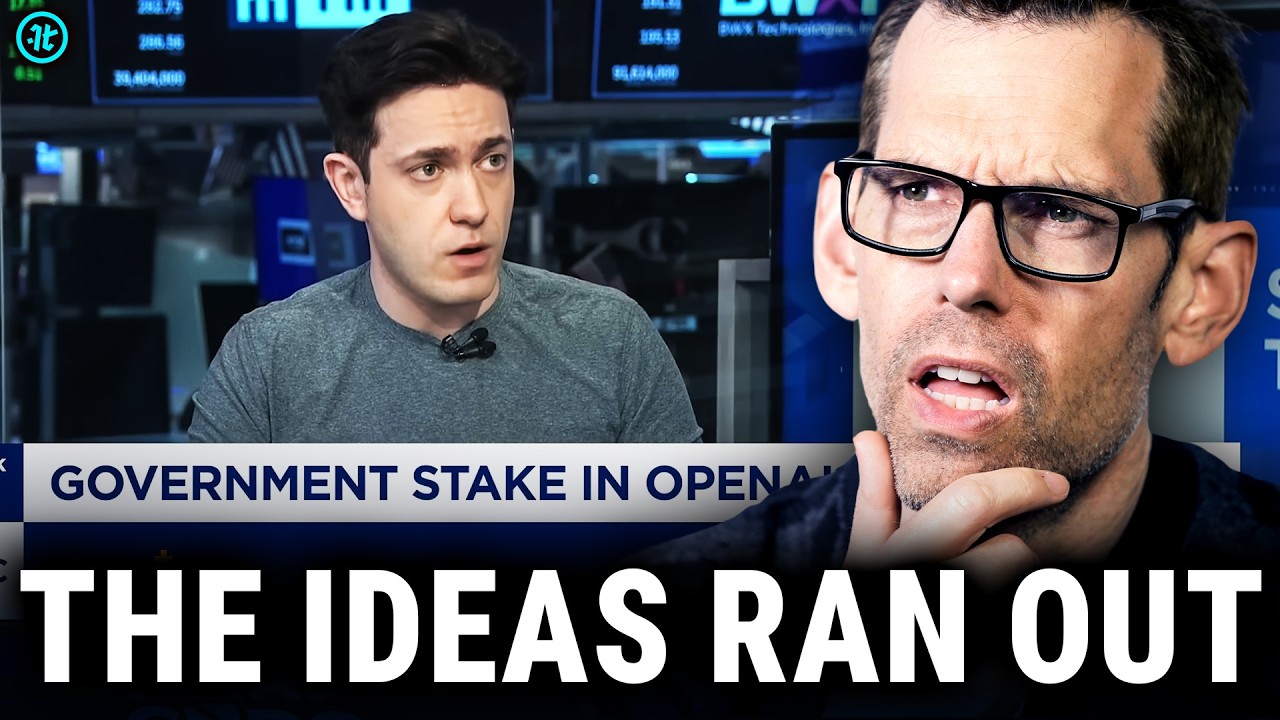
Video summary
The video centers on a critical debate regarding the financial viability of Big Tech companies and their massive investments in Artificial Intelligence, sparked by commentary from Ed Zitron who argues that the industry has run out of ideas and is merely using AI as a cover story. The hosts acknowledge Zitron's valid points concerning the severe mismatch between astronomical infrastructure costs and meager revenue growth, noting that major players like OpenAI have burned billions with no proven path to improving profit margins. While they agree that current business models are unsustainable due to linear cost increases relative to revenues, they disagree with Zitron's conclusion that AI itself is a dead end or hopeless technology. Instead, the hosts view AI as a revolutionary force capable of transforming society, particularly in fields like medicine and coding, even if the initial investors face significant financial losses similar to those seen during early internet development.
A key argument presented involves the historical pattern where first-generation infrastructure projects often bankrupt their original backers before an "inheritance generation" emerges to build profitable businesses on top of that foundation. The hosts draw parallels between AI data centers and obsolete technologies like railroads or canals, suggesting that while current hyperscalers are taking massive risks with debt they may not be able to repay, the underlying technology will eventually become cheaper and more efficient through innovations seen in China and advancements by companies like Elon Musk's ventures. They emphasize that intelligence is rapidly becoming a commodity, which forces these tech giants to pivot from selling proprietary models to leasing compute power or creating unique layers of obfuscation—such as Palantir's Ontology—to help enterprises protect their data and maintain control over how AI outputs are generated without falling victim to hallucinations or IP theft.
The discussion also highlights the systemic risks posed by this debt-fueled expansion, warning that if capital markets tighten or investors stop funding these projects due to concerns over non-payment, it could trigger a broader economic crisis similar to 2008. The hosts note that banks are already diversifying their portfolios into insurance and index funds linked to these tech debts, effectively socializing the risk while private companies struggle under the weight of unpaid bills from massive data center initiatives like Oracle's Stargate project. Furthermore, they address the geopolitical dimension, pointing out how governments view advanced AI models as potential weapons systems due to security vulnerabilities, which complicates commercial interests and may force regulatory interventions that alter the industry's trajectory. Ultimately, while acknowledging the current bubble-like conditions driven by inflation forcing capital into risky assets, the hosts conclude that history suggests we must endure a period of creative destruction where many companies fail before sustainable applications emerge.
In summary, the video concludes that although Big Tech has exhausted its hypergrowth ideas and is currently relying on hype to justify trillion-dollar investments in unprofitable AI ventures, abandoning the technology entirely would be shortsighted given its transformative potential once costs are optimized. The hosts advise investors and consumers to remain vigilant about where this debt hides within their portfolios and financial systems while recognizing that the true value of AI lies not just in pattern recognition but in deep integration into daily life through smart devices and specialized applications like protein folding for drug discovery. They predict a bumpy ride ahead characterized by market corrections, potential pullbacks on capital expenditure, and eventual consolidation where only those who can innovate beyond generic large language models will survive to harness the full benefits of an intelligent future without being crushed by unsustainable debt loads.
Read the full video transcript
This one is crazy. So, if you guys don't
know Ed Zitron, he's a bear. So, he is
um very negative on AI. Thinks that
basically the industry is a big nothing
burger that people blown it all out of
proportion. Uh this is one of the more
interesting ones. We're going to go deep
on this. So,
>> thanks for joining us here. So, you
know, we we don't really know at this
point in time, right, what the actual
financial picture of these companies
look like,
>> do we? And it they wouldn't be the first
with bad financial profiles to to go
public.
>> Well, they'd be the first to be this bad
other than we work. And even then, this
is so much worse than that. Open AAI
burned $20.9 billion in 2025. That's the
auditive financials that the FTI
reported. And the problem with these
companies is their margins are getting
worse and they actually their costs
increase linearly with their revenues.
There is no proof that they can improve
their margins. No amount of specialist
silicon or supposed Vera Rubins will
bring these costs down. So here's the
the big thing that people do not
understand about what's going on in AI.
Now listen my the final conclusion that
Ed makes I actually disagree with. I
don't think the industry is hopeless in
the way that he does. I think it is the
revolutionary technology. I think it is
literally going to change the fabric of
society. I think even if it asmmptoted
right now just the things that it can do
in the medical industry alone are
transformative. The amount that has
impacted our business is transformative.
But he is absolutely right in terms of
the mismatch between the revenue that's
coming in and how much money these guys
are losing because of the infrastructure
buildout is absolutely insane. I've done
deep dives on this topic, man. If people
do not wake up, they're going to get
blindsided. I I am nervous about owning
tech. I will just tell you that right
now. That's just a me thing. You do you.
But that people are not being honest
about the historical pattern that
repeats. We've seen this over and over.
I'll talk more about this as we go, but
we've seen this pattern play out before.
Uh so he he is getting people to look at
something that is so important to look
at. The mismatch between revenue and
debt accumulation uh the losses that
they're taking is terrifying and people
should be very worried about the rate at
which their revenue is increasing.
>> It's clear that people are wising up to
the problem of generative AI which is
there's not really a business there.
>> So that was something that was discussed
yesterday on Squawkbox. the the comments
from Alex Karp, the Palanteer CEO,
making their rounds. I think we have a a
clip teed up. Take a listen.
>> The general way these things were sold.
And again, these people are I Sam and
and and Dario, you there's nothing more
fun than debating Daario in private. So,
this is I'm not throwing shade at them,
but something has gone completely wrong.
And the basic view among enterprises in
this country is I'm going to chill lax
uh and waste my time with tokens. I'm
going to get no value and they're going
to get my IP.
>> We had talked about this previously.
What Alex Alex is banging the drum. So
for people that don't know their
Palunteer Palunteer has created like a a
a middle layer is maybe the right way to
think about it. I believe it's called
Ontology. And their whole idea is okay,
wait a second. I'm I'm a gigantic
company. I've got all this proprietary
data. I want to take advantage of AI and
um when I put it into AI, you're talking
your token costs are absolutely
ridiculous. So, I'm already getting
hammered there. And so, you see
corporations pulling back. And on top of
that, the companies have learned
basically the business model of these
companies that are using it. They're
training on all the data that they are
supplying the agent and then launching
competitive companies. They did that
against Figma and they're doing it now
in um medicine as well in medical. And
so it's like Daario was screaming to
basically the the creators of AI and
saying you guys need to understand
you've got a terrible reputation now
with the people actually using this
technology. You've got to get your [ __ ]
together. And so, um, I while I think
that feeds in a little bit to what Ed is
saying, Daario, uh, not Dario, excuse
me, um, uh, Alex from Palanteer Karp is
making it clear there's a there there,
but these guys have got to understand
they've got to put this obfuscation
layer in the middle where companies can
feed their data to something that they
trust, isn't storing it, retaining it,
uh, going to mimic them, and then they
can basically change the model to match
their weights. Now, they've created
something proprietary. Thi this is huge.
I I don't want to go on too long about
this, but understand the future of AI, I
guarantee you, is you have to somehow
someway be able to turn that AI into
something that is proprietary to you.
So, that gives different answers. With
AI, we're really trying to mimic humans.
And just like I can't put anybody random
in Drew's seat, you can't put anybody
random in my seat. It fundamentally
changes the nature of the show. AI must
be the same. the second you can just
swap it out because they're all the
same, you lose. And so that's the point
Alex is trying to make.
>> Enterprises are bing at this idea that
they're going to be tokens. They're not
going to be able to control the data
usage and how the data is is used and
they're not able to really measure ROI.
What do you make of those comments?
>> I mean, hate to agree with him, but he's
right. These companies, Anthropic and
Open AI, they encourage waste. They uh
he actually said that these companies
don't charge on outcomes. They don't
charge on success because you can't with
large language models. They're
inherently hallucinationprone as proven
by open themselves. And so they
encourage waste. They want you to spend
a lot of money and then they try and
pill for your ideas. Anthropic already
tried it with Claude Design with Figma
and I believe they have a relationship
with the company and Dylan Field even
said he was shocked by it. And what's
crazy is as well is their copies of
these companies not particularly good.
They don't make great software. You'll
notice that both Anthropic CEO Darama
day and Sam Whman have both said, "We
can't wait to see what you build with
this." Well, that's because they don't
know what you can build with this. They
want everyone else to do their
innovation for them, spend as much as
they can on tokens, and then take
whatever's left. In what universe would
you expect the telecoms who built out
the internet to know what's going to be
born of this? No. You look at the
technology, and it's a question of what
does it allow you to do, but how that's
going to play out over time. When the
internet was first born, I certainly
didn't think, oh, somebody's going to
come up with the iPhone and then
somebody's going to come up with Uber. I
never would have seen those jumps. And
then it's going to be, of course, a
question of, well, in what specific way
are you going to execute against that
thing? And everything is going to be
different. And many of them will fail.
And it takes, you know, one person to
just hit it right in terms of what the
world wants at that moment. And so the
fact that Sam Alman doesn't know what
you're going to do with AI or Daario
Amade doesn't know what you're going to
do with AI obviously as as it should be,
but these guys have to start thinking
about the these guys being the AI
companies have to start thinking about
themselves differently. And so one is
intelligence is rapidly going to become
a commodity. So where am I going to get
my intelligence? And so again, this goes
back to Alex Carput's such a banger
thing. We talked about it when it first
came out, but it was a really brilliant
drum that he was beating. You must
create that layer in the middle where
people can make that unique to them.
That's going to be the the thing that
makes this work. That's the thing that I
think that Ed is missing is just because
the the fundamental business model of
what AI is today isn't going to be the
thing. It's not going to survive uh in
the same way that the railroads went
bankrupt, the canals went bankrupt, the
internet went bankrupt, and then it was
the inheritance generation of investors
actually built on top of it. It is
almost certainly going to play out like
that with AI. But that doesn't mean that
AI isn't real.
>> Then what do you think should happen? Do
you believe that these are companies
that should be nationalized? As we read
in the intro, there's discussions
reportedly that the administration and
potentially some sort of sovereign
wealth fund would take a 5% stake in
open AI. I mean, is that a situation
that you would like to see happen or do
you think that's more disruptive?
>> No, I don't think there's any need to.
They talk about I think Sam Orman said,
well, we can share the benefits of AI
and the profits of AI. What profits?
What returns? That 5% will have to get
congressional approval. The sovereign
wealth fund is still an idea at this
point, but fundamentally large language
models are not the future. The only
reason big tech is investing in this is
that they've run out of hyperrowth
ideas. They don't have a next iPhone.
They don't have a new Google search. So
they've put over a trillion dollars with
trillions more to come.
>> So when people say that LLMs are not the
future, basically what they're putting
forward is the argument that pattern
recognition is not going to be the game.
I don't know that that's true. And this
is really going to come down to whether
or not because what AI has already done,
this is the part that I I really want to
get people on board with whether AI um
will make the initial investors their
money back. Probably not. That that
would be ahistoric. Okay. So when you
look back when revolutionary
technologies come on board that have
massive infrastructure buildouts, they
almost always bankrupt the first
generation of investors. And it's what's
called the inheritance generation that
comes along that's like, "Oh, cool. You
built out all the fiber. Oh, cool. You
built out the railroad network. Got it.
And then they build successful
businesses on the back of that because
they don't have to deal with the debt,
right? Same thing. US right now under
all this debt weight. We've got to get
out from under it somehow. You sure as
hell not going to pay it back. So AI
definitely faces that problem. You have
a cost problem. But China's already
showing us that you can drive the cost
down dramatically. uh even some of the
the companies themselves I think Elon
has talked about driving the cost down
um and so there you can look back at
history and say when these technologies
come on board in the beginning people
don't know how to do it well they don't
know how to make it very efficient but
over time these are the exact kind of
problems that get solved and so we can
expect that on a long enough timeline it
is going to get cheaper and so if you
just sort of go we may lose uh you know
a lot of money to people that have gone
and invested in this But the technology
has been invented. You're not going to
put that um toothpaste back in the
bottle. And even if we even if LLM's
asintote meaning they they stop getting
better. So if they stop getting better
right now today, the capabilities are
already extraordinary and they don't
seem to show any signs of stopping. I
don't know about you guys, but these
things keep getting better. Um there
you're not going to see just like this
only up phenomenon where um without any
um either building things out bigger
breakthroughs in the way that they
actually do the algorithms that make
these things more efficient. Uh you it's
not just going to go up to artificial
super intelligence in the next six
weeks. But in terms of the things that
we use here at the company like new
things keep coming online. For us, it
was a big step forward with the ability
to edit blueprints. Um, the amount of
our C++ now in the game that's being
written by AI. It's just like I keep
seeing that we're using it for things
now. It falls down. There's no question.
You hit limits and it's like, oh, it
sucks once you get to this part. Um, but
I would say that makes it great. This is
the what I call the golden age of AI
because you're still necessary.
If it ends up completely erasing us as
being needed, that isn't necessarily
going to be fun, but that's a problem
for another day. All right.
>> So, you think AI LLM's overall is a dead
end? You see no business model here. You
see no no utility from AI whatsoever.
>> I see this as in the future as a boring
hardwarebased business. The kind of the
Oracle licensing hardware model. I think
this is a 10 to30 billion TAM industry
pretending to be a trillion dollar one.
And because everyone's propping it up
because they have no hyperrowth ideas,
everyone's just kind of pretending it's
the kayfabe of the tech industry that
really has run out of ideas.
>> I think that's the the sharpest thing
that he says is that that's really going
to be the question that plays out like
are I really think that the people
investing in this are out over their
skis in terms of um you're pulling in
the case of uh SpaceX AI, if I remember
right, you're you're pulling forward
like hundred years. I mean, it was some
insane number. Maybe I'm misremembering
that, but it was an absolutely
ridiculous number of years at their
current revenue rate that they were
pulling into today. I did a a deep dive
on this if you want to watch it. I think
that one is crazy. Uh I don't think that
that's going to make people their money
back in anything approaching near-term.
And we'll see if they end up surviving
all of this. Um this is a debt game. I
think what you're unfortunately going to
live through is um
because this is following the
traditional trajectory of a
revolutionary new technology with a very
expensive um infrastructure buildout.
What you're going to see is we're going
to run the 2008 playbook where we try to
hide all of that debt. The banks are
going to diversify. The banks are going
to diversify into your insurance.
They're going to diversify into your
index funds. They're going to diversify
into your retirement program. that's
going to be the way that the banks like
mitigate the risk on their side. Uh it's
entirely possible that that debt gets
packaged up and given a high credit
rating, but it's certainly going to be
it's already being sliced up and hidden
in other places in the economy. And so
that's the part that worries me is
making sure that people understand what
they own because I think we're in for a
rocky ride in terms of this is this is a
super known pattern that these kind of
technologies go through. And so it
doesn't mean that the tech doesn't end
up continuing to have incredible
application, but his idea of like this
is going to be tied to the hardware.
That is very interesting. Now, I think
ultimately it it is it's going to be
tied to the hardware because that's how
they build these gigantic brains. But I
think that we've already seen the
evidence uh from the US and especially
from China that you can make these
things more and more and more efficient,
which drives the cost way down. So I
think tokens are going to get a lot
cheaper. I think the ability to store
more tokens in memory at once is going
to get more massive, which creates more
applications. I think we're going to
find that LLMs don't work for
everything, but it's so remember it's so
good at coding that when they dropped
Mythos, they treated it as a weapon
system that couldn't be exported to our
allies because it could hack basically
everything. So, these are things that
have extraordinary capabilities and it
just becomes a question of can we make
them more efficient over time. And so,
um, Ed is putting his finger on
something that I think is very
important. Uh, myself and countless
other people, um, have not been paying
enough attention to how can this go
wrong. I started to a few months ago,
just looking at the investing and the
debt and being like, uhoh, there's a
potential problem coming here. I think
Ed is maybe a little unjustified in just
how bearish he is, but he's making
people face something very, very
difficult. Um, one more thing about
this. He said he was completely right.
Is that when he was talking about the
total adjustable market is only 10 to 30
billion, not this trillion dollar thing
or
>> I don't remember when I said that, but
there's a couple things that Ed is very
right. One of them is that this is
currently very much tied to hardware.
Uh, he's very right that right now the
rate at which they're spending money,
just losing money outright versus the
rate at which they're bringing in
capital or or revenue is is so insane. I
don't know what people are thinking.
Like, listen, as a a very paranoid
investor who does not think he sees the
future well enough to go all in on one
thing, I'm captain diversify and I
totally understand that's not how you
get rich. The way that you get rich is
to have a concentrated bet and it pays
off. It's all true, but that's also how
you go broke. So, the show will be right
back in a second. But first, let me tell
you about something that happened to me.
I was traveling abroad. My phone got
hacked. It was a nightmare. That was the
moment I really understood exactly
[music] how exposed we all are. The hack
is just the entry point. Once your data
is out, it gets sold to data brokers who
then sell it again and again. Your name,
your address, your phone number, your
social security number, sitting on
hundreds of sites available to anyone
willing to pay for it. You can try and
remove it yourself, but tracking down
every site, submitting every removal
request, repeating the process every few
months as your data reappears
designed to be impossible. [music]
So, Incogn does it for you. You
authorize them once, they track your
data across hundreds of broker sites and
remove [music] it automatically. And
when it reappears, because it will, they
remove it again. Plus, with custom
removals, you send them any link where
your information shows up and their
dedicated team takes it down. Go right
now to incogn.com/impact
and use code impact for [music] 60% off
an annual plan. You can try it risk-free
for 30 days. We'll be right back to the
show, but right now, I want to talk
about your customers expectations and
why today's episode is brought to you by
Quo. Your customers do not care that
it's after hours. They need an answer
now. And if you can't give them one,
someone else will. Quo is the number one
rated business phone system on G2.
Trusted by over 90,000 businesses to
stay reachable and look professional
every day. Quo's built-in AI agent
handles after hours calls, answers
questions, and books appointments so you
never miss a lead while your team is
offline. All your calls, texts, and
voicemails live in one place. So anyone
on your team can see the full history
and respond fast. And it integrates with
the tools you already use like HubSpot,
Zapier, and more. So nothing is going to
fall through the cracks. When money is
on the line, always say hello with Quo.
Try Quo for free, plus get 20% off your
first 6 months at quo.com/impact.
[music] Now, let's get back to the show.
I'm like always super paranoid. I assume
there's something I'm missing. Things
are not going to go the way that I think
they're going to go. And so paying
attention to that discrepancy between
the extraordinary
levels of debt that these companies um
are taking on. Man, I don't get how
people aren't like, "Yo, this is like
really scary." And then another thing
that he said that I think I won't say
that he's completely right. I'll say,
"Oo, you got my attention. I want to
look more at that." Is are these tech
companies out of ideas?
>> Like, where's our new iPhone?
>> The the thing that hits like the iPhone
hit, right?
>> We're going Yeah, we're going on 20
years.
>> Yep. So, is that going to be robotics?
That's like when you start getting into
Elon territory. So, Elon is thinking
big. You You can say that he's a fool,
but you certainly cannot say that he
doesn't have a vision for how this all
ends up paying off. So, he's switching
over. Like if you want to think about,
okay, wait a second, these hyperscalers
are out of ideas. It's like, no, they're
not. We're just at a this I'm channeling
Elon here. Uh, no, they're not. We're
just at a different part of that curve.
And so now we're leveraging AI to build
things like self-driving cars. I have
ridden in a Tesla that took me like, I
don't know, five or six miles up into
the Hollywood Hills without the driver
ever once touching the steering wheel. I
could not believe it. So, I was like,
whoa, this stuff is getting good. It's
going to keep getting better. They just
need more training data. more training
data, more training data. Elon almost
always misses timeline, but ends up
being right in terms of what the
technology can do. And what he's saying
about robotics, man, listen, the
technology may not come as quickly as we
want, but the robotics is being driven
by AI. And so it's like these things,
one of I I don't think he is this over
is that the
>> uh we got a little bit more.
>> Okay. Okay. So, I don't remember if he
talks about it here, but um he has done
interviews where he talks about how um
the guys building the big data centers,
he was like if they had ideas, they
would just use the compute themselves,
but they don't. They're starting to like
lease it out to other people. And so, uh
the big data center that Elon built,
he's like leasing that out to Anthropic.
And so, he's like, "Bro, that tells you
like nobody needs this stuff. These guys
built this all in hype. They everybody
thought this was the next big thing. Uh
Capital is always seeking a return." And
uh now this is me. When you inflate the
currency the way that you're doing it,
you force VCs and stuff to go, we've got
to have somewhere to put money. And so
they'll they he doesn't say this
explicitly, but he's intimating this
that the VCs will trick themselves into
thinking, no, no, no, this is real. We
just got to like keep putting money,
keep putting money, keep putting money.
And because of the abuses of government
deficit spending, you are making the
number go up. So you look like a genius.
And so it's like, "Oh my god, this is
all like incredible. This is going to go
up forever." Then you get someone like
Ed who's like, "Wait, hold on. What are
you actually building with this again?"
Like, remind me, you you just built out
a massive data center, Elon. You're
saying you got to go to space and you
got to build more, but you're leasing
your unused cycles to another company.
Like, why the hell would you expect me
to believe that there's really a there
there? Like, so I think it is very
important to be able to step into Ed's
shoes and other bears and articulate why
they're so nervous. And if I were going
to put a really fine point on it, it's
really two beats. You've got they're
leasing out their own intelligence, if
you will, because they don't have
anything to do with it. They're not
pointing at anything. Right out of
ideas. Uh, and then you've got bro, the
cost versus return is so insane. You
can't do that. You can't do that. it is
guaranteed to um hit a wall of
problematic debt before the revenue
reaches something that makes it
self-sustaining.
>> Quote, "Some of our customers, OpenAI
may be highly leveraged. We may
experience risks of non-payment in our
dealings with such parties. Are the are
we going to see this from a market
standpoint first in shares of
hyperscalers? I think we might, but
Oracle is a particularly scary one
because they are building 7.1 gawatt of
capacity just for one customer. And they
even said in their annual report that
the risk was they might not get paid.
Open AAI only loses money. And I think I
estimate it's like $75 billion of
revenue annually that they will have to
pay for the full Stargate data center
project in annual compute revenue. Open
AI can't afford that. And if they can't,
Larry Ellison can't afford to pay back
those bills and Oracle stock will be in
jeopardy along with the margin loans
that Mr. Ellison holds. It's genuinely
dangerous and it's dangerous across the
board for Neoclouds, for hyperscalers,
for every associated party of the LLM
industry.
>> Not only not only is it dangerous, it it
is historically to be expected that
we're going to obliterate.
I mean, Drew, is it in the trillions?
It's hundreds of billions of dollars of
investment that is likely to get wiped
out because they won't be able to make
the payments on the debt. Is this is
this some of the reason why like X money
might be a thing that Elon is taking?
Like all right, I need to kind of hedge
my bet. See if I can do some type of
>> I'm just saying as anybody that's the
first new idea in the X AI in the space
as I was talking about.
>> Well, that's definitely not a new idea.
China's been handing us our ass on that
for god knows how long.
>> I'm just saying though as as a AI
company with all the four of them
together, they're going this way. Meta
is now making
uh do-it-yourself video game apps uh to
kind of come up with a new Instagram for
video games that's built with their
compute. So, they're trying to do these
side quest. I guess I'm just saying is
that something that they're trying to do
to kind of fill the coffers a little bit
to help the revenue or is it
>> Yeah, everything that they do is trying
to make a little bit of money, but the
the numbers here are staggering. These
guys, the odds that they'll be able to
make their money back by building a
thing themselves is effectively zero.
That's why I think right now the right
way to think of this is I'm a
hyperscaler. I build data centers and I
build the intelligence itself and then
the intelligence is a commodity that we
sell to other people. And the bet that
we're making is that everybody is going
to want that intelligence in the same
way that people want electricity. So if
you think of of the the um actual eye in
AI as that's what we sell, we sell
intelligence and we're neutral. We're
not. This is Alex Karp trying to
convince people stop. Don't be a company
that actually builds the business.
Create the intelligence. Create an
obfuscation layer so that the people can
go in and make this their own thing. Uh
that their AI is unique to them. It
gives outputs that nobody else can get.
And you're not trying to pill for that.
You're like trying to be a highly
trusted um always on provider of
intelligence. And when I look out into
the world, basically everything will be
imbued with intelligence. There's no
reason to have a dumb chair if you can
have a smart chair. Uh there's no reason
to have a dumb TV if you can have a
smart TV, right? So it's just going to
keep getting better and better and
better in terms of integrating into your
daily life. Um but right now there just
isn't enough appetite for what AI can
deliver. So to me, this just feels like
a timing thing. So the base assumptions
that I ride on the back on are you're
not going to get the revenue fast
enough. So the early investors are going
to get destroyed. By the way, that's
going to be terrifying to the global
economy, but I'm setting that aside for
now. So that's one thing. The second
assumption is that people will figure
out in the same way they figured out how
to integrate the internet in ways we
never would have thought of in like the
late 90s. Forget it. We didn't see this
coming. And we're at that stage of AI.
We're in the late '9s of AI compared to
where we're going to be. You know, 2007
becomes the iPhone moment. Uh when does
Uber come along? 2014, 2015, something
like that. So, it's like you got a lot
of years of people being like, well,
what about this? No, that doesn't work.
What about this? Well, that doesn't
work. And then slowly it's like, oh
wait, it's AI plus this. Like, oh, now
that my microwave has it, now I can
make, right? And it becomes like it
needs to start permeating. It needs to
get out there in order to be a thing.
But one of the um things that one of the
base assumptions that Ed has is that the
LLM as the progenerator of the
intelligence is just always going to be
dumb. Now that's me putting words in his
mouth, but I think that's pretty close.
So he thinks that's going to tap out.
And if he's right and this is like as
good as it's ever going to get and it's
like yeah, you get some efficiencies and
but you know, you can't just turn your
whole company over to AI and walk away.
Um, I get why he would think AI is cool,
but it isn't this multi-trillion dollar
industry. I don't share that assumption.
I think that even if you can't just keep
making it smarter and smarter and
smarter and smarter that just
integrating what we already have, just
making what we already have more
efficient and cheaper will transform
things. I don't know if he's not close
enough to the medical side and doesn't
understand things like protein folding.
I'd be very interested to ask him that
question because just seeing what's
happening in medicine
>> based on some of uh the things that are
coming out because AI can just look at
an unimaginable number of um patterns
and so the fact I forget how many tens
of thousands of proteins it has like
folded in its mind to know this goes
with this goes with this goes with this
that will play out in drugs and all
kinds of things uh in ways that I don't
think we yet fully understand and it's
already happened. That's the thing. You
don't need another breakthrough.
>> I think it could be the neoclouds
because with this rumor of meta selling
their AI capacity, I think companies
like Core and especially Nebus and Iran
and Cipher Mining and all of them,
Terowolf as well, they are all very
they're basically outgrowths and they're
subsidiaries of Nvidia. Nvidia is now
according to the information going to be
paying them to rent back their GPUs when
they install them in the data center.
This is the this is something that only
happens in an industry without diverse
and real demand.
>> Meta is an interesting uh case in this
instance because they don't as yet have
the third party cloud services revenue
propping it up. But people point to
their own top line having accelerated in
the first quarter of this year from like
23% to 33% presumably because they're
implementing these AI tools or somehow
making their platform more productive
along those lines. Um, and at the same
time it shows you the fallback option.
We're creating all this capacity even if
it's not a business model. The capacity
is there. We've gotten the kind of the
power and the compute in place. Maybe
that helps society down the road. Well,
the thing is with Meta is I don't
necessarily agree. AI is not driving
Meta's revenue growth. the fact that
they have an effective monopoly on
social media is Microsoft, Google, and
Meta and Amazon are all doing a funny
little I don't want to call it a scam,
but it's a a trick where because their
other businesses are still growing, but
they never disclose their AI revenues,
everyone conflates that with AI driving
their growth. In reality, their other
businesses are growing and AI is losing
them money across the board. You'll
notice that neither Microsoft or Amazon,
who both share their run rate of AI,
will share the actual AI revenues. That
tells you that these companies are
afraid. Public companies love good news.
If they had good news, why wouldn't they
share it? Because they've only got bad
news here.
>> So, what do you think then is the straw
that ultimately breaks the camel's back?
You've got trillions potentially at
stake in terms of just overall capex
investing through the years. I mean, it
seems like there is a a collective
desire for this to work. what ultimately
pro provides the challenge or presents
the challenge in your in your mind that
that kind of reverses all that.
>> So I heard a Goldman analyst say
recently that the first hyperscaler to
pull capex will get rewarded by the
markets. I think that capex pullbacks
are they're the sign. I also think any
financing falling through AI or
anthropic would be a sign. But I think
we're going to start seeing AI companies
kind of start falling out of favor and
not being able to raise money. But the
big thing is debt. when data center debt
stops being issued, [clears throat] that
will be when it's bedtime for this
industry. Because
>> even if they think AI is going to win,
we've got 100 gawatts or so of data
center capacity allegedly under
construction or in planning. That's
trillions of dollars of money needs to
come from somewhere. And we are tapping
out the debt markets. We saw that with
Google raising that $85 billion equity
race.
>> I'll be very interested to see what ends
up happening because you also have the
arms race aspect of this if Fable 5
really was as scary. Um because the
version that ended up getting released
to the public was nerfed so hard. But
the version that made Anthropic go to
the government and say, "Hey, listen. We
can hack basically anything. There's all
these legacy bugs that people didn't
realize. We're taking advantage of them.
We're shutting it down." And that made
the US government go, "Okay, whoa. We
can't even let our adversaries have
access to this." There's a big habaloo
about um OpenAI and Google selling
technology to Chinese companies via um
Singapore, I think. Uh, so and the
government's saying technically it's
legal but they don't like it and blah
blah blah. So they they are treating
this as a weapon system and so um I
haven't heard Ed talk about that. But
it's an interesting angle on all of this
like will the government be able to um
stop themselves from going all right
we've got to keep these guys going some
way or the other because from an arms
race perspective this becomes incredibly
important. All right I don't think we
need to keep going on this. We get the
idea. I I have a feeling that um we we
are not going to um see less of Ed in
the future. I think we're going to see
more. We are all going to have to
contend with what the bare case is for
this uh in terms of if we're going to
survive AI and we're really going to get
to the other side and we're going to
figure out um what this is going to be
in our lives. We've got to have a long
runway. There's got to be time for this
to play out for innovators to try things
and fail and the company just completely
goes under and then the next person
comes along and tries something new.
That whole process the creative
destruction of a new technology we have
to go through and I think that the
internet is our guide and I think that
we have expected AI came in like a storm
and improved so fast. I think that
people really and we needed that next
big thing from an investment perspective
because again you've got all this
economic pressure due to inflation
forcing people into the markets. They
want to know where they're going to get
their returns from. And so that because
there weren't just a endless bevy of
ideas that money was just going heavier
and heavier into AI. And so now you've
got yourself in a position where um the
debt is accumulating so fast, the
revenue is coming in slow. It's
systemically important to the entire
economy and certainly to any individual
investor, you've got to really pay
attention. And I think where um what Ed
said about the debt is the real thing.
And if you think about this as the
market starts to pull back and says,
"Ooh, like when um Deep Seek first
launched, I think we lost almost a
trillion dollars in value in a single
day." So people were like, "Wait, I
thought America was going to win the AI
race. Now all of a sudden, maybe it's
going to be China." Yo, investors got
spooked. So what's going to be the story
that spooks the market? That I don't
know. But if the market starts getting
spooked, that's when you start seeing
people say, "I'm not willing to pay for
that debt anymore." which then is going
to force companies to pull back on the
capex. Now, uh capital expenditure for
people who don't know, so it's you
investing in your business, you're going
to build a data center. That would be a
capital expenditure. So, when somebody
says capex, that's what they mean. Uh Ed
is saying the first person to not do it
because they're getting pressured or not
do it because they failed to raise debt
where they just go, "We don't need
anymore. We're good. We're not going to
keep expanding." That that's going to be
the winner. I think they might take a
bigger hit. I think people might go,
"Uh-oh, you're in trouble. You're the
first one to admit problems." And
they'll probably say, "No, no, no. This
is an industry-wide thing." But it
becomes a question of whether investors
buy it or not. And so now, I think it
will be difficult to be the first mover
because, you know, if you say, "Eh,
we're all out of ideas, but we're the
first ones backing out." Maybe people
buy it or maybe they just go, you're the
only one that's out of ideas because
investors are still incentivized for
this to be the next big thing to keep
pouring capital in. Uh and so this one
is going to be a bumpy ride. I've been
saying this now for a couple months. So
people need to Yeah. keep your wits
about you. I'll leave you with one last
thing and that is where is the debt
hiding? Where is all of this debt? The
banks are already diversifying. Is it
hiding anywhere in your portfolio that
you're not aware of? It's certainly
worth digging in and taking a look. If
you like this conversation, check out
this episode to learn more. Boys and
girls, things are popping off in China
and they have a goal to get out from
under the dollar. I don't think
anybody's confused about that. They also
want to be the global