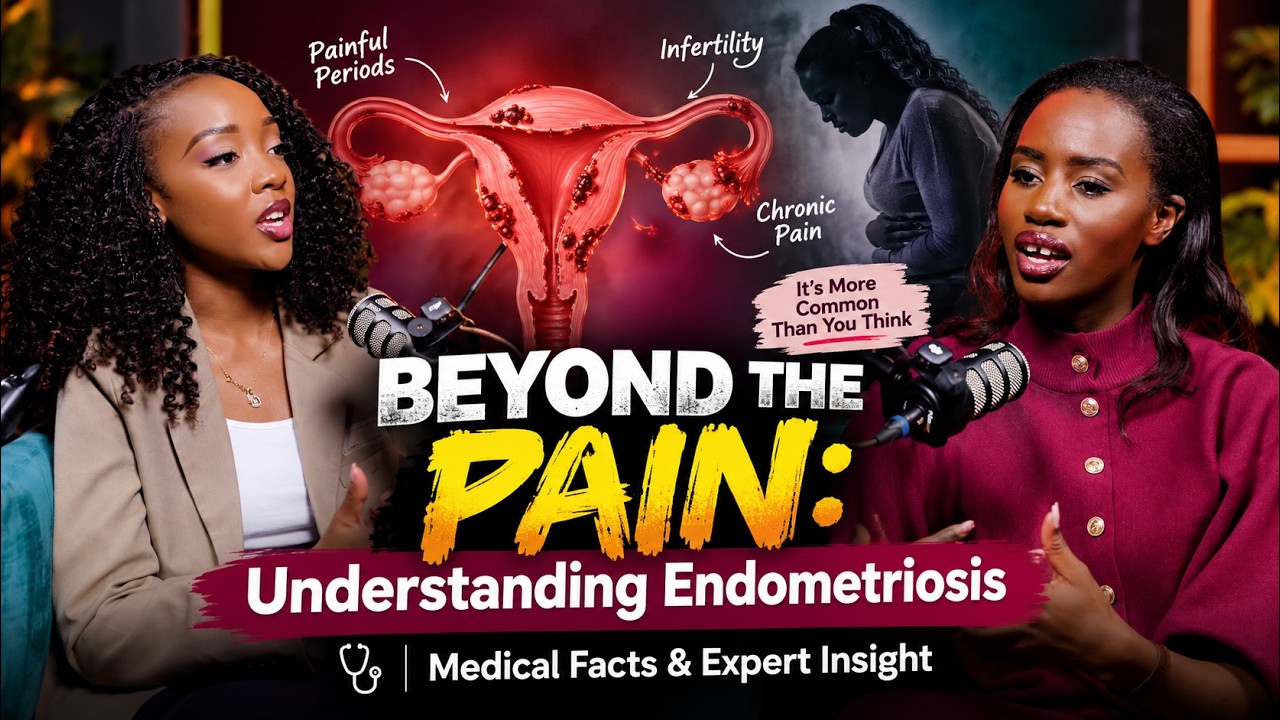
BEYOND THE PAIN: Understanding Endometriosis | Medical Facts & Expert Insight
Watch on YouTubeVideo summary
Endometriosis is a chronic, lifelong inflammatory condition affecting approximately 10% of women globally, yet it has historically been dismissed as normal period pain. The medical definition involves the presence of uterine-like tissue outside the uterus, which responds to hormonal cycles by thickening, shedding, and bleeding in areas where there is no natural outlet for that blood. This process causes severe inflammation, scarring, and debilitating pain that can last for decades. Unlike typical menstrual cramps, endometriosis pain often intensifies with each cycle, persists beyond menstruation, and may manifest as cyclic urinary or bowel pain, leading many women to mistakenly believe they have infections like UTIs or inflammatory bowel disease instead of seeking a proper diagnosis.
The journey to receiving an accurate diagnosis is frequently prolonged, often taking between four to twelve years due to systemic challenges within the healthcare sector. A primary barrier is the normalization of severe period pain in society and among medical professionals, who may lack sufficient clinical acumen to recognize endometriosis early on. Furthermore, diagnostic guidelines have traditionally required surgical biopsy for confirmation, which delays treatment while women suffer unnecessarily. While Kenya possesses a pool of expert specialists capable of managing complex cases, access remains a critical issue, particularly for the 80% of the population living in rural areas who must navigate inefficient referral systems before reaching tertiary care facilities.
Beyond physical suffering, endometriosis profoundly impacts a woman's quality of life, mental health, and economic stability by causing chronic fatigue, missed work or school days, and sexual dysfunction due to pain during intercourse. The condition also affects fertility, with 30% to 50% of affected women experiencing difficulty conceiving; however, this is not inevitable, as pregnancy can sometimes alleviate symptoms, and modern treatments like IVF offer hope for those who desire children. Importantly, the disease is treatable rather than curable, with management strategies ranging from hormonal suppression to surgical removal of lesions, aiming to restore function and improve daily living despite the chronic nature of the illness.
To address these challenges, experts advocate for a multi-faceted approach involving systemic changes in healthcare policy and public education. Key recommendations include ensuring that health insurance schemes cover necessary surgeries and medications equitably across all facility levels, training general practitioners and nurses to recognize early signs of endometriosis, and updating clinical guidelines to allow for earlier medical intervention without waiting for surgical confirmation. Ultimately, the message to every woman is that severe pain affecting daily life is not normal, and seeking help should be a source of empowerment rather than shame. With increased awareness, reduced stigma, and improved access to compassionate care, women can finally move beyond the silence of endurance toward effective management and a better quality of life.
Read the full video transcript
There's a pain that millions of women
have been taught to endure in silence.
>> First of all, [snorts] I think I just
need to state the actual data.
>> Yeah.
>> Cuz it's really disturbing honestly.
>> Mhm.
>> 10% of all women
eventually will suffer from
endometriosis.
>> That is approximately according to the
World Health Organization
190 million women.
>> That's a huge number.
>> For years severe period pain has been
dismissed as normal. Women have been
told to simply take a painkiller and
carry on. While for some, the real cause
of the pain remains undiagnosed for
years. Endometriosis is a chronic
condition that can have a profound
impact on women's health, fertility,
work, and quality of life. Yet,
awareness remains low. Diagnosis can
take years, and access to specialized
care remains a challenge for many women.
As conversations around endometriosis
grow louder in Kenya, we ask a crucial
question. Are we doing enough to
recognize, diagnose, and support women
living with this condition? Today, we
are having that conversation with a
specialist to understand what every
woman needs to know about endometriosis
and what needs to change.
Right with me here in studio is a very
beautiful woman who's been courageous
enough to put herself out there. She's a
doctor. And our today's topic is
actually something that's been very
vocal in our space right now. So allow
me to introduce her. She introduces
herself and tell us who she is and what
she does. Karibana.
>> Thank you so much for having me. Uh good
morning. My name is Linda Bambda. Um I
work as a medical doctor. um currently
just finished my previous job at a level
six facility that is the mo teaching and
referral hospital in Aloret. Have
relocated to Nairobi now and no one has
taken me yet. Um but I am a medical
doctor. I'm also a certified and a
licensed financial advisor with IC Lion.
I tend to try to um empower mostly women
and um and young children on matters
health and finance because I realized
both of them go hand in hand. [laughter]
Um I'm also a health advocate. I try to
do series and teach people on different
health topics. Yes. Especially um in
matters public health and preventative
medicine.
>> Thank you so much. It's so nice to have
you here. And to kick us off, we today
we're talking about endometriosis and
it's something that so many people are
actually talking about it right now. Uh
to begin, what is endometriosis and why
is it important for people to actually
know it better and understand it?
>> Okay. Um the classical definition of
endometriosis is the presence of uterine
like glands outside of the uterus. So
you have uterine cells, stroma glands
that are usually present inside the
uterus. You find them outside the
uterus.
>> Personally, I'm not the best um for I'm
not very fond of that definition. I like
the John's Hopkins definition of um
endometriosis that it's a chronic
inflammatory disorder that is hormonal
um hormonal dependent. I feel like that
encompasses the fact that women do
suffer
>> and it's a chronic disease that happens
to be lifelong.
>> Okay.
>> Um yeah. So um in the definition of
endometriosis we say that it is the
presence of you know um uterine like
cells and glands and tissues outside of
the uterus. So it can go to either um
the ovaries which is the most common
place. These cells and glands can also
go to um the fallopian tubes. They can
go to the pelvis around uh the bladder
and just within the pelvis in general
there's um ligaments within it. There's
a broad ligament and also rarely it can
also go to um your intestines. It can
also go to um your umbilicus and in case
you've had surgery before if you have a
laparoscopic scar or you've had a um a
cicerian section that scar it can also
be there and also very more rarely also
it can be in the lungs in the chest.
>> Um and according to very recent studies
that studied a thousand um women who
have suffered from endometriosis, it's
shown that it can even go to the brain
and the nervous system. Yes. Yeah. So
that's how I can define endometriosis.
But the most important bit is that these
cells are not just going there, but
they're also responsive to hormones,
specifically the hormone estrogen. Okay?
>> So when they go there um the same way
women go through this menstrual cycle in
a month, these cells will go through
that cycle where they'll um thicken,
they will shed, and then eventually they
will bleed.
>> In the uterus, there's an outlet for
that bleeding. But in those areas
there's no
end inflammation, you end up having
pain. You end up having discomfort and
this tends to happen in a um um a
constant chronic state over decades of
um in a woman's life.
>> Yeah.
>> Uh I mean just for better understanding
uh severe period pains have often been
dismissed as you know
>> something just very normal. How is an
individual able to differentiate the
discomfort between period pains and that
of endometriosis?
>> Okay. Um that's true. Unfortunately, in
our current society, period pain has
been normalized very
>> and it shouldn't honestly
>> um having a cramp or two um a few days
to your periods is normal even during
the periods and discomfort. It can be
very normal. However, there are
characteristics that might start tipping
you to think I could be having
endometriosis.
>> Okay,
>> the first one is that that pain can be
um endometriosis pain is very severe,
way more severe than the uh the period
pain. Um someone would ask what is the
scale for you to say like this is very
severe and this one isn't. The normal
period pain should not be very severe to
the point where you're unable to go on
with your daily activities like going to
school or going to work really right.
But endometriosis pain the one that is
very debilitating. You cannot work. You
have to lie in bed for the whole day.
>> That should start tipping you to think
that um it could be more than just the
normal period pain. That's number one.
>> Number two, endometriosis pain. You see
in um normal period pain it tends to be
the same intensity
every month in like every cycle. But
with endometriosis that intensity of the
pain tends to increase with every cycle.
>> Okay.
>> And then um that pain also can then um
mutate and become just chronic pain
either when you're having your periods
or even when you're not having your
periods.
>> And then um you can also have pain that
comes days before your period and even
after your periods. uh ceases, you still
have more pain even after and you're
like I think I've completed my periods.
It's a week or two after my periods but
you're still having the same exact type
of pain.
>> Mhm.
>> And endometriosis type of pain
especially if it has also um kind of
spread to your pelvic region. Okay.
>> You can have a urinary um pain like pain
when your passing urine that is only
mostly associated with your periods.
usually don't have any um pain when
you're passing urine, but anytime you're
having your periods, you have urinary
pain. So, it's cyclic urinary pain. You
can also have cyclic um pain with your
bowel movements. You want to go past
two, but when um when it's your periods,
you have pain. And then another good um
distinction factor that you should also
notice that the normal period pain
normally in many instances it responds
to over-the-counter pain medication.
Okay? like for example with rest with
using a hot water bottle um with a
painkiller like panadol but
endometriosis pain tend to not
necessarily always respond to um those
uh measures to to try to alleviate the
pain. So those are some of the things
that can tip you to differentiate um the
endometriosis type of pain and the
normal discomfort and pain that can be
associated with your periods. Yeah.
>> Okay. Allow me to ask this Dr. I mean
what are some of the symptoms that many
women have overlooked or mistook for
other conditions
>> other um instead of endometriosis?
>> Yes, instead of endometriosis.
>> Yeah, I think I've answered some of
them. Um the characteristics of the pain
um cyclic urinary pain which and
um which people tend to think that
>> I could be having a UTI urinary tract
infection but in actual sense it's
associated with the endometriosis. Um
and then and then and then you can also
have other symptoms that are associated
with endometriosis that number one um
this woman is of um of reproductive age.
The peak um presentation of women with
endometriosis is between the age of 25
to 35. So you these women also tend to
have what we call um bloating and um
some have discomfort um constipation
that alternates with diarrhea. So
they're like ah this is usually normal
when I'm having my periods. You see the
way we say that it's normal to have
diarrhea or sometimes constipation
during your periods. It might not
necessarily be that can be a sign that
um the uh this pain and the symptoms
that you're having are associated um
with endometriosis. Other signs and
symptoms include infertility.
>> Okay.
>> Um data shows that 30 to 50% of women
with endometriosis
>> present with infertility. Mhm.
>> Um and you'll find that up for this uh
for this group of women, some of them
will only come with infertility, they've
actually never had any symptom at all.
They just came for a routine checkup or
>> um you know with a presentation of
infertility and then you know a
diagnosis of endometriosis is now um
made or done. Yeah.
>> Okay. Amazing. Um why let me ask why
does it take long for women to actually
be diagnosed on the same breath what are
some of the challenges that the
healthcare providers face to be able to
diagnose someone with endometriosis
>> endometriosis
okay first of all I think I just need to
state the actual data
>> cuz it's really disturbing honestly
>> 10% of all women
eventually will suffer from
endometriosis that is approximately
according to the world health
organization
190 million women.
>> Wow.
>> That's a huge number.
>> Very
>> right. So one in every 10 women
>> eventually will suffer from
endometriosis.
>> Right? So this is something that we can
no longer keep on ignoring.
>> That's number one.
>> Number two, WH has shown that the time
it takes from the onset of symptoms for
an actual diagnosis to be made is
between 4 to 12 years. people go for a
decade plus with no diagnosis,
>> right? Number one is because well
according to our culture even I myself I
um my parents were both health
professionals but I used to have you
know um period pains and I'd tell them
and they tell me it's normal just take
your medication and then I I take
medication it's not improving they're
like ah it's normal it's it's part of
life so we have normalized period pain
>> the moment your period pain affects your
quality of life you can no longer um
continue if you're an adolescent go to
school. Um if you cannot go with your
daily activities that pain should be
assessed. That's number one. Number two,
endometriosis in itself
>> can be very complicated in terms of its
presentation. The presentation can mimic
other diseases including as I've
mentioned urinary tract infection,
inflammatory bowel disease and
arometriosis in itself also has also
been associated with other risk factors
and it can present um itself with other
diseases at the same time. So it has
been shown to be linked to other
autoimmune um diseases including thyroid
issues. Right? Uh but the things that
can tip you also is if you have a family
history of endometriosis there's a 7 to
10 chance more than the average person
um for you to have endometriosis. So if
you have a a firstderee relative a first
degree is like a sister brother or a
mother or a father um and and you
experience any of these symptoms then
you should be able to um um to get
checked for endometriosis. The other
challenge as to why the diagnosis is not
made early um um is is is the fact that
>> many clinicians don't have a high
clinical acumen for endometriosis. The
same way the normal monanchi has been um
taught that period pain is normal the
same way even these doctors grew up in
the same you know um
>> environment as us the same society as
us. So many of us and I can say this
although I was taught by a very good
doctor who's um the chairman of the
Kenya and gynecological society um in
the rift valley region he I actually I
remember I presented that class in sixth
day of medical school of endometriosis
um he really made sure that we were
taught but you'll find that in many
other instances endometriosis might not
been given that enough attention so we
need um the education system uh the
healthcare system to teach and train our
clinicians better to have it as a
diagnosis as a possible diagnosis when
when you're trying to diagnose a
patient.
>> And the other um which can be a
disadvantage and um a challenge that we
face is that you can actually go to
hospital.
>> Mhm. a a clinician does a a physical
examination on you, does imaging on you,
including ultrasound, including MRI, and
not pick up any endometrial um tissue
that is outside the the uterus and make
a an assumption that you don't have
endometriosis. Yet, in actual sense, the
latest guidelines by the World Health
Organization continue to prove that all
of that might be true, yet you might
still have endometriosis.
>> Yes.
>> Oh, amazing. uh here in Kenya in our own
country how accessible how accessible is
proper diagnose and uh you know
specialized care for women living with
endometriosis
>> okay um believe it or not we're doing
really really well okay
>> in terms of the presence of expertise we
really have many um expert uh doctors
who can very quickly um and very
accurately pick up endometriosis they
have a very high clinical acumen the
problem is access and the referral
system that we have.
>> Okay,
>> a woman in Nairobi, we are in Nairobi
right now, might have access
>> to a specialist, you know, um these
specialized services including MRI and a
specialized ultrasound that is done by
um a specialist substitution and
gynecology to pick up endometriosis. But
we forget that 80% of the Kenyan
population still lives in the rural
areas.
>> Yeah, for sure.
>> Right. So many of those women who live
in all these rural areas might not
necessarily get the same quality of care
that a woman for example in urban areas
might experience. So before they get to
these specialized areas where they can
get um have access to a specialist, they
usually go to different levels of
healthcare. I'm sure you've heard of
hospitals having a level one, level two,
level three, level four. So they go to
the primary healthcare facility. They're
probably sent home. Ah, it's okay. It's
period pain. And then eventually it's um
it becomes debilitating. They can't do
anything else. Um their quality of life
is really severely affected and that's
when they eventually referred to a level
six facility where they can meet a
specialist and get healthcare. So the
issue is not necessarily that we don't
have the expertise. We really do. The
issue is at the grassroot level. Do we
have clinicians who are trained enough
to pick up endometriosis who to have a
high clinical acument to think that h
this could be endometriosis. So there's
a gap there.
>> Yeah.
>> Uh I've come to learn that actually
endometriosis has stages. Maybe you
could take us through that.
>> Uh okay. So the stage one to stage four
I personally don't like and I've seen
even other experts do not like to
classify endometriosis like that because
if you have stage 4 endometriosis that
doesn't necessarily mean um that your
prognosis that is your outcome will be
worse as compared to someone who has
stage one endometriosis. It's just about
the extent to which this um uterine like
cells and glands are found outside of
the uterus. For example, in in stage
one, you might find that it's only
confined to the pelvis.
>> And there isn't much that inflammation,
scarring, and pain. And then that in
stage four, there's a lot of adhesions,
there's a lot of scarring, there's a lot
of uh pain that and discomfort that this
person goes through. It doesn't directly
correlate to the to the long-term
outcome
>> or recovery of the patient. You can
still have stage 4 endometriosis and get
the necessary help and have a good
quality of life.
>> Amazing. So, it's something that is
curable with a proper treatment.
>> I can say it's something that is
treatable. I don't think I can say it's
something that's curable because the
moment you're diagnosed with
endometriosis, it's a lifelong disease.
>> Yes. because we are yet to know the
exact reason why we find this endomet
why it happens. There are several
theories that have been stipulated but
there are still theories not necessarily
like actual causes that have been
confirmed yeah and established.
>> Okay. I don't to believe that treatment
is actually expensive and it would
require maybe long-term management. What
happens to someone who is unable to
access, you know, a specialist for care?
>> Okay. Okay.
>> Well, that's unfortunate.
>> Yeah,
>> it is. It is. Especially when there's
adhesions and scarring and they need
surgery and they cannot afford it.
>> Um, so it goes it um it it now um brings
in the aspect of the systems that we
have as a country in terms of helping
women. Um, does SHA pay for surgeries
um for women who have endometriosis
needing surgery? On paper, yes. But then
you'll find that if it's in a level one,
level two facility, it might not pay for
it. It might only pay for it. It might
only consider to pay for it if it's if
that patient is a level five, level six
facility or in a high-end private
hospital. The good thing about
endometriosis is that depending on um
your your your situation, we don't
generalize patients. We do personalized
care, right? Each patient will present
differently. So if a woman comes today
and they're presenting with
endometriosis and for example they don't
have a desire for fertility,
>> I'm able to put them on combined oral
contraceptives and other medication that
we say that gonadotropin hormone
releasing agonist or antagonist. You
don't have to know those nittygritties,
right? um but I'm actually able to put
them on medical um uh management to also
alleviate on the symptoms. Now there are
other cases where even that is not
enough.
>> Okay.
>> Now they need surgery. Right. Um and in
such cases that is where um specialized
treatment is needed and before you even
need to get that surgery remember to see
a specialist you need to pay for that uh
consultation fee. you need imaging to be
done and for a very long period of time
even the current guidelines still st uh
stipulate that clinical diagnosis is not
enough to diagnose um uh endoviosis.
What I mean by that is that you coming
to me as a medical doctor and me
assessing you and doing a physical exam
on you is not enough for a diagnosis to
be made. It has been like that for a
very long time. The guidelines have
always said that I have to do either
laparoscopic or an open surgery and note
ah there's that endometal tissue there
and then I have to take a biopsy it's
taken to the lab and then it's it's
studied and it's confirmed that it's
actually endometrial like tissue that is
outside the uterus but with the newer
guidelines and with this trend of
delayed um diagnosis 4 to 12 years which
is honestly unacceptable it is now
acceptable more and more to start um a
woman on treatment
even before that um uh the surgery and
and and the biopsy sample is taken as
you're waiting for those results, right?
Um and even with that, studies continue
to prove that medical treatment and
surgical treatment still kind of have
the same outcomes at the end of the day.
Uh but surgical treatment has a little
bit of a higher um um that is the
surgical removal of the endomet. There
are some surgeons who prefer to remove
them and there are some surgeons who
prefer to bang them or ablation. I'm not
the fan of the ablation type but you
know different surgeons different um
surgical techniques. Uh yes but
unfortunately um you might find that a
woman who is from a rural um community
and they're unable to afford it. They
might find it hardest compared to
someone who can afford it. However, many
of times in Kenya, we tend to think that
you can only get good quality care in
private hospitals. I want you to
remember that many of times when you're
going for the specialist in a private
hospital, it's kind of almost the same
specialist that you'll find in a public
hospital. You can also try to take
advantage of the public referral systems
and just seek healthare and you might
actually get help. I again I mentioned
that I was trained and I practice at my
teaching and referral hospital. They
have worldclass laparoscopic surgeries
now they do every single day. I've seen
them doing for women with endometriosis
and I've seen SHA paying for it. So it's
also something to consider.
>> So Sha is working.
>> I cannot say for it entirely.
>> I can say that I have
>> for this particular topic that we are
talking about
>> um Sha pays for it. You know, at the end
of the day, um I can't say a radical
statement like that cuz I have been in a
situation where a woman came to me. Um I
was at the emergency department and they
had a retained placenta that and she she
was at a very high risk of of postpartum
hemorrhage. She didn't have any money to
herself and Sh did not pay for it.
>> So it's I don't want to use an umbrella
term and say that sh is working. I'm
saying that I have seen cases where
women need surgery for endometriosis and
sh has paid for it.
>> Interesting.
>> How can uh endometriosis affect a
woman's fertility? And I mean at what
point should a woman who's struggling to
actually conceive be checked for the
condition be assessed rather?
>> Okay. Okay. So in that case we have to
define infertility.
Um, infertility is the failure to
conceive
um, for a minimum period of 12 months if
you're less than the age of 35 and a
minimum period of 6 months uh, if you're
above the age of 35. This is the new
guidelines that uh, that just came out
and when you're trying it has to be
unprotected intercourse and it has to be
that you're not on any form of
contraception. Right? So, you've tried
for 12 months and it's not working.
That's when you can start thinking of h
there could be either a primary
infertility or an acquired or a form of
secondary infertility. Right? As I had
mentioned 30 to 50% of women who have
endometriosis tend to present with
infertility and some of them infertility
could even like be the first um symptom
for them to present.
>> Okay.
>> Okay. So how endometriosis causes
infertility um is that we said that
there's a presence of endometrial like
tissue outside of the uterus. Remember
um the fallopian tubes are not part of
the uterus. This the ovary. So when it
goes to the ovary it causes what we
commonly call a chocolate cyst
>> or or an or an endometrioma. The reason
why it's called a chocolate cyst is that
it actually looks like chocolate.
>> Really?
>> Yes. on laparoscopic surgery you check
that ovary it does look like a chocolate
so it's called a chocolate cyst it's
brown uh so what happens is that this
endometrial like like tissue remember
because it's it's it behaves exactly
like the endometrial tissue and the your
endometrial tissue usually goes through
that cyclical changes uh with every
cycle where it thickens at some point um
the layer the lining of your uterus is
thin and then it becomes thick and then
eventually it sheds off
>> uh through bleeding
So when it goes to the ovary as an
example um on how it forms the chocolate
cyst it goes there it goes through those
exact same changes and that brown
appearance is that bleeding remember the
ovaries are the ones that are
responsible for manufacturing and
releasing the egg or the over. So um the
so it can directly affect the ovaries in
um their function to manufacture and
also release the eggs. But the most
common um associated form of infertility
is we see um due to anatomical
distortion where you find that for
example um uh we said that this um these
cells or the uterine the uterine like
cells that are found outside the uterus
if for example they're found in the
fallopian tubes these cells are um
responsive to hormones and specifically
the hormone estrogen. So eventually due
to that bleeding for example in the
fallopian tube eventually there'll be
inflammation that is secondary um
inflammation is likewa right you see
when you get stung by a bee and if I get
stung by a bee here my skin will become
very tender it becomes red swells
exactly like that so it causes
inflammation there and then eventually
with healing with scarring and with
scarring um sometimes if these parts are
together like this they they attach um
to each other so you find that this
anatomical call distortion such that
even the fall can fallopian tubes can
get stuck to each other. So there's no
room even if the egg is released and the
sperm um um has been also released
there's no room for um this to meet for
the egg and the sperm to meet. So it can
be due to those anatomical distortion.
Yes. and and and and the long-term
effects of the presence of endometrial
like tissue outside the uterus including
the inflammation the scarring we call
them adhesions also um in the medical
term
>> so I think you had asked me how
endometriosis can be responsible for
infertility and when to assess for it
>> generally if you experience all the
symptoms that I have told you and you
have a family history of endometriosis
many a times a firstderee relative I
think you don't need to wait for um the
traditional one year for you to say that
ah I need to go get assessed for
infertility. I think you can get
assessed immediately. However, it's very
important to note that not all women
with endometriosis will experience
infertility.
>> Okay.
>> Yes. You um there are people who have
endometriosis and they still go ahead
and have children. As a matter of fact,
um, pregnancy and multiparity,
multipariety is having many children has
been shown to cushion or or reduce the
severity of the symptoms of
endometriosis. It doesn't cure, but it
reduces the uh the symptoms of um
endometriosis. And another thing that uh
it can affect um the the fertility of a
woman is that it has also been shown
that uh endometriosis is associated with
uh pain during and after sex. So the
woman now starts associating sexual
intercourse and intimacy um with pain.
So they end up not engaging in it as
much. So you need sex to get pregnant,
right?
>> Yeah.
>> Okay. Maybe for better understanding,
allow me to ask this.
>> Beyond the physical pain, what other
impact does endometriosis have on a
woman's life in terms of, you know,
relationships, well-being, work, and
quality of life?
>> Okay. Um first of all many of times we
have noted that the pain especially the
the chronic pelvic pain that is
associated with endometriosis it's
severe pain.
>> Yeah.
>> And it can be debilitating to the extent
where you're no longer able to go ahead
with your normal daily activities
including work. If you're an adolescent
including school so you end up missing
out on school. You end up missing out on
work. it affects um your economic
capacity to you know work and bring in
an income at home. So it it doesn't just
affect you, it also affects the economy.
That's number one.
>> Yeah.
>> Um number two, just imagine um the
mental impact it has um for a woman who
is married and in a marriage and she's
unable to have intercourse with her
husband just because she experiences
pain every single time. Right? And
remember, some of these symptoms might
mimic that UTI. The WHO has uh clearly
brought out that some women might not
report the pain during um urination or
or or the pain during intercourse
because of stigma.
>> So, it ends up affecting their mental
health.
>> Yeah.
>> Right. Cuz uh they're just keeping it
all in. And eventually when they even
communicate
um and remember for example in the case
of Kenya 80% of the um of the Kenyan
population is based in the rural areas
they go to a primary healthcare facility
and they're told that's normal just take
this um over the counter medication and
and you should be fine and even if it
doesn't end up being fine they're just
told it's normal
>> it's normal right so you can imagine the
mental um impact that it can have on a
woman um and then the also associated it
with other um issues including chronic
fatigue and then the fact that
endometriosis um sometimes can present
uh with other diseases at the same time
or it can mimic other diseases. So you
have a really poor quality of life.
Imagine every time you want to go play,
you're feeling pain. Everyone um every
time you want to pass tool, you're
feeling pain. Um you're chronically
tired. Um you're not even motivated to
do things. And then it's on top of that,
it is associated with other chronic
illnesses like autoimmune diseases. So
it can be very debilitating on a woman.
Um yes. So yeah,
>> those are some of the mental health
impact and just the emotional impact it
can have um on a woman. And I think many
times since um the
what's the word um since it's more
common in women between the age of 25 to
35 we forget that even adolescence can
experience endometriosis.
>> Um yes so this impacts by the time it's
being diagnosed at 10 or 15 years later
this person has really really been
affected for a very long time.
>> Yeah.
>> Okay. Uh you've mentioned that sometimes
you know when a woman goes to the
hospital they told I mean it's just
normal pain.
>> Yeah.
>> You know to Leah to what advice would
you tell that lady who's repeatedly gone
to a facility and is like I have pain
and he she's sorry she's being told that
this is normal pain. What would you
advise that lady?
>> Okay. Um if you're in a position to seek
medical attention at a higher facility
and in Kenya we have um different
facilities. you have a level one, level
two, level three, level four. If you're
going to any of these primary health
care facilities and that's what you're
told, I think it's time for you to seek
>> expert medical attention from a
qualified gynecologist or obstitrician
and gynecologist. Um, or if you if you
have access to someone who has actually
subsp specialized in endometriosis, then
you can directly go to them, right? Um,
but that is not something that you
should be ashamed of. It's not something
to be ashamed of.
>> In fact, it should encourage you more
and you should be more proud of yourself
that you're willing to look and seek for
answers for some of the things that you
are experiencing. Experiencing severe
pain um period pain or severe chronic
pelvic pain is not normal. And sometimes
some of this chronic pelvic pain can
also present as chronic uh lower back
pain. And we we tend to normalize that.
It's not normal. I know it can be it can
be laced with stigma especially in you
know our day dayto-day society but seek
for help uh from a qualified
gynecologist and you should uh be met by
compassion. They should be able to
listen to you and they should be able to
do the necessary test and physical
examination um to and and help you to
get the help that you need.
>> Yeah.
>> Okay. Interesting. Uh let me ask Dr.
what needs to be done in the Kenya.
Yeah. To improve in the Kenyan healthare
system.
>> Okay. Exactly. Yeah. I know that. Um the
best way that I can answer that is that
we are not lacking expertise. As a
matter of fact, we have very many
doctors who are experts at endometriosis
and even diagnosing it and picking it
up.
>> The issue is the um access.
>> So it goes it boils down to a system
issue number one.
um SHA should be able to pay for
surgeries and medication for women who
um who have endometriosis the same way
they pay for other diseases and
conditions. That's number one. Number
two, we need to train more clinicians,
including um just medical doctors who
have not even specialized in, for
example, obsetics and gynecology,
general physicians to be able to
diagnose and pick up and have
endometriosis as one of um the
differential diagnosis when they're
treating these patients. And remember
also that you can have endometriosis at
the same time while you have things like
inflammatory bowel disease or an
autoimmune disease and all that. So
having that other diagnosis does not
necessarily negate this other one. So we
should train we should have better
systems in healthcare to continue
training um our people and and our
health care professionals and not just
doctors but also nurses, clinical
officers, physotherapists um on
endometriosis. We should also have more
campaigns to create more awareness to
the general public on endometriosis so
that we reduce on the stigma and also
debunk all these myths that have been
deeply rooted in us for many many years
that having severe period pain um is is
normal and also to help the women who
are experiencing these symptoms and are
afraid or coming forward for the fear of
being judged. for example, that they're
experiencing pain um during urination
and they're thinking it's a UTI and
they're thinking that it's an infection
or something like that and it might not
necessarily be that. Um so that so that
sensitization can help to um reduce the
stigma around um endometriosis. And then
the other thing is that um our system
should also um catch up with the re most
recent international guidelines where we
don't necessarily need to have a tissue
biopsy or a surgery has to be done for
you to start a patient on medication.
Even if you don't have the confirmatory
results the WHO has given the go ahead
please try to make your patient
comfortable like try to improve their
quality of life.
start them on a painkiller. Even if it's
just a nerdal inflammatory drug like
like like um panadol, start them, you
know, um alleviate the pain. Start them
on either hormonal suppressants like for
example gonadotropin releasing hormone
um agonist or antagonist. Like just
start them on on medication that can
improve their quality of life as we try
to continue to make you know a more um
decisive uh diagnosis. But it goes
beyond the individual. It also goes all
the way to the systems. Um. Yes.
>> Okay. Allow me to ask this. Do you
believe the Kenyan government is fully
supporting people living with
endometriosis?
>> Yes. I not sure if I can say it is fully
supporting people living with
endometriosis.
uh but when you look at for example in
every county as we speak right now in
Kenya there's an obstetrician and
gynecologist which is an improvement uh
in every county now they're trying to
set up you know an MRI ultrasound that
um these are things that never used to
be there in every county before but now
every almost every county has a CT scan
machine has an MRI machine that can help
to pick up um onomiosis so that's such
an um an improvement
And um we also have all these you know
public health measures and campaigns out
there that are going on uh on and
sensitization campaigns on
endometriosis. So I think it's
improving. We still have a long way to
go especially in terms of training
people who are at the grassroot levels
to help them to help these women
identify that it could be endometriosis
and refer them adequately and
accordingly and in good time. uh once
that referral system has um once that
gap in the referral system has been um
closed then I think to be good to go
really really done well. Yeah.
>> Amazing. Which brings me to my last
question. I can now at least say
finally. Okay. Finally.
>> What message do you have for every
Kenyan lady about endometriosis? What
would you love her to know about all
this? My message to every Kenyan woman
whether you have been diagnosed with
endometriosis or not is that number one
having severe debilitating
period pain is not normal and the word
severe can be very relative.
The moment the period pains that you're
experiencing is affecting your quality
of life in in a way that it's affecting
you in terms of your productivity.
you're unable to go ahead with your
daily activities. That is something that
um should be um evaluated almost
immediately.
You should not be ashamed. Um you should
not be fearful. Kindly come and seek
medical attention. You you should be
able to get help. Doctors are better
informed now. Um they're more listening
and compassionate. um in medical school
now it has been included in the
curriculum for doctors to have um a
communication skills assessment all the
way from first year all the way to sixth
year. So every single year we're taught
to you know listen better. Uh so do not
um hide with your symptoms. Kindly come
out seek for help and you should be able
to get the help. Um, if you're a woman
who's already living with endometriosis,
I keep on getting questions that since I
have endometriosis, am I infatile
automatically?
Yes, the studies show that 30 to 50% of
women with endometriosis can have
infertility. But we've also seen that
even these women once they this
endometrial lesions are removed, they're
actually able to regain fertility and
have children. and uh the more they get
pregnant and have more children, the
more even um the severity of the
symptoms improves. So in that case, it's
never like a death sentence that you
could never have children again. And
having endometriosis does not
necessarily translate to infertility. So
there's still help out there. Um and if
you also uh fear that if you cuz usually
the medication that we put on these
women who are who have endometriosis is
the uh medication that is that
suppresses hormones and it's literally
like a form of contraceptive because we
actually give them combined oral
contraceptive and sometimes progesterine
only contraceptives that suppresses
pregnancy. If you do des um desire um
pregnancy, we can still stay away from
the home um this medication and we go
for surgery directly. We remove this
endometal tissue. We try to see if um if
sorry um and correct the anatomical
distation and then we see if we can get
um expectant management and nowadays
there are more options. there's
interuterine um implantation, there's
IVF, you know, there's more option in
terms of getting pregnant. So, it's not
a death sentence anymore.
>> Um be encouraged. If you're going
through the pain, be encouraged.
>> Um yes.
>> Oh, thank you so much, Takari. I mean,
this has been such an interactive
session. I've been able to learn
personally. I've been able to learn so
much and I'm so glad that people will
now be able to get perhaps a better
understanding and you know so that we
can talk about it. Yeah. And I'm really
grateful for you creating time to come
here to our studios. It's so nice and so
you're such a beautiful soul and it's
really nice. Thank you.
>> [bell]