Beyond metadata: building an open context layer for AI with OpenMetadata
Watch on YouTubeVideo summary
The speaker introduces OpenMetadata as an open-source context layer designed to empower AI agents by providing them with a comprehensive understanding of organizational data. Drawing from a real-world scenario where leadership sought to build an internal AI data assistant, the presentation highlights that AI coding tools are not magic but rely heavily on high-quality context layers like code repositories. In contrast, early attempts at building a data assistant failed because they lacked shared context across five disparate systems, leading to hallucinations such as incorrect revenue calculations and misunderstandings of local business rules like fiscal quarters. These failures demonstrated that while AI models can generate SQL queries, they struggle without the semantic meaning and historical context necessary to interpret company-specific nuances.
To address these challenges, OpenMetadata connects to various data sources through over 90 connectors, ingesting metadata, schemas, and business logic into a single unified graph. This architecture allows data teams to collaborate on defining data quality, governance, and ownership while simultaneously making this information accessible to AI agents via APIs and Model Context Protocol (MCP). The platform solves three critical problems for AI: it provides context by cataloging what data exists, adds semantics through glossaries and ontologies that help AI distinguish between similar column names like gross and net revenue, and offers memory capabilities to store organizational decisions. For instance, the system can automatically identify test data that should be excluded and understand complex relationships between financial metrics based on defined business rules rather than guessing from text alone.
A key feature of this solution is its ability to create a persistent, versioned memory within a new interface called Context Center, which stores documents and decisions accessible to the entire organization. When an AI agent makes a mistake or learns a specific rule, such as correcting the definition of Q1 for a specific region, that correction is saved permanently rather than being lost after a session ends. This ensures that every interaction refines the organizational knowledge base, allowing AI agents to write back and improve over time without requiring a complete rebuild of the context layer when switching platforms. The open foundation built on standards like RDF and JSON Schema ensures flexibility and longevity, preventing vendors from locking organizations into proprietary ecosystems.
In conclusion, OpenMetadata transforms how AI interacts with enterprise data by bridging the gap between human governance and machine execution. By centralizing metadata, business rules, and historical decisions into a searchable graph, it enables AI agents to generate accurate, context-aware responses that respect local constraints and global standards. The speaker emphasizes that this approach not only prevents costly errors like accidental database deletions but also fosters a culture where AI corrections become permanent assets for the company. Ultimately, the tool empowers organizations to leverage advanced AI capabilities safely and effectively by ensuring that machines have access to the same rich context that human experts rely on daily.
Read the full video transcript
Thanks
uh thanks. My name is Mayur. I'm a
software engineer at Collibra. I'll be
talking about how you can build an open
context layer using open metadata.
For sake of this talk, let's let me wear
my data engineering cap. And let's say
this is the stack that we use within our
organization. We have Postgres as our
application database. We load it to
Redshift via a Fivetran pipeline.
There is DBT involved for
transformation. And finally, we have
Superset for our BI reporting need.
And one day the leadership comes to us
and ask,
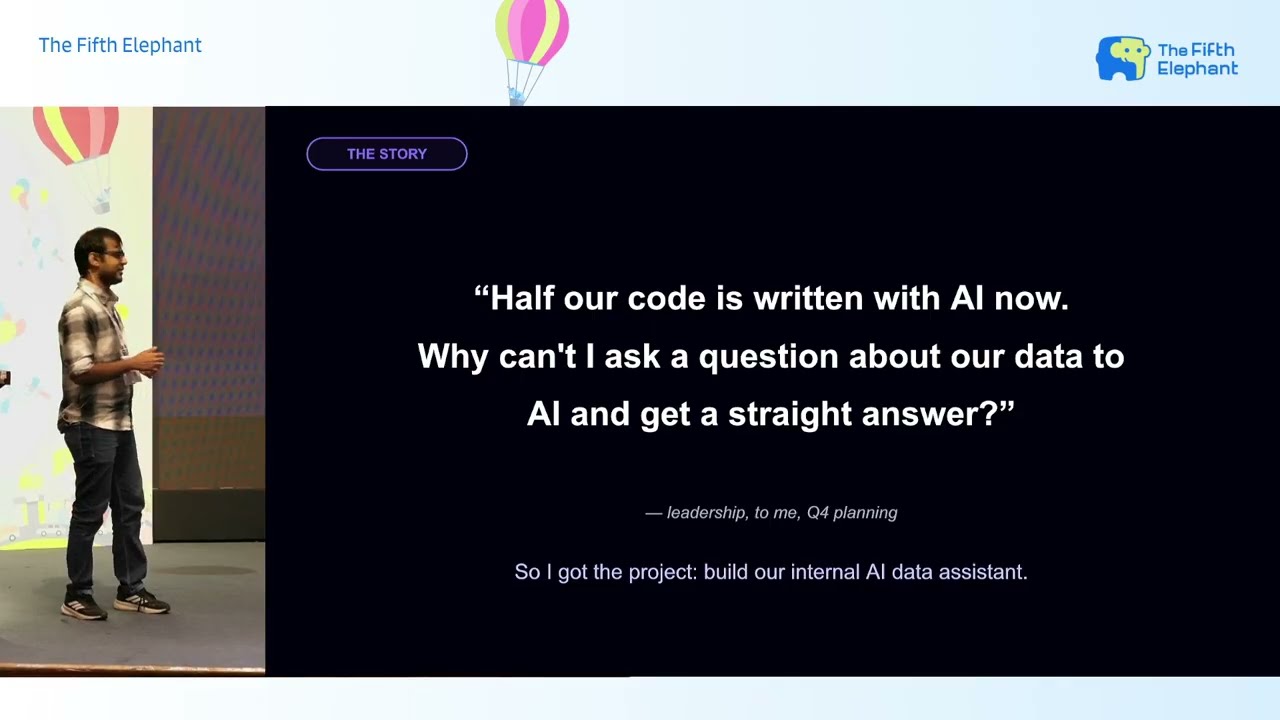
"Now we are generating more than 50% of
code using AI.
Why can't I ask question about our our
data to AI and get a straight answer?"
So they assign us the project to build
an internal AI data assistant.
And while analyzing this, we find out
that
AI for coding does not work by magic.
It works because it was built on top of
the best context layer available. That
is a repository.
The repository contains
the code. It is centralized. It can be
searchable via AI. So
it it can explore the code on its own.
It can find out what is available, what
is not.
And that it also contains a lot of
tests. So whatever AI is generating, it
can validate
by running those tests and it can see if
it is
it is passing or not.
Repository also has GitHub history. Uh
so it can understand why a line change
was made.
And finally, it also has a good
documentation and there is always human
in the loop for providing feedback to
the AI.
Now let's take a look at how this would
work for our data assistant.
We have five different systems
and five different UIs and there is no
shared context in between them.
And these five systems are not even
providing a complete picture about the
organizational knowledge.
For example, a physical year rule is
defined in some random Slack thread from
2024.
Now, we try to build our version one for
data assistant using We just dumping all
the table schemas in into the agent and
we ask it a simple question about
generate me a report of for Q1 uh for
the physical year and use the fact sale
table.
It very confidently generated a SQL
query and it is well-formatted as well,
but let's see what's the problem with
that.
Now,
there are three main problems.
I asked it to generate revenue, but it
gave me seven random sums. Now, it is my
job to figure out what is revenue from
that. It is That is not providing
answer. It is just dumping out
information and asking me to figure it
out.
Another problem is that it considers
that Q1 is from January to March, which
is not the case for us in India.
And this table also contains some test
data, which inflates my revenue and it
is not able to ignore that.
So, the model knows how to generate SQL,
but it does not know context about my
company.
And that is not the only problem
uh for this data assistant.
Let's say
I want to also integrate a different all
all of the systems into my AI agent
because let's say I want to also debug
broken pipelines. I want to debug broken
reports. So, for that, I need the full
context of our data.
And to build it, I'll have to
deal with authentication system for all
of the system. I will have to build
tools for AI to access the data if those
are not already available.
And finally, I'll also have to take care
about
data access
to not not end up into situations like
these where
Claude just deletes production database.
And that's where Open Metadata comes
into the picture.
Open Metadata is a open source
context layer for AI. It has more than
450 plus contributors.
It has 50 million plus Docker downloads
and it is deployed across more than
4,000 large organization across the
world.
And let's see how it fits into our
system. So, now Open Metadata is the one
which is connecting to all of these five
different systems. It pulls the metadata
and
information around metadata.
And then data and business teams
collaborate on the Open Metadata
platform
and provide meaning to the data.
Now, initially it was designed for data
and business team to collaborate and for
fulfilling their data discovery, data
quality, and data governance need.
But now, since this has the full context
in one graph, it has also been
accessible to AI agent
for becoming its context layer via MCB
and APIs.
So, let's see what Open Metadata is
trying to solve for AI agents.
It is tackling three problems.
First is the context to make AI aware
about what data exist in our
organization.
Second is to give semantics, like to
give meaning to the data that exist. And
finally, memory to keep record of all
the decisions that we made across our
organization.
And
for example, this is
the example of the stack that I
discussed earlier. I have five different
systems. OpenMetadata is able to capture
all of this in a single graph. And it
also captures the flow of data, so I
know that okay, Postgres is went into
Redshift via Fivetran pipeline, and then
that
table is consumed for my BI report.
And it not only captures information
from these five tools.
There are more than 90 plus connectors
uh from where it can extract metadata,
and including Apache Pig or
We have a lot of dashboard connectors, a
lot of pipeline connectors, and there
are many more categories of connectors
that we support.
And this is the example of metadata is
tries to pull, right? So, for example,
this is a dim customer table. It
automatically pulled up all the columns
available, their data types. If they had
uh description, we pull that as well.
And we can also attach information like
tags and glossaries to it. We can define
the ownership. We can define the
certification of if whether my table is
of gold standard or silver standard or
etc.
And
this information is not only available
to humans via this UI, but it all it is
also available to the AI agent via MCP,
right? So, it can pull in the same
information in just one context call.
And
let's see how it solves for semantics.
Let's say I have these three columns in
my fact sale table, and all of these are
representing a monetary value, right?
So, let's say if when I ask what is
revenue,
it will have to guess between all of
these.
But, that's where OpenMetadata tries to
solve it, right? You We see in the
previous slide that we can attach
glossaries to the column and from that
information it is able to determine that
okay, gross sale is for gross revenue,
net sale is for net revenue and total
sale it does not even contribute to
revenue because it has
taxes and shipping details.
And it not only interprets it from just
a text view,
it it can also
gather that information from a
relationship graph because Open Metadata
now also supports defining ontologies on
glossary terms, right? So, for example,
in this case, net revenue can gross
revenue is calculated from net revenue
and this information is available to AI
uh as well as a relationship graph. So,
it is not determining this information
based on text. It is able to reason it
on top of the the graph.
Uh and the final piece is the memory.
So, we talked about how Q1 how it made
mistake in our query where it assumed
that Q1 is January to March, but
it actually it should be from April to
June, right? And the the test data
should be ignored. So, let's see how it
can we can do that.
So, this is my Cloud desktop setup where
I'm asking it the same query that
generate me SQL query for fact sale
table and for Q1, give me the report.
And
you can see that it is making
call to the Open Metadata MCP and it is
able to search metadata.
And finally, it is able to generate the
SQL, which is much cleaner than what we
saw before, right? Now, it is not giving
me seven random numbers. It is giving me
proper net revenue and the currency it
is used for.
But still the problem of Q1 exists.
So,
what I do next is I'm telling Claude to
remember that okay, Q1 is from April to
June and you should exclude these
columns
because they are inflating my results.
So, now
this this step will not only remember
the this information in my local
session, but it will also create the
same memory in OpenMetadata.
So, OpenMetadata now has this new
UI called context center where it can
where it can store and create memory
which can be accessed by anyone in the
organization.
And finally, uh
after getting this information, it is
able to generate the accurate query. It
is able to figure out the Q1. It is able
to figure out the test columns needs to
be ignored.
And
let's go back and
the context center not only stores the
memory, it also can hold documents. It
can hold hold the articles like like
Notion to give the AI more context about
the organizational knowledge.
Okay.
So, now with the same model, we are able
to generate the accurate query. So, it
was not the model which was not capable
of determining this information. It was
the missing context that OpenMetadata is
solving.
And this context layer is open.
It is built on top of open foundation
like MCP, RDF, JSON schema. So, let's
say whenever you are deciding to switch
EI platforms, you don't have to build
the context layer from ground up.
And finally, it is also compounding
because EI agents cannot only read from
the data, but it they can also write
back.
And every correction, every decision
becomes permanent organizational
knowledge.
And that would be it. We saw how Open
Metadata is trying to solve for context,
semantics, and memory.
Thank you.
Do we have any questions?
>> Thank you.
Questions?
>> Uh
thanks for the nice demo on the cloud
side. Uh question uh
there needs to be a maker checker for
context updates, right? As in at some
point in time uh global context of the
org cannot be updated via uh like
individual chats, right? How do you
maintain that? Uh is there a maker
checker available? Uh how do you work
with
uh
like uh context that gets uh polluted
because of uh like local context, like
for a singular analysis versus a global
context.
>> Okay. Yeah. So, the context center that
I just showed you, it also captures the
version history. So, basically, you can
let's say if you if you figure out that
okay, there is something going on wrong
with the global context, you can go to
that that version history, and you can
make decision okay,
there was something which was changed by
someone which is not right, and you can
always revert back to whatever is the
correct uh context. Similar to how you
would do it, let's say
reset get reset command in in in the
get, right?
Yeah.
Any more questions?
>> Thank you.
>> [clears throat]
>> Thank