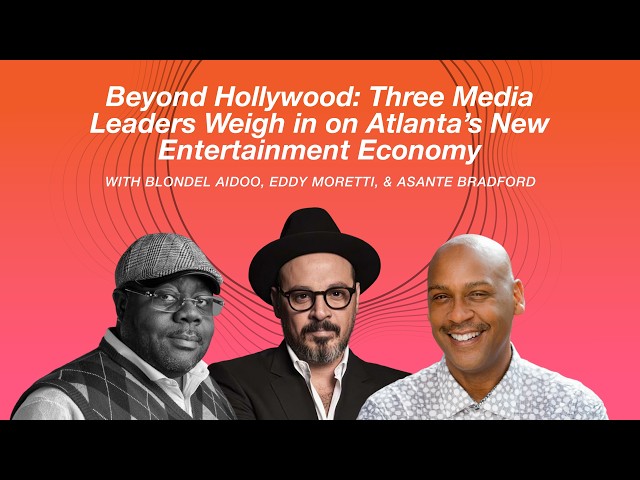
Beyond Hollywood: Three Media Leaders Weigh in on Atlanta’s New Entertainment Economy
Watch on YouTubeVideo summary
The video features a live panel discussion from an AD Week event in Atlanta, where three industry leaders—Eddie Moretti, Asante Bradford, and Londell Adu—discuss the city's evolution into a premier global entertainment hub. Eddie Moretti, executive producer at Laugh Cry Wow, explains how his company moved production to Atlanta after realizing the city offers a low-friction environment with incredible crews and economic incentives. He highlights that Atlanta is no longer just a filming location but a place to build lasting institutions, citing the success of their docuseries "Magic City" which was inspired by local friendships and cultural landscapes. The group emphasizes that Atlanta serves as an essential East Coast creative engine, allowing teams to avoid relying solely on West Coast hubs like Los Angeles while maintaining high production standards.
Asante Bradford, representing the state of Georgia's digital entertainment office, focuses on sustainability and talent development as key pillars for the industry's future growth. He argues that ensuring the longevity of Atlanta's success depends heavily on investing in K-12 education and local colleges to provide the next generation with necessary tools, including artificial intelligence skills. Londell Adu, who is relocating his tech company Rabbit Hole Studios from Los Angeles to Atlanta, reinforces this point by noting that the city's vibrant energy and diverse cultural landscape are crucial for creative flow. He stresses a moral responsibility to create opportunities for local youth, particularly those from historically black colleges and universities, ensuring they can build careers without leaving the state.
The conversation also addresses how brands are maturing their strategies in Atlanta by shifting away from traditional studio models toward organic partnerships and direct-to-consumer content ecosystems. The panelists describe a new frontier where brands collaborate directly with creators to develop original intellectual property that serves both commercial and artistic goals, often utilizing platforms like YouTube and TikTok to test ideas before greenlighting larger projects. This approach allows for a virtuous circle where brands save money through tax incentives while supporting local employment and economic health. Ultimately, the leaders agree that the industry is democratized, allowing anyone with a great story to compete globally, and they are eager to foster a two-way dialogue between agencies and creators to shape the future of storytelling in Atlanta.
Read the full video transcript
Welcome to AdSe
about the business of marketing, media,
and creativity. In this episode, we're
sharing a conversation recorded live at
one of AD week's events featuring
leaders from across the industry
discussing the ideas shaping brands
right now. Let's get into it. I'm happy
to be moderating this as someone that is
from Atlanta, born and raised. Um, I
want to thank you. So, if you all could
just go down the line and introduce
yourselves, what you do, and then we'll
kick it off. Eddie Moretti. I'm a
executive producer at Laugh Cry Wow, a
new production company. We just uh
produced Magic City here in Atlanta last
year and it's on Stars and go and watch
it please.
Hey everybody, Asante Bradford. I work
for the state of Georgia economic
development. Um couple things uh film
music dig entertainment office. So I've
been doing the digital entertainment
part for about 20 years now. and then
now um called what's called center of
innovation and I focus around what's
called the creative industries of
digital entertainment but I like to say
something first I'm just I'm sorry okay
>> meet people who who's visiting Atlanta
for the first time let me hear you
>> here I'm over there
>> I got a chance to meet a few at lunch
man so I just want to say man I hope we
showed out very well for you and hey
there there's my friends and uh man I'm
just excited when I heard that so many
of you guys are coming to visit man I
hope we really show you out well we're
we're really excited what's going on
here So anyway, thank you guys. I'm
Londell Adu. I have been a producer on
probably big big action type Hollywood
films all my life pretty much. And I
started a tech company called um Rabbit
Hole Studios. I was based in LA. We are
moving to Atlanta.
Exactly. And uh we're here to make it
happen, you know, and to uh to enjoy
everybody and to hopefully uplift and
unite and ignite change and new stuff
here. So, right on.
>> Amen to that. Okay. Well, I want to
start it off. When did you all realize
that Atlanta wasn't just a place to like
shoot something, but actually build
something that lasts?
>> I'll go first. Okay. So, the co-founder
of Laugh Cry Wow is Janie Girtz, the
actress. You might have remember her
from Twister or Lesson Zero. A few years
ago, she bought um the Atlanta Hawks.
So, she started splitting her time with
her family here in Atlanta. And soon as
she got into this town, she was
introduced to the cultural kind of, you
know, landscape. Made a lot of friends.
That's how the Magic City project came
to be was her children and Magic, Mr.
Magic's children were friends and became
friends and through that friendship sort
of developed the idea to like do the doc
series. So really since yeah years ago
before we started producing this show
realized that Atlanta is just a great
place to do business, tell stories and
create content and we'll be back.
>> Yeah, love that. Uh for me it was real
simple. Before I started with the state
I had a film festival and it was great
about oh god 20 plus years ago now but
at that time it was Tyler Perry and
Rain. So all these people were coming at
the same time. So it was really exciting
to see kind of what this movement was
becoming.
>> Yeah.
>> And then Larry this job came up because
so much of our young talent was leaving
the state. It was like well hey if we
can recruit those companies to come to
Georgia hopefully those kids won't have
to leave. And you're prime example of
that. You don't have to go nowhere now,
Brad.
>> Um, for me, I did a movie here a few
years ago called um, Red Notice. I don't
know if you anybody saw that on Netflix.
It uh, it was their highest grossing
film ever until K-pop came us off the
uh, picked us off the uh, the stage
there. But, you know, filming here and
um and working, I got a sense of, you
know, the the teams and the the crews
that are here and, you know, and how
professional and how great everyone was
and and my partner co-founder Janice
Fler and I just were like, man, this is
actually really cool, you know, maybe we
should look into staying here and
building something and doing something
more. So that was the first time for me
that, you know, I got the bug and now
we're we're moving. So it works.
>> You need to meet Paul Carpenter at some
>> must be.
>> So Eddie, I want to ask you, what about
Atlanta shapes the stories that you
tell? Like does a story start in Atlanta
for you or does Atlanta find its way
through the stories that you're
creating? Well, obviously with Magic
City, it's an Atlanta, you know, you
know, like a landmark, a historic
institution, kind of like a crossroads
for people in in uh um in sports and um
music and entertainment. Um so, it's
about finding Atlanta specific stories.
We are developing at least one music
project now because of Magic City. Um
that's homegrown talent here. I don't
want to I'm not ready to go public so
I'm not going to say who it is but
well-known musical artist from Atlanta.
Um and but we're also also going to
bring some of the storytelling that
we're doing elsewhere in the country or
the world and use Atlanta as a
production hub. We found amazing crews
here. You know, you need like a low
friction
um environment in order to like
efficiently make content, right? and
Atlanta is like provides that. So, yeah,
we're going to tell Atlanta based
stories. Always look out for cultural um
heroes from this city, but also some of
the sports shows. I I I can't announce
there's another one. We're close to I
was talking to my panel mates about
backstage. We're close to announcing a
new sports franchise. We will make sure
that we do the production here in
Atlanta cuz it's it's comfortable. It's
economically sensible. There's great
incentives. Thank you very much. Great
people, too. Um, and uh, yeah, it's a
wonderful East Coast hub for what
happens um, in development on the West
Coast.
>> Yeah, I remember you saying that Atlanta
is East Coast creative engine.
>> Yeah, it's like our our hub for us.
Instead of parking um, production and
post in New York, we're going to look to
do it here.
>> Yeah. And Blanel, I want to go to you
because there are a lot of things that
was founded in Atlanta. If you didn't
know, Coca-Cola, Cabbage Patch Kids,
Home Depot, me, you know, a lot of
stuff. Um, how are you revolutionizing
what it means to be made in Atlanta? Cuz
you're you work in tech, AI, Rabbit Hole
Studios. How are you revolutionizing
what that means? I mean I mean for me
it's like we create worlds right that
are beyond our planet worlds where we
have anthropomorphic animals and humans
coexisting. We're creating animated
projects as well. And for me, you know,
where you where you do that, you need a
a comfortable creative environment where
you can just flow, right? You know, if
you're writing a book or if you're
writing any story, you know, different
people have different things where, you
know, some people like to work in the
morning, some people like to work in the
evening, some people need the beach,
some people need, you know, different
terrains. And I mean, for me, I need to
be in a vibrant city that's that's got
an energy and a flow.
>> Yes.
>> Right. And and so I find myself, you
know, wanting that, seeking that. I find
the vibe here to be exactly that and the
culture. And so it for me it's just a
creative hub where you know I'm excited
about what's going to come because I'm
I'm one of those people that you know
you have the uh the little notepad or
the iPhone right next to you at 3 in the
morning I get woken up with a new new
idea.
>> Yeah.
>> Every week I think. So it's like oh and
I'll have to look at it later and say
what where did that come from or you
know so forth. And so I find the lens to
be that type of hub where you can just
relax and create, you know, and a good
environment. So for me it's it's like
building upon that and growing that and
and and it'll all be coming from right
here.
>> Yeah. Asante, I want to go to you
because we're talking about the growth
and the opportunity in Atlanta, but how
can we also ensure that like the
sustainability of what's happening in
Atlanta remains or is going to be local
crowdedly?
>> That would be you. Um that would be K
through 12. That would be our colleges
and and anybody teaching in colleges
here too. I'm they've done an incredible
job here in the state. People like
yourself are coming out right with
talent. So that's where we're focused.
Let's get this next generation. Let's we
call it um getting the reps. So the kids
have to get the reps to get good what's
a 10,000 hour rule kind of thing. Yeah.
So that's the goal to get the kid get
the tools in the kids' hands. I'm going
to be talking to this man a lot about AI
and getting these tools in the kids'
hands. Yeah.
>> And we feel the kids will take us to the
next level. I I I'm sorry I say kids,
but
>> the next generation will take and
hopefully sustain what we've been
building.
>> Yeah. And do you have anything to add to
what Blundell was talking about about
revolutionizing what it means to be made
in Atlanta?
>> Everything is changing.
>> Yeah. Um, you're at the vanguard and um,
I love how much you're pouring into me.
I [laughter]
Well, because it's important to know and
the reason why I'm here is because of
what you've done. Who pays your bills?
You guys pay our bills. The
entertainment bills are is always been
the entertain. It's always I'm sorry. in
commercials and entertainment industry.
One thing to talk about what you're
talking about was exciting and I keep
telling you you need to meet this guy is
um we're working on an initiative here.
We actually have a a I told you about a
commercial tax credit.
>> So anybody with brands in the golf if
you guys shoot your commercials here in
the state you get 20% back on your
money. And a lot of folks don't know
about that but that's how our bills get
paid you know. So I'm really excited
about that initiative. and Paul. He's
Paul's head of the uh the Georgia
Marketing Association here at Sorry,
Atlanta. I'm Georgia. He Atlanta. Um so
we're but we're really excited about the
opportunities to get our brands more
involved in the entertainment industry.
So I hope that answers.
>> Yeah. And what I love that you're
talking about while you are pouring into
me. Um another theme that's sticking out
to me is young and emerging talent. Um
and Eddie and Blendell, I want to hear
from you both, especially you Blendel
because you're moving Rabbit Hole
Studios to Atlanta. But when did you say
you're going to move?
>> First quarter.
>> First quarter to Atlanta. Um, and
Atlanta is a hub for universities like
and H.B.CU specifically. I grew up
across the street from Morehouse,
Spellman, Clark Atlanta University. How
do you plan on tapping that young and
emerging talent that wants to be in the
entertainment?
>> I got it. I already talking about it. I
got it. Abs. Absolutely. I mean, you
know, we all know Hollywood is a is a
place that
>> entry is is not guaranteed. We'll put it
I'll put it that way.
>> Yeah.
>> Um and I I even know, you know, for for
projects that I'm doing, I always get
some other producers's
you know, daughter or cousin or someone
is like, "Oh, can you intern this
person? Can you bring this person in?"
And you know, which is which is all fine
and and and so forth. However, for me to
be in a city where I can actually reach
out to people who normally would not get
the opportunity
>> Yeah.
>> you know, and provide an opportunity for
them to learn, you know, a craft and
skill that will enable them to feed
their families and to change their lives
is is not, you know, it's not an
opportunity, it's a responsibility,
right? And so my daughter goes to SCAT,
you know, and so her and all her friends
are already like, "Okay, well, you know,
your dad in their industry, you know, so
um and with all the tech that's
happening, you know, here with Georgia
and all the obviously the HB.CU and so
forth, it's white just, you know, we
have so much great talent here."
>> Yeah.
>> You know, that it's it's amazing. So,
we're excited about that and one of the
reasons why we're coming here.
>> Yeah. And I love that you said that like
the onus is on you and I think that's
what keeps Atlanta thriving so much in
the culture is because a lot of us feel
like the onus is on us to keep the
torch. Um HB.CU are having such a moment
right now and your daughter goes to Scat
too. So like I love that you feel like
the onus on you and you're moving rabbit
hole studios to Atlanta. Eddie, what
about you?
>> Yeah. So, you know, on the production
side, all the um projects that we do
here, we're obviously going to tap into
this amazing talent pool. But before I
joined Laugh, Cry, Wow, I was at a
company called Vice Media for 20 years.
>> Yeah.
>> Uh we did a lot of stuff down here. We
did and I created the Noisy Channel, the
music channel for um Vice. We did uh
Noisy Atlanta one. We did Noisy Atlanta
part two. Part of what And I was there
for the good 20 years.
with a good time years not the shitty 20
years I'm responsible over this part of
the company that part
um right so yeah you can talk to me
after the panel if you want more detail
but part of what made us I think
successful um in that great run was
leaving the door open and enabling
creators at the storytelling level to
come in and pitch their ideas So, um, I
we're going to make the same commitment
at Laugh Cry Wow. We want Atlantis
Storytellers. It's Eddie at Laugh Crywow
with a Y, not an IIE. That's my
>> Eddie with a Y at Laugh Cry. Wow. If
you're a Atlanta based storyteller,
>> come tell us what you want to do. Let's
go. And obviously there'll be stories
about Atlanta. But this is a cosmopol a
major American cosmopolitan city. You
guys have a perspective on the whole
country and you have a perspective on
the world. So, let's tell stories um
from Atlantic Creators. Eddie at Laugh
Crywow with a Y, not an IE, but that's
okay. It happens.
>> Thank you. I love that. Make sure y'all
connect with Eddie. Eddie, I want to
stay down with you for a second because
I want to pivot a little bit and talk
for the marketers in the room and talk
about how you see the production and how
you see the storytelling from a
marketer's perspective in Atlanta
maturing.
>> Well, so one of the things you laugh
>> Yeah. Um so one of the things I did in
my last career was I was on the
forefront of defining brand partnerships
um at Vice Media and at Laugh Crywow we
have a slate that's pretty heavily
invested in music sports and true crime
stranger than fiction. Yeah.
>> stories. Some of this slate, especially
the sports stuff is very amendable to
brand partnership, right? So, um this
sports franchise that we're working on,
for instance, I'm love to partner with
brands um that want to integrate into
the content um selling through to big
traditional distribution channels, but
also looking for opportunities to build
content ecosystems off channel. um that
brands can really play well. Um so um
like I said, there's a portion, yeah, of
this content that we're creating that's
really perfect for brand sponsorship,
>> sports, F1, we're looking at soccer,
NBA, we're looking at another NBA story.
So yeah, so there's definitely
opportunity for brands to get involved
and um I met some amazing people here
over the last two days. Um but um I need
a brand.
We also we have Brian Bonafide
distribution. I can't say what it is but
off stage I can say um if I whisper in
your ear. So
>> you mean and I thought about even the
FIFA World Cup is coming here. So you
got a lot to think about and deal with.
Um I want to ask you the same question.
How do you see brands maturing the
post-production storytelling process in
Atlanta establishing IP? Why do you
think this is a good investment?
>> Well, that's where everything's going
again. Brandon entertainment and all. So
my background is again I've been working
mostly in the video game industry. Yeah.
>> So literally that's where all this
coming from. They were at it 20 years
ago. So those those uh athletes
had to figure out how to monetize,
right? So again a lot of them went, you
know, they learned on Twitch and learned
how to make how to build my audience.
They learned how to reach out to the
brands and then the brands needed to
know who their demographics are and all
of that stuff. Gaming folks have figured
it out, right? And most of them had this
is they their own companies, you know,
they LLC. So now as I'm in called what's
called the creative industries, right?
If I'm going to work with film and if I
work with music folks and my first
question, do you have your LLC yet? I
again jobs as you guys know is a little
tough times in entertainment. What's
happening on the job side? But on the
entrepreneurial side, it's an incredible
opportunity right now. Specifically a
lot of stuff you're doing, right? So no,
I'm really excited. And um a lot of
folks don't know even in Atlanta Paul
knows this that we you know we were
considered a a martekch. We considered
one of the top places for marketing
right more automation and all that type
of stuff. Yeah. So as our agencies here
that are amazing and do a great job. All
you guys are here you do a great job. Um
we're really excited to get more that's
why I'm here man. I'm really excited to
get more tied into the brands
>> but also like I said not only can we
incentivize the brands to save money by
getting here as well but the real goal
is what we're talking about. How do we
get this next generation working with
those brands because they're going to be
the future filmmakers, the future Tyler
Perry's and all they're going to start
by doing a commercial with this one
brand. So that's our goal right now is
to build a say a pipeline but build a uh
a track way um for brands and and our
talent but simply more like you ones who
have figured it out. You figured it out.
You need to I I got a bigger
>> you figuring it out. Yeah. But it's
important for folks to see what you're
doing here. And I so that's why I yes I
will keep blowing smoke up your ass
because what you're doing is great and I
think as folks see that that's the model
now. Hollywood model is changing.
>> So um
>> get like I'm Hollywood points [laughter]
>> because he was Hollywood but he
and we don't we don't have a name yet
for we call it a different name but we
don't like any of the names yet. So come
up with a name that would lead for brand
marketing people.
>> Come up with a name, please.
>> Yeah.
>> So anyway, man, so yeah, to answer
finish up, man, I'm just really excited
to to bring in as the entertainment
changing and you're changing.
>> You're ch I'm getting older. Well, no,
you that the models change yet.
>> Yeah. And um so are the are we going to
stay in that old antiquated system or
are we going to make this move now into
what's coming with nets and stuff you're
doing you're doing?
>> Yeah. Vanel, do you have anything to add
to that?
>> Sure. I [clears throat] mean, I believe
we're at a crossroads right now where
everything is changing, you know. Um,
and even with uh making films and so
forth, you know, you used to be able to
get a star and put him in a movie and it
would open.
>> Yeah.
>> Almost no matter what, right? You have
Kiana Re,
you just sit back and pop the champagne
and it's all going to be great.
>> Not anymore. M
>> right and so I think everything is
changing to a to a place where we have
to rethink everything right and so what
we're doing is we're going direct you
know with shorts and smaller project you
know smaller teasers of projects to
YouTube and to Tik Tok and to all these
all these places gathering data from
that and things that bubble up right
then we we take them to the next level
in terms of of greenlighting them and
and so forth And I think, you know,
we're at a place where working with
brands,
I believe, will be the new the new thing
that we do, right? So rather than going
to a distribution company or a studio to
form projects and and and get things
going, if we work organically with
brands and make it good for everybody.
>> Yeah.
>> Right. We should be able to come up with
something that actually serves the brand
as well as serves the film and moves us,
you know, to a place where everybody
owns and when we do have great success,
everybody wins.
>> Yeah.
>> And I think that's I'm excited about
that as well because I think that's
that's the new frontier. and what I'm
what I'm seeing with with YouTube and
with all these other I've had so many
different meetings with other means of
distribution that's just amazing now. So
opportunity is there you know and for
for me and and creating these worlds I
need everything in those worlds. So
blends for me organically people are
using you know from Starbucks to Coke to
Pepsi to you know you name it it's there
and it's there organically and so I
think I think it's a really exciting
time.
>> Yeah.
>> But you got to think differently and
move differently.
>> Exactly. Absolutely. I agree. It's a
great it's an exciting time literally
every in my this my opinion of course
but uh it's democratized now.
>> Absolutely. It's like I was telling my
friends again, if they have a somebody
has an ET story, you can compete with
Spielberg now. It's just like it's about
storytelling who got the right. It's got
to be a great story.
>> It's also like part of the bigger
picture when you look at the companies
represented here at Brand Week. You're
looking at the economic engine of the
country, right? So the the this is like
about having our economy succeed, be
sustainable. We need these brands to
work. They can't just become inert
useless parts of our culture and uh
because this is driving the economy,
driving employment, driving health
wellness, right? So it's it's like it's
a virtuous circle really.
>> For sure. For sure. So I want to open it
up to Q&A. We have time for about two or
three questions. So if you have any
questions, can you raise your hand in
the audience? And I can't really see out
there. uh over here. Okay.
>> First, may he handle um my question is
what is the direct process to come into
any three of you with a project?
>> What's the direct process? Yeah.
>> Eddie with a Y at Laugh Cry out there.
>> I don't have projects but the state
LinkedIn. Best place to catch me.
LinkedIn.
>> Yeah. And I'm I'm here. Hit me up. Let's
you know, let's get it done here. And I
love that we have a question over there.
Hello. Hi,
>> my name is Shante Wilkins. I often hear
us in Atlanta talk about going after
these springs and getting them to engage
or what is the process have be has there
been any thought about how that would
happen or what that will look like in
the near future?
>> Sure. CL how what's the process to
engage the brands in the future? Like
how do you actually get in contact with
them? How do you get them on board for
the project? Is that what you were
asking?
>> Yes. Like what is the larger plan to do
that?
>> Yeah.
>> The point to to engage with the brand.
>> Yeah.
>> Well, I'll tell you from my perspective,
you know,
brands have money that they're putting
into, you know, uh that they're spending
on different things and and I am the
films that I make, you know, I I put
butts in seats, right? I don't my
partner [laughter] my partner is much
much more cultured I guess you'd say
she's more you know she's she's she
loves art and art films more so you know
for me I I do Indiana Jones type
projects you know bad boys that you know
I'm shooting some something or blowing
something up or you know so anyhow we we
put butts in seats and so if I can prove
that you know we can do that and make it
better for a brand to have something
organic in our in our movie where people
are spending money and then maybe using
an American Express or a Visa or
whatever have you. However, we can
organically put it in there and partner
with the brands for them to put funds
into the film and and so forth. For us,
it's that's a win-win. And for me to not
have to go to the studios and kind of
beholding to to that whole distribution
model is is a much smarter play, you
know, and that's why the you know the
the bringing of the two together to me
is so important. I mean you do product
placement too.
>> Yes. For laugh cry wow. Can I add?
>> Yeah, you can wrap for that. I don't
want to get in trouble. Um for laugh cry
wow. Sure. We are developing original IP
um and we want to take that IP to brands
but we equally also want to hear from
brands. Uh I've been in my career
challenged with creative briefs from
brands and agencies and that's how
motherboard was born. That's how the
creators project with Intel was born. Um
so I'm really open to the uh a two-way
dialogue. We have ideas, but we love
brands to um come to us with ideas.
Eddie with a Yapwow.com
if you're a brand or an agency that
wants to tell a story. Wow. Well, thank
y'all so much for this session and thank
you for being an engaged audience.
>> That was a conversation recorded live at
an AD Week event. You can find more
coverage, analysis, and interviews from
across the marketing and media world at
adweek.com. Thanks for listening to
Adspeak. If you like the show, be sure
to follow or subscribe wherever you get
your podcasts.