Beyond Headless - How Drupalists, Front-End Natives, and LLMs All Win with Next.js
Watch on YouTubeVideo summary
This webinar, co-hosted by the Drupal Association and Pantheon, explores the evolution from traditional decoupled architectures toward a component-driven open web powered by Next.js. As user expectations demand interactive experiences akin to native applications, JavaScript has become the dominant language for modern development, yet Drupal continues to offer robust, reusable back-end structures such as content models and permission systems that do not require front-end developers to know PHP. By separating the content management system from the presentation layer, organizations can leverage the optimal technology stack for each function: front-end teams specialize in JavaScript with Next.js while back-end teams manage Drupal, thereby reducing the need for hybrid specialists and streamlining complex development projects that once resembled costly "science experiments."
The integration of these technologies is significantly accelerated through tools like Pantheon's starter kits and DDEV, which allow users to connect a Next.js front end to a Drupal back end in under thirty minutes using pre-configured recipes. This approach not only enhances efficiency but also provides remarkable flexibility, enabling content managed in Drupal to simultaneously serve multiple channels including websites, mobile apps, and digital signage. Furthermore, the convergence of Drupal's Canvas component language with Next.js React components creates a shared underlying codebase that facilitates seamless data flow between visual editors and modern front ends. Although full automation is still emerging, CLI utilities are being developed to sync components between the two platforms, while AI models increasingly adopt front-end patterns to help generate maintainable and secure code based on pre-approved libraries.
Successful implementation of this hybrid architecture requires a strategic balance between technical rigor and the practical needs of editorial users, ensuring that content editors can easily manage their experiences without needing direct JavaScript expertise. While non-technical editors rely on visual builders like Canvas for creating layouts, upcoming authentication mechanisms will soon allow Next.js sites to link back to Drupal for content editing and user-specific gated content, bridging the gap between visual creation and backend governance. The community is collectively adopting these standards to reduce divergence between tools such as Paragraphs or Layout Builder, fostering a unified ecosystem where development pipelines are respected and the user experience remains central to project success.
Looking ahead, the discussion highlights ongoing efforts to build long-lasting structures rather than relying solely on AI-generated content that may lack durability, with new webinars planned for AI integration and starter kits set for release at Drupalcon Roderdam. The session concludes with an invitation to attend the conference in September, where further advancements in multi-site configurations and higher education course registration systems using Next.js will be demonstrated. Ultimately, the webinar advocates for a future where Drupalists, front-end natives, and LLMs all benefit from a streamlined workflow that respects both development complexity and editorial simplicity, ensuring sustainable growth for the open web.
Read the full video transcript
Hello everyone. Welcome to the co-hosted
Drupal Association and Pantheon webinar
for today. Um we're going to give it a
couple of minutes as more of the
attendees join. Uh we know we've got
quite a few folks registered, some who
will attend live and some who will check
out the recording. So we'll just take a
minute or two here. Um, while we're
getting set up for that, um, I do want
to invite you to, um, you can hop into
the chat, introduce yourself, where
you're coming from, all of those things.
Um, we'd love to know who you are and
where you're joining us from. Um,
throughout this presentation, you're
also going to be able to use the Q&A
feature. Uh, it's one of the toolbars in
the Zoom toolbar down at the bottom of
your screen. um to ask questions, upvote
other people's questions, all of that
kind of stuff.
Um
it looks like humidity might be a theme.
Um
>> yeah, because uh yeah, Portland's pretty
humid today, too.
>> Really? Usually I think of Portland and
I mean I grew up in in Eugene and
humidity is not something we had
>> that bad, but we're having some weird
summer weather at the moment. So,
I don't know.
Tim, welcome from Wilsboro.
Nice to have you here.
All right, some more folks jumping in,
but pretty shortly here, we'll just go
ahead and get started.
>> Yeah.
>> And make sure that it's ready. There we
go. Couple more in. All right. So, one
more time with housekeeping and then
we're gonna go ahead and jump in here.
So again, thank you everyone for
joining. Um we're expecting more
attendees to join live as well as a
bunch of folks to be watching the
recording afterwards and that means
there will in fact be a recording. Um
we're also uh have it set up to do an AI
summary and we have the Q&A open. So in
your bottom toolbar you can use the Q&A
tab to ask questions or upvote other
people's questions. And finally, I
encourage you to chat with each other.
Let us know where you're from, all those
little details or share your own kind of
stories and experiences related to this
topic uh using the chat window at the
bottom as well. Uh but without further
ado, we're going to jump in and get
started. So the topic for today's
webinar is beyond headless. How
Drupalists, front-end natives, and LLMs
can all win with Nex.js. Moving past the
painful days of decoupled into a
component-driven open web. There's a lot
to unpack there. It'll be an interesting
conversation and I think um a lot of us
understand kind of the history of Drupal
in headless decoupled spaces and also
how rapidly things have changed uh in
the AIdriven development world. Um and
so there's a lot of good places to uh to
talk but I'll start by introducing
myself. Uh I'm Tim Lennin Hanet on
drupal.org and the CTO of the Drupal
Association. Um and really glad to be
co-hosting this webinar with the
Pantheon team. Uh Will, I'll hand it to
you to introduce yourself. Just come off
mute there. Uh and then we'll go to
Josh.
>> Thanks, Tim. Uh hi, I'm Will Jackson. Uh
I am coming from Aken, South Carolina. I
have been working in the Drupal space
for just about 20 years since uh roughly
Drupal 5. Uh sort of flex days and uh
been over to CCK and uh so I've been
around for a while. I've been working
largely in uh an agency support uh realm
for um most of that time but I've been
with Pantheon uh beginning this year and
um yeah it's been great. I've focused
mostly on Drupal in the past few years.
I've been diving deeper into uh the
Nex.js world and uh really exploring
what we can do with uh the LMS and the
the new robots that are available. So
it's uh very exciting to be here. With
that I'll pass it over to Josh.
>> Uh yeah, thanks thanks Will. Thanks for
hosting, Tim. I really appreciate um
this and opportunity and yeah, there's a
lot of words and jargon and we'll get
through all of it, but hi, I'm Josh,
co-founder at Pantheon and prior to that
was a Drupal agency founder and owner
myself. So, have been doing this for a
similarly long number of years and, you
know, really enthusiastic honestly about
what the future of the open web holds in
this sort of brave new world that we're
all starting to inhabit. Um, so I would,
um, I'm just going to go ahead and dive
into some content. Uh, Will's got a
little bit of demo to show, which will
be great. And then, you know, we can
kind of go back and forth and talk about
what's happening in the industry, and
we'll take questions from, uh, from the
audience. So, just to to to start off,
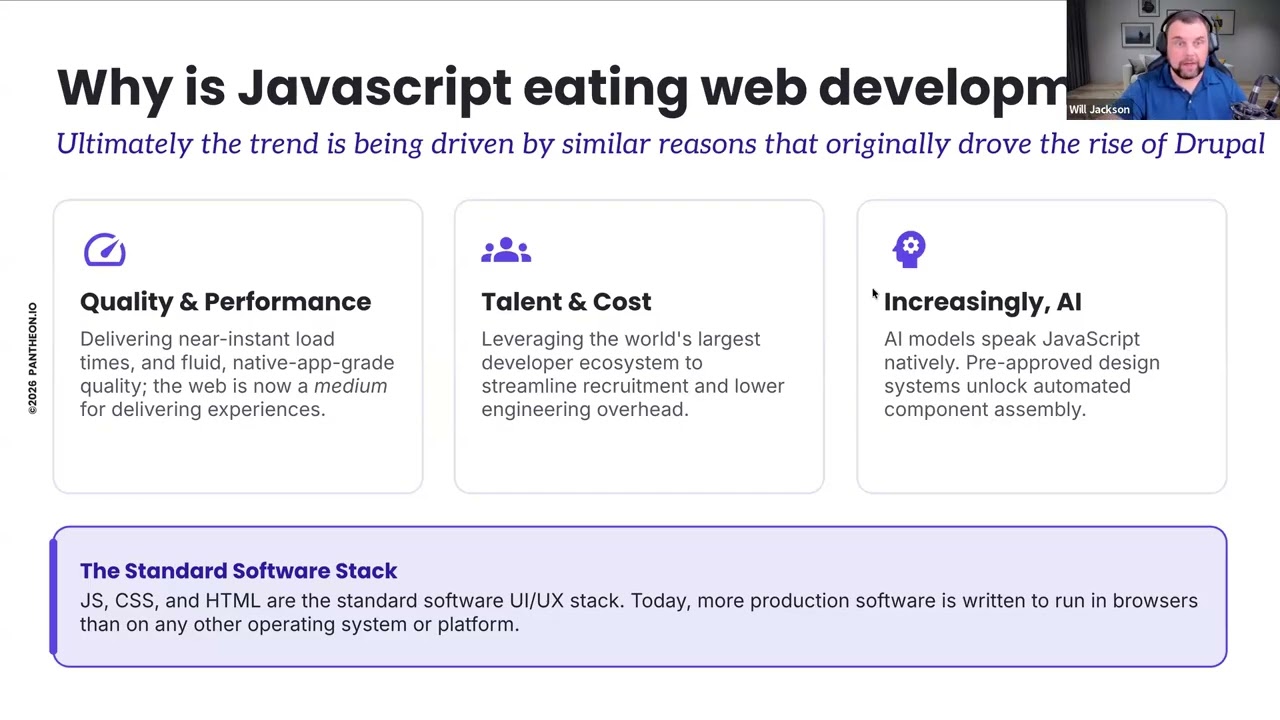
um, why is JavaScript eating web
development? Um, like I think this is
something everyone uh can acknowledge.
Um, and you know what's interesting to
me is when I take a step back and look
at what is driving just the rise of
JavaScript as the sort of the lingua
franca of the web. Um, it's it's like a
lot of things that actually originally
drove the rise of Drupal in the early
days of my career. You know, if I go
back 15 uh 20 years, you know, building
with uh Drupal offered the the the a
kind of a a a competitive edge in
quality and performance. there was this
really, you know, at the time
comparatively large ecosystem of talent
um compared to, you know, everybody else
who had kind of built their own thing in
a tiny little niche. Drupal had this
large open source project and all these
people professionalizing around it. Um,
you know, AI wasn't a driver uh back
then. That's that's the the the new
thing. uh but it's I think it's worth
acknowledging uh and celebrating that
like the the the way in which people get
the most out of the open web from an
experience level you know I think about
this as not just websites but like um
like what my kids do on their iPads when
they get 30 minutes of free time and
they go open they open a web browser
they go to a uh one of the many domains
they know where there are games they can
play and all that's just happening over
the web in in browser for them and they
and they love it and there's all kinds
of cool innovative things that you can
do with front-end technology now. And
you know, um Tim, I'm I'm like kind of
curious your perspective on like uh if
you're seeing this in your in not just
in your Drupal world obviously, but just
like in your own kind of everyday world
where there's this rising generation of
talent.
>> Yeah, absolutely. So, um you know, the
the immediate example that springs to
mind is my my brother-in-law, and he's
not that much younger than I am for that
matter, right? like you know I just
turned 40 and I and I was in hardcore in
the PHP traditional HTML CSS like um
first generation of of of that level of
development and in Drupal 4.7 I think or
something was my first version whatever
it was and um and he's you know only a
few years younger but his his kind of
entire technical career is JavaScript
focused is primarily designed around
building um what we would now call web
applications more so than websites and
with a with a strong focus on building
from a sort of front-end first
perspective or from a UX UX experience
first perspective, right? This concept
of of building um component libraries,
interaction libraries and all of these
kinds of systems. Um, and obviously I
think he was at the front end of that
particular wave, but but kind of every
generation since. This is this is what
people are are primarily learning in in
both formal education and when they're
when they're self-eing. And it's really
interesting because it's flipped around
some models and like lots of kind of
technical progressions, it's done some
new things really really well. Like
again all of the interactivity um of all
of this all the application like output
that you get um but it's also kind of
left behind some things. So I, you know,
uh, at every family gathering, I'm
talking to him about this kind of stuff,
and he's redoing a lot of the same
things that are part of the backend
structure of this. Every time he's, it
seems every time I talk to him, he's
writing rewriting a permission system
for for whatever the latest JavaScript
project is, or he's rewriting a data
model, or he's trying to decide, you
know, should um should this object
contain all of the fields for this
thing, or should it be two separate
objects and all this kind of stuff. and
and we always have these conversations
around how you know the the fundamental
content model modeling, permission
structures, entity structures, you know,
one of the powerful things about the
Drupal side is those are reusable, well
architected, built on 20 years of
experience. Um, and um, that doesn't
mean you have to do all of your work,
even your front-end work on PHP. That's
why we're having this conversation. The
whole concept of of headless
development, decoupled development,
whatever the the the term dour of the
day is, is that you can use some of
those like fundamental structural
decisions and still build all that
interactivity on top. Um, and I noticed
in the chat someone mentioning uh HTMX
as well as another another layer to this
uh conversation and the new
interactivity that's being added outside
of specific JavaScript frameworks. So
anyway, I just think it's really
interesting. I think it's an important
way for that Drupal can remain relevant
and not only remain relevant, but
actually bring what might be considered
our old ideas to what this new most
common development thing is and really
give them a leg up when it comes to
content structure, permissions, and
everything else. So yeah, it's been been
a real interesting experience for me
trying to be the uh the gray beard
evangelist to be like, "Hey, you know
what? You can do all those great things,
but you can do more, too."
Yeah, totally. I I I feel that. Um Will,
just since you're you've had that, you
know, like a long arc too and and you
said you'd spent a lot of time more
recently in your professional career
sort of walking in this world of of
front end. Any observations from you on
like what this, you know, what's driving
this change and what it's meant for the
practice of professionals in the space?
>> Yeah, absolutely. Um you know Drupal's
been around for a very long time and Tim
as you were mentioning you know the 20
years plus um with a lot of the thought
and um effort that's gone into these
systems. So things like the permission
system the user authentication system um
there's there's a in the caching system
too which all of it just really lends
itself for um you know working with
platforms like Nex.js JS and um and Josh
as you mentioned uh or um I have a a
cousin who um few few generation behind
me um but he went through the the route
of like the boot camps and um a lot of
those are really focused on Node.js JS
and exclusively that I remember I was
trying to tell him about Drupal years
ago when he was getting started in that
and he was like oh you know just not
really interested he was focused on uh
JS10 like you were mentioning he's he's
rebuilding a lot of the systems that
already exist and exist well in Drupal
that have a lot of support uh that have
a lot of sites and um you know folks
working on that. So I mean like security
updates and things that uh you typically
would have to you know really focus on
you know really pay attention to uh on a
on a you know per application level you
know going with Drupal it allows you to
you know leverage that uh open source
ecosystem um and not to mention the
contributed market uh with uh
contributed modules being able to extend
that functionality to um you know
further uh enhance the the site too but
out of the just out of the box Drupal
core does so much that uh really
complements a lot of the uh some of the
challenges that you run to when getting
started with Nex.js and other node
platforms.
>> Totally true, Will. And uh you know,
Josh, maybe we should step back even
further for a minute here because we
have some total some total newbies who
are who are on the call who are learning
about this. Would you quickly define
what the heck we even mean by decoupled
here, right? We're talking about the
advantages of Drupal. We're talking
about the trends in JavaScript. Could
you talk about what we mean by this
bridge a little bit? I know we'll go
into it in the presentation, but
>> Yeah. Yeah. just to level set I mean for
for people who who are joining the call
and and are trying to learn I think you
know historically and we'll talk about
this more later you know sort of Drupal
was you know the the complete stack you
needed for the website it it both serves
as the thing that holds the data holds
the content it's the editorial user
experience and it's serving the
outwardly facing public uh side of the
website too um and then you know there's
just been this movement in the past uh
you know over the past decade really as
the way in which that outwardly facing
layer gets built has evolved the
technology around that has become very
JavaScript driven. Um there have been
lots of different approaches to hey is
there a way we can use Drupal to manage
our editorial experience and manage our
content and our structure but let the
modern front end be natively itself. And
so you end up with an architecture where
there's sort of two layers to what
you're building. there's a core
underlying often we call this a headless
CMS because it's not serving the actual
content to the front end. It's just it's
just providing information that then the
JavaScript uses to deliver the actual
existing enduserfacing experience. Um
and so the reason why I think this is a
great conversation to have now is not
because this is new because I think the
practice around doing this is
converging. Um and so that's where I
want to introduce Nex.js. Right? Nex.js
JS is a open web success story um that
it's rapidly outpacing um like SAS tools
like web flow um any other JavaScript FL
framework like there is this sort of you
know deserved reputation of JavaScript
frameworks being having a flavor of the
month kind of uh aspect to them but
Nex.js JS is just actually leaving
everything in the dust. And the reason
for that is, you know, JavaScript and
then you layer on top of that React.
That's where all your components come
from. Reusable. There's tons of open
source components. That's one of the
reasons why it's so fun and fast to
build with this stuff. And Next has just
found the winning formula for using a
component-driven
uh uh approach to web development to
create sites or apps or things that are
like kind of in the weird uncanny valley
in between where there's a bit of both.
Um and you know there's this uh uh the
company behind Nex.js is called
Verscell. It's a great company. They do
a lot of cool stuff, but they're not
they don't own that market, right? It's
actually open source and the open web is
the majority of what's going on with
Nex.js. JS uh and so like we're um
obviously as a platform uh moving in the
direction of supporting that because
that's where the practice of a lot of
our customers and and users and partners
is going. But I just want to raise
awareness as you know for people who
have been hesitant because they're not
sure what to invest in. I mean, I'm not
going to tell you there's a right or
wrong answer, but I I will say um when
you look at technology adoption, sort of
moving with this kind of pace, it's a
fairly safe bet to say that if I invest
in learning and uh understanding Nex.js,
those skills will serve me well uh in
the future. Um, and the thing that I
think is really interesting is that in
the first decade or so of doing this, it
was like a big heavy lift to build this
way. It was kind of like, you know, you
had to invest a lot in engineering. You
know, you would think of if you were an
agency, right, proposing a decoupled
architecture, it's going to cost twice
as much as if you just did it the
oldfashioned way. It would be twice as
hard to manage. There's all this
complexity. um and you end up with a
sort of like a science project at the
end of the day. And this isn't specific
to Drupal, by the way. This is the whole
industry. We the whole industry went
into composable, decoupled, headless,
etc. And there's real value in doing
that because, you know, the the sort of
one one-sizefits-all solutions are I
mean almost by definition somewhat
limited. But the lack of guard rails
around how you do this work I think
created a lot of people where they ended
up feeling burned by the approach. And
so I think that actually there's a
little bit of a less ambitious way to
look at how Nex.js and Drupal come
together where it's not trying to be an
infinitely extensible integrate all the
things build a super complicated
architecture. It's actually just
rethinking what do we mean by building
the front end for a website and like
essentially an alternative approach to
that to traditional theming um which is
again using this outside in approach uh
Tim that you mentioned and allowing that
to kind of define uh what is necessary
to deliver the end user experience and
then now with like a little bit of good
open source code maybe a little help
from some AI to to match patterns you
can actually very rapidly put together
uh a a Drupal backend to match that
front end. Um and it's not something
that is a big engineering project. If
the front end is well defined, that's a
big if, but increasingly that's like not
hard to do, then the back end can just
say, "Oh, I see what you need. Let me
give you what you need." Versus the the
way it used to work was it would be,
"Hey, here's all the stuff inside
Drupal. What do you want to do with it?"
And then that creates a big challenge on
the front end to actually figure out how
it should work. So, I feel like this is
a we're on the cusp of something where
we're we're developing a new approach.
Um, and this is driven a lot by what's
happening inside Drupal Core and with
Drupal CMS and Canvas. Um, but it's a
it's a potentially a a really
interesting way to think about this
classic problem of quote unquote theming
that has always been in, you know, at
least in my experience, one of the
places where, you know, it like it's the
sticky part of a lot of projects. And
it's a place where things can like scope
can kind of expand unexpectedly. And
Will, I can see you nodding. And Tim,
I'm I'm curious if you have, you know,
from your perspective, any thoughts on
that?
>> Yeah, I I would add to that, right?
because one of the things that has been
true in the past is and and it wasn't
wrong is that people have thought about
Drupal as a monolithic um kind of
application for doing website
development and if you've been following
it closely and for those folks who've
been doing decoupled previously and are
just curious about the the latest
evolutions one of the really exciting
things both about this version of Nex.js
JST decoupled but also about the way the
architecture of canvas is built in
Drupal CMS and several other kind of um
more contrib related initiatives about
front-end design and theming is it is
this more kind of componentized you can
choose your front end your front-end
developers can work in their natural
language and in their in their natural
sort of frame of mind without having to
also be PHP developers also will be
Drupal developers and that level of
expertise. And on the Drupal CMS side
with canvas, we describe it as like you
can just give a JavaScript developer the
code component editor and they're
they're writing they're they're writing
native JavaScript and they might not
know anything about about the the bones
of the Drupal of Drupal underneath. And
similarly, when you're going this way
for this fully interactive application
with Nex.js, JS this this truly
interactive experience. Um you you now
have that kind of separation of concerns
that lets people specialize on the
technology they have instead of having
to be these hybrid specialists who know
everything.
>> Yeah, absolutely. the um and just a
further that too. I mean there's uh the
flexibility of just node JavaScript and
uh react you is is um a bit more than
what you can typically do with um you
know PHP twig and uh what's coming out
of the the standard uh CMSs. Um and it
hasn't happened as much in a while but
you know this looks and feels like a
Drupal site was a common term that I
would hear years ago. Um but now that we
have more flexibility and you know with
the frontends and less less so since you
know Drupal 9 and 10 and really um you
know some of the um more modern updates
with uh theming layer have come out
specifically with canvas um you know
it's there's just a lot more flexibility
than what it used to be and specifically
being able to uh tap other resources or
other talents that are um you know
specific to JavaScript. they're very
familiar with JavaScript but you know
like you were mentioning you not as
familiar with Drupal and then they have
to kind of onboard to that as well just
makes it uh makes it to where there's a
lot less friction.
>> So I want to move forward ahead just to
kind of um uh get us to to Will's quick
demo because that's obviously a a
important thing to show. But I think the
the future that I'm seeing is, you know,
this world where I think what native
front-end developers are looking to do
is, you know, they they they have a
place there's an architectural place for
them in the Drupal canvas. But I I think
many of them they don't want to use the
component editor. They actually are used
to having their own repository. like
they have their own they have existing
workflows that that already work and
they're working in many times building
these design systems and they want to
manage through that and I think there's
a world where meeting them where they
are and having a workflow that allows
them to just do that and then kind of
transpile that to to Drupal kind of
automatically also gives us the the
pathway to do some really interesting
things with AI because when you can
provide AI with a a library of
components and you know say don't don't
just write code just figure out how to
assemble it with these pre-approved
building blocks, you can end up with
stuff that is much more durable, much
more maintainable, um you know, much
safer that you can actually govern. And
so I see this future that that is not
very far off. This is where we have a
little demo today. We'll have more demos
to show uh circle Drupalon uh Roderdam
about this. But the the idea of of
really d bringing kind of safe
structured generated front end uh into
the picture and then meeting that with
the safe structured governed content on
the back end uh that that can come from
Drupal. Um so you know I think the
production ready version of this that
that you know we we're we've built today
and we're evolving with the customers is
you know um something that like gives
you know prioritizes still the front the
the editorial user experience. That's a
big problem with a lot of decoupled
builds is because these layers end up
separated content editors don't really
know what's going to happen when they
click publish and that's a kind of
that's a non-starter for most teams. um
the idea that we're managing two code
bases and we're we're sort of saying
both code bases can have a full DevOps
like cycle. Whether that's like a mono
repo with two code bases in it or you
actually split your repos, that's sort
of a a matter of taste. But this idea
that there's pipelines that are aligned
and that we can do things like manage
the cache across these different layers
and make sure that things are performant
and that they're ready to scale. And
then I think also like uh as a as
Pantheon as a platform that that serves,
you know, already serves today, you
know, billions of pages of Drupal a
month. Um we really want to be able to
provide people building this way with
like accountability around their
stability or their performance and their
security because one of the problems
that happens is when you integrate
multiple vendors, you sort of can have
those uncomfortable moments where
something isn't going right and
everybody's kind of pointing at the the
person next to them. And we think that
if we can provide all these things
together in a vertically integrated way,
it's going to help a lot of people build
really cool web experiences using this
combination of technologies.
And uh oops. So this is and this is sort
of my pitch that I just gave um about
all these good things. Um but basically,
you know, if you're interested in moving
in this direction, if you're interested
in evolving your practice in this way,
we've built some great starter kits. Um,
you know, if you're if you're with
Pantheon, uh, and you're an agency
partner or you're a customer of ours and
you have access to the multi-dev
feature, you have access to Nex.js. Uh,
and we have these great starter kits
that I want to turn it over to Will to
sort of show off if you're new to this
world and you want to explore what's
possible. Um, he's done some great work
to make that really easy, uh, to to get
started quickly. So, let's break for
that demo.
Okay. So, can everybody see the screen?
>> Yep. Perfect. Uh, so yeah, this is uh
one of our early previews of our uh
starter kit demos. And uh this is a
basic uh sort of one to one. So, one
Drupal site, one uh Nex.js site. And
with this uh we are serving the content
from Drupal. So, I'm already logged into
Drupal. I've already got it set up. It's
a uh pretty quick install process.
There's a um custom profile, standard
Drupal installation process. Uh but uh
this is what it looks like when it first
gets started. And we've went ahead and
added some sample content. Um and these
are these nodes are articles, events,
and basic pages. So article and basic
page are just what comes out of the box
of Drupal normally, but we've added an
additional content type for uh our
events. And if we look at uh one of
these and just edit, this is the one I
was looking at earlier, but um standard
editorial experience, you know, we have
our title, our body, uh we have an
additional field for our image and uh an
additional field for our tags. And on
the Nex.js side, when the site is built,
it is uh there's different ways to set
this up. The way we have this demo set
up is that it'll query uh the Drupal
site and grab all the content, pull that
down and index um some of the static
pages, but then also some of the um
content that would be updated more
frequently such as events and articles.
Uh those would um uh be able to be uh
they're not static, so you would be able
to edit that within the Drupal site and
see the the updates in real time. Uh so
on this page for example um this is just
our post page. But if I go into this how
to choose uh the right digital
experience platform and um this is the
the content here. If I go back to my
Pantheon site, this is the the article
and uh just making a small change. I'll
add an extra period here and save.
What that's going to do is um just make
that content available for the nextJS
site. So if I scroll down, I'll see that
my one little period change for for
quick demos uh was successful. Um and we
can see that here. And uh this is again
completely apart from uh the Drupal
site. Um the uh URLs are managed. So if
we go here, it's the same URL. Uh so the
same path for the content is what would
be posted here. And um and this works
for the rest of the content too. So we
go to events. Uh we have our go live
event that's coming up uh later this
year in October. Uh if we go here, this
is the content here. But the nice thing
about this is that it does separate um
the front end from Drupal. Uh so there's
a lot that we could set up with Drupal.
Um again, this is a a quick demo just to
kind of show you how everything is wired
together. Um and uh from there, there's
just a few modules that are enabled. Um
there is the uh next module and uh that
uh has a pretty quick configuration. Uh
you would just typically add a next.js
JS site and uh give it a name, give it a
base URL. There's the draft URL and
secret uh as well as the revalidation
URL and secret. Uh part of our uh
starter kits is that that custom
installer will handle some of that for
you. It'll provide you with the ver the
um secrets needed to copy into your
clipboard and paste over into the um the
site creation process with the Pantheon,
but it makes it really simple just to
kind of get things going. Uh so you
could be up and running uh in 30 minutes
or less um between with the headless
headless uh Drupal site with Nex.js and
then we would go into our content types
and this is where you would set up and
you know content type specific uh
revalidation. So I have all three set up
here and just taking a look at uh some
of the configuration you're able to
target which sites because one of the
things that's cool about uh this setup
um typically when you're working on a
website you have you know the the the
monolithic site you have the front end
and the back end all working together.
The nice thing about having it separate
is that uh now we have a Drupal site
that has content, but we could have
multiple front-end sites. And uh the
cool thing there is you could have
multiple channels and it doesn't ne
necessarily have to be a website. It can
also be a mobile app. It could be um
I've seen some folks use digital signage
um in you know physical locations. uh
all this content could be saved within
Drupal and then uh made available to
those other applications uh to uh
consume and to demon you know display um
whether it be a website, a digital
billboard or or a mobile app. Um and
it's it's a nice way to make make more
of your content, especially if you
already have a lot of content that's
already in your site. Uh so if you have
a a pre-existing Drupal site, um one of
the things that we did with our demos is
we focused on uh you you know leveraging
a lot of the great functionality that's
coming out of Drupal. Uh so one of them
being the the recipe initiative and
recipe API. Uh so this is built entirely
with recipes. So the initial setup with
the configuration is with recipes, but
in our case for our demo, we also have
our content that's being added in
recipes to to speed things up a bit. Um
but uh it's really simple to grab that
recipe and uh add it to an existing site
to add that base configuration if you
wanted to go ahead and start playing
around around with uh Next.js using that
content that you already have within
your site uh making that available to a
new front end. So it's something that
you could really explore if you're
already into it like if you especially
if you already have a Drupal site um and
uh but if you want to get started uh
from scratch we have plenty of starter
kits that we'll show you along the way.
And just to underline that, well, the I
thought that was really cool the way you
set this up. So the we have a if you
don't have anything and you just want to
play with this stuff, we've got this
sort of complete end toend setup. Copy
and paste the secrets and you get this
essentially can get the site that you're
looking at right now with some demo
content in it um in like you know 30
minutes or less. But also you built this
with recipes and the the the core of
just adding all the the um the API
components is its own sort of very
simple recipe that could be added to an
existing Drupal site. So if you just
wanted to experiment with I've got a
site, I've got my content. What would it
be like to expose that to a modern
frontend? This is a way to do that. And
again like you could do that in a in a
sandbox in a in a dev environment, in a
multi-dev environment. It's a way to to
sort of get your feet wet with this. Uh
that's that's pretty easy.
>> Absolutely. Yeah. Another thing too is
that our all of our starter kits come
prepackaged with uh DDEV as well. So um
the the there's multiple um uh starter
kits. So there's one for Drupal, another
one for the next.js site. So there's two
separate repos that you could um that
you would be able to download and use.
Both of them have DD um configuration
for them. So it's really easy to get set
up. Uh there are scripts provided to
you. So quick setup. I mean it's one
command you after the clone to uh
initialize the site test it um and uh
yeah and getting in and then getting in
you know launching it shipping it out to
Pantheon just a few more uh commands. So
um you know between uh Terminus and uh
the dashboard it's really easy to get
started and yeah especially with you
know pre-existing sites. So if you
already have content built up um and you
are looking to explore it to see what
that looks like you can grab one of our
recipes try it out. It's a quick Drush
command to install it and enable it. Um
may need to do a little bit more tweaks.
So like there's um if you're installing
the Drush command, it will ask you for
uh your URL. So like what is your your
backend URL that you're um or your sorry
your front end URL because part of that
setup with um uh Nex.js or with the
Nex.js module uh is that you would add
your site. So um it would you know it's
this configuration that she would have
to add, but it's it's very quick. So
it's and it's for the most part it's
just what's the URL and uh API draft
that's pretty static. Uh your key you
probably want to get a stronger key than
next.js Drupal. Um we our starter kits
uh when you install them uh they will uh
automatically this is one I created
before we added that additional
cryptography but um it'll automatically
create those revalidation keys and
secret keys for you. Um and then as well
as give you the environment variables
that are typically available to you here
on um you know once it's set up but we
make that available to you on the
initial setup too. So just makes it
reduces that friction just from getting
started um you know by a lot. So
>> cool. Thanks Will. um really appreciate
this and and like I would uh just for
anybody who's excited about this, it's
also um we're uh at the beginning of
building this um I'd say like um I can
throw if you don't mind I'll throw my
screen back up. Um
like I'm just convinced that the the
future of the web is going to involve
building more and more things this way.
Uh, I think like we're going to move
into a post theming era of Drupal and
there's going to be two different ways
that that happens. Like they're not
unrelated, but I think they'll they'll
be distinct. Like I think there's an
amazing amount of work being put into,
you know, sort of Drupal CMS and recipes
and the marketplace and all these
things. It's this batteriesinccluded
experience where you have everything you
need in one simple package. Uh, and
everybody can be happy with that. You
know, pick a recipe, build from there
with canvas. you can there's some AI
embedded in there you can use um it
really empowers editors to do a lot on
their own and I think like in the
perfect world you get to a point where
it doesn't require any custom code uh
for implementation and people aren't
thinking about the universe of modules
which can be somewhat confusing to lay
people and they're thinking more in
terms of these recipes and things and
that's a super exciting future for
Drupal to to be able to deliver
everything you need in one package and
then I think there's this other approach
which is going to be in combination
which today I'm I'm we're for
foregrounding Nex.js but really it's
just that componentdriven front end and
making those things fit together really
easily in a way that's easy to govern
where where you're going to have dev
teams probably on your front end and on
your back end. Um and those dev teams
are are they're both getting everything
they want from the experience and your
content editors are getting everything
they want from the experience. This is
where, you know, people are really
trying to push the envelope with what
that experience is to the end users or
where they're sourcing their data from
or if there's deep interactivity, what
that results in. You know, that's not
something that you're just going to
install a recipe and necessarily get out
of the box. Um, there's going to be real
development work put in on the front
end, on the back end, on those
integrations, but we're going to do it
in a way that, you know, is a lot more
easy to get started with, a lot more
structured. I think we know a lot more
now based on the past 10 years
experience of what good pipelines look
like, how to structure caching and the
CDN. Um, you know, other sort of common
pain points from the sort of first wave,
maybe not even the first wave, but from
that that first big push into decoupled.
Uh, and and I think we're going to be
able to show people sort of the better
way uh to do this. Um, which I'm I'm
really excited about. And and I see
there's a question in there which is a
really good one that we should get to.
Um but just you know I think throwing
out our opinions um um you know from the
Pantheon perspective you could have your
own. I think when people are thinking
about the the the world of decoupling
and if they want to if it seems like
they want to take advantage of full
advantage of modern front end. I think
these lessons are
evergreen and they apply honestly to any
technology. Like I could I could put
these slides up for a you know if I was
doing the same an equivalent talk to a
WordPress audience, right? Or or or to
someone who's thinking about doing it
all from scratch, god forbid. Um you
know like first things first know why
you're getting into this. I think a lot
of times we end up in situations where
technology decisions are driven by
technology enthusiasm and it often
doesn't end well because the um the
desire to move towards new and
innovative things is understandable but
if you can't ground it in a strategic
rationale um you may end up missing the
mark or ending up realizing that you
don't have all the allies you need or
realizing that there's no long-term
commitment to what you tried to do. So
really, I think as a uh, you know, this
is one of my gray beard moments. It's
like make sure that you have your team
behind you and that we all understand
what we're getting out of something
versus it's going to be cool. Like it
should be cool, but you have to
articulate it a little bit more fully
than that.
>> Yeah. There's a lot of hype chasing that
happens where where the new hotness
comes out in terms of the technology and
and a lot of times uh folks want to
adopt it for adoption's sake and and
it's really important to take that step
back and say there's real value to
adopting it if we do it in the right way
and that's and that's what we need to
pursue. 100% 100%.
>> Absolutely.
>> Um I also want to call out I do see a
raised hand I think from Hashim in uh
the chat. Please use the Q&A button uh
which will be in the toolbar at the
bottom. You might have to hit the more
button. you can throw your question in
that way.
>> And the other two things I think about
this are, you know, um just not missing
out on the rigor around managing
multiple code pipelines. Like I think
the the in this world of the coupled and
you know making modern front-end
developers and and Drupal or other
backend developers all happy, it's kind
of like everybody is actually doing like
in a perfect world, they all want to be
able to do their own DevOps and they
should, right? They should have their
own testing frameworks. they should have
their own automation. Um, and kind of
giving, you know, not making either of
those uh sides of the development
equation be the winner or the loser or
the first class or the, you know, the
the the second class citizen uh is is
super important because if one of those
two parties ends up having to compromise
a lot, they're they're not going to do
their best work. They're probably going
to be grumpy about the whole thing and
that again erodess the the both the
technical and the human dynamics around
these projects. And then the last piece
is like, you know, not only do you need
to make all the developers happy, but
again, it's it's just worth hitting over
and over again. If we're in the B
business of managing content and
creating things that go out on the web,
the there are going to be lots of people
that need to do that that are not
developers. the editorial user
experience is um is existential to any
one of these projects because if it's
not intuitive, if it's not pleasant to
use, if people are afraid to create with
it because they're not sure how it
works, it will just won't be adopted.
And if you put a bunch there's nothing
worse than putting a bunch of time and
energy into building out some technology
or some solution and then realizing that
it's not being adopted. So I think
sometimes we we end up because these
other two ch the the the technical
challenges can can be so uh difficult.
We end up running out of time or running
out of budget before we really get to
thinking about the editors and the
admins. But but that is you can't you
can't you have to almost put those
people first uh and make sure that
they're happy with what you're doing
well before you get to the point of
trying to launch something. You bring
them in early in the process. Make sure
their needs are really being met and
validate that along the way. And I think
that reinforces some of the things that
we've said earlier, which is to say like
again 20 25 years ago even right when
you're starting from PHP development and
frameworks like Drupal, we were
originally thinking not outside in but
inside out. We were thinking about the
fundamentals of content structure. We
were thinking about the the um content
types and how to construct views and
what the API layers might be all all
sorts of things. And like you say, it
could come into the situation where it's
like all the UX gets squeezed in with
the dregs of the budget. Um, but one of
the great things about that JavaScript
generation of developers is they've
they've already started thinking about
it in totally the opposite way with this
more outside in approach. And um the
other kind of interesting consequence of
that is because that has been the
dominant development mode during the
emergence of AI, most of what AI is
trained on doing follows that model. It
follows these patterns that it's learned
from the more common JavaScript
development world of of this sort of
outside in focusing on sort of UX
component experience things. So, so
we're finding that inversion of
priorities towards uh front-end look and
feel and towards editorial experience
happening in the emerging tools and um
figuring out how to enable them by again
your previous slide was awesome about
showing the the canvas versus the um the
kind of um uh uh front end uh oh not
front end what I leading edge is what I
mean of of other development and this
speaks to the maturity of headless
solutions and decoupled solutions.
Right. Um as you as you said sort of 10
years ago there was a lot more of like
the science experiment of how to do that
and um now there's a lot more sort of
alignment of patterns and
standardization of patterns and and ways
of doing things and more separation of
concerns so that you don't have to have
all that expertise at once. So I think
that's I think that's really good. And
um I won't go too far into this because
we're going to go to a couple calls to
action for y'all in the Q&A in a second
here, but speaking of the AI side of
things, um
>> there's a lot of interesting things
coming up on that front as well and a
lot of things interesting things of
course that already exist. It seems like
not just daytoday, but even like every
six hours something new comes out
related to this. It's there's a lot of
shifting sands and a lot of change. Um
but there are some really cool
developments coming up that relate to
how we kind of accelerate this and also
towards how we guide AI towards um more
rational structures and towards I think
you used the word durability. Uh Josh
earlier because we've seen the ability
of AI to generate vibecoded beautiful
gorgeous but kind of throwaway
non-durable sites. um whereas building
uh things that are actually durable in
the long term is something that there's
uh some emerging techniques. So in our
our next webinar we're going to be
talking a lot more about that. Um and I
think that's going to be really really
interesting.
>> Yeah, I'm excited to do that. Um we'll
be talking um just kind of what's going
on in general and then again the
Pantheon perspective. We're very closely
partnered with Google Cloud Platform and
I think their AI strategy is is and it's
their own fault, but but it's
misunderstood uh by most of the market
at the moment because people just see it
as like this this like three-way model
race between, you know, the anthropic
OpenAI and Gemini when in reality what
they're doing is actually much more
interesting than that. Like Gemini is
cool, but like the actual Google Cloud
Platform approach to AI is really really
um exciting to me. And then that's my
sandbox to figure out how to apply that
to Drupal. And again, there's this
there's these multiple dynamics. There's
inside out, there's outside in uh when
you when you think of AI and a lot of uh
exciting stuff happening there. We're
also building towards some cool demos
for Roderdam. But hopefully we'll be
able to showcase some of that ahead of
that in uh in the next few weeks uh with
you. Um so yeah, definitely looking
forward to that. So stay tuned. More
webinars, more cool stuff coming. Um,
and like the calls to action here, like
we it's like that's probably we've
talked about all this over and over
again. We don't need to belver the
point. It's easy to get started on this
stuff with Pantheon. Um, again, if you
have access to multev, you have access
to Nex.js. Uh, Tim uh Will's got his uh
starter kits, which we're actually
previewing a little bit here right now.
They're not being pushed out yet, but
they they will be, and if you want to
get access to them, you can you can find
them today. But we're going to start
blasting all that stuff out in the
coming weeks. Um we have a team on our
side that's here to help if you want uh
to talk about migrating some things or
just doing an office hours to to
spitball and then we are bringing in you
know we use the Drupal cons as a natural
rhythm milestone for us to bring a bunch
of things to to market uh and so we're
going to have a lot to share and show at
Drupalcon Roderdam and the team will be
there uh and happy to meet people live
but um let's let's get off screen and
get into um the the question I Tim put
in there is uh Tim Sharp, sorry. Uh was
a was a really good one and it speaks to
>> um I'll answer this a little bit and
then Will maybe you can chime in um a
bit as well.
>> Let me iterate the question out loud for
the sake of recording and people people
listening that way. So Tim Sharp asks,
are we able to create visual page
building experiences for our users with
NextJS Next.js? Does that replace
canvas? Does it somehow work with it?
What's the how how do we capture that in
the kind of decoupled context?
>> Yes. So,
um what we showed today in the demo that
that Will was showing is not that yet.
So, what we're showing now is sort of
the the sort of fundamental any Drupal
site could take advantage of this
because you have a bunch of structured
content and you want to make it
available to be um uh rendered using
modern front-end technology because
that's how you're building the user
experience. uh but you just have your
sort of like Drupal as as it's been
throughout most of its history with
great structured data in nodes.
what is possible and we're I'm looking
forward to being able to demo um by
Roderdam uh maybe sooner um is a world
where because the the language of canvas
in components and single directory
components and the language of modern
front end in react components is
actually the same thing. We are now
finally at this kind of magical moment
that many have uh envisioned for a long
time where it's the same code on both
sides. Literally the same code on both
sides. And now you can then easily see a
world where I'm using canvas to manage a
layout and maybe like not necessarily
just thinking in terms of the node edit
form and like structured content there,
but I'm using canvas to think about what
goes where on a page and what properties
have what settings. It's a different
mindset for how the data is structured,
but that can be very easily and
naturally exposed to a modern front end
that just renders it all natively uh in
its modern front-end way uh to the end
user. And there's um there's uh some
work to be done solidifying that sort of
what would be a you would you would call
an API contract between the the front
end and and that back end. Um but that
is um it's it's fairly the it's fairly
straightforward it the because again we
are using the same code in both places
and this this sort of language around
components and their properties is
spoken on both ends then it's just a
matter of like uh essentially having a
little Nex.js package that you can do
npm install and it knows how to uh
essentially get its marching orders uh
from Drupal canvas. And on the other
side, there's an easy way on the Drupal
end to run a Drush command or or
something that just reads from a design
system and populates canvas with the
right set of components and the right
set of properties to so that a human can
drag and drop wherever they need
wherever and then they have the right uh
bits that are editable or not editable.
Right? That's the other thing about this
this world where you have the library of
components defined in a design system.
It's not the wild west. You can say this
can be edited, this can't be edited,
this is an appropriate color selection,
this is not an appropriate color
selection. You cannot change the font to
comic sands. Uh and uh and so getting
those two components both the the the
way to set the contract and then manage
it from front to back and back to front
is like that is a we are inches away
from that being fully automated. And
once that's done, it's going to be so
easy to set up projects that leverage
both of these tools to their fullest
ability and give the developers who work
on both sides of the line everything
they want. I think it's going to be
amazing. It's going to be magic.
>> Yeah. Will, do you have something to add
to that?
>> Yeah, I I think Josh, you said it very
well. It's very well said. Uh, one thing
I would like to mention too, there is
there are with our templates, one of the
things that I'm looking into is exactly
that being able to get more par between
bridging that gap between
[clears throat] Drupal and Next a bit
more. Um, there are a few plugins uh
there's like a CLI tool that's fairly
new for um managing uh Drupal canvas uh
components. So having that would
actually or having a comp a tool like
that uh would go a long way for being
able to uh keep those in sync. uh making
it to where you could reliably be
building your um components from the
Drupal site and then being able to push
that out to the uh Nex.js site. Um but
yeah, it's some currently it's not
implemented yet, but it's on our radar
and we're very excited about it.
>> It looks like we got one one more good
question from from uh the audience.
Quick quickly before we get to that, I
do want to also add one of the really
exciting things about this is this is
something where the community at large
is rowing in the same direction, right?
So, as Josh already alluded to, right, a
canvas is is is using some of these same
fundamental ideas that also enable what
we're talking about with next and all of
these other kinds of things. And I I
happen to know that the Drupal CMS team
is also looking when they're looking at
their recipes for site templates,
they're also looking at can we construct
a headless starting site template. And
all of these kinds of things that can
work together, which means that this is
less of a situation of are you picking
paragraphs, display suite, layout build,
it's less of one of those kinds of
divergences and more of a we're all kind
of collectively adopting this as a
standard. And I think that's an
important thing to note as you explore
this um that you can have more
confidence in it. Yeah. Couple more
questions from from Tim Sharp. I'll go
to the the first one. Will, this is for
you. You mentioned being able to connect
to multiple sites and applications. Um
yeah. Uh could you could you give some
examples of what that would work and and
approximately the how we don't have a
huge amount of time, but a quick
overview?
>> Yeah. Yeah. Uh so very quick the uh
configuration I was showing and I see if
I can share it real real fast here
because I still have it up. um
here. So if we come back to the Nex.js
configuration, when we add a site, uh
it's as simple as adding a site. Uh now
you need a site in order to um you know
receive that information. But as far as
a Drupal side, uh if you come in here
and add a new site, you give it a label
uh and give it a base URL of what the
new site would be. um the draft URL and
the secrets uh those could mostly be
shared between the environments. Um not
not a good practice to do that, but to
get it going and test it out locally. Um
the main thing is just the the URL.
That's the thing. But if you want to be
able to test the draft and the
functionality of um being able to edit
content and seeing that, you know, as a
as a draft mode, uh you would need to
add a little bit more. Um on the Nex.js
side of things, whenever you're setting
up the site, uh there are the secrets.
So similar to like local invariables or
environment variables for a next.js site
or node application. Um those variables
uh for this the second um you for the
example of a website for the second
next.js site would just have the um the
backend URL and they would all use the
same backend URL. And um and then and as
far as setting it up with uh other
applications as far as um you know like
web or mobile applications or you know I
think the other example I gave was
digital signage. It's just however
you're managing your environment
variables there. You would just be able
to call back to uh the back end URL.
>> Yeah. So you know I can I I can think of
a few examples as well like the digital
signage one is a big obvious one.
various kinds of use cases I've seen in
the higher ed space for example where
you have um course registrations and all
this stuff that all the students are
doing and then you have digital signage
in your lecture halls or outside your
classrooms that are showing which
courses are there and all that kind of
stuff. That's that's a kind of common
type of case that the more advanced um
uh IT departments in some universities
are are starting to explore. Um, and
there's there's other kinds of things
that could be could also be in that same
higher ed use case, but in sort of
government or or um other kind of uh
constituent engagement management
platforms where you might have a site
that is the the the front end for users
to interact with some information and
you might want an entirely separate one
which is almost not exactly an internet
but an internal portal for accessing
that same kind of stuff. that might have
different types of interactions. Maybe
it exposes more sort of bulk reporting
data and things like that as opposed to
a user interface for individual users.
There's a variety of kinds of things.
Um, and I'm sure many many more that um,
a lot of creative folks have explored.
Um, one more question. Thanks again,
Tim. And I think this is probably what
we have time for. just on the headless
demo. Um, it didn't it didn't expose an
edit button that would get people back
to that that back end in Drupal where
they would actually make those changes.
Um, so what are what are sort of the
solutions like that or how do you change
or like what's kind of just again this
is sort of a user experience question.
What do you imagine is the kind of the
best practice for making sure your
editors can find what they need as
easily as the end users can find what
they need [snorts]
>> and will or Josh? Yeah.
>> Yeah, absolutely. That's a great
question. Um, and one that you're used
to. I mean, typically if you're on a
Drupal site, you would you have your
view tab and your edit tab and being
able to quickly edit that content. One
of the things that we would need to do
on the NextJS side is authenticate or be
able to associate your session on the
Next.js GS site with a session, you
know, with an actual user in Drupal. Um,
the starter kits themselves don't have
that baked into it yet. Um, got some
plans to eventually have that. But, uh,
once you have the authentication, uh,
piece there and you're able to
authenticate, then you could add
components for, um, you being able to
edit the content to be able to go back
into the back end that would only be
visible to um, that authenticated user.
And um and using that same connection
and the same API um and you know user uh
the user APIs within Drupal, you would
be able to um you know do things like
show gated content or show dynamic
content for that specific user. Um but
uh yeah, it's out of the box it's a
little bit more setup. Um but uh it's
not much more.
>> Yeah. And I'm going to sneak in one more
here and then we'll truly wrap up. So
Wen makes a good point um just his
commentary really which is just that
Nex.js JS is great, but the people
editing the site will be non-technical
and the need for that visual page
builder will be um really important and
at the moment that may keep a lot of
people closer to canvas or site studio
than things like Nex.js and I think
there's an important point to make here
which is Nex.js is for building that
front-end component layer. That doesn't
mean that the content editors are being
told they need to become JavaScript
experts, right? the user interface for
them is still ultimately going to be I
think in most cases something like what
Josh described as this this effort
towards still being able to provide a
visual site editor whether that's canvas
directly with some kind of new API layer
that makes it work in this decoupled
environment or whether that's you know
some other sort of visual site builder
um but yeah that's definitely still
known so in a to some degree just to
clarify um because I think it relates to
your comment wa we There there are sort
of three of these personas. There's a
there's a a maybe a backend developer
persona, a front-end Nex.js developer
persona. Sometimes those are the same,
and an editor persona. And they they
definitely all have those distinct needs
that need to be accommodated here. Yeah.
And and in a lot of cases to be honest
the um the reality of um landing page
building is is a infrequent operation
whereas you know creating managing
events managing the kind of uh
structured content that Drupal's always
been good at is the day-to-day operation
for editors and we didn't show it here
but it was up in the comments. One of
the things that's really changed in the
past few years is the way in which you
do drafts and previews has become really
well well trodd territory. So one of the
things that used to be a problem is I'm
I'm working on an event or I'm working
on a blog post and I like literally have
no idea what it's going to look like if
I hit post. Uh now you can get through
that uh really easily. And uh and then
the next frontier is yes what about
assembling a page that's not a piece of
content but it's a pastiche of many
pieces of content and so forth. that is
that is what the uh is being worked on
right now and I'm hoping we'll be in a
place to demo uh demo soon. So stay
tuned for more.
>> Awesome. So with that I think that puts
us in a really great place to wrap up.
So I want to thank my co-presenters Josh
and Will for um bringing this content to
you all and to those of you listening to
the recording. Speaking again of which
we will be sending this recording to all
registrants and you're also welcome to
share it with anybody else. Um, and uh,
I think we'll send over the slides and
um, you'll be able to reach out to
contacts um, I think either it'll be in
the slides or somewhere else uh, with
Pantheon if especially if you're already
a customer and you want to try out those
starter starter kits that will showed
off and things like that. And um, I want
to encourage you look forward to the
next webinar where we again have some
pretty cool um, things being set up
around how the architecture of emerging
AI tools can integrate into this. And I
would love to invite you all to
Drupalcon Roderdam uh coming up uh just
towards the end of September. So if you
haven't seen that yet, you can go to
events.rupal.org, get registered and we
would love love love to see you there.
So thanks again everybody and uh we'll
let you go for now. Have a great rest of
your day.
>> Thanks all.
>> Thanks everybody.
>> Bye-bye. Bye.