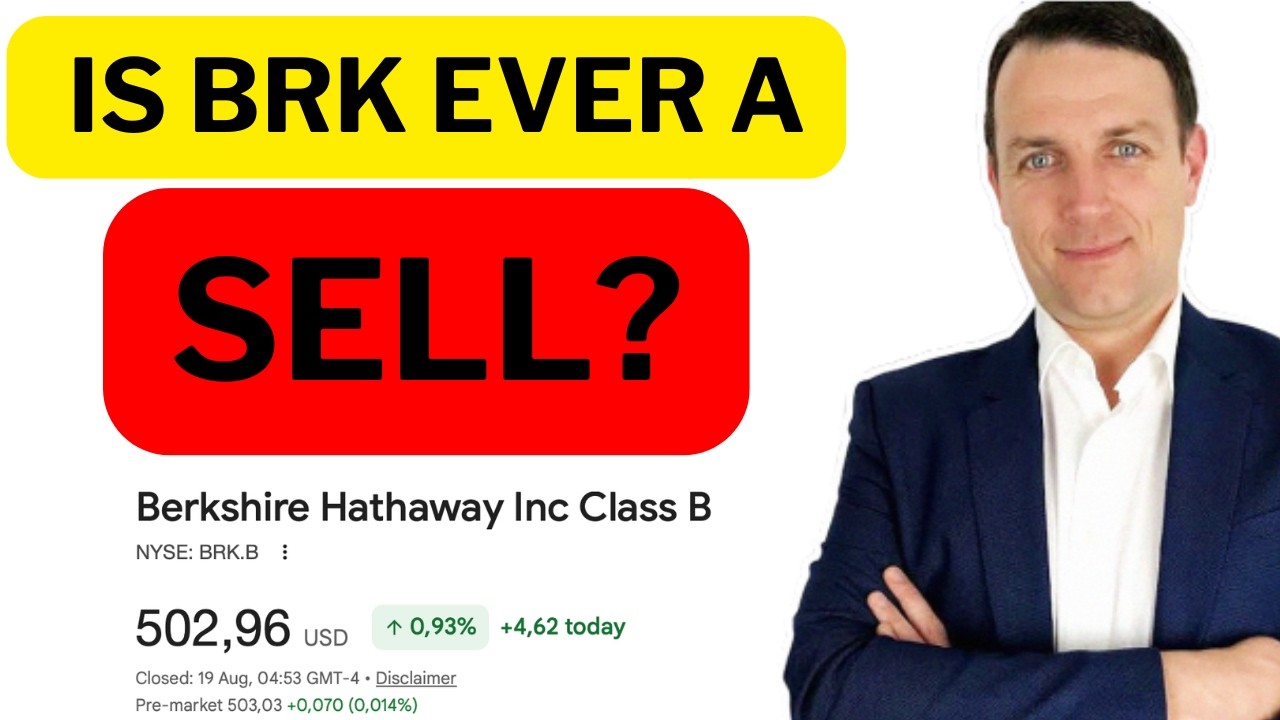
BERKSHIRE A SELL, VALUE INVESTING BLASPHEMY!
Watch on YouTubeVideo summary
The speaker challenges the conventional wisdom among value investors by arguing that selling a position in Berkshire Hathaway would be considered a form of blasphemy, yet he personally concludes that he would sell if he held ten million dollars in it today. He acknowledges that while Berkshire has been an exceptional compounder over the last decade, growing its net income from roughly 25 billion to 46 billion despite no major recessions or crashes, the current valuation leaves little room for future growth. Using intrinsic value calculations with a 10% discount rate, he demonstrates that even under optimistic scenarios with high earnings growth and P/E ratios, the potential returns do not justify the current price level compared to other opportunities available in the market.
The core of his argument rests on the concept of opportunity cost and the distinction between defensive wealth preservation and enterprising investing. He notes that Berkshire's massive cash reserves and safety margin are excellent for protecting capital against a potential crash, but these very qualities mean the stock is already priced in and offers limited upside. He warns that if every investor loves an asset, it is often a bad time to buy, suggesting that the current high price reflects a bubble similar to those seen in 1982 or the recent AI sector. While he admits Berkshire remains one of the best businesses with a long history of success, he believes the future returns will likely be modest, perhaps around 4-5% annually, which is insufficient for an investor seeking double-digit returns who can deploy capital elsewhere.
Ultimately, the speaker frames the decision to hold or sell as a matter of personal investment philosophy rather than a universal truth. He categorizes investors into two groups: those who are defensive and prioritize wealth preservation over decades, for whom Berkshire is an ideal vehicle regardless of short-term price fluctuations, and enterprising investors like Ben Graham who seek active growth opportunities. For the latter group, he argues that holding Berkshire now represents a missed opportunity to invest in assets with higher potential returns. His final conclusion is that while Berkshire will likely not crash and remains a safe haven for capital preservation, its current valuation means it no longer offers the attractive risk-reward profile required for his personal portfolio, making selling a logical choice for those willing to take on more risk for potentially superior gains.
Read the full video transcript
Good day, fellow investors. In this
Berkshire video, I went for blasphemy
because I said, "If I had Berkshire now,
I would sell." For a value investor,
that's blasphemy. And there was a
barrage of comments,
"What will happen next? How will this
work in the future? Berkshire is never a
sell. Berkshire is undervalued, better
than the S&P 500." Even my friend that
has a few millions in Berkshire said,
"Great video, but it made me cry." So,
the key question is, "Would I sell
Berkshire if I had 10 million in it?"
And depends on you, this video will give
you the answer on whether you should
sell Berkshire or not. Definitely not a
buy at these levels, perhaps. And then
see
what kind of investor you are. That's
the key because Berkshire is and will
always be Berkshire with all the
positives. I'm just looking at another
factor that some might overlook in this
moment. By the way, this is the same
friend that I told to sell gold. He sold
it 5,300
or something. So, we are still friends
for this year. When it comes to
investing, my perspective is, "Okay,
what is the true value? What are the
likely investment returns going forward?
And how does that compare to other
things that I own?" Because as Charlie
Munger said, "Investing is about
opportunity costs." And a disclaimer, I
haven't met a bigger fan than Warren
Buffett and Charlie Munger than myself.
My wife can confirm that. Now, let's
discuss Berkshire. People forget that it
is a 4x over the last decade. If I look
at net income, great chart, growing
everything A little bit here the last
7-8 years, ups and downs because of
accounting changes where they have to
account for the changes in the stock
prices. However, if I take the net
income from 2015, which is, let's say,
24-25
billion, something like that. I look at
the net income for 2025, 45 billion as
shown in Greg's letter. 46 divided by
25, 1.84.
10 years, 2015-2025,
6.2%
yearly earnings growth. And keep in
mind, we had no recession, no insurance,
50-100 billion hits, no stock market
crashes, just up, stock market bubble,
Apple, everything up, Coca-Cola's
everything up. So, in that line,
Berkshire has already delivered what it
was supposed to deliver. When I look in
the next 10 years from the current price
level, the situation changes. If we go
to our intrinsic value calculation
table, here you have Berkshire. You can
download this for free in my free value
investing course in the link description
below. Berkshire, here we have the net
income 45 billion. If I attach a 6%
growth rate for the next 10 years per
year, no recession, no nothing, all
great. If I expect a 10% return from my
investment, discount rate of 10%. If I
put a P/E ratio 10 years down the road
of 17,
then my terminal value for Berkshire is
1.3 billion. The current market cap is
1. something billion. Not a great
return. In the most exuberant case,
growth rate 8% of earnings, P ratio of
25, then yes, we are closer to the $1
trillion valuation, but still not there.
Worst case scenario, 5% growth rate in
earnings, investments take time,
insurance hit, P ratio of 12, present
value is 300 300 something billion. So,
in my calculations,
this is not value compared to the
current market cap. And now I already
know you've already commented, "Sven,
you're crazy. The cash, the stock
prices, the value of the holdings,
insurance." Sven, there is a margin of
safety. If Berkshire would liquidate,
that they would get a billion. So, there
is no way Berkshire can deliver such a
bad return over time. Plus, a P ratio of
17, it deserves a P ratio of 25, things
like that. Let's go back to the net
income of 2015.
Since then, we have done 4x, which means
the market capitalization was a quarter
of what it is now. 25 billion tum- times
12 is
300 billion, where Berkshire market cap
was adjusted for buybacks and
everything. So, that's it. Of course,
then I can say Berkshire's net income
doubled. Since then, market cap was 300
billion, now we are at 600 billion.
And yes, at 600 billion, I would say
Berkshire has a margin of safety. And
then you say, "400 billion in cash, 600
billion in margin of safety." Yes, but
something that I have learned from
Buffett, from Munger, from all the great
long-term investors, it's not about what
is now. It is what about might be in the
future. First rule of investing, don't
lose money. Second rule, don't lose
money. Third rule, look for an adequate
return no matter what. That's why
Buffett has been in cash for the last
decade. What does that mean no matter
what? Yes, valuations now after stock
market bubble financial bubble of 44
years that started in 1982. Of course,
everything is priced like crazy.
However, that might change. The stock
portfolio can have easily because it is
overvalued. If you look at the Apples,
the Coca-Colas, the American Expresses,
things like that. Yes, that can happen.
The cash the cash can be deployed into
things at prices when you say that's
crazy. When everyone panics, they will
say that's crazy what Berkshire is
doing. But that's Berkshire. Now,
everyone likes it because the stock is
4X, but Berkshire has been built over
the last 60 years on completely
different principles
that we are looking at now and that you
are liking. Berkshire has been built on
principles just 1% of the population
likes. If everybody likes Berkshire,
I know this is not a good time to buy.
In my
bad case low growth rate, mistakes,
disasters, this and that, P ratio of 12
because the market is crashing, things
like that. I get to terminal value of
800 billion, 20% down is my let's say
worst-case scenario 5-10 years down the
road. Let's do the bull case and here we
have 8% growth rate, high P ratio,
best-case scenario, 2 trillion terminal
multiple extremely exuberant. That's
still just a 7% return from my
investment. Is Berkshire safe as an
investors? Is it one of the best
businesses out there? Absolutely. No
question about it. However,
worst case scenario in 10 years I have
minus 20%. Still better than all these
AI bubble investors, Nvidia's things
like that. Nothing wrong against that.
In 10 years I can have a 2x. Okay, in
the middle likely return 4-5% per year.
My key point is at the moment
Berkshire's aura, as I already
mentioned, safety, cash, value
investing, great compounder. I agree
with all of that.
And I'm also saying it's priced in.
Because what is Warren Buffett's key
investment thesis? Something that's so
ingrained in our
cells that he couldn't do it. He had to
give everything to Abel to change that
now, where he's more of a relative
operating investor than an absolute
value investor. The price is what you
pay, value is what you get. Berkshire
will not deliver a 4x in the next 10
years. Berkshire might also crash in the
next crash, depending on insurance,
financials, things like that, where
everything gets repriced, as we have
seen in 2009. Will have its specific
issues, bad acquisition, mistakes are
made, and things like that. The stock
price can fall. Apple is crazy at a P
ratio 30-40, things like that. And then
the comments again, you own America
minus the fluff. Yes, but you pay a P
ratio of 20-something now. The
historical average was 10 to 20. The 13
P ratio has led to the good returns, not
the 20-something. And here another
comment on another video, but investing
is personal, and that is key when it
comes to Berkshire, too. I just
personally learned that I have to be
very careful to invest when everyone
loves something. And I'm very fine with
the hate. I see it as a compliment. If
there is no hate in the comments on my
channel, I'm not doing a good value
investing job. So, my conclusion for
Berkshire the next 10 years
simply the rewards are good, the safety
is there, great business, you cannot go
wrong, but the upside, the opportunity
cost there, is not enough for me
personally. Is it better than the S&P
500? Absolutely. Now, the question is,
if you had 10 million, Sven, would you
sell Berkshire and let's say have 10
million in another portfolio?
Another great question. And I think that
10 years is too little to think about.
This was a great comment. A person sees
it as a transfer of wealth 10, 20, 30
years down the road, and Berkshire is
one of the few investment vehicles that
offers that certainty. Just the
principles, everything, you know it's
going to be there.
Whether it will be 1.5 trillion or 3
trillion in 20 years, it doesn't matter.
You know you will preserve your wealth.
But that's completely different
investing than being an enterprising
investor, as would Ben Graham say in his
book, the Bible of value investing. So,
enterprising, you sell Berkshire now.
Defensive investor,
you hold forever, you add on the dips,
and that's life. So, it's one of the
safest investments there, especially for
preservation of capital, but it's not a
4X anymore. For me, personally, the
opportunity cost of investing in
Berkshire now at 5% is too big for the
opportunities that I have that are in
the double digits. I don't have the size
of Berkshire. I can understand different
markets, different plays, and that's it.
Looking forward to your comments. I'll
see you in the next video.