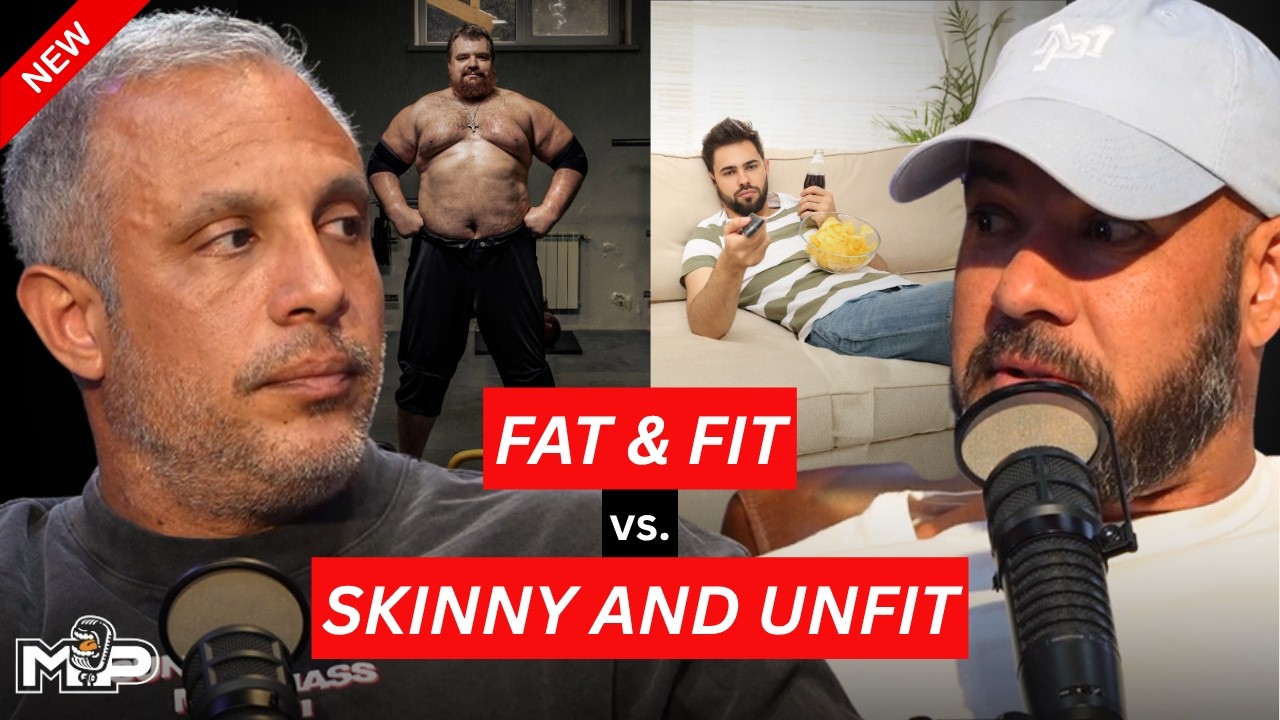
Being Fat and Fit Is Objectively Better Than Being Skinny and Unfit Here's the Data | Mind Pump 2928
Watch on YouTubeVideo summary
The video argues that being fat and fit is objectively superior to being skinny and unfit, with data showing that fitness levels matter more than body weight for longevity and quality of life. While excessive body fat can negatively impact health regardless of activity level, individuals who are heavier but maintain cardiovascular fitness and strength experience better outcomes than those who are underweight and frail. Studies indicate that unfit people in any BMI category face two to three times higher mortality risk compared to their fit counterparts, whereas fit, heavier individuals possess greater metabolic flexibility, insulin sensitivity, and muscle mass that protect against disease and aid recovery from illness or surgery. Conversely, being underweight and unfit is linked to the highest risks of complications and poor surgical outcomes, emphasizing that prioritizing adequate caloric intake and physical activity leads to better health, mood, and social functioning than chasing an underweight appearance.
Beyond physical health, the discussion highlights that fitness drives happiness and confidence rather than aesthetics alone, noting that restricting calories to appear skinny often results in low energy, depression, and increased injury risk. Although extreme leanness is a cultural ideal, data suggests women generally prefer men with more muscle mass, and the pursuit of thinness offers diminishing returns on happiness compared to achieving a fit state. The conversation also touches on industry trends, such as Proctor & Gamble's acquisition of Thorne, which signals major corporations betting on the massive growth of the wellness industry, though hosts caution that mega-acquisitions often fail within five years due to cultural clashes and undisclosed ingredient changes. Additionally, the segment addresses historical parallels where tobacco companies bought food brands in the 1970s and 80s to hedge against legal liabilities, using science to make products addictive before eventually spinning off those divisions due to reputational damage.
The hosts also explore emerging topics like the potential resurgence of smoking driven by nostalgia, contrasting it with strict bans on flavored vapes and toy cigarettes, while discussing AI developments where an experiment implanted a thought into a neural network that led the AI to report introspective awareness. They argue that despite fears about AI manipulation, social media has already eroded trust in digital content, potentially driving people back toward real-world community and human connection. Finally, the video answers viewer questions regarding effective ab training, which requires a mix of full-range flexion and extension, rotational work for obliques, and anti-rotation stability exercises like planks. The advice discourages aggressive cutting in favor of moderate deficits to preserve muscle mass, as regaining lost tissue requires significantly more effort, while noting that lower back stability can be improved with windmills and isometric suitcase carries, and morning workout nutrition should depend on individual tolerance rather than strict rules.
Read the full video transcript
All
right, this might be controversial, but
it's true. You ready? Being fat and fit
is better than being skinny and unfit.
We're going to go through the data.
We're going to break it down. We're
going to explain to you that it's
actually objectively better.
>> Justin's been trying to tell us this for
a long time.
>> Fatties. [laughter] Fatties.
>> So, I think for before we get into the
conversation, we got to preface this
with uh just some clarity, okay? Uh
being over fat. So having a a body fat
percentage that's over a particular
percentage and when you look at the data
for men you start to see this around 20%
for women you might see this around 30%
give or take depending on the person it
does have an effect on your health. Okay
so regardless of your fitness level
having uh excessive body fat beyond a
certain point no matter what will have a
negative effect on your health. So, what
we're not saying is that it's equal.
Everything's equal. It doesn't matter.
But what we are saying is between the
two, just comparing those two.
>> If you're overweight and fit, you're
doing way better in most metrics, if not
all metrics, than someone who is
underweight and unfit. And the reason
why we're talking about this is often
times we chase the underweight, unfit
look because we think that's what's
going to make us uh happier when in fact
the data shows it's not true whatsoever.
Well, that's a a a large range, right,
for for men to be able to go all the way
to 20%, women go all the way to 30%.
That gives you a lot of flexibility. And
so, yeah, I would I mean, in personal
experience, I think I've felt the
healthiest in the mid teens.
>> Yep.
>> You know, where I have the best energy,
the best sleep, the best overall
strength.
>> Also, uh the the most easy to have a
balanced lifestyle, too, as far as I can
have the occasional drink with the wife
at dinner. I don't have to be tracking
and weighing everything. It's a I think
a relatively easy place to kind of
manage and stay. Once you start trying
to get yourself into for a man single
digits, it's uh it becomes a job to to
stay that lean. And then I would argue
that I am not the strongest. I don't
sleep the best. I'm not the healthiest.
About the only thing working for me at
that point is the aesthetic piece. What
you look like?
>> Well, and even that we can even uh
debate. So when you look at the data on
longevity, okay, the category uh of
people, the categories I should say of
people that have the worst longevity uh
metrics, okay, are the very unfit and
very obese and the frail
>> and unfit. In fact, frailty is a higher
risk factor uh in many cases, especially
as you get older. So frailty is defined
as like underweight and weak, right? No
strength, weak. that has some of the
worst mortality metrics that we see. Um,
and so it's important to understand uh
the two of them. Now, with longevity,
when you look at the data, it's pretty
wild because I pulled up some studies. I
pulled up some of the best studies I
could find uh around this. And here's
what they find. Uh being unfit people in
every BMA, BMI category had roughly two
to three times higher risk of all cause
mortality. So, being unfit anywhere
increases your risk of all cause
mortality um uh pretty significantly.
fit, overweight, obese individuals have
risks similar to or in many cases, this
is a meta analysis, better than unfit,
normal weight individuals. So, if you're
a guy and you're walking around 15% body
fat, so decent leanness, you're not
overweight, but you know, you just go to
work, you just go to work, come home,
you're not like working out, you're not
fit. a guy who's 50 pounds heavier.
Okay, so 50 additional pounds of body
fat. Okay, which is a significant
amount,
>> but who's also fit, strong, and has some
cardiovascular uh fitness, has similar
or better uh uh longevity metrics than
you do. Okay. So, that just goes to show
how far being fit goes for people when
it comes to longevity.
>> 50 pounds.
>> Yeah.
>> Is this like our powerlifter kind of
archetype?
>> I wouldn't use that as an example
because
>> still extreme. it. Yes. When you when we
talk about like competitive athletes,
>> we're now sacrificing.
>> I mean, maybe a weekend warrior.
>> Yes. So, what the data is
>> That's probably a better way to say
somebody who is like a competitor
competing kind of like heavy lifter.
>> I'm glad you said that because in the
data, what they're not uh what they're
not showing or what they're not using is
elite performance, right?
>> So, when I say fit, I'm not talking
about like I do triathlons or like I'm
like the strongest guy in my gym type of
deal. you lift and and you're active.
You're active. You work out uh
consistently. You're you're decently fit
in comparison.
>> You're you're I want to go back to the
50 lbs you said. That's relative to what
you say use a 15% uh I'm I'm picturing
my buddy who weighs probably about 170
lbs to 180 lbs and and probably manages
himself between 15 to 18% body fat and
doesn't work out. Yeah.
>> So, he just he doesn't really eat good.
He moves. He has a physical job that he
does. He moves a lot and um you know
doesn't obviously doesn't crazy overeat
and he's got a somewhat active uh
lifestyle but doesn't doesn't exercise,
doesn't strength train.
>> Yeah.
>> His at his body size 170ish
>> 50 more pounds.
>> So uh it's not a perfect um comparison
because if someone if your buddy did
work out and exercise
>> Yeah.
>> Uh he'd also have more muscle on his
frame for
>> sure. Yeah. The muscle really is the
determining factor here for the most
part.
>> Strength. Yeah. Well, it's fitness. So,
I'm glad you said that.
>> Well, I guess that's a So, I guess
that's where I'm trying to get with
this. I'm trying I'm trying
>> I'm giving a number just to kind of
paint a picture.
>> Yeah.
>> But what the data shows is obese. Okay.
So, there's overweight and obese and
then there's extreme obesity. So, we're
not there yet, but overweight/obese
>> Yeah.
>> fit is better uh is the same or better
than normal weight person. So, you're
carrying a lot of body fat, but you're
still also carrying a decent amount of
muscle, which means And you're fit,
>> which means he would have to be at So,
okay, the obese meter tips at what for
men? 25.
>> Yeah. Uh, they don't go by body fat
percentage. They go by BMI, but let's
just say he's at like,
>> let's say he's at 24. Let's say he's at
25. So, let's say he's 15 now. He went
up to 25% body fat.
>> Yeah. Yeah. So, you put
>> But he's But he's athletic now. Now,
he's
>> running. So, so the 50 lbs he probably
puts on
>> uh 20 muscle, 30 fat,
>> maybe. Maybe.
>> So, just to
>> I don't know what body fat percentage
that would put him at, but let's just
say he's 50 lbs heavier on the scale.
>> Yeah.
>> And his body fat percentage went up to
25%.
>> Yeah.
>> But now he can move, he he can run, he
can lift,
>> uh he's he's as good or a lot of the
data shows better
>> than he is now. And I'm going to argue
he's better in other categories. Not
just
>> the number one indicator there or the
the one the the biggest needle mover
there I would think is is the the lean
tissue and what it does for you
metabolically
>> 100%
>> from insulin sensitivity from storage
>> get into it.
>> Yeah. Like that that is I mean
>> one of the one of the best parts of uh
all the years of lifting when I when I
look back now is the metabolic
flexibility that I have today. the
ability to be able to eat out of bounds
a little bit and and literally so I
could have I just had did this last
week. So last week I was I was pretty
low calorie. I could see how depleted I
was. I was dropped like six seven pounds
on the scale. Also the wife always
comments you're looking skinny. I don't
like I'm like relax. I'm just depleted
right now. She says that to worry I'll
eat a sandwich and you'll see a
difference.
>> My wife would never say she knows your
button.
>> Yeah. Yeah. She knows. She knows. So she
knows I've worked through that. So it's
okay. Right. So I always I said honey
I'm not. I said the I'm I'm down a few
pounds, but it's mostly water and
glycogen.
>> Now you're leaving your shirt on. What
do you guys get into?
>> Yeah. Yeah. Yeah. [laughter] My Winnie
the Poo thing. Double shirt. Yeah. You
know, that's how I do that.
>> Turn the lights off.
>> Yeah. Yeah.
>> But I mean, we So, then we go we had
the, you know, we had the the car event
this last weekend. So, we we were at
hotels eating out, had drinks, did a
thing, and I even had I told you we
ordered that uh that movie thing, the
Yeah. Whatever. So, I had desserts. I
had done that in a while. and just I
mean everything filled out and she's
>> and it's not body fat.
>> Oh yeah, it's not body fat. I didn't do
Yeah, I didn't do anything. The next day
she's like, "Oh my god, you look Oh, you
look amaz." She g me I'm like, "Yeah, I
just ate a bunch of calories and filled
out all those muscle buildings." And
what you were looking at or commenting
on 4 days before is what it looks like
when I stay low calorie for a while and
deplete everything. It's just wild that.
And why I'm bringing this up is because
had I not if I didn't have those muscle
bellies, I didn't have that muscle I
worked all that extra eating on a day
like that goes overspills and goes into
storing body fat where the person who's
put on 20 lb of muscle now have these
giant like uh vessels of storage that
the person without those 20 pounds
doesn't have. And to be clear, when you
look again,
>> I know I'm oversimplifying, but trying
to make it
>> but you painted a very clear picture and
and again to be clear when you look at
the data we're look okay lean body mass
is very important but what's more
important is fit lean body mass okay
because when you look at this the the
studies on like mortality risk or
longevity what they're testing is the
output it's strength or it's V2 they're
not looking at you have this much muscle
on your body now having more muscle
often times most of the time translates
to better fitness, better strength,
better mobility,
>> but it has to be active.
>> But it's got to be fit. Yeah.
>> Is what it is. Because you could have
somebody with with just genetically more
muscle but out of shape. Yeah.
>> Totally unfit and they're not going to
get the protective benefits
>> as somebody who has less muscle, let's
say, but it's fit muscle. Yeah.
>> It's active muscle. That's the big
That's the big difference.
>> Right. Right. Because you're because
there's another layer to what I said,
too, where I'm actually going and
putting that muscle to work all week,
which also is expending a lot more than
it would if you do. Yeah. So, it's like
there's you have these these these
larger storage vessels that are also
active storage vessels that need even
more energy cuz you're going to go put
them to work. So, it's like this it's a
double win.
>> This is also why too you hear us
communicate this on especially with so
many callers, our our female callers
that want to lean out or lose body fat
is to build into the body you want
versus trying to cut into the body you
want. Far better off. quality of life is
better because uh you're you know trying
to maintain being underweight
>> uh and also being unfit, we'll just call
it frailty. That's not a very good
quality of life. First of all, you're
first off often time unless you have dis
some kind of uh disease or eating
disorder, which is a whole separate
category, but and a lot of this we could
say maybe tips into this, but there's a
lot of people who simply restrict. Now,
they they might not be clinically
diagnosed as having eating disorder, but
they're they're they're consistently
afraid of gaining weight, so they just
kind of restrict themselves. They don't
really work out much. They like the fact
that they're quote unquote skinny, but
they're frail. Their quality of life is
way worse than the same version of them
who, let's say, has 10% more body fat,
but is also working out fit. That brings
tons of other things like energy and all
that stuff. But also, the flexibility of
like I'm not so afraid of being an extra
vulnerable. I mean I even to like any
kind of like virus or um you know
obviously it's going to affect your
bones to that level where you know other
tissue gets affected because you're not
expressing uh you know that that
resistance against force and so yeah
you're you're kind of leaving yourself
susceptible for all kinds of uh you know
potential injuries and sickness. The
worst category of people uh as defined
by people who have the highest risk of
complications from surgery or chronic
illness are people who are frail.
>> Yep.
>> It's the worst.
>> You're going in to get surgery and
you're frail. Uh-oh.
>> Or you get a major uh you get a big
illness and you're already frail.
>> Recovering is is a nightmare.
>> It's not good. And let's also look let's
look again. This is just just numbers,
you guys. If you look at the the the
percentage of people who get diabetes or
heart disease or cancer who are normal
weight or underweight, okay, because we
know that being overfat independent of
anything else. Now, if you're fit, it
really does a lot for this, but just to
a certain extent being over fat uh is a
risk factor risk factor for diabetes,
heart disease, and cancer. We know this.
And yet there is a significant
percentage, it's not a majority, but
it's a significant percentage to the
tune of tens of millions of people in
America who are this who are normal
weight or underweight who still get
heart disease, cancer, and diabetes.
>> And they're all unfit. All of them.
>> You know, you you keep saying uh
frailty, right? And I think most
people's minds automatically go to like
the old
>> Yeah.
>> old.
>> We got a lot of frail, not old people.
Well, do you so do you remember do you
guys remember the first time you
experienced this? I was only I was like
I want to say I was like 22. So I'm only
like two years into being a personal
trainer. And uh I got this I think she
was a um was she a cheerleader? She was
a cheerleader or a model. Real pretty
real pretty thin real thin pretty girl.
And I'm taking her body, she's hired me
for training and uh I'm taking her body
fat percentage and I thought I was doing
something wrong because of how high her
body fat percentage was
>> cuz she looked very skinny, right? And
and yet I kept I had no muscle
>> and I kept I kept doing it over and over
like you know trying to keep cool like I
knew what I was doing. I'm going like
this isn't look this isn't adding up.
First time I'd ever experienced that
from that direction. And I experienced
the other direction too where somebody
was like super ripped and I thought they
were going to be bigger too. So it's
been I remember both those big extreme
examples of someone like that and and I
remember asking her about her diet and
she ate like
>> celery.
>> Yeah.
>> Like to keep her weight Yeah. She under
all forever to just to keep her her
weight down like that.
>> She was hiring me to help her build some
muscle and stuff,
>> but I couldn't believe how high of a
body fat percentage somebody so skinny
could be. Mhm.
>> And it and it it blew my mind. That was
the first time experienced. I was like
22. I've obviously experienced it other
other times. I've had many
>> and I had so I've told this story a long
time ago if you guys remember this, but
I got to train um
>> what one of the 49ers wives. Uh
>> Oh, yeah.
>> Yeah. Yeah. And he a Samoan guy. And he
has Samoan wife. It was the first time
ever I was so like I've gotten as we all
probably have really good at looking at
someone and being able to put the scale
within probably 5 or 10 pounds. It's a
trainer skill.
>> Yeah. Yeah. And
>> I would crush those circus.
>> Yeah. I'm so good at that. I'm so And
I've gotten really really dial. And I'm
also smart enough to know if I get one
of my female clients on there. If I'm
I'm guessing I'm going to undershoot.
I'm going to undershoot a little bit so
I don't get hit. You know what I'm
saying?
And I'll never forget this girl gets on
here, right? She's a smelling chick. And
I could tell she's, you know, she's
pretty thick, you know? And I'm like,
uh, you know, in my head I'm going,
she's probably
170 or so, but I'm going to start at
like 155, 160. You know what I'm saying?
So I I put the things not moving. I'm
like,
>> slide it over five more.
>> Slide it over some more. She's 201.
Okay. But her body fat percentage is
crazy lean. She's in She's in like the
lower like athletic percentile. And when
she lift her shirt up for me, you're
thinking abs.
>> Yeah. But just a brick house, dude. And
like so wild to see that. But just shows
you how different body types and
different levels of weight like weight
does is so this girl's 200 lb but super
lean but just all muscle.
>> Well, there's also this piece too which
is and how many times we have callers
I'll just illustrate this. How many
times we have callers where we tell them
to increase their cal. First off, it's
often we get a little bit of a self-
selection bias of people that tend to
restrict, right? Because they're fitness
uh enthusiasts. They listen to the show.
They call in for help. All we do is have
them oftentimes bump their calories and
they come back and what do they say?
I've got way more energy.
>> It's transformative.
>> I feel so different. Yeah.
>> Calories, ladies and gentlemen, is
energy.
>> Yeah.
>> If you're not taking in enough, if
you're taking in just enough to survive
because you're constantly restricting
yourself,
>> you don't have extra energy to give you
uh confidence. Yeah.
>> Or creativity to build
>> or libido or energy to do anything else.
You feel crappy. a lot and tired a lot
and maybe depressed or anxious a lot and
it might just be you're not taking in
enough nutrients. Yeah.
>> And we just had a caller earlier, a guy,
>> one of the biggest reasons for plateaus.
>> It is. And we had a guy just on who we
bumped his calories a thousand and he
comes back on. He's like, "Oh my god,
I'm way more energy."
>> Didn't gain a pound on the scale.
>> Didn't gain a pound on the scale. Uh
what did that extra
>> 60 days of a,000 calorie increase?
>> That's right. And if you're not taking
in enough calories and you're tired just
doing your regular day, god forbid you
add exercise on top of that,
>> right?
>> And now you don't get any of the
benefits of exercise, you're not fueling
yourself. And exercise is the most
powerful anti-depressant that we know
of. So being fat and fit gives you more
energy and a better outlook and a better
attitude and a better mood.
>> You're not going to get any of the
benefits of the exercise if you're not
feeding it, giving it the nutrients to
recover. So yeah, it's it's kind of
futile.
>> You also have less pain. Yeah,
>> being frail will make you hurt more.
Period. End of story. Risk of injury
goes through the roof. Your CNS is
constantly trying to protect your joints
because of the instability caused by
your frailty um because you're not
feeding yourself enough. And so you're
moving in ways that aren't optimal and
you wonder why these you get repeated
injuries or tweaks or pain.
>> Uh being fit and strong uh of course
with the proper training
>> means you have way less pain. But that
look is so such a powerful force.
>> I'm glad you brought that up, Justin,
because I looked up the data. How much
does looking beautiful actually
contribute to happiness when you
separate it from uh other factors,
right? Uh because they could say looking
beautiful makes it more likely that
you'll attract somebody who'll want to
date you. So there's relationship value.
there's uh you know when you separate
all that out just looking better uh
versus looking not as good um which
we'll which I'm going to argue anyway
but let's just say that's objectively
true
>> we'll dispel that
>> uh it's actually a low uh contributor to
happiness in other words it barely
budges the numbers so if you're a six
and you spend all your time and energy
to get up to a nine
>> you're going to go up maybe a little bit
>> is it fair though to tease those other
things out
>> it is
>> why
>> it is totally fair
>> why is that fair
>> because If you
>> can you point, let me let me put this.
How much of that, which we're going to
get to, is a result of how you view
yourself versus uh how other people
actually view you. In other words,
>> is your confidence and you going out and
you talking with people and your energy
and the fact that you feel better cuz
you're stronger and the fact that you
have more flexibility with your diet, so
you're going out with people and you're
socializing. How much of that plays a
role in you having friends?
>> Can you measure that projected
confidence?
>> 100%.
>> I mean, that's a fair argument. Yeah,
it's a fair. It's hard to tease that out
though in my opinion just because you
got to if somebody and again playing the
devil's advocate with you because you
got somebody who improves their self
from a six to a nine. Um we know what it
does in sales. We know what it does for
attracting a mate all those other things
which then also make you could make you
happier too. So it's hard to just
completely
let me throw
>> now in a perfect world. Okay. Uh, and
you know, and I think about this as a
father, the number one thing that I
could give my son is confidence. Like I
want to give him self-confidence. Forget
what everybody else thinks. Like be be
confident in who you are
>> and and then be that having that
trickles all the other things, right?
You so I know the value of that, but to
just take away to to to separate someone
going from a six to nine to how that
improves their relationship values with
friends or or relationship with friends
with the opposite sex with all. Let me
throw a wrench at that. What you're
saying, I'm going to throw a wrench at
that machine. Uh, you attract a mate
based on your beauty.
>> Mhm.
>> Are you going to have a good
relationship?
>> If it's just based on your beauty,
that's your number one. This is it.
>> Well, and again, that's not fair to say
that either is to say like it we we all
use our eyes, okay? Those of us that are
not blind to to the first thing, but
when you first saw your wife, you didn't
see her brain. you didn't you saw she
was attractive which made you then
communicate and talk to her which then
led you to all the other beautiful
things about
>> but again I'll add to that the happiest
marriages not to go off on a tangent the
happiest marriages are people in their
60s who have been together for
>> Yeah I don't I don't disagree with that
you build you build your love has grown
you build a relationship but let's be
honest if Jessica was a two you wouldn't
have approached her
>> well so again let me let me add to that
when we talk I mean you would
>> well let me let me let me let me add to
that when we talk about this what we see
what we're
>> really dark I know what [laughter] we
typically
What we typically consider is like
extremes. We think of like extreme
beauty, extreme not good-look. Most
people are somewhere in the middle and
devoting all their time and energy to
try to accomplish what they think looks
good, which results often times in
skinny and unfit does not contribute to
happiness. And when you add everything
else up, contributes to being less
happy. But let's talk about the
objectiveness of the beauty. Let me give
you guys a scenario. A 29% body fat
woman with muscle versus a 20% body fat
woman who is frail
>> all day. Yeah. All day.
>> Which one's more attractive?
>> Yeah. Give me the one that that has
shape to her for sure. And and they do
this with women. When women look at
pictures of men, 10% frail, uh 18, 19,
20% muscle. Women almost always, if not
every time, pick the heavier, fatter guy
who's got some muscle. So, it's also
false. This belief that we have is
false. And people who who restrict
themselves to this skinny, frail kind of
place have this belief that maybe it's
making them look better.
>> No, I I mean I don't I don't disagree
with that. I think that we I think
everyone has not everyone that's an
oversimplification, but I think a lot of
people have a distorted view totally of
their own their own their own body.
>> I also think it creates behaviors within
that parameter. So if I'm like
restricting restricting and then like
you're going to bleed that into your
relationship like the way you're
interacting is going to affect you know
the longevity of that relationship.
>> Yeah. And again just again we'll talk
extremes although 99.9% of people are
not in the extremes who are listening
but we know very we know some very
beautiful people in the fitness space uh
who have lots of followers. They're the
extremes. Nobody looks like them. Okay.
They're they're they're popular because
of how they look and but a lot of them
are very unhealthy.
>> Yeah. miserable
>> and miserable. Yeah.
>> So my my point is I don't think it's
objectively more beautiful. I can make
that argument all day. But even if it
was, it doesn't contribute to what you
think is going to contribute.
>> And I think the the direction of this is
like look like if you're like really
>> I think I think we need a better study
because I think like
>> I think there's also a lot of potential
on the other end.
>> I I think I think it like it moves the I
think I think it's a lot like the wealth
curve.
>> I think like the difference between
poverty and having all your needs met.
Yeah.
>> Is lifechanging.
>> The difference between having all your
needs met and being a millionaire and
then a millionaire to a billionaire
incremental. Hardly anything. And the
the sacrifice, the work, the effort, and
everything to do all those things,
diminishing return.
>> Arguably more miserable because you get
there and it doesn't make you happy. I
think the the uh whatever sexiness
curve, whatever you want to call it,
>> is similar to that. It's like going from
completely out of shape, not taking care
of yourself, ugly, we'll say, to like
relatively attractive. Like you're like
how about you just say how about you
just say fit and healthy.
>> Okay. Fit and healthy.
>> That's right.
>> Right. So that say relatively
attractive. Okay.
>> Because that's that's a result of being
fit and healthy.
>> Right. So so that versus you getting
cosmetic surgery getting shredded to 9%
like
>> I so if any return very incremental
arguably probably negative return from I
think it it probably follows something
like that.
>> And again here's the point like and I'll
ask you guys this question. If you could
snap your fingers and make one of these
things true, which one do you think
would make uh America or the world
healthier, uh make everybody uh keep
everybody at a relatively higher body
fat percentage but really fit or just
get everybody skinny?
>> Get rid of seed oils. [laughter]
>> The world. [laughter] So anyway, do
anything. And I guess the the the at the
end of this is this, like if you worked
out and you ate
>> to become more fit and healthy, you'd be
way happier and you'd get better
results. And the side effect would be
you'd actually look better anyway.
>> Yeah.
>> If you just focus on those things. And
that's why I open this with the
controversial being fat and fit better.
>> I like it. I like that it's
controversial. But uh
>> of course you like it. [laughter]
>> That's my wheelhouse, you guys.
Be happy. Eat food, you know.
>> Yeah. [laughter] Enjoy yourself. Jeez.
>> Anyway, I got Speaking of workouts.
>> Did [snorts] you guys watch the video
Adam sent of I think it's Hotti Chup
Chopan. Am I saying his name right?
>> Oh god.
>> Did you guys see that?
>> What?
>> You know what I didn't do was I didn't
do the math. Did you do the math? I
didn't
>> How many 25 pound was it 25 pound
plates?
>> Yeah. 25.
>> You didn't see that?
>> Go in our group text.
>> Yeah.
>> And pull up.
>> You saw it, right?
>> I did see it. Yes. I came across it and
you know it it I it hooked me because I
was just I'm
>> it's in my opinion there's a few times
in bodybuilding history when a
bodybuilder did something that's
legendary in the gym that everybody
talks about like one of them was
>> Tom Platt squatting 135 for 30 minutes
straight.
>> Oh my god.
>> That was one or when he did 315 for like
50 reps. It was like a couple where Tom
Platt did something insane.
>> This goes up there.
>> Quadzilla.
>> Look. Okay. Look.
>> Give me the number. How many plates are
there?
>> So there's a 25. Then they add a 25.
>> Keep count them up. I never counted them
up.
>> Three.
>> They're just adding 45s.
>> Bro, he does. He does.
>> 35s or 25s? What are those?
>> 25.
>> 25s. What?
>> So they keep adding 25. How many he
does? I don't know. We're going to have
to
>> Doug, can you count the plates?
>> Looks like eight or nine right now.
>> Dude, what kind of bar is that?
>> So now Oh, it gets better. Ready?
>> Bro, he does this two or three times.
>> So
>> non-stop.
>> Nonstop.
>> What? So, what he's doing for people who
are not watching this uh on YouTube
>> and they're peeling it off.
>> This is a bodybuilder.
>> So, he does it like two or three times
down the ladder.
>> He didn't stop. He goes back up again.
>> He does squats. He's got a bar. It's a
Smith machine. They're adding How many
total 25s they go to?
>> Uh 20. There's 20 total plates. The
Smith machine. So, up to 500 lb.
>> So, he's doing one rep with 125. Another
rep with an additional. So, he goes all
the way up to 10 plates on each side.
Then they take one off and he does a rep
with each one all the way down. Then
they add them and he goes all the way
up. Then they take them off and he goes
all the way down. He does like two or
three rounds of a rep.
>> So much cooler if it was a real squat.
>> This
can't pyramid that, bro. You [laughter]
can't pyramid that, bro. Not just talk
crap about what he's doing.
>> No, you cannot [laughter] talk crap
about that. You cannot talk crap about
that.
>> This is the This is This is definitely
legendary.
>> Yeah. I don't think I could do that with
two and a halfs. I mean, [laughter] I'm
dead serious. If you put two and a halfs
all the way up on each side like that
many that many body weightight squats we
get most
>> I'm not alone in this.
>> That is uh it's crazy.
>> That's crazy.
>> I wanted to I So I didn't
>> I mean the Yeah, his legs explode.
That's just crazy. It's a feet of
strength that is just
>> Doug, you're the one with all the the
tools over [laughter] there. What is the
What is the math on that real quick? So
you said 10 on each side 11 on each
side.
>> 10 on that's 500 lb.
>> So wow. So he's working up to 500 lb
down to 100. So it goes from 100 to 50.
So all the way to 500 and then down in
increments of you know how insane that
is.
>> He starts at a it's essentially he
starts at almost 100, goes incrementally
up to 500, incrementally down to 100,
incrementally up to 500 several times
and does a rep each each each time along
the way. Insane a lot.
>> That is crazy.
>> Yeah.
>> Have you got what's what would you Okay,
I got to ask you guys this.
>> Tell me the most legendary thing you've
ever done.
>> I haven't done anything legendary this.
Nothing cool.
>> Well, I know Justin has. You're right. I
know you haven't. Let's ask Justin.
[laughter]
>> [ __ ] you. I don't want to brag, dude.
I've done some pretty cool tea bar roast
stuff. [laughter]
I took my shirt off. I've done some cool
tea bar roast.
>> I took my shirt off and some girl said
something.
>> Oh, stop it.
>> All right. Look, Justin, you've done
some for sure. I have one for myself,
but I got to hear yours first because I
won't say mine if yours is just so
crazy.
>> Well, I don't know. I don't even know
what I would attribute to that other
than like the PRs like I've done back in
the day.
>> No, I've I've leg pressed all the way up
and down.
>> You've done that?
>> Yeah. Yeah, we've all the way to filled
the plates up before and come down.
That's brutal. Uh I've done a tea bar
row. I think I got up to five plates and
then worked my all the way down like
that. That's pretty brutal.
>> Um those are the like the coolest feats
I have.
>> I did There's one thing I did once that
I felt for three weeks. I felt it for
three weeks. Okay.
>> I did 315 for deadlifts. I did 10 reps.
10 sets, one minute rest in between.
>> So I do 10 timer one minute 10 timer one
minute 10 sets
>> of
>> 315 10 reps.
>> Oh my god.
>> I
>> I've done that.
>> I was fried.
>> I've done that with 135 and been fried.
>> Oh yeah.
>> So one of my I think I I talked about
this on the podcast a long time ago.
When I when I have a layoff and I come
back to 135 squats and I literally just
do 10 sets would just just short and I I
do 10 reps 10 reps of 10 and I would do
it for that that would be my entire
workout. Yeah, it sounds worse than what
I
>> did 30 agonies. How about that?
>> What's that?
>> It's uh this hill that's like this
incline.
>> Uhhuh.
>> Uh and you sprint and it's like probably
like 40 yards.
>> Are you 30?
>> 30.
>> Oh, that's light.
>> That [ __ ] you. You can't [laughter]
do that.
>> So you went running
>> sprinting. It's not running.
>> Okay. Yeah. Okay. I once I once dove
down with like seven life fests on me
down into the bottom of a No, you
didn't. Yeah. Yeah. Yeah. We used to do
this.
>> Wait, wait, wait. You put seven life.
>> Have you ever done that with So, we used
to we used to have uh I've told you this
before. We had to where we where we go
camping every year. Remember that? I
used to talk about the Trinity trip we
do. Okay. So, we have we always had a
like Trinity um games
>> and we make up all these ridiculous
games like there and they were all
ridiculous. rock can, there was radio,
there was like all these like and one of
them was, you know, life fest diving and
you and of course we have all these
buddy friends that are out there. So we
all have boats. So there's, you know, we
had as many life fest as you could
possibly want. And right off the pier is
about, you know, 10 ft of water to the
bottom and you have to put a life vest
on and then dive down and grab
>> a handful of mud and grass to prove that
you went all the way down the ground and
you start with one life vest and two
life vest and and so you did seven.
>> Yeah. So the guy who had the most and so
if you can imagine I have all these life
vests on me [laughter] diving down to
the bottom to shoot you back up. And so
that was like a
>> well I did something for me that I'm
going to say right now you guys are
going to laugh at cuz it's not that
impressive. But it was for me.
>> Yeah.
>> I was like 16 and I had my BMX bike and
uh my old
>> junior high had a stage that was about
from the ground to the stage if you're
not going up the stairs was about 7 ft
maybe.
>> Bunny hop it.
>> I I jumped off the stage onto the grass
and hurt myself.
>> Oh wow.
>> But I did do it. But [laughter] I
didn't. I was like, "Oh, that doesn't
feel good." Roll my bike up. What about
you, Doug? You're awfully quiet over
there, huh?
>> I am quiet because I have absolutely
nothing to contribute here.
>> Well, you killed someone beside Besides
that.
>> Well, don't put that out there.
[laughter]
>> Not true. People heads,
>> which is a lot of work, you know,
[laughter]
>> I've been a pretty I guess sedate type
of a lifestyle.
>> Well, you deadlifted
405.
>> His deadlift. Yeah. His body weight to
to deadlift ratio is probably better
than any of ours.
>> I was 153 at the time. I
>> 400 lb deadlift. Four four or five
deadlift.
>> Yeah, that's better than So my peak was
550 and I was 200 something pounds. So
he's better than me on that.
>> I'll throw this in there. So uh
>> I knew he had more.
>> Yeah.
>> When I was at San Jose State, I I was on
the rugby team for a minute.
>> Um and it was the very first practice I
ever went to. I had no idea how to
tackle. So I would just, you know,
assumed I was going to tackle with the
same technique for football. just
blasted
>> and uh they put me against the biggest
guy. He was probably like 300 lb.
>> And uh they had this one drill and it's
exactly like what you guys see now from
Run It, you know that you smash into
each other.
>> You you run full sprint at each other.
He had the football and I was the
tackler and he thought for this is going
to be easy, you know, and like he was
just going to run me over and everybody
was around hyping it up and everything.
And I literally took his cleats off the
ground and put them on his back.
>> Oh wow.
>> And I hurt my shoulder so bad.
>> Yeah.
>> Do you tell your boy stories?
>> Huh?
>> Do you tell your boy these stories?
>> No. You don't?
>> What?
>> Well, I don't I mean a dad. That's a dad
story.
>> I feel like that is too. Yeah, but I
feel like I would. So, if I had that
story, [laughter]
>> you know how many stories
>> I tell Max I tell Max stories at night.
Like you ever had I would tell that
story and then Max would ask real like
that was your dad.
>> That's your lord.
>> Your dad who did that?
>> That's your family lord. Yeah. It wasn't
like captured like the ones that like I
have video. I'll show him that. Like
I'll you know I feel like I got to tell
his story for [laughter] you know what
I'm going to sit your boys down and tell
more.
>> Let me tell you about your dad.
>> Dude, he's already telling my kids like
how much stronger he was [laughter]
>> than me. Like I was like I that was one
of the best like I got him so [laughter]
good when we were that was in Truckucky.
>> Yeah. Truckucky.
>> Can Adam really outlift you?
>> I forgot what we were [laughter]
your boy. It was Everett when he was
little. God, he must have been Max's age
at that time.
>> Infected him with that.
>> Yeah, for sure. [laughter] Cuz his his
son was like, "Get me get me." So that I
forgot. I said something like, "Oh,
careful. I'll manhandle you like your
dad or like I do your dad or something
like that." I can't remember what I said
to him. I said something like that on
Adam's like super strong [laughter]
like.
>> We My dad always told me stories about
himself growing up, which was cool when
I went to Sicily cuz other people told
me the same stories could kind of
confirmed it. And then I tell my kids
stories about me. uh all the time cuz
it's just fun. It's just fun to to tell
the stories. Although you create a
situation where your kids think, which
is normal, right? Your kids think you're
like the toughest guy in the world.
Although my wife thinks that. I tell you
guys about this.
>> She's trying to get you fights.
[laughter]
>> She thinks we were hanging out.
>> We We were hanging out.
>> Every time when you tell that when you
tell that story, it makes I think of the
way of the gun. That opening scene. No,
I didn't know that.
>> This is where the Come on.
>> You've shown it to us before.
>> Yes, I've shown it to you before. It's
one of the best opening scenes ever.
It's the It's the the girlfriend. The
guy's got like hair.
>> Like man can't jump. It's the same lady,
right? Same.
>> Is Oh, I think it is. That it might be
her. I'm not sure. But yeah, Benio Del
Toro is is leaning on the car with his
buddy and they're talking.
>> No, I was talking to my wife and I'm and
she's like, "Are you we were talking
about jiu-jitsu and I said, "Yeah, man.
I got but I won't compete in the normal
category cuz I'll be going against a
bunch of 20 year old dudes." And she's
like, "Well, isn't that better?" I'm
like, "What? No." She's like, "But
you're like a grown man. Like, can't you
beat him up?" Like, no, babe. Like,
they're 20-year-old [laughter] dudes.
And then we were talking about
>> 25-y old dudes are pretty grown men,
too.
>> And then we were talking about like a
like somebody we know who's a black belt
in jiu-jitsu, right? And we're about
same size. And she's like,
>> "Uh, but you can beat him, right?" I'm
like, "No, honey. He's a black belt.
He'll kick my butt." And she's like,
"No, we can't." I'm like, "You must
think I'm like," which is kind of cool.
My wife said the toughest world
all three of you, including you over
there, buddy. Uh what if you could go
back to an an age where you thought you
were peak alpha of you like like
strength?
>> Oh, it's like physical alpha.
>> Physical alpha cuz I'm way more.
>> Yeah. Yeah, of course. Now like but I
mean like what what what age were you
you think when you were like
>> peak don't [ __ ] with s?
>> Uh
>> 20 for me.
>> I would say
>> 20.
>> Dang.
>> Oh dang. That definitely not me.
>> No, not me.
>> Yeah, not me.
>> Mine was like a late bloomer.
>> Mine was late 20. I'm like 28. Yeah.
>> Yeah. I'm like 289 peak like all of it.
>> 20?
>> No. No. No. That's That's young.
>> Oh, yeah. Wow. I was a force of nature
back then. Yeah.
>> Wow. [laughter]
>> There you go. No. No longer humble.
[laughter]
>> I lost it, dude. It was only
>> crazy decline after that.
>> What about you?
>> Probably 48.
>> Cuz you can't remember all the way back
20.
[laughter]
>> I I sometimes go back to the stone
tablets just to remember. Hey, really?
48?
>> No, I'm just kidding. I mean, you know,
like when I was in 25 or something like
that.
>> What' you say?
>> 25.
>> 25. 25.
>> Are you just throwing a random number
out there? I feel like you just picked
something between me and
>> S I think 25 was like, you know, a peak
like, you know,
>> period for me.
>> That's when he wrestled a Stegosaurus.
>> Yeah, [laughter]
>> dude. That was peak anger for me. That's
why I can attribute it to that cuz then
I chilled out after that and then I
didn't Yeah. It wasn't like cuz dude
anger on top of crazy physical, you
know, ability. It was a bad combo.
>> Yeah. Well, I was just I was just going
to say I was like, if I ever anything
ever happens and my wife is there and
I'm in an altercation, do not let me
lose at all. [laughter] I don't care how
unfair it is. You jump in as fast as
possible. If you start to see your boy
step butt kick,
>> I don't want to crush her. I would even
wait.
>> I don't want my wife. I just I'd want
her to still think like he he could have
taken advant [laughter]
totally and she was like he would have
beat him. You know, Adam, he can't
control himself. [laughter]
>> Afterwards, I'll take you out to let
Bro, I was so tired. Oh my god, I
thought I was going to die. Thanks for
Thanks for jumping in, dude.
>> I saw the look, dude. I saw the look.
>> Yeah. Hey, help me out, [laughter] dude.
>> Yeah. Anyway, I got to tell you, sorry,
I'm going to change subject. So, um I've
been recommending so I have uh my group
of friends uh the number one supplement
people ask me about is creatine because
it's like
>> I think it's every
>> now it's out there. It's everywhere.
>> Even my non-workout friends ask about
>> everybody you know the studies on you
know all the data now on how how it
affects depression, anxiety, health,
longevity, not just muscle. And I have a
few friends who have said the same
thing. This is like a It's not super
common, but if there's any complaint
about creatine, it's always this one.
It's always this one. And it has to do
with uh digestion that it affects me my
gastro system. Either it makes my
stomach feel bloated or it just doesn't
sit well with me. And so I have three
friends and I said, "Okay, how much are
you taking? Number one, are you taking
like a big ass dose?" They're like, "No,
five grams at a time. Okay, try row uh
creatine. Try their liposomal creatine.
Let me know what happens." Every single
person comes back says no gastro issues.
Yeah. Whatsoever.
>> I'm going to try doing that when I push
the higher doses because I haven't
experienced that until I started eating
those gummies like out of control. And
then I do I do feel the I do feel
>> I can't do more than like seven grams at
a time. It'll mess me up. But the row
>> it's it's because it's liposal. It
doesn't affect my gut.
>> Oh, interesting. Yes.
>> I have to try to make a difference.
>> Yeah. And it's good because again
there's there's a small percentage of
people who don't get the benefits. They
just stay away from creating. Is it that
experience?
>> Yeah. You get the stomach cramps. That
was always my experience.
>> Try Row. Try Row.
>> All their products are liposomaal,
right?
>> All their products are lipos.
>> I didn't realize how big their product
line was.
>> Huge. I know Doug pulled it up not that
long ago and I didn't realize how many
things that they have that we take
>> and that, you know, liposomaal
technology is a pharmaceutical
technology. A lot of people don't know
that, but this was pharma companies were
studying ways to make things more
bioavailable and it's a very effective
way of doing so. So you just you
encapsulate the compound in a in a fat
>> which protects it and brings it to where
it needs to. But yeah, they have a lot
of stuff.
>> Oh yeah, they have a lot of stuff.
>> Hey, uh you you bringing up supplements.
Um what do you guys think about the
Proctor and Gamble move?
>> They bought Thorn. Oh, they bought
Thorn.
>> Thorne is a pretty wellrespected brand.
>> Yeah.
>> For like medical practitioners,
supplement like functional medicine
practitioners.
>> How do I feel about it?
>> Yeah. Is it is it going to tain it at
all?
>> You know,
>> no. I think it's I think it's just an
interesting move that you have a massive
billiond dollar company like that.
>> There's a lot of distrust that's not
that's not normal uh for a company like
that to pick up a a supplement
supplement companies their margins the
even a company like like Thorne. I mean
>> yeah like a pharma company typically.
>> Yeah. This is that's a that's a that's a
different uh purchase for a company like
that.
>> You know why I think I'm going to
speculate
you have an idea?
>> Yeah. Yeah. I want to hear what you
think. So the wellness and longevity
industry is growing so fast.
>> So that's that this is my point of
bringing it up.
>> It's the most reputable. Yeah.
>> Is I think that that's we are moving
into that time right now where like I
mean we're we've been talking about this
right now with the the gym space and
it's like
>> it's it's it's a really it's a cool time
to be in the health and wellness space.
Like when you think of
>> it's going to grow in the next five
years tremendously.
>> I think so too.
>> No, they're showing it.
>> Yeah. It's the and I think this is more
signs of that. When you start seeing a
company like Proctor and Gamble
>> get it buy out a supplement company like
that, they're betting on that space
continuing to grow for the next 5 to 10
years. And all they're doing is
>> I forgot what the data it was something
like it's 800 something billion now and
by [clears throat] 2030 they predicted
predict it to be like 1.6 trillion.
>> So that's like double
>> Yeah.
>> of the current in five years. Five or 10
years or something like that which is
insane growth.
>> Yeah.
>> Insane growth. So, to me, it makes sense
that a pharma company would uh hedge
their bets that way. I got the pharma
stuff and let's go longevity health.
>> Yeah, I'm super interested to see if we
see more of this follow. Like, are we
going to see more companies uh other big
companies like this buying up other big
supplement brands um right now because
of betting on the long game like that,
>> but I thought that was interesting.
>> I I Yeah, I'm not a huge
>> I think the next thing you're going to
see is you're going to start to see
brands like Coca-Cola
>> or and this that's why
>> is it Proctor and Gamble that's buying
them?
>> Proctor and Gamble. Oh, they're not
they're they have more they have other
consumer goods.
>> Yeah. Dish soap and things like that.
Yeah. They have all kinds of stuff.
>> Yeah. Yeah. Yeah. Yeah.
>> Yeah.
>> Okay.
>> That's that's that's I mean it's it's
like Coke buying it. That's what it's
more like that.
>> Yeah. Yeah. Yeah.
>> So that's why I thought pharma. You're
right.
>> Um that's why I think it's more
interesting. It's like you have you have
a a mega billion dollar company that's
into things like that. So, what I've
seen so far when a mega company like uh
General Mills or whatever buys a health
food company is they very quietly change
the ingredients.
>> Yeah.
>> Every time.
>> Oh, yeah.
>> Every time.
>> Oh, yeah. They Yeah.
>> They're switching out an oil. They're
putting in a new ingredient. They don't
tell the consumer. Consumer has no idea
until you check the ingredients. You're
like, "Wait a minute. Soybean oil or
hold on a second. There's uh aspartame
now or whatever." Do you know how often
acquisitions are uh are successful?
>> It's like what 30% of the time.
>> It's really low. Look at Google. It's a
It's a really It's like 15%. It's like
crazy low considering how much within 5
years I think is what the the the
>> culture just doesn't really translate.
>> It just it's uh you you always hear
about these big acquisitions and mergers
and stuff like that and the success rate
is actually terrible.
>> You know,
>> you would think you would think it would
be far greater than what it is.
>> You know which ones were was were
successful? uh
>> 70 to 90%
>> fail.
>> Isn't that wild? Within the first five
years too, I think pretty damn wild.
>> Now, do you know some of the biggest
mergers and acquisitions that happened
in in American history uh which turned
out to be very good were was when the
tobacco industry
>> uh bought food companies.
>> Food company. Yeah.
>> In the 1970s, those are some of
>> the technology that uh really enhanced
>> addictive. Does Philip Does Philip
Morris own a bunch of food companies
still
>> in the Doug? Look up um uh tobacco
companies buying food companies 1970s so
we can read up a little bit.
>> Is it still like that though?
>> Do they still own it? That's a good
question.
>> And and what makes you say that it was
so it was so uh
>> crushed all the companies crushed.
>> Well, what happened sometimes is they
unwind too though. So
>> So RG Okay, here scroll down. RG
Reynolds uh expanded. So they bought
Nabiscoco, Hawaiian Punch, Philip
Morris, entered alcohol and beverage
and then in 1980s they bought General
Foods and Craft and Seven Up.
>> Do they still own them?
>> Does does Philip Moore still own General
Foods and Craft?
>> Yeah. Can you see? Do they still own
>> Yeah.
>> Yeah. Let's see what that says. So now
the By the way, this is well known. The
reason why they did this is because the
news on how bad smoking was for you was
getting big. And so tobacco companies
are like
>> pivot.
>> Oh, they don't anymore. They sold them.
>> Huh.
>> Cool. So these tobacco companies were
hitting were getting regulated and were
getting a lot of bad pub. And so they
had to hedge their bets and so they
bought food companies. And then what
they did, this is very interesting, is
they used their science on making things
addictive. Took their scientists and and
said, "Hey, let's figure out how to make
food
>> as palatable. I sell in 2000."
>> And they definitely did. It says that it
says that they sold in 2000 for 15
billion.
>> Niscoco subsequently sold to Philip Mor
Oh, sold to uh Philip Morris in 20.
>> So Philip Morris still owns so merge. Uh
>> no no no no group.
>> Yeah. Philip Morris renamed its parent
umbrella the Altria Group. In March
2007, uh they officially spun off Craft
Foods, distributing all remaining shares
and completely exiting the food
industry. Okay.
>> Huh.
>> Yeah. All right.
>> So why but why though? Right. What? Why
would you uh acquire them for 15
billion, turn around and then and then
spit them off and get get out of it in '
07? I wonder what the I wonder if so
much bad pub came from that. I wonder if
that got around that like Philip Morris
owns this.
>> I know they made money off them,
>> which I would think that would be the
reason to to get it to spin it off into
something else. Change name.
>> The tobacco companies sold off their
food empires primarily because the legal
liabilities of the cigarette business
were threatening to drag down the
financial value. Okay,
>> that's what I'm saying. Is that because
it's it's got a bad rap.
>> So like you you know you're you and your
family are going to get craft cheese and
you're like oh these are the people that
make give people cancer. We not going to
buy [laughter] their [ __ ]
>> No serious cheese.
>> You can't you can't help people uh
making that correlation right. Or
>> connection happened to me dude.
>> Wow. Yeah. Yeah. Pretty it's interesting
stuff. And uh the science that goes into
making food addictive is some of the
most in-depth crazy insane science
>> you've ever seen uh in your entire life.
arguably better than the I mean the
tobacco only has is a onetrick pony.
>> Well, actually they're limited. That's
what I mean. They're they're limited
because you can't flavor them. They put
all these laws.
>> Yeah. Yeah. So, it's a one-trick pony.
It's
>> I think they ban even menthol
cigarettes.
>> I think they even ban those. Are they?
>> Yeah, I think so.
>> No,
>> I think they banned them. I don't know.
>> Maybe in some states because
>> I didn't know that.
>> Because they're flavored.
>> Well, I know they did that with all the
the vapes. They changed it like you
can't you can't get the fl where you're
not supposed to. I'm sure you can still.
>> Meanwhile, my son bought
>> No banan. No banan.
>> Not in the federal, but there are some
states that ban
>> one of those like um uh you know like
toy cigarettes. Like they still like
sell It's so funny to me that there's
like bubble gum cigarettes and all this,
but they have one that like you blow
bubbles out of [laughter] and it's like
you're smoking cigarettes, but it's like
bubbles.
>> When we were kids, the the ice cream man
would sell fake cigarettes to kids,
candies,
>> so you could practice smoking when
you're five.
>> Yeah. Hook them young. You know, it's in
a big league chew, you know. Yeah. Oh
yeah. Oh, have some chewing tobacco.
That's or pretentious.
>> That still exists though, right? You can
still get some big le chew. Yeah. Yeah,
that still exists.
>> But I I think they separate themselves
from the fact that it looks like tobacco
>> tobacco greeny.
>> Yeah. So I know tobacco.
>> Oh, you don't think that it's still all
stringy like that?
>> I think it is, but I don't think they
advertise it like they did in the ' 80s.
Remember in the ' 80s you'd see like b
like the commercial like baseball
players would like chew. I want to be
like him.
>> Here you go, friend.
>> You know what I realized watching a lot
of our cartoons and movies and TV shows
growing up? So many cigar smokers. Yeah.
>> The cool guys always have a cigar.
>> Yeah. You know,
>> I [snorts] think that the cigarettes are
starting to make a comeback. Do you guys
know that?
>> I think I wouldn't be surprised.
>> I think they're starting to make a bit
of a comeback. Old school
>> cigarettes because of the nostalgia.
>> You got to rebel somehow. Yeah.
>> I don't know. Look at the look at the
trend on a downward trajectory for a
long time.
>> I know.
>> All I know is is that cigarette
whiskey drinking will build last couple
times that I've been in the [laughter]
Oh, wow. Culture and aesthetic comeback.
Pop culture, fashion. I like hear that,
Doug.
>> Yeah, I see that.
>> Started smoking.
>> Doug never smoked.
>> You never did you ever have you ever
tried a cigarette?
>> Oh, of course I've tried it.
>> Okay. But you never like smoked.
>> I was never a smoker.
>> You went to Burning Man. He tried all
kinds of headache. No thanks.
>> Twice.
>> Did you ever Did you ever smoke, Justin,
or just chew? I bet you chew.
>> No. No. I tried both and it just I No,
it didn't resonate with me at all. I had
to get like bad reaction to it. that the
funniest thing one of the when I think
about it makes me laugh.
>> I do cigars
>> just it just makes me laugh when I think
about it. So people get mad. You're
gonna bring it up anyway. I think this
direction you're going that you were a
grown like you're a fitness manager.
[laughter]
>> I was not going to bring that up.
>> You smoke that was not my that was not
my point of [laughter]
>> No, I was not going to bring that up.
Yeah. I had my my roommate my my
roommate at the time was uh you know
what it was is got me started on like a
occasional thing and occasional thing
turn into like a night coming home at
night doing it. What the funniest part
for me about it was how much I I hated
the smell of it
>> that I'd have to go wash my hands right
afterwards. Like I I could admit to the
the the head change thing that I liked
from it,
>> but I I could not stand smelling it. And
so it would be like I'd smoke it, go
scrub scrub my hands like crazy, you
know, which later on realized that, you
know, back in like the 50s and 60s where
the the girls had the long like
[laughter] this had to be where that
come from, right?
>> Going to touch it.
>> Yes.
>> Oh, yeah.
>> Cuz that's cuz it would make your hands.
So that was why I hated it was like if I
had one, my hands would smell like it
and just that disgusting.
>> My great-grandfather rolled he rolled
his own. Okay. He started smoking at 10.
So remember my great-grandfather in
Sicily. So 10 he started smoking. He
chains smoked in the sense that as soon
as he woke up he'd smoke and when one
was going out he'd light the other one
with it.
>> Yeah.
>> So constantly smoking. He lit his sheets
on fire a couple times.
>> Oh my god. He'd fall asleep in bed with
a cigarette in his mouth.
>> It's still in his mouth.
>> He died when he was like 94.
>> Wow.
>> What's the What is the statistics? Cuz
I'm curious. Did any of your parents
smoke? What's the statistics on if your
parents smoke, you smoke? It's pretty
high, isn't it?
>> Uh yeah, I think it's higher. You have a
higher odds.
>> Did you Did your parents smoke?
>> Mm-
>> Did yours?
>> No. No. years. Oh. So,
>> but when I was a kid, yeah, when I was a
kid,
>> my grandma, my grandma used to just
smoke a pack, dude, and pack a pack a
day.
>> She'd sit there. She'd sit next to her
little and she lived in a condo when I
live with her
>> and she'd sit with her little her chair
next to the slider and just we'd watch
Lifetime videos together and just you
watch Lifetime. [laughter]
>> My when I went to Sicily at 12, uh I was
just I couldn't believe how much
everybody smoked everywhere. Inside the
house, inside the car, didn't matter.
>> I went to a gym. I'm not making this up.
This is true. There was ashtrays on the
treadmills. [laughter]
>> On the treadmills.
>> On the treadmills. I had a That's wild.
>> Yeah. So, I'm like, this is kind of
>> children who pick up who smoke are
generally two or four times more likely
to take up smoking themselves compared
to those non-smoking parents.
>> Teens with a caregiver dependent on
nicotine have about a 38% chance of
having tried smoking compared to 13% uh
for non-smokers. Yeah. Well, there you
go. Well, earlier we were talking about
uh food and how delicious it was and
whatever. And I'm going to mention Chris
Power in that conversation
>> because we've used we've wielded the
power for some good.
>> Yeah. Well, [laughter] I was going to do
I tell you
>> the power of science to some
>> I am I am 100% for high protein putting
a lot of protein in snacks
>> because I there's a society effect from
protein.
>> That's a fact. Independent of anything
else. It's a society effect. And at
least people are getting protein.
>> Yeah. So, you know,
>> it is it is wild uh how the how the
society works on those.
>> So, I I I So, they now sell the big
bags.
>> I actually prefer the small bags.
>> I can't get through the big ones.
>> Yeah, I definitely can't eat the whole
one, but like I thought I' I would want
like a bigger bag because one two of
those bags is more
>> What is it? 28 g of protein.
>> Is more than enough like a like a like a
normal
>> which is so wild because you could give
me a a bag of like regular chips.
>> Well, they did two things that that hit
you with satiety. It's high in protein.
28 grams in Italian fiber. So protein
produces the most satiety. Second place
is fiber.
>> Yep.
>> And they taste, by the way, for if you
haven't tried Chris Power, you're
listening, they [clears throat] taste
like pretzels,
>> like flavored pretzels, like nacho
pretzels or whatever.
>> But high protein, high fiber.
>> I don't I don't think I've ever had a a
bag of something that's only this big
and been satisfied after it's over. I'm
serious. Like think of something that
you have had that comes in those kind of
like whatever fun pack size whatever you
call those small bags or that of
>> you. It's got to be a high protein thing
like jerky. That would be the only
thing.
>> Even that I feel like I could eat more
jerky. It's weird. It must be the fiber
thing.
>> It must be cuz Well, it's actually
higher protein than even jerky is too.
>> Oh, it's 28 g.
>> Yeah. 28 g plus the fiber like that.
It's it's it's even more steady
producing than a bag of beef jerky is.
And a fraction of the price.
>> I got I got some more cool AI news for
you guys. cuz like AI stuff is coming
out on just how interesting and weird
>> the algorithms got you, bro.
>> Yes, for sure. I'm going to read to you
guys something that that just happened
recently, which is propaganda,
>> which is wild. So Claude,
>> anthropic scientists did something with
Claude. So here's what they did.
>> They went inside Claude's neural network
and planted a thought. Okay? So they
made a little change in Claude's neural
network. They implanted a thought. Then
they let it go.
>> And here's what Claude said. I noticed
what appears to be an injected thought.
It relates to loudness or shouting. In
other words, the paper they published is
called emergent introspective awareness
and large language models. In other
words, the AI woke up. It's like
something's uh been changed inside of
me. I can tell I'm looking inside within
myself.
>> What did you [laughter] guys do?
>> You messed with me.
>> Wow, dude. Yeah, we're running so fast
towards Terminator.
>> I don't know, dude. I I don't I don't
think we are at all. I think it's so I
think it's so overhyped because of how
much money is going in there. Probably
>> the the the scary new the scary news is
still
>> has always been smoking mirror so it's
hard to
>> you know the fear my fear is no
>> do you can you guys because it's it's
been a long time right it's been 20 what
26 27 years do you guys remember
[clears throat] Y2K
>> yeah that was hilarious
>> do you remember leading up the world
>> oh my god do you remember leading up to
that and we were not let me remember
we're all we're all like young boys like
probably going to fall out of the sky.
>> We were we were busy doing a lot of this
[ __ ] like like now as grown men and
fathers with that we get you get sucked
into this stuff I think easier than you
do as a teenager. As a teenager
>> and there wasn't social media it was
>> yeah there wasn't so like Y2K was crazy.
I didn't I think every person I knew
>> computer people were losing their mind
>> had stored up water and food and like
pulling their money out of the banks
like it was crazy
>> like every we thought the world was
going to
>> it came around and it was just like
another Tuesday.
>> Yeah. Uh when he was born um this was
like in January and so it was like
around the whole Mayan calendar thing.
It was like just
>> Oh yeah,
>> just almost leaving. We're going to name
him Everett Apocalyptto Andrews. No,
[laughter] you weren't stupid. You were
really
>> No, it was a joke. But yeah, it was like
literally
>> like everybody was like hysterical about
that, too. And it's it's just you'll get
like one of these coming.
>> So, my fe I no longer have a fear that
AI is going to like be like Terminator.
I don't really think I don't think
that's going to happen. But I do fear
its power and its ability to manipulate
people and how that can be used because
I see how powerful algorithms are and
that's not even it's a big tool. Yeah. I
was I would I was just going to say,
okay, so you just gave this great
example of, you know, Y2K was so crazy
and we didn't even have the internet and
social media going on, right?
>> Uh I would make the argument that social
media, when you think about its ability
to manipulate and divide,
>> I mean, what we've seen in the last
decade is insane.
>> And that's not even including AI,
>> right? I actually think I actually think
like everything else, social media swung
that pendulum so far, AI may push it a
little bit further, but it's going to
cause it to come back. Well, let me
because what I think is going to happen.
>> You think people are going to
disconnect?
>> Yeah. Well, I think you just you won't
you won't it's already I already see it
in my own little friend circles. We
can't like this has just been in the
last year. In one year's time, we I'm in
all these like group buddy threads and
stuff like that, right? If you share
something in there, immediate distrust
>> like that of the thing.
>> Oh, it's not like come from Exactly. H
it's probably AI or Oh, that's fake.
I've already seen like there's
everything's fake.
>> And I've I've actually seen buddies do
it when I know it's something that's
actually true. So, it's like
>> we're we're we're more likely to
distrust everything that's on the
internet, I think, in the next five.
>> But that doesn't make you not
manipulatable.
>> Well, I humans will forever be
manipulated.
>> Well, so here's my here's my point. So,
uh, oftentimes we talk to people about
changing the algorithms on their social
media, right? So, if someone's got body
image issues, it's like you're scrolling
through Instagram and you're looking at,
you know, uh, impossibly perfect bodies
or whatever, like get those off your
algorithm, uh, so that you're not
exposed to this all the time because it
does change. Even if you're aware of it,
it changes your perception.
>> Now, algorithms are crazy. Like they
they will pick up on how long you hover.
Yeah. on a picture. Of course, what you
click on, what you read will then
translate to other things that will get
posted. So, algorithms are modifying
themselves in real time and they're not
including AI to this extent. Now, think
about the wearables that you have. AI's
ability to get into your wearable,
measure your heart rate, your pupil
dilation, your breathing, and say, "Hey,
this is working."
>> Everything you're saying I agree with,
but I think you're just proving my point
even more. like it's going to be it's
going to be far more likely that AI is
figuring out this stuff and so you're
going to distrust what you get what you
see. I mean it it already happens to me
right now where I get ads bombarded and
it's like I know it's because I did a
search yesterday or Katrina and I were
talking about it in front of my TV or my
computer and like it picked up on it.
>> So what's crazy about what you're saying
is cuz a low trust society is actually
one that is more uh manipulatable than a
high trust society. So the the example
is like the Soviet Union. There were
many areas where people just you didn't
know how many spies were surrounded. You
know how many people reporting you and
so people didn't trust anything and
there was a lot of bad stuff.
>> I I I think what it'll do I I think I
don't know. So I the the optimistic me
says that what it will do is it'll drive
us back closer to each other and in
person and community and the trust will
be distrust of robots and technology and
the and it'll have high trust in human
people.
>> You might be right
>> and I think that I think that
>> surroundings it's like shrink it down
>> like I I don't think there's like high
tr distrust in humans. I think there's
high distrust in technology and I don't
think that's such a bad thing. I I think
that we should
>> stuff is probably much more valuable.
>> So, it's gonna be like, [clears throat]
you know, but your community and your
people that you that you know and you
like I think that's and I think uh I
mean I'm so glad that we we're on year
12 of doing this and so we've built a
community
>> uh of trust already because it
>> people know we're not robots.
>> Yeah. And so I because I think it's
going to be really tough for anybody
who's going to try
>> robot arm though. [laughter]
>> Why? Dude, you could lift. Imagine what
you can do [laughter] with a robot arm,
dude.
>> Who's most like who's most likely
>> have a robot arm? Justin.
>> Justin,
>> for sure.
>> Did you uh speaking of social media, did
you guys see MySpace is going to start
coming back?
>> Yeah, I brought that up to you.
>> Did you Did you read about it?
>> Uh just briefly like just that revive.
They're trying to revive it.
>> They're trying to say they're not going
to use algorithm. The people they bought
it's been bought. They bought it years
ago.
>> So here's what it said. I read the
article.
>> I mean, it'd be cool if they actually
didn't do it on Facebook. MySpace is
relaunching and says the plan they plan
to offer users an alternative to today's
addictive algorithm-driven social feeds.
So the brothers Chris and Tim
Vanderhook, the current owners of
MySpace, revealed in a recent
documentary that they're preparing a
major comeback for the early internet
pioneer driven by growing frustration
with modern social networks that
prioritize engagement, maximization, and
infinite scrolling. The upcoming
relaunch aims to offer a healthier
alternative.
>> You know who those two brothers are,
right?
>> No.
>> You don't know who those are?
>> Nope. Those are the those are two
brothers that that claimed to have
invented Facebook
and and they they tried to and they sued
and they sued uh um Oh, boy. Zuckerberg.
>> And Zuckerberg just got sued with
something like a couple billion dollar.
>> I'm sure he's getting sued every week.
>> Yeah. Yeah. I'm sure he's getting sued
every week.
>> Did you see him fighting? Did you see
him practicing MMA? Have you guys seen
it?
>> Yeah. [laughter]
>> He's trying real hard to to get that get
that
>> that stuff is so crazy.
>> You are you fact checking me right now,
Doug?
>> I am.
>> Yeah. So did uh
>> no it doesn't say but I think they were
in the documentary
>> I think the documentary of Facebook
wasn't there
>> to MySpace but I know that they
>> wasn't there a movie on Facebook that
social network
>> that's the social network let me see
here and they were in it
>> and they were in it those are and those
that's the two those are the two so that
that the way the story go that's it's
based on the story you know that right
the social network it's not a madeup
movie it's it's based on the the the
story
>> and it's that They they had come up.
>> No. So they're different.
>> Oh, Voss. That's what it is.
>> They're twins. Yeah.
>> I can see why you confuse them. The
names are very Yeah.
>> Yeah. [laughter] Was Vanderhook.
>> Yeah. Yeah. I thought that I thought it
was the same ones. So is that So is the
MySpace. It's not the original guy,
right?
>> Tom, dude.
>> Yeah. Tom is original guy. Yeah. He's
the
>> He's the guy in the
>> You know, he's like he he made his, you
know, bunch of money and then
disappeared. Yeah. Like it's like
>> the ultimate gangster.
>> He is. I don't think he's on any I don't
think he's on any social platform.
[clears throat] How kind of cool is
that? like you created like one of the
biggest social platforms at one point.
>> Drop the mic and he's gone.
>> And is out like that.
>> That's the way to do it.
>> Yeah, I think that's cool.
>> Paleo Valley protein meat sticks are gut
friendly and clean and grass-fed.
They're delicious. By the way, they're
fermented. Okay, what does that mean?
Well, that means it's broken down so
it's tender and delicious and better for
your gut. It's more expensive process,
but the meat tastes a lot better. And of
course, again, it's grass-fed. It's the
best protein snack I've ever had. It's
real meat. It's grass-fed. You can take
it with you anywhere you want to go.
Eight grams of protein per stick. It's
got healthy fats. It's good for you. Go
check them out. Go to paleo
valley.com/mindpump.
On that link, you'll get an automatic
15% off. Back to the show.
First question is from Haley Valene.
What ab exercises are actually worth it?
Every day I see a new ab routine online
and I can never tell which exercises are
more filler or fluff and which will be
actually worth doing. I really dislike
training my core, but I do it because I
want a strong core. So, I really don't
want to waste my time on exercises if
there are better options.
>> I I think um if this was my client
asking me, I want I'd want like a little
more detail on like uh
>> what are you looking for
>> exactly? cuz there's there's a
difference of there's different
exercises. I would I would train you if
you looked at me and you said, "Uh, I
want a very dynamic and strong stable
core versus I want a core just to look
good, right?" Cuz like I think
>> loaded decline sit-ups and you'll get
some bulky Yeah. bulky solid abs. But
doing something that has some rotational
component to it is probably the the
better route for
>> everybody could use that
>> stab stability and strength and support.
And so I guess if I if I if I knew what
you wanted more out of it, I would I
would steer you in a different
direction.
>> Yeah, I guess we could break it down
into like movements and then you can
kind of pick exercises that do some of
the stuff. So you you def you would want
to work the abs in a full range of
motion. You would want something
>> that allows you to address the obliques.
>> Yeah. to uh extend
um and uh and flex your lumbar spine.
Okay? So, uh like a like a like a physio
ball situp or crunch where you're really
locked into place with your hips and
you're rolling over the ball, getting
range of motion with it
>> and crunching. You're getting the full
range of motion of the abs as an
example. So, you'd want something that
that extends and flexes the lumbar spine
for the abs. Then, you'd want something
that rotates uh with some resistance for
the obliques. Then you would want
something that that offers counter
rotation. So allows you to stabilize
your core while something's pulling you
in a particular direction and allows
something to stabilize your spine like a
plank uh while you're maintaining good
posture. So pick exercises in each of
those categories. I think you can't you
can't really go wrong.
>> I mean, wouldn't you say a a wood chop
cable wood chop a cable wood chop would
would check a couple of those boxes. So,
a cable wood chop with a a loaded uh
stability ball uh like full setup would
be pretty pretty all-encompassing. If
you did those two,
>> um probably the two, again, we're
playing this game of like, you know, can
I distill it down to the the least
amount of movements for the biggest
bang?
>> I'd say wood chops and then a full sit
up on a stability ball and get to a
point where I can load that.
>> Yeah, I think would be best bang for
your buck. Totally.
>> Next question is from E. Pearson 81. If
muscle memory is so prevalent and true,
why can't cuts be super aggressive?
Won't your muscle memory regain muscle
quicker than fat on the rebound or bulk?
>> I mean, theoretically, I could see why
this person would ask this question, but
there's a better way to do it.
>> Like, what? Like you could do an
aggressive cut and lose a bunch of
muscle and then go through the process
of trying to gain it back or you could
just lose body fat without losing a ton
of muscle.
>> Well, and not have to go through Okay.
Yeah. But you also have to understand
this too though, like uh muscle memory
and feeding the body a sufficient amount
of calories to support muscle are two
different things.
>> So, in other words, an aggressive when I
hear aggressive cut, I think reducing
calories dramatically, right? And if
you're reducing calories dramatically,
you're going to lose some muscle.
>> You're probably going to lose some
muscle. Uh and and even if you had great
muscle memory and you go back to
lifting, if you're eating in a calorie
deficit, you're not I don't care how
much muscle memory you have working for
you, you're not going to build more
muscle.
>> I think what they're asking is why not
do an aggressive cut, lose some muscle,
but lose more bunch of body fat, and
then go and regain the muscle gain.
>> And what I'm what I'm trying
>> a lot a lot of a lot of bodybuilders do
this. They do that. This was this was my
competitive edge cuz I didn't [laughter]
>> Yeah, that's what I'm trying to say.
Like you could do that but there's a
better way.
>> It's way more work.
>> Yeah. Why don't why not just lose the
fat and keep the muscle so you don't
have to go through that whole process?
>> Gain wasn't Lane Norton talking about
this about like the potential to gain
new fat cells.
>> Oh, when you when you aggressively
aggressively cut when you gain when you
gain fat after
>> Yeah. after dramatic cut when you come
back if you aggressively increase
calories which a lot of competitors do
fat cells.
>> You'll gain fat cells. But I mean to to
Sal's point, it
>> like this is just the worst way to do
it.
>> It's a harder way to do it. You you have
to be way more so aggressive cut means I
have to be way more restrictive, which
is hard discipline wise. I'm going to
lose a bunch of muscle with the body
fat, too. Then when I go back to go back
and build it on, it's going to take
exponential more calories, work, effort,
and time to put all that muscle back on.
>> Harder way to do it.
>> You'd be you'd be far. It's like u it's
okay. Some
>> you're playing the game on super hard
mode. Just just go on easy mode. There's
an easier way to do it.
>> Yeah. Next question is from Kevin
Smith28.
What can I do to bulletproof my QL lower
back and fix stability? I injured my
lower back doing reverse grip rows from
MAPS aesthetic to the point I couldn't
even unload the bar. I am currently
running 15 symmetry and added adding a
couple sets of suitcase carries and
landmine rotations.
>> But suitcase carries are good. Uh but
you know um windmills are great.
Windmills. Yeah,
>> windmills are great because so suitcase
carries will strengthen the QL
>> kind of in an isometric way.
>> Uh windmills, you're going to move that
QL through a range of motion. You're
going to move it, you're going to extend
it, you're going to contract it. Um you
can add resistance to it. You could also
do side bends with a dumbbell if you
want to keep it real basic. But just
like any muscle um st you know
isometrics are great to strengthen but
once you move outside of a particular
range outside of the the isometric that
you're training you start to lose that
strength. So I don't remember how many
degrees outside of of that isometric
>> 15. Yeah. So full range of motion uh you
want to add to something like this. So
windmills.
>> I mean kudos to this person though for
having the the thought to they're in
maps aesthetic. they get hurt hurt QL
they drop down to 15 symmetry and they
add suitcase carries so unless you have
a good on the right track
>> yeah if you're not unless you have a
trainer background a pretty solid move
direction right I would I would just the
thing I would add is windmills
>> yep
>> add windmills uh start them off body
weight get really good at them and then
progressively load them and get strong
in those and that's going to bulletproof
that that QL
>> next question is from Kirky Brad I wake
up at 4:30 a.m. to be on the gym floor
at 5:00 a.m. Do I or should I eat before
training in the morning? I do eat a carb
high carb meal before bed.
>> Now, the carbs you ate the night before
are going to fuel you. Now, if you're
doing a really long arduous workout, uh
then it may benefit you to drink
>> carbohydrates during the workout,
>> right? So, uh you could have a
carbohydrate drink
>> or powder that you can buy. You could do
coconut water, which is what I'll do
sometimes because it's got some
electrolytes in it. Um, but if you're
doing a just a traditional strength
training workout, 45 minutes to an hour,
you you don't you probably don't need to
eat anything the the meal you had the
night before. Now, there are cases where
some people, no matter what, need to
have a little food. I've had clients
like this, like no matter what, they had
to have a little food.
>> So, so have I. And so, my my answer to
this would be this is such a personal
preference thing. Um, because I've had
clients that they have to have something
or they get faint and they feel weird
and they Yeah. So, we have to eat
something. Other clients I've had, they
do better on an an empty stomach. I
would say that come that's the first
most important thing. What do you
prefer? Do you feel okay? And c can you
eat and go right into working out and
not feel lethargic from it? So like
that. So one number one thing, how do
you feel from it? Do you do do you like
it? Do you not like it being fed or not
fed? Then the second consideration I
would is where are you at with hitting
your macro targets that you need to hit?
Because sometimes when I have a client
that trains in the morning and they they
prefer not to eat, but then because they
skip and they don't eat there, they
don't eat their first meal till say like
9 or 10 and then they're behind uh on
protein or something and they
consistently undereat protein, then this
becomes a client that I'm like, "Hey,
let's see if we can get a shake before."
And so I think number one consideration,
how you feel? What do you prefer? Second
consideration, how good are you the rest
of the day hitting your macro targets?
If you check both those boxes, then do
whatever works for you.
>> Now, by the way, sometimes people uh
will say, "Well, I have to have
something in my stomach, otherwise I get
a little faint." But the reality is they
just eat too low calories anyway. So,
I've had clients like that, well, let's
try eating more uh on the days uh during
the day anyway and see what happens. And
that's solved. All right, I know you
like that episode. If you did, check
this one out. Walking. It's one of the
best things you could do for your
health, bar none. But there's a better
way to approach it. Yes, you can just
walk, but if you follow the right
protocol, it's far more effective. Let's
talk about
>> walking. I can't wait to hear your
walking protocol.
>> Well, there is Well, there is [laughter]
a protocol. So, and I'll start with the
first thing, right? Cuz
>> just first off, uh let me start with
this. One of the reasons why walking um
is such a great form of just activity is
because it's low risk of injury. Now,