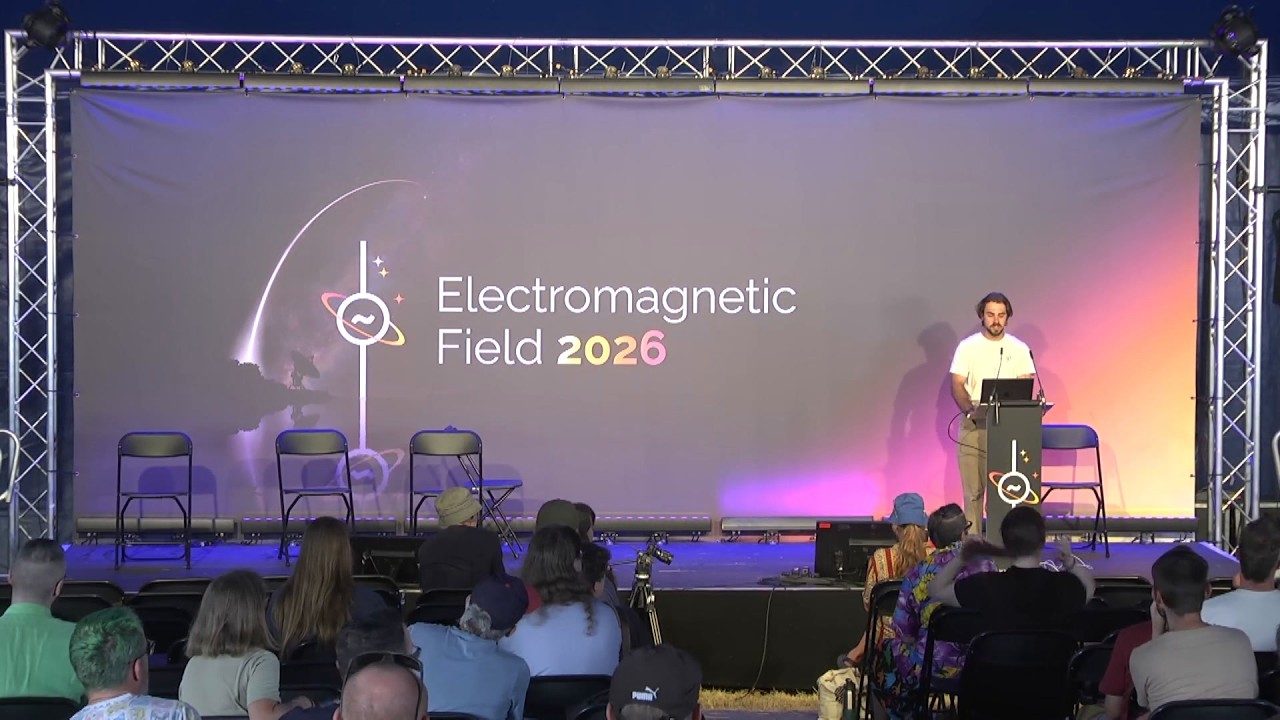
Behind the Curtain: Inside the Hidden Tech of Live Theatre and Events - EMF 2026
Watch on YouTubeVideo summary
Bu video sunumunda, EMF 2026 etkinliğinde sahne ekipmanları ve teknik yönetimi konusunda uzmanlaşmış John, canlı tiyatro ve etkinliklerin arkasındaki gizli teknolojik altyapıyı detaylı bir şekilde ele alıyor. Sunucu, kariyerinin başında veri merkezi mühendisliği yaparken günümüzde Broadway ve West End gibi prestijli sahne projelerinde ışık, ses, video ve özel efektler dahil olmak üzere çok çeşitli protokollerin entegrasyonundan sorumlu olduğunu belirtiyor. Öncelikle sahne raflarındaki karmaşık sistemlere değinerek, ışıklandırma, ses, ağ ve güç dağıtımı gibi farklı bölümlerin birbirleriyle nasıl iletişim kurduğunu açıklıyor. Özellikle 1986'dan beri kullanılan DMX protokolünün sınırlamalarını vurgulayarak, bu sistemin tek yönlü çalışması ve hata kontrolü eksikliği gibi tehlikeli özelliklerini hatırlatıyor; ancak modern çözümler olarak ArtNet ve Streaming ACN'in (E131) IP ağları üzerinden veri aktarımında sunduğu esnekliği ve senkronizasyon avantajlarını anlatıyor.
Sunumun ikinci kısmında, gösteri kontrolü ve iletişim sistemlerine odaklanılıyor. John, video ve ışık kontrollerinin genellikle QLab gibi yazılımlarla yönetildiğini, bu araçların farklı komut türlerini (MIDI, OSC, zaman kodu vb.) tek bir akışta tekrarlanabilir ve güvenilir bir şekilde tetikleyebildiğini ifade ediyor. İletişim konusunda ise analog partili hatlardan modern dijital sistemlere geçiş yapılıyor; Clearcom ve RTS gibi markaların eski analog sistemlerinin 30 volt DC taşıması nedeniyle donanımlara zarar verebileceği uyarısı yapılıyor. Ayrıca ses ağlarındaki devrim olan Dante protokolü ve açık kaynaklı AES67 standardının, saat senkronizasyonu (PTP) ve paket kayıplarını yönetmek için nasıl kullanıldığı anlatılıyor. Burada tek bir ana saat kaynağının (grandmaster) seçilmesinin ve tüm cihazların bu saate uyum sağlamasının kritik olduğu vurgulanıyor.
Son bölümde ise güvenlik, yük taşıma ve yangın kontrolü gibi hayati konular işleniyor. John, rigging'in öncelikle bir yapısal mühendislik sorunu olduğunu ve en iyi yazılımlar bile yetersiz bir fiziksel yapıyı kurtaramayacağını örneklerle açıklıyor. Çalışma yükü limitinin (WLL) güvenlik faktörü ile karıştırılmaması gerektiği, yük hükmünün asla test kırılma noktasına kadar çıkılamayacağı ve insan taşımacılığında 10'a 1 gibi daha yüksek güvenlik paylarının zorunlu olduğu belirtiliyor. Otomatik uçuş sistemlerinin (Kinesis, Stage Technologies) kodlanmış hareket profilleri ve çift sensörlü durdurma mekanizmaları sayesinde millimetre hassasiyetle çalıştığını, ancak canlı performanslarda ekstra önlemler alındığını anlatıyor. Ayrıca yangın alarm sistemlerinin tiyatro ortamındaki hassasiyeti, dumanın algılama türlerini nasıl etkilediği ve acil durum planlarının (kurtarma planları) hayati önem taşıdığı vurgulanarak, yetkisiz pyro kullanımı gibi hataların felaketlere yol açabileceği Rhode Island yangını örneği üzerinden uyarılıyor.
Video sonucunda John, teknolojinin sihirli bir değnek olmadığını ve her şeyin doğru planlama, eğitim ve prosedürlere dayanması gerektiğini vurguluyor. İzleyicilere, bir sorun oluşmadan önce ne yapacaklarını düşündükleri, kilit kararları önceden aldıkları ve belirsizlik durumunda durup düşünerek hareket ettikleri en iyi ekiplerin ortak özelliklerini hatırlatıyor. Mesajı net bir şekilde: "Eğer emin değilseniz, durun; parametreleri belirleyin ve güvenli bir şekilde ilerleyin" şeklinde özetleniyor. Canlı performanslarda izleyicinin fark
Read the full video transcript
Welcome, welcome. This is Behind the
Curtain. I am John. I'm a production
manager, technical director, special
effects supervisor. Um, for the last uh
3 years of EMF, I came on in 22 to run
the music team. Since then, I've been
one of the co-leads for the stage team,
and this year, I have been the rigging,
fire, and pyro lead, which essentially
means that anything to create or destroy
fire is unfortunately in my wheelhouse.
Um, many, many moons ago, I used to do a
lot of data center engineering. Uh, now
I mainly get, uh, paid to do things
mostly on Broadway and West End. Um, I
am licensed in an unreasonable number of
jurisdictions. Um, and I am here to
explain pretty much all of that to you
in various forms. Uh, we're going to be
talking specifically about a lot of the
in-depth technical details here in terms
of how these types of systems tend to
work. Uh, so quick disclaimer up front.
Uh, this is a talk, not training. Uh, I
have an unreasonable amount of public
liability insurance. Please do not try
anything that you are about to see at
home. Um, so first up, um, quick show of
hands. How many of you have at some
point gone and poked around the front of
house or back of a theater or tech
events venue? Maybe even here.
Excellent. Everybody here. Um, you will
probably have seen a number of different
boxes in one of those stage racks. And
those will be doing a number of
different things ranging from
networking, lighting, audio, show
control, video, power distribution, and
even coms. Um, and this stack is
generally relatively simple in terms of
each section of it. But the complexities
always tend to come in when you start
integrating across them because we have
various different segments in each one
that all have to interconnect and all
have to do various different things in
order to make sure that we have lights
and sound and video and all of the
wonderful things that we use to not only
bring you talks but also to bring you a
myriad of different live events and
theater in all its wonderful forms.
So, first up, um, every single one of
the lights that you currently see
illuminating me or anything else in this
room is controlled by a protocol from
1986 that most of the world stage
lighting still runs on. Um, it was
developed originally to replace a
collection of proprietary incompatible
control systems, a problem that will
never happen again. Um, and the key
limitations with DMX as a protocol is
that it is RS485.
It has 512 available channels per
universe. A channel being a single
parameter. So, red, green, blue,
brightness, intensity, etc. Um, and no
error detection whatsoever. Um, it is
completely one way only. Um, which is
extremely fun. um except if you're doing
RDM which I'm not going to talk about
here because that's complicated but
technically you can do two ways if you
start doing things that make you hate
yourself. Um and it's interesting
particularly because uh the standard
actually says verbatim that it is not an
appropriate control protocol for devices
that could cause injury. Um, which is
interesting because in most people here
will know at some point that you can
just go off onto eBay or AliExpress and
buy a DMX controlled flamethrower from a
remarkably unscrupulous website for
about2 to300. Um, which more on that
when we start getting to pyro control,
but uh please don't do that. Um, and
yes, specifically this is a very dense
um, like like you have a lot of stuff
going on here, but often that's still
not enough. Uh, because you may have
several hundred different universes, a
universe being 512 channels, um, based
on the sheer quantity of lights that you
have, especially if you're dealing with
things like LED pixels or any of the
larger, more complicated, uh, fixtures
that we get in the modern era. Um, and
along comes to solve that problem,
ArtNet, uh, which actually comes in in
1998 from a British company called
Artistic License. Um, and it's their
solution for blasting DMX over pretty
much any IP network. Um, it is UDP
broadcast, which means that every device
gets every single piece of data. Um, it
won essentially on sheer adoption
because the practical difference is that
streaming ACN is multiccast. The good
news being that your subscribed devices
only get the data for that specific
universe. The downside being that you
need managed switches and good network
hygiene and a million other things. Um,
and ArtNet will run on any off-the-shelf
unmanaged Ethernet switch. Um, so you
can tell which one succeeded on winning
the adoption war there. Um the flip side
is that um most modern installations
that are using considerable quantities
of DMX over IP or anything that requires
high high redundancy will be using
streaming ACN. Um and especially if they
happen to be using any form of
addressable LED pixel. Um because a
subtle pro problem here is that with
streaming ACN and to a lesser extent
with artnet sometimes um every universe
of DMX is its own network packet being
sent independently right because each
one has to go to a different place. Um,
so on a big rig that can be hundreds of
packets per frame and without any kind
of synchronization, each receiver is
then going to go and act on that data as
soon as it receives it. And then
suddenly all of your pixels are like a
fraction out from each other, which can
look really, really weird. Um, lighting,
you might not notice if you're mapping
pixel wall or like big color bumps
across the whole stage, you get like
visible tearing across it. Um, so the
good news is that we fixed this. Uh, in
the 2016 revision of E131, which is the
streaming ACN spec, they added a thing
called universe synchronization, which
is a data packet that carries a
synchronization address, and then the
source sends out all the data packets
for that frame. Every receiver then
waits for them all to arrive and then it
sends out a single synchronization
packet on the sync universe, which then
causes all of those receivers to then
update at the exact point that they
receive it. um which is great. Uh the
catch is that it has to be multiccast
which means that you again need a
network with proper IGMP snooping and
not every receiver implements the spec
meaning that if you happen to get one
that that is older or potentially like
less implemented it will just ignore it
and free run. So always worth checking
whether that's actually going to work.
Um yes. So show control um almost
everything in every single one of these
stages has some form of integrated show
control. um especially the video side is
running off of a wonderful combination
of a thing called bit focus companion
and a few other things. Um commonly when
it comes to technical theater we are
using a piece of software called QAB
which is probably the most common piece
of show control that people here will
have heard of. It's a really easy entry
point. What it does is it takes a bunch
of different cues, whether that's
network messages, MSC commands, MIDI,
show control, OSC, um different form of
show control, uh time code, all of those
in a defined order and then lets you
fire those repeatably and reliably. Um
because for most theatrical cues, we're
fine with tens of milliseconds worth of
precision. The value is all in
repeatability. You want to be able to
know that the thing fires the same every
time each night, that your lighting
board op doesn't have to remember to hit
go every time your audio board does in
order to make sure that your lightning
actually syncs with your lightning
sound. Um, that can get really really
silly. Um, and yeah, so this is this is
a zoo. Like the we have all of these
different protocols and they all exist
fundamentally because all of these
different problems have been solved by
different industries at different
periods of time and then we had to sort
of all push all of them together and all
of their transports and figure out how
to make them all talk. Um so let's talk
through a few of those now. Um so first
upcoms. uh the system that nobody in the
audience knows exists and the one that
everybody running a show cares about
immensely. Um this is how your crew talk
to each other. So think of this
essentially as little radio packs um
single single like group party lines um
and that gives you the ability to have
everyone on that channel hear and talk
at once like a big conference call. Um
so there's a few different major names
in this. you will most commonly with
analog party lines here. Clear common
RTS being the two big names. Uh most of
the tech of which still dates from the
roughly late 1980s 1990s. Um and the
idea of that in most cases is that
there's either one or two or three or
four shared lines. Everyone hears
everybody else. You do not have the
ability to directly dial people. Um, and
it's almost exclusively wired headsets
with a few exceptions. Um, for the uh
wireless intercom systems that run
wirelessly on analog. Um, and then
nowadays we have much newer, more
consistent stuff in the form of things
like the Redel Bolero series, any of the
modern forms of clear matrix intercom,
which basically allows you to set up as
many different groups as you want,
configure different belt packs to be
able to talk to those groups in whatever
combination you want. Um, and then
basically just fire off and and have as
many combinations as as you wish, which
is what a lot of the larger TV and
broadcast folks tend to do. Um, and the
the other fun with this as well is that
a lot of the older packs are also for
wireless are specifically 2.4 GHz, uh,
which will definitely fight with your
Wi-Fi. Um, Comm's quirks. Um, analog
party lines areing
weird. Um, cuz they they are all running
generally across a standard 3 pin XLR
mic cable. Uh, the difference is that
it's duplex. So, you are talking and
listening down the same line and then on
the other line is 30 volts of DC that is
then running all of the belt packs. And
that also actually carries the call
signal, which is the thing where if you
click the call button on your on your
belt pack, that will then flash the call
button for everybody else on the same
loop. Uh because your SMS and automation
folks and some other people can't always
have a headset on their ear. So you hit
call and their belt pack then lights up
to say, "Hey, look at me. Pick up.
There's something you need to see." Um
Clearcom does one channel per XLR like
that. RTS splits it two channels across
pins two and three. Um and the trap here
is that this is all on three pin XLR.
Um, and it's an identical plug and
there's 30 volts of DC sitting on the
comm's line. So, if you patch your coms
into a mic input or a DMX node that
takes three pin, congratulations, you've
just bunged 30 volts of DC directly into
it, and that is now most likely toast.
Um, and Clearcom and RTS also use XLR3
again, but with different pinouts. So,
even the two comm systems aren't
interoperable with each other. Um, which
is an additional thing. Um, all of the
wireless systems are decked. They're all
1.9 GHz. Like various different
additional fuzz on top of them. But like
Bolero, most of the modern Clearon
stuff, it's all it's all beening decked.
Like why? Um, other than the fact that
it is reliable as we all know being in
this field and definitely not having
picked up a phone call that has just
become like garbled. Um, lovely. So
let's jump on from coms to very quickly
talk a little bit about Dante. Um that's
the elephant in the room for audio
networking. It is the direct uh is the
direct protocol that is currently taking
my voice from this belt pack through the
air to the receiver at the back of the
room and then through into the Yamaha
DM3 sitting at the back. Um it is a
horribly proprietary system from an
Australian company called Odinate. Um,
and it has quietly become the absolute
default for how audio moves around
modern show environments. Um, the clever
thing about it is that it does all the
hard bits for you. Runs over gigabit
Ethernet, same switches, same cable you
normally use, but it deals with all of
your clocking, PTP clock discovery,
routing, all of that basically for you.
Um, and what you do is you go into a
piece of software called Dante
controller and you say, I want this
input to go to this output, which is
called a subscription. Um, and at that
point you can then go off and select
your latency offsets anywhere from half
a millisecond to five. Uh, and the
trade-off there is basically you're
trading delay for tolerance on a more
busy network because obviously more
packet drop means that you end up with a
situation where potential loss there
means that you actually lose the data.
Um, and obviously that then means that
you have one network cable that can
carry hundreds or thousands of channels
in both directions which can then
replace the horrific multi-core XLR
snakes that we've been using for years.
Um, the good news is that you don't have
to use this anymore because we now have
a wonderful thing called AES-67,
which is a common mode mostly
open-source protocol built on around
sort of the Dante spec, which pretty
much all of the modern um inter
interoperable folks that use Dante
support. Um, and it lets you effectively
um interoperate between multiple
different consoles that don't
necessarily talk the same control
protocols. They should all be able to in
theory talk AES67. Um, as long as
they're all set to that mode. Um, and as
with all things in life, uh, the eternal
cursed nightmare of this is clock sync.
Um because you always have to like elect
a single grandmaster PTP clock for every
single like basically PTP works by
having the most accurate clock in the
room. Um and the practical thing to know
here is that if you are in if you're in
an AS67 or a Dante network um as a
general rule every device is a potential
PTP participant. That is to say that if
something boots up and then it decides
that it is your PTP grandmaster while
another device has already decided that
it is your PTP grandmaster then
congratulations everything is going to
start unpleasantly clicking and dropping
out. Uh which is a great way to find out
especially mid show. Um now the fix here
is three-fold which is one enable IGMP
snooping on your switches. B get some
proper manage switches and C um get a
dedicated grandmaster that you actually
trust which usually if you're doing this
should be your sound desk um or actually
no e either your sound desk or your Rio
or equivalent stage box. There's a bit
of yeah people have strong opinions on
this that I don't really care about. Um
but it's yeah it's a diplomatic problem
as much as a technical one. Um
so um next up we will touch a little bit
on rigging which is the corner that I
have mostly had my hands on for EMF this
year. Um I would like to make it very
clear first that like rigging is a
structural engineering problem first and
an electrical and software one second.
Um the most elegant show control systems
you will find will not help you if your
halfton motor is attached to a beam that
can't make the that can't take the load.
Um so an example of this here um we have
a uh truss directly above your heads
that is run up to a couple of span sets
sitting on some halfton chain hoists uh
that I rigged a week and a half ago.
Dear god. Um and that is then connected
directly to a pair of steel safety
chains which then ensure that even if
those directly uh even if the underlying
um the underlying hoists fail that the
truss then cannot fail on top of that.
Um so couple of terms that you'll hear
often when it comes to rigging. Uh
working load limit uh working load limit
is not safety factor. This is probably
the single most misunderstood thing
about uh entertainment rigging. Um, so
you will generally see most things rated
at a safety factor of 5 to one, which
means that if you have a halfton
shackle, that is the 500 kilo working
load limit. That means that it has been
tested to break at 2,500 kilos. That
does not mean that you can safely load
it to 2,500 kilos. you load it to 500
because the factor exists specifically
to deal with things like dynamic
loading, shock loads, and the fact that
everything does eventually degrade over
time. Um, the other piece of this uh
load cells are your friend. If you are
ever doing anything that is particularly
complicated, uh, I'm specifically
talking here to the folks out there who
are doing circus rigging, which uh,
congratulations. I salute you and I'm
sorry. um you have lots of wonderful
complicated dynamic forces that will be
going on there. And often the easiest
way to solve for that particular problem
is putting a load cell on your motor
attachment points which will then give
you the exact ratios for how much things
are actually getting loaded. Um there's
a few different companies that make
these, specifically wireless ones, which
are excellent. Um, and it allows you to
basically get a full live picture of
what all of your points are actually
doing and then adjust them if necessary
to make sure that everything is truly
balanced.
Um, ooh, that's fun.
Interesting. Please hold.
We appear to have lost slide.
No, we haven't. There we go. Excellent.
Um, lovely. uh small brief vocabulary of
uh things that you will potentially hear
in terms of terminology when it comes to
this um structures. So this is box
truss. You will see some triangle or
trirust around places. Um I mentioned
earlier we have what we call spans sets
or uh soft shackles or gak flex which is
basically steel aircraft wire encased
within a much softer outer sheath which
we're able to use to set specific
rigging points for certain
circumstances. Um clamps various forms
doy cheesebor different US and American
terms for those um and then chain hoists
and also chain motors. Um, you will hear
those specifically referred to in the
context of single or double braded
motors. That effectively means in the
form of a double braded motor that it
has a built-in backup of some kind,
which effectively means that the the
motor itself is not capable of just
freef falling the load in the event that
the first um that the first break itself
fails.
Okay. Um, moving on, uh, from the main
fundamentals of this, uh, let's talk
about actually flying things in and out.
Um, so fortunately, we do not have any
counterweight flying on site as far as
I'm aware of. If you happen to find any,
please let me know. Um, but as a general
rule, when it comes to most theater, you
will find one of two specific um, flying
systems in use pretty much everywhere
across this country and and reasonably
the world. Um the first of which
counterweight flying um all muscle all
rope. You just have a single um pulley
set up loft bar head blocks over in the
grid. Um a batn or bar which is what
actually hangs your load set on a set of
wire ropes. And then an arbor which is a
cradle that you then load with a
specific amount of weight in order to
effectively offset the weight that you
have then put on the bar. The idea being
that your flyman then only handles the
uh amount of effort required to move it
out of balance. Um, as a general rule,
you should always be very careful to
wait your bars before you fly them.
Otherwise, they will have a habit of
running away into your grid. Ask me how
I know that. Um, and as a general rule,
uh, you have relatively little feedback
unless you're operating in a theater
that happens to have, uh, invested in
some kind of a front of house or top-
down camera system run to their fly
floor, which some of them have, but for
the most part, it is you are relying on
everybody else on the ground, your stage
managers, everybody else to act as your
eyes and ears in terms of safety
systems, and then you're putting a
couple of marks on the rope to be able
to take it from one point to the other.
Um
we have in fact managed to move past
this um though not without the addition
of a quite considerable quantity of
budget. Um so we now have a lot of
automated flying which is motorized
winches um all computer control closed
loop very very very fun systems and this
lets you fly people and set and vehicles
and whatever the hell you really want uh
reliably to roughly to the millimeter.
um often sometimes beyond that depending
on the system. Um a lot of the systems
that you'll hear for this is Kinesis
which I believe has now been bought by
Tate. Um Stage Technologies which also
do a lot of stuff in that corner. Um
yeah, bunch of different uh CM Loadar
also do some hoists that specifically
have these kinds of features built in.
Now um and this all runs to the MCE 143
spec. Um, and the critical number that
you're looking for here is safety
integrity level three, which is a formal
standard for how often these things are
allowed to fail. Um, the critical safety
function here is 1 in 10,000 demands.
Um, which I know seems low, but
realistically that tends to be more than
enough in a in a practical reality for
for what we're doing here. Um, and the
key here is position is position
control, not speed control. like you're
going to tell it to go to position X and
stop there repeatedly and it will do the
identical move every night because it's
all being watched by encoders and many
other fun things. Um, usually redundant
ones. And the safety heart of it is
essentially that you will have pretty
much two encoders on every single axis.
And if either of those two encoders
disagree about where something is, the
system isn't going to guess. It's going
to estop. um which is a very similar
fundamental to a lot of what you'll get
when it comes to aviation engineering
where you have like two pretty much two
sensors on everything unless you're
Boeing. Um yeah. Um and you get to
define all of the motion envelopes in
the software in terms of how quickly
those things will will bounce between
certain points. Um quick thing on flying
people. um everything on the automated
flying side still applies but the moment
that a payload becomes a living person
rather than a piece of scenery the
overall extra layer of engineering comes
in and the design factor goes up. Uh
generally if you're dealing with lifting
scenery or vehicles or whatever else
you're dealing with a 5:1 sometimes an
8:1 factor for human flying you do a
minimum of 10 to one on the entire
loadbearing path which means that all
components are rated at least 10 times
the full working load. Um and on top of
that you do not rely on any single
thing. You should duplicate every single
load path. Dual suspension wires, dual
brakes, dual um secondary safeties that
are completely independent of the prime
of the primary and can fall arrest if
required. Um and all of this is wrapped
in a lot of very specific standards. In
the US it's ance 143. Um in the UK
you're looking at the BS7905
lifting equipment for performance
standards. And all of that then sits
under the ABTT and DSA flying a
performance guidance. And then all of
that sits under Lola um which basically
is the mandated inspection regimen for
all of this. Um and also worth noting
none of this is worth jack without a
rescue plan because if your performer
ends up stuck in your grid, you need a
rehearsed practiced way to get them down
again. Um your performers are signing on
fundamentally to your trust and you need
to not only earn that but also back it
up.
Um yeah, a a a a point on this. Um often
these we we do a lot of complicated
often very dangerous things. Um most
often what you need to focus on is
competence rather than having the right
equipment. Um, the best example of this,
um, the one that basically every stage
pyro course will teach you is the
station nightclub fire in Rhode Island
where in 2003,
um, we was a band's tour manager showed
up with a bunch of jerbs, untrained,
unqualified, um, set them off. Um, it
then ignited the acoustic fire in the
walls and 100 people 100 people died,
230 people were severely injured. The
venue was burned to the ground in
roughly 6 minutes.
I say that not to be grim, but because
that is the clearest possible example of
what happens when pyrochnics especially,
but any form of critical safety system
is used without proper planning, proper
materials or safety assessments and
without coordination with the venue. Um
like every especially for pyro, every
single control we have in modern
proximate pyro practice exists because
at some point something went wrong with
it. Um, speaking of, let's talk about
fire alarms for a second. Um, so fire
alarm systems. Uh, as soon as you start
putting, uh, haze or smoke or pyro into
a building that happens to have fire
alarms, uh, congratulations, you are now
interacting with the fire alarm system.
Um, you should know how it works. For
one, there is a number of different
detectors built within this. You have
optical detectors, which deals
specifically with light scatter, uh,
which is most likely what you end up
with in most theaters. You have
ionization detectors which specifically
focus on the combustion particles. You
have heat and rate of rise detectors and
you have multiriteria ones which is most
likely what you will have in most normal
theatrical venues. The idea of this is
specifically that in almost all cases a
theater is capable of being dropped into
what we call a zone isolation mode. And
what that means is that you can turn off
or turn off certain facets of the fire
alarm systems within that area of the
stage. Meaning that, for example, you
can turn off the heat or ionization
criteria on a specific sensor and only
look at optical light scatter, for
example, so that haze might not set it
off, but much darker, thicker smoke that
could come from an actual fire will. Um,
there are specific requirements on this.
Again, normally if a system is in an
isolated or a silent alarm mode, then
you have I if if that alarm then trips
in most commercial venues, this is not
always true, you will usually have a
roughly 15-second period in order to go
and acknowledge that alarm on the panel,
at which point you then have exactly 1
minute and 30 seconds in order to
identify the alarm and cancel it out.
Otherwise, it turns into a fullscale
alarm and you then have to deal with the
joy of explaining to your set people why
all of your flats are now very wet. Um,
yes, HVAC often always has its own
sensors. So, if you happen to have any
smoke that is getting pulled up and
through vents, always keep an eye on
that. Um, and if you happen to be
capping smoke detectors, which is a
thing to be very clear that you should
only do if you are qualified and know
which ones you're capping, make sure
that they come off the moment that your
like show window closes out. Um, and
also always know who your fire marshall
is, know who has the reset keys, all
that jazz.
Excellent. Uh, we are going to jump
through a couple of things here because
we have uh relatively little time. Um
let's talk briefly about LED wall. Um so
for anyone who has dealt with LED wall
at some point, you will know that it is
a bunch of different LED panels uh
blocked all together with power running
in between them and what looks like
Ethernet running in between them. It is
not Ethernet. It is a horrifying
combination of serial and just bitbanged
JPEGs just firing their way across the
ether for some reason. Um, additionally,
all of the uh receiver cards are not
always, but at least in the case of
stage D, for whatever reason, very
volatile, meaning that if you reboot
them, they then proceed to lose their
config. Um, or if the flash on them
tends to get a little bit screwed over,
then they also lose their config. Um,
and at that point you end up with fun
things like firmware mismatch or if
anyone has seen the weird avanguard art
project that keeps showing up on stage
D's info beamer. All of them turning 90°
sideways for some reason. Um, lovely. We
have run through the specifics on that.
Um, lovely. I am going to finish off
with this. Um, 8 seconds. That is
roughly how long you have before any
audience will notice that something has
gone wrong. Not 8 seconds to fix it.
eight seconds before they notice. You
may have longer to fix it if you can
fill the time, but clocks on awareness
are very, very quick. And the best crews
that I've ever worked with all have a
few very specific things in common.
They've thought very carefully about
what they would do if something went
wrong. They have thought what would
happen, but what would what they would
do before that thing went wrong. And
they have clear decisions that they have
already made, dry runs, familiarization
runs, abort procedures, and very clear
human layers. And at the end of the day,
the principle across every discipline,
it should be, especially if you're
dealing with these kinds of systems, if
you're not sure, stop. Think about what
you're doing, figure out the parameters,
and then go back and and and do it the
way that you have now figured out. And
if it's a safety risk, you can always
call the show stop. House lights up.
Everything holds as is. Lovely. Um,
thank you so so much for coming through
to this. Um, none of this is magic. If
you would like me to explain any other
specific details or anything that I
happened to jump through on account of
time as part of this, I will be in the
Q&A tent immediately after this. Other
than that, thank you so much. Thank you
for showing up to this wonderful,
wonderful thing that we have all created
together. And yeah, thank you.
[applause]