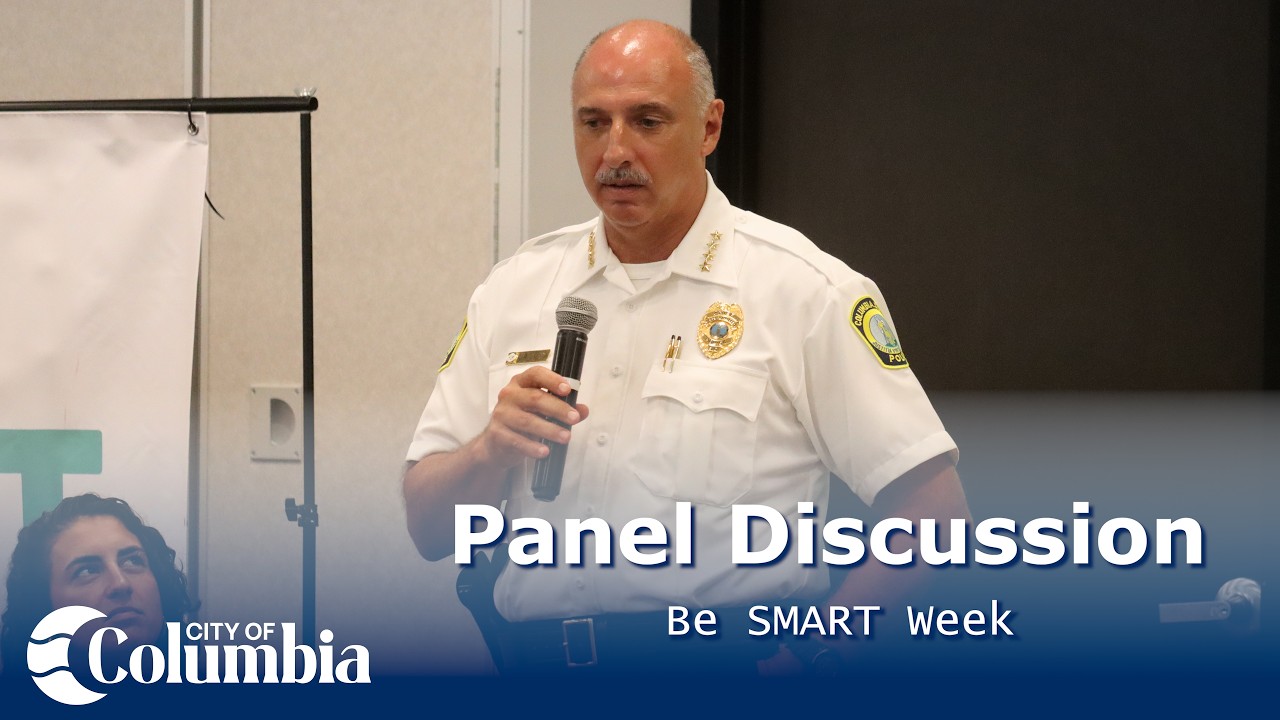
Video summary
The panel discussion at Be SMART Week 2026, moderated by Judy Gatson, centered on proactive strategies to prevent gun violence through responsible ownership, secure storage, and community accountability rather than merely reacting after tragedies occur. Speakers emphasized that a vehicle should never be treated as a holster, highlighting the daily theft of firearms from unlocked cars which puts children at risk when they make impulsive decisions. The conversation stressed the importance of normalizing discussions about gun safety among parents, drawing parallels to how seat belts and stove safety are taught early in life, while also addressing the negative influence of social media and music that often glorifies weapons. Personal stories, such as Cassie's loss of her husband Greg, a police officer, underscored that gun violence impacts every community member regardless of their background, reinforcing the need for shared responsibility and a mindset shift where no child is left to die on the watch of the community.
To overcome barriers like distrust in law enforcement and lack of transportation, panelists advocated for meeting youth where they are through repetitive education about gun laws and safety. They suggested utilizing advocates and community leaders to become familiar, non-intimidating figures rather than distant authorities, and maintaining a persistent presence through prayer and consistent messaging from adults. Specific action steps were assigned to attendees, including treating the event as an ongoing mission rather than a one-week occurrence, volunteering in areas like Orangeburg, Columbia, and Richland, and securing unsecured firearms at home using free locks available at local centers. The Chief announced a giveaway of gun lock and storage kits at the Busby Street Community Center, explaining that different locks serve different needs depending on household risks, while other speakers charged parents to get their children involved in community activities regardless of perceived risk to create a positive ripple effect.
The session also focused on breaking down cultural barriers such as the "snitch mentality" to encourage children to report unsafe situations and replacing gang promises of brotherhood with the safe bonds found in sports teams. Youth were advised that their friends often influence outcomes more than initial choices, urging them to be mindful of their company when entering lonely situations alone. Speakers shared testimonies on raising responsible adults, noting that children want to live and are listening when given positive messages, while also addressing practical obstacles like funding for recreation programs such as "midnight hoops" to ensure youth participation in safe activities. The discussion concluded with a recognition of the diverse backgrounds of Be SMART volunteers who dedicate their time despite full-time careers in fields like teaching, nursing, and medicine, ending with applause for their commitment to ensuring that tragedies shock the conscience enough to drive meaningful action through city council and state legislature advocacy.
Read the full video transcript
I would love to introduce the lovely
Emmy-winning journalist and community
community activist uh WIS co-anchor Judy
Gatson.
She will be our moderator.
>> Good morning everyone.
>> Morning.
>> Per usual, the podium is taller than I
am, but that's okay. Um listen, I want
to thank all of you for being here
today. This is so incredibly important
and this is an issue that as you hear
the stories you realize the impact on
our community. Um it's a conversation
that as some of our speakers have
already said that we need to normalize
in our community. And that's a part of
what you are here to do today. We are
here today all of us because keeping our
communities safe is not someone else's
responsibility. It's a responsibility
that belongs to each and every one of
us. And so for us here at WIS, Lena
Allen is here to cover it. I see some of
our other media friends are here as
well. It is not our goal to just report
on tragedies after they happen. We are
here. We are live streaming right now.
We are covering and amplifying this
issue because we want to all be a part
of the solution. And so we thank our
panelists for being here today, for
sharing your life experiences, to share
your stories, to be transparent in this
journey. Grief is a hard thing. And for
those of you who have been through this
from a grief perspective, to be able to
turn that around and use your story to
be able to help save somebody else's
life, it is powerful and it is
impactful. So, we thank you for that.
Uh, National Smart Week obviously
reminds us that preventing gun violence
is not just about what happens after
tragedy strikes. Um, as Dr. Walker
pointed out, Dr. Moore has always talked
about it as well. You know, the metal
detectors are working. That's great. Um,
the kids are listening. When they see
something, they're saying something.
That's great. But that is not enough. We
all need to be a part of the solution.
And there's a lot more we can do to make
sure that guns aren't being stolen out
of vehicles, that guns are not ending up
in the hands of our children. So, we
want to work together to prevent tragedy
before it happens, especially when it
comes to responsible gun ownership and
secure firearm storage. So, we have an
extraordinary panel here today. They
bring expertise. They bring experience
and in some cases deeply personal
perspectives to really ignite this
conversation and spread it beyond the
Busby Community Center. We want to thank
the city of Colombia for hosting this
conversation. But we want to spread it
throughout the state of South Carolina
to make sure that our community is a
safer place for our children where they
can live, they can play, they can learn,
and they can do it while having the
safety and security um of their
community. Just a very simple question
because I think this issue has been
unnecessarily politicized in a lot of
forums. This is not about politics at
all. This is really about keeping our
children safe. So, how can we make
secure gun storage common practice,
expected practice, standard protocol
among gun owners?
>> Well, I I think we have to do what we're
doing today. Um and each person can
magnify that that message. Um Judy, you
you always are leading the charge. Um
you bring, you know, attention to so
many critical issues, but we've had many
conversations about um the challenges we
have with gun violence and um
irresponsible gun possession or gun
ownership. Um the sheriff often talks
about um your car is not a holster. Um
and we still see farms stolen from cars
um just you know on a daily basis and
those guns end up in the hands of um of
people that have um make bad decisions
and have um you know poor intentions. Um
one of the things that I think is
important that um that that we really
have to understand is um our children um
in our young adults are still children.
They make so many impulsive
um emotional decisions, split-second
decisions that have life-changing
consequences. And um I think any
opportunity we have to to message and
stress the importance of of
responsible gun ownership and proper
storage. Um we we just we can't do it
enough. I I know we talk it all the
time. We also try to walk it. Um we uh
every community meeting we go to and
it's literally hundreds. We have over a
hundred community organizations or
community neighborhood organizations and
in Colombia and um you know gunlocks uh
along with a lot of other things go with
our officers to these communities and um
I think it has to be a consistent
cadence of messaging um to keep
attention to this and to exploit
resources like this. I mean, it's it's
that um just envelope, give out these
gun locks um will save a life. There's
no question about it. It will absolutely
save a life and we've got to do continue
to do our part to bring attention to
this.
>> Thank you very much. Would you pass the
microphone to Torian because I want you
to pick up on something that Chief just
talked about the impulse of our
children. And I've heard Sherblot talk
about this before that back in the day
if the kids got upset with each other,
they just fight and duke it out. Now the
first resort in some instances is a gun.
What do you think we can do to
communicate to our children? I guess
about you know Dr. Walker talked about
it emotional intelligence. I mean
regulating those emotions and just not
having that be the first response or
really any response.
>> I mean uh I look at you know just coming
from a a troubled child. Like you said
when we was coming up it was more so
fight. Okay, we might lose today, come
back tomorrow and do it again. You know,
try lose again. You know, you just can't
be let it go. Um I think with the gun
lock more so u it it might just might
might need to be a class for the youth.
I mean, I feel as as though when it come
to adults, we kind of know better, but
you got this f this trend going on with
the kids. And one of the things is
social media helping them,
>> you know,
social media helping them, you know, see
rappers talk about guns and stuff, not
realizing that rappers talk about this
gun entertainment, but they go back home
to their state. I feel as though, you
know, somebody need to sit down with the
kids and let them know, you know, that's
that's not reality of things. You know,
you talking about guns, this that
underage, you going to jail.
Basically, like I said, I I sit down and
I think about it all the time and I just
say, you know, we just need to be put in
a lot more effort to these youth,
actually snatching them up and sitting
them down and, you know, explaining to
them, you know, to say guns and, you
know, locking guns and whatnot. But one
thing I had to realize when I was
growing up, I did like guns, but I never
really had nobody in my face telling me,
"Okay, well, you stay out of trouble."
Okay, you like guns. When you get a
certain age, you can actually go get a
rescue gun, you know, protect yourself.
And I feel it's as though if a lot of
these kids really knew that, it'll get
him something for look to it instead of
just saying, "Okay, let me go break this
car and get a gun, you know, and have
it." A lot of them just don't even
understand that you can actually have it
and do the right things with it because
they really tell them. So, I think, you
know, we just need to get more active
with the youth as far as, you know,
>> that's great insight. Would you pass the
microphone down this way to Cassie to
your right? And you you make such great
points because honestly it comes back to
everything, right? We need to model
responsible behavior for our children.
You know, if they're trying to model
what they see on social media and
rappers and all of that and they're
putting that on their social media page,
people are going to make all sorts of
judgments and stereotypes about them
when they're just trying to be cool, you
know, and relate to what they see on
social media. Cassie, from a parent
perspective, I mean, you've also dealing
with this as a grieving spouse and so
many perspectives that you bring to the
table. How do we normalize these
conversations among parents? Because
part of the BS smart philosophy is, you
know what, before you send your kid over
to somebody's house for a sleepover, you
need to have this conversation with the
parents, not just about nut allergies,
but you know, our guns safely secured.
>> Absolutely. Well, good morning everyone
and Judy. Thank you so much for being
such a bright light and advocate always
in this space. I want to start by first
acknowledging the BS smart volunteers.
Can we do a round of applause for each
and every one of you?
Many of whom have lived experiences
really. Gun violence is something that
touches it all. And you all are truly
heroes in your dedication, your
commitment to spreading the word,
raising awareness. For many of the
volunteers, Judy, when I got to meet
them, I thought this was a full-time job
because they're doing it. I learned that
that is not the case.
>> And I think it's so important that we
highlight our BS smart volunteers and
everyone who is here and dedicating
their time and so much of their lives to
this cause because I think what it
highlights is that this is a
responsibility that we all have. And gun
safety, gun violence is something that
touches each and every one of us. It is
not something as we shared that is
restricted to one community, one person,
one neighborhood. But it is something
that truly touches all us all and I'm an
example of that. I think we may not
consider often the diversity of gun
violence victims and gun violence
survivors u but for those of you who may
not know my first husband Greg was a
police officer who was shot and killed
in the line of duty. Next month will be
11 years.
And something I have shared since his
death was what if we could have found
the person who killed him before that
day? Would we have found someone in
need? And what if we could have helped
him? And I think that highlights how it
is the responsibility of each and every
one of us to pay attention to everyone
in our community to look for those who
are hurting to have connections and
relationships so if we find someone
who's in pain that we know how to get
them connected to help. And then very
importantly as a mom now. So I have two
little boys. Uh my son S just started
sixth grade. He is so big. He's learning
Latin and bass and it is so fun. And my
wild little 5-year-old Silus. And I have
to give extreme kudos to Be Smart
because of your education. I know what
to look out for, how to educate and ask
when my kids go over to other homes. Are
there secured weapons? To think about
our own space. I think often we think
about that won't be me. like I am a
responsible person and I will tell y'all
just a few months after Greg was killed
trying to put my life back together, get
my feet on the ground, I consider myself
a pretty responsible, caring individual.
I love my son so so so much. Would never
want to put him in harm's way. But I was
trying to put pieces of my life together
and I relied a lot on child care. And so
one time there was a day I had a
babysitter over and I learned after the
fact that she invited other people over
to the house. And now remember Greg was
a cop so we had weapons in our house and
that's something I felt safe with. And S
was only a baby. He couldn't touch them.
But that highlighted to me how quickly
things can change in an instant. And so
for everyone who's watching at home how
important it is that we see that this is
something that truly impacts it all.
that we are all so interconnected and
that each and every one of us need to
care and take a responsibility whether
it's just as a parent, a concerned
community member, someone looking out or
if you take the cause on and become one
of these incredible be smart volunteers
who are making a tremendous difference.
Thank you. Thank you so much. We can
pass it down to Hayward. And this is the
thing too, Hayward. You know, you're
around kids all the time, right? What
think 12,000 kids, you know, as your
district in Orangeburg. I, you know, we
look at the BS smart strategy. It makes
perfect sense to me as a mom, right?
These the statistics prove, you know,
that we can make a difference, but we
can still have a disconnect in relating
to our kids, in connecting to our kids.
What are we missing that we still need
to do to connect and make this message
resonate with them?
>> Wow. Well, our our children, great
question. Um, our children can stop uh
fakes from a long hallway.
>> Yeah.
>> Like we can't be smart doing be smart
week and then be dumb every other week.
>> Like I said it because
>> let's make that the sub motto.
>> You know, I say it because like one of
my friend Johnson says this all the
time. He says commitment is staying true
to what you said you would do long after
the mood in which you said it in is
left. Uh meaning it can't just be a
feeling or an event. uh because what's
glorified so much and to hood on the
nail um guns are glorified so much that
our kids think they're our toys.
>> You know, I there was a time where I
went to more kids funerals than I went
to their high school graduations.
>> And that's not that's not supposed to be
the norm. And so I think we have to be
more intentional about making this
relevant to them. Um speaking with them
on a regular uh going to where they are
like it can't just be relevant when a
child dies. Like it should be if we said
we lost about 40 37 kids died. I'm
sitting next to my sister Courtney. I
sat in that classroom. Winston Hunter
was the best child I never got a chance
to meet.
>> I'm talking about this young man. She'll
tell she'll tell it way better than me.
But I sat in that classroom because we
had to provide counseling for those
students. And to see that empty desk on
a regular basis and those children
asking why my classmate six-year-old is
not here. And his last assignment, his
dream was that the world would be a
better place.
>> Like like we have to be it has to be a
movement every single day until we lose
nobody. Like it should be a mindset of
no child's going to be left on dying on
our watch, right? But again the we we
are kind in a sense hypocrites sometimes
as communities because in one breath
we'll say this is wrong. This is wrong.
But then at some of our sporting events,
we'll play the same music that our
children go to jail for, get arrested
for, or get suspended for. And so
there's a cognitive dissonance in our
community that we have to look in the
mirror and say, are we truly because our
children model what they see in us? Like
if they they would literally do better
if we just told them, hey, this is
there's a better way. As Torah was
saying, they they would do better. Like
we're not giving them enough credit. I
don't think our expectations are high
enough for our kids.
>> I don't I don't think we really expect
any more from them. I think we think
because they cry because we told them we
told them no, then we better let him
play this this dumb music. Let him let
him uh do a tick tock dance to murder
songs because we like the beat so much.
And so we have to look at ourselves in
the mirror and say, "Do we really want
them to live? Cuz if so, we would be
more intentional about sharing, speaking
life to them on a regular basis, telling
them what their future is." And so I
said, and I end my point by saying, I
said it's a mindset thing. You can
change the behavior all day long, but if
the mindset doesn't change, the behavior
won't change. And so, we got to get to
their mind. And so, that means going to
basketball games, doing tables, having
tables, making announcements, like
making it sound so relevant to the kids
like, dang, they really serious about me
living. They really want me to live a
long life. But I ask our question for
adults. How are we advertising
adulthood?
>> How are we advertising? Do our children
look at us and say, "Man, I can't wait
to grow up." or they look at our lives
and say, "Man, I don't want to be them."
They like they hate adulthood. And so,
again, I would say we got to be
intentional. Make it relevant in every
school, every classroom, every sporting
event. Um, and again, just be serious
about how how big we really want to be.
What vision do we have for our children?
>> I love that. Courtney, we want to come
to you because, um, as Hayward
mentioned,
Winston, I remember covering that story
on WIS and what a beautiful, beautiful
child in spirit. So for you to be in
this space of advocacy now, you know,
and as I listen to Hayward talk, I just
think about the truth that our children
are looking for boundaries, right?
Sometimes as parents, it's hard to
enforce those boundaries. But when you
just let them run wild, the message
you're sending is I don't care. You
know, at least when you put boundaries
in place and you are consistently
enforcing them, the message is I care
about you. As he said, I want you to
live. When you think about Winston and
just the work that you are able to do
now to resonate with these children,
what is I guess your challenge to the
community so that his loss is not in
vain? So that we learn something from
his loss to help save another child?
>> I think, excuse me, I think the biggest
challenge that I'm facing is I'm talking
to the people that's doing the work. I'm
not talking to the ones that needs to
hear it.
>> The ones that need to show up is not
coming out. So, what do we need to do to
get the ones that need to hear what
we're doing, the ones that need to
change, the ones that who needs to
secure the guns, the ones that need to
put the guns down, how can we get them
out?
And um just to piggy back off um the
normalizing, we normalizing seat belt
laws and we normalize cell phone safety.
We normalize, you know, we teach our
kids at a young age, don't touch that
stove cuz it's hot. So let's start
talking about gun safety as well. So I
think it need to start when they're
young because as they grow up and
they're going to hear it, they're going
to be reminded of that because I know
now at the age of two, he can understand
that that stove is hot. So why not at
the age of two this gun is not you don't
need to be touching it or you and then
also um a challenge is
getting the parents involved as well.
>> Yes, we can talk to the kids but if
those kids can't come out because when
they can't drive then we need to get the
parents involved as well. That is the
toughest challenge. But no matter how
tough the challenge is, I'm gonna
continue to fight for my son because my
son was where he needed to be that
night. But because of actions of someone
else that wasn't taught when they was at
a young age, I'm going to continue to
fight. They took my son's voice, but
they didn't take his mama's voice
>> and I'm going to be Winston's voice. So,
I'm going to continue to fight. And it
seemed like every day it's more and more
gun violence. So, you know what that
means? I'm just going to fight just that
hard.
>> I'm not going to stop. Yes, it gets
discouraging sometimes, but that just
put more fire in me. And I just because
with my anger that I have, yes, it's
hard some days. It is. But I'm just
going to channel the channel that
energy, channel that anger, channel that
hurt to just make so I can make sure
another mom do not have to deal with the
pain that I am dealing with. Not that
another child cannot grow up to be all
that they can be. So be smart. I thank
you. partnering with y'all is amazing.
But even when I see them just out in the
street cuz I think I seen you a couple
of months ago with my boys with the
boys. It just light up my world. I'm
like, "Hey, how are you?" You know, we
just hug. But like it's that connection
we have, the partnership that we have.
We're going to continue to fight. Yes.
Those days going to get hard.
>> Yeah.
>> But we're just going to continue to
fight even harder.
>> Well, thank you for your passion and
your voice.
Kelsey, I'm going to come to you next.
I'm going to pass Kelsey next. Um, and
and we thank you for being so willing to
be an advocate because, you know, I know
sometimes it feels like you just need
time to grieve, you know, and there's no
timetable. You never get over that. You
get better, I think, at dealing with it.
But what we learn in the dark, we share
in the light to help others. And I think
part of your point, which we'll come
back to Cassie in just a little bit,
taking resources to the community,
that's what serve and connect does so
well, to go meet the community where
they are. And I have a question. I want
to come back to Torian a little bit
about that, too. But Kelsey, from what
you do on a day-to-day basis, what what
have you seen that you think can that
you believe can help this message break
through and resonate so that everybody
cares about this whether they've been
touched by gun violence or not?
So I think as going out being a BS smart
volunteer and talking to people in the
community, one of the things that
parents don't really understand, excuse
me, one of the things they don't
understand is the ask portion of BSmart.
So they don't, you know, it's like a
light bulb goes off when you talk to
them and say, "Hey, if you're, you know,
even if you don't have a gun in your
home whenever your kids are going to
family members' houses or if they're
going to a friend's house, it's okay to
ask those questions. Hey, do you have a
gun in your home and are you keeping it
locked up?" Um, I think that's one of
the biggest things like even if you're
not a gun gun owner, like you can help
get this message out. You can help
spread the message about being smart.
Absolutely. Matt, let's come down to
you. What perspective can you add to
this in terms of implementing these
principles, normalizing it? I mean, it's
so great. I think that the school
districts were some of the very first
partners with Be Smart. I mean, and
that's meeting our children where they
are, but I think part of what we've
heard from our panel is that we need to
be connecting with the parents because
we already asked our teachers to do so
much. Toriian was talking about, you
know, a class and somebody to sit down.
That's parents who need to be sitting
down talking to their children. That's
parents who need to have their children
involved in community events and
Columbia Parks and Recreation. That's
parents who need to help find those role
models and mentors for their children in
the community. What would you add?
>> There's so much important work going on
in schools every day. We're blessed to
have eight plus hours of exposure to
students. We recognize that we need to
be more informed. You know, adverse
childhood experiences, we're trauma
informed. So, we can see when students
might turn to violence, might turn to a
gun. Where can you step in? you said
that early. If we got to that kiddo
earlier, could we have stopped
something? So, it's very valuable work
that aligns with this. It's not only um
educating adults, you know, as you
exercise your right, you do take
responsibility for that right, but also
recognizing kids are distressed. So,
that's very valuable work that we're
investing in as educators.
>> Toriian, I want to come back down to
you, go past the microphone down. I I
can't remember if I met you then, but
there was a meeting. Chief, I think you
were there. I think Sheriff Lot was
there. Um, it was over at the church
over by Columbia Place Mall. Do you
remember what I'm talking about?
>> Yes. And talking about trying to fund
and and get recreation equipment and
things like that to the community. I
mean, all of that stuff is a process,
right? We got to work through the
process to be able to get resources to
the kids. You know, not every child has
opportunity to go to summer camp at
Adventure. You know, not every child has
the opportunity to go to summer camps at
the zoo. But what do you think we can do
as a community to make recreation more
available? I saw something recent about
Columbia Parks Recreation doing like
Friday night hoops, you know, and things
like that, but we got to get the kids
there. So, what other ideas do you think
we need to be putting into action and
mobilizing?
Um,
like you said with the midnight hoop
thing, I did uh midnight hoop also from
hours of 9:00 p.m. to 2:00 a.m. just to
kind of keep the kids off the streets,
give them something safe to do. Um,
the funding, that's another part when it
come to the kids. Like she was saying
earlier, something like saying out here
earlier, a lot of time these kids want
to be involved and part of something,
but with no transportation or either,
you know, I had as a kid that me and
that hoop one night I said, "Well, a lot
of y'all play basketball real good. Why
don't y'all play for the school?" You
know, basically just encouraging them
that it is something out there for for
y'all to do. And I'm watching y'all do
it good. And the kid response was, "Man,
we ain't got money for a fist." And that
was like one of the saddest things to
hear going at a f,
you know, about 10 $15. So it's like
more so you got to you got to kind of be
able to get the kids involved, but
find out whether or not they can pay for
it because sometimes pride stop you from
letting a person know like, hey, listen,
my family don't have $10 for me to be a
part of this, you know? So, I just say,
you know, just sit down and um give him
something to do. I went to watch the
movie Tory Story. I think that's one of
the things that everybody should watch
because it it basically just showed, you
know, now with the new technology going
on, kids don't even want to come outside
and play now. They want to sit in front
of the TV and, you know, imitate
everything that that they seeing opposed
to just coming outside and being normal
kids, you know. So it's just more so I
say just spending time with the kids let
them know that somebody do care for you
somebody do love you know so that's
that's one of the things I think you
know a lot of people look at it like
that's what it's all about money but
these kids right now you can tell these
kids come on let's go outside let's go
run the neighborhood just to be a part
of something they going they going to
really be with it it's just the effort
that you got to put into it. Yeah, I
think that's a great point. We can pass
the microphone down to Cassie because
ultimately when you talk about what we
know as traditional gangs versus your
organization, they're looking to belong.
They're looking to belong to some kind
of family. You're going to decide which
family they belong to. And Cassie, we
were talking about taking the resources
and that's such a great point, too,
about removing the obstacles. I think
people take for granted, you know, that
every kid can afford a physical or every
kid has a pediatrician. I remember back
during co my boys were on the computer
and their PE teacher told them to go
outside and run around the house three
times. I was like, "Where are you
going?" He said, "He told me to go
outside." I said, "Oh, no, no, no." And
I called the principal cuz I'm like,
"Wait a minute. Not every child is at a
house, number one. Not every child has a
yard, number two." And they didn't mean
any harm. It's just a perspective that
you bring and you don't have that world
view if that's not your experience. So
in terms of serve and connect, your
commitment really is what I admire so
much about going to meet people in the
community. They don't have to go find
servant connect services. You take it to
the community. Why has that model worked
so well and how can we expand it? Um
it's all about partnerships and
collaboration and the collaboration and
partnerships with BS smart has been
second to none. And what I would
encourage is for anyone who is
listening, if you are someone who hosts
events or as a community leader,
community organization, reach out to Be
Smart. They have done a phenomenal job
of making it so easy to access this
information. And that's where we're able
to work together. So whether it be at
our community events or we also created
flyers in partnership with the Richland
County Sheriff's Department and had
volunteers going out into the
neighborhood to deliver them home to
home to make sure that people have
access to this information. Social media
campaigns, those are a few of the
examples and it's all of us working
together. And I think I'll I'll come
back again to the point I brought up
earlier is that gun violence is
something and gun safety that touches
each and every one of us. So my
challenge to anyone listening at home,
identify one action step that you're
going to take walking away from
listening to this news story, observing
this panel. What can you do? It may be
as simple as go onto the website and
learn what BSmart has to share. There
are such simple actionable tools that we
can each take to keep people safe. I
will tell you something that I'm going
to walk away with is we have one of our
programs, Grapes Groceries. It's our uh
program. We have boxes of non-p
perishable food. started in partnership
with the Columbia Police Department. And
I'm like, my goodness, for all of our
partnerships, how come there is not BS
smart material in every single box? It
is so easy. So, that's something I'm
going to take away and look into. And
all of us have the responsibility and
the opportunity to do something.
Something may also look like caring for
others, not living inside of our bubble.
We all touch people every day, but we
are all so so busy. It's easy to get
into. I wake up, I feed my kids, I go to
work, I come home, I make dinner. Take a
moment, check on the people that you
care about. Check on your neighbors.
Everyone may be hurting, may need a
little extra help. Or you may have the
single mom who is being pulled in so
many directions, just like that story I
shared about myself where I was relying
on other support and they may need that
little extra help. And I think we can
all take that accountability. But
definitely, what is the one action step
that you're going to take walking away
from today? And how can we access those
resources?
>> That is fantastic. And at the end, we
will have all of our panelists give a
charge to our community and everybody
watching online. And in fact, if you all
have any questions, we want to make sure
that we answer your questions as well.
So, if you raise your hand, I'll come to
you in the audience. But Chief, I want
you to touch on it. We definitely are
going to talk more about giving away the
free gun lots. I know Richland County is
doing it today and then I think on
Thursday, we have the information posted
on wisdv.com and I think on the
sheriff's department website, too. So,
we'll make sure we share the
announcement you made today. But one of
the things that we have talked about
that I know has frustrated you to no end
is unlocked cars. And my husband
actually did a dissertation talking to
young men about, you know, how they end
up kind of off the track and, you know,
trying to, you know, end up in
alternative school. And number one, they
said nobody cared. Number two, they said
we don't have, they don't even view it
as really stealing cuz they told them,
"Well, the car is unlocked." They're
like, "We didn't break into the car." I
mean, perspective is everything, right?
But the I mean you've told me and
correct me if I'm wrong, but what I
remember you telling me before is that
the crime rate in our city in our region
would drop overnight if people would
just lock their cars at night.
>> I I have Judy and u that's where it
comes back to this being a shared
responsibility and and I when we're in
neighborhood and community meetings, you
know, I I'll say if if you just will
lock your car, property crime rates are
are going to plummet. um illegal
firearms that are falling in the hands
of um you know of young adults and
sometimes children um you know that
would be cut in in a third and it's just
simply locking locking your car. It's um
it's very easy to do and to me it's a
it's your responsibility of being a a
citizen a member of our community and um
but but it is a absolute shared
responsibility and it it's uncanny
um we can talk about it every single
week and we do and and the next day
we'll have reports of car breakins or
letins is what we call them because
they're unlocked and a and a firearm
being stolen. And I have to, you know,
acknowledge our our city council, our
mayor and council, you know, they they
took a very courageous step a couple
years ago enacting an ordinance
requiring the reporting of a firearm
installed. You know, a lot of times we
will recover a firearm off of somebody
um and there's no report of it, you
know, being missing or stolen. A lot of
a lot of times people are scared to
report that a gun's been stolen. They
think they may get in trouble. They have
incomplete information. So, they're
reluctant not to um not to report it,
but um it is very important that we know
when a gun is stolen, what kind of gun
it is, so we can enter it into some
tracking systems that we have at our
disposal, but also so we can identify
patterns that might be occurring in our
community.
>> Wonderful, Chief. We'll pass the
microphone down to Kelsey and I do have
the information. The locks will be
available today from 5 until 7:00 p.m.
at 2500 Decor Boulevard in Columbia, not
too far from the Serb Connect offices.
Um, and then again on Thursday from 5
until 7 at the Richland County Sheriff's
Department Region One substation on
Lower Richland Boulevard. Um, Kelsey, as
you think about this, I want to follow
up on something that Cassie said
earlier, like the BS smart volunteers.
You would think this is a full-time job
because you guys are doing the work in
the community. Can you talk a little bit
with the folks here in the room and the
folks who are watching on the live
stream about what the why is for you? I
think part of this is connecting to
people so that they understand why
caring about this, why implementing the
smart strategy, it protects the whole
community, not just their family or
their child.
>> Yeah. So, it's important to me because I
do have a daughter that goes to Arford
County School District. So, um we've had
a couple instances where, you know,
things have just been said within the
school and I'm like, "Oh, did you tell
your teacher?" You know, of course you
teach your kids all the time. Like, if
you see something, say
Um, so I think that's very important,
but I don't ever want to, you know, send
my daughter to school and be scared of
what might happen while she's there just
because, you know, another child thinks
that, oh, this is just a toy. You know,
let me take it to school and show it off
to my friends and it not be a toy. So,
again, just making sure that parents
understand like, hey, making sure that
you're locking up your firearms because
you never know what a kid might do. You
don't know. Um, you know, you can teach
them all day, but if they have friends
over, things like that, just making sure
that they understand like, hey, you
can't mess with this. I'm going to lock
it away so you can't get to it. But
again, just I don't want to send my
daughter to school and be afraid of what
might happen because, you know, someone
else, you know, didn't secure securely
store their firearm.
>> Yeah, we all have a responsibility to be
involved. Herwood, I want to put a
charge on you to speak to our parents.
You know, I think about this um from the
perspective of, you know, like if you
hear a certain scripture, right? You
might hear it in your church all the
time, but you go to another church and
the pastor said it's like, "Oh my god,
it was life-changing." Right? Sometimes
dealing with my boys, I can say
something to them that might resonate.
Dwayne's like, "I asked them that. They
didn't tell me that. I'm like, "You
didn't ask it the right way." You know,
but what is it? I want you to talk to
parents because I think number one,
sometimes parents are so young. It's a
different life experience. Number two,
you know, I'm just keeping it real, like
don't tell me how to talk to my kid, but
what do we need parents to understand in
order to help everybody be smart?
>> Thanks so much. Uh, yesterday, I'm a
pastor as well, and yesterday I preached
a message um to our youth.
>> Feel free to preach here. Go ahead.
>> Amen. Um but I did and um in in
preaching the message to our youth, I
spoke to them about again about their
mindset and about being content and not
not comparing your self to others and
parents not having the pressure to try
to help your kids compete with the
person next to you. Um you don't know
what those parents did. You don't know
what those families had to go through to
get those $200 pair of shoes on their
feet. My mother raised me as a single
parent mom. Um and phenomenal mom. I
don't she's not labeled as a single
parent mom, but what she did for my twin
brother and me was extraordinary. One of
the things she did the most when was she
impacted my mind. She said, "I care more
about what goes in your head than what
what goes on your feet." And she was
committed to that. But one of the things
she also did was very powerful is she
also put me in the pathway because we
didn't have a father figure in our life.
She put me in a pathway of those who
could do for me what she couldn't do for
us. And so I would encourage parents and
and tell you one that your children are
not accidents. Your children have
purpose. They have destiny and there's
grace on the inside of them. And you may
not have all of the the knowhow or the
articulation or the degree or whatever
or or even know what what but you do
know that they were created for
something special that they have
purpose. And I say that because in also
doing that we also have to be make sure
that we are not compromising that by
allowing our children to be impacted by
information that is destroying them.
Like I would encourage you do not allow
it. I know it's difficult with them
because you don't want to say no to
them. You don't like those puppy dog
eyes that they give you when you tell
them no, but you cannot allow them to
celebrate and glorify things that are
meant to destroy them. It bothers me so
much that uh we celebrate these local
rappers maybe that make it out the hood
and now they're giving away toys and
turkeys um and everything, but at the
end of the day, sometimes they're giving
toys to kids whose father they took out
from her because of her. And so we got
to be careful about how we allow
ourselves to celebrate things that are
destroying us as a community. I rather
put flowers on my tie than on their
caskets. And so as parents, again, I
encourage you, your children have life.
They have destiny on the inside of them.
And if you don't know how to get them
towards that goal for their lives, there
are people that are in their pathway,
churches, schools, communities that can
help you do what you can't do for for
them as well.
>> Let the church say amen. Amen. Let's
pass Michael down to Matt.
Matt, we have about 10 minutes left. I
want to talk a little bit about this
other aspect that's can be difficult to
deal with sometimes in your capacity.
You deal with discipline and
intervention services. Um, you know,
that has changed a lot in the school
environment over the years. What would
you share with parents in terms of,
you know, we our children need to
understand what consequences are, right?
If you as a parent allow your child to
live life without consequences, then
when they get in the quote unquote real
real world to end up at school or on a
job and somebody else says consequences
are unnegotiable, they don't know how to
cope. So what guidance would you offer
to parents in terms of discipline, in
terms of intervention, in terms of what
that looks like to help children and
parents make better decisions.
>> It's already been said well here today,
but don't be naive to think it could
happen to me. not my community, not my
school, not my house. That's when we
fail as adults. Um, it can easily
happen. I have not experienced loss that
we've heard today, but I couldn't fathom
that as a parent. I cannot tell parents
how to raise their own children. I can
tell you in my house, I was a nosy
parent. You're in my house driving my
car. I want to make sure we're doing the
right thing. So, having tough
conversations, recognizing that yes,
your life is looks very different than
the neighbors, but we're all in this
together. I think that real conversation
not only as educators, as parents, as
adults, but as a community. Um, you're
right. Um, a lot of times when kids make
poor choices that end up in my realm of
decision- making, um, it's been a tough
day, but then I have to reflect on what
can we have recognized earlier. What
steps can we have taken? And that's when
the work starts for me as a parent.
That's when I start seeing, okay, where
are we not only in our household, in our
school system, our community, but what
am I doing about that? I think you said
earlier, we all take that active role
and recognize it could be me next. It
could be my household. It could be my
school. That's devastating to look back
and say, "Why didn't I do more when I
had a chance?"
>> Courtney, I want to come to you because
you talked earlier about a point that I
think is so important in really
addressing this in an effective way.
Just like today, so many people in the
room are doing the work. Um, so we need
to reach those people who don't maybe
understand what BSmart is, who, you
know, haven't normalized these
conversations yet. What ideas? And you
know, you have a great relationship with
Sheriff Ravenell, you know, uncle
sheriff as you like to call him, which
is which has been great, but even that
relationship and servant connects has
been instrumental in this too. Breaking
down the barriers between law
enforcement and the communities they
serve so that children are more
comfortable saying something when they
see something to break through this
snitch mentality. I mean, I've talked
with local law enforcement for years
about different crimes that are still
unsolved. They know for a fact people in
this community know what happened and
who was responsible, but they won't say
a word. What can we do to help break
down those barriers because all of that
helps make our community safer as well.
>> Um, again, I just think we need to meet
them where they are. Children are so
different nowadays. Um they're being
raised pretty much by children. They
having kids at a young age. So we need
to meet them where they at. Um we need
to continue with the education. I think
we need to continue to talk to them.
Yes, they may not want to hear. Yes,
they may get aggravated hearing. But
make it repetitive. We make laws and
unspoken rules repetitive. Why not
continue to make gun laws repetitive? Um
why not continue to educate them about
the safety? Continue to educate them
about putting them down. Um
and connect them with law enforcement
because a lot of people not you're not
going to want to speak to law
enforcement. So that's where the
advocates and the community leaders get
out, make them comfortable. Um not
necessarily be friends with them, but
definitely make your face known, make
your face familiar.
be approachable. There's a lot of people
they're not approachable. Go out there
and talk, teach.
Um I'm very faith based. I I stay prayed
up because on prayer is so powerful and
that's the only thing can change things.
>> So yes, we may not get to them today,
tomorrow, or next week, but if we
continue to stay prayed up, pray for
them. Let them know that yes, you may
not want to hear us, but you're still
going to hear. You're still going to see
my face. Um, you're still going to hear
my voice. You're still going to hear
these rules. You just, it does not have
to be a repetitive thing. It's a
non-stop thing.
>> Outstanding. Um, Kelsey, I'm going to
come to you in just a moment to ask
since you're our BS smart representative
on the panel, how we can better spread
the BS smart message. I mean, we want to
take everything, all the knowledge that
we have in this room and spread it out
across our community. And then panel,
I'll ask each of you to give our
audience a charge. One action step. And
Cassie, you can follow up because you
gave us a great one earlier, but one
action step that we can consider to take
all the information we have here to do
something because I think it goes back
to even as parents, less talking and
more doing. I can talk to my boys until
they're blue in the face. We read the
book, The Anxious Generation, and all
this stuff about what it does to be on
your phone before bedtime and deep
sleep. The one thing that makes them put
their phone down is when I put mine
down. It is really that simple to model
the behavior that we want to see in our
children. So Kelsey, talk to us about
what you think we can do in the media,
in our schools, in our communities to
better spread this message about be
smart.
>> So Hayward touched on it earlier, but
you know, this week is be smart week. Um
so you know, don't say this week or
today, um this is a great campaign. I
want to do something and then two weeks
from now, forget about it. you know,
make it a mission to get out there, look
at the website, figure out how you can
um volunteer in your areas. We talk all
the time about how there's so many
opportunities in Orangeburg. And while
we do have, you know, several great
volunteers in Orangeburg um and
surrounding areas, there are sometimes
where there are events out there that
are partners up in, you know, Columbia,
Richland, um Lex areas can't get down
here. So, um, if you're in the Armsburg
area, definitely, you know, check it out
and, you know, see how you can become a
volunteer. Um, but also, you know,
whenever you see us out, I think one of
the biggest thing is, you know, okay,
you know, I don't have a gun. I don't
need to hear about this. You know, no,
stop and listen, you know, listen to
what we have to say and then you can
take that information and spread it
around to those who may have those
firearms.
>> Fantastic. if you will pass your mic to
Matt. But Chief, I'm going to hand my
mic to you to give the information about
your gun lock giveaway coming up this
week.
>> Okay. Again, thank you to Be Smart for
partnering with us on Wednesday right
out here in front of our Busby Street
Community Center from 5 to 7. We're
going to be working with Be Smart to get
these uh gun locks and gun storage kits
out. And let me ask you to I want to I
want to ask Chief to address one more
issue because this is the other thing
that I hear when we talk about the free
gun locks and secure storage. There's
the idea out there among some that if
they use these responsibly, they won't
be able to access their gun in time in a
situation where they may need it. How do
you address those concerns?
Well, you got to um understand how to
work them obviously and some of them are
a little more restrictive than than
others. Um and I think it's just knowing
what piece of equipment you have with
with your gun. Um and you know how you
intend to use the firearm, too. Um but
it's it's not made for, you know, some
are made for immediate access and some
aren't. And that's intentional. So, it
really needs to be the type of uh gun
safety device that works best for you.
>> Sounds good. That sounds great, Chief.
It goes back to training, right? And it
depends, as she said, what you want to
use it for. It might also depend on the
age of the children in your home, you
know? I mean, when we had the story that
Dr. Walker mentioned earlier about the
six-year-old, when I first saw the
picture, I was like, "Oh, that looks
like a toy." Sher Bl's like, "If you
pick it up, you'll know it's not a toy."
And so, you know, if you have young
children, especially, you know, those
little ones, you don't know what they
can do until they do it, you know, and
they pick up things and they're so
curious and it really was a miracle that
that child didn't figure out how to pull
that trigger. But we want everybody to
be safe. You can't say the resource is
not available. You can't say I can't
afford a gun lock or gun safe. We have
so many resources in our available in in
our community. So, we want to make sure
that we're connecting our community with
those resources. So, Matt, we'll start
with you. your charge to our community
to take away an action step from this
forum today.
>> What have I done today to take
responsibility? Um, it's been said
earlier, I put on my seat belt and make
sure my kids are in their driver's seat.
I check the smoke alarms. I do all
things on a normal basis. Why is this
not normalized? So, I'm going to step
away from this and remind myself every
day, what have I done to help impact
this movement?
>> Fantastic. Courtney, your charge for our
audience today? Um my charge for the
audience today is to those parents
that's not getting their kids out. Um
encourage them to get them out.
Encourage them to be involved. Even
though you may think your child is not
um doing something, still get involved
because maybe that child can be a ripple
effect and and tell another child and
then that child can tell another child.
Just get the information out. Like um um
like she said, there's a lot of
information out there. the resources are
out there. We just to make sure we need
to get it into the hands of everyone,
not certain people, everyone.
>> Thank you very much, Courtney. I
appreciate it. Kelsey, your charge, one
action step you would encourage everyone
to consider.
>> Um, if you have a unsecured um gun at
home, go get you some secure storage for
it. Whether that be you going and
purchasing something or going out to one
of the community events that is going on
this week and getting a free gun lock,
but secure the firearm. Thank you very
much, pastor. A word.
>> All right. Well, you said it. Train up a
child in the way they should go. So when
they grow older, they will not depart
from the way. We're not raising our
children to be children. We're raising
to be responsible adults. And so when
you speak to them, you're not seeing
them. And I I have a baby girl and I
love my daughter. Sometimes it's
difficult to watch her grow grow. But I
realized when she was born that I'm
training her to be a responsible young
lady. I'm training my boys to be
responsible men. I say that because our
children want to live. I every funeral
I've attended of a young child, I've
never seen kids that who were their
friends laughing at the casket. They
were crying. They were balling their
eyes out. There was a preacher up there
preaching over them. Don't go to God
when they die. Go to God so they can
live. Like go to God so they can live.
They want to live. And what I did say
and I finished this point is after my
sermon, a kid, a 18-year-old texted me
and I went screaming through the house.
My wife will tell you. And They text me
this long um message saying, "Pastor,
I'm listening.
>> I'm listening." They said, "What you
were sharing about how can we promote
this and do this?" And I didn't know
that, but I'm glad you said that. I'm
listening. Our kids are listening. Give
them something good to listen to. They
want to live.
>> Everybody going to your church on
Sunday. Okay.
Torian, I want your charge to be to our
kids because I think your testimony is
the truth that it's never too late to be
who God made us to be, and that none of
us have to be defined by our mistakes,
right? We're all a work in progress. So,
what would your charge be to our
children about the decisions they're
making, the friends that they're hanging
out with, and how they're spending their
time.
>> Um, one of the things I like to tell
them is, you know, you came in this
world by yourself. So remember when you
get in those lonely places, nine times
out of 10 you going to be in it by
yourself. So I like to um pretty much
say, you know, when it come to the kids,
like I said, u it's not how you start,
it's more so how you finish. A lot of
kids, they want to do different things
in life, but sometimes it's it's the
company that you keep. you know, you you
want to go to school, um, get a good
education, but the friends that you be
around daily, you know, they telling
you, "Okay, well, let's cut school, do
this." A lot of time it it's going to
play effect on you. So, you want to be
mindful of the people that you hang
around. I ask the kids a lot of time
about gangs. Um, I joined when I was 13,
so I like to, you know, reach back in
and ask them, what is the reason that
you want to be a part of a gang? And the
number one answer is brotherhood. So I
have to sit down and break down to them,
you know, football, basketball, all
that. That's a brotherhood. I mean, it
ain't no different. So I just like to,
you know, pretty much tell the kids to
be mindful who you around. You know,
whatever you want in life, you hang
around those same people, you know, kid,
I had to learn myself as I had that
whole different people that you hang
around that those are the same results
that you going to, you know, pretty much
get. So I had to change up myself for
myself
to make sure my kids, you know, in a
better space because I had to realize I
was the biggest road for my kids. So
when I was going down that wrong path,
they didn't actually make it there, but
I seen it coming there. So I told myself
I had to change and glad I did because
my kids are in college a whole different
person from what I was when I was their
age and you know it working. So you know
that's
Awesome.
Thank you for the work that you're doing
because I know it hits different from
you because the kids know that you're
not just talking about what you think.
They know you've been through it and
that you know what they're dealing with
and that makes a difference. Chief, from
your perspective and your action step,
would you also address what we can
advocate for as a community that can
help CPD be more effective in addressing
this issue?
>> Well, I want to say I had two things.
Okay. actually as I was listening right
one you got to talk to your kids and I
think you would be shocked absolutely
shocked what they've experienced if you
ask them if they've seen a gun if
they've touched a gun if they know
somebody that has a gun it will shock
you what they will tell you and the
second thing is um message to our
parents and guardians you got to know
where the kids are you got to know where
the kids are my mom and dad always said
nothing happens good midnight and uh
that remains true today and we just got
to know where they are. Um, we got to
know, um, somebody mentioned, um, you
know, when they're out, they have the
responsibility of having a car, you got
to know who's getting in the car with
you, um, and what they're bringing in
the car with you. And what was what was
the other thing you
>> what we can advocate for as a community.
I mean, you know, everybody might not be
able to show up and volunteer. Everybody
might not be able to donate, but there's
something all of us can do. And if
there's something we need to advocate in
terms of support for CPD, in terms of
support through city council, the state
legislature, just in terms of resources
that your officers need to support
different events, what can we do to help
be a part of the solution?
>> It's to to me it's and you've heard me
say this a number of times. Um,
you know, we lack shock value anymore
and we have normalized tragedies and I I
think as a community, um, it has to
matter and we we have to be outspoken
about it. Um, it's, you know, we'll have
a this incredibly tragic incident and
um, it just it still amazes me that it
just does not shock the conscience like
it like it should. And it doesn't matter
where it happens, it's happening and
it's happening in our community and and
we we've got to um we have to share in
that responsibility of advocating for
our children and safe gun storage.
>> Thank you so much, Cassie. Final word
from you. Our charge we walk out of here
today, we are taking something that we
learned from this room to put it into
action.
>> Absolutely. Well, I just want to share
to my uh fellow panelists what an honor
it's been to share this space with each
and every one of you. Thank you for
everything that you do. Thank you for
your heart and soul and your commitment
to this mission and to everyone here to
dedicating their time and to our news uh
reporters for helping us to spread the
word. And so the summarize the charge
one more time for every single person
who is listening who is touched by the
story there is something you can do.
Maybe it is that you secure your
weapons. Maybe you learn you're already
a gun owner. Understand how to use them
safely, effectively.
Or if you're like, "This isn't me." Pull
up the website. Look at Be smart.
Understand, have a conversation with
your kids. There is something that each
and every single person can do in
response to this. And so that's the
charge. Do one thing if you're touched
by the story.
>> Thank you so much. Let's give a big
round of applause to all of our
panelists.
You all have been so remarkable. We
thank you for the tremendous work you're
doing in our community. And I will just
say from the media perspective, I was so
so grateful when we got all the details
last week that it was, you know, that we
had not lost life, right? But every
single time we get a report of it, I
immediately pray, you know, just hoping
that our children are safe, our students
are safe, that our officers are safe,
you know, because it's been a close call
too many times, you know, and I'm one of
those people I don't believe in speaking
it. So, I don't even want to talk about
it too much because I do not want this
to be a reality in our community. But I
think back to Chief, I can't remember
how long ago it was, but there was one
day when there was something that went
out. Social media can be good, but it
can also be a terrifying place and it
can be very destructive because there
was a report of an active shooter at
Blackwood High School and people were
immediately posting on social media. The
Richland County deputies rolled up. I
mean, it seemed like within seconds they
were pulling out their long like it felt
very real. It turned out to be a false
alarm. I hope and pray that is never a
real situation in our community. But you
know at some point you feel like my god
the odds are against us if we don't do
something. So I hope that this forum
today will encourage all of us to do
something so that we know that we are
actively being a part of the solution.
And so my charge to you would be to
share information on social media. Let's
use social media for good. Be smart for
kids is on Facebook. They're on social
media platforms. They have all the
graphics already for you. post one up
every day this week. When they're out at
tableabling events, take your kids by,
talk to them about the work that they're
doing. Let them talk to one of the
volunteers. If your kids are old enough
to volunteer, connect them with Serb and
connect. Help them learn about the
training through Be Smart. Have them do
their senior service project on helping
to spread word about this program. There
are lots of things. There's something
each and every one of us can do. So,
find what that is for you and commit to
being a part of the solution. And thank
you again to our panelists and
especially to all of our B Smart
volunteers. Thank you for the important
work you do every day. Thank you
everyone.
Before she step away, let's give it up
for our moderator.
She is so
I'm so happy to ask her to moderate. I
would have never done that.
>> Wow. We are coming to the end, guys.
This has been fantastic.
Oh my goodness. So before we close up, I
also want to give just really quick
another for real round of applause to
all of our panelists. They don't get
anywhere else this Monday morning, but
they couldn't wait to be here with us,
right? They did.
Also, I want to get all of my BMR
volunteers to just stand up right here
because and as they come stand up really
quick, I just want you to know that
these volunteers are teachers, nurses,
doctors.
They have careers, but this is so
important to them that they have taken
time out of their lives to promote this
message. It is so very, very, very
important. And I just wanted to give a
round of applause to all of the
volunteers for always being committed to
the mission, to the purpose, and the B
Smart meeting. Come on, let's give them
a round of applause.