Battery Storage and the Shift to DC Power for AI Data Centers | SMA America
Watch on YouTubeVideo summary
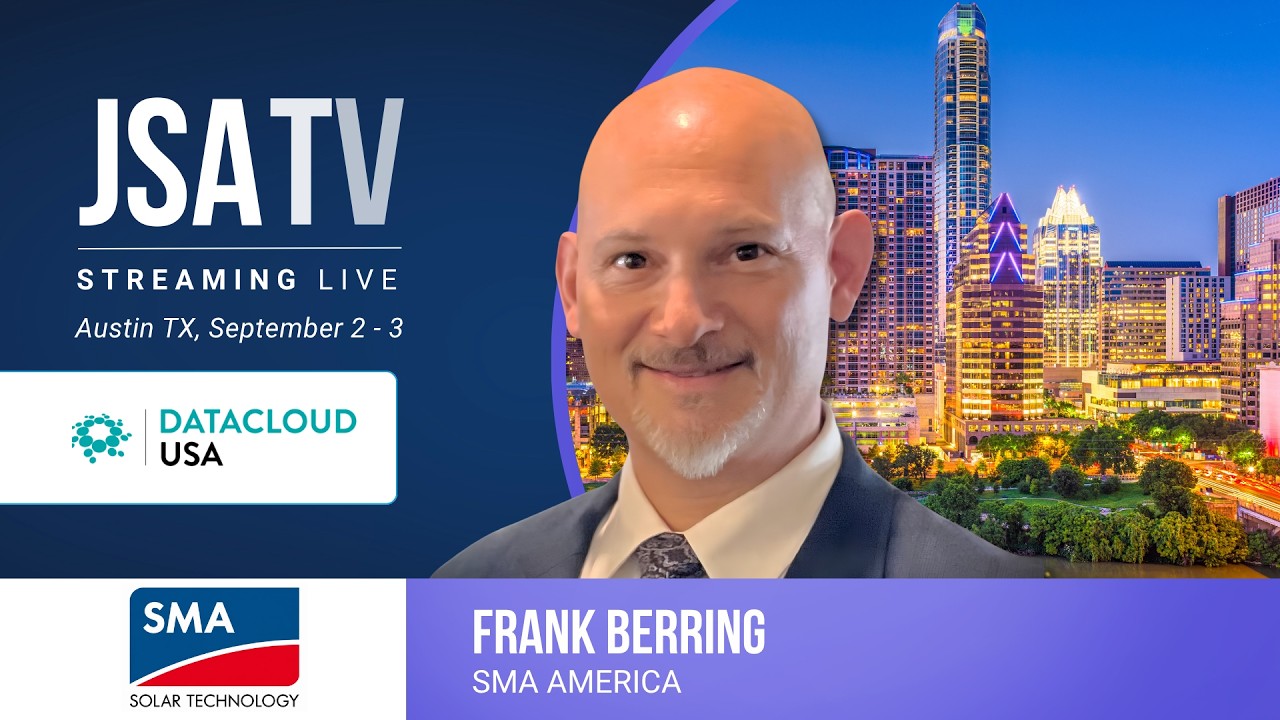
Frank Berring, senior director of business development at SMA America, introduces his company as a global leader in power conversion solutions headquartered in Germany with a significant presence in Northern California. At the Data Cloud USA event in Austin, Texas, SMA is showcasing its innovative technologies designed to address the escalating power challenges within the digital infrastructure sector. The core focus of their presentation highlights the critical role of battery storage in modern data centers, where these systems act as the essential interface between the grid and the facility's load. Berring emphasizes that connecting a data center to the grid without integrated battery storage is no longer feasible, necessitating power converters that are exceptionally reliable and capable of managing complex energy demands.
The rapid advancement of Artificial Intelligence has fundamentally altered the operational landscape of data centers, creating unique load profiles that require specialized solutions. AI-driven workloads, particularly those utilizing powerful GPUs, exhibit extreme volatility in power consumption, which traditional systems struggle to handle efficiently. SMA's power conversion technology is specifically engineered to offset this volatility, ensuring stable performance despite fluctuating energy needs. As the industry moves forward, the consensus among leaders is that data center infrastructure will inevitably shift from an alternating current (AC) chain to a direct current (DC) chain. This transition allows for greater efficiency and better management of the intense power requirements generated by next-generation AI hardware, a strategy SMA has already implemented in over a gigawatt of existing DC infrastructure worldwide.
When selecting a partner for such critical infrastructure projects, reliability and extensive experience are paramount factors that developers must prioritize above all else. While many companies boast impressive technical capabilities, SMA distinguishes itself through a legacy of solving complex problems over 45 years in the industry. This deep well of experience ensures that their products can withstand real-world challenges without failure, a quality that is non-negotiable when protecting high-value computing assets. The company's brand reputation is built on this unwavering commitment to product dependability, making them a trusted choice for organizations facing the rigorous demands of modern data processing. Their solutions are not just about converting power but about providing a robust foundation that supports the evolution of digital infrastructure in an increasingly AI-centric world.
Looking toward the future, the defining factor for digital infrastructure will be power density, driven by the insatiable appetite of advanced computing hardware. The industry is witnessing a transformation where the ability to manage high-density power loads becomes the primary metric for success, pushing designers and operators to adopt more efficient architectures. SMA's expertise in DC power conversion positions them at the forefront of this shift, offering solutions that align with the predicted trajectory of data center evolution. As GPUs continue to become more power-hungry, the integration of battery storage with advanced power conversion becomes the standard rather than an option. Ultimately, the convergence of AI demands and grid modernization will reshape how data centers are built and operated, making reliability and adaptability the keys to sustaining growth in this dynamic sector.
Read the full video transcript
[music]
>> Good morning and welcome to JSA TV where
we're live at Data Cloud USA in sunny
Austin, Texas covering the stories,
news, and trends of the digital
infrastructure leaders. This morning I
have with me Frank Berring, senior
director of business development at SMA
America's.
Hi Frank.
>> Good morning, Nicole.
>> Good morning. So, tell us a little bit
about your company and what you're doing
here at the show.
>> Yeah, thank you. Thanks for having us.
We are a power conversion provider, uh
one of the biggest in the world. Uh
based and headquartered in Germany, but
our subsidiary in America is located in
Northern California.
>> Okay.
>> This is our first data center show.
>> Wow.
>> Uh where we're showcasing our solutions
down on the second floor.
Meeting tons of new uh clients and
contacts in this industry. It's been
super exciting for us.
>> Wonderful. All right, so everybody
should stop down on floor number two and
see you, right?
>> interested in power conversion for
batteries and data centers, absolutely.
>> All right, so what solutions will have
the greatest impact on the industry's
growing power challenges?
>> Sure. Uh our power conversion solutions
are used for
a number of different applications, but
for data centers, battery storage is
kind of where it's at. Uh these data
centers have a very unique
load profile and use cases for the
batteries.
And the power conversion behind the
battery or say behind the
interfacing the battery to the grid and
to the load uh is
sort of the brains, I'd say, of the
whole application.
>> Got it.
>> Uh you really can't connect a data
center to the grid anymore without
battery storage. So, the power
converters need to be exceptionally
reliable and capable.
>> Yeah, that makes sense.
>> Yeah, that's what we're bringing
to this space.
>> All right. So, how is AI changing the
way that data centers are designed,
cooled, and operated today?
>> Yes, the the AI load profile is the
reason that the batteries need to be
brought to the power chain now.
Uh
and our power conversion is
exceptionally capable of offsetting the
volatility of these AI load profiles.
>> Okay, definitely need that then.
>> Yes, ma'am.
>> All right. So, um what is really
important for developers to consider
when partnering with an inverter
provider?
>> Reliability and experience.
>> Okay.
>> Uh above all else. Everybody has
technical capabilities that they will
talk about, but the reliability of the
product has to be second to none, which
is kind of how we made our brand what it
is today.
Uh and the experience. We've been doing
this for 45 years. We've seen it all and
solved all of these problems before.
>> Got it. So, you're just bringing that
solution here to this industry, right?
>> Absolutely.
>> Love it. All right. So, in one word,
what factor do you think is going to
define the future of digital
infrastructure?
>> I would say power density.
>> Okay.
>> Uh right around the corner, these GPUs
that are
exercising the AI load profile inside
the data center,
they're getting extremely power hungry.
And it's predicted by most of the
leaders in this industry that
the infrastructure of a data center is
going to change from an AC power chain
to a DC power chain, which we've been
doing for quite a long time. We've got
over a gigawatt of DC infrastructure out
there in the wild working already.
That's probably the biggest uh say
technology note that I see in the coming
years.
>> That makes sense. Wonderful. Well, thank
you for joining me today.
>> Yeah, thank you, Nicole. Appreciate you
having me.
>> Of Of And viewers, thank you so much for
joining us. Stay curious, stay
connected, and happy networking.
>> [music]