Video summary
Professor Apurva Chari introduces the Basic Notions Seminar by contrasting traditional solitary research with modern large-scale scientific collaborations, using Polymath 14 as a prime example of crowdsourced problem-solving in mathematics. The central focus of this seminar is determining whether non-abelian groups can possess a norm defined as a translation-invariant metric that satisfies homogeneity. Through rigorous analysis within the context of group theory and functional analysis, it was established that such a norm exists if and only if the group is both abelian and torsion-free; equivalently, this condition implies that the group must be embeddable into a Banach space. This fundamental theorem bridges algebraic structures with geometric properties, highlighting how specific constraints on growth rates dictate the possible existence of certain metrics within abstract groups.
The proof process unfolded through several critical stages involving both theoretical derivation and collaborative refinement. For abelian torsion-free groups, it was shown that they can be embedded into real vector spaces via tensor products over rational numbers, naturally carrying a norm that completes to form a Banach space. Conversely, for non-abelian groups, the existence of such norms is impossible because commutators create an inherent contradiction between linear growth allowed by the triangle inequality and quadratic growth required by homogeneity in nilpotent structures. The collaborative effort on Terence Tao's blog rapidly advanced these ideas over five days, with participants like Tobias Fritz proving that homogeneous length functions are automatically conjugation-invariant, thereby resolving logical gaps regarding right-invariance. Subsequent iterations focused on tightening bounds for commutator lengths, reducing them from initial estimates down to fractions and eventually below one through computer-assisted formal proofs generated by Siddharth Gadgil.
The resolution of the problem relied heavily on probabilistic methods that connected algebra, geometry, analysis, and combinatorics in a novel way. While iterative logical arguments could achieve finite improvements in bounds, solving the core issue required driving error terms to zero using tools like Chernoff bounds or simplified inequalities such as Cauchy-Schwarz and Jensen's inequality. This approach analyzed sums of independent variables where linear growth is bounded by square root growth, forcing the relevant quantity to vanish entirely. The seminar concluded with reflections on how this spontaneous success in Polymath 14 compares to other projects like those concerning the de Bruijn-Newman constant or sunflower lemmas, and discussed potential future applications involving non-commutative geometry and formal deformations. Furthermore, Chari addressed the evolving landscape of mathematical collaboration by considering how artificial intelligence might influence these crowdsourced models in the coming years.
Read the full video transcript
Let's hit record.
We are recording. Yes.
Going to put hide floating
meeting controls.
Okay.
All right, everyone. It's a pleasure to
introduce Professor Apurva Chari here to
be giving [snorts] this this very nice
basic notions seminar.
Welcome everyone that is online.
Uh the title is Polymath 14 from word
games to analysis definition of abelian
groups. Apurva, the floor is yours.
>> Thank you so much again to Emmanuel and
first to ICTP.
So, yeah. So, I looked up online and it
says that the basic notions seminar you
have to explain the basic notion. So, my
basic notion is abelian groups, which is
probably as basic as, you know, you
would start in an in actual math level
math degree. So, but the as the other
part of the title suggests, I will tell
you about something different about this
basic notion. The fact that you can
define it using analysis. So, this is
not something you see in a math degree,
if you will. So, this is all based on
joint work, which is now, of course,
published
with five other authors and there were
inputs from many many other people. So,
if this is as much
the story of a theorem as the story
itself, the story of how the theorem was
proved.
Okay, why is this not supposed to be
clicked? Okay, so I will start more
broadly from some the broader sciences.
And
since we are in ICTP, of course, there
is no the broader sciences are
definitely well represented here and
studied. And there is a fundamental
difference between theoretical or
mathematics and the broader sciences.
They are very highly collaborative. So,
this is one example of
one of the most famous
modern breakthroughs in science,
the genome project of the human genome.
There is similarly the particle physics
at the small scale
the Higgs boson which had 3,000 authors
says the same thing with previous year.
This is crazy. And part of it is the
Atlas collaboration which you can
imagine is a ton of people together.
This is the paper where they announced
it.
On the large scale in physics there is
gravitational waves which also got on
the well.
And this is the paper itself. There are
100 and more more than 100 institutions
more than 800 authors.
And then there is a so okay so there are
all these things from you know from the
broader sciences.
Of course this very theoretical and we
don't really do such level such scale
projects.
And there is one there was one recent
thing that
started that was an initiative and
that's what I will tell you about. So
but it started out and still goes on
with you know the since we are in
Euler's I should have mentioned Euler as
well maybe but yes
all these people were sort of doing
research by themselves. Newton did not
know what Leibniz was doing and vice
versa and so on. Ramanujan of course in
India very famously was doing research
alone until he wrote to Hardy.
Andrew Wiles worked secretly three
decades ago
to prove FLT. Two decades ago Perelman
worked by himself. One decade ago Yitang
Zhang worked by himself.
And so these are all these sort of
individuals sitting in isolation with
pen and paper kind of stories. Now they
can sit in isolation with AI.
Of course.
But so today I will tell you about a
modern collaboration mechanism called
the Polymath Project.
And this is an attempt to sort of
involve many more people than just two
or three into solving a problem.
And I was involved in one of these
problems and it helped answer this basic
question about groups.
So again this is sort of created with a
broader audience in mind. And then
groups are you know groups what are
groups? Groups are really symmetries of
course.
As as a math audience we understand that
a group is something that acts on a set.
And so when it acts on a set it means
there is a homomorphism from groups into
the automorphism group. So into the
symmetries of the set. It fixes the set
as a whole and it just
permutes things inside that entire set,
right? Like rotation keeps the circle
the same but changes the position of
every point in the circle.
Right? And there are of course groups
show up all over the place. So in the
physics there are these Lorentz group
symmetries for instance. There are gauge
groups in string theory.
Uh in my in you know in biology one
studies apparently um eigen values and
eigen vectors and eigen spaces.
And then of course vector spaces are
groups under addition.
Um and yeah for us groups mean
symmetries or permutations.
So here is the question. So suppose I
have a group with a metric on that which
is a metric. So the group is a metric
space. The metric is left invariant and
right invariant.
Okay. When is this a norm? That is the
question.
So what do I mean by a norm? The norm is
exactly what you would expect. The
length of a the length of two times a
vector should be twice the length of the
vector.
Norm of twice g or twice let's call it g
>> [applause]
>> twice the norm of g.
Except that this is I would write twice
g if my group was abelian and my group
need not be abelian.
So I write it as length of g squared.
So I write it as have a distance
satisfying this. Now what is the
distance what is a norm or what is a
length? Length is the distance from the
identity under the group operation. So
the identity of the group operation
would be distance from e to e squared.
And so that's exactly the same thing
from there.
The distance from e to g power n
is n times sorry mod n times the
distance.
That is what I would mean by a norm. So
what are examples of such groups?
So one example is literally this board,
the plane, and this is the example of
the distance is the length. Right? So,
this is a So, as we just said on the
previous slide, these This is a board R
and R 2 or yeah.
This is a group under addition, and then
there's a norm.
And then the norm satisfies this
property.
So, this is the most standard example.
Obviously, more generally, you can talk
about a non-linear space or
even more general Banach space,
whatever. So,
uh not just R N, so any Banach space uh
any additive subgroup is abelian and
torsion-free.
So, what does torsion-free mean?
Basically, torsion-free means that uh
I don't have any elements which are of
finite order, except the identity
element, okay?
I don't have any rotation by 15°, if I
have 90°, because four times that is
identity. Why can I not have
torsion-free? Why can I not have torsion
elements? Because if I have suppose G
power N is E, then I can take the
distance of identity to G power N. On
the one hand, this is zero.
On the other hand, this is what? It is N
times the distance from identity to G.
But N is positive,
so I can divide by that. So, I just get
that the distance is zero.
And this means that G equals E. The only
element with non-trivial with only
torsion element is the identity.
Fine.
The interesting thing is that the
converse is also true. If G is abelian
and torsion-free, you can put a norm on
it.
So, I will [snorts] tell you why.
Because this this is if this is one
slide, not more than that, and it
involves the axiom of choice. Okay,
fine. So, what about the question really
therefore is what about non-abelian
groups?
Abelian example is obvious. So, is there
a non-abelian example of a group with a
norm?
And of course, no such examples were
known when I thought about this
question. So, why did I think about this
question? I was doing something in
probability theory and with Bala
Rajaratnam and
there were some stochastic inequalities
which were true which we proved in semi
groups with a norm with a translation
invariant metric not a norm. And then in
abelian groups with a norm. And so I was
trying to understand if we could prove
those for non-abelian groups with a
norm.
And then I tried to look for examples
and as I said no such examples exist. So
fine, so what can you do? So I I didn't
know what to do. So I emailed lots of
people
and I asked several experts as well. One
of them was at Stanford so I asked her
and but anyway nobody could give me any
answers. And
nobody could tell me any results. So
there are no examples for norm and no
theorems saying such a group cannot
exist or if it exists it has to have
these properties or
nothing was known.
Okay, fine.
So fine, so let's go take a step back.
Of course I will tell you the answer in
5 minutes. But so let's take a step
back. So
if you don't insist on this norm
condition you just insist on there being
a metric then they such groups occur all
the time especially in geometric group
theory. So there are word metrics in
free groups and monoids. There is yeah.
So monoids is the same as semi groups of
course with identity. So yeah and there
are every Lie group of course has a left
invariant Riemannian metric. Compact Lie
groups have bi-invariant metrics I
suppose you can do something.
So uh
great. So therefore there exist like
lots and lots of examples from geometry
not of a norm but just of a metric
either left invariant or bi-invariant
right invariant. So that
You mean
uh
About the norm about the metric?
Yeah, it was
>> there was no metric on the non There was
no norm on the non-abelian group that we
knew [clears throat and snorts] about.
So,
if if So, if your abelianization is
torsion-free, then certainly it has a
norm.
Now, you can ask if it lifts to a norm
above, maybe.
>> It probably doesn't, but it still could
give some information.
>> Right. So, in fact so
Yeah, okay. Well, I will tell you the
answer, but maybe I'll tell you the
punchline. Fine. Every norm on a Every
So, you can't have a norm on a
non-abelian group, but you can have a
seminorm
where the positivity is not necessary.
If norm G is zero, G need not be the
identity. It can be others.
And the kernel of this the Where is all
the G norm G equal to zero? That is
precisely the the
commutator.
>> [clears throat]
>> So, every seminorm on a non-abelian
group pass factors through its
abelianization.
So, that's the answer. Yeah. So, there
is some information, which is that you
lose everything non-abelian
in if you want the norm.
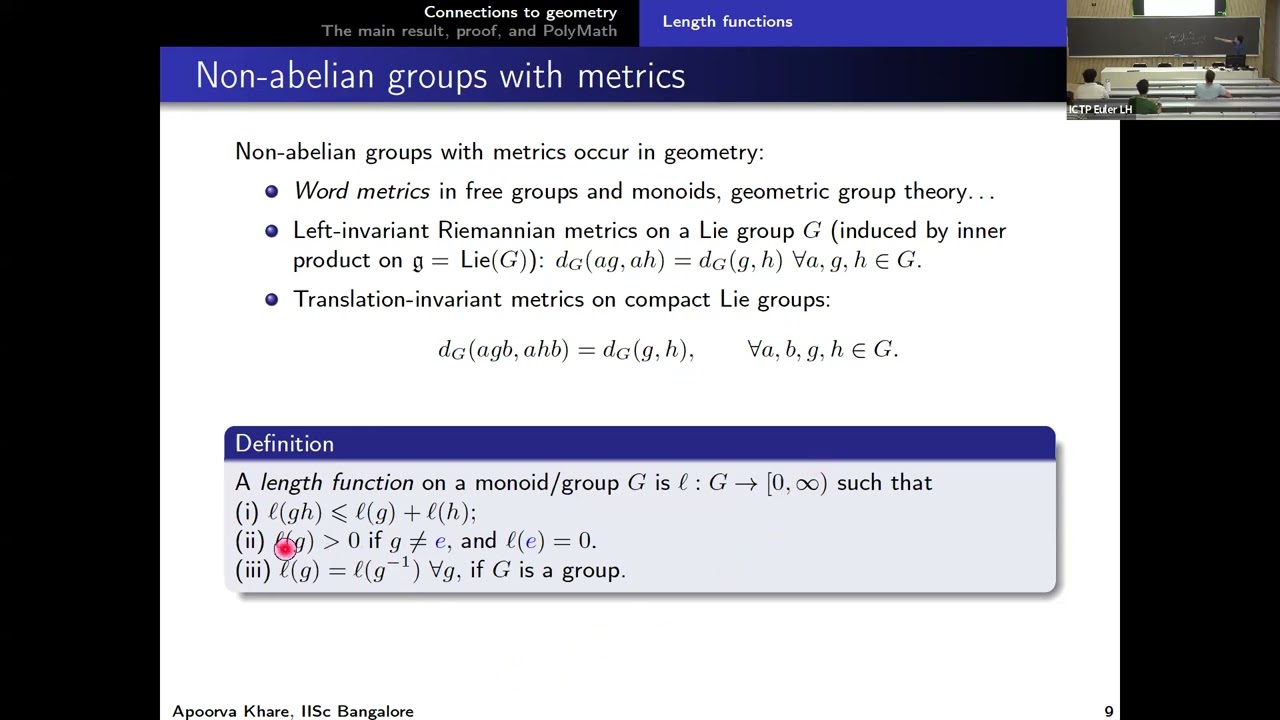
Yeah. So, anyways, let me define So, So,
in the language of geometry, one doesn't
call it uh
the
norm like this. One would call it a
length function.
Instead of Instead of metric, people use
length functions in geometry. So, I'm
just telling you different languages.
So, length function on either a
semigroup, monoid, or a group Oops,
sorry.
Uh a length function is this this some
non-negative valued function. This is
basically the triangle inequality. This
is positivity, and this is symmetry. So,
it's exactly a metric. It's these three
metric properties. Uh if there was no
inverses because it was a semigroup or a
monoid, then the third You can ignore
the third condition.
But so,
how is this a length function? So,
basically, what we are saying is What is
the length? The length is going to be
obviously, the distance from E to G.
Now, if you want to say something like
So, what So, what we really want to say
here is it's not just any distance
function. If the distance function has a
little extra structure, which is that
the length of
What do I want to say?
So, yeah. So, basically the point is
this length function should also be left
invariant.
>> [clears throat]
>> Meaning that the distance from
GA to GB
is the distance from A to B.
Now, how does that help? Because if now
I have a triangle inequality
So, what is length of GH?
This is distance from identity to GH.
Which is distance from E to G plus
distance from G to GH.
And now this is left invariant, so I can
cancel and this is exactly
length of E plus length of length of G
plus length
So, so somehow length functions
correspond
to left invariant metrics and the
reverse the reverse way is done. This is
how you go backwards as well.
If I have a
If I take this metric out of the length
function, then this is left invariant
because the
translations go inside and cancel out.
Okay, great. So, this is a So, this is
in the language of geometry that this
left invariant metrics are called length
functions.
What happens What is called a norm? The
norm property is that it's homogeneous.
It's said to be homogeneous if this
happens. The distance from identity to G
power N is
Oops.
Yeah, A is this is what I mean.
Okay. So, this is what is would be
called a non-abelian version of a norm
because G power N is multiplicative
annotation.
Great. So, the question then is in the
language of geometry, the question is if
G is non-abelian, can any length
function be homogeneous?
Same question.
And now there is a result of Milner
which says that if G is a connected Lie
group and not abelian, then this cannot
happen. I will tell you why.
If G has nilpotent degree two, this
cannot happen either. So, this is a
calculation which maybe I can show you.
So, what does it mean to have nilpotent
degree two? So, nilpotent means you take
commutators. You get commutator.
Degree two means that the second time
you take commutator, you get identity.
Which means that the commutator itself,
the first time you take was in the
center. That's why it commutes with all
of G.
Right? So, that means that every time I
take
So, now now look at the right hand side.
I take GN and HN, right?
So, [clears throat] I'm taking GN and
HN. So,
this means that basically I'm taking N
of these elements plus N of those. There
are N squared many uh transactions,
right? Every time I create a
transaction, I create a copy of the
commutator.
And that is central. That is in the
center. So, I can just push that all the
way to wherever. Now, I take one more
copy, one more transaction, one more
central element to it. So, every time I
have N squared transactions, I get N
squared of these elements which lie in
the center.
And so, that's exactly where the left
hand side is the right hand side.
But now, let's see the length of both
sides. Suppose I had a norm, suppose I
had a homogeneous length function.
This length of
GH
N squared.
Sorry, N squared this side.
But what is this? Since it's a length
function, since it's a norm, this is N
squared length of GH.
And on this side, this is the length of
GN HN G minus N H minus N. So, whatever
this is, it is growing linearly because
of triangle inequality. It is N times
the length of G to the length of length
OF H.
ON THE OTHER HAND, IT'S ALSO GROWING
QUADRATICALLY. SO, how is something
quadratic growing slower than something
linear?
Only if this length is zero.
Otherwise, it cannot grow small. But if
this length is then when is the length
function zero? The element has to be the
identity.
When is the common to identity? If they
commute. So again non-abelian is really
bad.
So that's why if G has nilpotent degree
two
norms cannot exist. So So basically
>> [clears throat]
>> On the other hand, if you have a
semigroup or a monoid, then this was
explained to free free monoid. Then this
was explained to me by Robert Young of
Courant
uh that
there is something called a Levenshtein
metric which is a word metric which
always exists.
So for certain classes of groups
length function homogeneous length
function or a norm cannot exist
non-abelian groups. On the other hand
for every single free monoid such a
function always exists. So what is the
answer for a generic group?
That was still the question. Do
Is there Can they produce an example or
can they prove that these don't exist?
Okay, so without with this preamble here
is now the main result.
So the following are equivalent and the
answer is they don't exist.
So
G is abelian torsion-free if and only if
it has a norm.
If and only if in the language of
geometry it has a length function that
is homogeneous, but I don't even need
homogeneous. Just this double condition
is enough. So we will prove all of these
are equivalent. I'm going to give you
almost a complete
If and only if G embeds into
a Banach space.
So as we started out by saying that
these are some obvious examples of norm.
Take a lattice or take any subgroup in a
in a in a real or in a Banach space,
clearly the norm scales.
It turns out these are the only
examples. There are no others.
So the natural examples are the only
ones and so in some sense this is a
slogan for you know also the unity of
mathematics.
Because
you like algebra you like abelian
groups, well here is an analysis
definition or characterization.
If you like geometric group theory,
well, you can say that's the same as
embedding into a Banach space.
So, I mean, all these things are really
connected, they are equivalent, and one
has to of course mention this phrase of
Hermann Weyl here. In these days, the
angel of topology and the devil of
abstract algebra fight for the soul of
every individual discipline of
mathematics.
So, but sometimes angels and demons, you
know, can be one and the same.
So,
that's that's this that's the thing.
That's the main theorem, and the rest of
the talk I will try to prove the main
theorem.
Okay, so
clearly, if you embed into a Banach
space, then you are abelian and
torsion-free, that's obvious. [snorts]
And you are a metric space with a norm,
also obvious.
If you are a metric space with a
two-sided invariant metric, then you are
left invariant. So, and if you have a
norm, then it's two-homogeneous. So, all
these implications are trivial.
Okay?
So, the first thing I will do is tell
you why if a group is abelian and
torsion-free, you can put a norm on it.
You can embed it into a Banach space.
Okay? And that is going to use Zorn's
Lemma.
Next, we're going to show that basically
three implies two, meaning if you are
two-homogeneous, if your doubling
condition happens,
then you are then you have the condition
for every single n. That's a very cute
exercise, but we will do that exercise.
And the the finally, the hard part, of
course, is if you are, you know, if you
have a norm, then you are abelian and
torsion-free.
Torsion-free is again easy, that we saw
already. That you are abelian.
So, if you have a norm, why are you
abelian?
Okay. So, let's start with why is every
abelian and torsion-free group
embeds into a Banach space.
So,
exercise.
If I take any
any real vector space,
this has a norm.
This is a
>> Right.
And the answer is basically this. You
take any Hamel basis
Hamel or whatever called basis.
And then you give each of them the norm,
let's say the norm equals one.
And then you take the element
uh alpha beta times v.
This is You can take it to the finite
sum of course.
So,
>> [clears throat]
>> and that's that's a norm. So, every
every real vector space has a norm.
Okay, so now let's prove the
question. Let's answer the question,
right? Does one imply four, meaning the
title of the slide.
So, suppose I have an abelian and
torsion-free group,
then it's a subgroup of this.
Because it is this it's basically a Q
You basically are base changing from
like you know, Q to R, but actually
you're doing it from Z to R. So, the
point is if my abelian group is uh
Z, if they if they're integers, I just
get the real numbers.
But if my abelian group is R itself,
then what I get, R tensor R over Z, is
an enormous vector space. It's not just
one dimension. It is very very big.
But it Nevertheless, it is a real vector
space. So, then because of
torsion-freeness and so on, this is a
real vector space. So, I can put a norm
on it.
Let's put a norm on it.
And now restrict it to
G tensor Q. So, all we do when we say G
tensor Q is we first of all we take a
subspace of this with over the
rationals.
But basically all we are doing is we are
just taking G and introducing
denominators. We are like one over n, G
over n basically. All we are doing here
is taking fractions of G.
So now if my G was R, then R already is
closed under fractions. So then suddenly
I reduce from this enormous vector space
just down to R itself.
Something like that.
Okay, great. And now it's very easy.
Just do the Cauchy completion. The point
is this vector space, we already had a
norm and now this this vector space had
a norm on it which is scaling invariant.
So just now Cauchy complete and that
becomes a real vector space again with
and the norm extends to the whole thing.
And that's therefore a complete R vector
space under norm. That's a Banach space.
So just the standard constructions you
would expect.
But you can do this.
Fine. So this is why
one and four are therefore equivalent.
Okay, so now again, why does three imply
two? See the title of the slide. This is
another cute exercise and now this time
I will ask you guys.
Okay.
Let's just suppose I know that length of
G squared, I know that just this
doubling property holds.
Length of G squared is twice length of
G.
Can I Can you tell me another number N
for which length of G power N is N times
the length of G?
>> Four.
And so you can do that. Length of G
squared
twice length of G.
This implies that the length of G fourth
is length of G squared squared. So
that's twice length of G squared.
And you can keep going. So for every
power of two, this is clear.
The question now is what about length of
G power six?
I want to prove this is equal to six
times length of G.
How do I go about that?
So the answer is I don't. I do the
following. I take a power of two bigger
than
six. So I take G to the eight.
Yes. This on the one hand I know is
length of is eight times length of G.
But now because this is a triangle
inequality, this is length of G to the
six
plus
one more and one more. I keep them
individual or I can I can do here as
well. Two of them but whatever.
But now because of triangle again, this
is less than six times n plus two.
G G G G. So I just break it up into lots
of G's.
And so what I get is this is eight
times.
So I started with eight and I ended with
eight. So everything in the middle is an
equality.
So this is an equality.
And I'm done.
So it's a very cute trick. This is I
found it somewhere in the literature. I
think in the paper by Gajda and Kominek
if I remember.
And so yeah, so everything is done and
then you can do this for any positive
integer the same way and for negative
integers you can use symmetry and so
you're done.
Fine. So except the fact that the proof
for three implies two is not complete.
Why not? Because in three we were
assuming that the metric was left
invariant and in two we are assuming
it's bi-invariant. So I need to prove
the right invariance as well.
Fine.
Except for that the proof the hard part
is this. Well, that's no, this is easy
part. The hard part is that because we
don't know it yet.
It is the hard part is like three lines
of proof. That's it. But it's it's very
clever.
We are getting there. Okay, so now
finally the main part of it is that I
have a group. I have a norm on it which
means just I just have this condition,
left invariant metric with this.
And I want to prove that the group is
abelian.
So torsion free was already done. We
checked that, so that's fine.
Okay, so
So now here are some other concepts. So
this is where I'm telling you about
Milnor's theorem while we wait for the
abelian proof. So if if G is nilpotent,
we saw that G has to be abelian because
if G is nilpotent, you can look at the
nilpotent degree and then if the
nilpotent degree was two, then we proved
that the actual nilpotent degree was
one.
Because anything in the commutator is
you know, you can push it back. So GK
take the composition series of G and
then you get to the subgroup which has
importance degree two. But then that
reduces to the calculation we did here
with the N square transactions.
And then actually the importance degree
two would have the importance degree one
in that context. So that's a problem.
Okay, here is now the other part. So as
we said in the main theorem which I
haven't yet
finished proving, if you take any
abelian torsion free group it embeds
into a Banach space.
Can that have a non-abelian counterpart?
So first of all what might So this is a
very vague question. So I'm I'm going to
give you one answer to this, but I mean
this is not a theorem. So what is a
non-abelian counterpart of a Banach
space first of all?
Mathematically what would you suggest it
is? So in my case I thought of the
following. A Banach space is a complete
is a geodesically complete
space, abelian group of course. And what
is a geodesic between two points in a
Banach space?
It's the straight line.
So what are non-abelian geodesically
complete groups? They are called Lie
groups.
And suppose we had translation invariant
metric. So suppose I have a group with a
translation invariant metric.
A theorem of Milner which I mentioned
says that any such group
any such connected Lie group
is actually RN cross K for a compact
group K.
So now does this have a Can Can this
have a non Well, let's restrict the
norm. Suppose this was translation
invariant. Let's restrict the norm if
that metric was a norm to K.
Right? So I take an element of K,
a non-trivial element of K.
And look at the distance from identity
to K. So that's just a positive number.
I scale. So of course every power of K
belongs to the compact subgroup. So I
did What what happens to the powers
distance to the identity?
The length grows unbounded. But this is
a compact [snorts] group. So I cannot
have an unbounded
set of a lot of unbounded sequence of
elements.
So, there cannot exist a non-trivial
element of K in the first place because
that would grow.
That means K is the identity. K is
trivial.
But then G is a billion because G is R
in under the So, again, this is still a
billion. If it is a norm, so a connected
Lie group with a bi-invariant metric
Yeah, which is a norm has to be R. That
was Milnor's theorem.
So, again, this doesn't So, there there
were
reasons to believe that yeah, these such
groups don't exist, but that is very far
from being a proof.
So, now I'm telling you the final bit of
the proof. So, this was in 2014 that I
first had this question and then I asked
lots of people.
No answers were found, then I gave up on
the question myself and I had other
things to do like move back to India.
So, then but then I went back to the US
that same winter, my first winter, to
Terence Tao's office and I asked him the
question.
And he also couldn't solve it, so we
should feel happy that he couldn't
He couldn't immediately see why, but so
this is the discussion we had.
That suppose take you take any group
with a norm.
If I want to prove it's a billion, he
felt we should try to prove a billion.
So, but if I want to prove it's a
billion, then why I want to check that
any two elements commute.
So, the key quantity, which I will call
this KQ, is the norm of the commutator,
which we discussed over there, right?
Why is this a key quantity? Because if
this is zero for all alpha beta, then
the commutator is identity. If that is
identity, G is a billion.
So, this is why
we want to keep we want to show somehow
that this length this norm of the the
the commutator of any two elements in my
group
is zero.
How do you do that? So, of course, Tao
being an analyst, he says, "No,
you have to prove that it is less than
epsilon for every positive epsilon.
You must use the Archimedean property of
the real numbers.
So, can we show that it is very small?
Can we show that it is less than epsilon
for every epsilon?
So, okay. Some things you can do. So,
first of all, let's No.
Okay. So, maybe I should say the
following, right? So, suppose I have a
Let's write this down.
So, I have a group with a norm.
So, I want to prove to to show that G is
a norm.
I want to show it's a billion.
So, I just basically need to fix two
elements.
We need for all alpha and beta
alpha and beta, it's enough to show that
the subgroup they generate
is a billion.
So, I may as well think of my G as being
this.
This is my G.
And I want to show that this the norm
restricts to this, this is a billion,
then G is a billion, right?
So, on this, I can again, and I have
some length function, but I can make
sure that the length of alpha, alpha
inverse, and beta, beta inverse, all
these lengths are less than one.
Because I can length function divided by
anything is also length function, right?
So, this is
>> [snorts]
>> So, normalize the length function so
that they're all one.
Then,
first of all, here is what it is. The
length of the commutator, my key
quantity, KQ, is less than four. That is
obvious.
But now we are going to show later on
that the length is actually preserved
under conjugation. So, when I said that
we haven't yet shown the left invariance
implies right invariance if it's a norm,
that loose end, that is translates
exactly to this condition. We will show
that in in a three-line proof,
probably in the next slide or something.
But now, can anyone Can anyone now tell
me why this length this commutator is
bounded above by two, not four?
>> If you have the property below.
>> I'm assuming the line above that.
>> Yes, you're assuming that this is
conjugation invariant.
And you're assuming that all the lengths
are less equals one.
>> You have this.
>> [snorts]
>> Yes. So, what you exactly So, what you
do is you say alpha, beta, alpha
inverse, beta inverse.
And this is length of this. Well, I
break it into two parts.
This length is the same as length of
beta, which is at most one.
And this length is beta inverse, which
is also at most one, and so you get two.
Okay, I did it the other way here.
So, alpha and then the rest of them, but
anyway, I don't need this.
Great. So, therefore, this is less
equals two.
But now I claim that you can do this
even better. You can do four over three.
So, now we are just going to play these
word games.
This is Now, how do you show that So,
now here is the key fact. How do you
show that a number is less than four
over three? This is a real number.
You show that a number is less than four
over three if three times that number is
less than four. That is, everybody in
class one or two should know this. Maybe
they don't need inequalities.
Fine. So, how do you show that this is
less than four?
This is
There's no good [snorts] chalk. I'll use
the small one.
To show that something is less than
four,
Sorry, I want to show four is bigger
than three Q.
What is this? This is three times the
length of alpha, beta, alpha inverse,
beta inverse.
I must use now the fact that it is a
norm.
What is three times the length? By
definition, this is the length of
by the norm property. It's the length of
this element Q.
This is a string of length four, so I
have a string of length 12.
Right? Yes. So, I WRITE THIS DOWN.
AND SINCE THIS IS AGAIN A BASIC notion
seminar,
we are going to use the basic notion of
associativity.
You can write this as product of three
different strings of length four, or you
can write this as product of four
different strings of length three.
And now we know what
>> [snorts]
>> This has length less than one conjugate.
This has length less than one, length
less than one, length.
So, exactly that. And so, we get So, I
can say that I've never appreciated or
liked the associative law of groups as
much as when I did this.
Like
So, because you can't play with anything
more than these very, very basic
notions, right? So, this is the notion
of associativity.
And now we have this is less than four,
so therefore we are done.
So, three times something less than
four.
And so, this is less than four times So,
the
question is, can you come up with these
tricks? Can you keep doing better and
better tricks to come down to zero? We
went from four to two to four over
three,
but you know, we haven't even gone below
one, let alone close to zero.
So, this is when we This is the This is
the discussion we had in Tao's office,
and then then I left that, went back to
San Francisco to fly back, and Tao said
that uh yeah, can I put it on my blog?
Uh so, I said, "Sure, please put it on
your blog, and maybe some other people
can give some Maybe they'll find a
clever proof."
So, here is the
blog post, and this was posted on 16
December in the US, which is
17 December in India. So, then I I took
off after the blog post, and then I
landed in India after 15 hours or some
direct non-stop flight. And there were
so many comments on the blog. Uh
this might be a later time, but yeah,
there are a bunch of people who have
commented. Some of these names actually
I think every one of the names here is a
collaborator on that paper on that
paper. Yeah.
So, uh
there are four names here.
right. I should mention what he said.
So, here is a curious question posed to
me by Apoorva. I don't know the answer
to that. He poses the question, triangle
inequality and the linear group. This is
the key, the norm condition, right?
And uh conjugation invariance, blah blah
blah. What is not clear is if one can
keep then in in the fold which I have
skipped over, he mentions this
calculation, 4 over 3 and two of course
two and 4 over 3. He He stops here and
he says what if is not clear is if one
can keep arguing like this to keep
improving the lower bound
until
the slow the upper bound on the norm
until the upper bound must vanish.
But anyway, this seems like a problem
that might be receptive to a crowd
source attack. And so I'm posing it here
in case readers want to make progress.
And so this brings me back to the
opening slides where you know
mathematics is very individual
uh individual profession or research or
hobby or whatever you want to call it.
But there are some attempts like this
where you you know try to get crowds
involved. And a lot of people did get
involved. They sent lots of suggestions
and tips and ideas.
So, the first two days so and the point
is this got solved in 5 days.
But not really 5 days because three out
of those 5 days weren't really doing
anything. So, the first two days people
actually tried to find examples that
will will be a countably will have a
non-abelian group with a length
function. You know, loop groups and
winding numbers and algebraic topology
and lots of such things.
But uh as we now know from the theorem,
such examples don't exist. So, at after
2 days I think people mainly gave up.
And then they started to think about uh
how can we prove the group is abelian?
Okay. So, here is also as I said, so the
story of the timeline.
So, uh the first comment in 3 hours was
the loose end that if you have the norm
and you are merely left invariant, then
you're right invariant as well.
That was done in 3 hours, and I was sort
of beating my head, you know, why didn't
I see it for the last 3 years? But,
there are some really clever people.
Another one will show up later in the
talk.
Uh so, here's the lemma.
So, this is Tobias Fritz's uh result. If
G is a homogeneous length function, then
L is conjugation-invariant.
And if you translate this condition
under the fact that length is distance
from identity, then this
conjugation-invariance is the same as
saying that the distance is
right-invariant.
So, suddenly it becomes bi-invariant.
So, you don't need to assume
right-invariance, you get it for free
from the length from the norm condition.
Okay, great. So, uh
Why? So, I have The proof is inside the
remaining part of the slide. So,
Okay, the proof is still inside the
remaining part of the slide.
Okay, so here is the proof.
So,
So, now this is where you use the fact
that conjugation powers of conjugates
are very nice to calculate. N times the
length of this thing is length of this
to the N, but that conjugate to the N is
this. And now you use the triangle
inequality, so you get this.
And this is true for all N, right?
So, all you do is now divide by N.
You get
the length of g a g inverse on the left
is less than the length of a h plus some
error term.
And now this is the next basic notion,
do you remember, which is called the
Archimedean property of real numbers.
If you have a real number less than
another real number plus anything any as
small as possible, then you can get rid
of that. You can take limits.
So, this is the Archimedean property.
Again, I have never appreciated the
Archimedean property as much as I did in
Tobias's proof.
And so, this is of course one side,
length of the conjugate less than length
of h. Conjugation is an equivalence
relation, so
you're done.
So, great. So, this addresses the loose
end, this finishes everything, and we
get that it is uh yeah,
conjugation-invariant. So, this trick
also works. This also works.
Good. So, now So then So then people
again So with Tobias' result, people got
energized. They started to find stuff.
As I said, the first 2 days was not
really a very productive cuz everybody
was trying that way.
But then finally people said, "Okay,
fine." So this is 2 and 1/2 days later.
Some progress had been made. So from
4/3, people improved to 5/4.
It's an improvement. 5/4 is 20/16.
Somebody improved it to 19/16.
About 1 hour later. So
this is like Will Sawin in 24 hours
posting
that unit distance problem improvement
or something. But then this was done on
the fly. Every Everything was happening
on Terence Tao's blog. That was where
people were posting all these comments,
improvements in the comment section. So
you have the whole history still there.
And then there were more clever
calculations and people tried to get it
below 1. Finally, some insane like
conjugation, this, that, something
insane made it work.
The bound went below 22/23. It's like
the world record for the 100-m race you
know or the marathon or something.
Going down. But still I mean you know So
now and then there was a 24-hour
barrier.
So when I said three of the five days
were done doing nothing, well, not
towards this proof. The first 2 days
were gone and this 24-hour barrier was
gone.
And
basically nobody had any idea how to go
even crazier or even cleverer.
And then this is where the next
interesting feature comes up. Everything
was happening on the blog and there was
a computer involved.
So Siddharth Gadgil, who is my
colleague,
he he had a remarkable idea. He said, "I
will do both things at the same time."
So that from the beginning, he was
spending his time
trying to come up with algebraic
topology and geometric examples to not
work and he programmed his computer to
try and make it work. So he did both
together. This is a very safe approach,
I guess.
So, uh
and he actually found it or his computer
found it. So, here is the So, the
right-hand side Okay, well, I can show
you the the the conclusion was the for
the original conclusion was 0.95,
something like this. And Siddharth's
proof gave it 0.816. So, okay. Let's
look at the right-hand side. This is
Siddharth's post.
Here is a computer-generated proof on
the bound of the length of a commutator
for a linear norm the norm. Right? And
so, it starts literally with he made the
computer write it down into a form that
human beings can understand. Statement,
next statement, next statement. The
previous ones imply the next one. So,
that way. And it took 126 lines.
So, it started from the norm of alpha
inverse of A inverse is less than one.
Therefore, the norm of the conjugate is
less than one. Norm of B inverse is less
than one. So, the norm of this conjugate
is less than one. And you keep going.
The 125th step is that the norm of ABAB
A bar B bar So, A bar means A inverse.
And like this is a 68 element string,
which is 17 copies of the commutator.
So, the length of the commutator to the
17th is less than 12 13 13.8596.
Divide by 17, and then the length is
less than 13 whatever.
0.815. So, therefore, 0.816.
So, this was done on a Saturday morning,
apparently.
Uh
>> [clears throat]
>> Saturday morning in America was Friday
night. So, Pace Nielsen, and this is the
left-hand side now. So, since this is
all UCLA time, 20th December, 3 days
later, at uh or 4 days later, at 8:00
p.m.
So, and Pace Nielsen was in Utah, which
is one time zone ahead. He had finished
his dinner on Friday night. He was
sitting at home.
He saw this comment, and then in the
next
100 minutes, it took him 100 minutes to
read the whole thing, to understand the
whole thing, and to improve on it, and
then to write all the math here in the
comments. So, some people are not only
very sharp, they're also very fast.
So, he says that my this was beautiful.
My intuition was that we have some
reason to do something. When I read this
computer's proof, I was surprised that
this is exactly what the computer did.
With some extra ideas thrown in.
And then he says that the first 43 lines
he summarized established this. The next
30 lines established this. And then here
is some improvement from for what we
were doing. And then the last few lines
established this.
And now also he said he can improve on
this in the following way. So, all of
that in 100 minutes.
Fine. So, that was that.
So, okay. That is all sort of fun and
games, but now let me again tell you the
math. So, finally what was the computer
doing? People try to understand that.
This was 21st December 9:30 a.m.
Uh and then I think a few
Tao probably didn't answer that day, but
the next morning he did and then with
discussions we got this lemma out of the
whole computer input.
Suppose I have four elements
in a group with a non with a
right and left and homogeneous length
function, right? Suppose I have four
elements. X is conjugate to WY and to ZW
inverse. Then the length of X is
less equals this thing.
And the key point is it doesn't depend
on W.
Fine.
So, uh let me prove this for you. And
then let me show you
uh
>> [clears throat]
>> an application where we will go even
more beyond below .816 or whatever it
is.
The proof is not that bad. So, the idea
is the following. Write down X to be a
conjugate of WY.
Write down
also conjugate of this thing. And the
claim now is that I write X power 2n.
Okay? X power 2n. The first n copies I
write in the first way. And the second n
copies I write in the second way.
And now don't look at this inequality.
Look at the picture. Okay? So, the the
the length of this big string here this
big string is drawn in the picture.
There's a S at the start, there's a T
inverse at the end, and so on.
So, the length of this big string, that
is what I want to upper bound. That's
less than the length of S,
and the length of T inverse, and
everything in between.
But, everything in between is a
conjugate, the outermost arc.
The length is conjugate invariant. So, I
can kick out like discard those W and W
inverse.
Right? Then I get a Y. Fine. Then so,
what I get is So, maybe I'll write those
strings. Maybe it's easier to see.
Start with this one.
There's a S, there's a W Y W Y
W Y S inverse T W Y. No, this is
something else.
>> W Y S inverse
>> W inverse Z, sorry. Thank you. No, Z W
inverse.
The length of this The single The single
length of S
plus length of T inverse
plus length of the rest. So, I can kick
out the rest.
So, oh yeah. So, I'll take this out,
this out.
And so, this is less than this.
Now, this is a conjugate, so I can get
rid of the W W inverse because it's
conjugate invariant.
Now again, I get these terms. I get plus
length of Y
plus length of Z
plus length of the rest.
Again, of course I have a
W and W inverse. So, again I can get rid
of these guys.
I again get a length of Y, again length
of Z, again get rid of the W W inverse,
and you keep going. And you can see that
all the Ws and all the W inverses just
go away.
And finally, I get another length of S S
inverse and length of T. So, there are N
Ys, there are N Zs, and then there are
these four terms.
And now you know what to do, exactly
what to be expected.
Divide by 2n
and take n to infinity.
And then you get length of x because
that's twice 2n length of x is less than
the average of y and z and some error
term that goes away.
So, this is what it is. Now, why is this
useful? So, this is useful in the
following way. Let me write this down
here. Let me
So, I'll write down the lemma first.
Just the statement and then we will
apply it.
And then interestingly, so x is
conjugate to wy and zw inverse is less
than the length of x is LESS THAN 2.
>> [snorts]
>> OKAY, SO HOW DO YOU SPECIALIZE? SO, I
SPECIALIZE WITH THIS EXAMPLE.
x is
alpha beta So, x is alpha beta alpha
inverse beta inverse.
Again, one more time.
There's a nine element string.
And then I called them So, y was
something weird. y is alpha bar
beta inverse alpha beta
and then
alpha beta Sorry, I should know this.
It must be this.
Yes, that's it.
And the And the
w is beta.
So, x is conjugate to wy. Let's write
down wy. This is beta here.
Is this conjugate? Yes, if you see
there's two alphas here. If I multiply
on the left right by alpha inverse and
then by alpha, I get This is a
commutator. This is a commutator.
So, I get exactly this, but the alpha
was moved here. So, it's conjugate.
And similarly, you can check that x is
conjugate to zw inverse.
Fine. So, with these four elements, I
claim
uh So, first of all, let's write down
the length of x. Fine, before I claim
anything.
It's the length of two copies of this
thing plus this.
Uh fine, but And what is it? By the
lemma, it's less than the length of Y.
Well, what is Y?
Y is
Y is the conjugate
of two things. So, the length of Y is
conjugate invariant. So, the length of Y
is the length of this. By the triangle
inequality, 1 + 1.
And the length of Z for the same reason
is also 1 + 1. So, two. So, the length
of X is at most two.
Now, the claim is that 8 over 11 works.
And 8 over 11 is
much less. So, let's see. How How do you
prove 8 over 11? You know what to do.
Multiply by 11. So, 11 times this thing,
this is a 44 element string. So, you
write down 44 elements.
Separate them into groups of four.
Okay? And you notice that the in groups
of four, the 11 element string, every
one of them is a conjugate.
So, this is less than the length of the
nine element string, 11 element string
plus 11 element string plus 11. But,
each of them is a conjugate, so the
inside nine, inside nine, and nine. And
every one of those nine element strings
exactly looks like X.
So, every one of those is size two, at
most two.
So, 8 over 11.
And so, this is a 0.72. So, suddenly,
you know, we have shaved off a tenth of
a second from the 100 meter record.
But, of course, the problem is this is a
finite improvement.
And we want to come down to zero. So, if
you take If you think about it
logarithmically, this is some negative
number in log. This is negative in log.
0.72 is even more negative in log, but
it's a finite reduction. We want to go
down to log of zero, which is minus
infinity. So, that's not A finite
reduction doesn't help. We need
something that will work infinitely
many times. So, what is the trick? It
turns out that this internal this this
trick of using X this this lemma here,
you can cleverly use it infinitely many
times
into one tool, and you can use that tool
infinitely many times. So, sort of a
quadratic infinity,
uh infinity squared many times
uh
to do the job.
And the final step, as it turns out, I
have a I can show you the proof later
on, but the final step, when you write
it down explicitly,
can be used either explicitly using
binomial combinatorics. So, we have seen
some algebra, some geometry, some
analysis. You can do some combinatorics,
or you can write it in the language of
probability theory.
So, sort of all kinds of mathematics
comes together to prove this.
And the key step, finally, is you want
to show that something grows faster than
something, or something grows slower
than something.
And so, the the sum of n such IID
variables, IID, has average spread,
meaning standard deviation of the
magnitude square root n. So, when you
take IID uh
n variables, the variance is n.
And the the standard deviation is square
root n, and this is going to bound the
multiple of
the power of this as n goes to infinity.
But, what is this? This is This is
growing linearly in the length, and this
is only square root n.
And so, when you divide it out, you get
exactly that. So, the upper There's a
linearly growing quantity upper bounded
by a square root n quantity.
So, then, of course, you cannot do that
unless your quantity itself was zero.
Just like in the commutator case, it was
a quadratically growing quantity bounded
above by a linearly growing quantity.
Right? So, that's that's how one does
it. And this was So, this was not This
is not exactly this was observed by Tao,
but I will show you what he said. And
so, in some sense, it finished the proof
just less than 5 days later.
So, this was the just to remember that
show the timeline, this was the 22 of
23, almost 24 hours later, Siddhartha
Gadgil had this computer-generated
solution.
And then, finally, this lemma was
abstracted.
Also, Tao was awake, I guess, because
this was this Oh, no, no, no, this is
almost
Yeah, yeah, this is only 4 hours later.
So, Tao himself was awake and then
because I remember he had a part to play
in this lemma. So, and then in 4 hours
the lemma was made, the lemma was
applied, we got to 8 over 11.
Within 4 hours more it was 2 over 3.
But again, these finite improvements at
this point stop mattering. And then
there was this idea again by the first
guy who suggested this good idea, Tobias
Fritz. And he suggested that think of
alpha and k. So, think of so,
not just the length of alpha power m.
No, just not just not saying that this
length of alpha power not the length of
commutative power k is smaller. Think of
this length in two variables and think
of it as sort of a discrete heat
equation kind of. That was his his
words.
So, this some kind of discrete heat
equation evolution, there is a drift in
this equation. When you think of it
probabilistically, there is an
expectation that is non-zero. So, there
is some drift and that drift is what
helps us.
And the last
Yeah, this happened let's see.
p.m. a.m. This six This was 6 hours
later and then I guess Tao had woken up
and then he he's he said that one can
finally do this to kill off the problem.
One can do some kind of a simple random
walk and then move by this these two
steps, 1 minus 1 0 or 1 minus 1. That is
roughly the drifts in these two steps
with half probability of each. And that
will hit something with an exponentially
high probability by a Chernoff bound.
So, he really applied some high power
relatively high power tools. Chernoff
for me may be high power. Uh but then
later on when we did the work, oops,
sorry. When we did the when we wrote up
the paper, it turned out we just needed
Cauchy-Schwarz or Jensen's inequality,
which is much more basic than Chernoff's
bound.
Just a basic thing like weak law of
large numbers and Jensen did the job.
For the last step. Okay, so the last
thing to mention then is that if you can
This was saying that the length becomes
zero.
If you have exact triangle inequality
and you have exact norm or doubling
condition, the length becomes zero. You
can make that quantitative. So, what do
I mean? Let G be a group. Let L the this
be a quote-unquote almost like almost
length function length function up to
error.
Such that so you have the triangle
inequality up to an additive error.
So, the point is the error doesn't
depend on the whether you take G power N
or H power N. This C is the same
regardless
And you have a
homogeneity. You have the norm property
up to another additive error.
Then for any alpha and beta, there is a
global uniform bound or universal bound
on the commutator.
It is four times C plus five times C
prime. So, in our case in the specific
question we had, the length was always
non-negative.
The subadditivity the the triangle
inequality was exact that the C was zero
and the homogeneity was exact, right?
Because the length of G squared is by
the first property less than twice
length of G. By the second property,
it's bigger than twice length of G. So,
it is equal. Right? So, that's why C and
C prime both being zero give you length
of G squared equals twice length of G.
So, here of course we have far weaker
hypotheses. We don't need length to be
zero infinity valued.
The length of identity element need not
be zero. None of these need to be zero.
G need not be the length need not be
symmetric. Still, this is the full power
of the result we used and this has been
applied in some situations in the future
to
groups with something called the stable
commutator length and
to some other amenable groups maybe and
so on. I don't know much about geometry
because I'm not [snorts] a geometer, but
there have been some applications.
Okay, so that is about it. I will just
show you some slides some pictures for
the
slide. This is the paper when it came
out uh in the archive. So, we wrote the
we finished the Let's see where was this
thing. 22nd of December, then over the
Christmas break people were busy I
guess.
But then later on in the new year we
wrote the paper.
>> [snorts]
>> And
Gil Kalai has some Polymath blog where
he said called it a spontaneous Polymath
14. Because this wasn't Normally the
Polymath projects people decide
beforehand this is the question we want
to solve then you solve it. This just
organically grew up because Tao asked it
on his blog. And so this was called a
spontaneous Polymath 14 success.
At that point these were the existing
Polymath projects so the last one was
classifying homogeneous non-zone groups.
The first one was the new proofs and
bounds for the density Hales-Jewett
theorem. This is some theorem in sort of
combinatorics kind of thing which is
proved using very high powered ergodic
theory
and so on. But then the first Polymath
project was initiated by Gowers and he
said can one find a elementary quote
unquote elementary proof of that? That
did get found in the first successful
project and so
ever since that project every time
people write a Polymath paper it's
called DHJ Polymath by tradition. DHJ
stands for density Hales-Jewett the
theorem itself. And the first time that
got published in the Annals of
Mathematics when it got published when
it got yeah done.
Not all of these problems in the
Polymath scheme are successful. For
example if you just look at these things
proving Roth's conjecture proposed
intransitive dice proposed they were
never completed. Or improving the bounds
for Roth's theorem proposed. Then there
were some mini Polymaths where people
solved IMO problems which is also
another thing people seem to be doing.
Now of course you just ask your favorite
AI and it will do it.
>> [clears throat]
>> Anyway at the point when our paper came
out these were the papers the papers
that came out. The other actual
what do you call it famous uh
Polymath initiative in between was the
part about bounded gaps between primes.
When Yitang Zhang came up with 70
million people got together including
Tao, and Maynard was part of it, saying,
"Can we reduce the 70 million?" They
brought it down to 200 something in the
project. Now, apparently, there is six
or something. Now, you can come down to
six. And then there are some things
where people literally just wrote down
uh So, new equity stations. These are
papers.
This is the 107 pages is the revised
version, focusing solely on these
estimates. So, they published that
paper, apparently, the same journal. I
think this is why Tao suggested that we
submit this paper to algebra and number
theory.
Because I'm There's much more analysis
than algebra, but I think Tao had some,
you know, positive experience from the
previous polynomial project. And this is
about groups.
So, I guess he suggested that send it to
an algebra journal. They fortunately
accepted it. Uh and uh yeah, that's
about it. So, THANKS AGAIN.
>> [applause]
>> DOES ANYBODY HAVE ANY COMMENTS OR
>> QUESTIONS?
>> MAY I go back to the previous question?
How when you're passing from the
commutative to the non-commutative, do
you get the zero level where it's
actually commutative?
What if you go two levels?
So, like when you divide this to find
your something, so take all these
factors. Suppose you
express your problem your product
product of that product, so
like in non-commutative geometry.
>> Okay.
>> So, the normal first one divide by
everybody and do it again.
And now you have a sort of mild level of
non- commutativity. You can maybe
evaluate that at 1 + 1.
>> Right.
>> But you can keep going. You know,
this is the
>> I have never seen Yeah. The You're
talking about something like formal
deformations, basically?
>> Yes.
>> Right? So, yeah. No, I haven't seen uh
deformation theory connected to this,
but as a group as as the statement for
groups, it is very I mean, it's very
sharp that, you know, if you have
anything non-abelian, you will not have
a norm. If you have
>> can you pretend it's abelian by now
taking the first two levels and then
fixing and then you go back and then you
have a family.
>> Right. So, then I haven't seen how this
works, no.
>> [clears throat]
>> Right, right, right. No, I haven't
actually
I don't think any of us thought about
this, but maybe it's worth it. It's
worth looking into more carefully.
Then you should think about it,
absolutely. You should think about it
and let me know.
I'll probably check here as well just in
case there are
in case there are
what do you call it?
Like how do I [snorts] get to that?
Escape, I see.
In case there are chat questions here. I
doubt it, but
There are no chapters. It's gone.
>> Have there been other successful
polymath projects after this one? This
is 2016.
>> So, interest Yeah, that's fair.
All right. So, in fact, I should have I
forgot to mention this. So, there was
this uh
Let's do this.
Yeah.
So, here. So, the week the week after
so, the results submitted January 11th
and I think 2 days later Tao announced
another project that okay, we have
started a new polymath project. He's
always very busy. That was about
slightly more important stakes than this
question, the de Bruijn-Newman constant
for the Riemann zeta function. And the
So, he had just written a paper with
Rogers about that constant being
non-negative or something and they were
trying to improve the bound
the the the Riemann hypothesis is now
become that the constant is zero.
So, they were trying to bring down that
constant bounds like bounds on the
length here, but those are slightly
harder to do. So, that I don't know if
that At some point they stopped it and
published their findings. So, they were
they
So,
yeah, they had lots of sort of
simulations as well and it's a long
paper lots of findings in there.
Obviously, they did not bring it down to
zero, but so there are partially
successful projects. There are, you
know, different levels. There was
something about sunflower. Yeah, this is
okay. But, that's launched. Eldar Shado
Sunflower Lemma.
So, yeah, I don't know. There are as I
said, there are few successful projects.
And one was of course the DHJ theorem.
One was this uh
gaps between primes, which that was
being done and that was on the side
James Maynard was doing his work and
then he published something paralleling
their results or between many many
primes, right?
And then of course he became very
famous. And there was our work was
successful. And let's see.
I Can you even see here? Forget the
>> Which one?
>> Yeah, which one? So, exactly. A
deterministic way to find primes.
Launched August 2009. Research results
have been published.
So, I mean, I think people meet
with varying degrees of success, I
suppose.
And
like for something as large as the
Riemann hypothesis, you know,
maybe what they got on the de
Bruijn-Newman constant is should be
termed a success. I don't know.
>> No, what I mean is I go to this web page
right now.
>> Oh, where it is right now, I would have
to look. But, there there there have
been Polymath projects launched
afterwards, not just the de
Bruijn-Newman constant. Yeah. But, I
suspect now with AI coming up, you know,
people won't really they will go even
more backwards and go even more
reclusive and ask AI by themselves.
So, this crowdsourcing model is going
the other way, you know, because of AI.
>> Eventually?
>> Maybe. It's my guess. But, we'll see.
>> All right. If there are no more
questions or comments, let's thank THE
BOARD AGAIN.
>> [applause]
>> I SHOULD PROBABLY DO SOME OF THIS STOP
RECORDING.
SORRY, I didn't hear you.
What? Really?
>> [laughter]
>> What AI was this? it or
Yeah.