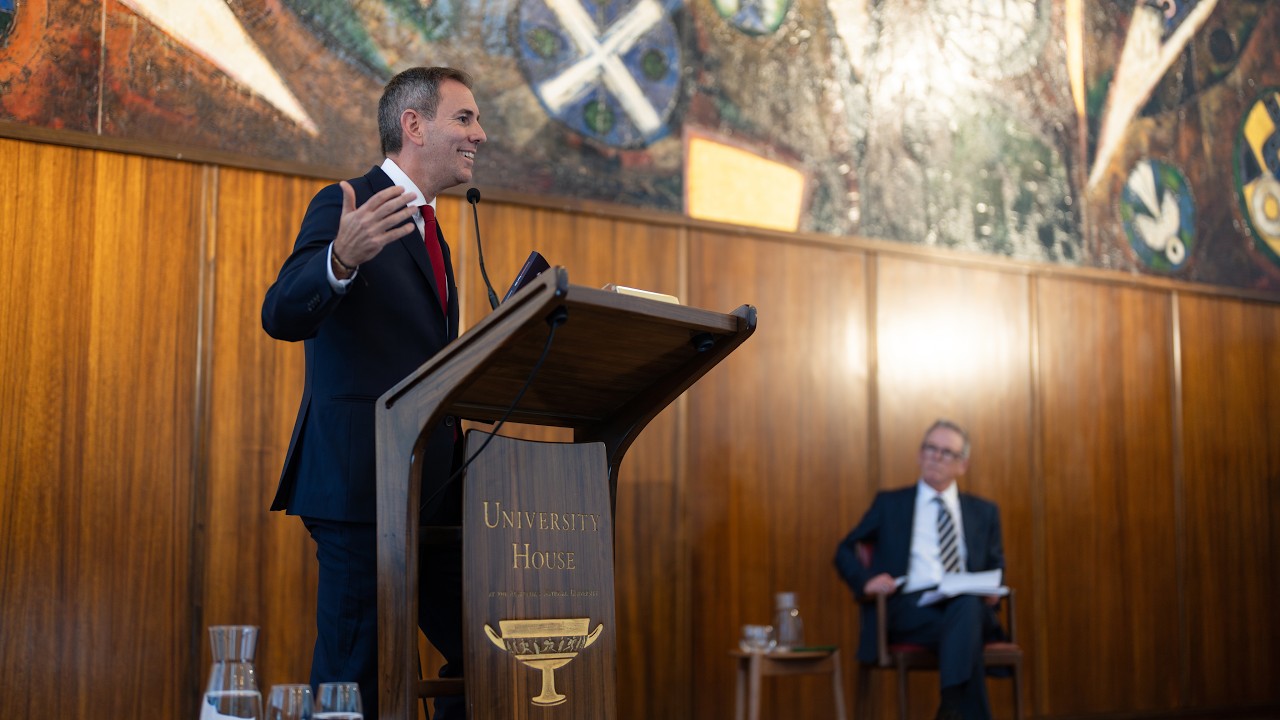
Video summary
In his 2026 Annual Lecture at the Australian National University, Treasurer Jim Chalmers presented the key findings of the seventh Intergenerational Report, outlining a future where Australia's population is projected to reach under 40 million by 2066 due to declining birth rates and increased life expectancy. This demographic shift marks a historic turning point where deaths will outnumber births for the first time in the nation's history, driven by falling fertility rates that are occurring faster in Australia than in many other economies. Despite these challenges and global uncertainties such as geopolitical fragmentation, accelerating AI adoption, and climate change, the report concludes that Australia is better positioned than its G7 peers thanks to lower debt levels, higher living standards, and an economy expected to double in size over the next four decades.
Chalmers identified five accelerating shifts shaping this future, including artificial intelligence, the energy transition, demography, industry evolution, and geopolitics, noting that while two-thirds of businesses have adopted AI, significant productivity impacts are still emerging with growth projected at 1.2% annually through technology and cleaner energy. He emphasized that a disorderly energy transition would be disastrous, yet Australia is well-positioned to lead in green exports worth up to $100 billion annually by 2050. To address pressing issues like an aging workforce and housing affordability, the government has outlined comprehensive reforms including tax adjustments to align income from work and assets, expanded parental leave with superannuation contributions, migration program changes to attract skilled workers, and significant investments in housing supply.
Regarding fiscal sustainability and taxation, Chalmers explained that the report's assumption capping tax receipts at 24.2% of GDP is a deliberate choice to prevent bracket creep from driving taxes higher indefinitely, contrasting this approach with previous reports that allowed for rising tax-to-GDP ratios. He expressed dissatisfaction with rising personal income tax as a percentage of GDP and committed to cutting income taxes where affordable over the next forty years, arguing that previous cuts have already lowered the burden on workers compared to alternative scenarios. Furthermore, he highlighted the importance of NDIS reforms to prevent future budget pressures and noted savings of $200 billion on debt interest repayments inherited from previous administrations, while also stressing that broader capital deepening beyond recent AI data center investments is necessary to boost productivity through private sector decisions supported by government actions like foreign investment reforms.
The session concluded with Chalmers expressing his vision for a modern Australia where citizens are beneficiaries rather than victims of global change, possessing both security and opportunity, even as he acknowledged short-term political pressures that make long-term planning imperative for intergenerational equity and economic resilience. He clarified that while the size of the public service was not a primary focus of the report, technological improvements and increased responsibilities mean the current workforce size remains appropriate. The event ended with Chancellor Gordon De Brouwer thanking Chalmers for his insights on fostering fearless discussion at ANU, followed by a lighthearted exchange about running around Lake Burley Griffin, underscoring the blend of serious economic forecasting and community spirit that defines the institution's role in shaping Australia's future.
Read the full video transcript
Well, hello and welcome to Australian
National University uh to the Australian
Studies Institute's annual Australia and
the World lecture. I'm Mark Kenny,
director of the Australian Studies
Institute, and I'd like to acknowledge
the traditional owners of the land on
which we meet, the Nanal and Ambry
peoples, and pay my respects to their
knowledge and custodianship of this
beautiful country we meet on. Can I also
acknowledge the chancellor of AU, Dr.
Gordon Debra
and um the founding director of the
Australian Studies Institute, Professor
Paul Pickering and of course the master
of university house in which we meet
today, Peter Kenowski, Professor Peter
Kenowski. So thank you and welcome to
all. Um now I'd also like to just at
this point thank Dr. Jim Charas for
accepting the invitation to do this
lecture uh because he's returning to a
campus that he's very fond of. Of
course, he has achieved great things in
his life in this very place. He has a
PhD in political science and
international relations. But he also has
another feat uh which was um achieved on
a very cold August night way back in
2002.
Many of you will have walked past the
fish pond that extends for an enormous
distance along the uh the sort of um
entrance here to this fantastic hall.
And uh in that cold August night in
2002, Jim Charas repeated a feat that
Bob Hawk had done before that of
swimming the fish pond. Uh and anyone
who knows anything about Canberra in
August knows that is heroic. Uh perhaps
you can ask him a question about that. I
don't know.
Um just a quick word on the format
today. Dr. Charas will speak for around
30 minutes and then there'll be time for
30 minutes of questions. We have quite a
few from the press gallery here. So,
we're looking forward to that. And then
refreshments will be served after that.
So, with that, let me invite the interim
vice chancellor, Professor Rebecca
Brown, uh, to do a formal introduction
of our speaker today.
>> Uh, thank you Mark and uh, good
afternoon everyone. I also acknowledge
the Nanowal and the Nambry Camry peoples
as the traditional owners of the um
lands that we're meeting on today. These
very beautiful, these sacred and these
unseated lands and I pay my respects to
all Aboriginal and toouristrate islander
peoples joining us here today and
especially to professor Peter U. I also
formally acknowledge the honorable Dr.
Jim Charmer's treasurer, Jenny
Wilkinson, PSM, Treasury, uh, Secretary
to the Treasury, His Excellency, Andrew
Nees, High Commissioner for New Zealand,
Jennifer Cole, acting deputy high
commissioner for the British High
Commission,
other distinguished guests across
Treasury and the Diplomatic Corps. So
great to have you here. Of course, our
chancellor, Dr. Gordon De Brower and I
think our former vice chancellor,
Professor Ian Chub, may be here today
and uh Professor Peter Canowski, Master
of University House and colleagues,
students and friends of ANU. Welcome to
the Australian National University for
the 2026 Australia and the World Annual
Lecture. I thank Professor Mark Kenny
and the Australian Studies Institute who
bring us together each year to consider
not simply where Australia is today but
where we are heading. Uh and that
question could not be more relevant. The
intergenerational report released today
brings together major forces of change.
Artificial intelligence, geopolitical
fragmentation, the energy transition,
population aging, and the continuing
evolution of our industrial base. the
transformations that will shape our
economy and society for at least the
next 40 years. It puts a pretty sharp
focus on intergenerational equity and
the experience of many Australians, not
least young Australians in our housing
market. AU was established over 80 years
ago to build knowledge and the
capability needed to serve Australians.
Um, and this work today speaks directly
to that important challenge. A key part
of what we do here at A&U is we convene
for consequence and that's been set out
in our new strategy A&U by 2030 and this
report demands that we must do so. Today
is exactly that convening for conf for
consequence providing evidence-based
knowledge with government, academia,
industry, peer universities and
communities. And our role is to bring
bring those cohorts together to engage
with real dedication around the sets of
choices Australia continuously faces and
bringing the best evidence to decision
makers for that. Our keynote speaker
today, it's particularly fitting before
the titles and the budgets, the
honorable Dr. Jim Charas was already
part of our A&U community. He completed
his PhD here in political science and
international relations. He taught
politics and public policy. It's a
pleasure to welcome him here back today
as treasurer, as an alumnest, and as a
very valued member of our community.
Long before becoming treasurer, his work
was concerned with how our economy
responds to change and what
technological disruption means for
working Australians. so apt today.
[snorts] His 2017 book, Changing Jobs,
co-authored with MikeWigley, examined
what technological change would mean for
Australian workers. And nearly a decade
later, just over a decade later,
artificial intelligence as one of those
significant technological changes sits
at the center of one of the most
defining transformations in the report
the treasure will be releasing today.
That speaks to the larger purpose of the
intergenerational report. The Australia
we are building for those who come after
us. The treasurer before his address
very soon he met with a group of our
students. And that 40-year horizon this
report contemplates is not some distant
stu distant future for our students.
It's all within their lifetime. Our
students will help make the decisions
that shape what Australia looks like
from 2026 and and and and into the
future from there. A&U has long been a
place where scholars, policy makers,
diplomats, parliamentarians, and
students come together to exchange
ideas. Treasurer, thank you for choosing
A&U to release the seventh
intergenerational report. It's a real
honor for us and to deliver this year's
Australia and the world annual lecture.
We're delighted to have you back. Please
join me in welcoming the treasurer of
Australia and A&U alumnist, the
Honorable Dr. Chim Charmer's MP.
[applause]
Well, thanks very much Rebecca for the
welcome. Uh big thank you to uh Mark and
Paul for the invitation uh to give this
year's Australia and the world lecture
here at Peter's House uh at University
House. Uh I'm really grateful to
everyone who's joined us here from the
A&U, including the students I met with a
moment ago. Jenny, I promised some of
them that I would put in a good word.
those of them looking to work in the
treasury under your leadership. A couple
of uh incredibly sharp young people
there. I encourage you to have a good
look at their CVs. Uh but I also wanted
to thank your new chancellor uh Gordon
de Brower as well, the great friend uh
of mine. I acknowledge the parliamentary
press gallery here with the laptops uh
here in the front couple of rows and
everyone who is here from further a
field as well including uh from the
diplomatic corps. Uh I did want to make
the most of this chance today to take
you through the key findings of the 2026
intergenerational report. uh but I be
begin by uh acknowledging with some
humility uh we are talking about the
uncertainties of the next 40 years in
the context of meeting on none land part
of 65,000 years of continuous culture
and so I I honor as Rebecca and Mark did
uh their elders customs and traditions.
I also wanted to thank my predecessors
from both sides of politics uh who began
and then built on this intergenerational
report uh and the officials, advisers
and cabinet colleagues who helped us put
it all together. Uh this is the seventh
time that this report has been released.
Uh Treasurer Costello did the first two.
There was one each for treasurers Swan,
hockey and frightenberg. And this is now
my second. Now, I know that not
everybody supports the way that
governments go about these 40-year
projections. As we were talking with the
students about before, there is a
degree, a greater degree of uncertainty
the further forward that you go. We
understand that. And we also know that
there are very substantial pressures in
the here and now which remain the
government's primary focus. But I also
think that everyone can agree on this.
Uh, no IGR, no previous IGR has
contended with challenges this great or
politics this fraught or a future less
certain. Yet, this IGR shows that we are
better placed than our peers in almost
every regard. The global and
generational risks are serious, but
Australia's opportunities are endless.
These are the main conclusions of the
IGR. But if you read the whole thing,
you'll see one observation repeated more
than any other. Not just that the world
is changing, of course it is. And not
just that the change is affecting us
here, of course we know that as well,
but that the pace of change is
accelerating. And this puts very plainly
the choice before us. To keep up and
succeed or to lag and languish.
Now the word change has always been
something that people enu imbue with
their own ambitions and anxieties. For
that reason, it's not enough to say the
world is changing or even to say it's
changing more quickly. So let's be
specific.
The world is becoming more dangerous,
more unpredictable, more unequal, and
more divided.
And these aren't just individual
threads. They're part of a bigger
fraying of that intergenerational
promise of better times.
Now, the writer and activist James
Baldwin said of the American dream that
if people are denied participation in it
by their very presence, they will wreck
it. I know that this was the 1960s, not
the 2060s. I know it was the US and not
Australia, but I think it still speaks
to a truth on every page of this
analysis and in every corner of our
Commonwealth. If people are unmed
economically, generationally, they feel
disconnected from and disregarded in our
politics.
At worst, that's what we're seeing now.
At best, it's what's at stake.
Accelerating change is putting more
pressure on people. It's eroding trust
in the institutions of democracy. It's
exacerbating the strain felt by younger
Australians and younger generations in
particular.
And so the division in politics now is
not between those who accept all of this
and those who don't. It's between those
who pray on it and pick at it and
politicize it and catastrophize it and
those who seek to alleviate it. And so
the responsibility that we embrace today
and every day is to respond to the
pressures of the here and now but also
plan so that the accelerating pace of
change is accompanied by the
accelerating pace of opportunity.
Now, this generational report,
intergenerational report, shows that we
face very serious risks and pressures,
but that we are better placed and better
prepared for them. Better positioned to
benefit from the AI revolution, to
succeed in a fragmenting world, to make
the most of cleaner and cheaper energy,
to manage our changing population, and
to thrive in an era of new industries.
Now this report also shows that we have
a better plan to maximize our
opportunities and minimize our risks to
grow our economy and lift living
standards, embrace new technologies and
share the benefits.
Now there is a lot in this report
but at its core it shows an Australia in
20 2066 where people live longer
healthier lives. Families have fewer
kids and that will make the population
grow more slowly to less than 40 million
in 40 years. Living standards will be
higher and people will retire with much
more super meaning much more security.
Our economy will be more than twice its
current size and the budget will be
strained but still stronger than in the
last update. Our industrial base will be
dominated by services powered by cleaner
energy completely transformed by
technology in a much more fragmented and
uncertain world.
Now, the future will depend on how we
respond to the five accelerating shifts
in AI, energy, demography, industry, and
geopolitics.
The AI revolution is the most
consequential new emphasis since the
2023 report and the biggest economic
transformation of our lifetime.
The productivity, investment, and labor
market impacts of AI will be dramatic.
AI will play a pivotal role in re
reaching long-term productivity growth
of 1.2% and higher if productivity gains
accelerate over time. The IGR shows from
2030 onwards each extra.1% of
productivity growth from AI could
improve the bottom line by 0.07
percentage points and reduce gross debt
by.3 percentage points within a decade.
Now, we are well positioned with
Australians adopting AI at a higher rate
than almost every G20 country, but the
productivity boost from AI depends on
translating that into better ways of
working. Twothirds of our businesses
have adopted AI in some form, but fewer
than 10% describe it as significant.
This IGR also shows how the AI
investment boom is reshaping the global
economy. Capital expenditure by the five
largest hyperscalers in 2023 was $230
billion. But in 2026, it will be four
times that, more than $1.1 trillion.
That investment pushes AI token prices
down and demand for computing
infrastructure up. And this explains the
massive data center boom here and
abroad. Australia has positioned itself
early and well. We have over $150
billion of AI infrastructure projects
scheduled over the next five years,
which is about 5% of our GDP.
New capital expenditure has already
almost doubled since the last IGR,
reaching 11.6 billion in 256.
Now, the skills in demand are changing
as well, but human judgment,
coordination, accountability, and
relationships will remain essential.
So far, there's more augmentation than
automation. 79% of the current workforce
has low automation exposure compared to
4% with high exposure. But we don't take
this for granted. We know that AI offers
a lot of upside, but also very serious
risks to minimize and manage. We already
see dangerous proliferation of
misinformation, scams, and malicious
cyber operations.
We're vigilant about managing the
infrastructure builds impacts on our
resources and our communities and risks
of market concentration, social harm,
and economic disruption.
Now, this AI revolution will have major
implications for the energy transition.
It will add to demand for electricity
and the infrastructure that supports it.
In 2023, renewables made up around a
third of the grid. Our efforts in cheap
and clean energy mean they now account
for nearly half already. Over 60% of
coal fired power generation will retire
over the next decade, meaning renewables
will play a much bigger role. Generation
is up and costs are continuing to fall.
Families and businesses have seen costs
for renewables fall 80% in a decade.
Now, if current electrification rates
continue, average household energy costs
could decline 40% between 2030 and 2050
in real terms. And the changes for
industry will be just as dramatic.
Australian green exports could exceed
100 billion annually by 2050.
Around 80% of global GDP is tied to net
zero commitments. So demand for coal and
LG will decrease over the century while
demand for upstream commodities
including our critical minerals will
climb dramatically. Lithium demand is
expected to triple nickel, graphite and
rare earth to increase by 50 to 90%.
Now the IGR shows that a disorderly
energy transition would be disastrous
for our economy but also for our
environment. greater damage from rising
sea levels, flooding and erosion, lower
productivity from higher temperatures,
smaller crop yields, and tragedy for our
tourism industry, too. In action also
means disaster recovery spending around
25 percentage points higher in 2066 if
temperatures exceed 3° of warming.
Now, at the same time, our population
will change in shape and size and faster
than we previously thought. Australians
living longer and healthier lives is
obviously overwhelmingly a good thing.
It's welcome recognition of the quality
of our universal health care and the
contribution that older people make and
it's worth every dollar of extra
pressure that it puts on our budgets.
Now, the higher life expecties and fewer
children that this IGR forecasts are
familiar, but what is new for the first
time in this one is that deaths are
projected to outnumber births by the60s.
That's much later than other OECD
countries, but fewer births mean much
lower increases in Australians aged
under 20, growing just 10.4% 4% to the
early 60s compared to almost 28%
forecast in 2023. And this will
contribute to slower population growth
averaging.9% annually which is 2
percentage points lower than in 23 and a
third lower than the last 40 years. The
number of Australians over 85 will
triple by the mid60s putting further
demand on health services. Health and
social assistance employment has already
grown 13% in just 3 years and it will
grow 23% more over the next decade. This
means onethird of new health care
spending over the next 40 years will be
because of aging. Now despite all of
these pressures again we are much better
placed than many others. Our working age
population will continue growing
supporting economic growth and migration
will play an important role here as
well. An important source of skills that
complements our domestic workforce and
our health care system is the envy of
the world and its future is safeguarded
by our efforts to make the NDIS and aged
care more sustainable as well.
So all of these forces are shifting and
shaping our industrial base too. This
IGR shows that our advantages of the
2010s, Chinese commodity demand,
education and tourism will shift towards
new advantages in renewables and
critical minerals, strong institutions
and strategic partnerships and AI
enabled services. An aging population
will increase demand for the care
economy, and AI will unlock new business
models, accelerating this shift towards
services, spurred further by rising
household incomes. And commodities will
stay crucial to our prosperity with
demand for critical minerals and rare
earths growing as global demand for
fossil fuels comes off.
Now, all of these domestic shifts are
playing out against a more fragmented
world. Conflicts between countries have
risen since the last IGR from 2 to 8,
which is the most since the Second World
War. These conflicts are hitting the
global economy harder, with the war in
the Middle East demonstrating just how
much the world relies on the precarious
transit of foreign fuels. Global trade
is changing rapidly as well. American
tariffs are the highest they've been
since the 1940s. Over 18,000
discriminatory trade measures have been
introduced since 2020 and twothirds of
global trade is now subject to
regulations.
Foreign investment is not just a matter
of economic advantage but geopolitical
interest. Nations are imposing more
export controls and restrictions on AI
technologies, semiconductors and
critical minerals.
But even while trade is restructuring
and changing along these lines, it's
still growing. Global trade as a
percentage of GDP reached 68% last year,
which is an all-time high. So, this
doesn't mean we can be complacent about
rising protectionism. There will be
long-term costs and consequences from
the rise in trade barriers that we have
seen. But the changing shape of trade
does provide opportunities for Australia
to set ourselves apart as a more trusted
partner and a more reliable exporter.
Now, there's no separating these five
accelerating shifts from each other or
from their consequences for our budget
and our economy. And here I think the
challenges are most stark. An aging
population means a proportionately
smaller workforce but broader demand for
health and aged care. A smaller
workforce means a proportionately
smaller income tax base at a time when
pressures on social services and tools
of state craft including defense will be
growing not easing along with the fiscal
risks of climate change and more
frequent disasters.
It is remarkable and it is exceptional
that our budget is strengthening even as
these pressures are intensifying.
Government spending over the next 40
years is expected to increase by much
less than we previously thought.
Spending will grow by less than a third
of what was forecast in 2023, just 1.1%.
The cash balance has improved since then
as well, ending 1.2 2 percentage points
better than in 2023.
Gross debt is a massive 7.2 percentage
points lower, reducing interest payments
even as borrowing costs go up and giving
us more headroom to fund the biggest
pressures and priorities.
Now, the IMF expects US debt to rise 13
percentage points of GDP by the 2030s
while ours falls. Australia's strengths
like super will pay dividends in the
decades ahead. In this regard, by the
mid 2060s, the age pension will cost $31
billion less supported by higher
superanuation balances. The IMF projects
our overall public spending to fall over
5 years as well by the 2030s, lower as a
percent of GDP than all of the G7 and
revenue lower than five of them until at
least the 2030s too. Our
economy is already growing faster than
almost every G7 economy and the IMF
expects this to continue for five more
years. No G7 country is forecast to grow
above 2% into the 2030s like we are. So
this is a stable foundation to build the
next 40 years on. Our economy will grow
more slowly, that's true, but still
average 2% a year until it's double its
current size. Incomes will be 55%
higher. Living standards will be better
and life expectancy, as I said, longer.
Participation is still expected to grow
every year until 2040, which is
remarkable, and remain higher than
previously thought, supported by more
women in the workforce. Participation
finishes 1.4 percentage points higher
than the 2023 IGR and 10 percentage
points higher than the first IGR. That's
equivalent to around 300,000 more
workers in60 than was forecast 3 years
ago.
Now, productivity, we acknowledge, has
been too low for two decades here and
abroad, but global technological
progress has increased Treasury's
confidence in its long-term productivity
assumption of 1.2%.
Now, we did lower this in our first
budget to be more realistic than the 1.5
that our predecessors assumed. budgets
have maintained that since then to
reflect the balance of upside and
downside risks and the range of
assumptions used by similar economies.
So this puts us in the middle range of
comparable countries. But in other
welcome ways we are an outlier. The
fiscal position is the starkkest
example. We have lower debt than every
G7 country and it will peak lower as
well. The US has 12 times more people
than Australia, but 40 times more debt
and higher interest payments. Australian
births will outpace debts for much
longer than most comparable countries.
We'll spend less on pensions than any
OECD economy by the60s, even as
retirement incomes in Australia go up,
not down. While average spending on
public pensions in those countries will
rise to over 10% of GDP, ours will fall
to just 1.8%. and our workforce
participation will continue growing
while other OECD economies decline.
Now, every generation is confronted with
unique choices about the kind of economy
they build in the face of these kinds of
pressures.
Previous generations of Australians
built an agrarian economy, then an
industrial economy, then a more open
service-based economy in roughly 40-year
cycles. Each of these economies
responded to the challenges and
opportunities of their era. But the
solutions of the future don't reside in
the past. The economy of the next 40
years will be built with AI enabled
services and smarter technologies, new
clean industries powered by cheaper
energy and more secure partnerships in
the world. Now whether these next 40
years benefit our people, grow our
economy, and strengthen our sovereignty,
or whether they fracture and fray our
social compact is up to all of us, not
just governments. But we take
responsibility for getting policies and
planning right. We know that economies
aren't built on forecasts, they're built
on actions.
Our primary focus is on the pressures
that people are feeling today and the
global and domestic circumstances which
are intensifying them. But at the same
time as the pressures in this report
make all of our longerterm reforms more
important. At the same time, we've made
productivity a whole of government
priority. We're rolling out the broadest
productivity package in 25 years to
ensure the IGR's warning of lower growth
doesn't translate into lower living
standards for the next generation. To
reverse the long-term decline in
dynamism, we're revitalizing national
competition policy, creating a single
national market to improve labor
mobility, help resources flow where
they're most productive, and boost
longrun GDP by $13 billion annually. To
compete in this growing scramble for
capital, we're cutting business taxes,
accelerating approvals, and reducing
compliance costs, which will get
projects off the ground faster and lower
the regulatory burden by $10 billion a
year. We're harnessing AI in our
national interest to maximize the
productivity dividend. We're making
adoption easier for workers and
businesses, boosting innovation,
encouraging labor augmentation over
automation to move us closer to the
global technology frontier. We're
working to attract the right kind of AI
training to give us more control and
capture more value in the AI supply
chain to manage the growth in data
centers and digital infrastructure and
keep Australians safe. We're legislating
worldleading national standards that
protect our resources and our
communities.
We're building an adaptable,
well-trained workforce to help offset
the projected decline of workers as a
share of population. We're making
participation easier through expanded
paid parental leave, super unpaid
parental leave, more access to early
education, and tax cuts, which will
increase total hours worked by about 1.3
million per week compared to previous
tax settings. equivalent to over 30,000
full-time jobs. To respond to rapid
changes in our economy, we're making our
skills and education systems more
dynamic, more integrated to help workers
gain and retain skills over their
lifetime. To build the homes and
infrastructure we need and take care of
more older Australians, we're training
more workers in construction, energy,
AI, and the care economy, addressing
skill shortages in areas of growing
demand. And we're also attracting that
talent through migration. We're
complementing these investments in
skills with a more robust and
well-managed migration program. That's
what last Thursday's reforms were all
about, to shore up our labor supply as
our population ages and fertility rates
decline. And we're boosting productivity
and workforce capacity by reforming the
migration points test, which will select
better educated, higher skilled, and
younger migrants.
We're rebalancing the tax system to
support workers. To address a heavier
burden on proportionately fewer workers,
we're better aligning the tax treatment
of income from work and income from
assets, reducing workers share of the
personal income tax burden by two
percentage points. This will help level
the playing field for younger
Australians and future generations. And
our combined tax cuts will benefit the
average worker by up to $2,800 a year.
We're increasing our capacity to cut
workers taxes again in the future by
strengthening the budget, but also by
establishing the working Australians tax
offset as a new feature of the system.
We're helping more Australians into
housing to address one of the biggest
drivers of intergenerational wealth
inequality. We are reforming the tax
system to reduce distortions in the
housing market. We're changing
arrangements for capital gains and
negative gearing to deal with plummeting
home ownership rates among young people.
At the same time, we're rolling out a
comprehensive plan and making record
investments to boost housing supply.
We're making retirement more secure
because as our as our population ages
more rapidly, we're strengthening the
super system to lift retirement incomes,
to boost economic security, to improve
standards, and to take pressure off the
pension. Our reforms to payday super,
super on parental leave, lowinccome
super will help more Australians secure
tens of thousands of dollars more in
retirement. The IGR shows the median
retirement balance is set to more than
double to around $450,000
by the end of the medium term and our
reforms will help the system grow and
mature over the next 40 years as well.
And as more Australians move out of
accumulation, we're assuming that we're
ensuring that they have more information
and better products to make the most of
their super. We're delivering cleaner
and cheaper energy. To capitalize on
shifts in global demand, we're
developing new industries worth up to
hundred billion dollars in green exports
by 2050. To ensure families and
businesses benefit from this, we're
incentivizing electrification through
solar and battery take up, which could
reduce household costs by thousands of
dollars a year. To replace the energy
from retiring coal fired power stations,
we're providing certainty to investors
through the capacity investment scheme,
unlocking 73 billion in new private
sector investment in renewable
generation and storage. We're boosting
national resilience to shield us from
global energy market volatility and more
frequent shocks. We're reducing our
reliance on foreign fuels and reforming
our gas market with our first term gas
reforms already lowering gas prices by
26% over the year to June at a time when
prices were escalating in Asia and
Europe. And our gas reservation will
strengthen the domestic market even
further. As demand for critical minerals
soarses, we're growing our capacity to
mine, refine, and trade with trusted
partners, helping diversify our exports
and global supply chains. We're
investing in our broader industrial
capability as well through the future
made in Australia to take advantage of
new export markets, boost resilience,
and help our industries make the most of
the clean energy opportunities. And
against the rising tide of
protectionism, we're actually cutting
nuisance tariffs and forming new
international partnerships to reduce
costs for Australians and expand access
to new markets. And we're improving
budget sustainability as well. In
response to rising structural budget
pressures, we're delivering the single
biggest savings package in history,
which will reduce our debt and our
interest servicing costs. To meet
growing demand for services, we're
reforming and securing programs like the
NDIS and age care to ensure future costs
don't overwhelm the budget. To alleviate
structural pressures on our revenue
base, we're making tax concessions more
sustainable, including in housing, but
also super.
Now, we're taking this responsible
approach so we can manage fiscal
pressures as they emerge, but also
improve our budget sustainability as
global uncertainty and and upheaval
forces up borrowing costs as we're
seeing right now.
Now, I'd finish by making these few
points.
No other country has a plan more
comprehensive than the one that I've
just run through to modernize our
economy and to find opportunity and
security in all of this uncertainty in
each page of the IGR. Now, of course,
the findings and the forecasts in this
report will challenge us and some of
them in quite confronting ways. And of
course, much of it will be weaponized by
those who always like to see things
through a more pessimistic and often
more political lens. I assure you that
the government is not complacent about
any of these challenges. On the
contrary, never before have the risks
been more serious or the opportunities
more substantial.
Australia's opportunities make us more
optimistic about the future of our
country, our people, and our economy.
And not despite all of this accelerating
change, but because of it. Thanks for
the opportunity to run you through the
key findings from the intergenerational
report. And I'm looking forward to
taking some questions now. [applause]
Thank you.
Thank you very much uh treasurer. Uh
it's a wide-ranging speech and um very
interesting uh subject. It does so
closely align as the as Rebecca Brown
was saying so closely align with the
remit of this lecture series to think
about Australia in the longer term and
its place in the world. Um we're going
to go to some questions from from our
media gathered here. I thought I might
just start though with a question that
kind of goes to that. You touched on um
the how dangerous the world is, how
volatile it is, a number of inputs that
are that make uh predictions highly
problematic. Um it make uh planning uh
need necessarily a dynamic thing. I
wonder is there a tension inherent in
the long-term focus of a thing like an
intergenerational report and the
shortterm exigencies of the political
cycle and how do you ensure that the the
the the advice that you've got the
studies that have been done the thinking
that's gone into this report um can
continually inform the decisions that
you are making
>> well here I want to pay tribute ute to
uh Peter Costello who began uh these
intergenerational reports. I've done
that before because I think in a
political system which does encourage
shorter and shorter term thinking, a
media cycle that operates on much faster
cycles even than when uh you were
knocking around the parliamentary press
gallery mark. So much of the incentive
in our political system uh encourages
people to think in shorter and shorter
term ways in shorter and shorter term
cycles. And so the reason why I have
always been a big supporter of the
intergenerational report uh is that it
encourages governments, it compels
governments uh and anyone who reads it
to think uh in bigger longer term
cycles. Uh and I know that at a time
when the cost of living pressures are
substantial as we've acknowledged and as
we are responding to in the here and now
uh I know when those near-term pressures
uh are serious as they are right now
it's harder and harder to focus people
and to focus governments on the long
term. But I think it's possible to do
both. But more than possible I think
it's imperative that we do both of those
things at once. And so for this
government overwhelmingly
uh the primary focus is on the pressures
that people are confronting right now.
Uh the war of the in the Middle East and
its impact on inflation. Uh what that
means for borrowing costs at the
household level but also for
governments. Uh when you see what's
happening with bond yields around the
world uh when you see what's happening
with expectations for interest rate
rises around the world. Uh that is the
government's focus. But we can maintain
that focus at the same time uh as we
share with the country our thinking uh
about how we think this will all play
out over the coming decades. And the
further you go out obviously the less
certain the less confident you can be
about some of these projections. Uh but
that doesn't mean it's not worth the
effort because if you make a list of all
of the things that Australians are good
at, uh I believe they're good at
navigating the here and now at the same
time as they plan for the future. And
that at its core is what the IGR is all
about.
>> Thank you. Now, first question I think
from Claire Armstrong, although it may
be from James Misola. Is Cla here? No.
Uh James Misola.
>> Thanks.
>> Hi James.
>> Thanks Mark and thanks treasurer. Look,
I might ask one for CLA as well as
myself given she's absent. Um the first
is um around the productivity
assumptions uh in this document. So um
>> it's estimated we will return to around
about 1.2% productivity growth per year
over the next 40 years. The document
says a large part of that is because of
um AI. It's short on detail. We are at
the dawn of a AI. I do understand that.
But it's quite short on detail how that
will actually come about. If you go to
page 195 of the document the estimate of
gross debt to GDP the ratio at a 1.2% 2%
rate it's about 30% 28% which is you
know quite a good position for us as a
country to be in. If it's8% which is the
figure Labor has been using until
recently uh gross debt to GDP and I know
that's only one measure but gross debt
to GDP is around 60% which is a much
less comfortable position for this
country to be in. So I guess my question
is how confident are you uh or how can
you be confident that we will continue
to hit that 1.2%. And then my second
question for CLA, the document also
notice notes um the significant decline
in indirect tax revenues, things like
excises.
>> Would you under any circumstances
consider altering the GST,
>> raising it?
>> Uh in reverse order, so Cla's question
first, uh that not something that we've
um contemplated really at any point. uh
on your first question about the
productivity assumption. I understand
and accept uh that uh for you and and
for a couple of your colleagues uh this
has been a big focus of how people are
grappling with the the intergenerational
report report. First point is I think an
obvious one which is that every
uh number in the document is sensitive
to uh assumptions and uncertainties and
the further you go out into the 40-year
horizon obviously it becomes harder and
harder to make uh concrete predictions.
We acknowledge that I think every
treasurer who's presented the an IGR uh
has acknowledged that in one way or
another. But on the productivity
assumption obviously
uh we have grappled with this quite a
bit as well. I think uh quite early in
the life of the new government in late
in 2022
uh I remember talking to Patrick
actually about um the early advice that
I got to take the productivity
assumption down from 1.5 to 1.2. I don't
know if you remember that meeting in the
office Patrick but uh that was when we
were grappling with bringing it down. We
thought 1.2 was more realistic. We've
maintained it in budgets since and we've
maintained it in the IGR for a couple of
good reasons. Uh first of all, um we
shouldn't assume that the risks to that
1.2 productivity number are all to the
downside. As you can see in that
scenario we presented for AI in
particular, there are upside risks as
well to that productivity number. And so
we think the 1.2 uh strikes a pretty
effective balance. uh it also represents
not the precise midpoint but it is in
the it is below some other comparable
countries assumptions and it's above
others. So it's below the US and the UK.
I think the UK is one and a half and the
US is 1.4. Uh the Kiwis have got.9. Uh
so we are broadly in the kind of middle
ranges of the productivity assumption.
Uh there are also some other kind of
more complex considerations. For
example, uh one way we compare ourselves
to the US which is relevant to
productivity is how we calculate our
relative living standards with the US
relative living standards. And so uh it
would take a little longer to explain
that relativity, but something that uh
we've been talking about with the
Treasury. All of that means we think
that 1.2 two is appropriate. Not because
uh any economist can bet their life on
an outcome 40 years down the track, but
because we think it best balances all of
these different considerations.
Jade Gber,
not everybody gets to ask one for CLA as
well. Jade,
>> um thank you, Treasurer, for your
speech. Um, your report states that if
home ownership levels had remained at
1981 levels, around 250,000
more households aged 25 to 34 would own
their own houses.
>> What percentage of the coming
generations does the government want to
see on the home ownership ladder to
reduce the rising age care burdened on
taxpayers? And should those new
homeowners essentially accept that the
great Australian dream of a house with a
backyard and the hills hoist is dead?
Well, not on our watch. And you might
have noticed that um you know, we've
taken some very substantial
political risks uh in order to meet our
intergenerational obligations and
responsibilities.
Yeah. here. Again, I shout out uh
wonderful group of students I met with
before I came here to give the speech
because I was able to look them in the
eye and and tell them what I what I'm
prepared to say again now, which is
that, you know, in all of the 20 or so
budgets that I've worked on or responded
to in my time in politics, there hasn't
been a budget that has been more serious
about meeting our intergenerational
obligations. And I think the the
pointiest part of that, the defining
part of that is really the housing
market which has locked young people out
for too long. And so we're not targeting
a particular percentage. Uh but we do
want to shift the needle over time
because
you know one of the the key conclusions
I'm hoping that you draw from this
intergenerational report when you've
gone through it in detail
uh is that every page of this IGR in one
way or another justifies
uh validates and I hope one day
vindicates the difficult decisions that
we've taken reforming the housing market
and reforming the tax system. Uh, and
one of the reasons why I think the IGR
is so important, it goes back to Mark's
first question,
we do have obligations to each other,
not just in the here and now, as
important as they are, but down the
generations as well. And so, if we are
to look young people in the eye, and
tell them that we are doing the best for
them, you can't do that without doing
something about housing. I'm convinced
of that. We were convinced of that
before the budget, and we knew that
there would be that that would be
contentious and contested. We of course
it of course it was going to be but no
objective reading of the IGR or anything
like it would conclude that the housing
market was doing justice to the dreams
and aspirations of young Australians in
particular and that's why we're changing
it.
>> John Kio.
>> Thanks Treasurer. John Kio from the
Australian Financial Review. Thanks for
the opportunity to ask some questions
today. Um the intergenerational report
it puts a tech a technical cap on tax
receipts at 24.2 2% of GDP uh whereas
your budget document doesn't I think tax
receipts keep rising to more than 25% of
GDP over the medium term. Um could you
just explain the thinking behind the
difference there
>> and are you able to give us any
indication approximately how much um AI
is thought to contribute to GD um
productivity growth are we talking like
0.1 2.3 over over the medium term
>> yeah well on the second part of your
question there's a there's a analytical
box in the document which goes to that
precisely the different range of
possibilities from uh AI and so I'd uh
I'd direct you to that uh on the first
part of your question about tax to GDP.
I mean, every intergenerational report
has had to make uh an assumption on tax
to GDP, as you know. I suspect you've
probably read uh all seven of them more
closely than most. Uh and so you're
forced to make an assumption so that the
tax to GDP doesn't just climb forever.
Uh in this document, what we've chosen
is the 24.2, which reflects tax to GDP
no higher than it was in the Howard
years. uh but I accept that uh different
governments have chosen different levels
in the budget uh because it was a
shorter time period. We let the tax GDP
assumption run. Uh I think the the
fundamental point about the 24.2 two or
or tax to GDP in this IGR or in any of
the previous six IGRs
uh is it's an assumption that
governments I think a worthy uh
assumption a fair assumption uh that
governments of both political
persuasions whenever they can afford to
do that uh return as much bracket creep
as they can and I say that as a
treasurer who's done that five times in
three different ways
uh and so tax to GDP is always a focus
of these IGRs you have to make an
assumption. We've chosen to pick a
number which is no higher uh than a
couple of those years that we saw under
Howard and Costello.
>> Patrick Commons.
>> Thanks very much, Treasure. Um one of
the most striking um forecasts or
predictions is that there will be more
deaths than births by the time we get to
the60s, which is the first time the IGR
has um projected this outcome. Um, it
feels like I think a lot of Australians
might read that and be a bit alarmed and
think, well, in a world where there are
more deaths than births, in a country
where there's more deaths and births, it
feels like it's a symptom that something
is going wrong. How worried are you
about this forecast about falling
fertility rates? Is this something that
you point out in the IGR this is
happening all around the world,
>> but is this something that we should be
actively um taking steps to avoid or is
it not a major issue in your eyes? Yeah,
I I mean I think this um combination of
issues is really important in the IGR.
Uh the first point is to inject a bit of
perspective in in that you're right that
for the first time the IGR will uh
project that uh but that will be much
later in some cases decade decades later
than other you know really quite good uh
economies uh where they expect deaths to
outnumber births uh much much sooner.
That's the first bit of perspective. But
on the issues that underpin it, um on
fertility rates, I think that is one of
the big changes in this IGR compared to
2023, we expect fertility rates to fall
further and faster. Uh that's one of the
key conclusions. It's one of the reasons
why uh population growth will be slower
than we anticipated and the overall
population number lower uh by the
mid60s.
Um now when it comes to fertility rates
um I do not and will not give people
free advice about these very personal
decisions that they make about whether
to start a family and when to start a
family. I you can see in those fertility
rates uh that more people are choosing
to have kids later and that means that
uh families will be smaller. If you look
at the decline in the fertility rate, I
think almost half of it is because of
fewer uh families where there are three
or more kids. Um so I'm not giving free
advice to people. Our job, the
responsibility that we embrace and have
embraced uh is to make it easier for
people to make that choice if they would
like to. So the early childhood
education reforms are key to that.
Expanding paid parental leave is key to
that. Paying super on paid parental
leave really important part of that as
well. And so those are our efforts to
make it easier for people to make those
choices if they would like to uh in a in
the context of people making a decision
to have smaller families later in life.
>> Dana Daniel
we'll come to you. Sorry I'm running a
dynamic list here. It's a bit like
dynamic pricing you know it's changing
all the time.
>> Thanks Mark. Thank you treasurer of your
speech. Um the the IGR I've just got
some questions around the forecasts
around lower government spending. Um how
much of this depends on NDIS savings
being realized and could you also share
what is being forecast for the size of
the Australian public service? The
report says AI will reduce the cost of
the public service. Have you modeled
what proportion of GDP will be spent on
the APS? Will it be less than 3 and a
half% and will fewer public servants be
needed as a proportion of the
population?
>> Yeah.
Um the second part of your question
wasn't a big focus of the of the IGR you
know that we think with technological
improvements but also increasing
responsibilities that we think that the
size of the public service is broadly
right and so it hasn't been a big focus
of our uh thinking in the IGR but the
growth in the care economy has been uh
and that's why the NDIS reforms are
really important a really really
important part of the story here um And
you know, one of the reasons why we
engaged in that NDIS reform really was
to save the NDIS from itself because
absent that reform uh over time it would
have tempted governments perhaps of a
different uh political persuasion than
ours than to then to uh cut harder than
we think is wise. And so uh NDIS reform
is key. uh getting the interest
repayments cost down from saving $200
billion off the debt trajectory we
inherited is key. Uh ongoing effort in
age care is obviously key. Uh making
sure that we continue to bud manage the
budget in the most responsible way that
we can. Uh it is quite remarkable as I
said that even with these gathering
pressures uh we are seeing the budget uh
better than we anticipated in 2023. But
again, that doesn't make us complacent
because the growth in the care economy
and in other areas will put very
substantial pressure on the budget.
>> James Maker,
>> thanks Treasure for your uh speech
today. Um looking at the uh AI
investment over the last say 3 years
from 2023
if you exclude investment into data
centers from the capital investment data
in the GDP data business investment is
banging bumping up and down about $43
billion a quarter. Um and so all of the
growth we're seeing in the economy is
coming from data centers. Now excluding
obviously the you the AI revolution
you're talking about what else does
business need to do to increase uh this
their investment and their productivity
gains because obviously you know
productivity is not just a matter for
government action and and you can't
control all the get productivity gains
that you're speaking about today.
>> Yeah. Um I mean first of all it's it's
always true not to be flippant about it
but it's always true if you take a big
part of investment out of the investment
calculation investment will be will be
smaller and um yes uh AI investment AI
infrastructure has been a been doing a
lot of the heavy lifting uh in those
business investment numbers which have
been very strong. It hasn't been the
whole story. Obviously, energy
investment uh even dwelling investment
in the most recent national accounts uh
we saw uh pretty strong in in welcome
ways. Uh but the broader challenge is
still there and the broader challenge is
to
uh attract the kind of investment where
we can get that capital deepening to
make our economy more productive. Uh
that was one of the key things out of
the reform round table. One of the key
elements of the productivity package in
the budget is attracting more
investment. Uh and so yes,
overwhelmingly it relies on decisions
taken by the private sector. Uh but
we've got a role to play in this and we
are playing it. You know, we're we're
we're consulting right now on another
big trunch of foreign investment reform.
Uh we whether it's environmental
approvals or other kinds of approvals,
we're speeding them up because investors
tell us that's a big challenge. how long
it takes to get a project approved and
and up and running. Uh we're working
with the states, you know, working doing
a heap of work with the states, uh
trying to make the national economy more
seamless. All of this is about
attracting more investment uh because we
do acknowledge whether it's in AI or in
other areas. We've got huge advantages.
Australia is extremely attractive in the
world right now. Uh investors love our
stability. Uh they love our geography.
They love our combination, our unique
combination of advantages, but there's
work that we will continue to do uh to
attract that investment in our national
interest, whether it's in AI or in other
areas too.
>> Uh Sarah is sorry
>> Sarah is from the Australian. You'll
note I now introduce myself fully as
opposed to when we first met.
um in the intergenerational report uh
personal income tax as a percentage of
GDP is going up. Are you happy with that
and how can you restrict that growth?
>> Uh well, no I'm not and that's why we're
cutting income taxes. Um and you know if
you consider that as our population gets
older uh and proportionately fewer
workers are doing heavier lifting in the
tax system uh then the responsibility
that I've embraced and the
responsibility of future governments
over that 40-year period uh will be to
cut income taxes where we can afford to
do that. you know, we've cut income
taxes five times. Uh, and because we've
done that, the share of um personal
income taxes paid by workers is a couple
of percentage points lower uh in this
IGR than it would otherwise be. Now, I
understand that there will always be uh
those who want us to cut income taxes uh
further and faster. I'm enthusiastic
about that. Uh you got to make sure that
you can pay for it. So over time,
whether it's our government or
subsequent governments, not pretending
that we'll be in office uh for the next
four decades, I think every government
will look seriously at taking as much of
the burden off workers as he can afford
to do in the context of all of these
other pressures. And again to come back
to uh some of the um parts of Jade's
question before
you know one of the reasons why we took
some difficult decisions in the 2026
budget about better aligning the tax
treatment of income from work and income
from assets uh knowing that there would
be a reaction to that is because we can
see this issue coming at us and
accelerating over time. Uh and so in
order to fund those tax cuts for workers
uh we've made difficult decisions uh
elsewhere in the budget uh and that's to
try and strike a better balance which
recognizes the pressures on workers in
particular.
>> Does the IGR take into account those
that desire to continue cutting income
tax cuts as you say does it capture
that? It does in the sense that and this
goes to John's question before uh about
assuming that the tax to GDP number
doesn't climb forever. Uh and so
imposing a a realistic assumption about
the return of bracket creep in the IGR
as part of that. Uh but also I mean look
at our record of cutting taxes. Um
that's the other thing I would I would
encourage you to look at. If it weren't
for our efforts to cut taxes, the
problem identified in the IGR would be
much worse. uh our government and other
governments of both political
persuasions I suspect will look to cut
income taxes uh further when the budget
can afford it.
>> Thank you,
>> Treasurer. We're pretty well out of
time. Um can I just ask you one question
without notice before we wrap up? Um and
that is if we think back to John
Howard's uh answer to a question, I
think it was from Liz Jackson when he
talked about a country that he wanted to
be comfortable and relaxed.
When you think about this
intergenerational report, when you think
about the country in the long term, when
you think about the political divisions
we see in the country at the moment,
what sort of country do you want to see
over the next coming decades?
>> Well, I think my motivation, whether
it's in the IGR or in, you know, the
reason I'm here more or less, is because
um I want more Australians to be
beneficiaries of change. And as the pace
of that change picks up uh so does our
uh inter the pace of our
intergenerational obligations. And so
the country that I want to see as a
country which is
uh has the the capacity to you know be
the the the world's most successful in
the context of all of this change that's
happening around us. uh and
you know a country which is much more
modern
uh a country where
uh we find much more opportunity in all
of the uncertainty and much more
security as well. Uh and it comes back
to your original question. You know, if
we if we have the ability to focus on
the here and now and think about the
future, we give ourselves a really good
chance of making our people
beneficiaries, not victims of all of the
change that you can see in this IGR
today. Thank you very much. Can I invite
Chancellor Gordon De Brower to uh move a
vote of thanks?
Thank you very much.
>> Uh thank you very much uh treasurer um
for coming here to uh this uh beautiful
noneal Nambbury country uh to this
beautifully restored um uh university
house on the Australian National
University. It's a real honor uh to have
you here uh and presenting the IGR. The
IGR is an extraordinary opportunity to
have a conversation about the future of
Australia and it can set out what the
challenges are that we face. But I think
more than that, it's uh there is always
a very good path to the future no matter
what the future holds and no matter how
distressing the future is. I'm not
saying anything that you don't know. I I
I know that's how you think uh of what
what's the path through, what's the good
path through. I I do want to say for the
university, we want to be a partner with
you in that. Uh I I thought I'd go back.
I've been reading the history of the A&U
and uh going back to over 80 years ago,
Nugget Kums's view around the close but
independent relationship between the
government and the Australian National
University. Nugget Kums was very keen on
having something in the preamble to the
A&U act that ultimately the solicitor
general rejected. uh but can I just read
it out because it is this idea of how do
we have a social debate about the issues
that we face and what's the role of
institutions in that and in that what's
the role of the Australian national
university so the bit that nugget kums
lost uh and the solicitor general won
was whereas a free democracy has its
basis in the decisions of the people and
if those decisions are to represent
wisdom and maintain truth it's essential
that facilities be granted for the
attainment of knowledge and for the
fearless and informed discussion of
vital issues. So that's part of the role
of the university. I I want to thank you
very much treasurer for coming here
today to talk through those issues in an
open and and free exchange. So Mark is
going to give the treasurer and I wanted
to thank you too Mark and and the center
very much for organizing this annual
lecture. But as Mark gives a small gift
to the treasurer, could you please join
with me in in thanking the treasurer of
Australia?
[applause]
>> Thank you, Chancellor Dauer. And uh Jim,
I know you're a runner um around the
lake in the morning. Um, a slow runner,
you say. Uh, I'm miked and you're not.
This is a disadvantage you're at at the
moment. Um, but look, this is a gift.
It's a, uh, people who can't see it from
the back. It's a democracy sausage cup.
Um, which you can use to drink when you
return from your run. And I've even got
a democracy sausage sausage t-shirt,
which you can be wearing as you uh,
circumn the lake. Thank you very much
for delivering this lecture. [applause]
There you go.