August 2026 Developer Meetup: Behind the Scenes: App Competition 2026 Review Process & more
Watch on YouTubeVideo summary
This video from the August 2026 Developer Meetup provides an in-depth look behind the scenes of the App Competition and the evolving review processes for the App Hub. The session begins with a detailed explanation of how applications are evaluated, highlighting that this year's competition received 21 submissions ranging from admin toolkits to AI metadata tools. The review team utilized a structured approach involving initial collective viewing of demo videos followed by independent technical assessments using a standardized checklist. This process scored apps based on three key metrics: their impact on the DHS2 community, technical quality including code maintainability and the absence of hard-coded values, and overall design usability. A significant portion of the presentation was dedicated to addressing a recent security incident where malware compromised a reviewer's machine during the evaluation phase. Consequently, the review protocols have been strictly updated to prioritize security scanning in sandboxed environments before any local interaction with source code, ensuring that only safe repositories are built or opened.
The discussion then shifts to the specific guidelines for submitting new apps to the App Hub, which now follow a four-step prioritized approach due to an increase in submissions and the widespread use of agentic coding tools. The first step is a mandatory security scan to detect injected payloads or dependency tampering, followed by verifying that the app functions correctly according to its documentation without requiring manual source code edits. Reviewers also check for consistency in design systems, encouraging the use of the DHS2 UI library while accepting consistent custom solutions. A major update highlighted is the requirement to migrate from browser-based credential handling to using roots for external service connections, a stricter measure implemented after mid-June 2026. The review team has moved away from generating lengthy feedback reports in favor of direct dialogues with developers, allowing for quicker iterations where AI agents can often address code quality issues within a single day.
Looking toward the future of community engagement, the host announced plans to introduce a new regular segment dedicated to open discussions about AI subjects during upcoming meetups. Inspired by frequent questions at recent conferences regarding agent usage and development workflows, this initiative aims to create a peer-to-peer space where developers can share experiences, effective prompts, useful skills, and feedback loops. The session concluded with an interactive poll gathering community interest in topics such as the risks of blind AI use, sustainability of solutions, local model deployment, and the balance between professional development and "vibe coding." By fostering this collaborative environment, the team hopes to collectively navigate the rapidly changing landscape of AI tools while establishing best practices for secure and effective application development within the DHS2 ecosystem.
Read the full video transcript
So, hi everyone. Welcome to this month's
uh developer community meetup. We have a
couple things that we'll uh that we'll
share with you today. Uh first, my
colleague Yuan will u share about the
the review process that we did for the
app competition this year where we had a
lot of cool community apps submitted and
and several that we're really excited to
kind of elevate and share and um kind of
how we went through that. they'll tell
you more about that and also the process
that we have when we go through um
submissions that we get on the app hub
which are a little bit different but um
uh share a lot of the s the uh share a
lot of similarities but um also yeah a
similar process
and then after that I'll share a little
bit of an announcement of something that
we'll be doing in upcoming uh community
meetups which will be a uh a regular
slot just to have kind of open
discussion about AI subjects. It seems
to be a a common interest just to talk
to other people about these kinds of
things and ask each other questions. And
so I think it'd be valuable to have the
space to talk about this. And I'll uh
I'll share a little more about what what
that'll look like at the uh at the end
of this meeting.
And uh so think about the kinds of
things that you'd be interested in in
hearing from other people about uh what
are they using, what are they doing,
what what's working, what's uh what
pitfalls have they run into.
Uh so yeah, I'll talk a little more
about that at the end and then for now
I'll hand it over to Yuan to talk about
the the app review processes.
>> Yeah, thank you K. So I just go ahead
and share my screen.
I hope you can see it. Okay.
So yeah, I'm just going to talk a bit
about what the review process was for
the app competition or the the app
competition rather for the conference.
um how we went through everything and
also uh I would then go into the um app
hub submissions that we are getting as
well and the review process we have when
we get these new apps and how it's
changed in the last year or so um I
would say with the increased use in like
aentic coding uh and how we use agentic
coding ourselves but also how we see
others use these kinds of tools for the
apps that they submit.
So, first off, the app um competition.
So, thanks to everyone who submitted. Uh
the technical quality for the this
year's app competition was really high
and the top five or even like 10
candidates were really close in like
total score that I got and the
submissions range from like admin
toolkits to AI metadata tools. Um we
also had some like Android clients as
well and even our package as well. So a
lot of interesting and varied stuff. So
we got in total of 21 uh apps and
extensions submitted. Uh what we aimed
to do during the review process was to
use around uh 30 minutes per app but we
started the entire thing by just going
through all of the submitted demo videos
together. Um so we sat down went through
everything and this was usually enough
to give us an indication of uh what kind
of apps we wanted to look closer into um
and and so on. So we went through this
initial list um and then we picked out
from that list uh what kind of apps we
wanted to look at more closely. So with
this process we ended up having between
two and six independent reviews per app
which we are very happy about. So the
the final results is really a good
indication of what we actually um think
about the apps. Um so we split uh the
score metrics into three as well uh
where we could score each metric from
one to five and I'll get a bit closer
into this uh different metrics a bit
later.
So the review process itself is really
quite straightforward. uh we had this
huge um Excel spreadsheet where we have
listed all of the apps. So the first
thing that was done was that the
reviewers picked an app from the list of
submissions and as I mentioned the
initial reviews were done together in a
team um just to give us a feeling of
what kind of apps we wanted to look into
and how we should split the review
process between us. Um and then once the
app was picked, we would open the
submission details. Uh that this is data
that was connected to the submission
itself. So the GitHub link to the source
code um some of the apps were already um
listed on the app hub. So this also
included an app link uh and a demo video
as well. And the 2-minut demo video was
usually the fastest way in and enough to
give you a feeling about uh especially
the design and usability of the app and
also the impact it might have. But for
the technical quality, we would often
have to go into the source code itself
and have a closer look. Um we also
created this review template that you
could use which was basically a list of
um checkboxes.
So you would then copy this review
template into your own notes and just
walk through the list uh of the
checklist and um you could just check
them off as you went along and then you
could use this checklist to um score
your three metrics basically. So it was
scored based on the technical quality of
the app, the impact it might have on the
DHS2
um
yeah the the DHS2 community and also the
usability and design of the app and then
you simply just loged your review. So
the reviewer added a row on the review
list with their own name, the app, the
three scores and a short comment on
anything unusual.
So
um
as I mentioned the three scores, it was
impact like what does this app enable
for DHS2 users and how would um DHS2
team get real value out of this app? um
does it fill a gap the platform leaves
open? Um is it generic, is it useful and
so on. And then uh the technical quality
as well. Um the general code quality but
also the maintainability.
Um so an example of this is if there are
any like hard-coded values or if there
are separation between the configuration
of the app and the source code itself.
Um, so we looked for like um hard-coded
values within the app. Um, if uh it's
tailored for a specific use case or if
it's been made more generic, for
example. Uh, we also checked that the
app platform is being used and uh DHS to
UI library for example. And here we
often use aentic tools to help. So we
could do a quick scan of the entire repo
and give the AI agents a list of things
to look for basically. So instead of
having to go through everything manually
uh we could get like pinpoints to where
we should look. So in this way uh
agentic tools is really powerful and can
save you a lot of time.
Um the last score metric was design and
usability like the ease of use and
visual design. Uh also the quality of
the documentation itself and how easy it
is to follow the readme to install
everything, configure everything and
test it on the different versions.
Um, and the final score that the apps
got was the mean across every review
this app received.
And yeah, I would just like to take the
time to thank all of the reviewers. We
actually got more than 60 total reviews,
which is great. And also for the domain
specific apps, we asked the product
teams to add their own reviews which
they happily did. Uh so big thanks for
to all of the product teams as well to
take the time and go through many of the
apps
and also thanks to everyone from our
team who took the time to log the
reviews. So we have Lena, Kai, Musafar,
Gasim, Claude and and many others as
well. So big thank you to to everyone
and also congratulations to DHS2 audit
vision for winning this year's
competition. Um well deserved and yeah
there were a lot of good apps this year.
Uh so I don't know if Edson is here but
yeah um clap for for Edson. really good
job.
Um, but sadly we also were a victim of a
malware attack during this review
process. So, um, I just quickly wanted
to bring it up just to give a bit of
context and to why we have updated uh,
some of the review process we're now
doing for the AppHub um, submissions.
So, we noticed that some of the
submitted apps were unfortunately
infected with malware. Um, I just want
to stress this that this was not the
submitter's fault at all. Their machine
had been compromised without the
knowledge and the app itself carried it
along. Um,
so given the scope, we were lucky that
only uh one machine got infected. Uh
sadly this was my uh machine. Um so all
that I did was to open an infected app
in VS code. So I did not install the app
I did not build the app and this was
enough to get infected.
So the trust boundary now is not
installing the app. at the moment you
open the folder in VS Code. Um, so we
just put uh the review process on hold
until we had everything under control
and we were able to scan all of the
submissions as well. Um, but sadly by
the time this was identified, the
malware had already accessed all of my
Google accounts, my GitHub tokens, and
my SSH keys. Um, so I thought that I was
able to clean my computer, but sadly it
had already downloaded child processes
that were running dormant on my
computer.
Um, but all of this has led us to a more
much more strict security process during
app reviews. So before we even touch the
code, now we do a complete security
scan. um preferably just read only
directly from GitHub without pulling
anything from GitHub and down to your um
local computer.
Um
but yeah, this also resulted in the
Pollen rider attack where my GitHub got
hijacked and basically just pushed all
of the same malware to as many branches
it could reach in the shortest amount of
time.
So, um if this happens to you and if
you're able to spot it, I would
recommend you to
um first off remove yourself from any
organization that you're in on GitHub
and then um turn off your computer
completely and contact the DHS2 security
team as quickly as you can. and you
would have to uh reformat your computer
that is affected. It's not enough to
identify the process and kill it because
by the time it has already installed
child processes that are um not easy to
to dig up. So yeah, the the security
routines have been um upgraded after
this attack as well. when we go through
all of the apps.
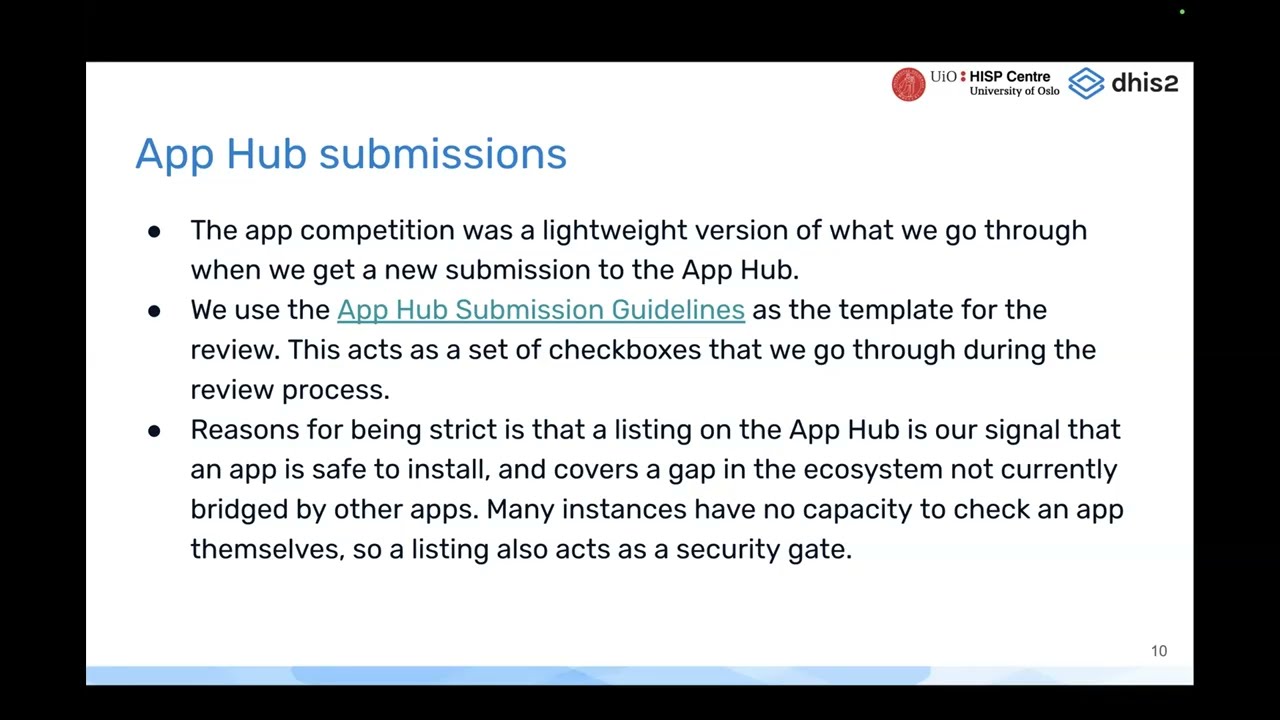
So this also leads us into the appub
submissions. So this is similar to what
we did for the app competition. So the
app competition is kind of a lightweight
version of what we go through each time
a new app is submitted to the app hub.
Um we use the app hub submission
guidelines as the template for the
review. So this acts as the list of
[snorts]
like checkboxes that we go through
during the process. Um and we are quite
strict now with what we approve directly
into the app. um because first off it's
a signal that it's safe to install and
it covers a gap in the DHS2 ecosystem
that is not uh currently bridged by
other apps
and many instances doesn't have the
capacity to check an app themselves. So
this listing on the app hub acts as a
security gate um as well. So if an app
is on app, it should be safe and trusted
by the HS2 team. That's the core idea.
So this review process has changed a bit
the last year. Um earlier we just went
through the app hub submission
guidelines and uh did everything in
um like one sitdown and we created this
extensive review document that we would
share with the developer once we've gone
through everything. Um but now since the
number of submissions had gone up um
probably in some ways due to uh use of
agentic tools
um we have uh altered the review process
a bit. So now we have this four-step
approach where we um have like this set
of priorities. So the first item is the
most important and
um if we run into a blocker we reach out
to the developer immediately. So we no
longer create this um full reviews. We
try to have a more open dialogue with
the developers uh of the apps early on
in the process. Um
so the first thing is the security scan
which we've incorporated now um after
the last attack. So the whole repository
is scanned in a sandbox before anything
is built um or open in an editor. So
again we use agentic help here. There
were a lot of good tools that got made
during the last attack. Um so we used
some of those scanners now as well to
help um identify attack vectors, common
attack vectors like injected payloads
and all of these things.
So yeah, injection tooling hooks, um
dependency tampering and all of this. So
a clean scan means it's safe to build
and if anything is found we stop the
review process immediately and contact
the developer.
Um and then we basically follow the
readme
um as it's stated in the source code. Um
so we follow it directly and uh go
through the setup instructions on all of
the supported versions.
of the app. Uh and then we also test all
of the documented features and check
that everything is working fine. Um, and
basically if we have trouble configuring
things and if we see that you can't
um install the app directly from the app
hub without having to manually tamper
with the source code. um we give this
feedback um as well because it's
important that you are able to um
install the app from the app hub and it
should work at least in some way. Um you
might have to do some configuration but
this should be handled through the app
itself. Uh you don't have to go and and
edit the the source code.
So uh this is just a test on how well we
are able to follow the readme and if we
run into any issues ourselves and also
if you have like third party services uh
integrations that you have to connect to
this should be really transparent and
what kind of setup instructions there
are in place for those kind of third
party services should also be declared
in the readme. So you should know um all
of the different um services the the app
is talking to and how it's done.
And then we check for the code quality
and again we use some uh aentic tools
here. Um we check for the use of the
DHS2 app platform, the app runtime, uh
the DHS2 UI library. Um we also see
now more than before that
um if people are using agentic tools to
help develop the app, we can see some
uh structure and leftover code as well.
Uh like dead code that is left in the
source code from previous um features
that have now been surpassed. uh unused
configs
um also documentations for features that
have been removed
and reference to documentation that has
yet to be released. So um things like
that we are looking for and also a
really important thing is the security
in the code as well like using roots for
external services. Um I will talk a bit
more about this later.
um using no credentials in the browser
and also no hard-coded values in the
source code. Um
and lastly, we go through the the rest
of the items in the submission
guidelines which uh are not too
important and can be easily fixed. So
usually for apps we we end up either
here or here now before we have to give
feedback to the developer which is
great. So these are like the simple um
checkbox items that are on the app
submission guideline. So does it include
screenshots? Um how is the app
documentation?
How is the app name, app icon? Um, is
the description honest? Use of external
services, transparent impact,
genericness, and and so on.
Uh, and as I mentioned already,
uh, we've had to alter the review
process a bit. Um we see that now with
people using more agentic tools the code
quality is often uh really good. Um so
this means that we can be a bit stricter
as well on code feedback now since agent
can address those fixes in a day where
it used to take developers a long time.
So one example of this and what we see a
lot when people use AI agents is that
the agents often define their own
components.
So we see a lot of custom CSS uh and a
lot of custom solutions in the submitted
apps. So one of the feedbacks that we
usually give is to use a consistent
design system and we do um want people
to use the DHS2 UI library of course.
Um so this is one of these kinds of
feedbacks that we tend to give almost
for all of the submissions now. Um and
we also see like the general number of
submissions have gone up quite a lot. Uh
so as I mentioned we used to compile
this large feedback report but now we
are having more of a dialogue with the
developers
and we hear back from roughly half of
the submitted apps. uh which is why we
have
moved away from this uh full-on report
to this kind of dialogue as well because
if we don't hear back from them then um
yeah we can't really uh approve the app
until we've [snorts] had updates. So
um we also see a lot of apps now with AI
features as well like AI built into the
apps um chat bots tools that helps set
up the just metadata natural language
queries to third party registries
um and so on.
Uh but if you use this kind of tools and
you connect it to third party services
uh you have to be really transparent
about how this data is handled on the
other end. If it's saved, if it's
stateless,
um how can you actually verify this and
who is handling the data on the event?
Is it saved somewhere? Um
uh and so on. So
uh the DHS2 admin must be able to opt in
basically if there are some third party
uh connections going on.
And another interesting thing we've seen
now with [snorts]
the use of agentic tools is that some
apps are submitted
that is not connected to DHS2 at all. So
it's not connected to your instance.
It's not using the API at all. Um, so
it's basically a standalone app within
the DHS2 global shell and everything
that it does is to connect to a third
party service. So we have to be a bit
careful about the kind of architectures
we're seeing and and stuff like that as
well.
So if you want to create an app for the
DHS2 app hub and you want to be uh
approved quite quickly
uh this is the kind of u sheet you
should follow. So, first off, follow the
app hub submission guidelines and check
that you have ticked all of the boxes.
Basically, um test the documented
workflows for all of the versions that
you are supporting. Um be mindful of the
sign system. Uh preferably the DHS2 UI
library, but others are okay as long as
you are um consistent in the use. Um we
see that some
uh organizations have their own u um UI
systems and we have more or less um
approved these kinds of apps since they
are consistent in how they use um the
different components. Uh we also checked
for use of the DHS2 app runtime
um and test app and all supported
versions and that it's transparency
about the third party services and
integrations as well. So if you follow
all of this um and that uh the source
code doesn't include any malware of
course then you could be quite sure that
you uh have come a long way in getting
your approved.
Um we um now that roots are available in
all supported DS2 versions um apps that
connect to external services should use
them. So
uh browser based credential handling is
no longer accepted on the appub and we
are quite strict about this as well for
new submissions. Um the deadline across
the app was midjune 2026.
So we will now begin to review the apps
on the app hub and find out which apps
needs to be migrated to using roots
instead of um browser based credential
handling.
So if you know that your app currently
stores or fetches third party
credentials in client side code
um please prioritize migrating to use
roots.
Um thank you. Um that was all that I
had. Um here is the appub submission
guidelines and the roots migration guide
if you want to go for from uh browser
uh credential handling to
the roots.
Thank you. Are there any questions? I
saw that we had some uh messages
in the chat.
So we had one message about one of
attack and
yeah. Okay.
>> Sweet. Thank you for the presentation.
on interesting to
see the pro see these processes and and
what's new in the world of the appub and
uh also thanks for the the incident
report. Uh yeah, it does sound like a an
important thing to share as my Miko said
with uh with the community and give a
heads up because that that does seem to
be like a an attack surface that uh I
think most people don't think about. U
so cool. Thanks a lot and feel free to
to write any more questions in the chat
if you have them about uh the AppHub
process or the app competition or other
things that we've seen
and then in the meantime I will present
uh a little bit. Oops. Was that the
right window? Yeah,
great. So, um yeah, I just wanted to
share for future. Sorry, one second. Let
me get my Zoom set up.
There we go. Yeah. For future dev
meetups, um, something that we want to
do is have a space for people to kind of
just have free form conversations
uh about AI subjects that are on your
mind and would love to talk to someone
about. This was inspired by um [snorts]
a lot of conversations that I had at the
annual conference this year that a lot
of people just come up to me and ask
what are you doing here? How like what
what agents do you use? Like what
processes are your team using? How do we
like connect these with instances? Um,
and I feel like this is something that
uh is a world where we're all kind of
exploring and there aren't many like
textbooks written on it yet. And so it's
a lot of individual exploration and and
trial and error and reading articles and
things. Um, and it's it's nice to have
an opportunity to get together with the,
you know, a group of other developers
and and talk about what you're doing
because it's a you know, we're in a
we're in a similar context together.
Um and so yeah to support a space for
that
the um yeah the plan will be to have
discussions in these meetups uh um a
little bit free form. will will come
with a subject
um
kind of sharing on a particular or yeah
one subject
uh as a as a start and ideally we'll
invite someone to just kind of kick off
something that they've they've used that
they think is effective and they can
talk about that a little bit for maybe
uh five or 10 minutes and then other
people can ask questions but it also
doesn't it also doesn't have to stay on
that subject if someone's got a burning
I'm sure so many other people do too and
it's useful to talk about that and
collect information in this kind of
peer-to-peer environment.
Um, so this will start next month. I
think we'll set aside about 30 minutes
in the in the session to to talk and we
can kind of explore how that goes. If if
the conversation is going uh really
actively and we want to have more time,
we might uh either extend this or or
make a separate session uh from the
developer meetups.
[clears throat and cough]
But um that's where we'll start and see
how it goes. uh anyone who kind of does
this kind of kickoff thing and and
shares something that they're uh uh that
they're interested in or has found
effective will be um recognized with a
community of practice badge. we'll make
one for uh AI forum contributors
and um in the meantime also between
these sessions always remember that you
can post in the community of practice um
and and make any subjects we we can
maybe like keep an eye on those and
bring those up each month um you can use
the AI tag to make it a little easier to
filter but uh probably in the
development section if that's where the
[clears throat] there are other sections
in the the community of practice to kind
of filter down uh where these uh where
these conversations go and have them
easy to find.
Um, I have a couple ideas for what these
these kind of base subjects might be.
And again, they uh we can go kind of
wherever we want to. It's it's not
strictly Yeah, it's it's not a rigorous
format. The idea is just to to get
together and have a venue to talk. But
um uh but also think about some things
that you're interested in and I'll
collect them in a second. We have a
little interactive form that I'll put up
and you can share ideas um with uh with
me and the group here for what you're
interested in. But just as some examples
to kind of get you started thinking for
the for the next section here with the
with the form. um things like effective
prompts that that you're using and and
what gets you better output with agents
when you're when you're doing code
things. And uh this is something that
I've done actually. I've I've looked
back into my prompt history and seen
what what's worked and what's needed
like updates or follow-ups to kind of
fix
um things like useful skills and plugins
that you found to do what you want. the
the for example the grill me skill has
been uh seen as pretty useful in
different contexts here in the DHS2 core
to help spec out uh a system for kind of
setting an agent loose on it. Um plus we
have some other skills that we've made
for um DHS2 apps for example and are
looking to make more. uh anything that
you found for effective feedback loops?
I know of of uh things that an agent can
run and then test something
uh practically to see if it worked and
then kind of correct itself and do those
things because there are ways that you
can set that up. for example, with test
instances to like run a real app and uh
with real data and stuff,
things like PR review processes, things
that you found effective to um for your
team to or for yourself to get good
feedback consistently that what finds
what like gen genuinely adds value and
what can be a little bit of a waste of
time. Um,
and also something I've been hearing a
little bit about, uh, one of my
colleagues has set up a cool system to,
uh, and this is this is, uh, Ulav, my
colleague, um, isn't here in the meeting
today, but he set up a cool system for,
uh, spinning up, uh, instances to test
against, and we'll spin up like
instances of several different versions
to make sure an app works against all of
them. um and things like that and kind
of like workflow tools and um maybe
things that you've set up working with
production instances or uh but also
things like um uh ways you've used
models inside of apps effectively.
Uh what uh what kind of things work well
on on mobile in your experience? Have
you set up a model running in your
organization's environment so that you
don't have to send uh like a data out to
um a a commercial entity out on the
internet? Um there's lots to talk about.
Um and it it'd be great to share
experiences. Uh, so
we can switch over to this um this
little interactive poll here. I'm
curious to see uh what kind of subjects
you would be interested in hearing
about. You can use this either go to um
menty.com
um and type in that code or you can scan
in this uh QR code to open this up.
There's two two prompts here. One is um
what subjects would you be interested in
hearing about and and asking your uh
peers and colleagues about?
And uh after that there there's a
question um about is there anything
interesting that you've experienced that
you'd like to share
and uh what those things are.
Feel
free to write as many things as you
want.
Nice. Really? Yeah. Really interesting
subjects here.
And yeah, a lot of these um
definitely
uh
yeah, big questions like risks of blind
use of AI and sustainability of AI
developed solutions.
That's something that's been coming up a
lot in conversations.
local models and open uh open source AI
tools,
people's developer rules.
Yeah,
that's uh
looking to the future is definitely um
a big subject and hard to predict.
professional AI development versus vibe
coding. Yeah, that's something that uh
we think about a fair amount um in these
things and
uh I think we're we're in a time where
the development tools get better and
better and so like vibe coding will
approach kind of professional stuff. Um
it's interesting to to wonder where
things uh will go
and where it'll reach. Um in the summer
we made the assertion that it still
takes professional developers to make um
production worthy things. Uh but it it
could conceivably happen that with the
smart enough tools and uh and models
>> with and guided well enough
>> could become
>> like successful.
>> Someone have a question there
step-by-step demo of things useful.
Yeah, I agree. like um
we only ever get to see our our own
workflows and there could be lots of
different things that we uh that are
effective out there. Um so seeing some
of those things would be useful.
All right. Nice. And then uh in the
I'll just leave it on this slide since I
think um let's see there's more
mitigating malware using AI. Yeah. Um
there yeah I think there's two sides of
that. There is um
AI models running
uh to do development things can
potentially install packages that it
doesn't it doesn't vet and uh supply
chain attacks have have grown a lot in
the last year or two. npm security is is
stepping up more um I think as a part of
that
>> and so when when agents are installing a
bunch of packages into a a project those
can be potentially like risky
without uh like a human kind of uh
vetting them so that that's one area
that an AI could potentially trip up. Um
but also there there's the side of like
using agents to do like useful security
scans. there are kind of security
oriented models that are um that seem to
be getting pretty useful and effective
and uh have been used internally in DHS2
for some for some uh um useful research
and uh
yeah so there's
um yeah those are those options
so this is great thank you for these
suggestions
I'll uh yeah, feel free to post more.
You can you can email me at kai
dhhs2.org if you want to message me
directly or you can message developers
at dhs2.org.
Um if you have more ideas or post on the
community of practice and um I think
these are a nice start. We'll we'll pick
some from these to kind of kick off the
next subject. Um, and yeah, thank you
for your input. I think that that
um we'll wrap it up for today. I think
we can end a little early. Thanks
everyone for uh for sharing your ideas.
I'm excited to kind of uh start this up.
Gossam has a helpful post. Uh remember
to pick up your developer uh developer
meetup attendee badge in the community
of practice.
And thanks Yuan for the very cool
presentation. Nice to see those things.
Thanks everyone for being here and uh
we'll see you next month. Have a good
rest of your day.
>> Thanks everyone.
Byebye.
Thanks everyone. M