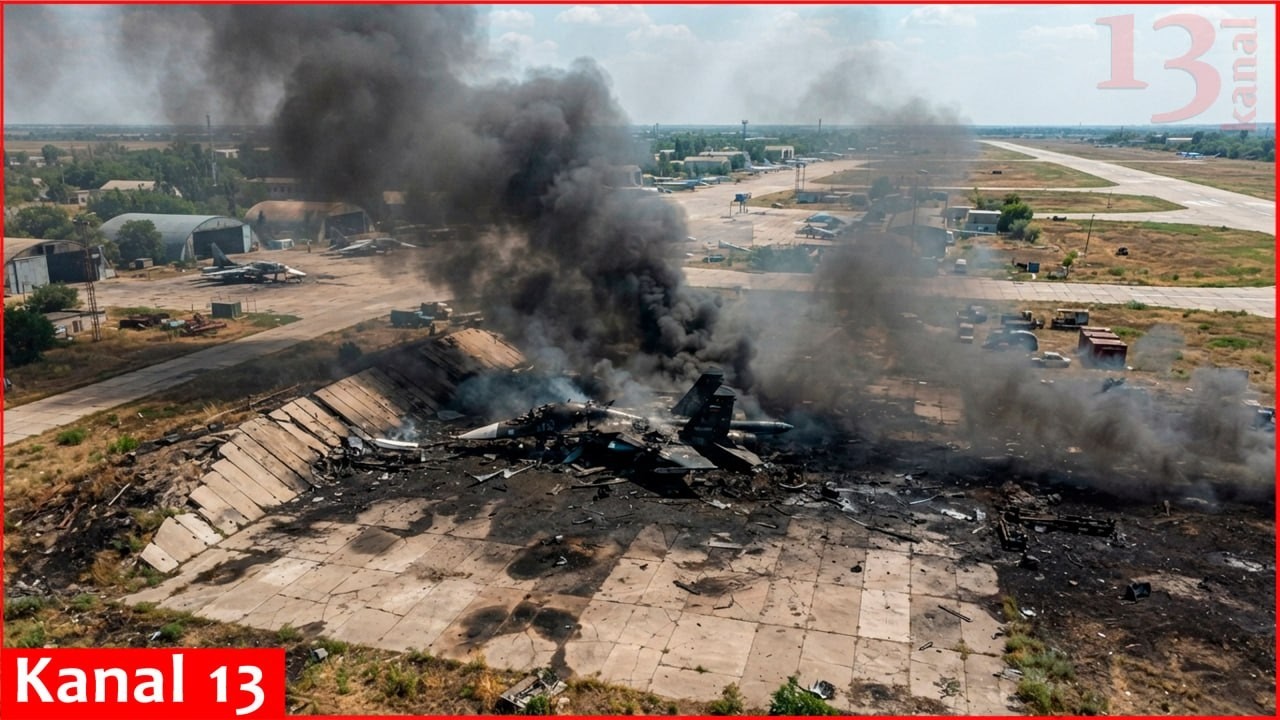
Attack on the Akhtubinsk military airfield in Russia: Su-34 fighter-bomber was damaged
Watch on YouTubeVideo summary
Defense forces recently launched a strike on the Akhtubinsk military airfield in Russia's Astrakhan region, successfully damaging an Su-34 fighter-bomber during the night of August 20th. Satellite imagery from the Telegram channel Absolutely Reliable Source confirmed at least two impact points within the facility and revealed that fuel had spilled near the damaged aircraft. Following the shelling, Russian personnel reportedly moved or evacuated the remaining planes to other bases, while analysis of the camouflage on the destroyed Su-34E suggested it was likely a flying laboratory used for testing new onboard systems and weapons rather than a standard operational unit.
This incident marks another blow to an airfield that has already suffered significant damage, having been hit previously on June 8th, 2024, when Ukraine struck Russia's advanced Su-57 fighter jet. The Akhtubinsk base is located approximately 620 kilometers from the frontline, yet it remains vulnerable to long-range drone and missile attacks as demonstrated by recent strikes in Marinovka. While the Su-34 was originally designed to replace the Su-24 Fencer as the primary tactical strike platform for deep interdiction missions against NATO infrastructure, its real-world performance has been disastrous, earning it the grim distinction of being the most destroyed Russian combat aircraft in the war.
The Su-34, known by the NATO reporting name Fullback and nicknamed "Platypus" for its duck-billed profile, is a formidable-looking twin-seat tactical bomber equipped with advanced radar systems and capable of carrying up to 8,000 kg of ordnance. Despite these impressive specifications on paper, including hardpoints for various guided bombs and air-to-air missiles, the aircraft has become a primary target due to its predictable flight paths when launching glide bombs. Ukrainian Patriot batteries operating from deep behind the front lines have been effective at intercepting these bombers at medium altitudes, while NASAMS and IRIS-T systems engage them closer to the front, resulting in catastrophic attrition rates that go beyond normal wear and tear.
The scale of destruction is evident in the numbers, with at least 41 Su-34s confirmed destroyed in combat since Russia's full-scale invasion began in February 2022, representing approximately 25% of the entire fleet. British intelligence reports from early 2026 indicate that over 30 aircraft were lost solely to combat, excluding additional losses from operational accidents, maintenance failures, and a growing shortage of spare parts. These figures suggest that the true operational loss rate is likely even higher than the confirmed statistics, painting a picture of severe hemorrhage rather than simple attrition for a platform that entered service with such high promise.
Read the full video transcript
Defense forces struck the Russian
military airfield Akhtubinsk in the
Astrakhan region and damaged a Su-34
fighter-bomber. The military portal
Military reported this. It noted that
the strike took place on the night of
August 20th. The Telegram channel
Absolutely Reliable Source published a
satellite image showing at least two
impact points within the military
airfield. The strike reportedly a Su-34
frontline bomber with fuel spilled
nearby. The report states that after the
shelling, the Russians moved the
remaining aircraft around the airfield
or evacuated them to other bases. It is
noted that analysis of the camouflage of
the damaged aircraft indicates that it
is an export version of the Su-34E.
Military reported that this is most
likely a flying laboratory based on a
Su-34
or a primer coating applied to new
aircraft before painting. Flying
laboratories are used to test new
onboard systems, aircraft weapons, and
electronic equipment in real-life flight
conditions. As reported, this is not the
first strike by the defense forces on
this airfield. On June 8th, 2024, at the
Akhtubinsk airfield in the Astrakhan
region of Russia, Ukraine first hit
Russia's most advanced Su-57 fighter
jet. At that time, the American
publication The War Zone published
satellite images of the damaged
aircraft, which showed significant
damage. The main intelligence
directorate previously released
satellite images, but only of one
fighter jet. The agency noted that the
Akhtubinsk airfield is located
approximately 620 [music]
km from the frontline. The Su-34 was
supposed to be Russia's answer to the
F-15E [music]
Strike Eagle, a twin-seat, twin-engine
tactical bomber capable of delivering
precision-guided munitions deep behind
enemy lines while defending itself in
air-to-air combat. Instead, it has
become the most destroyed Russian combat
aircraft of the entire war in Ukraine, a
grim distinction for a platform that
entered service with such promise.
The Su-34,
NATO reporting name Fullback, is one of
the most unusual combat aircraft in the
world. Its flattened nose, which gives
it a vaguely duck-billed profile that
earned it the nickname Platypus among
Russian crews, houses a Leninets V004
passive phased array radar and a
rear-facing radar in the tail stinger
for missile approach warning. On paper,
the Su-34 is formidable. 12 hardpoints
carrying up to 8,000 kg of ordnance,
including KAB-500 and KAB-1500
guided bombs,
>> [music]
>> Kh-29
and Kh-59 air-to-surface missiles, and
R-73 and R-77 air-to-air missiles for
self-defense. In Russian military
doctrine, it was designed to replace the
Su-24 Fencer as the VKS's primary
tactical strike platform, flying deep
interdiction missions against NATO
infrastructure in the event of a
European war. The numbers tell the story
with merciless clarity. At least 41
Su-34s have been confirmed destroyed in
combat since Russia's full-scale
invasion of Ukraine in February 2022,
approximately 25% of Russia's entire
Fullback fleet.
>> [music]
>> That is not attrition. That is
hemorrhage. The losses have come from
every direction. Ukrainian Patriot
batteries, operating from well behind
the front lines, have picked off Su-34s
at medium altitude as they attempt to
launch glide bombs. NASAMS and IRIS-T
systems have caught them closer to the
front. The recent Marinovka strike
demonstrated that even parked aircraft
hundreds of kilometers inside Russia are
not safe from long-range drone and
missile attacks. British intelligence
reported in early 2026 that Russia had
lost over 30 Su-34s to combat alone, not
including operational accidents,
maintenance failures, and the growing
number of aircraft grounded for lack
[music] of spare parts. The true
operational loss rate may be
significantly higher than the confirmed
combat figure suggests.
>> [music]