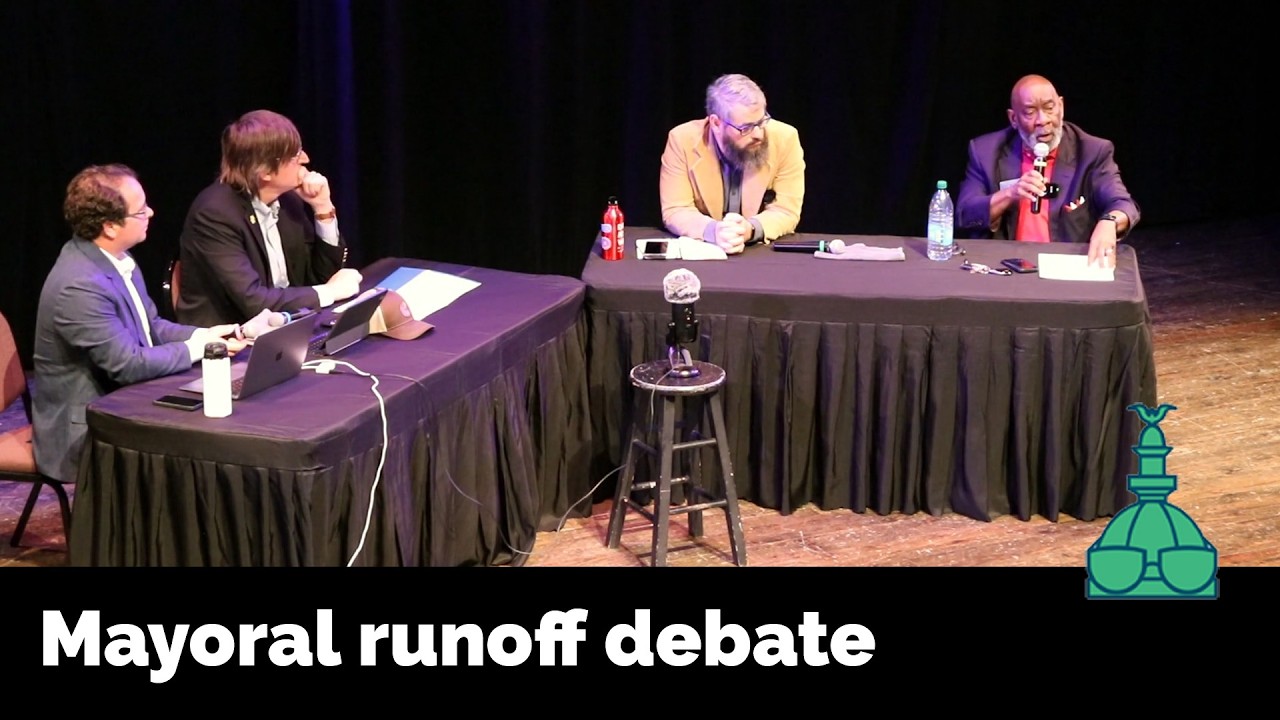
Athens, GA Mayoral Runoff: Tim Denson and Dexter Fisher debate
Watch on YouTubeVideo summary
In a heated debate held at Athens' historic Bordon Theater ahead of the May 16th runoff election, candidates Tim Denson and Dexter Fisher tackled critical issues including housing affordability, homelessness, road safety, and infrastructure challenges stemming from city-county consolidation. The discussion on housing centered on strategies to lower costs in a tight market with only 2.1% vacancy rates; Denson advocated for increasing density through "missing middle" options like triplexes and updating zoning laws to allow tiny homes, while also urging the University of Georgia to build more dorms to prevent student displacement. In contrast, Fisher argued that land constraints often make high-density housing unfeasible due to neighbor opposition, proposing instead that the government utilize its own lands for projects and suggesting a temporary construction moratorium to assess local bed counts accurately before proceeding with new developments.
Both candidates addressed the urgent crisis of homelessness, agreeing on the need for more emergency shelter beds and funding despite political divisions over spending versus accepting street sleeping. Denson emphasized the severe shortage of shelters beyond Bigger Vision's capacity and pushed for a "Housing First" model that addresses addiction and mental health barriers through case managers, while Fisher highlighted his district's plans to build a 60-bed facility but criticized past decisions that allowed encampments instead of renovating existing buildings. They also debated the influx of people transported from surrounding counties; Denson defended Athens' role as having state-licensed behavioral health services, whereas Fisher argued resources should prioritize locals over outsiders dropped off by jurisdictions lacking their own facilities. On road safety, both supported measures like speed bumps and traffic calming devices to address fatalities since 2023, with Denson citing his work in Homewood Hills and Forest Heights while Fisher pointed to a T-blot project on Jefferson Road aimed at improving pedestrian and cyclist security.
The debate further explored infrastructure promises made decades ago regarding sewer expansion north of the loop, where Denson expressed skepticism about unrealistic timelines but prioritized clean drinking water access first, while Fisher supported incremental progress through cost-sharing with developers. The conversation also touched upon controversial decisions such as the "5010 plan" to reallocate police funds toward social services and a vote on siting a new fire station against local opposition; Denson defended his past votes without apology, citing resident concerns, while Fisher expressed pride in expanding co-responder units despite admitting the community was not fully ready at that time. Both candidates reflected on their proudest accomplishments and regrets, with Fisher highlighting an eviction prevention program that kept over 830 families housed and Denson noting his work opening youth centers via Opera U funds, both acknowledging past mistakes regarding transparency and internal communications but emphasizing a commitment to rebuilding trust through accountability.
In their closing statements, the candidates outlined their visions for leadership and community engagement as they face off in the runoff election scheduled for June 16th. Fisher emphasized his forty years of living in Athens and his ability to unite diverse demographics after personal experiences with racial profiling, pledging that his first hundred days would focus on extensive community outreach where residents help shape governance. Denson thanked attendees for their patience during another election cycle and promised to solve issues like unaffordability and unsafe transportation by working hard alongside residents rather than relying on broken systems, guaranteeing active engagement from City Hall or the streets regardless of the outcome. Fisher also committed to being accessible by returning phone calls within 48 hours, while Denson proposed attracting high-paying biotech jobs with supportive amenities and leveraging student housing revenue for infrastructure needs to combat poverty and improve living standards across Athens.
Read the full video transcript
Good evening and good evening. Good
evening. Good evening, ladies and
gentlemen. Welcome to the Athens, Clark
County, Georgia Unified Government
Mayoral Runoff today.
Hey,
give yourself a round of applause for
democracy.
Hey. Hey.
All right, Drew. How's it going? What
are we doing tonight? We're going to
have a great time. All right. All right.
Well, I'm Russell Edwards, co-host at
Abract. My co-host Drew, everybody.
Hello, everybody. We have a round of
applause. Mr.
building this evening this beautiful
dogville theater that belongs to the
community of Athens, the Bordon Theater,
Miss We have some celebrity ushers. Miss
Gwin Looney, give a round of applause.
House
Thomas Whitehead
for breakfast and black futures in
Ltown. We have Mr. Fred Smith
and we have Mayor Dodd Frell. Also,
you can see here we'll remind you all
day long that the election day is June
16th. that one off, but you can do early
voting if you want to. So, the format
today, because there's only two
candidates, we're going to give you more
time to elaborate some of the policies
that you have uh the vision that you
have for uh the next four years. Um
we're also going to allow for more
discourse. So, um if you have questions
that you want to ask each other, um
we'll keep that within reason and we'll
let you know how much time we'll have.
But, um we really want to give you all
the space to um talk about your vision
for for the next four years. Um, maybe I
can start counting. Um, but before we do
that, we need to figure out the word of
who's going to go first.
There's only one way to do it.
Rock, paper, scissors.
Let's go.
>> Okay. 1 2 3 shoot. Get ready. 1 2 3
shoot.
>> Oh, Mr. Fisher,
your opening statement, sir. Take it
away.
>> Well, good afternoon.
Hope all y'all are doing well. Is what a
great great great day. First, I want to
thank Russell and Drew for putting this
on. And what a great great facility to
be standing here tonight. It was founded
by Mr. Pink Morton back in the 30s and
40s. And think about all the
entertainers that came to this stage.
Cab Callaway, Betsy Smith, Lena Horn.
Just think about the historical
connection of that in this particular
building here. And then think about the
historical connection that you all have
an opportunity to collect to elect your
first black mayor. So I think Pete
Morton would be very proud that I'm
sitting on this stage right now possibly
leaving this community as your next
mayor. Just a little bit about myself.
How much time I got guys? Y'all didn't
give me a time limit.
>> About a minute.
>> Got a minute left. A little bit about
myself. Well, you know, we've been
through this and Tim and I talk about we
had 15 of these things just during the
regular session and and some of y'all
came out and heard somehow spill. But
tonight, I think you really going to
have an opportunity to really um find
out who you want as your next mayor. You
want somebody who's an activist or
somebody who can govern. And I'm the guy
that can do that. So, I'm looking
forward to this tonight. I'm looking
forward to the anticipation of what you
all want from us as the next candidate
for mayor. and I really enjoyed being
here and thank you for coming out and
may God bless you.
Good evening folks. Um I am Tim Densen,
also candidate for mayor of Athens,
Clark County, and I'm running uh first
and foremost because we need to have an
Athens, Georgia that works for everyone
and that is affordable for everyone. Uh
over the last few years especially, it
has become very expensive to be able to
live in this community. Housing costs,
food costs, gas prices, all of these
things. Um and a lot of those things we
don't have control over in the local
government, but some of them we do. And
we need a local government that's going
to work on that. That's why if I'm
elected, one of the main priorities I'm
going to have is working on lowering the
cost of housing for homeowners and
renters alike. I also want to focus on
child care for a lot of working-class
families. as the second largest expense
for them when they have young children
and creates a local child care subsidy
program so that we can make sure that
more working-class families can have
access to that quality child care they
deserve. And the third big plank of my
platform is to reduce homelessness here
in Athens, clar county. something that's
very important to me, something I've
been working on for the last few years,
uh, directly working in homeless
services, specifically working to
actually get those who are facing
homelessness into housing and to help
remove the barriers that caused the
homelessness there in the first place.
The reason I'm doing this is though
because I love this community and it
that can sound kind of corny, but it's
very true. I moved around a lot as a
kid. Uh, my parents were preachers and
we didn't stick in one place for a long
time. So, I never really felt like I had
a hometown until I came here to Athens
um o over 22 years ago now.
>> And I just want to make sure that the
experience that I've had here in Athens,
Georgia of having a loving community
that helps me, that helped me get
through hard times, that helped me
prosper, I want to make sure that every
other person here in Athens, Georgia has
that same experience. And I believe that
we can do that. And I enjoy having the
opportunity to talk to you more about it
here this evening. Thank you'all.
Thank you.
The hot topics of the day,
housing. We have numerous housing
studies currently on the shelf somewhere
locally.
That all show we are short about 6,000
homes.
The most recent data compiled by the
University of Georgia analyzing our
housing market from 2019 through 2023
found that out of 32,681
units for rent, only 684 units were
available for rent, a vacancy rate of
2.1%.
According to the Federal Reserve, date
of May 1st, 2026, the average listing
price of single family home in Adams
Clark County is $62,000.
A housing shortage benefits landlords
and home sellers who can name their
price. In a quote from the New York
Times today, the national pattern is
clear. The way to bring down housing
costs is to increase housing supply.
Mr. Fisher, you won rock, paper,
scissors.
What is your plan to increase supply and
bring our housing costs under control?
>> Two minutes.
>> Okay. First of all, thank you, Russell.
And I think one thing we got to realize
first of all that when it comes to our
housing, we're landlocked. So, my
candidate or my opponent always talk
about density. And the four years that
I've been on this um commission, every
time we talk about adding more density,
our neighbors come out and say they
don't want density. My idea would be we
own land, the government does, and we
need to take a look at that land that we
long that we own to make sure that we
can use some of that housing for people
that needs housing. Now, one of the
thing we got missing is what I call a
missing middle. You know, we can provide
houses when we got Habitat, we got the
land um bank, and we got other entities,
but when it comes to our missing middle,
we got an issue here. You can't put
houses in place if you don't have the
land for it. One of the things I think
we got to do, we got to be smart about
where we going to put housing. And more
density is not the answer. Now, yes, if
we had more density, it would bring down
the cost of housing. But because we're a
landlock and we got to keep in mind that
we have to have an infrastructure in
place to support that housing. So, we
got to look at where we can put housing.
We're going to do a new development on
Overdoor right now for senior housing.
Good project,
130 units. Those are the type of thing
we have to look at where we can build at
and where we can't build that. We did
our future land use. We need to take a
look at that. And then we got to take a
look at our zoning ordinance. You just
can't stick houses out anywhere without
having a zoning ordinance that have not
been updated for the last 25 years. So
just say that we're going to have
affordability. That's a pipe dream. We
got to really take a look at that.
Understand where we can put housing at
and build from there. Now we are
building housing
close to 4,000 single family houses
right now. But now but the cost of those
housing are high. So again, we got to
look at how do we get that mil that
missing middle and get those into
housing. And I think we need to study
that, take a look at it, and make sure
we can be smart about when we're looking
at how we do housing in this community.
>> Thank you, Mr. Fisher. Mr. Densen, do we
add density or create more sprawl?
>> Here's the thing. Uh the idea that
housing affordability,
it that cannot be a pipe dream. That is
unacceptable. The cost of housing here
is too high. It's unsustainable. And the
people who are going to get pushed out
are workingclass Athenians on fixed
incomes. The people who are going to be
able to afford to come in here and pay
for the high price of housing are people
on the outside, people coming from more
wealthy communities. But the people who
are going to be pushed out are going to
be the people who run this community.
And that is unacceptable. There is no
way that we can have a mayor who's going
to say affordability is a pipe dream.
I'm going to that is going again like I
said during my opening statement that is
going to be my number one focus because
that's what the people here in this
community need and we do need to have
density that is going to be one of the
key ways that we do it missing middle
housing is density miss to explain
missing middle housing is right now what
we get a lot of times is single family
housing not dense at all and uh
highrises like we have down here
downtown of like student housing um
which are very very dense but very large
and very limited where they can be put
the missing middle is the stuff in
between which often times is triplexes,
quadplexes, cottage courts, um uh
smaller apartment buildings like we have
in Normal Town and such. Those are the
kind of things that we do need to have
and we have had studies that have shown
exactly the nodes that uh are best fit
for that and that have the
infrastructure for it. It is much more
costly for us to build infrastructure
for sprawling houses, single family
houses on the outside of the county than
it is for us to build it in dense areas
that already have the infrastructure for
it. That means it's going to be cheaper
for all of us. But again, we it's not
acceptable for us to say it's we can't
make it affordable. We absolutely have
to.
this outdated zoning. And then you also
talked about missing middle and one
thing struck me. You know, in our
commercial general zoning here in
Athens, Georgia, you can only build 24
bedrooms per acre. In our commercial
downtown zoning, you can build 200. So,
it's quite a a jump
or missing middle. Correct. What zoning
ordinances would you champion to change
with G? I think the one thing that we
need to look at is um we're um tied into
only when it come to single family
homes, it have to be a thousand square
foot or more. I would take a look at can
we do tiny homes? Can we do
manufacturing homes? Those are the type
of things that you have to look at when
you're trying to look at um when we talk
to zoning also. And I think that's
important because right now our zoning
laws they outdated and that and that's
unfortunate that they are and we have
not kept up with the time. I think what
happened was this town grew so fast.
I've been here close to 40 years. When I
first moved here, Athens was 75,000. UJ
was 25,000. Now we got 130,000
people that live here, 40,000 at UG. So
the town has exploded um for it come to
population. So again, but we we
landlocked though and again and we got
too much student housing. My opponent
has supported more and more student
housing. That doesn't work for me. For
example, we did with the foundry
property. They doing 1400 beds in that
founding property. What to get into is
in a predominantly black neighborhood.
So that's where all the gentrification
happens. And we have done gentrification
in this community for the last 20 25
years. And they always pushing out
African-American people. So that's where
your density goes in those
neighborhoods. It's not fair to those
people. And he's right. We do need to
make sure that people that live here in
this community can afford to live here.
But if we continue to give people the
opportunity to go into those
communities, build student housing, and
put your neighborhood out, that's not
working for me. So that's why I'm saying
when I talk about
>> Sorry,
>> but that's where I'm going. That's where
I'm going with that.
>> Mr. Dens, same question. What zoning
ordinances changes
would you champion? And uh go for
Can I ask a question here? Is that
>> Yeah.
>> Okay. Uh so Mr. Fischer, you just said
that we should not you're against having
more student housing.
>> I am.
>> But then you also said that you're
against the student housing being pushed
into these neighborhoods, which I am
also completely opposed to. you yourself
have admitted that UG is going to have
at least 400 new students every year
coming in here.
>> So where are those people going to go if
you're opposed to us having dense
student housing but also opposed to
having student housing in those
neighborhoods? Where are those people
going to live?
>> So for me, and I've had conversation
with UG already, they're also looking at
building more dorms on that campus. It's
one of the things that they're looking
they building a 500 bed um dorm right
now right there on Lan Street. And one
of the conversations that I'm having
with them was how can they build more
dorms on that campus to make sure more
students stay in that particular area.
We made mistake as a community to start
letting those um student housing go into
those neighborhoods and that and that's
bad for us and bad for what the
government did for over the last 20 30
years. We got to do better by the people
that live here. You don't see these type
of student housing in other
neighborhoods that look like me. So the
problem I got with that is we got to
make sure when we start looking at
trying to push student housing or any
type of housing that housing going to
fit that community. Everybody want to
push students downtown and again it
comes with an infrastructure problem.
That particular new um on the foundry
project we had to add in more sewer and
water capacity to get that project
online. So again if you're doing more
density downtown then you got to add in
more infrastructure. you know, it
doesn't fit.
>> That's right.
>> Thank you. Um, a quick followup maybe
for both of y'all. Obviously, this
housing is so important and it's what is
clearly within the authority of the
local government. Okay. So, I hear two
arguments often in Athens. One, oh, UG
owns too much property and they don't
pay any property tax. And then on the
next,
oh, there's too many apartments being
built. So, I guess my question is, would
we rather have UG get more land or build
more dorms that contribute nothing to
our property tax roles? Or would it be
preferable to allow for the construction
of apartments that do contribute
property tax to the tax ro?
So no, I think this that's part of this
problem and that's the thing. We have to
be realistic about this. Uh yeah, UG is
building its first new dorm in in how
many?
>> Four years.
>> Four years four, five years.
>> So I think right now they have about
about 18%
uh housing they can house 18% of
undergrads.
So if that's the case, again, where are
the I mean 500 beds, that's enough for
one year. That's enough for one year,
y'all. And and that's if that UG
actually keeps that promise that they're
only going to have 400 to 600 new
students coming here. We have to have a
plan so that we don't have what's
happening right now. What's happening
right now is that students are moving
into our single family neighborhoods and
they're taking up the housing there and
they're living there and especially in
yes historic black neighborhoods like
East Athens. So therefore, there has to
be an alternative to doing that. There
has to be we can dream all we want to,
but we have to actually be realistic
about this. And yeah, so then we can say
UG is going to build more uh apartments.
They're not I don't think they're going
to anywhere close to the rate they would
need to. They would need to be building
literally thousands of new beds every
single year to be able to catch up
within the next 15 years. So I that's
why I'm pushing that we create a student
housing overlay district close to campus
where we can be encouraging the
development in a dense way that's right
there next to campus so that we don't
have those folks coming in and taking up
the beds and the houses in our
neighborhoods and communities. Mr.
Performance
or
>> Well, I think it's the same thing that
we're talking about. Okay, we want to
add more housing our community for the
people that live here. But why shouldn't
we not be having those conversation with
UJ about them building more dorms on
that particular campus? I mean, those
conversations that they are real
conversations we need to have and we
need to as me as mayor, I'm going to
push them. I need for you all to start
building more dorms on your campus so we
have more people in this community that
can live. Now, the reason our rent is so
high, you know, and let's don't get it
twisted, you know, it's it's a
studentdriven market and have driven a
lot of our residents out of their, you
know, out of their homes. Especially
when people die off, relatives may sell
that property. So that cause a problem.
But we really got and again when I say
pipe dream, we got to realize we're land
locked. We the smallest geographical
county in the state of Georgia out 159
counties. So again, we got to figure out
where we're going to do this density,
where we going to put those housing. And
I'm just, you know, we just need to to
me what I what I have suggested Russell
and Drew is put a pause on all our
construction and let's really find out
how many beds do we have in this
community. I think that's a realistic
look that we need to take a look at.
>> Mr. Bishop. Um, following up on the
point you just made about a possible
building moratorum. How long do you
think you would support enacting a
moratorum on new construction to find
out what we need to find out?
>> No more than, you know, for me, no more
than 180 days. That would be 6 months.
If I had to push it back and I have to
push our staff to make sure we do it, I
would do a 90-day moratorum just to get
a feel, okay, these are the number of
beds that we have in this community and
then we figure out, okay, who do those
beds belong to? Are they student
housing? Are they single family housing?
Are they apartment housing? And we have
never done that in this community. I'm
not sure why people get so um upset
about when I talk about trying to pause
construction to really find out what our
housing issue is. To me, we need to know
that and the housing is just not tied to
Athens, Clark County. Housing is a
problem all over this country, all over
the state of Georgia. Only thing I'm
asking is we really want to know what
our housing issue is. Let's find out how
many beds that are actually in. And
right now, I don't think nobody knows
the answer to that question.
>> Thank you, Mr. Pitcher. Uh, Mr. D,
what's your feeling on a on a moratorum
for housing construction for 180 days?
I'm opposed to it because we know how
many beds. Georgia Initiative for
Community Housing, we have a gig team.
They have proposals coming this this uh
next week uh before the commission.
Everybody y'all can look Google it. Uh
Google the G the Athens, Georgia
Initiative community housing study. Uh
they they did a study of how many beds
we have. Uh how many of them are in uh
single residential and mixed residential
student housing. They came up with the
density number. I mean, we had been
coming into this, Russell, you you
stated very precise stats. Y'all, we're
not a stupid community. We have very
smart people here who understand these
problems and they have been studied. We
have economists. We have worldrenowned
economists at the University of Georgia
who have again stats presented by them.
We know this stuff. And the idea that we
going to stop for 6 months just because
potentially my opponent hasn't read
those studies is not fair because that's
going to put us six months further
behind actually being able to solve this
housing problem and solve this
affordability problem.
>> Mr.
>> Yeah. You know, you know how many
studies we have done on um how many
housing and like you said earlier that
set on the shelf that thing's gone back
and forth and yes, it is going to come
before the um commission. And the reason
I hadn't read it because I want to make
sure that publicly right now that all
our people that live in this community
can see it at the same time I can see
it. So once I get it, I'll take a look
and if there's good data in there, then
no, I would not propose um a pause, but
same time we never done that. And again,
um not trying to hurt developers. Um but
I think, you know, I said 90 days or
180, but we we just need to take a look
at and you and and you know what, Tim,
you're exactly right. We got a lot of
smart people that live in this
community, a lot of people at UG that
can help us with those things. But at
the same time, you know, and that's part
of the problem sometime. We do knee-jerk
reaction to try to solve problems. We're
not really not taking a look at what
needs to done, what needs to be done,
how we can really solve our housing
issue. And it's just not going to go
away easily. And we got to figure out
where we gonna build that. And and
that's my number one thing. Where are
you going to put the density at? And
again, I tell you all every time we talk
about density, people are lining up at
the door at city hall saying we don't
want more density. So unlike you in one
instance where a neighborhood kept
coming out again and again and again and
said we don't want housing and you voted
against those people in Ningham because
you thought it was the best interest for
those that housing and not for the
people that you represented and that did
not happen. So we're not going to force
feed you all on density and we should
not do that as government and I will not
do that as your mayor.
Mr. Jason, if you'd like to to respond
maybe to the question of, you know,
these projects get proposed to build
housing to to build the supply and folks
who backyard may be impacted by a new
building come to the podium and they
complain. They get very upset and they
feel this fear of change that might be
coming in this community.
What would you say to those people?
Yeah, I'll be honest with y'all. I'm not
going to say the most popular thing and
tell every one of you that I'm going to
do exactly what you want me to do as
mayor because that's a lie. I'm not.
What I'm going to do is what's going to
be best for this community.
And if we just keep saying no to
building more housing again, while we
have very wealthy people moving here,
because Athens is a lovely place to
live, and we keep seeing the people who
work at the University of Georgia, the
people who work at our restaurants, who
work at our retail stores, who run this
community, and if we keep on seeing them
get pushed out of their housing and
having to go and move outside of the
county or find a new place to live,
that's unacceptable to me. And I am
going to work. And you know what?
Sometimes some people aren't going to
like the choices I make. We That's being
a good leader, y'all.
>> Uh if we just were going to do what the
most popular thing is at one given
moment, we can just We don't even need a
person for that. Just do a little straw
pull. We do that thing. But guess what?
We'd have a pretty screwed up community
if we had that. So yeah, I will be on uh
Mr. Fischer, you are correct. I am I am
not going to do whatever people come and
complain about. I'm gonna do the make
the hard decisions to do what's best for
my community.
>> Uh supporter of direct democracy, straw
polls or representative democracy.
>> I think well again you all going to be
making decision who you going to want
your next mayor. So, do you want a mayor
who just going to force feed you and
what what he thinks you all should have,
or do you want a mayor that's going to
listen to you, take a look at what we
really need and get the job done? See,
you know, this ain't my first rodeo. I
understand how to get things done. I
understand how to connect the dots. You
just can't force feed people. I would
not be a mayor who I'm going to slam
down my agenda, my own personal agenda
down your throat and expect for it to be
okay. That is democracy. But you all you
all elected us to make decisions for
this community. So if you're going to
get up here and say I'm going to make
decisions based on what I think is best
for the um for the community, that's the
wrong thing. I'm going to make decision
based on what you all have said put us
in office to do. That's what we do as
elected officials. And that's part of
the problem. Too many elected officials
stop listening to the people that put
them there and got their own agenda. I
don't have an agenda. My agenda is the
Athens agenda. It's the people that live
here and that's what I'm going to
support 100% of the time.
So, we're kind of frontloading. We're
giving more time and space to these
first dimensional topics.
We'll we'll kind of get rolling. So, uh
on a related topic of homelessness, uh
Mr. D, this will go you first on two
minutes in Michigan. Um on our recent
podcast apphat where you can find on
Spotify or Apple wherever you find
podcasts um we talked about this uh
question home with pretty much everyone
and I want to contextualize this
question by telling you something that
Commissioner Mike Handy said. So
Commissioner Mike Handy said to solve
the homelessness problem in our
community we're going to make both
progressives and conservatives upset.
You don't have to agree or disagree with
them. Commissioner Hammy said, "We'll
likely make some progressives upset
because we will need to come to terms
with the fact that it is not
compassionate to accept that it's okay
to have people sleeping on our streets."
He also said, "We will make some
conservatives upset because we will need
to spend money to fix this problem." Can
you give us specific examples of policy
that you want to pass here in Athens
Clark County that will help mitigate the
problem of homelessness? And again,
we're going to be asking for specific
examples and specific policies. Mr.
>> Thank you. And again, that's a perfect
example as what Commissioner Hamby said.
People are not going to be happy with
everything. This is the thing. And
therefore, if we're kind of go away that
we're always going to listen to every
single person, what that gets you is
honestly what's been happening a lot at
Seahawk lately. Nothing. Nothing gets
done because always the easiest thing
for an elected official to do is nothing
because people do not get I'm talking
right now, sir. Thank you. Um and so, so
if we want to get something done, hold
on. Yeah.
>> Okay.
Everybody's going to be chill. There's
no haggling. All right. We We're in this
beautiful theater. We plunk down the
cash to rent this thing to hear from
these candidates. Okay. Thanks. Go
ahead.
>> And I'll definitely be in the hallway.
I'm happy to talk to you in the hallway.
Whatever person we have there. Um and so
yeah, and it's it's true. And I think
what I've been saying is the one thing
that I think this entire community can
agree on is that we don't want
homelessness happening here. I want to
start from there. And yeah, we're going
to have to bring the people to the
table, definitely some people with more
conservative ideas, some people with
more progressive ideas to work on those
solutions specifically for specifics.
Uh, one thing is we don't have nearly
enough emergency shelter beds. We have
one emergency shelter in town. I know we
people talk about Salvation, Army,
Family Promise. None of those are
emergency shelters. If you found
yourself homeless tonight, right now,
there's one place that you could get
into tonight, and that's Bigger Vision
that has somewhere between 30 and 46
beds at one given time. Um, so we need
to have more emergency shelter beds. We
need to be also uh we need to have more
case managers and people working
directly with these folks, the work that
I do because that's the only way that
you're going to be able to do a housing
first model that works. Meaning that you
get somebody into housing and then you
actually have a case manager working
with them to remove the barriers,
whether that be addiction, whether that
be mental health issues, physical health
issues, uh domestic violence issues,
whatever those things are to be able to
address those things. Um and and then
also like yeah the biggest part we're
going to have to have funding. It is
going to cost us money. But if we
actually want this to want this to go
away, if we want to stop seeing
homelessness here in our community,
we're going to have to spend that money
and start helping people. And I believe
that if we present it right, and I plan
on working with all these folks, the
university, the school district, the
hospitals, which are spending millions
to all come around and work on this
issue together.
Mr.
policy uh that we can help mitigate the
issue of homelessness here in front.
>> Actually um I agree with Mr. Densson. We
don't have enough um housing for our
homeless population. And again, I think
one of the things we got to look at
though, where can we put those
particular um um facilities? Right now,
we're getting ready to build a 60 bed um
facility. actually in my district on
Mitchell Beach Road with advantage. It's
going to um be for people that have deal
with mental health issues, substance
abuse. So that would give us 90 beds to
help us deal with people that dealing
with mental health and substance abuse.
So that's a start right there. And
again, I do agree with Tim. We need more
housing for our homeless population. I
think one of I think one of the mistakes
that we made when we got the $57 million
from Opera, we really could have did
something right then. What we did do, we
did a homeless encampment. I wouldn't
have voted for the homeless encampment.
What I would have voted for though,
there was a building sitting right there
on that property. We should have
renovated that building. We probably
could have served up to 150 to 200
people right there in that facility to
help with our um housing situation. I
would be looking at spaces that may be
available where we can do things like
that. And he's right, it is going to
cost money. But the way we going to pay
for that is we got to bring our
faith-based community to the table. got
to bring our business community to the
table. He's right. UG the school
district, our hospital, it got to be a
lot of partners involved for us to do
that. So, I don't disagree with him
where we going with this, but we got to
do it the right way. One of the problems
that we're having though, and one and
don't nobody want to admit it, we got
more people get dropped off in our
community. And that's that should not be
happening. Other communities should not
be dropping off people from their
community in our in our space. and that
takes up the resources actually for the
people that are here that need those
resources. So we got to take a look at
that and see why that is happening on a
continuous basis.
>> Thank you.
So
Mr. D first um so there's some talk out
there that people are being bust into
our community and that it's kind of a
disagreement you hear. Some people think
it's happening, some people say it's a
lie. Okay. Uh a study a couple of years
ago said showed that around 70% of the
homeless population are Athenians. Um
Mr. Benson uh are people being busted to
Athens Park County? Um do you believe
that you say what you see?
>> Yeah. And and they're not. So that with
that uh new development that's being
built in Mitchell Bridge Road, I work
there uh every single week. Um I've been
watching they're actually on the second
floor now. It's very exciting to see
them building it. Um, and that
development which I'm very excited about
that is that is uh the idea of this
busing in people coming in it it's tied
to it because here let me explain what
happens. I I worked yesterday 12 hour
shift at the crisis walk-in. Uh let's
just say we had 12 people come in. Uh on
average a lot of times people come in on
what they call a 10-13 involuntary. They
come in from different counties. It's
true. They come here because we have the
state license for it. uh that's been
developed by the department of
behavioral health and developmental
disorders. So when somebody is having a
mental health crisis in Jackson County,
Madison County, Oglethorp County, they
are supposed to be brought to here to
Athens County where we have the services
for them. And a lot of times they come
in for substance use. They come in for
mental health, schizophrenia, suicidal
ideiation, whatever those things are.
And then yeah, a lot of times they are
here for a little while trying to get
the services and the help that they
need. People are not being uh if they're
dropped in, that's already illegal.
There is a state law against it. bring
in what is happening is yeah those
sheriff's departments bring the people
here also the Pedmont also the St.
Mary's all those counties I just said,
they don't have hospitals, y'all. They
don't have hospitals. So, uh, as a flyer
that was put out, uh, attacking me,
saying that, uh, my opponent was going
to get rid of all of the magnets that
brought the homeless people here, those
magnets are our hospitals. Those magnets
are our behavioral health hospitals.
Those those those magnets are the fact
that we have a domestic violence shelter
here, only two in this entire area. I
don't want us to get rid of those. And
you know what the price sometimes is
going to be? That we're helping other
people, too. Wow.
And
and I will admit that it's not the
perfect system. I would love the state
of Georgia to be giving funding and
support to Madison County, Ogathorp
County, all these rural counties around
us so they can have their own hospitals,
have their own behavioral health places.
And I will fully support that and be at
the state capital lobbying for it. But
until they don't, we need to stop
attacking homeless people, acting like
they're outsiders and paras, and that
they're somehow suckling on the tit of
of Athens, Clark County, and using us.
They're not. We're helping people.
>> Thank you. Thank you. So,
our homeless population is a population
all is all our problems, all our
concerns. I think one thing we got to
look at again and Tim is right when
people do come here for mental health
and substitute from other counties other
counties kick in. What I'm talking about
and he knows this is true. I've seen
this with my own eyes. I've seen the van
from Fulton County pull up to the
sparrow's nest and people get out.
>> So that's not fair to the people that's
here. That's all I'm saying.
I want to support and help the people
that are here in Athens in this
community. That's what we supposed to be
about. Helping folks that are here. I've
always tried to help the homeless and I
always will continue to help the
homeless population. But again, what I
said earlier, it's gonna take a village,
a full community support to help us to
curb some of the homeless issues that we
have. The go we can't buy our way out of
this. The government can't do any all of
this. We got to have partners to help us
with this. We got to have partner that
will help with housing. We got to have
partners who can put people in place.
and our hospitals do a great job, but
they're not equipped to deal with
substance abuse or mental health issues.
That's why the advantage um property and
and the construction that's going there
is going to me I think going to be a
game changer. It's going to help us and
it probably will help cut down on some
of the issues that we're dealing with
with our homeless population. But I've
never said I'm not sure who sent you to
Florida, but I never said that the
homeless population that we need step I
would never say that. So for you to say
that is wrong and you know you're wrong
and you should not do that ever again.
>> Yeah. We uh talk a lot about housing
clearly within the authority of the
local government planning and zoning.
Another clear area of your authority
will be road safety planning roads,
traffic calming measures, keeping our
communities safe on the roads. From 2023
to 2025, three years 45 people have died
on Athens roads.
So far this year, four have died.
How, Mr. Fisher,
would you plan on addressing this
problem?
>> I think one thing we got to look at, and
we're doing that right now, look at our
traffic patterns and what's happening um
with those particular area. We got to
put in more traffic common
um type things within especially in the
road system. Just in our district alone,
to your point, had three three
fatalities on Newton Bridge and Cwood.
That need to be a red light right there
cuz people be coming across that hill
wide open. So, we need to start really
looking at how we're doing our road
construction, how we're putting things
together. Um, two projects that I did in
in neighborhoods actually, we put in
speed bumps. Some people don't like
speed bumps, but in Homewood Hills, we
got speed bumps. We just started with
Forest Heights, we got speed bumps. So,
those are type of thing that we got to
do. But on our major areas when we start
looking at trying to construct those
road, one of the first thing I would ask
them to do, how do we do safety for
those particular roads? What is that
going to look like? Do we need going to
have more biking lanes? Do we need to
have more walking lanes? Those are type
of things that we got to look at when we
talk about um safety and what happens.
And we're going to have a great
opportunity with this um North Avenue
quarter. They're going to be a perfect
example how we take care of that quarter
and what happens there when we start
looking at road safety.
Mr. Dson, road safety. Uh people are
dying on the roads
uh routinely
and uh you know we might put in a speed
bump or increase a curb cut but uh the
motorists might get mad. So
where can we find the courage to save
lives on our roads if somebody feels
inconvenience as a driver? Again, we're
we're talking about one of those complex
issues that everybody's not going to be
happy about. Therefore, we need a mayor
who's going to be able to do what's best
for Athens and not just listen to every
single person when somebody comes up and
says no at the podium, then we vote no.
Um so, yeah, we need to have especially
for our multimodal transportation here.
Um the so whenever I was on the
commission, uh Jefferson Road uh was
having multiple fatalities, still a very
dangerous road, very fast on there. Uh
so I worked with community members to
get a t-bloast uh project put in place
for transportation safety measures to be
put in place there which is still being
worked on uh cuz things do take too
long. I'll give you that. I know I know
that Mr. Fisher will agree with you on
that one. Uh but we put those funding in
place. Same thing with Prince Avenue
here uh with us us two laning that uh
two laning that road um or three laning
that road. um we're we're going to have
to take and make some different changes
on how we think about transportation if
we want to keep pedestrians safe, if we
want to keep cyclists safe, if we want
to keep people waiting for their buses
safe. Um and that's one of the reasons
that it's a big part of this is funding.
And that's why I have a proposal that
I've been campaigning on called
inclusionary parking where we can be
gathering a new funding source
specifically so that we can build out
sidewalks, crosswalks, bike lanes, and
public transit system so that we can
keep people more safe and get them
around. But yeah, uh, right now if we're
talking about we're going to choose if a
person has to take an extra 3 seconds to
get from downtown from the county line
or we can make our community more safe
and less people die, I'm gonna choose
the latter.
Everything's interrelated here. So,
we're going to talk about infrastructure
and density. Um, so, uh, Mr. Jackson was
spoken first. During the city county
consolidation of the early 90s, there
were many promises made to different
communities. One promise was to expand
sewer capacity to various areas of the
county. It has been over 30 years since
consolidation and these sewer expansions
have not happened. A new study estimates
that to expand sewer capacity north of
the loop in the Sandy Creek basin would
cost over $und00 million. Do you believe
that we should make good on these
promises and expand sewer capacity to
these communities? You have a minute and
a half.
>> I believe that we need to start working
towards it, which is what our county
manager and our staff is proposing uh
with a timeline of different projects
that will incrementally get us closer to
that. Uh I'll be honest though, I think
that uh there was maybe a bunch of uh
promises or ideas that were floated back
during unification that were not
realistic and people were kind of being
lied to to be honest. Uh and now we're
dealing with the repercussions of that
here later on uh many decades later. Uh
but I do believe that we need to be
working first and foremost I do think we
need to be focusing on making sure that
everybody has access to clean water
which we are much closer to uh than we
are when the sewage and I think that is
a priority. We still have some neighbors
and some communities that do not have
safe access to clean drinking water. Uh
and that's absolutely that's
unacceptable and we are closer there and
I believe we can prioritize and get that
done. When it comes to the sewers, I
think we just need to start taking this
incremental steps and slowly get us
there and also try to work with these
communities to find ways that we can
find some costsaving measures where we
can have maybe entire neighborhoods or
developers uh helping chip in some of
the cost to tie in things. Um, but I'm
not going to sit here and and and
honestly lie and say that if I'm
elected, we're going to have uh sewer to
every single home cuz it's just not
going to happen right now.
>> Thank you, Mr. Fisher. Do you believe
that we should make good on these
promises and expand sewer capacity to
these communities?
>> And again, I I agree with Tim. We we
can't just do this overnight because
this probably did not happen overnight.
And again, I was I had just moved here
when unification was being talked about.
And he's right. People got lied to. I
was sitting in on those meetings when
they was talking about doing sewer and
water um countywide also talk about
economic development um within east a
and none of those things happened
actually if you go back and read the
charter four years after the charter
started suing water supposed to have
started in this community and that
didn't happen and and has built up and
is matter of fact I was surprised at how
I thought the cost would be a lot higher
than 100 million that's been pronounced
but you're right we can't just buy our
way out of this one. It's going to take
time. But not only do we got to expand
it, we got to improve the infrastructure
that we got in place already cuz that's
crumbling. When I first started this
campaign, none of other commissioners,
I'm sorry, none of other candidates were
talking about infrastructure till I
started talking about it. I'm a
facilities guy and I understand to get
things done, you got to have stuff
underneath to make sure it's working.
So, we didn't do that. So, so we have
failed our community,
past commissioners, past mayors, and now
we got to play catch-up. But again, it's
going to take time for us to do that. I
think I want to bring all our um our
staff together and start chipping away
at it. But also, just keep in mind, we
got to fix also what we already got in
place.
>> Thank you. Thank you, Mr.
a little bit of some frustration with
our local government at times. And one
thing that comes to my mind is that it
took 23 years to put a protected bike
lane that's about.7 miles. It took 17
years to connect the greenway through
Okonial Cemetery.
>> Yeah.
>> It's taken
It's taken
30 years in counting for the Firefly
Church. You feel like
our citizenry is maybe losing faith in
our local government's ability to
deliver on promises to build good things
with the taxes y'all collect. And what
would you do as mayor to speed it up and
bring some of these projects to deliver
some of these projects?
One minute. Great question, Russell. And
I've been talking about this. See, I've
done splash projects. I did it for the
school district. We brought in two
schools, a fieldhouse, and a track. I
was only there for three years. Within
two years, under budget and on time.
Problem we got in Clark County is we try
to collect the taxes first and then
build. You can't do that because
inflation catches up with you. In my
administration, once a project is on
paper and that's a priority, then we're
going to design it. We're going to build
it and we're going to get it done. You
can't wait. We got stuff since 2011.
2011 that's still on the books. We got
stuff from 2018 that's still on the
books. That's unacceptable to you all
out there. There's a better way. I know
the better way. I've done this. I've
been a hands-on manager, a hands-on
leader. So, I understand how to make
those projects work and how to connect
those dots. And you're going to need a
leader who understands that to get
things done moving forward.
It's a great community, but golly, it
takes decades sometimes to build a
sidewalk.
>> Uh, Rust, what were those three projects
that you mentioned in the in the
question?
>> Uh, 23 years for the protected bike line
on Prince Avenue, 17 years to connect
the greenway through OK Cemetery, 30
years in counting for the firefly
direction. So, uh, very proud to say
that during my four years as a county
commissioner, before the state
legislature removed me from office by
redistricting, all three of those things
were done whenever I was on the
commission and got passed. Because one
of the big things that we need is we
need to have elected officials that are
going to have a bias towards action,
getting things done, and that are going
to have the political will to move
forward. All three of those things also
had massive uh uh amounts of people and
a lot of times not a large amount of
people but people coming to our podium
saying they didn't want it to happen.
And from what I'm understanding from Mr.
Fischer is if that people coming to say
they don't want it to happen then he's
not going to do it. And if that's the
case we need to have someone who's going
to push things through. Again we need to
be doing having a government that's
going to do what's best for Athens. It's
not my personal ideas, my personal
things, but but we actually have
studies. We know these projects, these
things, and we need to move forward on
them. And if we are we if we are
delaying them constantly because people
come up and complain about the Firefly
Trail or complain about having the
Greenway connected, uh you're not going
to get things done. And that's one of
the big reasons that things didn't get
done until we had a commission and a
mayor that was willing to move forward.
>> Actually, but the problem with that is,
you know, you all had it, but you didn't
get anything done. And what I'm saying
is we know what those projects are. You
price them out. And I give you a perfect
example right now. We voted or this
group voted on the judicious center. It
started out as a $40 million project.
Right now, we're looking at playing $200
million for judicious center. If you had
commissioners on it that understood
that, let's go ahead and bond this
particular judicial center. Let's get it
built. The judic system would be in
place right now. That's the type of
mayor I would be. I would watch your
pennies and watch your dollars and make
sure things get built. That's part of
the problem. That's why you all don't
trust us because we wait 18, 20 years to
get things done. And that's unfortunate
that these things happen with elected
officials cuz they don't want to do the
job and do the work.
>> Mr. Speaker,
to public safety, um
Mr. Vincent,
when you were serving on the
county commission, I remember clearly
I was serving as mayor pro 10 and we
were going through the budget
discussions in the wake of uh co George
Floyd meeting virtually
u and you had a proposal that you worked
on with another one of our colleagues
known as the 5010 plan which would have
moved to reallocate funds from the
police department 50%.
Within 10 years, um there's been a lot
of discussion about this plan over the
years and I wanted to ask you um now
that you have this experience, years
have passed since that proposal was
floated, how do you feel about it today?
>> Yeah.
um for the general idea of it that was
behind it. I I I still believe that we
are putting so much responsibility on
our police officers to be the people who
are social workers, to be the people who
are homeless services resource officers,
to be the people who are uh responding
to uh uh family violence issues. um all
these different things that we have
shown, studies and studies have shown
that are best dealt with when there's
done through a mental health specialist,
through a social worker, through the
co-responder units. And and I I'll admit
I I believe that this community uh is
not ready and was not ready for uh to to
the to the level of what the 5010 plant
was. But I am also very proud that over
the years, every single budget almost
has expanded those co-responder units
that we put in place during that budget
so that we can actually be uh reacting
more to those kind of emergencies and
mental health crisis uh better than we
were years ago. And right now, we're
just still not responding to public
safety in the way that I believe we
should.
talking about back in the blue, Mr.
Fiser. Uh let's talk about back in the
red. Uh there was a a vote uh I guess
almost a year now ago to site a new fire
station on the east side of Athens. We
went through a search committee twice
over two years of public meetings trying
to figure out where to put this fire
station to expand service to provide
diligent service. Fire chief was very
outfront with his recommendation that
this be built. um you made a decision on
that vote and I was wondering if now the
time that has passed have you thought
more about that vote and thinking about
uh do you maybe wish that you had
approach that differently?
>> Well, you know, um Russell, safety
should always be priority number one in
anything that we do in this community.
And again, um, for those people that
lived in that particular unit, um, in
that particular part of the county, um,
they was adamant that they did not want
a fire station. I went and I went and
talked to some of those folks. So, and
it went in my district. So, I did talk
with those, um, residents in that
particular area, but they was pretty
adamant that they did not want a fire
station. Now, the vote passed. So, one
thing about me, um, you win some and you
lose some, and that's okay. And we move
forward. They got a fire station out
there. It's going to add more safety to
the, um, to that particular community.
But why you didn't ask me about the blue
question? But that's okay. But uh but
but but you know, I I feel I feel
adamant about you know, let me tell
y'all something. I'm never going to
apologize for the last four years that
I've been on that commission for any
vote that I've taken. You know, I'm I'm
if it was the wrong vote, it was the
wrong vote. I'm mad enough to admit
that. And we keep it moving. Then we we
live the fight for another day. But I'm
never going to apologize for any vote
that I've taken over the last four years
that I've been on that commission.
Let's move on to another another area
here um to a new segment on debate
series uh where we ask the current
commissioners to ask you questions.
>> We didn't know what those questions are.
>> Get ready.
>> Um so Mr. Benson, I'll just go to you
first and then Mr. Fisher. Melissa,
Commissioner Melissa Lyn from district 2
asks, uh, "What accomplishment from your
time on the commission are you most
proud of? What decision from your time
on the commission do you most regret?"
>> Yeah. Okay. Great question. Uh, I think
the one that I'm most proud of would be,
uh, getting the eviction prevention uh,
program put in place. It was a lot of
work. uh worked with uh officials in
Gwynet County pulling them together to
help uh us model what they've had in
place over there with our own staff. Um
and it it took a while again longer than
it should have to get pushed through
because there was uh a lot of political
push back at first, but we got that
program put in place and because of it
uh kept over 830 families in their homes
instead of being evicted. and want to
talk about the best way to combat
homelessness is to make sure that people
don't become homeless in the first
place. And that's one of the biggest
reasons I think that eviction prevention
program has been so successful and that
uh if I'm elected that will become a a a
fully funded program that we will move
forward as part of our budget. Um also
definitely zero public transit system in
place. Very proud of that one too. Uh
and then the the one that um the one
that I would regret um and I've I've
talked about it publicly.
>> Okay.
um you know that uh whenever we had the
police uh uh the public safety civilian
oversight board and we were picking the
who was going to serve on that board and
um there was uh a group of folks who
really didn't want to see that board
existing uh and and that was their
prerogative and some of them applied to
be on the board and I uh sent text
messages to some of my colleagues which
was completely illegal way because they
were open record uh and uh the way I
addressed it was was improper and I
should not have saying that, you know,
work make sure that these Republicans
and I should not have been saying that
because I think that was unnecessarily
divisive and and unfair. Um, and so I
think that was uh yeah, and I've I've
owned up to that and I've learned from
that and uh will continue to.
>> All right. Thank you, Mr. Fisher. What
accomplishment of your time on the
commissioner and proud of and what what
do you have as the most? So one of my
biggest passion is the young people in
this community our youth development and
one of the things that we've done and
that u my colleague we had money sitting
from opera u for youth development that
wasn't getting used so one of the things
we did was we made sure that we opened
up four community centers in our Athens
housing project to make sure those young
people will have somewhere to go on a
daily basis. I'm really proud that we
did that as a ongoing um um program
that's happening now. All those kids
this summer will spend time at um um HT
Edwards and um and also at Shallow um
Boy and Girls Club. So that's going to
be very beneficial to them. And then
when they come back in the fall, those
four community centers will be there for
those young people to help them with
educational needs, help them as growing
needs. And so some of the things um for
me anytime it comes to our young people
is is really part of my passion. Um be
honest with you guys um there hadn't
been um a lot of regrets for me. Um I
think one of the things that um has
bothered me is that our community has
lost trust in us as a um government and
I want to build that trust back and I
think we need to do better from a
transparency perspective from
accountability perspective. So for me,
we need to build that trust back because
I regret that our community don't trust
us to do the work that you all actually
hired us to do. So um as the next mayor,
we're going to have transparency. We're
going to have accountability and we're
not going to do anything illegal or
unethical. So we'll be embarrassed by as
we move forward.
>> Commissioner, uh Mr. Benson, why don't I
go first?
So, uh well
well this one this
this one
this is coming to you with the bark on
from one of your former colleges. All
right.
Uh from Commissioner Allison Wright.
Oh, this is indeed a great question and
I spoke with Commissioner Wright before
reading this aloud.
Oh, this is indeed a great question for
Tim. No team in Tim, only an I. I would
ask how he plans to work with folks he
never worked with before. I experienced
him as a dude that only had his agenda
in mind, not woman friendly and never
collaboratively beyond his small circle.
In four years, he never asked for my
opinion, not once. A great question for
your podcast would be aligned with what
skill set do you have that helps improve
community relations and commissioner
support. Tim is divisive and portrays
himself differently for campaigning. His
wish list of mending his divisive past
is not realistic.
Well, Commissioner Wright's not a fan.
Um,
and that's fine. It is fine. Um, you
know, I uh I can definitely tell you
that um you know, and I that got pretty
personal and I'm not going to do that
back because I think that's kind of
almost like what's trying to get me into
there. Um, this is the thing and if
anybody who's ever took the time to get
to know me, anybody who's worked with me
over the last 15 years as community
organizer,
um, they will they know that I'm going
to I meet people where they're at. I
will listen to folks. I will um
I I dra I desperately want to work with
people because as as one of the big
parts of community organizing is that
you're not organizing for people, you're
organizing with people. And that's why a
big part of my when I was on the
commission, I came on and said that I'm
going to hold a uh you know a town hall
uh basically every month that I'm on a
commission. And I did I held uh at least
10 every single year, more than 40 town
halls when I was on the commission for
those four years. And I will do the same
thing as a mayor going into the
communities not expecting them to come
to meetings uh where oftent times you
know some especially for public comment
where you have uh certain commissioners
I won't say names uh who would leave
early before the public comment ever
happened almost every single meeting um
uh and I want to make sure that I'm
sitting there listening to people
working with people uh I was out
knocking uh over 40 doors just this
afternoon before coming here over on
Fourth Street talking to folks folks at
their door, listening to what their
issues are, listening to what their
concerns are. That's how I govern. Um,
and that's how I will continue to
govern. And I will happily meet with
every single commissioner and every
single state rep. Uh, I mean, Houston
Gaines also worked to get me
redistricted out of there. But you know
what? I met that guy for coffee multiple
times a year, every single time. And I
will continue to do so if I'm elected.
rough and tumble world of politics. Mr.
Fisher, any any remarks from you?
>> Sure. I have a question.
>> Yeah. Well, you know, for me, I've
always been a collaborator. Um, always
been one who can bring people together,
you know, and that's my superpower. I
have sit down with people that's
different from me. People have political
um ideology from me. That's what I've
done my whole life. Um, I've always
gone, you know, and Tim say he's been to
Fourth Street with I've been going to
Fourth Street in those areas for years.
Um, not sure how how many times he been
on it, but I've gone into these projects
and talk to those young people. One of
the things I pride myself on and I tell
people is if I get an invitation to go
talk to young people, no matter what I'm
doing, if I have to change schedules,
I'm going to do that cuz they need to
understand that they can achieve and do
whatever they want to do. when I worked
at UG and you know I worked for three
different presidents um Chuck Knap,
Micah Adams and Jerry Mohead. All three
of those presidents had me at their
table helping them how we can shape
things at the University of Georgia.
When I ran my department I had over 500
employees. I had more women, more people
of color in leadership positions. We set
up GED program. We sent them back to
Athens Tech.
>> We doing all those things in my career.
I know how to build um coalitions. I
understand coalition. You can't do these
things in silos and sometime people try
to do that because they think they they
smarter than everybody else. But me as
your next mayor, I'm going to work with
the whole community. That's why I said
my first 100 days. We're hitting the
ground running. And I told these people
who's getting elected, you better put
your running shoes on cuz we're going to
be out in these streets talking to this
community and you all going to help us
shape our strategic plan over the next
four years.
All right,
questions.
>> That's all. That's all. That was
terrible. All right. Commission.
>> All right. We had a couple commissioners
ask multiple ones. So, all right. All
right. We'll keep it going. Okay. Uh on
the heels of of your remarks, Mr. Fiser.
Um who wants to take this question
first?
>> Okay. Mr. Fisher.
>> All right.
We need to interrupt it.
Is it important to work with UG? If so,
what are specific actions or policies
you would work towards with UG? This
question comes from Commissioner Alita
Thor.
I think we cannot work with UG. I mean,
it's the largest employer. It's the
elephant in the room. It's the largest
employer in this community. I spent 32
years on that campus. I understand the
ins and outs. We got to have a
relationship with them. Nothing happens
in this community without UG. Right now,
at least on the upper um um echelon,
there's not a relationship. Now, our
staff, they get along great. But from
day one, I will have an audience with
Jared Mohead. And some of the
conversations I'm having with them right
now is reducing the number of cars that
freshman can bring on campus. To me,
that's important. having those
conversation about building more dorms,
having those conversations about how we
can collaborate together to make a
better Athens for everybody. I'm the
only candidate and just the two of us
who can do that from day one. Same thing
at Athens Tech. I spoke at their
commencement last year. Same thing with
the school system and I worked in the
school system. So, I understand how
those relationship work. This last
commission, they talked bad about UG.
They did not want to have anything to do
with them. They said nasty things about
them. That's not how you build
relationships with the largest employer
in this county. Now, do they have issues
there? You're darn right they do. And I
understand that there's not a perfect uh
employer in this town, but at least we
need to be having some meaningful
conversation for how we make all the
Athens better for everybody. I know how
to connect those dots. I understand how
to connect those dots and we'll have a
seat at the table on day one in my
administration.
for everybody or for everyone.
All right. So, same question. Work with
UG. What are the specific actions or
policies you work for UG?
>> I think everyone just rolls off the
tongue better, but um so, so yes, I mean
obviously we do uh the Athens wouldn't
be Athens without the University of
Georgia and University of Georgia
wouldn't be what it is without Athens.
Um we're very much tied into this and um
you know but I do I do believe that UG
needs to do more. I do um for too long
wages were stagnated here
and uh it's the largest employer yet for
so long in some positions they're still
not paying a living wage. I I expect
more from state institutions who are the
largest employers here. Um and but yes,
we the way that we get those things
changed is by having a healthy
relationship and conversation. And I do
believe also that our the relationship
right now is pretty unhealthy. Um so we
need to come to the table with both of
them, but not give UG not just give
everything up. You know, we're not going
to just settle for that. We need UG to
step up. Uh right now, yeah, UG has owns
a ton of property. They don't pay taxes.
Obviously, that was a big part that they
do not pay any kind of taxes into the
system. Um there are ways that we can
work with them to maybe that again this
student overlay district that we have on
the edge of campus possibly University
of Georgia uh uses some of their
property for that overlay district and
gives puts it in. So finding those ways
that we can find common ground and move
forward again homelessness I think a big
one finding that common ground the ways
that we can move forward but at the same
time not selling out our community
because our community deserves better.
Yeah, just responding to that. Um, one
of the taxes that UG does play our storm
water fees. So, that's one of the things
that they do. But again, I think what we
got to do and again, as your mayor, I'm
going in as a mayor, not as a former
employee. So, they they understand that.
And what I'm what I'm bringing to the
table is let's start this conversation
right now because I am at that table.
And yeah, they can do better. And one
thing that we need to really focus on,
not so much at the top, but those a
number of departments I have had um had
conversation with some of those deans.
They are willing to kick in money with
us to do the things that we need done.
But again, you got to go ask the
question. You got to have a seat at the
table. Last commission four years before
me that didn't happen because everything
was, you know, there was a big devil in
the room. That's not how we need to
handle or talk with the people that, you
know, that live in this community.
That's not what we do. We're better than
that.
>> Thank you, Mr. Fisher.
>> Okay. We've got a uh our next portion of
the debate where the candidates can ask
each other a question. And before we do
this, uh audience members, uh we'll be
asking you to ask some questions after
this segment. So, put your thinking caps
on and we'll give you more instructions
in a minute. Okay. All right. So, Mr.
Fischer, how could you ask the first
question, Mr. Benson?
>> Sure. One of um things um Tim has um
sort of accused me of is um I think it
may be in our first forum where he said
that um a developer gave me Well, let me
back up. One of the things he said on
his um website that all the money that
I've taken in came from corporations and
packs. And I need you to tell this
audience tonight that's not true. And
you know it's not true. Every penny,
every dime, every dollar, every $100
I've gotten came from individuals not
only in this community, but people that
I've developed relationships over the
last 40 years of my life. My college
roommates, people from my hometown. So
for you to put that on your website to
say this is what I raised, hardworking
people. This is what this guy raised.
Corporations and packs. You need to tell
this audience that that's not true.
What would you tell this audience?
>> Um, yeah. Uh, so, and I'm I'm I'm I'm
sorry you took that personally. I'm
actually looking at the the post now cuz
you brought this up to me before and it
says some of Tim's opponents have deep
pockets. Uh, and it goes into
uh that, you know, we're not taking any
money from uh says some candidates who
have relied on donations from
corporations and packs. I will say this.
It never states your name one time,
Commissioner Fischer.
>> It you can use my phone. You got I
>> just wanted to make sure you knew it
does not say your name one time. Um it's
kind of the situation of like, you know,
don't protest too much. Like it doesn't
say anything about you on there. Um but
what I h what has happened I think all
of us have experienced
is that there are packs involved in this
campaign
>> and those packs they might not have
given you money directly which is not
often times what packs do but those
packs have sent derogatory
uh uh mailers to our entire community in
support of you calling me out for my
working-class background which I'm very
proud of uh for leaving out every female
candidate who has been running for
mayor. And yet that Athens Forward pack
uh has sent I have received four mailers
supporting you in that. Um and so I am
not and I have not personally and I will
say this right now. I am not accusing
Commissioner Fischer of taking money
directly from packs or incorporations. I
am not I have not said that and I'm not
saying that. And if I have say anything
that's made that construed, I am not
saying that. But what is going on is
that we do have a pack right now with
absolutely thousands of dollars for some
reason pushing you putting your quotes
and quotes from your uh endorse
endorsees onto these things trying to
lead voters astray here in Athens
County. I don't think that's right and
I'm not accepting any of that kind of
money. My campaign is running something
very different. And I know that wasn't
coming for your campaign, but it's still
happening. And I would love to hear that
you would denounce this pack and ask
them to stop doing that, not to do that
during the runoff.
>> I'm You know what? And I'm glad you said
it cuz I did. Matter of fact, my team,
we got together and again, so Russell
and Drew, so you'll know. We don't know
who the packs are
>> and he's right. We don't
>> know. Yeah. Athens for
>> Yeah. So we don't stand up.
>> So So, so we don't control our campaign.
Don't so so you all understand how pack
work. No candle controls u what pack put
out.
>> I had no control. They didn't they
didn't reach out to our team and say we
was going to do this and I have said we
don't want you to put out anything about
my campaign
>> without our permission and my campaign
manager sitting in the front seat would
tell you that. So I've said that
publicly. So I don't control that and to
you I don't appreciate that. I I don't
think nobody toot my own horn. I got a
pretty good horn to myself. So I don't
need nobody, you know. So I don't need
Pat to tell me, you know, you know, and
that was and you're exactly right.
>> You're exactly right. They put that out,
had me in your picture. Three other
candidates were in the race. What a dumb
thing to do. That should have never
happened. But again, I don't control it
and I'm saying this publicly. Um I don't
want I don't need their money. We run a
clean campaign. Have not taken any money
from corporations or from tax.
>> Thank you. Um and just to be clear
and forward is not pack. It's a
independent. Okay.
>> There's a difference. Google it.
>> Okay.
>> All right.
>> There are actually more important
differences between
Mr. Dson, please ask your questions, Mr.
Fisher.
>> Sure. Um so, uh Commissioner Fischer, at
at uh previous um debate, you said that
you did not believe that we can afford
to have zero fair public transit
anymore.
Um yet you have been very uh forcefully
pushing for us to have a subsidized
airline to be at our airport here in
Athens, Georgia. So I am curious why
it's a higher priority for you for us to
work towards having a commercial airline
which back in the reason we lost this
airline is because we could not average
more than six passengers a day. Yet, we
have an Athens transit system that has
2.1 million rides that working-class
Athenians use every single day to get
by, to get to work, to get to get their
jobs, and to get the things they need to
do. Why do you will you not support
Athens transit subsidies, but you will
support subsidies for a commercial
airline?
>> Okay, thank you, Jim.
>> Thank you, Jim. And that's a fair
question. First of all, um not that I
don't support free fair. The problem is
how do you sustain that? The legislator
just passed legislation right now where
in the tlash project they're taking away
any free fair type subsidies in our
community. So how are we going to pay
for that? That I mean that's a real
question. That's all I'm saying. I'm not
saying I'm against free fair, but that's
a legitimate question. How are we gonna
sustain free fair? And if we're talking
about expanding into other counties,
expanding into our routes, that money
got to come from somewhere, Tim. So, how
are we going to pay for it? Now, on the
airline, you're right. Back in 2014, we
lost our airline. Right now, 1,600
people a day leave Athens, Georgia to go
to either Atlanta or Greenville to catch
a flight. To me, that doesn't make
sense. And we already got three airlines
talking to us. And we don't have to have
subies for these airlines. Those
airlines would pay for theel right now.
Our biggest how we make money out there
right now is through private charter and
with our and with our gas tax. So for me
in it brings economic development and we
had even talked about that. I'm not sure
why y'all guys have not talked about
economic development which is so
critical to grow this community and
nobody has talked about it the whole 15
times that we've been on these forums
and we need to talk about economic
development in this community and how
it's going to help expand our community
and possibly help people get off of um
out of housing and to get them into
homes. So we need to be really having
some really um good conversation about
our economic development here in this
community also.
Audience cares about economic
development.
Does anybody care?
Let's see. So probably two or three
questions. Anybody care? Anybody care
about the economy? Anybody?
>> Oh, right here. Richard Whitfield. Hi,
both of you uh speak about affordability
and generally focused on prices,
levels of rent, potentially mortgage
payments, the like. But what I have been
spoken about are the levels of income
and the levels of retirement and
disability benefits. I think all of you
know that there are too many people in
Athens who are working full-time, have
poverty wages, and receiving poverty,
retirement, and disability benefits.
What do you think you can do as a mayor
to eliminate or decrease poverty and
poverty benefits?
>> You got to repeat that, Russell.
>> Mr. Bishop, go ahead. I I I'm I'm not
exactly sure what he's asking. You he
mentioned retirement. Can you sort of
give me a scale, Russell, about what he
what Richard is asking? Just is it more
about retirement, Richard, or is it more
about affordability of wages? Um I'm
just trying to understand the question.
That's all.
>> How about you just shoot us your
economic vision development?
>> Well, I think one of the things we need,
>> okay, one of the things that we need to
really talk about is is breakable
industry to the community. Right now we
got a company um a miser 1,700 jobs
that's going to be coming to this
community. The biotech company starting
gonna be $65,000
um a year. Those the type of um clean
jobs that we need and I want to attract
those type of companies to here. And
again we want to talk about getting
people in housing. We need those
highpaying jobs but at the same time we
got to get people trained. I rather
spend money in training programs to make
sure people can have jobs and make sure
they can stay on those job with
retirement, health care and also one of
the things I talk with my about since
Tim talked about um child care is would
they be interested in putting child care
facility on their campus to help with
the employees that work there. I think
those are some of the things that we
need to look at when we attracting
businesses. Child care should be
actually a number one issue with helping
those people that's going to be working
for them. So to me, that's the type of
thing I like to see coming to our
community.
>> All right, Mr. D.
>> Sure. And and to speak directly to uh
some of Richard's question. Uh one of
the things that we can do is that we
need to keep funding our um our
neighborhood leaders program, which uh
was discussed about almost didn't make
funding this past year. we need that
needs to be in there because those
individuals are specifically helping
folks get on to disability, uh get their
SSI, get on retirement, uh helping them
with a lot of different services,
helping them get on on caps for
childcare, helping to get to SNAP, uh
because those systems are difficult and
right now we have the federal government
and the state government has been
intentionally making them even more
difficult. Another thing though is yeah,
we need to be increasing wages and it's
difficult for us to do at a mayor's
level. One of the things that I will put
in place is the mayor's living wage
award because we can't force businesses
to be uh give paying a living wage, but
we can give them incentives and so that
we are praising those businesses and
entities that do pay every single
employee a living wage or higher so that
we can be encouraging people to go to
those businesses and you know you can
see which businesses are on that list
and which ones aren't and you make the
choice where you want to spend your
money.
>> All right.
Hey everyone, my name is Maliko and I'm
a musician here in town. Um, Athens has
a really rich music culture that draws
visitors, drives economic activity, and
shapes our city's identity. Yet, many of
the musicians who create that culture
struggle to earn living minimum wage.
Uh, I know myself and my bandmates, many
people, we put so much work into shows
and after weeks and weeks of work and
practice rehearsals, all taken $10. Uh,
what concrete policy tools would you use
to ensure that working musicians can
afford to live in a city they help to
find?
>> Take one minute each. So one of the
things that when I was in the commission
I we explored but then unfortunately the
state government said we couldn't do it
was to actually be able to give a
discounted liquor license rate to uh
venues that could prove that they were
paying uh again a living wage to the
performers who perform at their venues.
Uh so I wanted to continue exploring
that and find ways that we could
possibly do different levels of
occupation tax for those businesses
because they are supporting and giving
back to the artists and musicians who
work here in our community. The other
big thing that I am proposing as part of
my platform is creating an entertainment
district here downtown that will allow
open containers uh here in downtown
Athens like they've done in commerce and
wer and and uh and many other smaller
rural communities that shown that this
can work and then having that in in
designated cups that they would buy from
the county so that we would actually be
making revenue off of it every time
somebody has an outside cup and then
using that money to pour it back into
downtown into our festivals. We have
AFEST uh making sure that we have better
public safety downtown, better
resources, better infrastructure because
again we're going to need to find new
revenue sources so that we can be
supporting those artists and the
beautiful downtown that supports them.
And that is a toughy, you know, when
when we got and I love music and and I
appreciate the music that you bring and
that's a toughy there. I think for us,
those venues that are being um um used
for you all to do your music, we need to
put some pressure on them. Say, "Hey, if
we've got a packed house, you all pay us
for what we and how we perform and what
we bring to the table." So, I think part
of that is is part of the negotiation.
Um with you being a um sort of private
um contractor, I think you have to put
pressure on those businesses. If you
want me to perform, you pay me. If we're
packing this place out, I need to get
paid accordingly. So I think it's
important that you use your negotiation
and how you do things in order to make
sure you get paid by those venues that
you're doing your music for. So that
would be and I would support you 100%.
That's how we start having those
conversation and make sure those music
venues are paying you the wage that you
deserve as a musician.
>> All right, we have one last question
before we go to final final.
>> Hey, thank you very much for taking time
on Saturday afternoon. I was a little
disappointed in both of your answers to
the infrastructure and sewage.
My property taxes have doubled in the
last 6 years and we have not done
anything for sew and it's really a
problem from an infrastructure
perspective. Both of you have been on
the commission and have not executed and
I've heard both of you say that you
might have a chance to get to it. I
didn't hear anything firm or complete,
but we were going to get to it. We
burned through SWAT. We burned through
the dollars. We need some
accountability. I need to hear from you.
What are you going to do to hold people
accountable?
Can when you say to hold people
accountable at the end there, what what
were hold which people? Us. You're
saying hold the government accountable.
commission mayor people.
>> Okay. Um so yeah, I mean one of the
things is I mean that infrastructure is
uh one of the most expensive things that
we have to deal with here. Um and one of
the most challenging and I think part of
it's going to we're going to have to get
creative and work with to find new
revenue sources. Um uh Commissioner
Fischer spoke about uh the project uh of
the student housing over there on the
north part of downtown. Part of the
what's happening is they're giving was
it $9 million? 7 million and then 9
million for affordable housing.
>> I said that was seven.
>> No, they're doing afford they're doing I
know they're doing sewer and they're
doing affordable housing. I believe it's
a total of $16 million.
>> So that's one of those creative ways
that we're going to have to deal with
things. Um you know my opponent here
voted against that. I think that that
makes we're going to have to find those
kind of things so that we can get that
money because like yeah we have a hole
right now. We need to have more revenue
going towards that infrastructure and I
think that we should be relying on the
developers who are building more uh
housing here having them pay a larger
portion of it just like they did in that
project. Uh that way we can be moving
the money that we already have
designated towards some of those more
challenging areas outside of the
downtown area.
>> Thank you Mr.
>> Yeah. And and thank you for that and
you're right but I talked about this
earlier in our u in our forum though.
One thing we're doing we're playing
catchup. You know, this is this this is
just not happened four years, eight
years or 12 years. This happened started
some 30 years ago about our
infrastructure and what needs to happen.
And you were right,
but we have to be and it's going to take
time. This is not going to happen
overnight. I'm not going to um try to,
you know, get any um political points
for this, but it is going to take some
time. It's going to be is going to be
costly. We got to figure out how. But
what what I bring to the table though is
make sure we get those projects done in
a timely manner and we're not waiting 10
15 and 20 years for a project to get
completed. So that that's what that's
what I'm going to do as your next to
make sure those projects get completed
on time. And yes, I did vote against
that particular um project. And the
reason I did, if you put a 450 car
garage in front of a community center
that's going to impact black kids, you
darn right I'll vote against it because
why would you put a a a parking deck
where children go on a daily basis and
now their parents going to have a
difficult time trying to drop them off.
So yeah, I did vote against that
project. It was a bad project
and I'm sure the candidates will be
hanging around afterwards. You can ask
them, but we have a nice lady here who's
patiently waiting. Go ahead.
>> How you doing? Well, my question is
about
>> the a lot of um
there's been a lot of um false arrest
and then when these people are found
innocent and spent a lot of money out um
paying attorneys to do these cases and
then they walk away, the police around
here is not being held accountable for
the things they're doing. And it has
happened several times, which I'm only
one and has happened two. And then when
everything come to light, I'm left
without the bag of having to pay out
debt for something that wasn't even
nobody's account for. And I need to know
what what's all going to do about that.
>> So I think I understood your question.
So
>> it's accountability.
>> It is accountability, but is it is a I
think to me is is the court's
accountability. our officers can arrest
them,
but when they go to trial, it's the
judges who making those decisions. And
you're right, some people do the crime,
they get a good attorney, they get back
on the streets. But if it's a jury
trial, the jury is making that decision.
But if it's the judge who's making those
decision, I think one of the biggest
things that I hear from our officers,
>> that's not where she at.
that they were they're innocent.
>> Oh, okay.
>> They're innocent. They falsely arresting
these people and when they're found
innocent, there's nothing done about it.
And my question to you is there's a lot
of cases that I know, which I am one of
the ones that have witnessed it and
nothing was done about the police when
they did the damage.
>> Okay,
>> that's what I'm asking.
>> Okay. Thank you. I'm I'm sorry I didn't
hear that. So, one of the things that we
did do and I give credit to u my
colleague over here we we um we created
a um public service oversight committee
which called peace call and one of the
things now that people that feel they've
been falsely arrested or falsely accused
they can go through that process and
that committee which is an independent
committee and if the police department
have found been found to not have done
their job or falsely arrest somebody
then what we do is deal with that
situation. deal with that officer either
through reprimand or through um
termination. But we do have a committee
in place called Peace Cob where as a
citizen you can write your complaint,
send that information to those to the
Peace Cob committee. They'll make a
concerted effort to maybe get down to
the what's happening and try to get that
case resolved or see why the police did
what they did and make them be held
accountable for their actions.
It's situations just like that, which is
why I worked with uh some of my
colleagues in the Athens
anti-discrimination movement in the
Georgia ACLU to to create that public
safety civilian oversight board. And
it's also why I worked to make sure that
that board didn't have people sitting on
it who wanted to dissolve the board. Um
because it's very important because we
do have injustices happening constantly
in our criminal justice system. And it's
also one of the reasons that I do
believe we need to become taking a
different take at public safety. Um, we
can't just be expecting us to arrest all
of our problems away. Uh, putting more
and more people in jail, expanding the
jail. Um, it's it's it's
inhumane. It's ineffective. Um, and I
believe that Athens Clark County does
not believe in doing things that way.
And right now we do have a a criminal
justice system that uh puts far more uh
arrests far more black and brown people
in this community and puts far more
black and brown people in that jail and
keeps black and brown people a lot more
longer in that jail than they do the
Caucasian counterparts. And uh that's
why we need to be doing some we need we
have to do something different. It's not
working. And so yes, did I did I propose
something that was very controversial
with the 5010 plan? I did. But it's
because I'm trying to explore to find
solutions to these problems instead
relying on what's work, what's not
working right now, especially from
minorities here in this community.
Participating in small D democracy. We
will now move to the final portion of
the event with the closing statements
and then we will close her down.
Mr. Nson, you'll go first. You have two
minutes for your coating.
>> All right. Oo, we're bringing bring the
lights down a little bit. You know, get
some mood lighting here. Um, y'all,
thank you all for being here tonight and
thank you for honestly your patience of
going through another election. Uh, and
uh, and you know, for this runoff, it's
going to be on June 16th. Uh, again,
like I said, I'm running because I love
this community. I'm not perfect. I'm not
going to pretend that I am, but I do
believe that working with this
community, we can make a more perfect
Athens, Clark County that does work for
everyone and it's more affordable for
everyone. Um, I've dedicated my life
honestly to serving this community
because it ser it served me so well and
that's why I've been working as a
community organizer most of that time
completely unpaid for the last 15 years.
uh working as a school as a school board
member that I'm currently on, working as
a county commissioner, serving on
numerous uh boards and committees trying
to make this community work better. Um
and I want to do that with y'all. It's
going to be hard, but I'll tell you this
that again, we have all these problems
that we're talking about. We have to do
something about it. We've had we've had
local governments in the past who
accepted the fact that we have a
criminal justice system that doesn't
work, especially for black and brown
people. We've had community local
governments that accept that this
community is getting more and more
unaffordable and haven't done much about
it, that there's not enough housing for
folks, that people can't afford child
care, that people can't get around this
community safely. We can do a lot about
this. And I can tell you one thing I can
guarantee you is that I will work like
hell to to solve these problems and I
will work with you. I want to be
innovative. I want to have that bias
towards actions. We're getting things
done and so that people look at Athens,
Georgia and they're like, "Hell yeah,
why can't my community be more like
that?"
>> And I believe that we can get there. Um,
and I can also tell you this, if you
vote for me on June 16th and elect me,
I'll be in city hall doing all that
work. If you don't vote me for me on
June 60 and I'm not elected, I'll be
doing that work in the streets with you.
Either way, I love y'all. I love this
community. Thanks for being here. I
can't wait to go see the mountain goats
right after this at the 40 watt. Thanks
y'all.
>> Again, we want to thank you all for
coming out tonight and this is what
democracy looks like and that what needs
to happen where we see two candidates
that are vying to be your next mayor.
I've been here 40 years in this
community. I've started my, you know, I
didn't just move here for a cause. First
of all, I moved here for school, but at
the same time, I got involved
immediately when it came to our
unification, what this community is
going to look like over the next 10, 15,
20 years. I've seen the growth. I've
seen some of the things um that we need
to do here. My candidacy as mayor, what
I bring to the table, I bring leadership
skills. I bring skills that can bring
people together. I'm not divisive. I've
always been one who can bring folks
together and get people to sit down and
have meaningful conversation. You know,
he talks about um is interesting white
guy talking about black and brown
getting um get arrested. You know, I
understand that. Been there, done that.
I understand what it's like driving in
my car and get stopped
because, you know, because the officer
thought, you know, I was somebody else.
I understand that. And yeah, our
criminal justice system is um is bad and
we need to correct it. But I've lived
that life. I grew up in the 60s and I
understand what it was like. Somebody
call me the N word. So I understand
that. So I know what it's like. I have
those life experiences and I understand
that this community is going to bring
all of us together. I know I can bring
all of us together. I can have those
meaningful conversation with anybody.
Always have. We always continue to do.
If I'm elect your mayor, and I talked
about this, my first 100 days, we're
going to be out in these communities
talking to you. You're going to help us
decide how you want to see us over the
next four years. That's critical. I'm
not going to sit up in city hall. I'm
going to be out in the streets talking
to you. You're talking to me and I'll
return your phone calls. One of the
things I pride myself on when I got
elected as commissioner district 5, I
will call you back within 48 hours.
So,
Texas fish is the man for the job. I
know I can do this job. I've been
preparing for this job for the last 40
years. If you elect me as your mayor, I
will not embarrass you. I will make sure
that I do right by you and I'll be glad
to serve as your next mayor starting in
2027. Thank you and may God bless you.
on Snapchat. My co-host Snapchat will
have podcast episodes coming out.
Thank you for joining us.