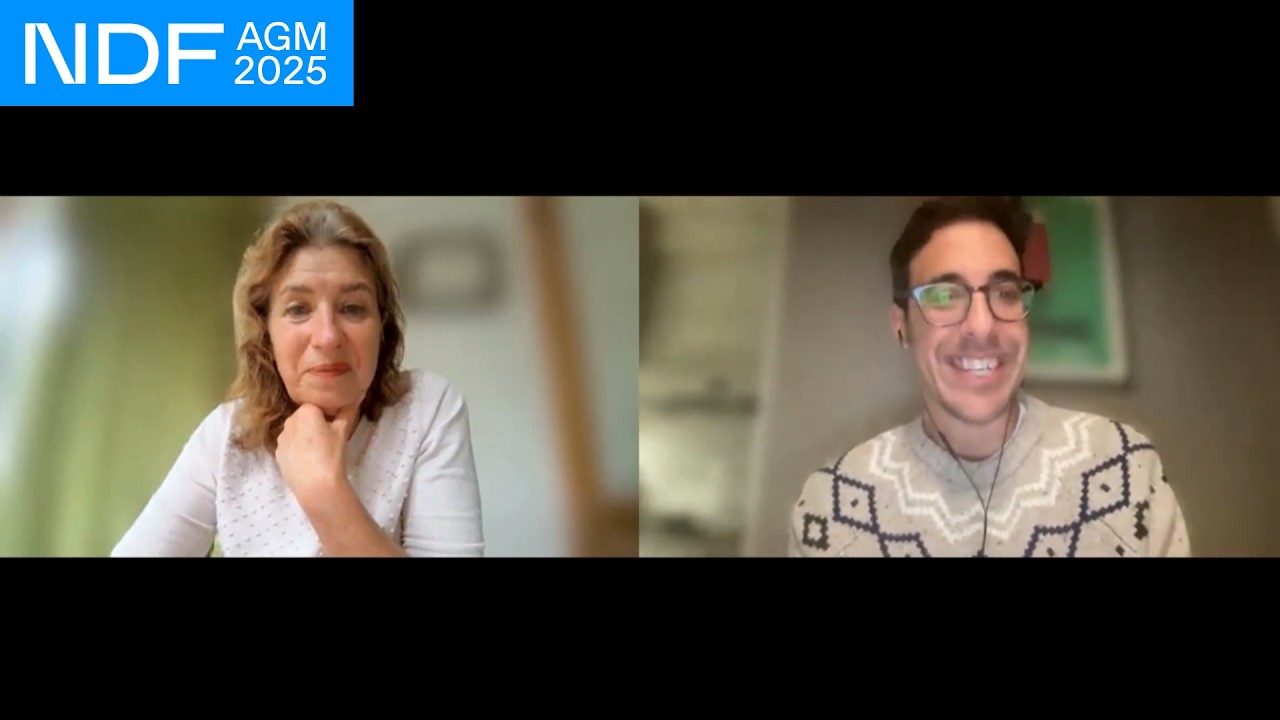
Ash Mann in conversation with Rachael Davies: Imagination, resilience, & letting go | NDF AGM 2025
Watch on YouTubeVideo summary
Ash Mann introduces himself as a self-taught coder and digital generalist with over two decades of experience in cultural and nonprofit sectors, having held roles ranging from early adopter to first digital manager at various organizations. He currently works independently as a consultant focusing on strategic challenges that blend institutional capacity, technology, and audience engagement, while also running a podcast and newsletter. The conversation centers on the critical importance of imagination not merely as creative vision or ambition but as a practical tool for navigating complex adaptive problems—those cultural, messy issues that cannot be solved with technical fixes alone. Mann emphasizes that in an era marked by rapid change, sector-wide fatigue, and widening gaps between expectations and realistic capacity, organizations must shift from viewing challenges through a purely technical lens to recognizing them as deeply human and systemic issues requiring patience, collaboration, and structural support for experimentation.
A key argument advanced is the distinction between "clocks" (technical problems with clear solutions) and "clouds" (adaptive problems rooted in culture and behavior), drawing on insights from thinkers like Ronald Heifetz and Carl Popper. Mann warns against misdiagnosing adaptive challenges as technical ones, which leads organizations to seek quick fixes like new tools or reorganizations that fail to address underlying cultural shifts. Instead, he proposes six actionable shifts for cultural institutions: making it safe to learn through failure rather than shaming it; clarifying goals and success metrics before launching projects; ensuring sustained resources beyond initial launch dates; embedding regular reflection into daily rhythms; empowering teams with decision-making agency; and leaders taking responsibility for fostering a culture where experimentation is normalized across all levels. These steps create the necessary conditions—time, safety, peer exchange, and stability—for imagination to translate into tangible impact rather than remaining abstract or performative.
The discussion further explores Nassim Taleb’s concept of antifragility via subtraction, urging organizations to resist their natural tendency toward addition (more programs, platforms, roles) and instead practice strategic restraint by saying no to initiatives that dilute focus or resources. Mann illustrates this with two compelling case studies: the Museum of Design in Zurich's "Museum of the Future" exhibition, which integrated diverse digital experiments into its core programming rather than treating them as peripheral novelties; and Helsinki’s main library (Udi), whose services were co-designed with 3,000 citizens over decades to ensure genuine relevance and collective ownership. These examples demonstrate that meaningful imagination requires intentional scaffolding—clear purpose, realistic timelines, inclusive processes—and cannot emerge spontaneously without structural commitment. Even in constrained environments, Mann argues, organizations can carve out pockets of oxygen through subtraction to nurture learning, resilience, and innovation at every level.
Ultimately, the dialogue concludes with a call for honest conversations about doing less to enable deeper impact, recognizing that busyiness breeds fragility while thoughtful restraint fosters antifragility. Imagination is not just an attitude but a disciplined practice embedded in organizational habits, supported by leadership modeling curiosity, delegating responsibility, and inviting audiences into co-creation processes. As Mann notes, even when resources are scarce, imagination remains one of the few domains where individuals retain agency to shape outcomes. By embracing small-scale, well-defined experiments that surface lessons quickly and avoid repeating past mistakes, cultural organizations can sustainably evolve amid unprecedented challenges—turning uncertainty not into paralysis but into a space for collective growth, joy, and enduring relevance in rapidly changing societies.
Read the full video transcript
So, uh I guess it's evening to you,
morning to me. Um but welcome to uh the
NDF AGM, uh what we refer to as a
fireside chat, but I have no fire. Um
but
>> I have candles in front of me, so fire
in the in the room. And we've been
talking a little bit for a while, Ash,
but um what would be really helpful is
um I have your bio, but nobody wants to
hear me read it out, but uh it was
really good listening to you just
briefly talk about your experience. So,
by way of introduction, can you just
give us an idea about um what you've
been doing um so far in the digital
realm in the world?
>> Yeah, certainly. So, I think I'm
probably the archetypal generalist. Um,
you know, I'm a sort of self-taught
coder back in the day. I My undergrad
was in music technology. I've always
been a tinkerer with digital things and
tech technological things. Um, I've held
various roles in the cultural and
nonprofit sectors inhouse. I I went
through a period of always being the
first digital manager in a few
organizations which was an interesting
experience sort of helping people to
define what that even meant. Um I then
ran uh Substract for nine years which is
they're a digital agency based out of
the UK but working with cultural
organizations around the world normally
on on web projects. Um, and then last
year I I went freelance and I'm now a
consultant that works with organizations
on
things that normally involve some
combination of a strategic challenge or
opportunity,
um, institutional capacity, technology,
and audiences. Um, and those ex exist at
different levels of volume in each of
the different scenarios I find myself
in. Um, and I I sort of run a podcast. I
do a newsletter. I find this stuff
interesting and have sort of been doing
versions of it for the last over 20
years now.
>> Perfectly placed to talk to our uh our
AGM audience today. Um and you and I
have had a bit of email exchange, but um
we've uh got a discussion um today that
looks at imagination, resilience, and I
love this phrase, letting go. Um so by
way of kind of kicking off that that
conversation, should we talk a little
bit upfront about why this topic and why
now? Um and particularly for glam
because as we were just saying um a few
of us are experiencing
you know the somewhat backflow of chaos
still out of co and also in a world that
is uh somewhat changing at a rapid pace
and the ability to be able to cope with
that. So yeah
interested to hear your thoughts around
uh that from your position in the world.
>> Yeah. So I mean maybe I'd start with why
imagination and then I'll go to the sort
of moment that we're in because yeah it
feels like we talk about imagination a
lot in our in our sector you know
creative vision
>> ambition innovation
>> but imagination on its own isn't going
to change anything and I think what
matters as much but doesn't get as much
airtime is the sort of the scaffolding
the conditions that helps imagination
move from aspiration to, you know,
actually having a tangible impact on our
organizations and and our visitors and
our audiences. Um, so, so I'm interested
in maybe talking a bit about
imagination, but also talking about the
sort of systems that that imagination
exists within in our sector. um and
maybe what we might be able to do to
allow more imagination to happen, but
that imagination to be able to be
nurtured and sort of turned into impact.
Um and I think the moment that we're in,
as you've just said, everyone I speak to
at the moment is describing this this
pattern of sort of acceleration of
challenge. It seems like there are more
challenges that are more strongly felt
across a greater array of
of how they exist. Um,
accompanying that there is sort of quite
significant levels of like fatigue
bordering on burnout um
>> on a like sectorwide level. I I think
and that there also seems to be this
widening gap between
not even ambition but sort of
expectations and the realistic capacity
that organizations have to to deploy.
Um, and
and and so I'm sort of interested in how
imagination
maps onto that as a possible not
solution, but tool that we might be able
to use to try and work out what we do.
What are we going to do to try and dig
ourselves out of this this situation
that we find ourselves in?
>> I guess the other thing is, you know,
change never goes away. change is
actually more of a constant than we all
think. And even having that uh
capability and thinking about the way
that we can best deploy imagination is
something that will always happen. But I
think the other point that you'd put in
one of your emails to me, which I
thought was great, is this actually is
about potentially enjoyment and a bit of
hope. So without being too rosy or
positive, you know, we do have some
degree of privilege in the work that we
do and the way to bring our audiences
with us and our organizations
a longer path to something that's a
little more positive and joyful. Um,
>> absolutely.
>> Which I really liked. So, so yeah,
should we dig into it a little bit more
and think about you talked about what
are those conditions and thinking about
what we are needing to consider at this
moment in time um with all those
challenges that we have in front of us.
>> Yeah. And I I think it's maybe
interesting to start with thinking like
what's the nature of the challenges that
we're that we're facing. Um and there's
this distinction that I think is quite
helpful from a a thinker called Ronald
Hyetsz. Um, and he makes a distinction
between what he describes as technical
problems and they are clear, relatively
easy to solve with existing expertise,
whether that exists within your
organization or not, and what he calls
adaptive problems. And adaptive problems
are messier, harder to define, don't
have a one clear solution, and they're
normally cultural in some sense. And I
think that maybe the reason, one of the
reasons that everything feels so hard at
the moment is almost every challenge we
are facing is adaptive in nature and a
response requires
a change in habits, you know, being able
to take people with you. Um, clarity,
shared understanding. It's not just
about skills or better tools.
Um, and I think that maybe digital
practitioners are more comfortable with
this because most digital work sort of
mixes, you know, it's a it's a heady mix
of technical and adapt adaptive problems
that non-digital practitioners maybe
perceive as adapt as technical problems.
Um but I I think that the danger that
exists in our current moment is a
misdiagnosis
of the challenges that we're facing as
problems with a technical solution
>> rather than actually these are adaptive
challenges. We can't probably just buy
some new tools or hire a couple of new
roles or reorganize our teams um and
expect them to be resolved.
Um, and and I guess just extending this
this idea a little further, there was a
philosopher called Carl Pauper,
excellent name. Um, and he wrote he
wrote an essay in 1965 where he defined
challenges as either clocks or clouds.
Um, and you can fix a a clock by taking
it apart and tightening its bolts, but
you can't fix a cloud in the same way.
And so I think that's it's another um
version of of of of that diagnosis I
suppose. And I think we need to try and
recognize that what we're dealing with
is a is a sort of a a context that
requires
quite messy solutions that are going to
be powered by people and collaboration
and culture.
um and they will probably be quite slow
to fix. Um and in the past I've talked
about this idea of like slow change and
fast change and cultural organizations
um are generally quite good at fast
change. That is sort of like you know
doing a rebrand, getting a new website,
but they're maybe less good at
sustaining the slow change, you know,
around behaviors alignment because of
the quite reactive nature of a lot of
the organizations that that we work
within. Um, and I think coming back to
our sort of umbrella topic, that's where
imagination actually becomes really
useful, not just as like having new
ideas or blue sky thinking, but actually
as a way to explore these adaptive
challenges, test assumptions, start to
experiment with what better conditions
might look like. because I think the
challenges that we're facing sort of
require a combination of patience,
learning,
collaboration, and imagination supported
by structure, which we can maybe talk a
little bit more about in a moment.
>> So, sort of like a ways of working. Um,
one of the areas that you know you you
you were um highlighting was the work
through Acme of the digital mentoring.
And I there were a couple of phrases
that really um kind of um stuck out to
me. This whole thing around
uh
increasing a greater tolerance and
receptiveness to experimentation,
feeling comfortable with ambiguity,
knowing that things are going to be
unpredictable.
uh and then using imagination as I think
these were your words actually uh in
terms of uh being curious and with that
curiosity you start to feel a little bit
more secure and then with that security
you start thinking about that as a way
as being able to feel in a positive
position to be able to tackle things.
This sounds all quite theoretical I
guess at the moment. So um knowing that
our audiences uh are working in real
time um what are your thoughts around
how this then transfers into the working
environment with uh you know with some
really interesting application of that
digital mindset and imagination.
>> Yes. So I mean you referenced that the
Acme um and Australia Council um CEO
mentoring program that happen that's
happened twice now. Um there's a really
good evaluation report that I would
encourage people to skim. Maybe it's
quite a long document. Um but I think
yes that report identified that this
trait of digital imagination was really
important but it also identified that
that trait was only effective and
valuable and impactful where there were
specific organizational conditions.
>> Yeah.
>> Um and those were things like time to
think and learn. um access to
and I think this this is important
sectoraware experts so it wasn't just an
expert in a particular digital thing but
someone who understood specific
constraints and priorities of of
cultural organizations um they also
identified that it was really important
to be able to access exchange with peers
who were tackling similar problems and
also that there needed to be enough
organizational stability for
experimentation to feel safe.
>> Um, and those four things might all feel
slightly luxurious to people listening
to this, but they are also sort of
deeply tangible things that can be
created. Um, I I it's possible to create
those four things within most
organizations. how possible it is at the
moment for individual organizations to
do that is going to be wildly um
different depending on or organizations
context but certainly the acme research
identified this I'm currently involved
in the leadership development program um
working with uh cultural leaders in the
UK and very similar things are emerging
that
when the cohort on that program have
been able able to start to create some
of these conditions within their
organizations actually the beneficial
effect of that is felt almost
immediately. Um so whilst it might feel
slightly luxurious and slightly can we
afford to do this
there is I think a growing body of
evidence to show that when organizations
can carve out the time can start to
create this sense of safety around
experimentation and can start to connect
into a wider network of both support and
exchange with peers that that can start
to hold a space for um really productive
experimentation.
>> You'd made this comment to me that was
really interesting. Like it really stuck
out to me and I thought, "Wow, I want to
ask you more about this." Um the work
that you're doing at the moment in the
UK. You'd said, um the sector's
difficulties with doing less, saying no,
being clear and aligned about what the
priorities are is also a break on
progress and impact for many. And I
thought that's really fascinating
because as a middle management person or
someone who's going to be working in
senior leadership, we have an
expectation to be able to do good
governance, efficient management,
deliver on time. We have all these very
sort of traditional tools that we use uh
and very much around managing risk and
making sure that we are responsible with
public funding. But this kind of you
know tension with the break on progress
or the impact for many is that they
would like to do more and take risk but
then we have this tension. Um can you
talk a bit more about that because I I
thought that was really interesting.
Yeah, certainly. And I think maybe this
is a relevant moment to mention a re
research report, easy for me to say that
I published earlier this year which
looked into
>> failure in digital
>> um because I think a lot of these ideas
were present in that analysis as well.
So I heard from almost 50 um cultural
organizations who shared stories of
digital projects of all kinds that had
failed and we looked at the reasons why
those projects had failed. Um and there
were some really clear things that came
out of that. I mean perhaps most
importantly to reiterate is that most
digital project failure was not because
of anything to do with technology or
technical reasons. Um so the findings
sort of were that projects are rushed,
goals are vague, leadership support is
inconsistent, teams are really stretched
and lessons go unlearned. um you know
there was sort of this uh people
described that we either launched the
thing and then immediately moved on to
something else or the thing failed and
we immediately moved on to something
else. There isn't this sort of um
embedded practice of reflection and then
capturing what those lessons actually
are so that they are useful again in the
future. Um and so so I think that there
may be six shifts that it would be good
for cultural organizations to consider.
Um I think the the f the first and
perhaps most important one is to
make it
um safe to fail you know and that's not
to say you're encouraging failure but
that you're acknowledging failure is
part of learning you know it's not a
source of shame. Um, and maybe a reframe
there is rather than saying it's safe to
fail, you're aiming for it's safe to
learn because if you never fail, you're
never going to really learn any lessons.
>> Yeah. Safe to experiment, isn't it?
>> Exactly. Exactly. Um, and sort of making
that habitual across an organization,
you know, from across every level and
that leaders are really modeling that
that curiosity is is welcomed,
normalizing that, encouraging that. Um,
you know, this next one is really super
obvious, but I think almost every story
of failure that I received had a version
of this not present, and that was be
really clear about your goals and what
success looks like before you start the
project. You know, why are we doing
this? Um, and so often I'm brought into
projects halfway through where that
question is very differently understood
across the mix of people that are
working on a project. I think that's a
really key thing. Sorry to interrupt.
It's it's across the group of people for
sure.
>> Yeah. Yeah. Yeah. And I think that that
in in that what I'm not describing is
I'm not saying drive for consensus
because you will probably never achieve
consensus.
>> But what I am saying is you need to
drive for clarity and agreement on what
the goals actually are. Even if not
everyone is saying and I think this is
the right thing, you want them to say I
don't think that's the right thing but I
do agree that's what we're doing.
>> Yeah, for sure.
I think there's a thing here that the
next one is maybe difficult you know
within a sort of constrained funding
environment you know I know lots of
organizations having to make difficult
cuts but we heard and this is a version
of a challenge again I hear a lot of um
projects projects are fund funded until
the go live date and then not beyond at
all and actually
with almost every example I can think of
you need to have some level of sustained
resource beyond that initial launch
point because otherwise you're you're
setting it up for failure from from the
start. Um
and you know that that maybe means you
need to constrain your ambition and with
what the thing is that you're launching
so that you're actually protecting
resources to maintain and evolve that
beyond the go life point. Um
uh the next one is around sort of
building reflection into the rhythm of
your work. Um and
that's you know that can be as sort of
prosaic and every day as like regular
check-ins asking questions like what
what is working? Let's capture that and
what isn't working? Let's capture that
and sort of unpick that. Um when you
start to habitualize that type of
conversation as well, you get better at
surfacing issues earlier which in turn
reduces the cost, effort, complexity of
fixing them. Um certainly also in my
observations those types of questions
lead to better conversations which leads
to better work. Um, so sort of building
that reflective practice into the rhythm
of the organization. Um, and and lastly,
and you hear calls for this in every
conference you've ever been to, but
fostering collaborative,
but I think this this next word is
important, empowered teams. You know, I
I work a lot with leaders and a lot of
leaders express to me that they get very
frustrated that everything seems to get
escalated. You know, every type of
problem immediately gets pushed up to
the highest point in the organization
for a decision to be made
>> and that is
>> symptomatic of disempowered teams. Teams
not sure about what they're allowed to
make decisions about. And so I think
fixing that
is good for your teams because you're
giving them agency, you're giving them
power, you're giving them more control
over the work they're doing. But it's
also a good thing for leaders to do
because you are clearing a load of stuff
off your plate. You know, not as much
stuff is going to get pushed up onto
your desk if you're fostering more
empowered teams. Um, and there was a
really sort of there was a nice couple
of quotes I just want to sort of read
verbatim. So, one person said, "The real
failure is pretending everything went
fine when it didn't." And so, I think
sort of remembering that. And the next
one is someone said, you know, not
everything needs to be a huge success,
but we do need to learn something from
it. And I think the idea of learning is
really, really important because so
often I see organizations stuck in this
cycle of making them same mistakes every
3 to 5 years because people leave, stuff
gets forgotten, and that's really
inefficient. And when we don't have as
much resources as we would like, that is
sort of a a really dangerous way of
wasting time and money.
The thing I think that's really I mean
you know a lot of this term spells I'm
sure with many people listening to this
as well as myself but um this
empowerment of staff and in and trusting
expertise because you have the right
ingredients collaboratively across your
team and so trusting them with some of
the decision- making um and being able
to contribute and also just being really
clear about what your level of
responsibility is as a leader so they
don't feel the weight of everything on
their shoulders. they are free to go and
imagine like you said you know do some
of that thinking um there was something
else that you you'd noted as well which
I thought was really great was also
taking responsibility about
experimentation
across all levels of the organization
um because it's good to empower your
staff at the same time you need to
recognize
as with that last quote illustrated that
if you're asking people to experiment
you're also asking them or say giving
them permission to fail fail and learn
for the organization.
Uh, and taking that responsibility
around that.
>> Oh, have you paused again?
>> No, no, no. I'm I'm I'm I'm here. And I
and I think, you know, as with
imagination, I'm not just saying have
loads of ideas
>> with experimentation. I'm not saying
just throw a load of stuff haphazardly
at the wall and hope some of it sticks.
You know,
>> we don't have the luxury of being able
to do that. you know, everyone has uh
more work to do than they have time to
do it. Um, and ambitions that out
outstrip the budgets available. But I
think you know if we return back to our
description of the current moment we are
facing and I'm going to use that word an
unprecedented
set of challenges that are either novel
in nature. You know the culture sector
hasn't had to deal with them before or
they are larger in scale than the
culture sector has had to deal with in
recent memory. And so the the sort of
tried and tested tools and approaches
that have got us to where we are today
are probably not going to be appropriate
for dealing with that completely novel
set of challenges. And so therefore
experimentation becomes essential in
trying to work out how we move forward,
how we actually take our organizations
sustainably forward from here. Um and
again that can't be something that is
only held at an operational level or
only held in executive conversations. It
needs to be a practice that sort of
threads through the
>> the mindset and frames lots of what
institutions do in sort of every
every corner. And I think again this
this this word experimentation is you
know like so many words digital what
does that mean? Experimentation what
does that mean? I think it's about
um it's about being quite specific and
potentially quite uh small scale
initially with with the ideas that
you're testing but being really clear
about why you're carrying out an
experiment. You know is there a new
opportunity that you've seen? Is there a
different solution to a challenge that
you're experiencing? Being clear about
what the experiment involves, how long
it's going to run for, and how you'll
know whether or not it's successful.
Because certainly the the organizations
that I sometimes work with, this fear of
experimentation seems to come from fear
of the unknown. You know, it's like, oh,
it'll be a distraction. We don't really
know what what it'll involve. We don't
really know how we'll know whether or
not it's working. And actually if you
can have quite specific and clear
conversations about that, it doesn't
need to be some giant monthsl long
pieces of of work that's a complete
black box. You can be experimenting
as I said at all levels of
>> one of the things I you know I've always
got on the side of my mind is um the
practical reality
um of then and I really like the idea of
smaller experimentation and being nimble
to put that through. But um one of the
readings that you sent through which we
were talking about before we pressed
record on this chat was the Ed Rodley
post uh which is about this sort of idea
about anti-fragility and the right
ingredients that you have in an
organization to be able to to be able to
respond to the challenges across all all
echelons. Um do you want to talk a
little bit about that? I I quite like
that idea about the balance that was
talked about at the end with the
barbell.
>> Yeah, sure. So yeah, Ed's post is great.
Um, if it's out there, I think on his
his newsletter. Um, and he's talking
about this book from Nasim Talib, which
is called antifragile. Um, and in that
there is this uh idea that Nasim calls
the via negativa. um which is defined as
the route to resilience through
subtraction rather than addition. You
know, and Ed, I think quite correctly
diagnosed that the museum sector is
quite good at additive solutions, you
know, more stuff. We'll have a new new
platform, we'll start a new program of
activity, we'll hire a new role,
whatever it might be. Um, we're not so
good at subtractive solutions. So,
stopping doing something, you know,
saying no, we're not going to pursue
that funding opportunity. We're not
going to worry about this particular
challenge at the moment. Um, and it's
also worth saying that humans as a
whole, there's been some research around
this. Um, their our I'm a human. there
our natural response to to problem
solving is to add more stuff.
>> It's not natural for us to solve a
problem by taking away. Um but in
antifragile
talib
describes this really effective practice
of subtraction and actually if you think
about it potentially every no that you
say every subtraction that you make is
going to create a little pocket of
oxygen whether that's like time or money
or attention.
And in those pockets of oxygen, that's
where experimentation, imagination, and
learning can happen. Um, but it's it's
difficult. I absolutely recognize that
it's difficult because subtraction is
pretty laughable maybe to think about
when you're already running super lean.
You're running on the bare minimum. You
know, lots of teams aren't making a
choice between addition or subtraction.
They're sort of in survival mode. Um,
and also we have a lot of funding models
that reward newness and they reward this
sense of more.
>> Um, but they don't really reward either
maintenance
or a a stopping of activity. Yeah.
>> Um,
but you know this the whole focus of
antifragile from what I can tell through
Ed's article is about resilience and you
know busyiness is not resilient. You
know busyiness is super fragile. And so
I think we maybe need to have some
really tough and really honest
conversations about doing less, knowing
when to stop something, knowing when we
can simplify something, or being really
clear about what the core things are
that we're protecting and what is u
maybe more elective. And I think even
for organizations that are in that sort
of crisis survival mode, in those modes
when every other resource that your
organization has available is
rescending, imagination sort of becomes
potentially the only thing that you can
have agency over. Um so I think
imagination is is still valuable even in
those really constrained and difficult
contexts. Coming to the end of our
conversation, I know that a lot of us
really find examples uh in real life
really helpful. Um and knowing that you
work with so many organizations of
different scale, it would be great and
and even outside the sector even um if
you want to give us a couple of uh
examples of some of the things where you
think would be useful case studies or
things that people could go and have a
look at.
>> Yeah, certainly. So, I'm going to maybe
pick uh two recent examples, places I
visited this year. One from Finland and
one from Switzerland. Um because I'm I'm
in Europe, so let's go full European. Um
so, I was in in Zurich a couple of weeks
ago. I went to the museum for Galung,
which is the design museum in in Zurich,
and they had part of the building was
dedicated to an exhibition that they
called Museum of the Future. Um and in
that exhibition they had uh programmed
17 digital experime experiments
to explore how their collections could
reach people differently.
So this was everything from some AI
stuff
um through to the world's biggest
digital image. It was like three
terra pixels. It was enormous. Um
through to a bunch of motiontracking
play experiments that used um
uh Swiss
puppets from a contemporary puppet
designer from 1918
as the sort of creative catalyst. And
then there were all these experiments
from these post-graduate students using
a variety of of digital um tools and
techniques. And what I liked about it is
that a it was presented as part of the
museum's main program. It was given
significant real estate within the
building. It wasn't sort of uh in an
annex that you had to walk through
another gallery to get to and like you
know one small slightly sad set of
headphones that where the right ear cup
didn't work and you know weren't quite
sure what you were looking at. It was it
was a diverse and interesting set of
experiments that were from museum
practitioners, digital artists,
students. um they had brought together
quite a diverse cohort of different
collaborators that supported and helped
curate the exhibition. And so I think
that was
a good example of like genuine
experimentation
existing at the heart of a museum's
practice rather than sort of innovation
theater. Um, and so I think that was
interesting and there's stuff on their
website um, that you can check out. And
I think that was maybe interesting to me
because it it was polished. You know, it
was an a nicely designed exhibition that
it didn't it didn't feel ramshackle
going around, but it was clearly
experimental in nature and some of these
experiments were much more successful
than others. And I think that was quite
a usefully brave decision that they
made. A framing it so clearly as a set
of experiments and b sort of learning in
public um and allowing that plurality
and diversity of perspectives and voices
to have fed into what that ex exhibition
looked and felt like. So I think that
was a nice example of the ex
experimentation stuff done
credibly.
Um and then maybe if we talk about we go
back to this idea of imagination and
this idea of
conditions um and this idea that
imagination doesn't need to be just
something that exists at the top of an
organization in strategy conversations.
So the main library in Helsinki is
called Udi. Um recently reopened in a
beautiful Zara designed building. Really
stunning building. But I think what's
really interesting
is that the
um the focus and the nature and the
design of the library, what it actually
does, how it operates, the services that
it offers was co-designed with the input
of 3,000 citizens of Helsinki.
Um, and I think, you know, again, that
was a really genuine, I think, um,
expression of code design,
but that didn't only come about because
they had a new building. They have a
long sort of two decade
long practice of genuine sort of
openness and engagement with the public.
Um
and so again, this wasn't performative
in nature. This was a genuine um
exercising collective imagination.
And there's a there's a really good
article which I I'll reshar a couple of
times where one of the librarians says,
you know, this isn't a library that
librarians would ever have imagined.
This only exists because we asked the
people of Helsinki to help us imagine
what a library for them needed to look
like, feel like, function like. Um, and
then they they created structures
through which that um that imagination
could be articulated
um and that that sort of ownership could
be delegated and and distributed. And so
I think it's a really nice example that
actually collective imagination between
an institution and 3,000 perspectives
from the public doesn't need to be
chaotic,
>> but it does need designing and it does
need scaffolding and it does need uh
designing over a realistic sort of time
horizon. And you're seeing some other
versions of this sort of reimagining um
in the UK. The National Gallery
recently,
>> yeah, Birmingham Museums Trust
absolutely did this sort of um they call
it Citizens Assembly and the the
National Gallery.
>> National Gallery. Yeah.
>> Um borrowed but to take an inspiration
from that idea as well. And so I think
it's interesting to see an organization
like the National Gallery which is you
know 200 years old conservative with a
small C in nature um you know big slow
is opening itself up to that um nature
of external reimagining. I mean how how
much impact that program will have let's
see but I think it's interesting that
that we see more examples of this and I
think again it's
um an example
in Helsinki at UDI where imagination
isn't just about enthusiasm and having
loads of ideas actually in order for it
to feed through into anything meaningful
or tangible you have to have those
structures and it has to be focused and
it has to be engaged with intentionally.
So I don't that's just to say I don't
think we it's useful for organizations
just to say we're being more
imaginative. We invite imagination from
our audiences. It sort of needs to have
a purpose.
>> Yeah. That goes back to that whole
preconditions. I mean I think you know
you should come to New Zealand. you
should come to Alteora Ash because
there's some really interesting practice
here that's been going on for many years
especially in line with fertility
practice and considerations of uh of
inviting people and ensuring that um
people who need to be at the table are
at the table. Um, so
you know, you could almost track an
evolution in museums for this practice
and see how it's it's evolved over time
and how that is a really useful and
responsive healthy way to ensure that
you remain relevant as well as fit and
able in the society that you're
servicing. So yeah, I feel like you need
to come here and we could we could talk
more about the cultural context in which
we work. Um it'd be really interesting
to compare that. Uh
>> yeah, absolutely.
>> So Ashley, I just want to say thank you
so much on behalf of NDF for uh you know
making time for us today was really
appreciated. Uh so many good links and
thoughts that you had. Um and what we
will do uh we will make sure that those
links are available. We'll post them up
somewhere so that our members can access
them uh and you know follow up and
listen to your work on your podcast. Uh,
and also go to your website. Um, I know
I recently listened to one about the
choreographer Brandon Powers, uh, and
his intersection of his work with VR.
So, I thought that was really
fascinating. So, yeah, it would be
great. So, thank you so much for your
time. Oh,
>> you're so welcome. Thanks for the
invitation.
>> Great. Thank you.