Art as a System of Knowledge: Arts-Integrated Inquiry in Scholarly and Professional Discourse
Watch on YouTubeVideo summary
The central theme of this presentation is the proposition that art functions not merely as a medium for expression, but as a distinct system of knowledge capable of generating insight and revealing complex relationships. The speakers introduce themselves from diverse backgrounds in education, technology, and leadership to present "Sparkenue," an initiative built on the idea that knowing happens through a dialogue between the heart and mind. They explain that achieving emotional coherence—a state where feelings like gratitude calm the nervous system—enhances cognitive clarity and resilience. By guiding viewers through a brief breathing exercise focused on appreciation, they demonstrate how shifting into this coherent state allows individuals to access deeper insights more effectively than when operating from stress or disconnection alone.
To illustrate how art generates knowledge rather than just communicating it, the video explores specific examples of arts-integrated inquiry in educational and professional settings. In science classrooms, students who construct visual food webs or act out cellular functions often discover dependencies and systemic relationships that reading textbooks alone would not reveal. This process mirrors a cycle of observation, hypothesis formation, revision based on new information, and final insight. The speakers argue that while science provides clarity regarding "what is happening" and religion offers purpose for "why it matters," art uniquely enables us to perceive the connections between these realities and see possibilities within them. They cite spiritual texts alongside scientific findings to suggest that both disciplines point toward a profound order in creation, with art serving as the tool that cultivates the perception necessary to understand this meaning.
The presentation culminates in an interactive exercise where participants visualize a real-world dilemma using simple shapes without words, followed by a structured dialogue between artist and observer. This activity forces individuals out of their habitual analytical modes into creative inquiry, allowing new perspectives to emerge through careful observation rather than immediate judgment. The experience demonstrates that when teams or communities engage with problems creatively first, they can navigate complexity more effectively and build shared understanding. Ultimately, the speakers conclude that art is essential for professional discourse because it deepens comprehension through creativity, fosters unity through consultation, and generates new knowledge by engaging both emotion and intellect in a coherent state of being.
Read the full video transcript
Good morning, everyone.
We want to start with a simple idea that
has been shaping our work.
That art is not just a form of
expression, it's a way of knowing.
We're all very familiar with the idea of
science as a system of knowledge,
and we're familiar with the idea of
religion as a system of knowledge.
But today,
we want to explore the idea that art
also functions as a system of knowledge.
One that helps us perceive
relationships, generate insight, and
understand complexity. And we're not
just going to talk about that.
We're going to experience it together.
I'm Amalia Gubat. I have a background in
communications and education and a
Master of Arts Leadership in Cultural
Management.
I'm joined by two collaborators in this
work.
>> Hello, I'm Kat Golohorn. I'm an
educator, a librarian, and an arts
entrepreneur focused in ceramics and
publishing.
>> And I'm Stephen Morris. I have a
background in computer science
and organizational leadership and
change. I'm a retired Air Force officer
and also an artist.
And together, we created Sparkenue.
>> We'll then invite Kat to begin by
helping us to arrive in the space
together.
>> Thank you, Amalia.
Before we explore art as a system of
knowledge, let us remember how knowing
happens in the body.
It's really an ongoing dialogue between
our heart and our mind.
Research in neurocardiology shows that
the heart and the brain are in constant
communication.
Our emotional state directly shapes how
clearly we think, perceive, and relate.
When we experience emotions like
appreciation and care or steadiness,
the body shifts into what is called a
state of coherence.
Our understanding of coherence is
grounded in decades of research on the
connection between the heart, the brain,
and the nervous system.
And it's used globally as a practical
tool for resilience and performance.
In this coherent state, the heart's
rhythms become more ordered, and that
signal supports the brain in functioning
more effectively.
People often describe this as clearer
thinking,
greater resilience,
and increased access to insight. And
this is not abstract. These are
practices being used across the world
already. In schools, it helps students
regulate attention and improve learning.
In health care, it supports stress
reduction and recovery.
In business and leadership, it
improves clarity and decision-making.
And in high-stress environments, like
military and emergency response,
it's used to help people stay steady and
effective under pressure.
For so many of us, this may feel
something familiar, like the quiet calm
that we enter in through prayer,
like insights during quiet reflection,
or the connection that you feel with
nature.
It's the state of being in which our
thinking, our feeling, and our attention
are all coherently aligned.
And this is something
we're naming. It's simple,
but it's powerful.
It's something we can learn to access
easily
through practice.
Mhm.
And so natural, I bet we can already do
it.
Let's try it together.
>> Okay.
>> I'll guide you guys through a quick
coherence technique. Let's see what we
feel.
Okay.
So, there's no need to do anything
really. Just notice, where are you?
How do your feet feel on the ground?
Turn your attention inward.
How are you feeling
right now?
It's just a notice.
I invite you to focus your attention on
your heart.
If you feel comfortable, place your hand
on your heart.
Maybe close your eyes if that feels
good.
To direct your inner attention to your
heart.
Tell your heart thank you for its
life-sustaining labor.
Bring to mind something or someone that
brings you joy.
Brings you peace.
Hold them in your heart.
I invite you now to slow your breathing
down a little.
Imagine you're breathing in and out
through your heart.
Feel the swell of your breath calming
the heart and the nervous system both.
Like giving yourself a hug from the
inside.
Take two slow, deep breaths like that
through your heart.
Feel yourself relax.
Mhm.
Now, heart feeling.
Bring to your mind that something you
care about that brings you joy, a
person, a place, a moment.
See if you can fill your heart with that
special feeling that makes your heart
smile.
Feel the appreciation for that special
connection
and breathe it into your heart.
Can you feel that?
That calm inside your body?
Mhm. This is what we mean by a coherent
shift.
When that peaceful feeling is there, it
fills you up and that is the shine.
Mhm.
Did you feel that?
>> Yes.
>> Mhm.
>> I [clears throat] did.
>> I can see everyone is shining more
brightly.
Now, check in again. How are you feeling
now?
Are you any different?
What's different?
What just happened is simple.
By slowing your breath
and bringing in that feeling of
gratitude, even for a brief moment,
you've shifted your body out of that
stress response and into that more
coherent state where the heart and the
brain and the nervous system work
together.
You did quite literally just shift and
shine.
We also just shifted into a more
creative way of thinking.
You may notice that you feel more open
to new information
different perspectives.
All right, Om Raya. I think we're ready
to see what's next.
>> Thank you, Cat.
In our experience, insight doesn't come
from information alone.
It tends to emerge when a few conditions
come together.
Attention, emotional coherence,
curiosity, and shared inquiry.
You'll notice those conditions woven
through everything we do today.
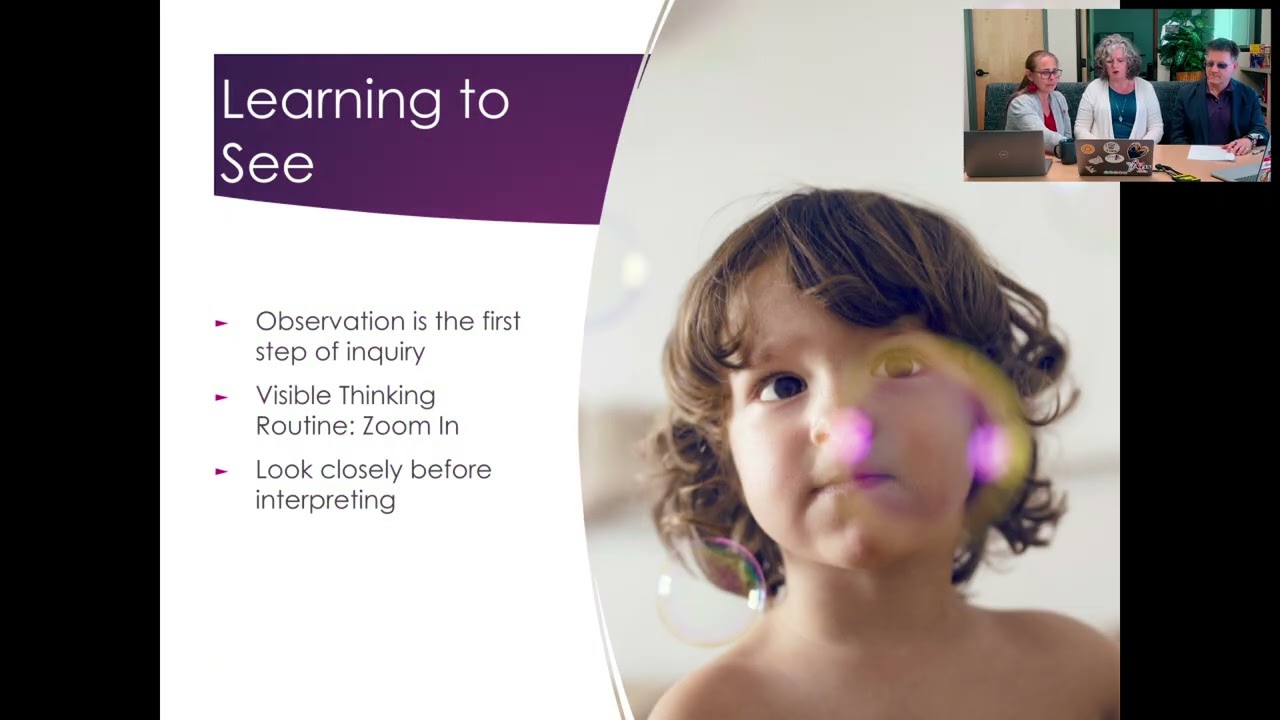
Today, we're going to begin with
something very simple, learning how to
see.
I'm going to show you part of an image,
and I want you to just notice what you
see.
No interpretation yet.
What do you notice?
Now, look a little closer.
What do you see?
What might this be?
There's no right answer here.
How have your interpretations changed
based on more information?
And now the full image.
What has happened to your thinking?
>> You moved through a process.
Observation,
hypothesis,
revision, and insight.
That's a knowledge-generating process.
So, here's what we're exploring. Art is
not only a way of expressing what we
already know.
It's a way of coming to know.
It helps us to see relationships,
surface what's implicit,
integrate different forms of
understanding.
We often talk about science and
religion. Science helps us understand
what is happening. Religion
helps us understand why it matters.
And what we're proposing
is art helps us see relationships and
possibilities within those realities.
>> There's a passage from the Gleanings
from the writings of Bahaullah that
says,
"Every created thing in the whole
universe is but a door leading into His
knowledge,
a sign of His sovereignty, a revelation
of His names."
Interestingly, scientists have expressed
something similar.
That a profound and exhaustive study of
science reveals the immense order, the
complexity, and the inherent
intelligibility of creation.
This deep insight into the structure of
the universe leads the observer back to
a sense of awe,
or recognition of a greater, even divine
reality.
Arts cultivates the perception that
allows us to see meaning in creation.
It can also create by itself profound
experiences associated with the
numinous.
Those moments that suggest the presence
of divinity.
So, there's a shared idea
that reality contains meaning.
But perceiving that meaning requires
training our attention.
That's where art comes in.
When these systems are working together,
science gives us clarity,
religion gives us purpose,
and art helps us see how these things
are connected.
In organizations, that ability to
perceive relationships is often what's
missing.
>> The Universal House of Justice describes
the arts as a means of generating joy,
strengthening unity,
disseminating knowledge, and
consolidating understanding. So, the
arts
aren't peripheral.
They are part of how communities learn.
>> And this is where ACT comes in.
ACT is Arts Integrated Creativity
Training.
It is a structured way of using
using artistic processes to explore real
questions.
So, it's not just art for art's sake,
but it is a method of inquiry.
We're going to try a short version of
that in a moment.
But first, here's a very simple example
of arts integrated instruction.
>> In a middle school science class
studying ecosystems, students might
create a visual food web using simple
symbols and arrows.
Plants, insects, birds, predators.
And then they explain how the energy
moves through that system.
What's interesting here is that by
constructing the diagrams themselves and
discussing it with the classmates,
students often begin noticing
relationships and dependencies that they
might not have recognized through
reading alone.
Or imagine a biology classroom.
Students are grouped together and asked
to create a short skit in which each
student becomes a different part of a
plant or an animal cell.
One student becomes a nucleus, another
becomes a mitochondria, another becomes
the cell membrane.
As they act out the functions of the
cell, the rest of the class
tries to guess each part.
The goal isn't performance for its own
sake.
The creative process helps the students
understand relationships, systems, and
function through embodied experience
and helps them remember that concept.
Think about that jingle from an
advertisement you saw in childhood that
you still remember. My bologna has a
first name.
>> That's arts-integrated instruction. An
act builds on this tradition.
Not simply to support engagement, but to
help individuals, groups, generate
insight through creative inquiry.
Now, let's practice it ourselves.
This activity sharpens perception.
Remember the exercise earlier, the one
with the wave? We were walking through
the steps of observation, hypothesis,
revision, and insight.
Now, I want you to go out and find
something to write on, like a blank
index card or a piece of paper and a
pencil and pen.
You can pause the video while you find
find something.
Okay, have you found something?
Now, I want you to think of a real
question from your work, something
you've actively trying to understand.
And then I want you to represent that
question visually
on your paper. Use simple shapes or
symbols. No words, just focus on
relationships.
This one on the slide, for example,
represents a workplace or organizational
dilemma involving competing priorities
between financial performance,
operational pressure, human well-being,
and insight or awareness.
But really, keep it as simple as you
need to. You'll have 5 minutes to draw.
You can set your own timer, or you can
just pause the video.
>> So, now that you've finished your
drawing,
we've explored the idea that art can
help us generate new understanding.
We'd like to invite you to experience
that for yourself.
Whether you're watching this alone or
with someone else, you'll have an
opportunity to move through the same
cycle we've been discussing:
observation, hypothesis, revision,
insight.
If you're watching with another person,
I'll give them
give instructions for working together.
And if you're watching on your own,
simply pause the video when invited, and
we'll describe what you can do.
So, turn to your partner and share your
drawing.
For the next 3 minutes,
your partner will simply make
observations.
The
The observer will respond with what they
notice, or what they feel, or what seems
significant. The artist simply listens.
Don't explain your drawing. Don't defend
it. Just notice what you hear.
>> As you're observing your partner's
drawing, remember your role is not to
solve the problem.
It's simply to notice and be curious.
Try to remain in observation mode before
moving into interpretation.
You notice the details. Notice the
relationships.
Notice what draws your attention.
Often, the most valuable
begin with careful observation rather
than immediate analysis.
Okay. So, pause the video for about 3
minutes.
When you're ready,
start the video again.
Now, the artist has 3 minutes to
respond.
You may respond with what surprised you
or what felt really accurate.
What helped you see your question
differently?
Pause the video again for 3 minutes
while you visit.
When you're ready, start the video
again.
>> Finally, switch roles and repeat the
process.
Pause the video whenever you're ready.
And then start it when you're ready to
come back.
Now, if you're watching this
presentation on your own, we'd like to
invite you into a slightly different
version of the exercise.
Place your drawing where you can look at
it from a distance.
Take a slow breath in
and out.
Now, imagine that you're seeing the
drawing for the first time. Ask
yourself, "What do I notice?
What emotions does it evoke?
What seems significant? What questions
arise?"
Write down whatever comes to mind
on the back of your picture or on a
journal. Don't judge it, just observe.
And when you're finished,
ask yourself one final question.
"What is this drawing trying to teach me
that I didn't know before?"
Take a few minutes to reflect on that.
In your journal or on the back drawing.
And then continue the presentation.
Let's come back together again.
So, what shifted in your understanding?
Did you see something you hadn't seen
before?
Let's sit with this idea.
The arts didn't communicate the
knowledge, it generated it.
While this was a very basic example of
the process, it does demonstrate our
proposition.
That the arts are an important system of
knowledge we can draw upon in our
professional, personal, and community
life.
>> What you just experienced follows a
familiar pattern.
Observation, hypothesis, revision, and
insight.
But instead of analyzing your question,
you engaged with it creatively.
And that generated new understanding.
Artistic inquiry follows a cycle like
scientific discovery.
And it is also like that familiar humble
posture of learning that includes study,
consultation, action, and reflection
that we're all familiar with.
>> So, what does this mean for
organizations or for communities?
In organizations, it means that learning
becomes more experiential.
Teams can generate insights together.
And complex problems
can become more navigable.
Creativity
will support
consultation and decision-making.
>> And in communities, it strengthens
shared understanding. It encourages
protagonism, moving from completing a
course to applying concepts to our lives
and our service.
It builds collective creativity and
unity with the diversity of thought.
>> So, we'll leave the you with this.
Observation begins the process.
Creativity deepens understanding.
Consultation
generates shared insight.
And ultimately, art does not simply
communicate knowledge. It generates it.
>> We would love to hear your thoughts.
Where might this kind of knowing be
needed in your work?
Or what questions or reflections are
coming up for you?
We also have a bibliography available
for your reference if you'd like to have
one.
>> So, we'd like to close with saying thank
you so much for watching our video. We
would love to hear from you.
Please reach out and connect with us for
more information.