Video summary
In anxiety and OCD, avoidance is a pervasive habit that often feels like the only logical solution in the moment of distress. When triggered by intense fear or intrusive thoughts, individuals instinctively engage in safety behaviors such as rituals, compulsions, excessive Googling, or seeking reassurance to temporarily alleviate their discomfort. These actions provide immediate relief, creating an illusion that they are effective and reasonable responses to a crisis. However, this short-term comfort is deceptive; while the individual feels better briefly, they simultaneously minimize the severity of the situation, convincing themselves that skipping a lunch or spending five minutes on a ritual is "no big deal." This minimization prevents them from seeing the cumulative impact of these behaviors, which slowly crush their lives into an unrecognizable form by reinforcing the cycle of fear and avoidance.
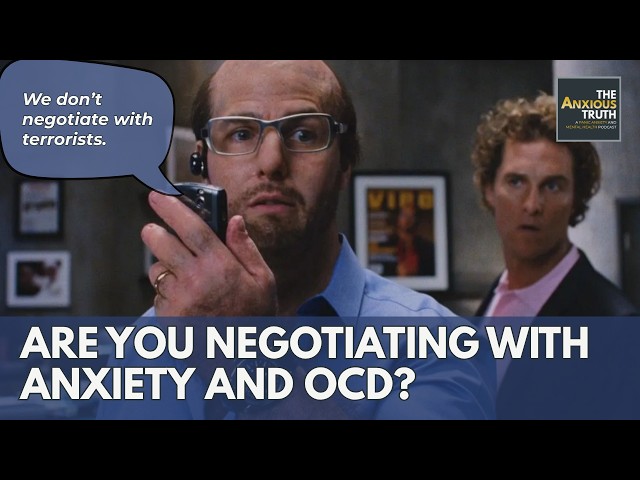
The core issue lies in the psychological dynamic of negotiating with one's own anxiety or OCD, much like bargaining with terrorists. In these high-stress moments, the mind whispers that performing just one more avoidance behavior will satisfy the demands of the disorder and allow the person to be let off the hook. The individual agrees to this deal because it seems safer to play it safe than to take a chance on their own resilience. Yet, anxiety and OCD are unreliable partners who consistently renege on these agreements; after granting temporary relief, they return with new or intensified demands shortly thereafter. Whether the interval is minutes, hours, or days, the cycle repeats, trapping the individual in a loop where every inch of avoidance given results in a mile of entrapment, ultimately ruining their ability to function normally.
Breaking free from this cycle requires recognizing that thoughts are not reality and emotions do not define one's identity, but rather indicate what we care about. Recovery involves making a brave decision to stop negotiating with the "terrorist" in the head and instead choosing to face the discomfort without performing safety behaviors. This does not mean expecting perfection or believing that one will never slip up again, but rather understanding that even if they do not negotiate, they will wind up okay anyway because they can handle their feelings. By refusing to give in to the urge to avoid or ritualize, individuals begin to dismantle the black hole of anxiety disorders and OCD, realizing that the catastrophic predictions made by their minds are unfounded and that they possess the inherent strength to survive these moments without external crutches.
Read the full video transcript
In anxiety and OCD, avoidance is really
common. We talk about it all the time.
And if you give me about six or seven
minutes today, I want to explain how
avoidance in the moment seems like a
good idea, but when you add it all up,
it's a terrible idea. I'm Drew
Linsalata, creator and host of The
Anxious Truth. Today, we're going to try
something a little bit different. This
is a condensed YouTube video version of
episode 352 of my podcast. I will link
the original version in the video
description if you want to hear the
whole 25-minute episode, you're welcome
to do that. And if you want to find more
about The Anxious Truth or the resources
I make available uh on anxiety and OCD,
go to my website at the anxoustruth.com.
So, let's talk about avoidance and how
in the moment when you are triggered,
when your anxiety is through the roof,
when your OCD is kicked in, when your
GAD is in high gear, when your health
anxiety is screaming at you, in the
moment, the thing that you do habitually
and almost automatically to respond to
that, to try to feel better, seems to
make sense. In fact, it seems like a
good idea because, well, you do feel
better, temporarily, and then you got to
do it again.
And what's worse is that when you engage
in avoidant behavior, an avoidant
response, a saving, a ritual, a safety
behavior, a ice packs, breathing
exercises, grounding, tapping,
ritualizing, compulsing, asking AI over
and over and over if you're going to be
okay, speaking your fear out loud to
your anxiety support group, whatever it
is you seem to do habitually and
automatically to try to feel better in
the heat of the moment, not only seems
to work cuz you do start to feel better,
temporarily, but it doesn't feel like
it's that big a deal. I was feeling
terrible, I was really scared, I was
uncomfortable, I was dysregulated, air
quotes, and I did something to fix that.
What's wrong there? And more so, what's
the big deal? It was only 5 minutes. It
was only 10 minutes of Googling. It was
only a 5-minute meltdown. It was only
one birthday party that I skipped. It
was only one lunch. It was only one ice
pack. It was only only only. It feels in
the moment like you're doing the right
thing to stay safer or feel safer, and
it also feels like what's the big deal
for each individual avoidance or
compulsion or ritual. Except when you
zoom out and you add up all of your
compulsions, avoidances, and rituals,
you start to see that if we add them all
together, they are slowly crushing your
life into an almost unrecognizable form.
So, I want to talk today about the idea
that you are trying to negotiate with
your OCD and your anxiety. What if I do
just just do this one thing? Will I be
okay? Will you let me off the hook if I
just do this one avoidance? If I just
Google one more time. If I just wipe
down my counter for 5 more minutes. If I
just tap my face the right way. If I
just fold my laundry a certain way. If I
just call my partner and ask again if
they love me. If I do this one little
thing that seemingly is very innocent
and seems to make good sense because,
you know, just in case and play it safe.
Will I be okay? OCD and anxiety, if I do
this one little thing for you in this
moment, will you leave me alone and tell
me I'm okay? Doesn't seem unreasonable,
except it's always going to say, "Sure,
do that one little thing and I'll let
you off the hook." And then it does, but
then it tells you again in 5 minutes to
do another thing and another thing and
another thing. And whether that interval
is 5 minutes, 5 hours, or 5 days, if
you're watching this video, I'm guessing
you know what I'm talking about. You
have to keep repeating that over and
over and over. Now, you be maybe at a
point where you're not negotiating at
all. It says jump, you say how high, you
just blindly follow it and don't
understand what's going on, which
everybody starts at, by the way. I I get
that. That's not you failing, that's you
maybe being new to this and not
understanding what's going on, in which
case go back and listen to the rest of
the podcast episodes here and go to my
website and learn more about this sort
of thing. Most of that stuff is free,
you don't have to pay anything for that.
But, if you are in a situation where you
do recognize what this is and you keep
in the heat of the moment, in the
triggered moment, negotiating with your
OCD or your anxiety because, well, it it
will will make me feel better. It feels
like the right move just in case. Don't
want to take too much of a chance and
what's the big deal? This doesn't really
do anything. It just makes me feel
better. It's fine. It's no big deal.
It is a big deal. You have to stop and
look and say, "Yeah, but I've been doing
this now for weeks or months or even
years and clearly it has become a big
deal. If I zoom out and look at the
overall scope, the overall impact it has
on my life and my ability to function."
I want to keep this a little bit short.
Again, if you want to listen to the
entire episode 352 of my podcast, I will
link that in the video description. You
can just listen. There's no video on
that one. But, what I want you to take
away from this is if you are in the
habit of negotiating with your OCD and
your anxiety in the heat of the moment
to feel better and try to do just this
one thing, this one more time. If I just
do this one thing, what's the big deal?
It'll let me off the hook. Maybe this
Maybe I'll be okay if I just do this one
thing. What's the big deal? I want you
to really kind of challenge that.
Recognize that like, "Oh, I have been
triggered. I'm really scared. I'm having
a lot of feelings in my body. I'm having
a lot of thoughts. I'm having a lot of
emotions. None of them are good. They
all feel like a nightmare or a disaster
and it makes me want to feel better,
which means I'm going to do a thing that
I seem to keep repeating over and over
and over. And oh, I want to say that
it's fine because it's just in case or
just to be safe or just to calm down for
this minute. And what's the big deal?" I
want you to try to remember, "Oh, it is
a big deal because I'm watching this
video that this crazy therapist from New
York is doing
because I keep doing these things and I
feel like I can't stop and I don't know
what's going on and it is changing or
ruining my life and I don't want to live
like this anymore." Now, making a
different decision to not negotiate with
the terrorist in your head, which is
your anxiety or your OCD, like we're not
going to negotiate with terrorists. One
of my favorite moments in a movie ever
was Tom Cruise playing Les Grossman in
the silly movie Tropic Thunder and he
says that here in a very funny little
monologue and then he hangs up and he
says, "We don't negotiate with
terrorists." And in a way, that's what
we have to do in anxiety and OCD
recovery. It's not easy. You're going to
take sort of brave incremental action to
change that escape and avoidance
response, you're not going to get it
perfectly right. Nobody hears a video
like this and decides, "Okay, I'm never
going to compuls again." I wish it was
that easy, but just recognize that if
you are hearing things in your head
like, "No big deal, just this once, just
this one more time, this is no big deal,
it's only one more time, it's not going
to really change anything." If you're
hearing that sort of stuff or you're
hearing, "Just once just in case, just
once because I don't want to take a
chance." Then you know that you are
being tricked by your anxiety and OCD
into negotiating, and it feels like it
lets you off the hook, except that it
does not hold up its end of the bargain,
and it just comes back again, whether
it's an hour, a minute, or a week again
down the road, and it just makes the
same demand again. So, keep that in mind
as you go through those triggered
moments, and you have to try to watch
that process play out. If you feel like
you want to negotiate to get out of a
tough moment,
what would happen if you didn't?
Consider what would happen if you
didn't. Spoiler alert, you'd wind up
okay anyway, cuz you can in fact handle
those feelings. Thoughts are not
reality, they they are not predictions,
emotions do not tell you who you are,
they only tell you what you care about.
So, we have to use all of those
principles.
Don't negotiate with the terrorists in
your head. OCD and anxiety can almost be
seen that way. They're going to renege
on the deal all the time. They're going
to take more and more. Every inch you
give them, they will take a mile. So,
try not to give that inch. Experiment a
little bit. It's really hard, but that's
what leads us out of that black hole
that you call an anxiety disorder or
OCD, and guess what? I would probably
call it that, too, cuz it sucks. I get
it. I I was there, too. Anyway, if you
have any questions about this, you can
interact with me on the disordered
community app. That's at disordered.fm,
cuz disordered is a podcast that I do
every Friday with my buddy Josh
Fletcher. He's also an anxiety therapist
in the UK. If you have any questions,
I'm hanging out over there. Hopefully,
this has been helpful. You can go and
listen to the full episode if you want.
Uh take advantage of all the other
resources. I'll be back again in 2 weeks
with another one of these little
condensed podcast episode videos, if you
guys seem to like it, at least.
Hopefully, YouTube will think you like
it. Uh thanks for hanging out. See you
next time.