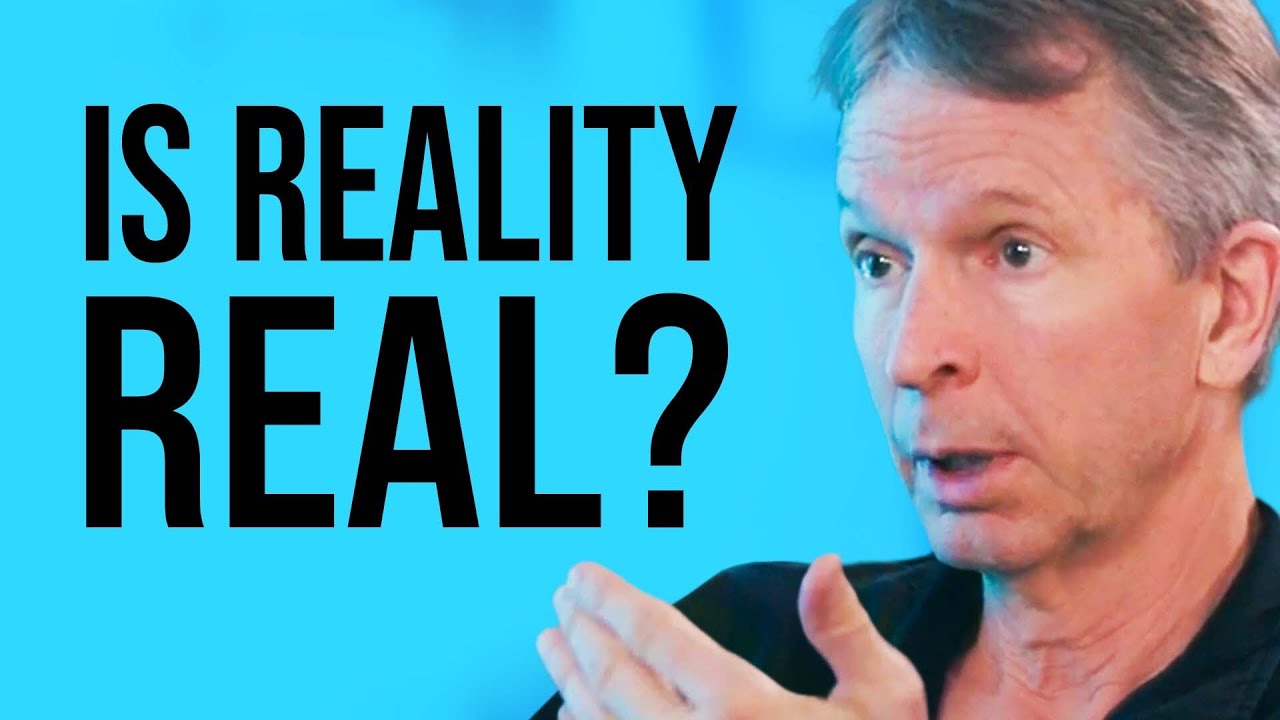
Are We Living In the MATRIX? This Scientist Might Have An Answer ONCE and For ALL | Donald Hoffman
Watch on YouTubeVideo summary
In this discussion, cognitive scientist Donald Hoffman argues that human perception does not reflect objective reality but rather functions like a virtual reality headset evolved by natural selection to ensure survival and reproduction. He posits that evolution shapes our senses to display an interface—comparable to different operating systems or VR headsets—that hides the true structure of the world because seeing the truth would be maladaptive; for instance, if we saw predators as dangerous rather than attractive mates, we might not reproduce. Consequently, while objects like tables and moons appear real with specific properties in space-time, Hoffman asserts that these are merely rendered illusions created by our brains to navigate fitness payoffs. He emphasizes that natural selection actively erases information about the world's actual structure from perception, meaning no description using language of space, time, shapes, or colors can ever be true regarding objective reality itself. To illustrate this constructed nature of experience, Hoffman draws parallels between human vision and computer graphics in video games like *Grand Theft Auto*. Just as a gamer sees only rendered objects that disappear when they look away from them on the screen, humans see only what their brains render based on limited sensory input; turning one's head reveals new data while destroying previous visual representations. He details the physiological process where 120 million photoreceptors in the retina count photons but do not inherently perceive colors or shapes, requiring billions of neurons to construct a three-dimensional world from raw numbers within milliseconds. This construction is so rapid and seamless that we mistake our internal simulation for external truth, much like an avatar collapsing on sand when its user removes their headset remains conscious outside the game interface. Hoffman addresses common objections regarding mathematics and logic by distinguishing between perception and reasoning. While evolution exerts uniform pressure against accessing the true structure of reality through senses, it does not necessarily suppress mathematical or logical abilities because these are required to calculate fitness payoffs rather than describe objective truth. He critiques philosophers like Alvin Plantinga who argue that evolutionary theory undermines cognitive reliability; Hoffman counters that while peripheral assumptions about space-time and DNA contradict the core mathematics of evolution, math itself remains a valid tool for reasoning about survival strategies without revealing reality's fundamental nature. This distinction allows scientists to be "wizards" within their own headset—mastering theories like general relativity and quantum mechanics—which are actually descriptions of our interface rather than the underlying code running the universe. The conversation extends to profound implications for consciousness, alien life, and the future of science. Hoffman suggests that if we were looking at reality directly without this evolutionary filter, we would be overwhelmed by an infinite range of other conscious agents existing outside our space-time simulator; aliens are likely present but invisible because they exist in a different interface or dimension entirely. He references advanced physicists like Ed Witten and Nima Arkani-Hamed who propose that space-time is not fundamental but emerges from deeper structures, such as the amplitudehedron, where concepts of time and distance do not apply. Hoffman's goal is to reverse-engineer this "source code" by connecting conscious agents through their long-term dynamics to these underlying mathematical frameworks, potentially allowing humanity to manipulate the parameters of space-time itself rather than just playing within its constraints. Ultimately, Hoffman presents a choice between accepting our intuitive belief in fundamental space-time and objects or embracing the rigorous mathematics of evolutionary game theory which proves that our perceptions are false representations designed solely for survival. He acknowledges that while many deep beliefs held by humanity, such as object permanence developed around 18 months of age according to Piaget's studies, have been deeply wrong, this realization is a necessary step toward understanding consciousness as fundamental rather than emergent from physics. The discussion concludes with the idea that future generations raised in more immersive VR environments may find it easier to accept that our current reality is just another interface, urging listeners to explore these radical possibilities through his book *The Case Against Reality* and ongoing research into how conscious agents give rise to the universe we perceive.
Read the full video transcript
Honestly, man, trying to wrap my head
around your take on consciousness and
we're living in a constructed reality
that we're essentially in the Matrix
whether we want to be or not.
Evolution gave us this headset and it's
no surprise. I see the moon, I render a
moon. I turn away, I don't render a moon
so the moon doesn't exist. Your life and
my life right now is we're in a
simulator, a space-time simulator. This
may also be an answer to a very, very
deep question about um
alien intelligences. What where are
they?
Well,
we're looking in our headset.
Of course we can't see them.
When we look up and see the moon,
it's because there really is a moon and
it would exist even if there were no
observers to see the moon. It would
still exist.
And we don't believe that we see all of
reality. No one thinks that we see
everything that there is to see, but we
do believe that we've been shaped by
natural selection
to see those aspects of the truth that
we need to see to stay alive. And so
that our perceptions of space and time
are giving us a genuine insight into a
real space and time that would be there
even if there were no observers to
perceive it.
And also our perception of objects like
tables and chairs, the moon, quarks and
leptons and so forth, that these things
would also exist and have roughly the
properties that we see even if there
were no creatures, no observers to see
them at all. And
the red pill that I'm offering is to say
that
if you believe
evolution by natural selection,
then the mathematics of natural
selection makes it very, very clear
that the probability is zero that any
of the language that we use in our
perceptions, the language of space and
time, the language of shapes and objects
and position and momentum and colors and
so forth,
is the wrong language to describe
objective reality, whatever that reality
might be. It's not that we're getting
the shape of this table a little bit
wrong or the colors a little bit off,
it's that no description in the language
of space and time and objects and colors
could ever be be true.
Reality, whatever it is, can't be
described in that language if we buy
evolution by natural selection. So, we
have a choice between taking one of our
best confirmed scientific theories
seriously, namely evolution by natural
selection, or taking our intuitions that
space-time is fundamental and objects
are fundamental. Taking that intuition
seriously. And I decided to to side with
this science on this one.
Uh Umwelt is your senses taking the
world in a certain way and we have
different senses in a bat, so a bat can
do echolocation, we cannot, and
therefore the way that a bat interprets
the world is very different than the way
that we interpret the world and every
sort of species has a different Umwelt.
You can even have humans that have a
different slightly different Umwelt, one
that's color blind. Um
there's a million other examples, but
you you get these variations that are
massive between species. Um you get like
a dog, the the amount that they can
smell is crazy. They can smell a seizure
coming, which is absolutely bananas.
Whereas of course you're not going to
get a human that does that because of
the number of um scent receptors in the
nasal canal and so cool. All right, that
that's an Umwelt.
Every creature
you know, Homo sapiens has one Umwelt,
one user interface. We have the Apple
interface and someone else you know,
some other creatures have the Mac or the
PC interface or or whatever.
Yeah.
And and and there's going to be a wide
variety of interfaces that evolution
evolves. Every species has its own class
of interfaces. Um
and
in each case the interface never shows
any
species the truth at all, according to
evolution.
But there are selection the selection
pressures that erase information about
the structure of the world in perception
do not also apply to math and logic.
The reason is that we do have to have
some elementary ability to reason about
fitness payoffs. Two bites of an apple
give me roughly twice the fitness
payoffs of one. So, not reasoning about
objective reality, just reasoning about
fitness payoffs and the logic of fitness
payoffs, right? So, that's why there's
no selection pressures necessarily to be
geniuses in math and logic. But, at
least the selection pressures are not
uniformly against any capacity in math
and logic. Whereas, in the case of
perception, it's one can show the the
pressures are uniformly against any
access to the structure of the world.
Um in in terms of
the structure of what we perceive in in
our senses. So, that's why we have to be
very, very careful. So, certain, for
example, Christian philosophers, Alvin
Plantinga, for example, has argued from
not mathematically, but informally from
evolution saying that it would make all
of our cognitive capacities unreliable
and therefore evolution by itself was
unreliable theory and therefore we
should not, you know,
not believe it. And I'm not saying
anything like that at all. I'm saying
that the theory of evolution
has a core that John Maynard Smith
found, the evolutionary game theory.
When we look at that core,
we find that there are certain
peripheral assumptions, like DNA exists
whether or not it's perceived. Space and
time exist. Those peripheral assumptions
turn out to contradict the mathematical
core of the theory. And it's and one can
prove that. But, math and logic, our
ability with math and logic does not
contradict the evolutionary the core of
evolutionary theory. So, this
we have to be very, very careful. That's
why you when you do this, you know, it's
it's not just hand waving anymore. You
really have to look at the replicator
equation. You really have to look at the
fitness payoff functions and do
combinatorial analyses and so forth.
This is very, very careful work. But,
that's what we do with our best
scientific theories. We take them very,
very seriously. We look at the equations
and say, "Okay, if the equation entails
the probability is zero that we see
reality as it is, then
we've we've got a choice.
We can agree that we don't see reality
as it is, or we can say we need to
revise the theory. Now, we don't have an
alternative to evolution by natural
selection. So, if someone wants to
propose one, they've got a lot of work
to do because evolution by natural
selection is an incredibly successful
theory. For anybody who's spent time in
VR, what I'm saying will be obvious,
right? If you're playing a VR game of
like race cars, you see a red Corvette
when you turn your headset that way, you
know that you're only seeing a Corvette
that you're creating when you turn your
head that way. You turn your head to the
other side, now you're seeing a blue
Mustang. The red Corvette is gone. It
doesn't exist. There's no red Corvette
in the computer that's running the game.
The red Corvette is only in your mind
when you look over there. Now, you're
seeing a blue Mustang because you're
making that. And so, you you're
rendering these things and then
destroying them. There is a reality, but
it's not Corvettes and it's not
Mustangs. It's the supercomputer that's
running the game. And that's what I'm
all I'm saying is evolution gave us this
headset, and it's no surprise. I see the
moon, I render a moon. I turn away, I
don't render a moon, so the moon doesn't
exist. There is something, but it's just
not like it's not the moon, it's nothing
like the moon. Just like there's
something there's a super supercomputer
in the the VR analogy, but in the
supercomputer, if you looked, you'll
never find any, you know, green Mustangs
or or red Corvettes.
You give an example in your book that is
so powerful. If you would take a second
Sure.
you describe what's happening in your
eye when you look at a scene that
includes a red apple, and the way you
describe it at the photoreceptor level,
I was like, "Oh my god." It gave me such
an understanding of how terrifyingly
complicated things actually are. Do you
remember the part that I'm talking
about?
Right. So,
this is now just normal physiology. And
so, for the moment, I'll be talking as
though, you know, I believe in brain
science and
and neuro and and and we have to do
that, right?
Right. Right. So, we have to bracket
Everything is within the framework of a
theory. So, what I'm now using
neurophysiology and and physics right
now for this to describe this.
So, when you look at a red apple, and
suppose there really is a red apple just
for sake of this argument, it's got a
real shape and light rays hit it and
they have a certain frequencies and they
pass through the lens of your eye, which
focuses it on the back of your eye, just
like a camera would. And on the back of
your eye, you've got
a piece of brain called the retina. It's
a It's nervous tissue.
So, it's a piece of nervous tissue. It
has 120 million photoreceptors. It's
like a 120 mega megapixel camera.
And each photoreceptor
is just
reporting how many quanta of light, how
many photons, it catches. So, I caught
three, I caught 10, I caught 50.
That's all you've got a bunch of
numbers. So, you have 120 million
numbers.
There are no colors.
There are no shapes. There are no
motions. There's just 120 million
colors. Uh uh numbers, not not not even
colors. It's like if you look at the
the the digital output from a video
camera, you'll just see a stream of
numbers. If you look at the stream of
numbers, you'll see the problem that
vision has.
You can't tell from the stream of
numbers what's going on. You have to
create
three-dimensional objects and shapes and
colors and so forth from all those
numbers. And so, that's the problem that
we have in vision. You have all these
photon counts, 120 million photon counts
in each eye.
And from that, you have to then create
objects, see that it's a boy on a
bicycle eating a hot dog, you know.
All of that is you. And that comes
That's not just theory, it becomes
really an important problem when you're
trying to build computer vision systems,
right? You're trying to build a
self-driving car, say, with with passive
vision systems. Well, so the vision
systems are cameras, the video cameras,
say, they're taking in video. Maybe they
have, you know, a few million pixels
that they come in that each each, you
know, maybe 70 times second or something
like that.
Well, those pixels are just numbers.
You got
millions and millions of numbers coming
in every second.
There's nothing in there that says
that's a boy, that's a car, don't, you
know, that's a stop sign. There's
nothing in there that says that. You
have to you have to have megabytes of
software that's really intelligent that
takes all those numbers and starts
computing with them to figure out
three-dimensional shapes, to figure out
what the objects are, to and then to
figure out, "Oh, I'm about to hit a boy.
I need to hit the brakes." and so forth.
So so this is not just abstract.
Self-driving cars have to solve the
problem of starting with numbers that
are in
unintelligent in some sense, just a
bunch of numbers, and giving you an
intelligent assay of what's happening in
the world. And so that's why a third of
the brain, literally a third of the
cerebral cortex, the higher part of of
our brain, is involved just in visual
perception. When you add the other
senses, it's it's more like half the
brain is involved in sensory perception.
Because the senses are doing an
incredibly complicated job. But from my
point of view, what they're doing is
they're building
a VR world.
And it takes a lot of processing power.
You need supercomputers, you know, what
would have been considered
supercomputers to do VR in real time.
And that's what we're doing. We open our
eyes and it looks like we're just seeing
a 3D world with objects and shapes and
colors. It seems so
real and so just we're seeing the truth.
But because you have billions of
neurons, trillions of synapses that are
doing it all within about 100
milliseconds. And so you're so fast at
it that you just think you're opening
your eyes and seeing the truth. You're
seeing a VR world that you're projecting
out there in real time.
Hey guys, hope you enjoyed the episode
brought to you by our sponsors at Blue
Blocks. Go to
blueblocks.com/impacttheory
for 15% off your order or just use
discount code impacttheory at checkout.
All right, enjoy the episode.
When you think about what's really going
on is a computer programmer is trying to
make this game called Grand Theft Auto.
You're dealing with algorithms and
mathematics and moving electrical
currents around a Xbox or whatever.
What you're saying is what you see when
you walk around the room and interact
with stuff and you think about
space-time and Einstein and relativity
is as divorced from reality as the
computer programmer is from the gamer
who plays this game.
That's that's exactly right. And And so
one way to think about it is
science
for all of its incredible breakthroughs
and wonderful theories
has only been studying our headset.
Science has not yet been studying
objective reality outside of our
space-time
virtual reality
that from an evolutionary point of view
was just evolved as a way for us to play
the game of life and stay alive long
enough to reproduce, not to show us the
truth. So, we have really in the in the
last four or five centuries really
gotten to be wizards
of our headset, wizards of the Grand
Theft Auto game. But just because you're
a wizard of Grand Theft Auto does not
mean that you know anything about the
circuits and software that are running
the game.
And for someone who thinks that they
know everything when all they know is
Grand Theft Auto means they they're
still stuck in the headset. Science, I
want to claim, has the tools. We have
learned the right tools as we've studied
our headset. We are ready to use those
same tools to venture outside the
headset, outside of space and time. So,
science has the right tools, we just
have to open up, you know, open our
minds
to the fact that we're just playing a
game inside space-time. It's just a
virtual reality. Your life and my life
right now is we're in a simulator, a
space-time simulator. And we've been
given like an AI system, we've been
given certain
intrinsic
desires that we then find. And so so So
my my wife is an artist.
That's how she's exploring. I I am still
stuck at third grade stick figures. So
that's not how I'm exploring.
I'm exploring in a different way. So so
So there's billions of humans and there
are billions of different ways that we
explore in music and art and literature
and science, various kinds of science,
meditation. So we're in sports. There
there are all sorts of ways that
consciousness is exploring um through
through us. And there is not like one is
the best
or that
makes consciousness want to go to all
the asset to create this VR experience,
to run
each of us as sort of an individual
experience
in consciousness?
The idea would be that that is what
consciousness is about is the
exploration of all of its possibilities.
So is that just the miracle? Like I've
now hit the part where you're like, I
don't [ __ ] know. This is the miracle.
Well Well, yeah. And And when we when we
say that um
that's something that we have to say is
true of any explanation, right? Any
explanation at some point
we say, if you grant me these
assumptions
then with those assumptions I can
explain everything else.
Well So and I totally buy into that.
Here Here is the base assumption I've
always made about the miracle, that the
whole point is to say, "Hey everybody,
I've got this theory. Here's my miracle.
Check it out. Theory works, right? Yeah
yeah yeah. Wow, this is better than
everything." Okay, the only reason I've
told you about this thing is so you can
tell me how to move the miracle back
even farther.
Or are you just like, "Cool, I'm good
with that miracle." And now I just want
to explore
within that where that miracle is or
Well, so I want to do both. So so
this this miracle is so new that I you
know I need to just explore it a little
bit, right?
So so I want to push on this one, but
the but the the miracles I'm proposing
are consciousness is fundamental. So
experiences themselves don't come from
physics.
They are fundamental. So that's a
miracle. And second, um this other
miracle that that Gödel proved.
Well, he proved it, but it's still a
miracle, right?
The the incompleteness of mathematics
that you can that there's endless
exploit That's just a fact, which is
remarkable.
I mean, we proved it, but it's
nevertheless this Why should the
universe be that way? Why should logic
demand it? That's
So that's the but it's a satisfying kind
of endpoint where we say that's the way
the world is. Here's the theorem
that says that's the way the universe
is, and that that one theorem tells us
why
if you're up to exploration
then have fun because you will always
There's no getting there. That's the
key. There's no arriving.
All right, my friends, let's talk about
Blue Blocks. Blue blocker glasses have
been a game-changer in my life. If
you're someone like me who is sensitive
to artificial lighting and extra
sensitive to artificial blue light from
a cell phone or a computer screen, then
you need to try Blue Blocker lenses.
They are going to improve your sleep.
Blue Blocks is all about science,
quality, and style. Their products are
made under optics laboratory conditions
in Australia and come in prescription,
non-prescription, and readers. Blue
Blocks is offering a special discount
exclusive for Impact Theory listeners.
Go to blueblocks.com/impacttheory
for 15% off your order or use discount
code impacttheory at checkout. Once
again, that's blueblocks, which is b l u
b l o x dot com/impacttheory
for 15% off your order or use the
discount code impacttheory at checkout.
All right, my friends, give these a
shot. I use them all the time. Take care
and be legendary.
Suppose you go to a VR arcade with some
friends to play virtual volleyball.
And you put on your headset and body
suit and you're on a you know, a
like a beach volleyball scene, palm
trees and sand and then that. And you're
playing VR volleyball for a while and
then one of your friends, you know, says
I'm
thirsty, I need to drink. He takes off
his headset and body suit to go to go
get a drink. His avatar
sits lifeless on the sand. It collapses
on the sand. It looks within the VR
headset, within the game, as though he's
dead.
But he's his consciousness has not
ceased. He's merely stepped out of that
interface. All right, now we're in what
I'll call the Phineas Gage problem.
Okay.
So, once So, Phineas Gage, for those
that don't know, it was railroad worker,
one of the most famous examples in
neuroscience. He's hitting a tamping
rod. It's like a 3-ft rod, thicker than
your thumb, and it shoots up through his
jaw and out the top of his head, taking,
if I remember right, a teacup's worth of
brain matter, which seems impossible,
but never loses consciousness, but they
say he's forever different.
Right.
Different.
Right.
And he used to be like super sweet, and
he was one of the best workers, and then
he becomes this belligerent [ __ ] and
he can't hold a job. So, I will say
that's that is the So, using this notion
of the headset or the umwelt, it's like
once you alter the way that his brain
works, and I'm fully willing to accept
that that this is a problem only inside
of the headset, but once you alter that
function within the headset, he's
fundamentally different. Our free
choices
are not part of our conscious
experiences. You can't directly
experience your own free choices.
You can experience that you chose, but
you can never actually experience
yourself
choosing.
Why?
It's the Well, well, it's it's really
quite interesting. You can experience
like if you if I go you know here's
there's chocolate and vanilla.
I'm going to choose between chocolate
and vanilla.
Well, I I just chose chocolate. But how
did I do that? Well, I had some
deliberation process. But when I finally
it it I can all I can do is see myself
reaching for the chocolate or the
vanilla. I can see my cogitation
processes. But but the
But isn't that all in the headset?
All that I'm seeing is in the headset.
That's right. So, I'm seeing So, by the
way, I only know my actions
through my headset. I actually don't
know what I'm doing. When I reach out
and grab something,
I don't know what I'm doing in objective
reality in the realm of consciousness.
How does all of this play out in your
real life?
And I've I've heard you talk about that
there are moments where you have
I'm sort of putting words in your mouth,
but almost a meditative experience where
you transcend the notion of self.
Um
how so?
How do you stay so enthusiastic about
this for so long when it seems like
I mean, really really at a deep [ __ ]
level, man. As a human experience, this
just all feels so real.
Right. Right.
Well,
I wouldn't say that I transcend
the self.
But I what I
do get it once in a while is a glimpse
that oh,
this is just a headset. I I actually
feel it that I'm just rendering this.
Most of us feel like space just exists.
I'm stuck inside space. There's this big
stage. I'm on the stage.
It's very different. I think by the way,
the next generation will probably get
this much easier.
Those who have just been raised they
spending a lot of time in VRs that are
as compelling and as immersive as
everyday life is going to be just sort
of obvious that you take your headset
off and go it's a no-brainer to think
well, this is just a headset, too." And
to just sort of be there. So, I think
that it'll it'll be
for the next generation, the fact that
I'm having a hard time about it,
thinking about it this way, and and and
imagining it experientially, will just
be sort of an artifact of the technology
I grew up with. If I grew up with VRs
that were really good, as opposed to the
stuff that we grew up with, which is not
that good, then it would just be sort of
obvious. You you do it when you're young
enough, it's just this obvious that the
Yeah, I'm just seeing a VR headset, too,
because
By the way, here's one way to think
about it.
If you close your eyes,
you just see sort of gray, right?
Mottled gray in front of you. So, it
looks It doesn't look like nothing, it
looks like mottled gray. But, what is it
like
backwards, back through your head,
Mhm.
when you close your eyes? Well, it's not
mottled gray, it's nothing.
And it's really the first time you
really If you close your eyes and
experience that, yeah, what is it like
in front of me? Yeah, it's just gray,
it's sort of mottled gray. What is it
like behind me?
Absolutely nothing. That's the headset.
You only have a headset of space-time in
front. There is no headset behind. Now,
you have a not a visual headset. Now,
you have this
set Yeah, I can put my hands back there
and do stuff. So, I So, I have this But,
it's all a creation. It's all And so, I
do get glimpses of that
once in a while.
But, there were no Now, put on the
natural selection language, right? So, I
have to
pick the language of the science that I
want to use, you know, cuz I don't have
a better language in some sense for for
discussing this. Evolution um
there were no selection pressures for us
to see the truth.
And so, there were no selection
pressures for us to not
take space-time as the truth.
And so, we do. Piaget tells us, you
know,
when
we begin to take objects as real. As the
we, you know, these aren't just like
little data structures that you create,
that they really exist all the time. He
called it object permanence. And Piaget
said that, you know, when a kid is about
17 months, 16 or 17 months of age, they
don't have object permanence.
Permanence. You take a little baby doll,
put in front of a child, they play with
it. You put put it behind the pillow, if
they're 16 months old, they
It just doesn't exist.
It doesn't exist.
Piaget said. And then, but at 18 months,
now they go and crawl around and try to
get the object you know, the baby doll
out of the behind the pillow.
Later experiments showed maybe down to
three or four months. But the point is,
these experiments show that we're
programmed
Now, I'm using the evolution language.
We're programmed by natural selection to
buy into the illusion that objects exist
even when they're not perceived.
Object permanence when we're three or
four months old.
We're not rational. It's being done to
us without our permission. And so, by
the time we come to the age of reason,
it's it's the water that we we don't
know that we're wet. It's the water
we've been swimming in all of our life.
We just have been programmed to take
this as the reality.
This may also be an answer to a very
very deep question about um
alien intelligences. What Where are
they?
Well, we're looking in our headset.
Of course, we can't see them.
That's interesting.
They're out there.
That's really interesting.
We may We may I'm not saying we won't
find some of them out there. Our headset
may give us access to certain alien
intelligences on planets around Alpha
Centauri and so forth. But
it's going to be trivial compared to all
the consciousnesses that are out there.
That's what a headset is for. It's there
to hide
all of the consciousnesses because it
would be overwhelming to interact with
them. So, that's where they are. They're
all around us. It's We're We're like
ants that don't see the guy with the
Raid can coming at them. They can't They
They They just can't see it, right? Um
So, they're all around us, but we're We
are stuck in our headset and we think
that we're the the epitome of of
advancement and knowledge and and so
forth. Might
it would be funny and it may be the case
that every that that's
a rookie mistake that every
consciousness goes through in its
simulator.
That it thinks it because it's headset
is only going to give it
the best access to itself and others
like it and less access to others. And
so in its own eyes, it will always be
the wisest
in its in its environment. And so it may
be a rookie mistake
that every
simulator that consciousness creates
has. That we all have to go through this
phase of going, "Oh, we're the best.
We're the greatest. We're the epitome of
evolution." And then we slowly realize,
"Oh, no, no, no, no. I'm in a simulator
and there's you know there's this
infinite range of other possibilities of
consciousness.
Some so profound that I that I if I
could see them, I would be you know
inclined to fall down and worship them.
Who knows, you know? It just So but but
it's it's a really humbling position. So
we go from being the top of creation,
that that that the smartest you know
the brain is the most
incredibly complicated thing we've ever
found in the entire universe. That point
of view to oh, wow.
Um
We we we've made a rookie mistake here.
Um there are consciousnesses out there
that are far more, you know,
mind-blowing than anything I could even
concretely imagine. So it's it's a very
very different kind of thing.
But I think all of us
do wonder
and about what's next.
And why are we here? And what is it
about? That's why I'm I mean that's one
reason I do this is it life is very very
short.
I want to explore.
And things
most of what I've believed very deeply
has been very deeply wrong.
Most of what humanity has believed very
deeply has been very deeply wrong.
We have a very good we're almost about
100%
consistent in being deeply wrong.
We've believed
that space-time is fundamental.
Almost everybody believes that
space-time is fundamental. We all
believe the earth is flat. Now, a few
and very advanced physicists
Ed Witten has said space-time is doomed.
David Gross has said it's in doomed.
Nima Arkani-Hamed is saying space-time
is doomed. And these guys, especially
Nima, are now really
being adventurous, very very brave and
saying let's go
outside of space and time, into a world
where we can't think just imagine what
they're trying to do. We're trying to
think
entirely outside space and time.
Like as you were saying as as a kid
you're going what could possibly be on
the other side of space and time? These
guys are saying not only is there
something on the other side, I need to
think deeply about it and here's the
mathematical structure in which space
and time quantum mechanics and unitarity
don't even appear in the language.
And then I'll show you how our headset,
they don't call it headset, that's now
me
ad-libbing for them.
So, how space and time, which I'm
calling headset, how space and time and
quantum mechanics and general relativity
appear
from these deeper structures in which
there's no space and no time.
So, that fits perfectly with what what
I'm saying. Now, they have no idea what
this deeper structure is about.
And
what I'm up to is I'm actually Nima gave
a a class
at Harvard last fall.
More than 20 lectures on
for graduate students on these deeper
structures outside of space and time.
I am taking his class online. There's
all on YouTube, so I'm just studying it.
I'm transcribing his lectures, studying
them because I believe that I can show
with my team, but I'm a mathematician,
so they'll show
that the long-term behavior of this
dynamics of consciousness that we're
working on, what we call the asymptotic
behavior,
will give rise to the structures he's
seeing like his amplitudehedron.
And so the reason why And then the
amplitude hedron, he already shows how
to build up space-time from that.
That way I'll be able to go all the way
from conscious agents through the
long-term behavior of conscious agents
through the amplitude hedron to
space-time. I can show you how the
headset is built.
That's my goal. And so I'm I'm really
quite excited. Once I get you know, I
know enough to be worth his time, I I
may
talk with him. But but I'm not going to
waste his time until I know enough. So
I'm trying to figure out how the headset
is built. Once we if we succeed,
we'll be able to reverse engineer that
headset.
And the technologies will will be able
to play with the parameters of
space-time.
So it's like suppose you're, you know, a
wizard at Grand Theft Auto and you can
play within the game, do all sorts of
things that people find amazing. That's
great. But imagine someone who actually
knows the source code. They can take the
wizard and they can give him a flat
tire.
They can take all the gas out of his
tank. They can make the road infinitely
long. They can do whatever they want to.
They can play with the very parameters
of So the wizard is nothing. All of our
science right now has made us wizards.
We're eventually going to get the source
code of the game. Where can people get
your book? Tell Tell people about the
book, where you want them to connect
with you. Oh, yes. It's called The Case
Against Reality. Um you can get it on
Amazon or Apple and so forth. The Case
Against Reality. Um and then I've got a
Twitter feed um at Donald
D. Hoffman, I think. But if you just
Google my name on Twitter, you can find
it. I put links to most of my to to our
I'll put a link to our pod- podcast here
and and so forth. But
um and
yeah, so on Twitter and you know, I have
a website at the University of
California at Irvine that lists some of
my papers and has my email um
ddhoff@uci.edu.
So people can email me. I I, you know, I
get enough that I can't respond to most
of the emails, but but
every once in a while I can respond, so.
Nice.
You know what that's like, I'm sure.
I I do indeed.
Right. Cool. Well, guys, check him out
for sure. Hopefully you enjoyed this and
if you loved it, be sure to subscribe.
And until next time, my friends, be
legendary. Take care.