Video summary
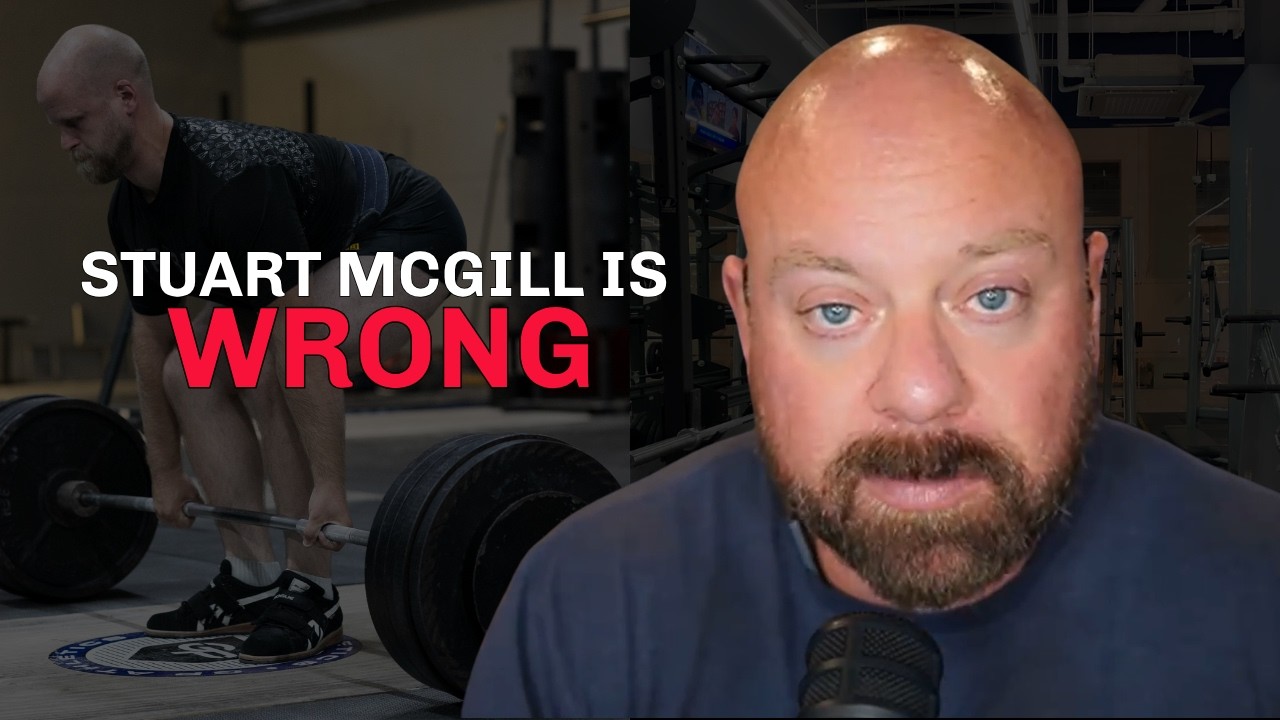
The prevailing fear that deadlifts are inherently dangerous to the back is often contradicted by scientific evidence and real-world observations. Studies indicate that even individuals who perform deadlifts with poor form, such as those with rounded backs or excessive spinal flexion, rarely suffer actual injuries from the exercise itself. In contrast, back injuries frequently occur during mundane daily activities like awkwardly sitting on a toilet, dropping keys, picking up children, or loading soil into a truck. These everyday movements often cause more harm than structured lifting because they lack preparation and control, leading people to mistakenly believe that avoiding heavy lifts is necessary for spinal health when the real danger lies in unprepared, random motions.
When evaluating the safety of deadlifting, it is essential to consider the risk versus reward ratio within the context of any physical activity. No training method carries zero risk; even sports like basketball or soccer involve significant injury rates that often exceed those of weightlifting. Competitive powerlifting, for instance, has an injury rate of roughly one incident per 1,500 to 8,000 hours of training, and this figure includes all types of injuries, not just back issues. For the average person engaging in general strength training, the likelihood of severe injury is similarly low. While minor setbacks like tweaked backs or tendonitis can occur with any exercise, these are typically manageable through intelligent adaptation rather than avoidance, ensuring that lifters remain strong and healthy over the long term.
The most critical distinction to understand is that pain does not automatically signify tissue damage, a concept that should guide how one responds to discomfort during lifting. Many people instinctively stop training entirely when they feel back pain, choosing to rest in bed or on the couch for weeks, which often results in the pain persisting or worsening due to stiffness and lack of movement. A more effective approach is to immediately reduce the load and continue lifting with perfect form, slow control, and a full range of motion. By systematically working through the discomfort rather than avoiding it, lifters can often find that their condition improves significantly within a single session, as active rehabilitation proves far superior to prolonged inactivity for resolving back issues.
Read the full video transcript
I'll throw all of that to the wind and
tell you that the reality is is that the
studies have shown that even people that
deadlift or lift with terrible form,
with very rounded backs, with flexion
form, with dog pooping in the woods
form,
usually don't actually injure their
back.
People injure their backs from like
random things. They get into to the car
weird. They sit on a toilet strange.
They drop their keys on the floor. They
pick their kid up. They're like they're
loading a bag of soil into the back. And
they think, "Man, I can't even load a
bag of soil in the back of my truck
without throwing out my back. How could
I possibly deadlift?" That's why you
should deadlift. Because we're going to
prepare the back for load, right? So,
then
the risk versus reward argument. Like
risk The risk isn't worth the reward.
Risk compared to what? Like no training
carries zero risk.
Everything has risk, right? We've seen
the studies.
People injure themselves at an
exponentially higher level doing
something like pick up basketball or
soccer or whatever running down the
road, right? Then in weightlifting or
even competitive powerlifting, I believe
it's one injury per somewhere between
1,500 and 8,000 hours of training. You
get one injury, right? And not
specifically to the back, any injury,
right? And so it is a very safe
model or method of training. And that's
competitive powerlifting. Most of us are
just general strength training. And so
we're going to get generally strong.
Now, will you tweak your back? Yep, at
some point you're going to tweak your
back. At some point you're going to get
biceps tendinitis. At some point you're
going to impinge your shoulder a little
bit. And we will train around that and
we'll learn how to train through that
and adapt around it. Not to continue to
saw the labrum off until I don't have a
rotator cuff. Not to continue to train
my biceps in a way that's like illogical
and not smart, so I tear my biceps. Like
those things very Those very rarely
happen, right? And then to understand
that pain and tissue damage are not
synonymous. We can still lift with back
pain. We can lift intelligently. We can
back off the load a little bit. What I
found is that when I tweak my back and I
decide to do nothing and I lay around in
bed or lay on the couch or sit in my
chair for 2 weeks and I come back and
deadlift again, the back pain is still
there.
But instead, if a couple days after I've
hurt my back or even in
the 5 or 10 minutes after I tweak my
back, if I drop the weight down
significantly and I force myself to
deadlift with absolutely perfect form,
slowly controlled, nice and smooth.
Maybe it's an RDL. Maybe it's a deadlift
from the floor. I found that by the time
I get done with that session, it's
significantly better than it was when I
when I tweaked it, when I hurt it, when
I felt that pain. I still might have
pain, but I have less pain than I had
when I got that initial shock of ooh, I
think I threw my back out. You throw
your back out and then you let yourself
get really stiff and then your back just
continues to hurt worse. What I need to
do is work it through full range of
motion, very intelligently, very
smartly, very systematically, right?