Video summary
The April 2026 Science Update highlights significant progress in the development of Ashc 2.3, which has been accepted for publication with a DOI assigned. A major focus of the first quarter was the cooperative optimization of water models using Sage to outperform existing TIP3P and OPC3 models, specifically targeting improvements in density and mixing properties. Initial experiments showed that swapping to better three-site or four-site water models like TIP3P-FB or OBC3 improved performance even when Sage parameters were fitted to TIP3P. However, further attempts to refitting bond angle parameters to OPC3 did not yield overall metric improvements, though they did help address specific outliers. The team also identified and corrected several data issues, including a bug in the evaluator that incorrectly inferred molecular forms and a new check to exclude amines with high pKa values that are poorly represented in current mixing enthalpy estimates.
Infrastructure updates played a crucial role in supporting these scientific advances, particularly in fixing bugs related to virtual site refitting and automatic form inference within the OpenFF Evaluator and ForceBalance software stacks. The team addressed significant gaps in their training data coverage by collaborating with NIST to access additional public datasets, aiming to fill voids in chemical space representation for binary mixtures. Concurrently, efforts were made to modernize the software stack to support virtual site refitting alongside updated charge models like Naga charges. These technical improvements were essential for preparing a Minimum Viable Product (MVP) that will utilize existing public small molecule data, with Michael securing compute time on the Oak Ridge Frontier cluster to refine workflows for future large-scale grant applications.
In parallel, substantial work was conducted on protein and lipid force fields, where the Rosemary Alpha model faced challenges in maintaining folded protein structures and handling specific elements like sulfur and phosphorus. Benchmarking revealed that while Rosemary Alpha performed well on small molecule and unstructured peptide data, it struggled with larger folded proteins, often deviating from NMR models. Experiments attempting to fix sulfur and phosphorus issues by refitting to QM data resulted in degraded performance on protein benchmarks, suggesting that a mix of equilibrium and non-equilibrium geometries is necessary for optimal training. The lipid optimization project successfully improved alkane parameters but encountered difficulties with phosphate torsion drives due to geometry constraints, prompting further investigation into alternative optimization methods using restraints.
Looking ahead, the team plans to continue refining water models and advancing protein and lipid force field development while addressing remaining bugs in charge assignment tools like OpenEye. A key strategy involves testing whether rescaling alcohol charges or including cap streamers in training data can improve mixing enthalpies for alcohol-water systems. The project also aims to construct a new library for co-optimizing valence and van der Waals parameters using smearing and descent, moving away from force balance methods to better manage distributed compute resources. With the standardized benchmarks repository nearing completion, OpenFF is poised to streamline future candidate evaluations, ensuring robust performance across diverse chemical environments while preparing for the next phase of development in Q2 2026.
Read the full video transcript
Hi everyone. This is the science update
for Q1 2026.
Uh just a quick note, I am coming down
with something, so I'll try and edit out
all the sounds of me being sick from
this video, but uh honestly, I probably
won't do a very good job of it, so
apologies in advance.
Right, so like I said, this is the
science update for Q1 2026. This will
cover the work done by the science team
at open force field largely from January
to March this year. Although I'll add in
some updates from early April as well
for ongoing projects.
Uh here's a a quick outline of some of
the projects that we have to cover. Uh
as you can see there's actually quite a
lot to cover today. So I'll get right
into it.
First up, a manuscript on the
development of Ashc 2.3 has been
accepted for publication. Uh so that's
exciting. It probably won't be online
yet uh by the advisory board meeting,
but we have been assigned a DOI. I think
we've talked a lot about Ashg and Sage
2.3 in the adboard meetings already.
There's not much more to add, so just
quickly moving on.
Uh next up is the water models co-op
optimization project. So uh we've been
spending most of Q1 on a road map goal
of co-op optimizing a three sight water
model with Sage that outperforms tip 3P
and OBC3.
In particular uh what we're aiming for
here is a co-op optimized force field
that improves performance on our typical
physical property targets of densities
and the mixing. uh in particular uh some
of the outliers that we've identified.
Our plan is to start from the tip 3PFB
and OPC3 water models as starting points
and optimize both the vanderals and
geometry uh to both pure water and
mixture properties.
This is part of a wider collaboration
between open FF uh the charts lab
including Barbara and Lee Ping uh
looking at both three sight and forsight
water models.
As an initial step, Barbara and Chris
both looked into whether swapping water
models would fix some of the allies that
we see in our water mix properties. So
Barbara benchmarked the performance of
Sage 2.3 with a number of different
threesight and foresight water models.
Um and found that performance improved
with Sage 2.3 if if we use better ones.
So for example, uh tip 3P FB or OBC3 in
place of uh tip 3P itself. And this is
despite the stage 2.3 parameters being
fit to tip 3P.
Chris took it a bit further and looked
to see if he could improve performance
even further by refitting the bandw
parameters uh to OPC3 water directly.
Surprisingly in terms of B metrics, this
actually didn't improve um overall
compared to just using the existing
stage 2.3 parameters and just swapping
in OBC3 as the water model.
That being said, we did improve of some
of on some of the aiming water outliers
uh down here, which is great to see.
At this point, we also started stepping
back and taking a closer look at some of
these outlier points uh in more detail.
And we identified a few further issues.
So, for example, looking at one cluster
of outliers up here, uh we realized that
we had been simulating this lact form
with water, which is not the stable
preferred torma. uh instead here we
should really have been using the lactam
form. We eventually actually trace this
back to a bug in evaluator itself which
was inferring to automatic forms using
the ini um instead of preferentially or
uh incorporating the use of the pack
name. Uh but more on infrastructure
updates later.
A second consideration was whether we
may be ignoring meaningful protonation
of amines which are a group that perform
quite poorly with water uh with sage. We
implemented a new check that such as
Kemble or tries to predict pKa using the
PK learn predictor and excludes amines
with pKa over 11 where we might expect
that a reasonably high proportion of the
amines are proteinated in each with
water and therefore not well represented
by the approach that evaluator takes in
uh estimating the enthaly of mixing
using the same chem graphs over uh each
component.
And lastly as part of a general survey
of the ML we identified and excluded
some measurements. Um so for example uh
these points that that are more than 10
sigma away from other uh apparently
identical measurements um in the thermmo
database. These actually haven't
affected fit so far but better safe than
sorry.
So we really did kind of a general
re-review of the data available in the
public sement ML and we found that the
current coverage of co solvents and
chemical environments that we're
interested in is fairly patchy overall.
Uh so this figure is heat map of the co
occurrence of uh chemical environments
in binary mixtures. Um and on the top
and the right hand side here we've
labeled u not the specific functional
groups but the group that they lie in.
So for example different kinds of
ethers, different kinds of alcohols and
so on. Um and you can see that there's
quite a lot of blank space here. Uh the
heat map represents the number of data
points available for that mixture in a
general broad sampled set. um and gray
represents a lack of coverage.
So, we're also in talks with NIST to see
if we can collaborate on another public
release of data to augment our training
and fitting data set uh and and expand
our coverage of chemical space to fill
in some of these gaps.
This is still ongoing, so it's likely
that our three site model will be
restricted to public data only, but will
be really beneficial to future fits.
Uh also as part of this effort, the
science team has been working with both
the infrastructure team and leaping to
get the uh necessary software stack back
in working shape. Prim primarily this
focused around updates to open FF
evaluator and force balance where we
needed to get virtual site refitting up
and running again uh in tandem with each
other.
We've also fixed some other bugs to do
with fitting in evaluator as of version
uh 0.5.3
including some issues that touched other
projects around open FF such as the
lipid force field. We put in a fix for
inferent automatic forms as mentioned
previously and we're also making u
evaluator a bit easier to use for the
water optimization project in force
balance. We've also put in a few updates
that we'll hopefully get released
shortly. Uh so this includes updates to
the virtual site refitting modernizing
to work with the um modern open FF
toolkit including Naga charges as well
as some unrelated updates to the GMAX
and PIM and buy interfaces.
And lastly, interchange is largely the
domain of the infrastructure team. But I
thought I would just mention here that
we did find and fix um a virtual site
geometry bug. So if you're using virtual
sites with open FF, please do use open
FF interchange version 0.5.1 and above.
Uh so we generally at a point where
we're about to start with a site MVP
where we'll go parameters to existing
public ser ML data. As part of this,
Michael led a grant for uh getting us
some compute time on the Oakidge
frontier cluster. So we're in the
process of setting up both FFitting
experiments and refining technical
workflows to prepare for a larger grant
application down the line.
And lastly, this has just started, but
Chris is also looking more closely at
alcohol and water mixtures. Uh, as you
can see here, this subset also performs
particularly poorly in both densities
and enthalpies of mixing. The direction
that we're currently investigating is
whether rescaling alcohol charters will
improve enthalpies of mixing. Uh, this
is still in progress, so I won't talk
too much about it, but you'll probably
hear more about it next quarter.
On a very related note, we have
continued with our remark goal of moving
away from force valance by constructing
a new library for co-optimizing veance
and vanderal parameters with smear and
descent.
While the call group have been
successfully using sme and descent for
optimizing veance parameters, fitting
parameters to simulation data such as
physical properties requires more
management of uh distributed compute and
we have determined that putting in this
new library would be easier to maintain
than upgrading the evaluator library.
We're also taking this opportunity to
add uh some quality of life improvements
and support for anticipated fitting
needs. While this currently falls under
the umbrella of scientific code,
progress here is actually being driven
by Matt Thompson from the infrastructure
team.
In terms of other uh updates to SME and
descent, which currently are also
regarded as scientific code, we have put
out a new release version 0.17
and are working on updates to descent.
SMEI version 17 or 0.17
uh corrects a few nasty bugs affecting
fits in particular with periodic systems
on CUDA and also removes the current
dependence on amber tools. In descent
we're aiming to add a few features that
will also be useful to periodic fits and
remove the uh amber tools dependence as
well. This progress is mostly work that
is being driven by Javal and Finlay in
the collab.
uh this ties in well towards progress on
our our next major effort which is
refitting a stage 2.4 force field using
smear and descent.
So this covers a number of experiments
where the overall goal is to work out a
good fitting workflow for stage 2.4.
Unlike our force balance workflow where
we fit to optimize geometries and
torsion drives, smear descent currently
only support fits to energies and forces
of individual snapshots. Uh therefore
there's still quite a lot of open
questions uh on which data is best used
with being descent whether we should use
the existing spice 2 data set of of
equilibrium snapshots or whether we
should use our existing data set uh
corpus of equilibrium data as Jennifer
Finlay's comparison of per per atom
force magnitudes uh these data sets do
differ quite a bit we ran a few
experiments here that I won't go into
but the overall takeaway is that trying
to use only our existing data set of of
optimized data without off equilibrium
data results in force fields where the
bond and angle force constants trend
continuously towards zero. This also
leads to drift in the equilibrium bond
and angle values and the overall result
is much worse performance on benchmarks
like relative uh confirmer energies.
Uh in parallel Jennifer Clark has also
been experimenting with fits just as
spice to in particular investigating
whether finite partitioning of chemical
space improves performance. Jen has also
run a lot of experiments here that I
also won't get into this time. They're
not quite ready yet to talk about. But
the overall pattern again is that the
force constants here seem to trend
towards zero over the course of fit. And
again, the equilibrium values can drift
quite a bit.
Our overall hypothesis from these
results and from other results that
Finlay and Danny have shown is that the
optimal training data set would include
a mix of equilibrium and of equil
equilibrium geometries.
To test this hypothesis, we want to run
an experiment fitting to a data set
combining spice and optimized geometry
data. So to that end, Jen is applying a
library that she developed for the
Genentech collaboration for robust
chemical perception to the OML 25 data
set.
We're choosing to use OML 25 instead of
combining the existing spice and goosey
archive data sets to avoid any possible
issues that might arise from using
different levels of theory.
OML 25 recmp computed a number of
existing public data sets including
spice and helpfully they also took 30%
of the GM data set and geometry
optimized the subset which provides us
equilibrium data. It took a non-trivial
amount of work for us to convert this
data. So Jen is uploading our results to
hugging face as a complete public use
and you can find uh you can find these
data sets here at these links.
Uh all righty on to the protein force
field to recap the goals outlined for
this project. We're aiming for co-op
optimized parameters for both proteins
and small molecules that achieve similar
accuracy to existing protein force
fields. And we're using amber force
fields, most specifically amber 14 SP as
our reference.
As a reminder, we are evaluating the the
performance of each protein forcefree
candidate on several tiers of
benchmarks. The first is uh a rapid
evaluation of QM data and smaller
structure peptides. The second tier
focuses on maintaining protein structure
of folder proteins in simulation as well
as maintaining the hicity of a fifa. And
of note, this tier includes the GB3
protein as well as head and egg white
lysosyme just because I will be
mentioning those later. And the third
tier of benchmarks includes a wider
variety of protein structures as well as
binding free energy targets. And I won't
get into the fourth tier because we're
not really there yet.
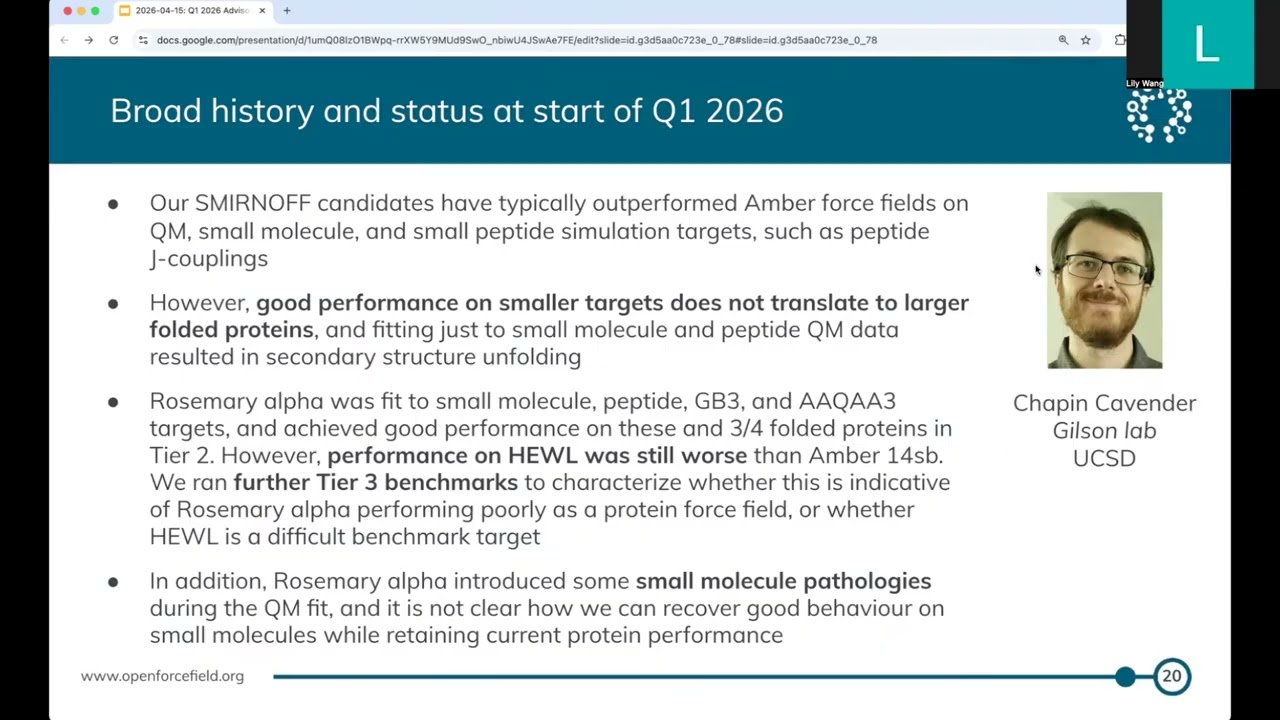
And uh as a brief recap of the history
of the project and where we were at the
start of the year, Chapen has done many
different experiments fitting SMOF
candidates to various data. Typically
the trend that we've seen with our
candidate force fields which descend
from the stage 2.1 small molecule force
field is that they do better than amber
on QM small molecule and unstructed
peptide benchmarks.
However, that doesn't translate to good
performance on larger folder proteins
and for all fits shape and tried where
the force field was just trained to
small molecule and peptide QM data. Uh
we would see secondary structure
unfolding with the folded protein
benchmarks.
The rosemary alpha force we had released
last year extended the small molecule
and peptide QM data set to add GB3 and
the helico 15 as training targets and
this did result in good performance on
these targets
across the entire tier 2 benchmark suite
which includes four folder proteins. The
rosemary alpha performed within range of
amber 14 SB on three of them. The one
exception was for hen and lysosyme where
the performance was worse for rosemary
alpha than for 14b.
So we also wanted to benchmark on more
diverse structures to characterize
whether this was indicative of rosemary
alpha performing poorly or whether hen
egg is just a difficult target to hit.
So at the start of Q1 we had just
finished running additional tier three
folded protein benchmarks although we
had yet to look at the results. And
lastly uh last year we also benchmarked
rosemary alpha on our standard small
molecule benchmarks and we discovered
that that it introduced some issues with
sulfur and phosphorus parameters. So at
the start of Q1 2026, we were also
beginning to think about what the
release process would look like of
taking rosemary alpha to a full force
release and whether we could fix these
small molecule issues in a refit without
ruining performance on proteins.
Okay, on to some of the work that we did
in Q1. Firstly, the tier 3 benchmark
results. This is not the complete tier
three set, but the results that Chapen
looked at seem to indicate that the
rosemary alpha in general has problems
with keeping folded proteins stable. out
of the eight proteins that he looked at,
three of them deviated more from the NMR
model uh than Amber, four were similar
and only one was better. So that's still
a substantial proportion of the data set
where the rosemary alpha is not doing
well, suggesting that it might be more
of a general false problem.
Uh on the right hand side here is an
example of one of the aggregated RMSD
plots that J showed for the proteins. So
instead of show showing a typical time
series trace per replicate, this plot
combines data from three different
replicates and plots a cumulative
distribution function instead where a
force field having a line more to the
left um indicates closer agreement to
the NMR structure and more to the right
in uh indicates worse agreement.
Since we saw such improvement from
incorporating GB3 and the helical 15
into our fitting targets last time,
Chapen then investigated various avenues
of adding hen egg white lysosyme data
into the training set as well. Uh but
neither way that he investigated offer
clear directions forward. So some
experiments for example fitting to NOE
distances uh resulted in force fields
that maintain good performance on GB3
and the helical feet 15 month but using
the same iterative approach that worked
well for for the GB3 NMR fitting did not
correspondingly improve performance on
head equating
to hen egg white lysosine PMFs also
resulted in force fields with somewhat
patch performance for example improving
performance on J couplings but degrading
performance for residual dipole
couplings and NOA targets even for hen
of white lysosyme itself. Chapen also
recently took a closer look at PMFs over
fine s for caps reus. Interestingly,
this revealed that this man force fields
consistently have higher energies near
the alpha basin uh than the cure profile
and the amber force fields here in in
blue and purple reproduce this the shape
of the profile much better. Chapen tried
a couple of things to see if they would
shift the PMF and the profile is
improved if he um if he swaps in ambber
and non-bonded parameters. uh that's a
brown line here although not to the
extent of reaching the amber force
fields the other approach was adding cap
streamers into the training data set
itself which resulted in the pink force
field null streamer QM disturbingly this
didn't seem to shift the profile at all
uh resulting in questions about how we
could improve our workflow this is going
to come up later and we're still
starting investigations so I won't get
into that much here but here is the
state of things at the end of Q1
on a similar topic though we have been
exploring the general question of QM
fits with rosemary
uh with our small molecular benchmarks
we noticed that the rosemary alpha has
some problems with uh sulfur and
phosphorus parameters resulting in
geometry optimizations with very odd
angles the main question we want to
answer is if we can refit rosemary alpha
to QM data to fix this behavior without
degrading protein image marks so ran uh
a couple of experiments where he refit
the rosemary alpha to QM data in two
ways one where the torch were all free
to move and one where the protein
specific torions were frozen.
Both fits unfortunately resulted in
worse performance on tier 2 benchmarks
and would probably require another round
of NMR fitting to get back to rosemary
alpha level performance. So you can see
these two fits in olive green and red
here and you can see that the the uh kai
squared value is much higher than the
rosemary alpha value in orange. The next
experiment we're planning to try next
quarter is to refit with tight price
across all torsions, not just the
protein specific ones since some of the
general torsion parameters in the
rosemary force field are also involved
in secondary structure. Last but not
least, I just wanted to introduce
another effort that has started up in
collaboration with the infrastructure
team with Ashley, which is starting
peptide benchmarks with smart
candidates. One of the big advantages
that Rosemary will bring is being easily
applicable to non-standard peptides,
including cyclic peptides. So Ashley is
starting to set up a small benchmark set
of peptides to compare performance with
other peptide and protein force fields
on these targets.
Um all righty onto another ongoing
project in the consortium which is
improving lipid parameters with the goal
of reproducing membrane properties in
simulation.
This is being led by Julian in the SH
lab and she's starting off with
phosphoippids which has several key
parts. The head group with a phospho
group, a glycerol linker and hydrocarbon
tails. So as a sub goal, this project
aims to improve alkan, alkan and
phosphate parameters.
A targeted approach has worked well for
alkane and alkan parameters. Julian was
able to optimize the force fields
starting from stage 2.2.1 to alcan
density and enthalpy of vaporization
data which substantially improved
performance in those areas and porting
those vandal parameters to stage 2.3
retained performance.
One interesting outcome from this
experiment was that the force field that
performs best on alkan torsion profiles
relative to QM overestimates the
transcal ratio in simulation more so
than a force field that slightly
underestimates the relative minima
underscoring the need for fitting and
benchmarking on condense phase data. Um
however she ran into difficulties
extending this approach to phosphates.
Even an optimization and benchmarking on
a single phosphate torsion drive became
complicated as the constraint
optimization that's used in torsion
drives often results in a phosphate
geometry that was quite different from
the QM structure. We're still
experimenting with alternate approaches
such as converting the constrained
optimization to one that uses restraints
instead. Uh so we'll have updates on
this in the next quarter.
Uh okay so a quick update on QM data
sets run by a data star Jennif Clark the
stage 2.3 optimization and torsion drive
fitting and benchmarking data sets are
now available on QC archive and zunotto
for easy download
we've also added a few new data sets and
additional torsion drive data set for
lipids multiple data sets expanding the
chemical diversity of sulfur nitrogen
and phosphorus groups and uh a data set
reoptimizing torsion net 500 at the
openf level of theory
The first two are largely for improving
for bits and the last is for use as a
benchmark set
for the in progress section. We're
really excited that the architected data
set for diverse organometallic uh lian
complex structures is finally up and
running. Uh this was the result of a
huge amount of work from Jen and would
really expand coverage for the genetic
collaboration.
She has also recently folded a subset of
problematic geometries from Spice which
are largely rare chemistries that Sage
doesn't perform well on and is running
geometry optimizations on these as
additional fitting data. While we're on
the topic of collaborations, Jen has
also been working closely with Open Fe
to collaborate on building out a more
standardized benchmarks repo. This
includes support for both protein lean
binding for energies and absolute
solvation for energies. uh includes uh
both a set of standardized systems as
well as code for discovering these
stores a standardized set of partial
chargers uh in the repo and contains
examples of building or using previously
generated networks. We're really excited
that this is nearing completion um as
this repo and this project and
collaboration will make it much easier
for open FF to run our own benchmarks
for future for candidates.
And lastly onto a few odds and ends. One
item that Jen uncovered during her
collaboration with the open FE
benchmarks reburn is that our current
scripts actually interpret the molecules
from the Minnesota salvation set
incorrectly. Um in particular during the
conversion step where we infer the
chemical structure from the molecule
name.
Some of this is because the molecule
name itself is underspecified. It
doesn't specify uh which is to use and
we wind up using a different one than is
in the paper.
In other cases though, um it's likely
due to an underlying issue with how
we're passing back names. It turns out
this is very sensitive to any
modifications to the input. Uh so for
example, adding a space to fend formate
results in a different structure and
actually the correct structure here. Uh
we did a preliminary check and none of
the incorrectly passed molecules were
present in our stage benchmark sets and
we have now identified and removed them
for future benchmarks.
While we're on the topic of bugs, um a
somewhat Sonia bug is uh one that we've
recently discovered impacting our
calculation of A1 BC charges and this is
specifically using open eye software.
This bug affects atom types that should
get assigned um atom type uh 23 uh which
is a highly deoized lone pair nitrogen
and the cononical example given is the
nitrogen in indul. With this bug,
however, this type actually gets
assigned type 21 instead. This error can
result in very different chargers on the
nitrogen such as a point4 elementary
charge difference. Um, and we notified
open eye about this last year. Uh, since
then they've gone back to us and there
should be a fix coming in the next
release of the software.
But this bug has now been present in uh
open eye charge assignment for multiple
force field fits over a number of years.
We wanted to look at whether Sage had
been negatively impacted by this bug and
whether users should upgrade their open
eye versions when the fix came out. So
we did a quick analysis of the Sage
2.2.1 benchmarks and we broke down
molecules by their BCC differences by
open eye and ambitals. And we did this
because Amptors doesn't assign the indol
nitrogen incorrectly which is actually
how we discovered the issue in the first
place. We were looking into a systematic
discrepancy between the two toolkits.
We found that the ring nitrogen
differences typically fell into the bin
between 0.4 and 0.6 of an elementary
charge difference uh which is this
purple line here on this plot comparing
um relative confirm energies.
You can see that this purple line
actually arguably performs better across
DDE. It has lower differences in
relative complment energy than the bins
with lower charge differences in blue
and red.
So our main takeaway here is that saved
was not negatively impacted by the bug
and it's likely that the parameters had
been fit to compensate for it. So when
the next release of open eye is out, we
actually recommend not updating to
maintain consistent charge behavior with
Sage.
Okay. Uh thanks for holding with me to
the end here. u major focuses of the
second quarter will be continuing on
with the projects that I've gone over uh
throughout as well as some that I
haven't gone into like the next
generation espala work
um we will of course have the annual
workshop in May some of the conferences
and I'll also be offline for a while so
in general we're anticipating that Q2
will be a bit slower pace than Q1 but as
always we'll aim for concrete progress
on road mapap items such as refitting a
water model uh working towards a protein
and lipid force build continuing
collaborations around open FF and OMSF
and core projects such as constructing
the dim sim package and progressing
towards stage 2.4.
So you can hear all about this next
time. Uh thanks for listening.