Video summary
Jeff Wagner, technical lead at OpenForceField, presented the first quarter 2026 infrastructure update, highlighting a series of minor releases and significant ecosystem improvements across key packages. The Interchange package received two updates focused on bug fixes and enhancements, while Nagle saw a release improving support for custom toolkit registries for power users. Pablo was updated to resolve bugs identified during internal testing regarding polymers and modified proteins, and it now includes a new function for creating residues with additional crosslinks. Additionally, OpenForceField coordinated with OpenFE to maintain Pontibus, a bridging tool between projects, an effort largely driven by contributors from OpenFE who are helping define how OpenForceField can better support its development.
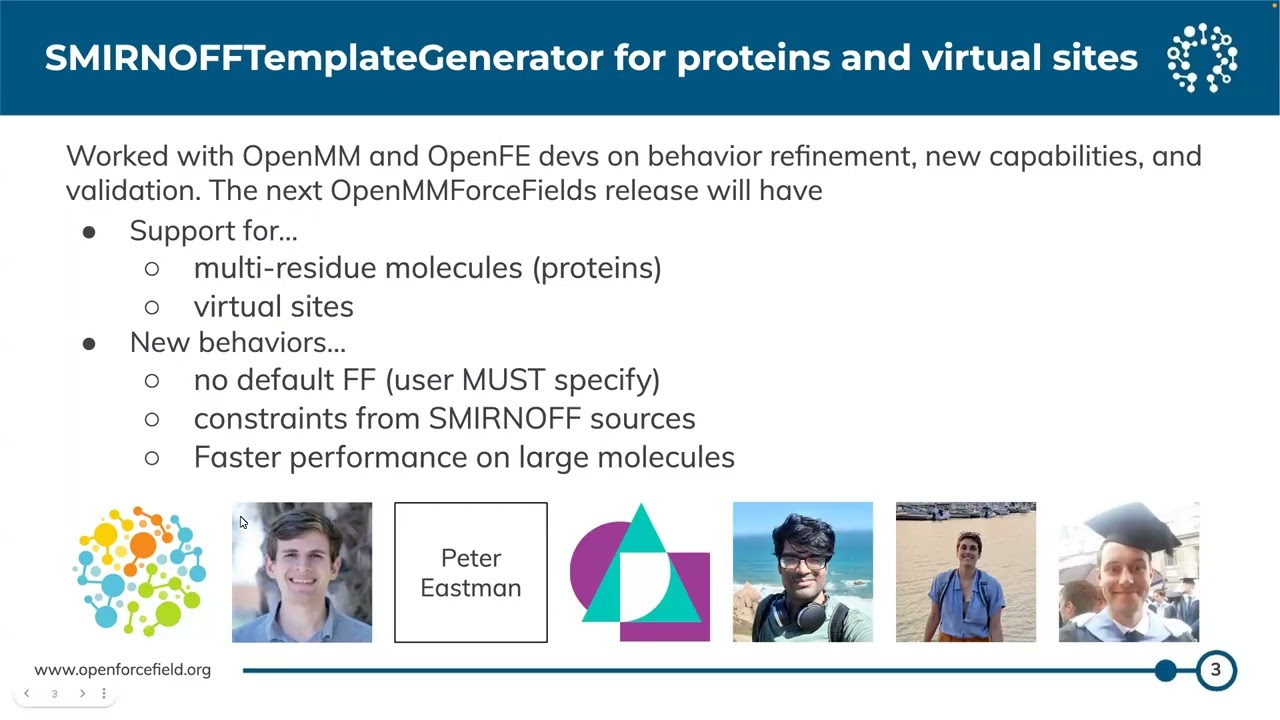
A major focus of the quarter was a significant update to the Smirnoff template generator and the OpenMM Force Field ecosystem, which now enables the parameterization of proteins and the assignment of virtual sites using Smirnoff force fields. This initiative, led by Evan Pretty with support from Peter Eastman, introduced new behaviors that address previous scaling issues for large molecules like proteins and biopolymers, resulting in faster performance. The update also enforces stricter definitions for force field usage to eliminate ambiguity about which parameters were applied and ensures that constraints from Smirnoff sources are automatically included in the final OpenMM system rather than being removed or added via keywords alone.
The team also concluded their 2026 virtual workshop series, featuring sessions on simulating proteins with post-translational modifications (PTMs) and fitting Smirnoff force fields using PyTorch to advance their force balance strategy. Workshop materials are available on GitHub, with recordings soon to be uploaded for the PyTorch session, while the PTM recording is already accessible via an SBGrid webinar hosted by Harvard. Notably, this quarter marked the first time environments were made available using both Conda and Pixi; Pixi is introduced as a fast tool capable of managing dependencies from both Conda and pip repositories, with its configuration files resembling standard Conda YAML structures. The team also demonstrated how to combine Rosemary proteins with Amber lipids, providing a clear pathway for users to set up membrane simulations by parameterizing existing coordinates once they are constructed.
Finally, the update addressed staffing changes due to industry funding shifts, which left the infrastructure team with 2.8 full-time equivalents and the science team with only one core-funded member. To realign resources with their mission of delivering better force fields rather than just maintaining software, efforts from Matt Thompson and Ashley Mitchell were redirected toward scientific goals. Matt is implementing fitting for physical properties within their PyTorch-based stack, while Ashley is working on infrastructure to benchmark Rosemary candidates on cyclic peptides using a Kubernetes-based cluster equipped with GPUs. The team expressed hope that these infrastructure improvements will lead to tangible science progress by the end of the second quarter.
Read the full video transcript
Hi everyone. I'm Jeff Wagner, technical
lead at OpenForceField, and this is our
first quarter 2026 infrastructure
update.
We've had a number of minor releases to
our major packages. We've had two
releases of Interchange that focused on
bug fixes and minor improvements.
We had a minor release of Nagle that
improved support for custom toolkit
registry usage, which some power users
might want.
We made a new release of Pablo that
fixes a couple bugs that we found in
internal testing on some polymers and
modified proteins,
as well as adding a new function to
create new residues with additional
crosslinks.
We've also been coordinating with OpenFE
to help
coordinate maintenance and updates to
Pontibus, our tool that kind of sits
between the projects.
Uh this is largely driven by Erfan
Alabai and Alissa Trappett at OpenFE,
but we're we're figuring out how OpenFF
can help support the maintenance and
development of this project more.
Something that you should see soon is a
significant update to Smirnoff template
generator and the OpenMM Force Field
ecosystem.
They will be gaining the ability to
parameterize proteins using Smirnoff
force fields as well as assign virtual
sites from Smirnoff force fields.
This effort was largely driven by Evan
Pretty, an OpenMM developer, with
support from Peter Eastman.
Uh in the next OpenMM Force Field and
OpenMM releases,
uh we'll have support for multi-residue
molecules, so basically proteins,
parameterized using Smirnoff force
fields in OpenMM Force Field,
as well as virtual sites. Also, over
discussion of how these things have been
used in practice, we defined some new
behaviors. Some of these are breaking,
but they sort of have the full weight of
OpenFF and OpenFE and OpenMM behind
them, so feel free to talk to us if you
don't like these, but we're pretty sure
these are improvements.
Uh one of them is Smirnoff template
generator now will always require
definition of which force field you
intend to use. Previously, this wasn't
the case and people would do studies uh
using a default argument and they had no
idea which Smirnoff force field was
actually used.
OpenMM force fields now will honor
constraints from Smirnoff sources.
Previously, it removed all constraints
and then added them based on a keyword
in the OpenMM API about which
constraints the users wanted to add.
Now, constraints from Smirnoff sources
will always be in the final OpenMM
system and the OpenMM API keyword can be
used to add additional constraints.
Evan also found that
this was unsuitable for proteins because
of some scaling issues for larger uh
molecules and so Evan did some major
improvements that provide uh faster
improvement uh faster performance on
large molecules like proteins and
biopolymers.
We're happy to announce that we
concluded the 2026 virtual workshop
series.
We had two unique workshops that we ran.
One was on simulating proteins with PTMs
as well as highlighting a number of
other best simulation best practices.
And one on fitting a Smirnoff force
field using PyTorch, which reflects the
new fitting stack that we're going to be
moving towards as we uh try to put force
balance behind us.
The workshop materials for both of these
are available at the GitHub repository
linked here and I'll put this in the
chat during the meeting.
The fitting recording will be uploaded
soon. The recording of the PTM workshop
is already uploaded. This is thanks to
the SBGrid webinar series hosted by
Harvard. Uh you can watch us on YouTube.
This actually came out great and I
really strongly recommend that people
watch it.
This is also the first time that we've
made environments available using both
conda and pixi.
Uh
pixi is a tool that can install that can
basically create environments
including conda packages and pipi
packages.
Uh it's very fast and it a lot of people
are moving over to it. So over here I'm
showing what a pixi.toml file looks
like. This is how it defines
dependencies for a core of a package and
then dependencies for optional features
of a package.
I just wanted to to show you all this
because this looks a lot like a conda
file. It's not exactly the same as conda
yaml but it is a pretty close match with
a a little work.
Um so if you hear your colleagues in the
future talking about using pixi, this is
just what it looks like. It's a lot like
conda. We will continue providing all of
our instructions and stuff um assuming
that people use conda for the the
foreseeable future.
But just to let you know, for some cases
we will additionally be providing pixi
instructions.
I also wanted to point out that in the
PTM workshop, we show an example of how
to combine a rosemary protein with amber
lipids.
This is something that we we hadn't
shown very much before but I thought
that I should highlight it. Here we're
constructing an OpenFF force field using
the rosemary alpha and the OPC3 water
model and we're creating an interchange
for that.
But additionally, we're using the OpenMM
force field class to load uh a port of
an amber lipid force field and we're
using that to parameterize
the lipid component here and then
finally we're making the simulation
system by using the interchange.combine
method.
This is something that's that's good
enough for us to put in a workshop. If
you want to use membranes in your
workflow and you've been waiting for the
go-ahead from OpenFF, uh consider this
your go-ahead. You can use basically
exactly this code and you should be able
to to set up and run membrane
simulations. Note that we don't build
membranes, so you're still you still
need to come to us with coordinates and
your and your box.
But we can parameterize them once you
have it built.
Finally, uh the the paths of fate and
employee turnover or turnover at OpenFF
have left us with uh 2.8 industry-funded
FTEs or like core-funded FTEs on the
infrastructure team and just one FTE on
the science team, that's Lily. We also
have Jennifer Clark, but she's funded on
a special project.
This is not great because our mission is
to deliver you better force fields and
not just maintain software.
So, we are rebalancing Matt Thompson and
Ashley Mitchell's efforts towards
infrastructure supportive science goals.
Matt's working on supporting uh our
force balance replacement. Our
PyTorch-based based fitting stack is
already quite good at some valence
fitting tasks, but it can't yet do
fitting to uh physical properties.
Matt's implementing that.
Ashley's working on infrastructure to
benchmark Rosemary candidates on cyclic
peptides. This is being done in
conjunction with Chapin. Uh we have a
Kubernetes-based cluster that can
provide us more GPU compute. That would
accelerate our protein force field
efforts, but we need to kind of rewrite
things to run on on Kubernetes
efficiently with the GPUs that they have
available.
So, that's our update for Q1. Hopefully,
I will have uh some science progress to
show you with infrastructure effort at
the end of Q2.
Thank you.