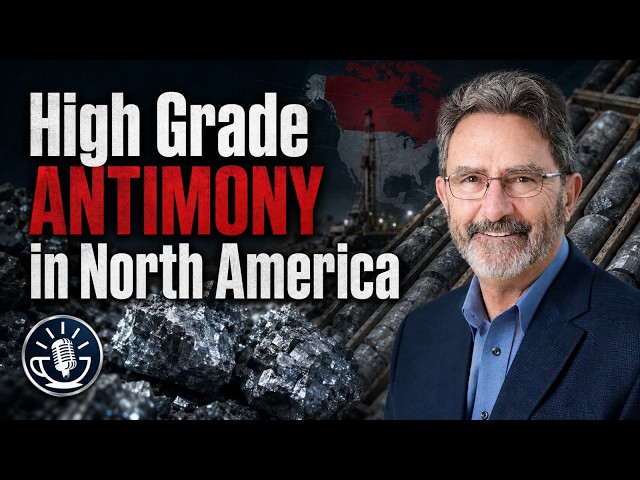
Antimony Resources Positions Bald Hill for North America’s Strategic Supply Race
Watch on YouTubeVideo summary
Antimony is currently emerging as one of the most critical strategic minerals globally, often described as the most important metal that the public remains unaware of due to its dual role in military and industrial applications. It serves as a vital hardener for lead used in ammunition and artillery, while antimony trioxide acts as a crucial flame retardant in automotive interiors, children's clothing, and military tents. The geopolitical landscape has shifted dramatically following China's decision in December 2024 to halt all antimony exports, which previously supplied approximately 75% of the world's demand. This move left major economies like the United States without a secure supply source, prompting a global scramble for alternative projects. Consequently, experts now rank antimony alongside tungsten as perhaps the second most important strategic metal in the world, noting that without access to it, nations theoretically lack the capacity to maintain their armies.
In North America, Antimony Resources holds a significant position with its project located in southern New Brunswick, which is recognized as the highest-grade antimony deposit on the continent. The site's strategic value is amplified by its excellent logistics, being situated just 85 kilometers from the US border and 75 kilometers from a deep-water port, alongside reliable road access and hydroelectric power. The local government in New Brunswick has further enhanced the project's viability by introducing a new mining act designed to expedite permitting processes and implementing a specific strategy focused entirely on developing strategic metals. This regulatory environment allows Antimony Resources to align perfectly with provincial goals, offering a high-grade resource that can produce a superior product suitable for both civilian manufacturers and military needs without relying on foreign supply chains.
Regarding the processing and supply chain, there is a concerted effort to avoid shipping concentrates to China due to geopolitical restrictions, with several alternative refining options currently available or under development. These include a federal government-funded upgrade of an existing smelter in Kimberley, British Columbia; a new refinery in Byron Bay, Australia, owned by Trafigura which is already accepting concentrate from non-Chinese producers; and the established refinery in Montana, though its supply security remains uncertain. Additionally, the company is investigating hydrometallurgical processing methods that could produce pure antimony metal directly at the mine site, thereby increasing the value proposition beyond standard concentrates. While spot prices have fluctuated significantly since China's export ban, with historical highs around $60,000 per ton, current market conditions suggest a more stable range between $25,000 and $35,000 per metric ton, making high-grade deposits like the one in New Brunswick particularly attractive.
Beyond antimony, the project has recently revealed significant potential for gold, with loggers identifying visible gold in drill cores from the central zone. This discovery adds a valuable by-product to the economics of the operation, as the company aims to determine if this gold can be effectively recovered alongside the antimony. Looking ahead, Antimony Resources is currently in a hiatus period to allow laboratory assays to catch up and is preparing for a metallurgical drilling program that will test approximately 150 to 200 kilograms of material. The upcoming exploration phase will focus on three newly identified zones—the central, southern, and west or Marcus zones—while also expanding drilling into the main zone to fully define the resource extent. With permit applications expected by late 2026 or early 2027 and a streamlined approval process anticipated from the provincial government, the company projects a construction timeline of two to three years followed by a one-year run-up, potentially bringing production online within three and a half years from now.
Read the full video transcript
Today I have the pleasure of speaking
with Jim Atinson from Antimony
Resources. And of course, Antimony is
one of the hottest critical minerals in
the critical mineral sectors right now.
Can you tell us what Antimony is
currently trading at and give us kind of
an overview on why everybody out there
should be doing their due diligence in
finding out more about Antimony?
Well, antimony, and I say this every
time, is probably the most important
metal nobody knows about. And it's it's
important in several different ways.
First of all, it is a military metal.
It's used in bullets and artillery. It's
also used as a hardener for lead anytime
you have you use lead. So, it has
industrial uses as well. Anthamonic
triioxide is actually a flame retardant
which is used in many places where where
you need that kind of property. For
instance, automobile uh interior uh
upholstery, children's clothing, you
know, one of the things that we found
out is that most military tents are
actually sprayed with antimony
triioxide. So, it's a very important
industrial and military metal. It's also
very important as a strategic
geopolitical metal and that is because
in December 2024,
China which produced about 75% of the
world's antimony cut off all export of
antimony. So there is no major supply of
antimony anywhere in the world. In 2024,
United States also imported about
140,000 metric tons of antimony
triioxide. So they now have no source of
antimony triioxide or any kind of
antimony for that matter in the world.
So they're scrambling for that. And as
you can see if you look at the news
they're busy putting money into antimony
projects all over the place including uh
all over the US. So one of the things
about antimony that we think is
important is its strategic political
aspects. If you don't have antimony,
theoretically, you don't have an army.
That's as simple as it gets. But it's
also, as I said, has very many
industrial uses. So, we consider it
after tungsten probably the most
important strategic metal in the world.
And people talk about lots of other
ones, but we think it's it's up there
with tungsten as far as being the most
important in the world. So, that's the
importance of antimony. The other
importance of our project is our project
is in North America and you know
notwithstanding what's going on with
other projects this is the highest grade
antimony project in North America and as
such you know has a tremendous value uh
simply because it's you know because
it's high-grade nature means that you
can actually get a very good product
that can be shipped to manufacturers or
military whoever ever wanted. And I
think that's another important thing
about our project. It's, you know, it's
high-grade. It's also well located. You
know, it's it's located in southern New
Brunswick. We're literally 85 kilometers
from the US border. It is very
important. We're 75 kilometers from a
deep water port. You know, we have road
access and hydro and power, all of that
stuff. So it is very strategically and
uh located in there in southern New
Brunswick. New Brunswick also is a very
very mining friendly province. They have
put together a brand new mining act
which is very supportive of of let's
call it rapid turnaround for for
permitting for for applications for for
mining permits. They have also put
together a new what they call strategic
mineral strategic metals strategy. So
they are focused very 100% on developing
strategic metals in New Brunswick and of
course Antimony fits right in with their
with their plans.
>> Um I was reading a report by Halgarten
Plus Company. It said uh he was citing
antimony at $60,000
per ton. Does that sound correct?
>> It was that high. Right now, it's much
less than that. Probably in the order of
30 to 35,000. The challenge with a spot
price of antimony, it's not like other
products like copper or gold which are
sold basically on the open market. All
antimony is really sold by contract. So,
we know right now the Australians get
around $35,000 a metric ton for their
concentrate which they're shipping to
China. So that's kind of a base a base
price. I think as far as getting a spot
price for antimony, it depends where you
look. You'll get a different price in
Shanghai, a different price in Vienna,
different price in Philadelphia. It
really depends on who's talking to you
know and again all of the big let's call
them market metal marketers, they set
their own price based on contracts. So
it's very difficult but it was at one
time especially after the China shutdown
export it was trading at least on the
spot market for $60,000 a metric ton I
would say 35,000 25 to 35,000 is a more
reasonable price which again talks to
the fact that our high-grade project our
high-grade deposit becomes much more
attractive because it has the grade that
can withstand you know a price at that
much lower than say $60,000 a metric
ton.
>> Uh Christopher Ecklestone in that
particular whiplashed by war uh piece on
antimony was talking about high-grade.
Okay, grade being a big component and of
course antimony resources is very
competitive for grade and he talked
about geography and of course you were
in North America. Um one of the
questions from investor talk this
morning was was processing there's a lot
of misinformation. One of the uh
questions was, "Well, Jim, you're going
to have to send this to China." And you
corrected him. Would you mind sharing
that with our audience on where an
antimony exploration play like yours
might be targeting processing moving
forward?
>> Well, of course, yes. Everybody talks
about China. I don't believe any mine in
Canada will be allowed to ship
concentrate to China, but let's talk
about where there are possibilities. For
instance, the federal government
recently put up $400 million to upgrade
the the existing smelter in Kimberly,
British Columbia, which has been
upgraded to produce uh antimony is one
of the metals. I think geranium is the
other one. So, there's a possibility
there. Now, it's a it's a refurbishment
of an existing smelter. Probably take a
couple years. That's how long those
things take. There's also a new refinery
that's just opened up to produce
antimony down in southern Australia, a
place called Byron Bay. It's owned by
Trafigura. It is presently accepting
concentrate from some of the Australian
producers, especially one from Western
Australia that does not that do not have
contracts with the Chinese. So, there's
some available capacity there. There's
also, of course, the refinery in Montana
and Thompson Falls, which is an antimony
refinery, has been operating as such for
quite a long time. They really don't
have any secure supply. They're sort of,
as I understand, looking around trying
to find somewhere to get antimony uh to
to antimony concentrate. So, those are
three kind of options uh of where you
know where a possibility of of a product
would go. I would like to mention also
that one of the things we're looking at
and and several other companies in fact
are looking at is hydrometallergical
processing. Now hydromeergical
processing would actually take place
right at the mine site and would produce
antimony metal right at the mine. Of
course, that makes quite a bit of
difference on the value proposition
side. Difference between produc
producing pure antimony or producing
concentrate which is 65% antimony. So
there are some possibilities outside of
China.
>> Uh the last time we spoke and for those
of you following antimony resources of
course you've had consistent output of
drilling results. with the most recent
one. You've identified another win
obviously for shareholders with visible
gold. Can you comment on this?
>> Yeah. Yes, we did see we always knew
that there was gold in the project
associated with the antimony and also a
little bit on its own in some places and
we've only just begun to try to evaluate
what what the possibility value of that
gold would be. But one of the things
that that happened recently, one of our
loggers who a young woman actually
identified visible gold in the core. And
it's always exciting to find visible
gold. And now I would just mention also
that that drill hole was from the
central zone, which is a zone that we're
only just beginning to explore. And you
know, would it it would perhaps indicate
that that zone may have a higher gold
content. We don't know that yet because
we've only just started getting results
from the central zone, but it's always
exciting to find visible gold.
>> We were also discussing about timelines
uh you know there is a real timeline uh
for getting antimony from exploration to
production. Of course, you are one of
the few people in the actual industry
who has run an antimony production uh uh
mine in the past. Can you tell us a
little bit more about what's happening
in North America for the evolution of a
supply chain in uh producing antimony?
>> I yeah that's a difficult question. I
think a lot of people focus on perpetua
because perpetua is in the process of
building a mine. It's a gold mine and it
has some antimony and so they are in the
process of building that mine. So, they
sort of have a timeline. You know, as as
we all know, when you're building a $3
billion project, there's always delays
and cost overruns and all of that, but
they have put out a they put out a a
timeline. They reckon they'll be in
production by 2030. So, that let's say 3
years and more from now. I would say
that our timeline, you know, may be
similar because we will be submitting
our permit application at the end of
2026, early 2027. The New Brunswick
government has has said that they would
have a very rapid turnaround time for
the approval of that. We also, I would
mention, sort of decided to to speed
that up. We had a meeting with what was
called the technical review committee.
And this is a group that actually does
the review of permit applications. And
so we had a meeting with them and we
just asked them straight out, what is
your what is your main concern? What are
the things you're going to be looking at
in the in the permit application and we
made sure that we addressed all of those
issues. So we expect a fairly short
turnaround time for the permit
application. that will give us a mining
a mining uh mining permit and that will
mean that from then we can then start to
talk about okay what's the construction
going to take how long is that going to
take it's a small operation seven you
know let's say 7 or 800 tons a day a
small operation small capex and though
you know although those things take time
we think that would be a short amount of
time so you know we could see two or
three years for construction and then a
year for runup. So maybe, you know,
three, three and a half years from now,
you know, we would be talking about
potentially being in production.
>> So what's happening now into the fall?
What should shareholders be looking
forward to, Jim?
>> Well, we are in hiatus right now. We're
taking I know it's fall. Damn, I hate
that. But anyway, we we have taken a bit
of a what we call a summer hiatus. Uh
we've stopped all of our drilling and
all of our work. Uh that's for for the
main reason is to let the assays catch
up. Uh the assay turnaround times are
are very slow right now because it's
summertime that labs are very busy. So
we're looking at four to five weeks sort
of average turnaround time. So we'll be
shut down for that for that amount of
time. Let the assays catch up. Let us
you know update our modeling, update all
of our database, all of that all of that
work that needs to be done. We are also
putting together a plan for a
metallurgical drilling program which
will probably collect about 150 to 200
metric uh a kilogram sorry of material
for metallurgical testing. So that's
that's what what we're working on. So
those are the things coming up. So
coming up for shareholders when we get
back to drilling in in a month or two
months however long um we will be
focusing some of our attention as I
mentioned in the main zone metallergical
drilling but also we'll be focusing a
lot of our attention on the new zones
that we have identified. So we have
identified three new zones of
mineralization which we call the central
zone, southern zone and the west zone
which is also called the Marcus zone. Um
we have done a fair amount of drilling
on the central zone. Part of that
drilling was to try to understand the
distribution of mineralization. We had a
lot of antimony mineralization in the
form of stibite in the surface trenches
where we trenched this zone over about
200 m but it had never been drilled. So
we we did a significant amount of
drilling on that and we'll see how that
turns out. We'll also be starting up
drilling on what we call the south zone
which has been drilled in the past had
had a couple of drill holes into it and
we again trenched that one over 200
mters and we'll be exploring that and
we'll be exploring the west or Marcus
zone. Uh the reason we couldn't do that
in the past even though we discovered it
last winter was because the
mineralization occurs right underneath
our our drill road and we needed the
drill road to be in place to drill to
continue some drilling uh from the west
side into the main zone. So, we'll be
digging up that road, doing some
additional trenching work, exposing the
west zone a little bit more, and also
probably putting in a new drill road so
that we can access drill locations to
drill that off. So, most of the news
coming out, you know, starting in the
fall, I think, will be focused mainly on
these new zones where what we're trying
to understand, people ask all the time
about a maiden resorts. We still don't
know how big this is. So it's hard for
us to say, "Yeah, let's, you know, let's
do a maiden resource when we really
don't know how big the thing is that
we're trying to do a resource on." So th
that additional drilling will be part of
that. We also will probably do a little
more drilling on the main zone. It has
not been closed off to depth, nor has it
been closed off to the north. So there's
still expanded drilling there to do. So
yeah, we'll be drilling. That's that's
what we do as an exploration company and
our news will be about that. I think
there'll be some interesting news from
metallurgical work as well because one
of the things we're trying to understand
in the metallergies we know we can
collect the antimony mineralization very
easily you know this has been shown many
times in many various places but what we
want to know is can we recover the gold
that's there we think the gold averages
between let's say 7 g and point and one
gram per ton that kind of grade and can
we recover cover that and of course that
would be significant for the overall
economics of the project.
>> Thank you so much for the excellent
overview and update on antimony
resources. And for those of you that
want to continue to find out more about
uh loggers sec uh finding visible gold,
please go to the following website and
to stay on top of the drilling and assay
results. Thank you so much, Jim, for
joining us today.
>> Well, thank you very much for having us.
We always enjoy talking about this
project.