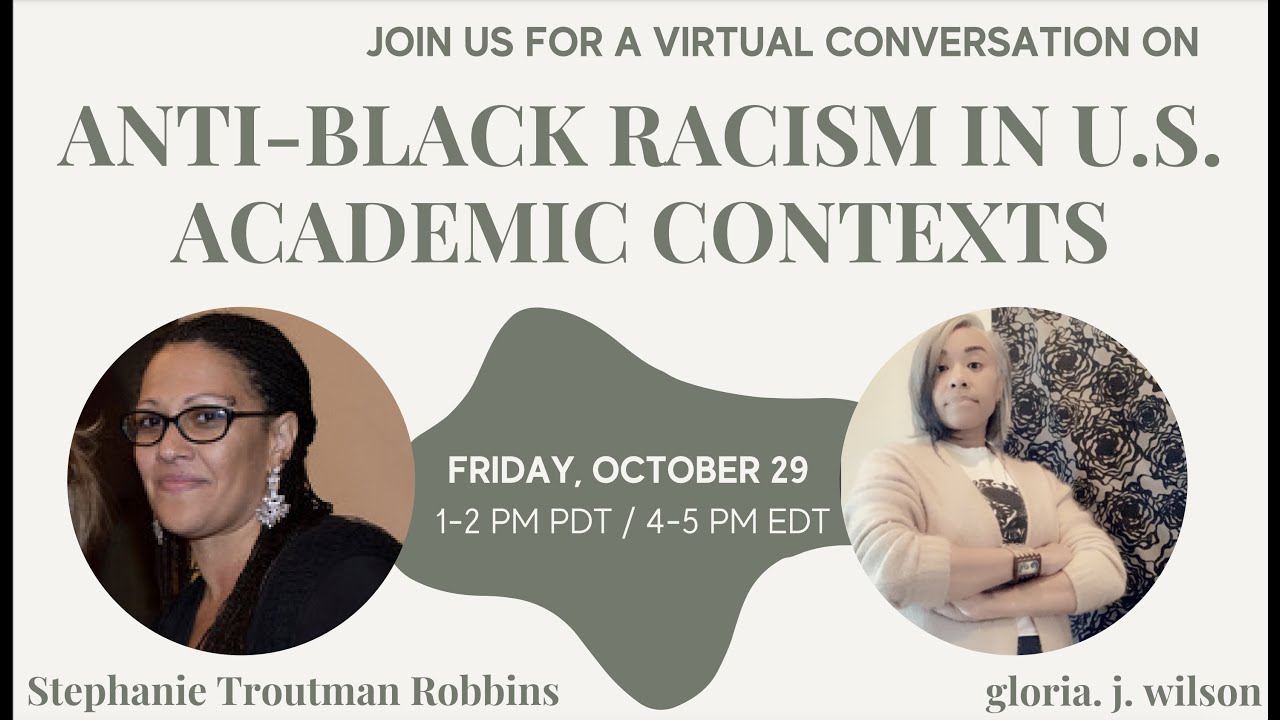
Video summary
The second campus week virtual event on anti-Black racism in U.S. academic contexts featured Dr. Gloria J. Wilson and Dr. Stephanie Troutman Robbins, who shared their experiences transitioning from public school teaching to higher education while confronting the persistence of systemic bias. Despite expectations of progress within academia, both scholars highlighted how anti-Blackness remains deeply embedded in institutional structures, citing incidents like police attributing a broken window solely to them rather than acknowledging racism at Dr. Wilson's first job. They explained that Black scholars often endure "mental gymnastics" when studying their own communities or identities due to systemic biases that question the rigor and seriousness of their work compared to white peers, leading to microaggressions and racial battle fatigue that disproportionately affect faculty of color.
These structural challenges manifest in specific gatekeeping practices, such as tenure committees attacking portfolios focused on Black subjects, which contribute to significant disparities in promotion timelines for Black women due to additional labor and service burdens. The speakers emphasized that academic hierarchies and institutional barriers consistently silence faculty regardless of their rank or status, noting that racism is an endemic phenomenon rooted in global color hierarchies rather than just proximity to whiteness. While Diversity, Equity, and Inclusion committees are popular mechanisms for addressing inequities, the discussion warned against them becoming cycles of inaction where reports gather dust without implementation, urging members to demand accountability or resign if their efforts are not taken seriously by leadership.
To combat these issues effectively, true allyship must move beyond passive support into active co-conspiracy, requiring white allies to intervene directly in hiring decisions and lead workshops on implicit bias rather than remaining silent observers. The speakers advocated for reimagining disciplinary cultures to ensure diverse representation in opportunities without making assumptions based on identity or family status, such as penalizing single parents, while utilizing allies to defend research proposals against biased committees. Supporting Black graduate students facing retention issues requires an ethics of care through regular check-ins and a collective effort to disrupt narratives that label qualified candidates as "not a fit" solely due to their race.
Ultimately, the event concluded by stressing that addressing racism in academia demands persistent discomfort and vigilance rather than seeking quick silver-bullet solutions, acknowledging that recent social movements have made these issues more visible but not yet resolved. Resources like the book *Surviving Higher Education* were recommended as tools for navigating these hostile environments, while effective actions include organizing letters of support, conducting seminars on bias, and publicly standing with colleagues of color during critical tenure reviews. The core message remains that those holding privilege must actively interrupt subconscious biases within academic structures to create a more equitable environment where all scholars can thrive without the constant burden of proving their legitimacy or facing systemic erasure.
Read the full video transcript
hello everyone we're gonna wait a little
bit
to have more attendees join us and then
we're going to officially start the
event by welcoming everyone
all right
um hello everyone i would like to start
um
by saying we respectfully acknowledge
that the university of arizona is on the
land and territories of the oldham and
the yaki peoples who have stewarded this
land since time immemorial
hello and welcome everyone my name is
abhinu audru puni and i am an assistant
professor with the department of german
studies here at the university of
arizona i'm
happy and excited to welcome all of you
to the second and last campus weeks
virtual events this week which is a
conversation about anti-black racism
and u.s american contexts
and i would like to start um by
introducing our conversationalists for
today
um dr gloria
j wilson is the co-founder and director
of racial justice studio an assistant
professor of art and visual cult visual
culture education at the university of
arizona
an artist public scholar and qualitative
arts based methodologist she has
presented her research nationally and
internationally her current research
work is situated within black studies
cultural studies and critical public
pedagogy she studies power situated in
north american-based cultural texts
which have produced race and racism in
general and more specifically examine
representations of race across creative
modalities and how these practices and
processes work to re-inscribe and refuse
hegemonic systems
she has been the recipient of a
fulbright award to study in tokyo
ogizaka japan and has also been an
invited artist speaker for spelman
college's museum of art black box series
she's recognized for a work in
facilitating anti-racism workshops in
museums and community spaces across the
us
her current art making practices are
grounded in critical arts based inquiry
and methodologies and include like adam
include the black academic project and
forthcoming art installation dedicated
to honoring lives of the descendant of
the clotilda survivors in africa town
mobile alabama
next i'm going to introduce our second
conversationalist dr stephanie troutman
robbins is a black feminist scholar
mother and first generation college
student she's the department head of
gender and women's studies at the
university in arizona and is an
associate professor of english
she is a formerly affiliated faculty
member of africana studies teaching
learning and social cultural studies and
the lgbt
institute she has received a dual phd in
curriculum and instruction and women's
studies from the pennsylvania state
university in 2011.
a former high school and middle middle
grades public school teacher stephanie
is a scholar activist who has been
recognized across a variety of community
and campus spaces for mentorship student
advocacy and social justice leadership
she is the recipient of ua links awards
the study affairs faculty impact award
and the dr maria teresa valles
outstanding mentor award
dr troutman robbins
is the former director of two outreach
projects between the university of
arizona and tucson schools wildcat
riders and the southern arizona writing
project these partnership programs serve
as local community serve the local
community by focusing on title 1 schools
and providing them with opportunities
for professional development academic
resources and program programming rooted
in diversity equity and inclusion
through writing
her research interests include
literacies focused on social justice
feminist pedagogy critical race theory
film studies black feminist theories
schooling identities and education
she's the co-author of the 2018 book
narratives of family asset community
gifts and cultural endowments
reimagining the invisible knapsack and
the co-order of two part of the two-part
and encyclopedia
race and ethnicity in u.s television
published earlier this year
her research has been published in the
journal of girlhood studies the journal
of race ethnicity and education
meridians feminism race and trans
nationalism taboo the journal of
cultural and education and in the
journal of literacy and social
responsibility please everyone join me
in welcoming dr stroutman robbins and
wilson
thank you uh so much for that uh
wonderful
and detailed introduction
um i'm uh happy to be here today with my
colleague gloria wilson um as we get
ready to uh have this discussion
uh about anti-black racism
anti-blackness in the academy um
you know gloria and i actually uh both
share background in public schools and
in teaching
and so i think you know
we'll probably just jump right in and i
bring that up just just to sort of
foreground that you know a lot of the
i don't know about you gloria but for me
a lot of the issues that i encountered
as a public school teacher as a black
public school teacher
you know i kind of assumed that those
things would be different
uh in higher ed
and
i don't you know the the more time goes
on and i reflect on these different
experiences of schooling
um you know working in schools and then
also you know being
an undergraduate being a graduate
student and i began to think about um
anti-blackness and different anti-black
encounters i've had
um you know it
it's a little bit disheartening uh for
me that we are not further along in some
ways and so
i wonder um you know just kind of
opening with that you know
what your experiences have been if you
kind of feel the same about that
sure yeah i'm so happy to be here thank
you um so much of benue for um
the wonderful introductions um stephanie
it's good to be with you today um to
continue
conversations that you know we've had
even away from uh campus life and so um
i just appreciate uh having this space
to to sort of bring this topic to the
fore uh and and stephanie you reminded
me that yeah we had a whole we had a
whole career before we got into higher
ed i mean we were you know uh secondary
school teachers and so this is really
making me think about um those moments
um prior to coming even coming into the
professional space space of higher ed
um
that um you experience micro and macro
aggressions and so this is making me
think about
um
teaching in a high school in
mobile alabama and so i have to say that
my father is a black american he is from
alabama he was in the military
and i was in just approaching high
school when he retired in mobile so we
had lived you know overseas we lived in
washington state we had lived in south
carolina and um i think
you're right some of my um most um
watershed moments came when my dad
retired and he retired very specifically
in mobile alabama and we know that
there's lots of history uh in alabama
montgomery birmingham um and so i
remember my first year teaching at this
predominantly white high school
and prior to that i had taught in a
predominantly black middle school and so
this was just you know an entire shift
um not only in racial demographics but
also culturally
and it was a very rural area in mobile
and um i remember one of the first
visualizations that i saw um
on campus was the confederate flag being
represented in students wearing belt
buckles and hats and t-shirts um license
plates um all trimmed in you know con
confederacy
uh and so that very first week of school
um my window was blown out
the driver's side window um and it i had
it was planning period and so it was
early in the morning you know it's fall
and it's not very hot early in the
morning and i remember
um
calling my father first of all because i
was i was upset and then he told me well
you know maybe you just want to report
it and i reported it and here comes the
sheriff
the sheriff comes and the first thing he
says to me is
that son sure is something else isn't it
so he was indicating
at least in my interpretation that it
was the heat that had blown out my
window but nobody else's
nobody else is in the parking lot you
know and that was my first sort of
you know moment um of understanding
um
where i was you know i'd come out of
this you know teaching in this
predominantly black environment black
students black teachers you know and
here i am you know now in this
predominantly white environment um
experiencing you know my very first week
of teaching there um this this what i
would call macro aggression you know
there was nothing micro about that and
then to have you know the person who's
who's assigned to sort of protect you
know um say to me
um what he said it was it made me you
know want to quit
teaching you know and and thankfully i
had a reasonable dad who kind of calmed
me down and talked me through uh staying
there and nine years later you know i um
was the department chair um and had done
lots of things but had experienced quite
a bit of
um
disruption along the way
yeah
you know it's interesting too there's a
there's another there's a connection
which i don't think i realized before
which my dad is also a southern
black man he's a retired military
retired law enforcement um in georgia
um and so you know there's this
interesting um
piece that's about very much about
geography right and and location and i
think being in the south
you know
one of the things i've learned i guess
um as we're reflecting is that you know
anti-blackness is really everywhere
and so i guess maybe in the south when
you're there geographically you expect
it in a certain way because of the
history of the united states but i think
that there's also right ways in which
you don't think these other more
progressive spaces are going to have the
same
level right of racism and then you find
out that they do especially if we're
talking about higher ed and just
especially reflecting on incidents of
the last couple years with police
violence um in certain metropolitan and
you know other kinds of areas and so
um i think you know
it's really hard because
in some ways uh again you can anticipate
the racism in some of these places even
though it's still unpleasant
um and i think for me
i didn't you know i didn't anticipate it
in the academy in the way
that i encountered it and i
you know my first job in higher ed was
also was in a predominantly black um was
that an hbcu between cookman university
and so at bethune cookman you know it
was
very much an all-black pro-black
environment of course there are teachers
who and professors from other
backgrounds but given the student body
and kind of given the history of space
you know the racism wasn't um you know i
felt it differently um and there wasn't
as much of
an issue
um but then moving into more
predominantly white institutions and
spaces
you know it definitely came up and i
think i was very naive i think you know
um i didn't as i said i didn't expect it
right and so because i wasn't expecting
it i wasn't well prepared for it
and i think that that's one of the
things that if anything
i hope that you know younger scholars
and graduate students
will hear that it is
alive and well in the academy
unfortunately while there are programs
and different you know mechanisms in
place to try to combat it
that it's it's very much here and
they have to be prepared right because
uh again i think if you're not prepared
you're you know you're kind of behind in
in being able to to have mechanisms in
place for support or for community or to
like push back or or deal with it right
and so i think that um
you know for me
understanding that yeah you know
academia is not this
liberal bastion of like multicultural
misfits who are all going to
you know who are here because you know
they're committed to some of the same
the same things you know and i think
some of that's been a an interesting
lesson uh that i continue to learn
in higher ed
yeah yeah i agree um the being naive
part um you know and then sort of being
startled out of your naivete you know
trying to um do the mental gymnastics
about
what is happening to you at the time you
know and this is reminding me you you
mentioned um students and sort of what
that experience um might be like
um and and i think we also talked about
um a little bit about um you know the
the less visible ways that these things
show up you know and anytime that you're
you know you have you know sort of
you're doing sort of this mental
gymnastics about you know whether it was
something that someone said to you
um or
um you know maybe even a look that you
that you notice that seems a little bit
odd
and just even recalling my own graduate
experience and having
a professor who
needed to um
needed to support me
in articulating that i was studying
black people
um and and she felt the need to support
me in that and this was a white
professor because i was hesitant to
articulate that out loud
because of a program that i was in that
had silenced me
in many ways and so
um
it's just interesting how how these
things happen and if if we don't have
the systems of support that you talked
about
whether it's through colleagues or
whether it's through professors
your peers
that you're you're constantly doing this
you know the mental gymnastics you know
and feeling a little bit crazy
yeah i mean i i totally agree with you
and i feel like you know you bring up
this interesting point about how like
our objects of study or our communities
of study and i think about how
you know a lot i think a lot of black
folks experienced black graduate
students um experience this sort of
this tentativeness or a hesitancy to
name that they want to study you know
black life or some or some aspects of
like african american identity or
african diaspora culture anything like
that
because we already know right there's
already this this knowledge that we're
going to be
thought of as less serious scholars that
we're going to be thought of as doing
you know vanity projects
or um you know like naval gazing or
self-interested you know identity-based
work that's not gonna be as rigorous
that's not gonna you know it's not gonna
fit um these paradigms uh for what is
considered you know quality scholarship
and it's one of those things that i
think white uh grad students and faculty
really never have to think about or
contend with and you know because if
they're doing work on you know white or
european populations well that's the
assumption right the assumption is that
that's the work you're doing so you
don't have to explain that or
second-guess it or think about it and if
you are doing work on minority
communities you also don't have to worry
about it either because you're a white
scholar so you're allowed to kind of do
whatever you want and when people are
like oh you're studying you know this
afro-brazilian community or you're
studying you know uh black folks during
civil rights movement
you know people think that that's you
know that person is
you know an expert or an authority or
that that person is going to bring some
kind of you know critical esteem or
value to that area uh in a way that you
know i think black scholars you know we
don't we don't get the benefit of the
doubt in that regard and we actually get
more of a negative
uh kind of reaction
and push back around um
around that and i think
you know in keeping with sort of a line
of reasoning or line of discussion
around graduate students i know that one
of the things that happened at penn
state where i was a grad student
um you know i
i was getting my hair done by this
african woman whose husband was a
postdoc
and she was telling me that during the
orientation for the african post docs
they were told not to
not to befriend black americans
that they should not be
you know getting too involved with
african-american students in particular
because i guess she had mentioned that
somebody in the group
um asked about you know black resource
like resources for black folks and asked
about like oh i heard there's a black
graduate student union you know do post
docs engage with that
you know how does that work how could we
reach out and find out more information
about that at which point they were like
oh that's just for black americans like
you don't want to be in that group
and so there's this you know here's this
group on campus that is a staple of the
campus that's like a community of
support that is funded and promoted you
know by different entities on campus and
you have
you know
people still viewing that in a negative
way and still and you know advising
uh african
students not to
engage in that space don't participate
there because you'll be seen as a
disrupter or don't participate there
because you know the black
the black american community on campuses
is remedial right like so that's like a
space
for them so that they can get you know
support to do this work that you don't
need because you're you know not coming
from within this context
you don't have the same issues right and
so i think that was another really like
wow kind of moment for me i
i just wasn't you know expecting that
right absolutely and it goes back to
this you know this mental gymnastics um
that one has to perform when
certain narratives are shared you know
and so in in connecting with um sort of
the narrative that you were um exposed
to that was shared with you um
you know i think about um
you know the extra work that it takes
in order to undo you know
these assumptions
right and so often
um the lots of these narratives are
not true
you know and particularly um as it
relates to communities
um
communities of black people right so
this this is starting to make me think
of you know about the systemic nature
um of anti-blackness and how these can
be internalized by anyone
you know and so i remember hearing these
narratives um
myself
um you know just the fissures that or
that create fissures um across um black
the black diaspora
you know
and and so if if if we don't do the work
to
push beyond the narratives that we're
told um the question becomes you know
how do we then internalize
um these negative messages as well
and
to even extend um
into extend into extend the culture that
we're talking about so within higher ed
spaces
um i recall
um
an
an instance where i was
questioned about where i thought that my
work was going to be published
so
the suggestion was
gloria you might want to think
about whether or not you want a
tenure-track job beyond graduate school
and what that might mean for
you studying
the subject matter that you're studying
so race and specifically black people
and which journals
will accept
your work
and so talk about a message
you know
that one has to do this mental
gymnastics around i remember the moment
that i needed to decide
whether i was gonna push through and do
the work that i was really interested in
which is the thing that i was being
warned about
um right
um or whether i was i was just going to
take the safer
route and study something like
creativity which is what my peers in my
program were studying you know we're
just gonna study creativity you know um
and so again we get these these messages
that we have to really tease through um
and ask ourselves if if that is true and
i will say that
um you know i did make make the decision
to study black teachers
you know
black high school teachers art teachers
um and i have not had any trouble
having my work published in the journals
that i decided and so it again you know
um
sometimes it we have to do a little bit
of extra
um
thinking about these things you know to
ask ourselves particularly as it relates
to
you know black communities in the
diaspora um if we're going to
internalize these you know sort of
warnings um
and be fearful
uh about pursuing the work that we're
really interested in doing with our
communities
you know i think and this is such a
really important and valuable point
because it happens so often right and i
think that you know uh black students
and black graduate students you know
there's this a tremendous amount like
you're saying you talk about the mental
gymnastics and like these sort of subtle
right um
hints or warnings right
and so um i think you know all of that
you know think about
how much labor
that creates right how much emotional
labor and visible labor on top of
already being in grad school where it's
stressful where you're one of
you're just one sometimes right like i
and i think that that is another thing
that is that's kind of shocking is
sometimes you go into a space in
academia in higher ed and you are the
only one whether that's as a black
undergrad a black grad student a black
faculty member um and this is um
you know this is evidence right of the
anti-black
racism that continues in the spaces just
the the low n number of of us right and
so
it's this very um
it becomes very taxing and very like
you know stressful um and i think you
know i've had white colleagues who are
professors say to me like gosh i can't
believe that you know working with this
really talented black student and you
know she
you know
um it's clear that she wants to work on
this area right of you know
that involves black identity in some way
or another um and but you know but then
her proposal came in and it just said
nothing about this and you know i i'm
not really sure what to do because it
seemed clear from our conversations and
other work that was turned in that that
she was going in this particular
direction and now all of a sudden it's
just going to be about
you know teachers in general or it's
just going to be about
you know
this this other group of people um and
i'm confused and i have to have the
conversation like you're just saying
right now
where i have to tell that person well
that's because that person
doesn't feel authorized to continue
for their real project for their serious
dissertation research in that field
right it's safer to maybe explore
examine some of these things in course
papers or in other projects but they
feel like they cannot
advance that research agenda
and unless they have permission and i
hate to say it that way but that because
of the power hierarchies that exist in
academia like i'm just going to call it
what it is they want permission from
their advisor or whomever to say like no
you you can do this and you should do
this because this is what you're
interested in this is what you're
passionate about and your contribution
is valuable
and so then you get into the space of
like the white um professor advisor
who's like
uncomfortable
with having to even have that
conversation and not knowing how to have
it which is why they have come to me
um to say like hey this happened one
student what i do
and then when i tell them the answer
they're like oh
then it puts them in a position to have
to sort of like think about this
hierarchy to think about the history
of what we're doing and and how the you
know how the academy came to exist right
who's been excluded et cetera et cetera
and then they're in sort of the
uncomfortable position of having to
authorize or you know give grant
permission
and i'm like look don't i mean yes
that's what it is but also think of it
as
um that you're supporting that person
right
instead of like oh i have who am i to
give permission well you're in the
position of being the person's advisor
so you have to give permission and but
like let's not dwell on that let's think
about the fact that by doing this
you're taking the stress off the person
you're helping them get closer to their
true
interest
and you're offering your support as they
continue in this way what you're really
doing is committing that hey i'm going
to support you
while you do this work it's not you know
just that oh i think you should do it
but i'm actually going to support you
and help you find the journals and help
you you know combat
you know the any racism or imposter
syndrome or other things that come your
way in relation to this research
trajectory
and i think that that you know is is um
is really valuable it's really important
absolutely
i want to pause quickly just to remind
folks to please uh use the q a box as
we're talking we're just kind of
having trying to have more of an organic
discussion here and so things that
you're interested in or you know we
might not get to but go ahead and put it
in the q a and we're happy to answer
that we're going to save some time at
the end
um
so yeah just a reminder on that logistic
um but yeah so going back to that sort
of idea of you know supporting uh
students and recognizing this additional
labor right and
you know realizing that it's already
stressful to be a grad student but then
when you add you know racism to it
um
there's there's even more
um there's even more pressure there's
even more challenges and i don't
think and i mean the microaggressions
are just endless and so that's
that's one of the things that i
you know you just never get used to it
at least i never get used to it and so
i um you know even coming here it's been
it's been interesting i've gone to
events where i on campus where i'm the
only black person there
yeah yeah
yeah i i i don't get used to them i mean
because and you know that's the
you know that's sort of the
um
[Music]
the sometimes latent nature um of the
that violence you know because it adds
up
um
and it comes out of nowhere you know and
it's not always intentional you know
there there are folks that you know um
i guess and it's often how a
microaggression you know is sometimes
defined is that it's it's sometimes
unintentional but when when you've
experienced just
a lot
of them it it adds up and it could you
know also impact us in the ways that we
go inward
you know and maybe want to check out
particularly if we are the only one in
our program
uh and i think it speaks to what you
mentioned earlier is having the support
um and and locating those communities of
support um not only as a minoritized um
student you know racially minoritized um
individual um but it's also useful for
you know those
who are in our communities who have not
had the same sort of um
you know racially minoritized
experiences
to you know put some tools in their
toolbox you know so that they know if if
you know you are advising a student who
wants to you know do a particular type
of research
um
and who is also having a very particular
type of experience that you know who in
the community the university community
you can contact or put that student in
contact with so that it is a supportive
um part of their experience
um
yeah it's more than just paying the lip
service to say that one is an ally
uh for a racially minoritized person you
know i think bettina love um articulates
it beautifully when she calls you know
um
calls these humans co-conspirators
um i think of brie newsome and her
scaling the pole to bring down that flag
and and i can't ever think of the other
person that was a co-conspirator with
her it was a white
white man man yeah and he put his hand
up right he put his hand on the flagpole
the metal flagpole you know sort of
in in protection of her body as this
officer was standing there with a taser
and so this this you know um this
co-conspirator realized that he probably
would not get tased as a white male
you know and actually physically putting
his hand on the pole to protect you know
her very vulnerable self
um
is is doing the work you know it's not
necessarily
um
maybe it doesn't manifest in the same
way but are you willing to put action
you know into into the work that that
one says that they want to do um to be
in support of
like students or black faculty or you
know
colleagues i completely agree and i
think one of the things too that i've
become frustrated with over time because
i get asked to do a lot of
anti-blackness anti-racist work
and one of the things that frustrates me
you know and i've had to say to some
units well you probably you wouldn't
have to call me to come here if you had
more black people like
in your unit or if you were building
better relationships um even outside
your unit with other units in the
college or with people in the community
um then you could have different
conversations then you could you know
not you would have options right because
other people are first of all there are
other people that exist here so you need
to do a better job of knowing who's here
number one and number two
like
the community
again is important and you should be
looking there as well but also thirdly
like you need to cultivate black faculty
and staff
through through a pipeline through an
initiative through
you know recruitment and retention
measures like that needs to happen
actively
and i know that you know certain
colleges in the past have really tried
to do a hard push for more black faculty
or for more faculty of color in in being
very clear about like okay you know any
units who get approved to hire we want
you to know we're prioritizing diversity
and we've actually had you know white
colleagues on this campus respond to
that
call for diversity or that
prioritization of diversity by saying so
you're telling us we can't hire the best
person
instead like and and so instead of
looking at it as an opportunity right
they're looking at it as prohibitive
because the best person in their mind is
white is not diverse and now since you
said diversity
we can't hire who we want right or we
can't hire the best person when really
what it is is you can't hire who you'd
be most likely
to hire
per se right like
and so i just i find that you know
really troubling especially when it
comes from you know unit leaders or
department chairs who are in all white
departments which there are some here at
the university of arizona in 2021
um not some but many uh and so
you know where you're looking around
your department and then that's your
response when you're told that this
should be a priority or consideration
and so i just think like you know when
people say oh it's not racist it's like
but it is right it's just maybe not this
somebody's not smashing your window in
right absolutely
but but
it's still here and it's just as harmful
absolutely well this you know it speaks
directly to um
uh what whose knowledge and what types
of knowledge are valued
you know so when we're talking about um
you know what we consider
as you know
rigorous
types or rigorous forms of research and
i'm a qualitative and arts based
researcher and so we have lots of
conversations in my classrooms you know
about
um
about the precarity of these types of
methods in relation to what is more
often privileged which is quant you know
in statistics and it's not to do away
with that but it's it's the fact that
these other forms um can be in
conversation with quant you know you
you've got the numbers but they're
stories with the numbers um and also you
know um
[Music]
when i think about um
ways of
um
ways of thinking about what constitutes
data you know there are communities for
which knowledge resides in orality
in storytelling you know and so when
we're thinking about um
hiring people or when we're thinking
about inviting you know folks to
contribute to a larger conversation
how are we thinking about
um
what constitutes
knowledge
you know and and and that being that
being part of the ecosystem of racism
you know when we're not considering
forms of knowledge um beyond the status
quo as valued and valuable
um
then we're really getting to
you know
sort of these more subtle forms
um
that folks would not consider as part of
a racist
practice
absolutely i mean i think you know
i've i've definitely been in situations
where people have
made comments about experiential
knowledges
um about more um you know cultures that
have that use you know different
language practices or written language
practices right
um
folks who you know are very um they
don't want to use a land acknowledgement
they don't see it as you know important
or necessary
um and so i think you know we
these are all forms that that like
anti-that racism and anti-blackness
take and i think you know one of the
more and i think there's you know there
are some really blatant ways but then
there again there are these these other
ways in which
you know i think some of it is hard
because i don't
i would say that in some cases folks
don't even know
that they're perpetuating
you know these these issues
they're like thinking about you know
for example i
i feel that
a lot of times black faculty like some
of the needs that we have right we're
seen as being we have to self-advocate a
lot so that's the other thing i just
will put that out there we have to
self-advocate a lot
um and a lot more than other people do
like i know that most of the black
faculty who i know
you know have had
either issues with retention
or issues with getting things that they
were told that they could get or have or
even promise in writing like having to
go back and find it right and produce
receipts to hold people accountable for
things that were
standard that they were supposed to be
getting right um i know black folks
struggle more with you know spousal
higher just different issues that i
think you know a lot of our white
colleagues don't deal with and don't
know about either
right and
so i i just
you know when we're when people want to
say that they're an ally it's like you
know
i need to know
what you're doing
you know beyond you have the black lives
matter sticker on your water bottle
uh i need to know what you're doing to
sort of speak up
on behalf of racist things that are
happening
to your students or two faculty
colleagues right or within you know your
unit
and i think you know one of the things
that
was very appalling
you know is is to also know like we know
the numbers and the numbers let us know
that black women you know take longer to
get
promoted and tenured and that not many
of us even attain the rank of full
professor
and in part
it's due to i think racial battle
fatigue
the microaggressions the additional
service and labor that goes into
educating our white peers and to dealing
with white students and to helping
support the black and other marginalized
students right it's like so many layers
and then to only for us to do all that
work and then come to have our portfolio
or our dossier come before a committee
that then attacks us for working on
black people
and attacks us for not you know
publishing as much
um which is not always the case but
sometimes um
or in or in certain spaces right like
doing these really racist gatekeeping
practices
that have to be disrupted
and so you know the the only way those
things can be disrupted is by more of us
like becoming associate professors with
tenure becoming full professors and
being in those spaces but also white
colleagues who call themselves allies
have a responsibility
to step in and say
no
you know
i'm sorry but
when you know so-and-so went up for
tenure they had the exact same profile
and i've sat you know in different on
different committees for third year
review and other things where
you know the white candidate
is a superstar
and they're amazing
and you know the person of color
candidate with similar background
um
and doing other and doing interesting
and valuable work
it's just not even that person is seen
as doing what they're supposed to do and
i'm like but wait a minute this person
also did this this and this and if we're
gonna nominate this person for a
president's early career award why are
we not nominating this person as well
right you know and it's just
you know you're the only one in the
space though and then and then you have
to and even for me i find that i have to
have a white person cosign once i raise
it if i'm the only one
i have to look around and hope that
there's going to be an ally who's going
to stand up and be like oh i agree with
stephanie or like actually stephanie
that's a good point i'm glad you you
mentioned that because yeah we could
right like promote both of these
these scholars or support them both in
this way
and so i just think you know the
anti-blackness
it in some ways it's really visible in
our in our numbers and you know in how
we show up but then in other ways there
are these very systemic and ingrained
kind of beliefs and practices
that people don't don't stop to question
right absolutely and then there's the
the precarity of you know um
so if you're in a tenure track position
and you're still junior faculty um if
you are the only one um in your
department and your program uh the
question becomes do i speak up
you know and if i speak up do i make
enemies by speaking up it's all of these
these things that mental gymnastics
again absolutely absolutely but you have
to you know
consider um
how you
how you navigate the space you know in
hopes that you've come into an
environment where like you said there is
at least one um you know person that can
co-sign you know what it is that that
you're having um ideas about or
challenges with
um
yeah there's so much stephanie right
there's so much i mean the more i think
about it i'm just like
we're just basically scratching the
surface i know we're almost at the end
of our time before we transition to q a
but there really is so much and i i tell
people all the time you know that um you
know i i go to therapy and and then the
time is spent right with like it's 50 50
between like my childhood and my job
and being an academic right like these
are the things that i'm constantly
working through uh that are sort of you
know just lifelong like hmm you know
because it's it is it is ongoing it's
not there's not really an end point you
know and there have been times maybe
where i've had a sustained period where
i haven't encountered any
microaggression or any racism and then
you know you get a little bit
comfortable
uh and then boom and then it happens
again you know and you know we haven't
even begun to talk about you know the
way that black folks are you know
treated in teaching evaluations the way
that plays a role
in promotion and tenure practices you
know we have those colleagues who you
know are
overtly
um
you know unsupportive or or just racist
right and you know who won't have
discussions
um
unwilling to have even you know talk
about certain aspects of of race and how
it's showing up in the
department or the program or the
curriculum i mean there are many many
things that we will not get to cover
today but i
i'm really appreciative of this sort of
this opportunity just to connect with
you on this gloria and for us to talk
about it
i always like being invited um
but yeah i'm happy to
open it
to
you know conversation or uh questions
yeah same same and if i might i'll offer
a um a resource that you know both sadly
and gladly i came to as a graduate
student and then returned to this
resource
um after i graduated and would you know
sort of use it to inspire
work and i'm sure stephanie and probably
others in the room have seen this book
um and again sadly a book had to be
created around you know black black
academics and their survival in the
academy um and so i've dropped it in the
chat
oh yes
so interesting that you pull this book
gloria because this book was actually
given to us at penn state and through
the um they have you know they had
support for
black and underrepresented you know
graduate students and so we have certain
professional development and support
that was available to us
and one of the things that they gave us
was this book right away um
and so it was it's definitely one that's
super helpful there are many other
resources out there i would say that
probably one of the most effective
um acts of allyship that i had a white
colleague
do for me
when i was at
appalachian state university which is
one of the top 10 whitest uh schools in
the country it's in the mountains of
north carolina and that's where i was
before i came here but what i tell
people all the time is that you just
don't know where the good allyship is
going to show up actually and in that
environment i had amazing
white colleagues and so even though i
was the only one
they were super vigilant about their
commitment to anti-racism
and so they were not i mean even before
i could ask for support they were there
providing support they're like oh we
heard this and so now we've organized
and we're showing up and we're writing a
letter you know to our department chair
or we're being you know pro proactively
advocating you know in this way or that
way and they just were there with it and
one of the really effective things that
um one of my colleagues did was he pro
he did he led a group um he led a series
of seminars he's a white man on um
that were from presumed incompetent
another really great book that looks at
you know anti-blackness in the academy
racism that you know scholars of color
face and so he led this this workshop
for white administrators specifically
and for white full professors
um so that you know that they would
could become aware
of their behaviors and um and their
biases and so that he can give really
direct
approaches
and examples not only what they were
doing
um but he had like sat in different you
know faculty meetings different spaces
like took notes of things that people
said and did
and then connected it directly so that
they couldn't escape right like well you
know
we're talking about this because it
happened in the book but jim
i remember you said this on this date
at the meeting and like just really
called folks out but of course you know
he was a white man and he had tenure but
it's an example of how people can use
their privilege you know to actually be
an ally
and you know to actually advocate and i
think to you know your point about
junior faculty if you're the only one
and you're not tenured yet like how much
can you speak up and you know what kind
of risks are you
able to take and i i think of one of my
gender women's studies and african
american studies professors at penn
state um who went on to be at uc santa
cruz and sadly you know is not is no
longer with us but um you know in her
time in the academy dr aaronette white
amazing black
scholar feminist just incredible
professor um you know she told us
there's never going to be a good time to
speak up
right you're
you're a grad student and you can't
speak up because your committee will
won't approve your your work you're an
assistant professor and you can't speak
up because you don't have tenure you're
an associate professor now you can't
speak up because you'll never get full
um it's just like so there's never a
good time and so we have to understand
that like
regardless of
the the ten year scenario that there's
always going to be some obstacle or
barrier or challenge that tries to
silence us
and we have to transcend that
absolutely and you know i think we've
been we've been saying it in many ways
um all along um that
one there's work involved from everybody
whether it's finding your communities of
support you know whoever you are you
know so if you're a student finding
other students finding you know faculty
that you can trust
um
uh if you are you know not uh of a
minoritized group um doing the work of
unpacking
um
you know
biases you know i think universities are
now
um for better or worse being called you
know to the carpet about
um you know inequities racialized
inequities
um and and fortunately unfortunately it
caught the pandemic you know plus also
the series of murders you know of black
people that have always happened but you
know that came to this critical
you know moment last summer
um that has kind of shaken things up a
lot you know and and
having us really reckon with um
reckon with the unhealed scars
uh of this entire
you know globe really i mean you know um
anti-blackness is a global phenomenon
right it is i mean there are these color
hierarchies yes
already spaces right like so it's not
just
i mean again it's about a proximity to
whiteness and these other kind of you
know political dimensions and identity
pieces
but um you know you're right that these
most recent incidents in the racial
justice movement and this
the way that social media has really
played a role in visibilizing and you
know making
more you know
more salient these issues that have been
going on i think that you know you're
right that's been a huge part of the
response i think um because when it
wasn't as you know visible or readily
accessible
um in a visual you know domain i think
people were able to more easily ignore
it or deny it right and we now see that
that's that's no longer possible so we
do have a question about um our thoughts
on diverse equity inclusion committee
approaches that are
a favorite
they're a fave in the academy um
they are very uh exciting uh people are
excited to use these mechanisms
but i find you know i don't know i think
it's a mixed bag right on the one hand
it's better than doing nothing but at
the same time i mean how many of these
you know reports end up you know in
somebody's desk drawer or you know not
being you know they come with
recommendations and you get thanked for
your service but the recommendations are
never implemented and then two years
later it's another diversity equity
committee doing the same work you know
replicating essentially the work that
the last committee formation did that
never got implemented and it can become
this like cycle of inaction
and so i would just warn that you know
anybody who see who decides to serve in
this capacity or on these committees you
know needs to really um
first of all understand that it's a big
time commitment so if you kind of show
up in the room and you don't feel like
the folks that you're working with are
actually going to be committed to
getting
something done to passing an agenda or
calling for accountability
i would
resign and
if you know in a best case scenario you
get the right people who all have you
know a particular kind of energy and a
particular level of um
you know power and commitment and then
the committee can actually sometimes
move the needle on certain things but i
think you know it's complicated because
there's so many moving parts and there
are a lot of there's a lot of turnover
and shifting um and so
it's hard because of you know the
different
the different factors but also you know
diversity equity inclusion committee is
is a low-hanging fruit but everyone
should have that minimally some version
of that in their unit you know just to
like ensure that conversations are are
happening i suppose
yeah i think it says you know it says it
says something that
that we have to have this in the first
place right so that speaks to you know
um
the ever-present concerns um of
each of these
areas you know and and
also um
brings to question how people are
defining
these things like how how
you know
we know that there's no silver bullet
approach because racism is endemic
it is not trendy
it is time
less you know i've heard lots of you
know folks that say oh this is so timely
like well no no
this is timeless you know we we could
have had this same conversation 60 years
ago
80 years ago 10 years ago
you know and so i have to ask what is it
that we think we're doing
when we bring these sorts of committees
together um and if we're not
attempting to have the structural
conversation about how these structures
were designed very specifically and what
are the methods
to undoing and interrupting these very
you know endemic and structural
um frameworks
um
how how will things change
you know it requires quite a bit of
discomfort you know when we shake up a
system
um much like it really does
an insistence right i think there's also
a point at which people like well you
know i said what i could or i said my
piece at the meeting or i did whatever
and then i just felt like you know once
so and so brought up like it just wasn't
gonna you know it wasn't gonna go any
further and it's like
but you need to persist
right
um
and you need to insist right and there's
not a there's not a point at which you
know
um you withdraw when you're committed in
a certain way and i think that
that's the thing it's like well no
matter you know what this other person
said about this candidate or whatever
it's if you're trying to do anti-racist
work you know it's your job to
continually
disrupt you know this this other
narrative or discourse that's happening
in his space i mean i really hate the
conversation about well fit this
person's just not a good fit like fit is
the conversation ender in these academic
spaces right it's like well this
candidate does you know has this to
offer and this candidate has this to
offer and you go back and forth back and
forth and what ends up happening is you
say well these are both excellent
candidates
one's black one's white they're both
great
we actually need them both
but we can only have one
and then people say well i just
think anne
is a better fit
than shantae right like and that and
then that's it then everybody's just
like
you know and so i i feel like you know
it's my job since i have tenure um and
and other folks right who are committed
um who have some kind of privilege
whether that's race or rank or whatever
it's our job to say
but why
why is this this white woman a better
fit
right if we have determined that they
have equal qualifications and
credentials they're both phenomenal then
why
is this person a better fit what makes
them a better fit
you know and we have to push for that
conversation and like you said it
requires discomfort it requires
vigilance
and you know i think there are there are
a lot of you know white folks who are
not willing to to get to that level
right and to those folks i say well
every day we have to be at that
hyper-vigilant level
as black scholars as black women in the
academy of like dealing with and
deflecting and processing
microaggressions racist colleagues you
know um
all of all of the things so if we have
to go through that and you want to call
yourself an ally then you need to be
okay with pushing through with some of
these
you know questions or tactics
strategies right in these other settings
and spaces right
and
i mean i know we're short on time there
was a last question about how academic
units can better support black graduate
students
who are experiencing micro and macro
aggressions uh what are you what are
your thoughts on that gloria i'll let
you have the final one well yeah oh
um
uh so wow
you know when we talk about structures
um again i have to
reiterate that there is no silver bullet
you know and so one has to ask
where one wants to enter into
the interruption you know of patterns
you know so if patterns of
um
uh
in the inability to retain
students of color you know or black
students is you know sort of the issue
at hand one has to
um look at you know the community and
the ecosystem um if you are the only one
what is going to encourage you
to to stay and if you have no sense of
who else what other black students you
know are in the community again it goes
back to you know who
who
who are the resources
um on camp on campus the human resources
that students can be connected with
um and
what messages are students receiving you
know i think this ties really well into
everything that we've been talking about
you know is the is the student's
research
considered valuable
you know is their method considered
valuable
um how can
how can those who want to be allies or
co-conspirators re-imagine
um
what these students
already bring
with them and it might require
reimagining the culture of a field or a
discipline
um i have friends who
you know i was in grad school with who
were parts of different programs and it
required selecting a committee member
who may happen to be in a position of
power whether it be through tenure or
whether it be through their skin
privilege that they could actually
support that student in their in their
defense of their research proposal you
know to sort of check the other
committee members that may not have
supported them otherwise so there's so
many different
i think points of entry
that that we can interrupt sort of these
anti
you know um
these racist practices you know
subconsciously these biases that we have
you know just to start undoing the
[Music]
and harm
would say too like even beyond that it's
just like you know check in
in the same way that you check in with
other students you know like
you know you seem stressed
are you good
um i haven't heard from you in a while
or you didn't you know you didn't show
up at this event and i
you know in the past you have been at
these types of events i noticed you
weren't here
is everything all right you know like
just checking in and you know you have
to assume that something's wrong but
it's okay to check in and that that
affirms that you notice right that that
student is not there or that you're
wondering if they are struggling in some
way in the program so i encourage people
like some of it's not as hard right
there are really difficult structural
things but then there's also just sort
of like the human engagement of like
you know an ethics of care practice and
ethics of gender you know especially for
your students of color and minority
students and also again like i was
saying in the case of the two junior
professors
when you're thinking about students that
would be great for this award or this
scholarship or this research opportunity
make sure that you check that the
students in that conversation are not
all students who look the same or who
espouse one particular identity make
sure that we're talking about all these
other students and i know that some
people
i was a single mom when i was in grad
school well you know it wasn't it wasn't
race stuff it was just like everyone
knows you're so busy because you're a
single parent i'm like
that's for me to figure out right you
don't get to decide for me that my
single-parent status means i can't do
this research or i can't be part of this
opportunity
i might have a babysitter
i might have you know family who's
willing to watch these kids you don't
know
you know and and i've tried to take it
upon myself to be that professor who
especially when there's a student parent
i'm like we should consider so and so
when people raise those concerns i tell
them my own story of like wow i got
overlooked because of assumptions and
that and if we know for a fact that that
student doesn't have support as a single
parent well what could we do
to provide that support so that that
student can have that opportunity
you know i mean i think it really does
require
a lot of you know a lot of commitment
yeah yeah i think that's a beautiful way
to you know sort of
um
put a pause or put a pin i mean because
this conversation can go
can go on forever um
but
you know like you said stephanie i'm
just glad to have the space uh to share
with you know you to share with everyone
um on today to just sort of you know
crack open um a part only just you know
just a teeny tiny we've only scratched
the surface here yeah yeah and i hope
there will be more conversations and i
hope folks will look for you know
additional resources to continue to
educate themselves and to grow
absolutely thank you so much
for inviting us
thank you both so much for this really
interesting conversation um bringing
some really important points to the fore
um and thank you everybody for your
engagement thank you for your comments
in the chat really appreciated thank you
also to campus weeks for sponsoring this
event department of german studies we
really appreciate
the time and and support financially
that went into this also thank you so
much gloria wilson and stephanie
troutman-robbins both professors at the
university of arizona we really
appreciated hearing your perspective and
taking the time to join us today thank
you
thank you everybody thank you all
you