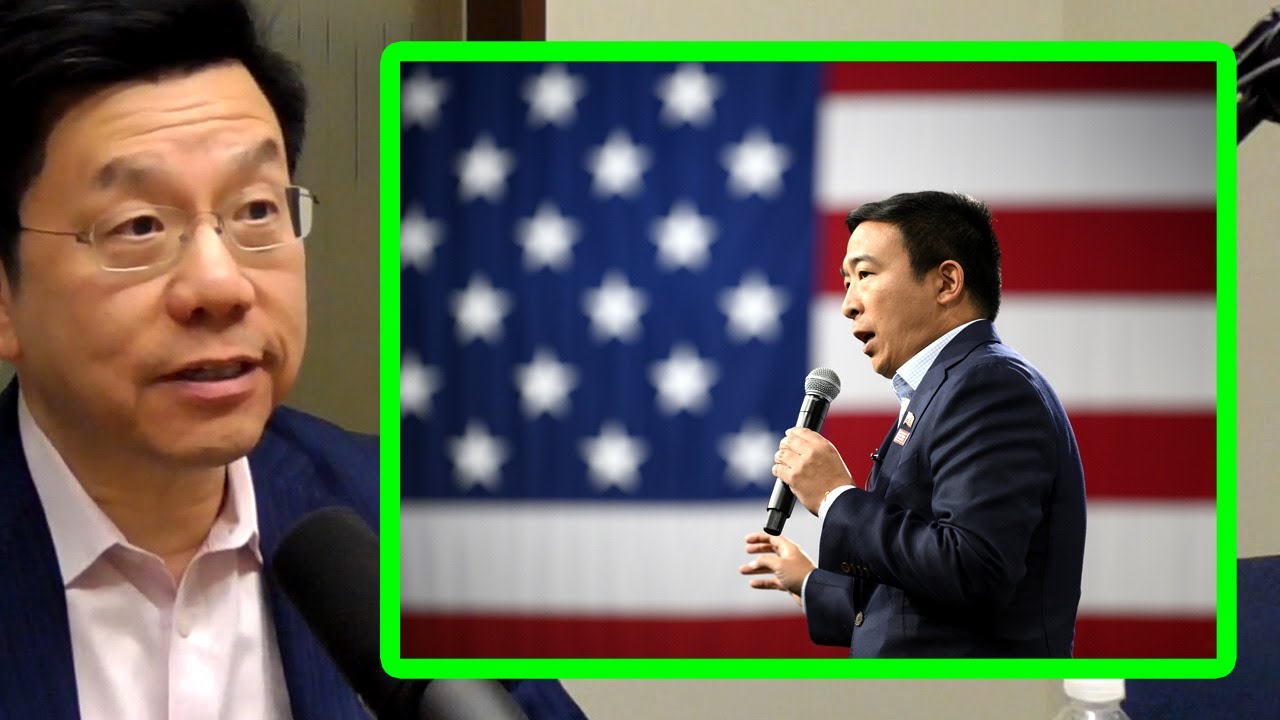
Video summary
In a discussion regarding Andrew Yang's presidential candidacy, Kai-Fu Lee acknowledges that while Yang's core concerns about job displacement due to automation are fundamentally correct in direction, his political approach faces significant timing challenges. The primary obstacle is that current unemployment numbers remain relatively low, which makes it difficult for the public to perceive an immediate crisis severe enough to warrant voting for a candidate whose platform focuses heavily on Universal Basic Income (UBI). Lee notes that both he and Yang share this specific hurdle: convincing voters of the urgency of automation-related issues when traditional employment metrics do not yet reflect the looming threat. The conversation delves into why standard economic safety nets may be insufficient in an age of artificial intelligence. Historically, technological revolutions displaced routine jobs only to create new ones; however, AI represents a paradigm shift where it is expected to replace all routine tasks eventually rather than simply augmenting them. Lee argues that if AI can perform a job routinely and efficiently, there would be no economic incentive for humans to do so. Consequently, the nature of available work will change from routine labor to non-routine roles, creating a mismatch between displaced workers' skills and future market demands. Lee emphasizes that financial aid alone, such as monthly checks ranging from $1,000 to $2,000 without conditions or guidance, is not an adequate solution for this structural shift. Simply providing income allows individuals to do whatever they want but fails to address the critical need for retraining and career guidance. The proposed social stipend must be structured specifically to support routine workers who have lost their jobs in transitioning toward non-routine careers that can sustain them throughout their lifetimes. Without active intervention to facilitate this transition, a significant portion of the workforce risks becoming obsolete as automation continues its march into every sector previously dominated by human labor. Ultimately, the dialogue highlights a tension between theoretical necessity and practical political viability. While Lee agrees with Yang's identification of displacement as a major issue, he suggests that the timing is not yet ripe for such ideas to gain widespread electoral traction because society has not yet experienced mass unemployment caused by automation. The path forward requires more than just policy proposals; it demands a demonstration of how AI will reshape the job market in ways that current data does not fully capture. Success depends on proving that without proactive retraining and social support systems, workers displaced from routine jobs will struggle to find meaningful employment as non-routine roles become increasingly scarce or inaccessible due to their own technological advancements.
Read the full video transcript
[Music]
I'm not sure if you're familiar with
Andrew yang yes I am so there's a
candidate for president of the United
States whose platform Andrew yang is
based in part around job loss due to
automation and also in addition the need
perhaps of universal basic income to
support jobs that are folks who lose
their job due to automation so what are
your thoughts about his concerns him as
a candidate his ideas in general I think
his thinking is generally in the right
direction but his approach as a
presidential candidate
may be a little bit had at the time I
think the displacements will happen but
will they happen soon enough for people
to agree to vote for him the
unemployment numbers are not very high
yet and I think you know he and I have
the same challenge if I want to
theoretically convince people this is an
issue and he wants to become the
president people have to see how can
this be the case one and employment
numbers are low so that is the challenge
I do agree with him on the displacement
issue I think the main issue is
retraining so people need to be incented
not by just giving a monthly $2,000
check or $1,000 check and do whatever
they want because they don't have to
know how to know what to retrain to go
into what type of a job and guidance is
needed and Retraining is needed because
historically with technology revolutions
when routine jobs were displaced new
routine jobs came up but with a eye on
automation
the whole point is replacing all routine
jobs eventually and AI will create jobs
but it won't create routine jobs because
if it creates routine jobs why wouldn't
a I just do it so therefore the people
who are losing the jobs are losing
routine jobs the jobs that are becoming
available
non-routine jobs so the social stipend
needs to be put in place is for the
routine workers who lost their jobs to
be retrained and then take out a job
that will last for that person's
lifetime
you