Video summary
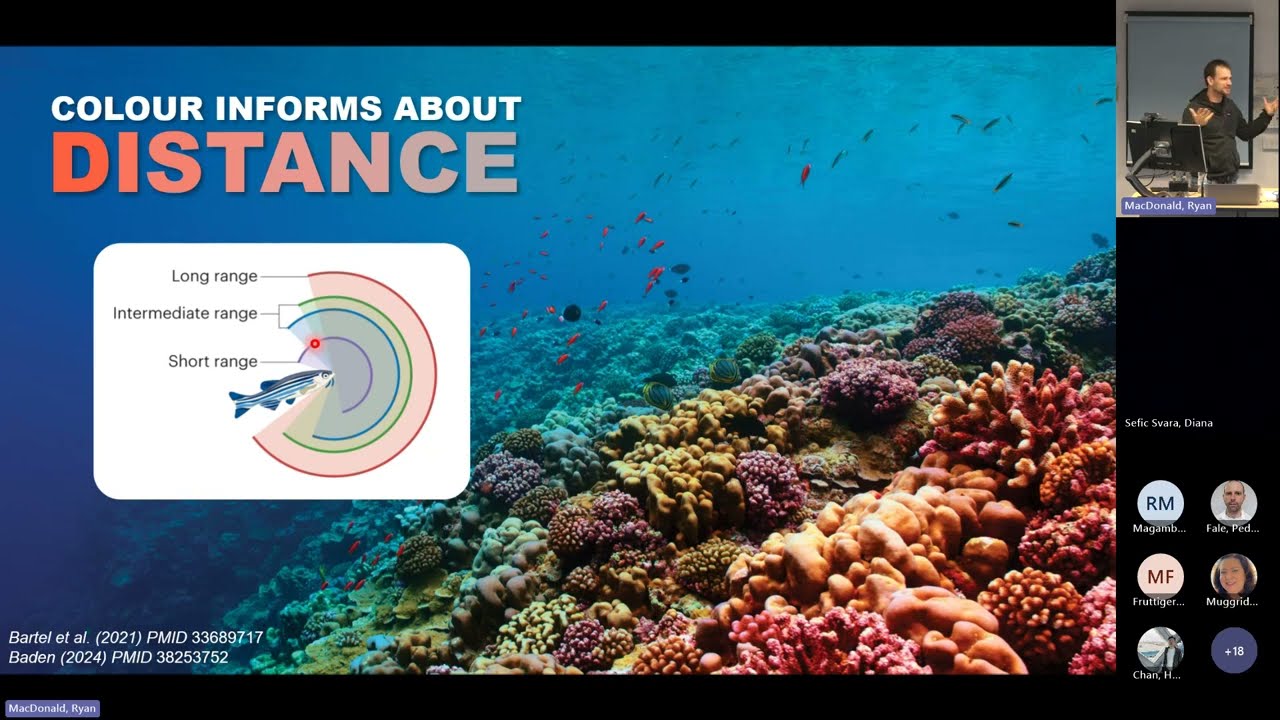
Tom P proposes that ancestral photoreceptor diversity serves as the foundation for fundamental visual behaviors rather than color perception, a theory illustrated through studies on zebrafish and comparative vertebrate evolution. He argues that multiple cone types evolved to address distinct physical constraints in underwater environments: the red (ancestral) cone functions as a fast, high-gain detector optimized for capturing abundant long-wavelength light to enhance detail and speed, while the UV (ancestral) cone operates as a slow, low-noise photon counter sensitive to short wavelengths. Neural circuits such as horizontal cells amplify these intrinsic differences by sharpening spatial resolution in red cones but blurring them in UV cones, thereby creating distinct gray-scale channels tailored for specific tasks instead of enabling color vision alone.
The green and blue cones found in many vertebrates are evolutionary derivatives where the green cone represents a shifted red ancestor and the blue cone a shifted UV ancestor; P suggests these middle-wavelength systems function primarily as regulatory mechanisms rather than primary drivers. In zebrafish, the presence of green or blue cones suppresses visual responses to stimuli like moving dots under white light—a phenomenon termed "white bias"—whereas genetic removal of red or UV cones severely impairs core functions such as motion detection and prey capture, while removing derived green or blue cones often potentiates remaining signals. This indicates that the ancestral red/UV system is essential for basic visual behaviors, with the derived systems acting competitively to regulate output based on spectral distance cues rather than facilitating color perception per se.
Experimental ablation studies further demonstrate how this regulatory architecture dictates behavior and phenotype under varying light conditions; removing red cones mimics a "dark" state regardless of ambient lighting, while UV cone removal creates a "light" phenotype that drives indiscriminate attraction to any source. Although green cone loss severely impairs optomotor responses like tracking moving stripes, blue cone ablation has minimal impact, yet double ablation restores function better than single losses alone, highlighting a critical regulatory interaction where the green system requires modulation by the blue system. Phototaxis experiments confirm that UV cones drive attraction to light, whereas removing them causes erratic movement toward any illumination source, supporting an ancestral model of a core drive regulated competitively by red and blue systems.
This evolutionary framework suggests that mammals likely lost this complex regulatory circuit early during rapid terrestrial adaptation because it was inefficient in low-light or noisy conditions, while birds and reptiles retained the full complement of photoreceptors to maintain diverse visual capabilities. In specific cases like mice, true UV cones are concentrated at the top retina facing upward to detect aerial predators against a sharp background, distinct from red/green systems viewing the ground, indicating specialized spatial segregation of function. Furthermore, rod development may involve co-opting precursors originally destined for cone types during evolutionary history, suggesting that the transition between photoreceptor classes involves repurposing ancestral genetic pathways rather than entirely new inventions, ultimately shaping how different species perceive their environment through a balance of speed, sensitivity, and regulatory control.
Read the full video transcript
uh in the space of visual system
development and function um he started
as a as an undergrad all the way through
to a PhD student at at Cambridge uh
telling me earlier it was in Zoology so
that's sort of fit uh he then did his
first postdoc with Le Lano before going
onto the lab of Thomas uler in Germany
um before moving to Sussex in uh
2016 uh so p has again made a lot of
seminal discoveries in the field of
visual system development it's probably
easier for me to list the things he
doesn't work on when it comes to color
vision than it does uh to to name them
all but essentially he's he's been one
of the Pioneers in using zebra fish to
study high high Acuity vision for
example uh cone adaptability prey
capture so on and so forth and he's
going to tell us a little bit about his
his recent work on color vision uh today
uh Tom has won a number of
awards uh the idorf prize the lisst
prize uh amongst a number of others um
so he's very well decorated in that
space but also I think what should be
mentioned is p is a big proponent of
open science um and he was a very early
adapter of bioarchive for example
everything goes on there You' started
open software uh
platforms um and you you basically share
everything you do including probably
this seminar uh soon online right so I
think that that's a really commendable
thing for science nowadays is really
sharing everything and and Tom's at the
Forefront of that uh the other thing
that Tom does which I think is
particularly impressive is he started
Trend uh for Africa or Trend in
Africa um which is a nonprofit uh
organization where he basically uh
science training and communication in
Africa I think there's over 40 academics
who contribute to this it involves uh
training in the field but also acquiring
equipment that will allow them to you
know start to work towards Cutting Edge
uh Science Education in Africa and
that's something that Tom started uh
several years ago so that's also a very
impressive uh feat I think um and
something that Tom should be certainly
recognized for so um with no further Ado
um I will turn the the seminar over to
Tom and we'll we'll hear all about his
uh really amazing
work so I
will start
this and I will give you a pointer it's
all yours all right
well thank you very much for the uh
invitation and the introduction um I
won't be talking about Africa or open
signs and I will barely talk about
cision because having worked on cision
for so many years kind of gone off it
because I
think television is an ny phenomenon let
me let me explain what I mean by that
um hey clicking doesn't work this does
so
so this might as well be on the cover of
a textbook on color vision right so
that's that's kind of how we think of it
so we've got our rods there one type um
doesn't really matter what spectral
wavelengths they're sensitive to because
there's only one which means you can't
do spectral
comparisons um you can't tell intensity
independent from wavelength that's the
definition of color vision in most
people's books um and therefore
everything that we see at night is gray
and you can test that go to the forest
at night it's gray it's just correct um
however when you switch on the light or
you wait to the daytime then we get to
use our cones which are less sensitive
than the rods the cones as it so happens
in the human ey come in three spectral
flavors um that means that if we were to
take the signals from these cones and
compare them rather than add them
together uh we can make a spectral uh
comparison that is different from just
an intensity measurement um and based on
that um we can see color or we can tell
we can tell wavelengths that depend from
from from intensity and our brains
interpret that as color um so that's
great um So based on this what you might
conclude then is therefore the presence
of multiple cone types enables color
vision and I think that's true if you
have multiple cones you can do this
that's fine but I think what we've been
doing and I think it puzzles me how how
this this hasn't been challenged before
it kind of what we always say that
therefore the purpose of having more
than one cone type is to have color
vision but that makes no sense um
because they could have evolved for
something else and then we just use them
for color vision right so we've kind of
flipped our causalities and it doesn't
get challenged um and what I'm hopefully
trying to convince you of today is that
at least the original purpose of having
multiple cont types is to enable
something as fundamental as Vision so
aspects of vision that are not about
color um and they are specifically
important in the water where Vision
First evolved right so All Eyes almost
all eyes across animals have evolved in
the water first and one day they came
out of the water in a species such as
ourselves and then you just work with
what you inherit from your Aquatic
ancestors and I think that's also the
case for our vision so um if we take our
little diagram here of our rods and Cone
rod and cones and we take our
combination contrast we feed them
everything into the vision box and we
say this is vision and then once on
multiple times probably in the history
of evolution of vision this system has
then become co-opted to also allow color
vision but this is like an optional
Branch you don't need it you humans use
it but some species might not but quite
fundamentally this just happens because
the spectral information that comes in
through these different channels is not
identical it's actually quite
overlapping but it's not identical
therefore if for any reason other than
color vision you take two of these cones
and you contrast the signals you're
going to end up in aely with a
spectrally complicated signal some sort
of opponency will happen and if it's
here used for something useful you could
also use it then to in addition get the
sense of color vision out of it so I
think this is sort of the a more
plausible history of color vision um and
now I need to convince you of that so
here's
water uh and the rainbow and hopefully
what you can see is that this rainbow is
very rainbowy in the top and not very
rainbowy in the
right there's nothing magic about this
this is just physics this is the
interaction of light with water
depending on the wavelengths I.E energy
of the photon that you have you interact
with water stronger or weaker there are
some wavelengths that penetrate water
better than others that means that well
color or the wavelength composition is
informative about all kinds of stuff in
the water and this would have been the
evolutionary pressures driving
everything to do with how how we set up
our detectors and
um now what we've done here um is a very
simple thought experiment so here paint
in the background what you see is the
average spectral
content um of light and shallow fresh
water so this it's not muddy it's just
like basically res fish it's like half a
meter deep it's clear water it's lovely
stick spectrometer in there and just see
what's the wav length composition and
hopefully it's and not is that flipped
here so normally what we plot is we plot
red over here and UV over here but here
this time I red here and U be over here
because this is an energy axis which is
invert length just to make my argument
here and what I ploted on top of it is
the invo spectral sensitivity functions
of two of the photo receptors of the Ze
fish The ancestral red cone and the
ancestral cone and hopefully and we've
measured these using to phon with all
kinds of tricks in that paper so um
hopefully what you can appreciate is the
red cone is basically a copy of all the
light right the red cone is a light
detector it just sees the light that's
there the UV cone is doing something
completely different the UV con is very
specifically trying to get the base that
is actually UV okay so you don't really
have a red and a UV system you have a
gray and a UV system if anything um now
starting on that
premise we might be able to then just
plot these two counts in in this
arbitary space of how many photons you
have the red gets a lot more Photon than
UV just because there's a lot more light
when you measure all the light um but
the UV uh cone gets the good photons the
high energy photons um UV is the highest
energy light we can see if you go higher
energy that didn't when it doesn't get
through skin doesn't get through
anything right so this is this sort of
biological limit of how far you can push
this this is the best of the light but
this is the most of the light um and you
can use those for different purposes so
for example you could say if I can count
a lot of photons that means that I can
shorten my integration time therefore my
photo receptor becomes fast therefore if
I want to do fast Vision You Really Want
A system that catches all the light like
the red cone the UV cone is terrible at
speed but with the UV cone is really
good at its game the reason it's good at
game is because the energy is so high
that you don't run into thermal noise
right so this is one of the key things
there's a reason that we don't see
infrared infrared is really low energy
light and it's so low that the energy
coming in to trying to photocon convert
your your opsin well your your rmal is
so low that it gets matched or and and
swamped by the thermal energy of the
system right so if we operate something
like 38 degrees in your eye or whatever
um you just can't push the Ops further
into an infrared region you will just
start seeing nothing you run into theral
noise um that problem exists on this end
it doesn't exist on this end on this end
the problem is cancer right so as long
as you can keep your DNA Dage at Bay um
you want to go that way and that means
that a UV cone really hasn't got much
thermal noise at all right you could use
it as a photon counter it would be
fairly clean and that means though that
even though there's not a lot of phons
in the UV you can take your gain and you
crank it up all the way as much as you
want you're not going to run into Noise
Okay so you've got a completely
different detector system you've got a
fast low gain system and you've got a
slow High Gain system and this is
not the properties of the photo setor
yet this is the property
of this is just what inevitably happens
if you build a detector that works in a
certain wavelength
range um and it's not just invertebrates
it's true pretty much ACR any species
you look that has multiple Spectrum
receptors they always like that now um
what then becomes quite interesting I
think in verteb at least is that the
vertebrate eye of course doesn't have
the photo receptors in isolation has
them in the circuit and the circuit does
things and the first thing that the
circuit does is it takes these photo
receptor signals which are already
different and it put them apart and
makes them more different so for example
here the photo receptors in ey as most
ver eyes are contacted by horizontal
cells horizontal cells do interesting
things if you take your horizontal cell
uh well if you if you record a red cone
this is a red cone glutamate response to
the stimulus you can see it follows the
low frequencies and eventually gives up
and then you block the horizontal cells
nothing else then you clip The High
Frequency response right so what that
means is that the the presence of the
horizontal cell through whatever
mechanis I don't want to get into that
makes the cone faster right that's the
purpose of this system um if you do the
similar experiment for the UV cone we
didn't use a CH here we just used the
flash of light it goes the other way
around the cone is normally quite slow
um is is slow in the presence of
horizontal cells and when you block them
it gets quicker okay so the horizontal
cells make the red cones faster and the
UV cones slower right that take the
intrinsic differences and make them
bigger suggesting that this is a
difference that you want to work with
Okay so we've moved the dots a bit then
let's talk about space so um if you open
my textbook and you look at how a cone
is supposed to respond to light in space
it's supposed to have centers suround
organization you hit the exact the outer
segment of the cone it responds
negatively because these are off cells
so the decrease activity but if you hit
it near the center but not on the center
it should go actually the other way
around because there's an opponent
circuit an inhibitory circuit that goes
the other way around um so and in redes
we can repr produ this right so here's a
very simple experiment you've got little
red bars we recording red cones and it
keeps missing and here hits it and then
misses again right so this is just a
central receptive field it's quite small
it's couple of degrees makes sense in
the baby have a fish because the ey is
small um but then what you can do is you
can contrast invert that stimulus and
play the same game and you will find a
place where the black bar sits exactly
on the cone and the Red Bar sit exactly
not on the cone that causes the like
that hits the opponency and then get you
flip the signal you turn it into an
onell you know so this this this is
textbook stuff this is what should
happen with the con it's a center
surround unit what Center surround does
is it makes when it decorrelates in
space it basically it makes it makes
your ability to encode edges and space
better yeah and the entire visual system
is kind of based on that principle it's
just it starts in the cones you try that
in in a in a UV code it just doesn't
work right so here this and this is
equivalent except that we're recording
from a different photo receptor and
hopefully you can appreciate that the
receptor feels huge or something like
10° this is crazy big for a photo
receptor bear in mind that the outer
segment of the photo receptor is not 10
degrees it's maybe one degree okay so
something's going on there I think it's
chromatic aberation so basically you
can't focus all W flinks the same and
the eye just lives with that and then
that becomes basically a massive
detector um but also we we just can't
oops I haven't got this here we can't
get a surr out of this so we've tried
this experiment doesn't work at all
we've tried all kinds of clever other
experiments doesn't work we've never
managed to invert the polarity of a UV
con based on a cleverly designed spatial
stimulus implying that either there is
no surround or it's so weak that we
can't detect it okay so what that really
implies then is that that the way
there's a tiny little thing the center
and the surround of the uh of the red
one yeah they don't seem to be in the
same place or near it's a different cone
sorry oh it's a different one okay go no
yeah good point though um yeah so they
just do completely different things then
a different position speed in a
different position game and they're in a
different position space they're
basically two completely different ways
of sampling the world yeah and if you
sort of mentally translate into what
that would
do red is basically your detail channel
right it sees everything as well as it
possibly can be seen pretty much like if
you take a a grayscale camera and you
just point it on under the water and you
have enough pixels that's roughly what
it'll tell you plus some processing you
get a nice black and white image U image
by itself will also give you black and
white image right it's no color
computation it's just it looks at the UV
bit but it'll it'll it'll have a really
high gain it'll be quite slow um which
also drives the gain up again um uh and
it'll have terrible spal solution right
it's just it's trying to look at a
completely different thing it's a very
sensitive Channel but it's not not a
detail Channel okay so um it seems then
that this this is sort of the principle
of feature selectivity in the visual
system right like the idea usually is
that you have a where the photo
receptors detect the light and then it
goes to the bipolar the gang cells goes
into the brain does kind of things and
then you get these features and these
features might be you've got a big
receptive field you got a small
receptive field you've got one that is
very sensitive one that's not very
sensitive well it looks like the cones
are kind of doing that for free right
like the visual system starts with these
features but this is just two of them
okay so you might call both of them by
itself they brightness channels are
black and white Channels with different
properties now what about the other two
channels that fish like many surface
dwelling tell or basically anything that
swims in the water that evolutionarily
never left the water has four cones
that's State there the green and the
blue and a while ago we did similar
experiments for the spectral sensitivity
function that show you in the beginning
um for these and turns out that these
are color opponent at the firsts of
vision right so basically these guys
through the horizontal c network um they
don't tell you greenness or blueless
they're just a color opponent signal
they respond positively one W lengths
and negative Le other wavelengths now if
you've got a color opponent system um
the mind immediately goes to color
vision right we know that the currency
of color vision is color opponency and
that's true in the humans as well um so
that's how wrote up the paper and
published it and thought that was great
but actually coming to think of it I
think that was shortsighted I mean yes
it will give you color vision if you if
you choose to use it that way but it's
so much more useful for much more basic
things so if you think about about this
this gradient again the gradient doesn't
just work down it also works along the
water column right if you stick your
head in the water look along the cor
Reef you're going to see this you see
color where you are and you see bless
where you're not right and it works for
the fishes well that fish is near that
fish is far okay so the spectral
composition of an underwater image tells
you about distance now I would POS it to
a animal that swims around the water
unless it's a very specific purpose
distance is more important than color
right because distance allows you to
interact with the world long before you
understood what you're interacting with
stops you from running into things it
stops pred getting you stuff like that
so working on that assumption let's
think about what these wavelength
channels would do with color well first
of all
red sees all the light therefore it sees
the Fest right there's just no way
around that UV actually doesn't travel
very well in water at all therefore if
you only have a UV Channel you don't see
very far so if you only have a red in UV
Channel you will get two distance
shelves um just for free but then these
color opponent signals they will
actually Travel Intermediate es and
because the color opponent system don't
have an identical zeroc Crossing fish
two different zero Crossings it will
give you two different distance shells
so kind of just for free by The Way That
these channels are set up you will get
four distance shells if they're space
like this I don't know but something
like this and it would be crazy for fish
to not have evolve to use this it seems
like the cheapest way of doing
distance um which incidentally should
work without even having any decent spal
resolution like this
you could do with the single Pixel
detector that just measures different
wavelengths you could do this in syation
like that so if we then think
conceptually as the input Channel and Z
fish not just as four color channels but
basically as two completely different
detail uh two different gray scale
channels on the extremes plus a couple
of different distance channels here um I
think it makes more sense and I just
want to point out so what I've done here
this is a GoPro image so red green blue
human optimized right you stick it in
the z natural habitat this is actually
taken in India um and this is what it
looks like when you look at the when you
just pull the channels this is what what
it looks like when you take a red
Channel and your green Channel and you
flip the green Channel and put them
together right I didn't do any magic
here I just made a color opponent a fake
human Centric color opponent signal and
already you can see the foreground and
the the background just disappears right
so these color opponent computations
they're really powerful tools to get
distance
information um they're basically for
ground
enhancers now working on that so if this
is our basic model it's not very
satisfying though is it it's just a
bunch of boxes so how can we unpack this
and really understand what's under the
hood so
um my proposal is
this we have in the
Rea of fish but also in human still two
main systems we've got the ancest red
system which goes together with rods you
can ask me about why I think it goes to
R later just take my word for it for now
and on the other hand you've got the U
system which goes by itself and they
give you the high resolution versus high
sensitivity
systems and they can individually Drive
certain behaviors so for example opot
the kinetic response type things are
generally associated with long W link
vision and I think it's actually just
the red cone circuit um pre capture in
zra fish for example is a UV circuit
right so there are examples where really
the cone seems to be the key thing um
and I would argue that this is all of
vision um why would I say
that um I just a detour just to make the
point that ancal red cones in Z fish are
both red and green cones in humans and
the blue cones in humans is the
ancestral system right so humans don't
have the green and the blue The
ancestral ones they've got the ancest
red UV
ones um and this is important because
it's true for pretty much all
vertebrates here's a little F tree of
most major branches of the vertebrates
up here you've got squidy little fish
more interesting looking fish then we
started to get into lizards amphibians
and whatnot we put the MS down here and
hopefully what you can appreciate is
that if you look at the rod always there
right there are reports of rodless
species like a chameleon was T to be
rodless turns out it's wrong they just
don't have very many so they haven't
they been miss so I'm not aware of any
vertebrate that doesn't have rods not
even hafish which barely have an eye
they still have rods um then red cones
is the next best one almost all
vertebras have red cones the only ones
where it's unclear is lon fish live very
very very deep silicons very very weird
and very distantly related to anything
that's life today and hack fish barely
ey okay so basically red cones are
always there and red cones will forever
shift the spectral sensitivity to match
whatever makes sense so for example in
the human case there's the red and the
Green version but it doesn't stop them
from being ancestor red con they're just
different versions of it and that happen
actually a bunch of times in
evolutionary story of animal okay so the
red cone is almost always there next
best one is the one it's like the red
cone except you've got some special
cases like seals whales basically large
aquatic secondarily aquatic species um
that have losted and again these these
wees and the Sharks and race which are a
little bit well they're basically the
size of a dolphin similar problem um
so almost all vertebras have this
system and that is entirely untrue for
this system the blue and green cones are
missing and pretty much half of the
lineages none of the mammals have them
there's a report of platypus I think
this is probably wrong um and you can
ask me in a year or two after we've
checked it um if the Platypus is wrong
all of the mammals are done there's no
survival of this system and there might
be a new occurrence in the in the
stunard which is
very unclear basically mammals don't
have this system can you clarify which
system we don't have with mammals
because I mean we do have green and blue
c and justari so that that's um that's
what I meant here that our green and
blue what we call to be the green and uh
what we call the green cone is an
ancestral red cone with a green shifted
dos and what we call the blue cone is an
ancestral UV cone with a blue shift like
for example L they all have this but
also you know cats dos horses basically
frogs crocodiles it's uh it happens
quite often that this UV Ops Shift Into
the Blue range but the photo receptor
itself is the ancestral U V1
yeah so um and hopefully organize them a
little bit from live in the water live
sometimes in the water don't live so
much in the water and hopefully you see
there's a bit of a pattern there it's
like it's a water system it survives in
some animal that don't live in the water
like some birds some lizards I'll get to
that if I have time um but basically
it's an ancestral water
system and what I would posit is that
this is not used in how we think cones
are used I'm saying that this is used as
a regulatory system we know in the Rea
we've got horizontal cells as lateral
connections we've got Ames as lateral
connection I posit that these middle
cones are part of that system they're
the regulatory system they're not the
drive system and I know this is
heretical so I will justify it
so how do you test
this let's go back to the distance so
there's a lot of aspects that you could
test but we thought the distance ones
maybe the sexest to look at so um how do
we think about distance well actually a
color disappears with distance that's
quite clear but color is the EP
phenomenon of a much more simple
phenomenon in physics and that is the
the narrowing of the wavelength with
this right stuff that's near you have a
lot of wavelength available to make
spectral judgments that's I think do
look colorful but really it's the
whiteness that disappears in the front
stuff can be white but if you take a
white T-shirt and you start swimming and
the distance it would be a blue t-shirt
right so the spectral width is the is
the easiest to measure factor that
changes um so just to illustrate how
that it's really powerful right so
here's an RGB movie these are artifacts
these are not real right so you know
that so basically you've got a little um
uh underwater movie again where LIF what
we can do is we can just extract the
brightness component by just adding all
the channels and yeah us being clever
humans we can tell where's the
foreground and where's the background
right but it's it's it's cognitive you
need to think this through right if you
just look at the whiteness so if you
just look at how road is the Spectrum
based on these three pixel like the RGB
values that are available in the video I
think it's really obvious that the
forground here is super high weightless
and it just very obviously decreases and
um I like to point at this particular
home of grass or sewe or whatever it is
right it sort of comes out of the
nothing so the whiteness really is a
very powerful and easy way to signify
distance or lack of distance so how
would you measure this so if you are a
fish
um you could use different photo
receptors to to pick it up so let's
let's start with the ex Spectrum so
here's the hypothetical Spectrum it's
not what actually looks like this the um
so if if this is super near you as you
as you go further away there the sh the
Spectrum will shake towards a much more
narrow one typically bias towards the
long wave length right so this is near
this is far this is roughly what would
happen um if you have a spectrally broad
non opponent system like one down here
it'll just copy the Spectrum more or
less right so you lose exitation there's
less light to integrate Therefore your
signal goes down but it goes down a bit
right as you make this narrower you just
lose a little bit of signal but the
opponent systems they're more
interesting because in the beginning
when you've got a broad spectral input
the negative and the positive will
cancel and you get nothing right so
opponent systems are silent under white
light but as you get rid of some of the
wavelengths but not others that's when
the opponent systems kick in right so
the opponent system actually start to um
be more and more active up to a point
then they go down again right so if you
have an opponent system in your eye and
a non opponent system in your eye and
you just contrast them right you
basically
say I'm going to take my non opponent
system to drive everything and I'm going
to use my opponent system to regulate
the system then all of the entire output
of the visual system will become white
Biers like stuff that you do will work
really well if it's white and stuff that
you do uh if it's not white your
responses are going to go down your
retinal output is going to go down right
so you don't need to do clever nitive
computations or anything you just need
to take an oppon a non opponent system
contrast them and make that the output
of the eye yes is there an assumption
here that the reflectance of the objects
that you see uh is going to be very
broad for example if all objects were
blue this will not work you're
completely right yes okay so what is
your assumption there because I wonder
whether actually you're assuming that
it's flat that there are objects of all
colors using the words that we would use
for color in the in in the sea in the
ocean in I don't know this is fresh
water this is fresh
water um so you assuming that yes but
actually if you so um if you walk around
nature with spectrometer and you pointed
at things almost everything gives you
some sort of broad spectrum with a
little bit of a kink this way or this
way right so if you point it at a leaf
it goes this way if you point it at the
sky it goes this way but it never goes
like this right whereas if you pointed
at a children's toy or something perfect
red then it goes like this okay right so
it's it's it's man-made objects that are
like this and the occasional occurrence
where animals or plants have evolved to
try to be narrow like some plants for
example some feathers of birds they are
narrow but they come much later in
evolution than any of this would have
been important and actually there's very
little evidence for the existence of
structural color on pigmentation of skin
or anything in in in old things right so
the the first clear evidence for the
existence of
should we call a purposeful color um is
um something like 300 million years old
uh but the I would have evolved 550
right so this it's uh it's quite a
difference but you're completely right
yes it doesn't work if everything is
monochromatic then this
fails
um okay so how do you test this
um but we have tested this and I'm going
to give you the punch line before I show
you
um first of all using Ze fish we see
that fish Vision Ze fish vision is white
biased and it's not a little bit white
biased it's crazy white bias if you give
a zeber fish white light everything
works
better two I'm going to show you that
the red and the UV system is necessary
and sufficient to drive all of vision so
when you take it out vision goes away as
long as it's there vision's
fine the green and blue system
completely different you can Che out the
green and blue system vision is fine and
actually some aspects of vision
improve um or the gain goes up improves
maybe the wrong word so the green blue
system is not necessary nor sufficient
for vision it um and it's actually
packed a mutually competitive way to
inhibit Vision um four I'm going to show
you what that means in behavior and five
if you've got time I'm going to talk a
little bit about Evolution so here is
finally your standard Ze fish experiment
here Ze fish that's the brain lots of
neurons they're all expressing gamp and
we have a two photo microscope to record
the activity uh we scan this bit of the
brain this is the tectum this is the
other tectum and fish all the
information goes across right so if you
stimulate from here all the activity
will be here specifically in this Red
Zone which would be the retinotopically
aligned bit of the brain from where our
stimulus is then we've got a custom
stimulator that can do it can give it
fish white so real white or all kinds of
combinations thereof
um here's the actual stimulus that we
use so here is the spectrum of light in
nature that's the average one and here's
how we've placed our spectral channels
um um in power and wavelength hopefully
you can see we're trying to approximate
this white light right so the idea is
that if we pop on all four spectral TRS
at the same time we're approximating the
natural Spectrum I'm going to cool this
white um if you take if if you do the
exact same thing but you take out the UV
I'm going to call it visible this what
we would use maybe and but this for
example would be you be only stimulus
and the experiment now is very simple
having set this up we're just playing a
stimulus like this right we're showing
some great things that start to move
then we're switching off the light we're
showing some dots this would be like a
pre capture type stimulus and then we're
doing a contrast inverted thing of the
same thing on with the dark dots and
we're just seeing what can we
get okay so this is now in white and
here just a bunch of example cells so
for example this is a cell that responds
to grings every time you show GR thingss
it responds it doesn't respond to
anything else it's a gr cell simple this
is a DOT cell responds to light dots
this non cell if not cell you find what
kinds of things most cells are quite
selective for one of them sometimes they
get two but that's actually an edge Edge
case most are pretty selective now where
in the brain are they okay the grating
cells are in the retinotopically aligned
area of the brain where they're supposed
to be the dott cells are also in that
part of the brain the on and off cells
are all over the place it looks like
they
um either they don't come from the eye
all of them because the fish has other
photosensitive bits or if they come from
the eye they get distributed in such a
way they reach the whole brain which
what the two it is I don't know but
hopefully just the location of the cells
shows you very clearly that this is not
the same system it's something else is
is the full retinotopic within the area
yeah so the screen is roughly where the
yeah
okay but I took away my punch line but
here's my punch line we take the white
we delete the U and leave everything
else intact so we just taking away this
tiny little bit of light here and you
see how this breaks right the great
thing in your dot response yes there are
still
cells but the proportion of cells
compared to what you get with white is
pitiful yeah whereas this on and off
system isn't I mean it's affected a bit
but not so much much okay so when people
study zbra Vision do they usually use a
UV monitor uh some do it's rare okay but
if they don't they're missing a lot it
there's a criticism that would be valid
yeah you said it not
me okay so but then you might say well
maybe you Fe amazing maybe you Fe the
remaining 85% here and then we solve the
problem um but that's not true because
if you only show you we you also get P
for resp it light dots go up a little
bit and I think that's because PR
capture and Z fish is a very UV heavy
Behavior but even that is less than half
compared to White right so even bra
capture isn't UV only it's just UV helps
kind of system so what's going
on obviously we tried more colors more
color combinations and I just want to
make the point just how strong is this
for grating is extremely strong for for
for Dots Whenever there UV you get some
activation but basically you get this is
white works really well anything else
works very badly the best thing after
white you can lose this which is white
minus the blue they not the blue doesn't
seem to hurt as much but even that hurts
right and it's not a lot of light so
clearly this is a white biased output to
the brain at least the brain
representation of the stimulus is white
biased um dots is completely lost I mean
this this is a few percent and you can
work with this right but this is not the
native response this is the
resp um so what's going
on um well this being fish can do things
that you can't do in other animals and
that is you can break things without
getting into trouble so here is a wild
Ty fish what do you think would happen
if you were to genetically upate the red
cones acutely so there's no
developmental anything you just take a
fish take out the red cones what should
happen this okay almost complet lose the
grating
response um and actually this is so the
significance is always versus zero not
against here right so this is
significantly more than zero this is not
sign significantly more than zero um the
dots is still significant and there are
still a few dot responses but hopefully
you can see that this is much worse than
this okay so the red cone is basically
most of
it the green cone is not most of it you
take out the green cone
not only are responses still there
whether they go up or down you can
debate but actually if you just these
maps are not just the number but the
number multiplied by the amplitude of
responses and if you take that as a
factor then actually at least the light
dot responses go up when you kill the
green cone right so the green count
isn't there to drive these responses if
anything it's there to stop them a
bit can you remind me the ratio FR plus
um in the baby ze fish they're almost
one to one to one to one not quite but
roughly there right so the number of
cones are not crazily
different um here's what happens when
you take out the blue cone it's a bit
like the green except that now the
gratings are a little bit more
potentiated than the dots but again it's
still there this fish can still see they
got the UV cone it's almost like the red
cone it's just the other way around a
bit now the great things are a little
bit alive and the dots are less alive
even though they come non significant
okay so red and UV matches green and
blue do weird stuff okay so but we do
have some sh
left both in the right and the new V so
what happens if you take a both then
it's completely toast okay so the red
and Cones are necessary for this
certainly and I'll show you later it's
it's the whole visual system um if you
take out the middle tube you clean up
the texto right get potentiation and
both and everything looks pretty much
intact
so green and blue cones not necessary
nor sufficient for vision they must be
doing something else and actually what's
kind of cool is there's there's an
additional phenotype that I didn't talk
about so when you play in a control fish
dark dots they don't love it there are
responses is not many um but on a map
like this they come out as basically
nothing if you take out this middle
system they come back right so the Ze
fish has some sort of circuitry by which
it takes its middle cones and suppresses
the dark dot response Maybe maybe
different species of fish has the light
response whatever the point is that you
take out cones and stuff comes back
stuff stuff gets more not
less okay so remember I talked about the
white effect in the beginning so let's
look at this at a bigger picture so this
is now many colors we're looking at
gring responses and we've always got the
white uh the controls and the double the
green blue double upated and hopefully
can appreciate that you starting to
potentiate especially in the long
wavelength range um
the responses to gratings so for example
if you've got a control fish and you
give it red gratings which is sort of
the standard stimulus used in the field
then you get this little hump here and
then if you take out the green blue cone
you rescue it almost to control levels
okay so the presence of this green blue
system causes the white effect yeah you
take it out the Ze fish vision is no
longer white
biased um so we wondering how can we map
this onto the different C the nice thing
is that we have special sity functions
of the cones and we can therefore take
each of these stim convol them with our
special sensitivity functions and make
predictions of how the cones would
respond to the different colors and then
once we have that we can use those cones
and fitter model and basically predict
which cones probably underly which kind
of things so here is for example a model
trying to explain in a green blue up
lated fish the grating response which is
this
line um so so the way to read this is
here would be red cone only here would
be UV cone only here would be both and
these would be opponent and these would
be both negative right and hopefully you
can see very clearly that all of the
good model fits end up on this side
which is basically red only and maybe a
little bit tilted upwards which tells us
that the system is mostly red with a
little bit of UV mixed in for fun okay
and then we can see given that we've now
looked at this we can see what's the
remainder what's the difference that
we're getting here because that must
come from these two cones if you do that
and you fit the model then it folds into
the bottom quadrant which is green minus
blue right so it's not like the green
and blue system are working together
they're working against each other to
regulate the red UV so like the
difference this slide and the one before
um in so in this slide we're fitting the
green blue upated right so basically
what's left up they take out the system
and that you can explain with a red cone
fairly
well whereas this you can't explain with
a red cone you need the green blue and
you need the green blue in this sort of
configuration green positive but blue
negative so it kind of suggests that
we've got here again this system
positive and then here a regulation and
actually these two are fighting with
each other for the right to regulate so
it's green minus Blue System okay so far
so good this is great things what about
Dots Dots is actually even clearer the
DOT tuning functions if you look at the
updated version you get a very clear R
plus UV a little bit wise towards UV but
basically both cones are important and
if you look at the remaining response in
the in the control it's very clearly
green minus blue so again same
architecture gives you a slightly
different tuning function because the
weights are different but the
architecture is the
same
now what about
Behavior so we thought well the the
easiest Behavior we can do is nothing we
just put the fish in the dish and we
watch them let's see what they do so
here's some control fish this is
probably the most boring bit they swim
around and they do this with the bouts
and then do a little turn and then they
do some bouts you can count the bouts
you can count the turns you can see how
many they do you can do this in the
light you can do it in the dark and this
is the non phenotype of it's not
phenotype this is what fish do when you
put them in the light they don't move so
much you put them in the dark they move
a bit more the
same so
now we take out the cones and what I
think is very cute is that we basically
get a light phenotype and dark phenotype
right so the red cones no matter what
you do if you show them light or if you
don't show them show them the light they
behave like a control fish that is in
the dark so it's almost like they don't
see right they always think it's that
the UV con are the other way around if
you take out the UV con they behave no
matter what you do as if they are in the
light so it almost suggests that the red
UV system has a has a push pull on on
the on the behavioral decision as do I
respond as if I'm in the light or in the
dark so maybe it tells the
fish it sort of an underlying behavioral
stage type thing something we're looking
into um if you're killing the Blue by
itself it's a little bit like the
controls they're all right in the light
and then they s of almost reach the dark
state but not quite the grain are
completely broken they go the wrong way
around it's not significant but it's
certainly not doing the right thing but
what I think is my favorite is that if
you UPL both you kind of rescue them
right so the control to remember goes
from here to here and the green blue
from here to here so they're almost like
the controls and I think what the key
thing to notice here is that the double
upated fish are
better than the individual upated fish
you take out only the green system they
B you take out only the blue system
they B you take up both they're
kind of okay yeah so it's like a
misregulation when you have only one out
but when you take out those right again
there is a very clear phenotype of the
double lated ones though and that's this
one so instead of counting the number of
turns you can just see how much they
turn like do that turn like this or do
that turn like this like a good control
fish and the double up later ones the
terrible they do
this yeah it's a very striking phenotype
it's a lot of fun to watch so that can
do fishy things but they're sort of a
bit overe excitable right they it's it's
almost as if they're lacking the
regulation to to do the right thing or
to to do a modest
thing
um so what happens you start stimulating
them optim motor is fairly easy Behavior
test so we just adopted this setup
published from Flor lab um and basically
you don't opot response you watch the
fish you give it some Stripes turny
quantify controls are very good at it
red up L fish are very bad at it so far
so good
you V blad the fish are very bad at it
makes sense the green blue
um they also kind of bad but notice that
they're better than these guys um but
where it becomes really interesting is
uh you take out the green by
itself absolutely terrible take out the
blue by itself not so bad and notice
that both of these are significantly
different from the double ablated
phenotype right so again it's a sort of
rescue of the green effect the blue
isn't so involved doesn't matter so much
but the green really breaks it and if
you want the Green from not breaking it
you also need to take out the blue so
it's the green blue system they're
talking to each other and if you take
out one it goes
wrong okay so this is the phenotype I
just talked about where where they turn
too much this is spontaneous well it
turns out that if you do stimulate them
it overrides it I mean some of the
mutation neotypes do do wrong things a
little bit but but the uh scale is
completely different R so so they're
like 10% turn too much it's just the
numbers are so high that it becomes out
significant right but hopefully you can
appreciate that the the basic phenotype
is essentially gone right so these green
blue uped fish in the absence of
systematic stimulus they get ere excited
then you give them something easy to do
like a phot sub Stripes they okay they
can do it
yeah okay so that's op theot respon I
just want to point out so I haven't got
the data here because it's literally
coming right now but this was done in a
setup that doesn't do UV this is a red
bean blue setup it's a standard setup
with a standard screen and everything
and we thought what's what's up with
that and we thought why are these so bad
they're meant to be better so what we
have done now is we have set up an
aquarium outside and we've put it in the
sun which sometimes comes out in this
country as you might have witness um and
we put a big conveyor Bel type thing
under the tank and a camera above the
tank and like try basically a natural
type thing and if you do that not only
are the green blue are these dou BL fish
um completely the same as These Guys
these two are still terrible but what's
actually really cool is if you then
increase the water depth the controls
stop responding and the green blue up BL
it still respond so basically this
distance idea that I was pointing out it
looks like it actually plays out even in
something as city as an opom mot
response right it's not it's not just a
break capture thing over way you might
expect that this is important like
something as fundamental op the motor it
seems to work we just need the numbers
to make a nice plot and see if it if it
comes out a significant okay so this is
optimo um but we wanted to test if it
generalizes across other behaviors so
here is perhaps even more uncensor
Behavior as photot taxis right photot
taxis is you switch on the light you
check out if the fish go to WS or away
from the light and turns out that in Ze
fish um it's a special behavior so if
you give them your V light they go
towards it if you give them blue light
they don't care green light they go
towards it again and red they love it
right so that's the spectal tuning
function of your um of your controls you
take out the red cone this time it
doesn't matter so this is one Behavior
Where The Red cone doesn't seem to be so
important but you take out the UV cone
then it breaks it seems to be a UV cone
Behavior but again where I think it
becomes really interesting oh yeah and I
should point out that photo toxis isn't
part driven by the cones but part driven
by melanopsin system so that's
intrinsically photosensitive gang
yeah um but those get input from cones
still so it's still the cones are
involved um but where become really
interesting if you take out the green
cones they they love it they love a bit
of attractive even at the wrong colors
they just go they always go for the
light you take out the blue they hate it
they want to don't want to do it at all
you take out both they're fine yeah so
again even in something as ancestral as
phot taxis which doesn't even need an
eye you don't need an eye PHX you just
need to be able to measure how much
light there is and start moving yeah
even there it still seems to be the case
um so it looks like you've got this
regulatory system in place again so what
I um would then propose is that this is
probably not right at least for fish um
and you've got some sort of core
architecture where you've got this the
core system sometimes the red is
important sometimes the UV is important
you can recruit Metals in circuits but
there's a core drive and there's a
regulatory drive and the regulation
always comes from the GRE blue system
and it seems that it's always in
competition with each other such that
when you damage it half it's bad if you
damage both it's fine again is now
um in Fairly rapid closing hopefully let
me give you some perspective on what I
think this might mean for animals that
are not zra fish so ancestral State four
cones quite clear I think they're Inc
composite so this is this is the model
if you look at basically all of the fish
they more or less old habit sharks and
rays are weird and many of them live at
depth and have they've gone through
weird bottlenecks so if we ignore the
Sharks and Rays you can probably say
that all the primitively Aquatic
lineages have the
system um then you've got this Branch
this is Branch is everybody that ever
went walked onto land that isn't a mamal
okay what happens here is they almost
all have it except for weird secondarily
aquatic species like Ro
um but what happened if you the Tetra
pods come here tet pods are things with
fors um they already have lungs they
already big eyes stuff is changing but
they still live in the water for quite a
long
time then they start becoming amphibus
one branch of that is
amphibians and the other big branch of
that is basically everything that would
become reptiles birds that sort of thing
and they also stayed aquatic for ages so
between tetrapod and this line we've got
100 million years of buffer window to
adapt to the idea of I don't live in the
water anymore let's see if I can
rearrange my visual circuits to use this
ancestral system for something new and
they seem to have all managed to keep
it and the branch that's broken off here
is the mammals and it looks like the
mammals didn't have this buffer zone the
mammals very quickly went from
completely aquatic rot here to
completely
terrestrial um so I would
posit that it was probably related to
the fact that mamals went very rapidly
onto land it wasn't time to evolve new
strategies to use the system because it
is a subtractive negative inhibitory
system is probably bad for signals and
noise so if it doesn't give you benefits
you should get rid of it and I would
posit that these early synapses which
eventually would become mammals L and
just to make the point I've got this B
notal bot on in here you might have
heard of the nocturnal bottleneck the is
the idea that mammals lost their cones
those cones during the age of the
dinosaurs because they were nocturnal
because the dinosaurs were dial they
would eat the mammals that would come
out during the day so everything was
nocturnal at night you don't see color
but there's not enough light to see
color there you lose the ground that's
the ancient Theory but there's
many it's just wrong but let me just
give you two reasons for it one the
actual window for con loss where we've
got where we can got any inside
of because we know the cones are present
here because all of these branches have
it we don't know it's if the pla was
wrong thing is wrong then none of this
Branch like it's possible they got lost
here rather than here which is what's
always proposed okay so the window for
cone L is very broad um but at the very
latest even if PL was has blue the blue
cone must have been lost when PL was
split actually be here um so that means
that the nocturnal bter neck does need
align with a possible window of no loss
so it's not very plausible there and
um what was my getting confused now
um it come back to me there's more um
anyway I would posit that this was
probably a key reason so let me just
close in making this little argument
here so you've got your Ze fish and I
think Z fish is a fairly typical surface
to a Lim fish um of course it's all Al
550 million years removed from the
ancestor but at least it still has a
lifestyle that's a little bit similar to
what we think our ancestors will like um
we've got four counts and Rod and that
fans out into a massive array of first
order inter neurons you've got loads of
bipolar cells something like 23 types
you got four types of horizontal cells
so there's a lot there like a five b
Banning out home network perspective and
then you've got all of these second
order neurons and you go into your third
order neurons which is your gangling
cells in yat and that actually that
Divergence isn't all that big by the
Numbers it's about two two two and a
half okay so what then happens if you
take your fish and you try to turn it
into Mouse so you just take out the
system what happens to the top at the
top what happens is you get a
proportional
reduction yeah so we still got a time
five panning out and the way it's
achieved is by losing some horizontal
cells and some bipolar cells yeah so the
numbers the ratios are exactly the same
it's just you've lost some cones and
therefore you lost some cell some
horizontal cell but then what happens
down
here then be massively increase not only
do mice have as many G cells cells as
fish they have more that's way more
right so this Factor becomes seven
rather than two and a half so I would
posit that mammals lost this system very
early in the evolutionary history coming
out of the water not having use for it
um but they're still needed to do the
things that the system does which is
like get distance right and compute
interesting things that I haven't
thought of which I'm sure these counts
will do still so they needed to evolve
compensatory strategies and one of the
ways of doing that is to put different
circuits in and what better circuit to
use than an AM cre cell which is highly
diverse it contacts all the right bits
in the Resa to do similar kinds of
computations um and it seems a very I
mean I've used the fish versus mouse
example here but it's it's it's a mammal
example mammals have crazy numbers down
here and if you look at something like a
bird or reptile they still have the
entire complement they actually have
grown the complement there's new count
types this is still sort of factor five
sometimes factor four up here um and
then they s intermediate down here so
the birds and the reptiles they seem to
sort of stad Two Worlds of the of of of
the sort of early Divergence in a fish
and the late Divergence in a mamal so
there's something to be thought about
from a network P Evolution perspective
here so um this is actually my in case
there's time which there isn't so I will
skip it and I will thank everybody
apologize we're going slightly over and
yeah
thanks thanks Tom for a great talk there
any
questions yeah Mato I have two questions
one is uh when you were doing the
calcium Imaging the gratings and the
dots were moving stimul right yeah the
drifting gratings as well so could you
be that this applies to rting images but
not still images that the fish
sees
um
so there are very few so what you might
what you might have noticed in the
stimulus is that there's a static rating
and a moving rating back to static the
responses are almost all to the moving
so I think the transition from like a
black screen to a stripy screen that
doesn't move is I mean yes the fish sees
it but it was represents it with a
handful of neurons whereas if you start
moving it then it
goes so
um yes what I've said applies to moving
stimul but I think and part of that is
because non-moving stimul are well a
rare um and maybe less is less difficult
to represent them so you don't need many
neurons and the other thing I was
wondering so I always thought on you
talk I
the way I estimate distance mainly is
because things got more
blurry and uh I mean it's interesting to
you suggest fishal this might use
changing color as well um color
appearance do you have any way to
estimate which one the cas is faster
like to say to say that the change in
how white or how colorful something
appears changes faster than how they
blur yeah I mean I don't know if it's
efficient to jump back to that slide but
um
actually I can probably just scroll it
up I mean if you look at my silly little
movie uh where is
it no it's
not this one it playing the GI yeah
so I mean you can see the liness the
bright right but I would argue that this
effect is stronger so I think the
whiteness effect is the over shorter
distances I mean this is anecdotal I
haven't Quantified this but this is my
hunch any other
Nicole so you mentioned a couple times
that you think that the monitoring
findings they don't have U cones anymore
think sort of a weird Mion thing maybe
not being right so do you think it's
that they have the ancestral UV cone but
then turned on the sws2 Ops and lost the
sws1 yeah that's what I think yeah it's
just so evidence for the Platypus blue
cone rather than U cone is the presence
of the gene for the Ops in the Gen
that's it right there's no no one's
looked even in the Rea if it's so yeah
the evidence is
weak okay any
other yeah one one last question then
let's go with that no you're you're good
you're good a question about the mouse
because the mouse seems odd in in that
it's got this UV uh for receptors that
are looking mostly at the sky I think
and the and the greenish ones which are
the gray for you are looking mostly at
the Earth or down so what's what's your
view with that well this is uh one of
the things that are on my optional
slides so thank you for
that I will take my
payment
uh okay so here's my mouse bit I'll try
to zip through it very quickly so this
is basically the way that's described so
first of all what's happening is that
the real UV cones still exist and the
the red cones have a green or UV
sensitive option depending on location
so there's actually two versions of the
UV sensitive cone the original red one
and the original UV one so that's the
first critical distinction then um they
are positioned in different places the
top of the retina is standard bottom of
the retina is the weird one because that
has the real UV countes the fake UV
countes and the occasional still green
cone which is red just to confuse you so
what happens when you the video no it's
not okay so this is this is data from
Thomas lab basically what they did is
they build a camera that sees in Mouse
wavelength screen and UV and just took
videos of the same scene here's the
green view here's the UV View and
basically this is what it would do right
so you got a
green I just greened it out here right
so this is what it would see and this is
what would see of as glue together
picture and hopefully what you can
appreciate is that UV picture is better
than the green picture it's sharper
right so above the air UV gives
beautiful C very nice um where but below
the below is terrible because nothing UV
doesn't Bounce U V light Silhouettes
right so anything on the ground you
don't want to use UV for it so it makes
sense from ecological view to do that
but okay so this is the world that the
mouse fa faces itself right like okay I
need to see this how do I do it do I
take my UV system completely rewire how
my red might work and point them at the
sky in order to use this niceness or
they just take my red system and put a
UV hat so that the UV system sees in so
that the red system sees in UV but codes
like a red system that seems like a much
simple strategy to do this yeah um and
then actually quite recently they
discovered that the true U cones the
ancestral ones have a massive splodge in
the bottom of the right now looking up
that's different from that um
distribution that you just saw this is
the real UV cones they exist everywhere
but there's a huge hot spot that hot
spot looks at the sky and I think it
looks for birds and here's a very nice
video that again from from to paper so
they've got the green andv and up here
you see a
drone and it's really hard to see it in
the green Channel but in the U sample
it's really easy to see right so if
you're using u channel to look at the
sky not only to get the nice cting from
the trees and the grass and everything
but also see your predatory Birds better
right but it's nice to do it better or
you can use your mega sensitivity trick
of the UV system to see it even better I
mean this obviously just take enhanced
but the point is that if you take your
real UV system and you you really crank
up the game um and look and point it at
the sky you will see your birds so I
think that's in part what it's doing and
here's some um data from how they
respond so here um at the time we didn't
we couldn't distinguish the real and
fake UV cones in the mouse but basically
what we found is we found some photo
receptors that are very linear and
respond to Green some photo receptors
that are very linear and respond to UV
but not green and then we found some
photo receptors that were extremely
nonlinear and biased to dark contrasts
they were always UV right so we at the
time couldn't tell if these are the real
UV cones and the other ones were the
fake UV cones but I suspect they are so
we're testing that now um but that's
basically what I think is going on bu
I picked up a lot of rods because they
also co-opted some like UBC based system
have any thoughts on that or whether
that's real you think need spend them
it's the so an non laab did this uh a
while ago this is a few years ago now
where they basically found that some
early Rod precursors started or they
determined to be Rod precursors for
trying to turn on UV opim but then they
wouldn't continue into a cone fate they
would switch them to A rod fate so this
idea that they were taking cones that
were destined to be a cone making them
into rods instead as part of the
nocturnal Bal neck
solution so
I I can't give you anything concrete
about that but I think there is
a it comes back to the question of where
the Ros and Cones come from I think and
I think if you do we've done this with
if you do transcri toic across all the
rods and all the counts and all the
species you can get your hands on you do
clever clustering and you sort of
compare what is most like the next
you'll find that the rods are by far the
most molecularly distant for receptor
like you've got all the cones and you've
got the rods so that suggests that if
they come from a single precursor Once
Upon a Time the rods are the first thing
to split off and then the cones follow
spectral order the red ones are like the
green ones the green ones are like the
blue ones the blue ones are like the UV
ones so probably either the UV ones or
the red ones are the original one if
it's the UV one it gives you rod and
towards the other cones that might
explain it um I do have reasons to
suspect though that the red one is the
original one so I think there's
something to
be cool great thank you very much Tom
again start okay thank you very
much there any questions