Video summary
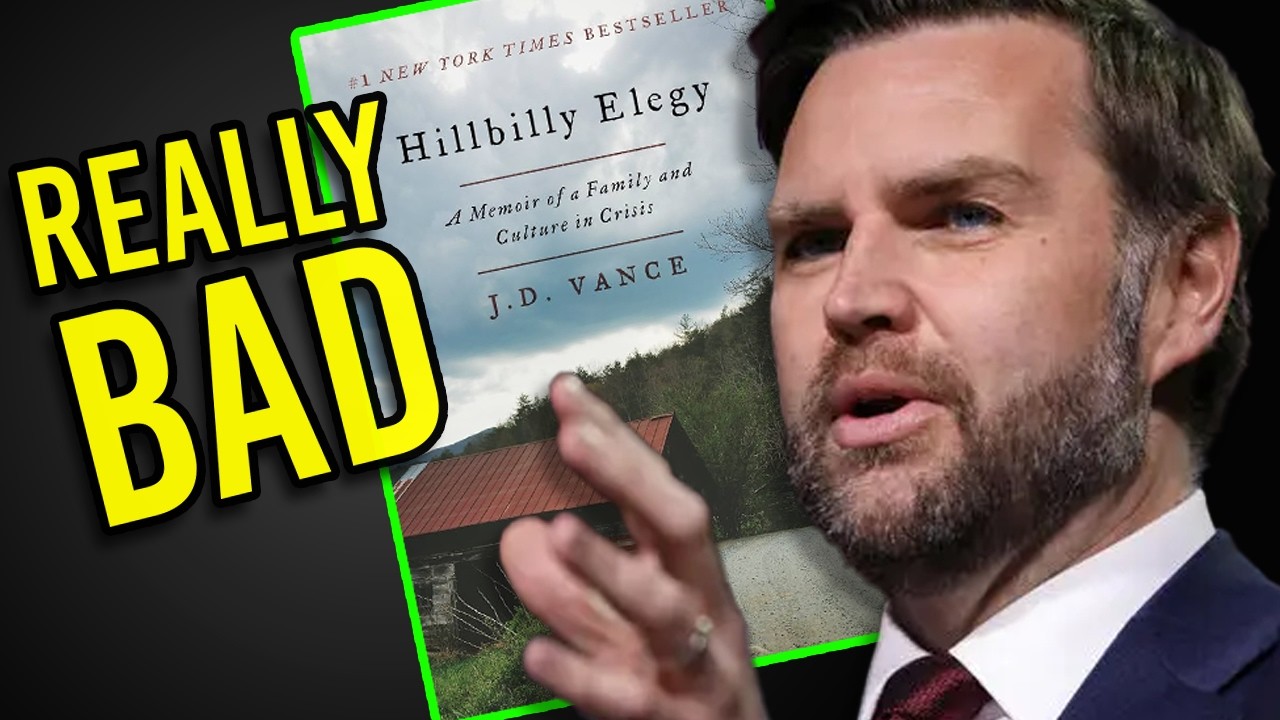
The video transcript analyzes JD Vance's new book, arguing that his worldview is fundamentally flawed due to a distorted understanding of religion and economics. The speaker begins by critiquing Vance's view on Christianity, which he claims incorrectly confines faith to private life while ignoring its historical role in public spheres like politics and science. According to the analysis, Vance fails to recognize that modern European culture was built upon Enlightenment principles that separated church from state, whereas a true embrace of Christian values often led to conflict rather than prosperity. The speaker points out that Vance selectively highlights positive aspects of history, such as castles, while ignoring centuries of religious wars and stagnation, thereby presenting a biased narrative that ignores the complex reality of how civilizations evolve or decline.
In terms of economics, the analysis suggests that Vance adopts arguments typically associated with socialism but frames them through a Catholic lens to appeal to working-class voters without alienating his conservative base. The speaker notes that Vance frequently quotes Pope Leo XIII's encyclical *Rerum Novarum*, which advocates for fair wages and labor rights, yet interprets this as a rejection of individual responsibility in favor of state intervention. This approach is described as "social democracy" or even corporatism—economic models historically linked to fascism—which aims to reconcile capital and labor through government oversight rather than free markets. The transcript argues that Vance believes capitalism inevitably leads to socialism if unchecked, so he proposes preemptive measures like Sunday work bans and stronger unions to prevent social unrest, effectively using leftist talking points about relative poverty and wealth redistribution while maintaining a conservative political identity.
The discussion further explores the motivations behind these views, suggesting that figures like Peter Thiel might support such pandering as a survival strategy against rising socialism, whereas Vance appears genuinely convinced of this ideology due to his integralist Catholic beliefs. The speaker contrasts Vance's authentic conviction with Thiel's pragmatic calculation, noting that while Thiel may endorse appeasement tactics merely to protect wealth and power, Vance seems driven by a sincere desire to apply Christian egalitarianism to societal problems. Ultimately, the video concludes that Vance has been tricked into believing that conservative culture wars are less important than economic populism, leading him to embrace policies like tax cuts for corporations only if they align with broader socialist-leaning goals, thus blurring the lines between traditional conservatism and modern progressive economics under a religious guise.
Read the full video transcript
Yeah, I mean let's start really with
let's talk about his views on economics
and uh and and the the extent and the
way in which religion inspires them or
his Catholic Catholic religion inspires
him.
>> So let we have to start from the
religious part because if we don't
understand this we won't understand
anything. I'll just read a small passage
from his book because I think it's the
most telling part of the whole book. He
says, "We confine Christianity to the
most private of questions, relations
between husbands and wives, reproductive
decisions, and then we're surprised when
kids like me grow up in the faith and
then discard the faith." So basically,
he's telling if we confine Christianity
to our everyday lives, Christianity is
weak. Christianity is timid
>> which is which is which is the way the
enlightenment viewed Christianity and
the way arguably the founding fathers
viewed Christianity. Christianity is
what you do at home. It's it's and and
the whole achievement of the
enlightenment. The whole achievement of
the one of the big achievements of the
enlightenment is the relegation of
religion to the home and [snorts] away
from public the public sphere away from
science and away from politics. So, and
here's how he evaluates
>> what you just said.
>> Yeah.
>> We have to do better.
>> If Christianity is true, it must be true
for the whole human person at all times
of life. To quote the famous theologian
Abraham Quiper, there is not a square
inch in the whole domain of our human
existence over which Christ who is
sovereign over all does not cry mine.
So everything everything belongs to the
Christ. and and he repeats this theme
throughout the book that in all aspects
of your life, the solution to everything
from racism to the epidemic of
loneliness to sexual frustration to
everything, the solution is
Christianity. And the state should stop
pretending that it hasn't got a say on
these things because then the result is
what we see. He keeps using this phrase
something like judge them by their
fruits.
>> Yeah.
>> So judge the culture by what it has
produced. It has produced opioid
epidemics, loneliness. We don't have
children anymore. Therefore, reject the
culture that gave us this result and go
back to embracing the culture that gave
us this country that gave us Europe
which is Christianity.
>> Yes. which is a misdiagnosis of history
because the culture that gave us this
country and gave us modern Europe is the
culture of the enlightenment exactly
that culture that relegated Christianity
to the home and away from politics
because the culture that actually
embraces Christianity in every part of
the world in every part of life was the
culture that gave us the 30-year war
which is you know and what what the
enlightenment was rebelling against the
mass slaughter in the name of Jesus
And it's very interesting that he never
mentioned these times. So he says look
what Christianity has given us. He talks
for example about a trip he went and
there's a nice castle in Wales and he
says this is what Christianity gave us.
Nothing about the wars, nothing about
the stagnation. Yesterday you were
talking about civilizations
going backwards, going extinct and then
we have to reinvent ourselves. Isn't
this something that what happened at
some point in the Middle Ages? He
doesn't even pose the question because I
know some historian will say, "No, this
is not what happened." But there's zero
curiosity about that. It's just
everything that is nice.
Here's a nice castle. That was
Christianity.
>> Yeah. I mean I I don't know why you
would associate castles with
Christianity. [snorts]
Castles exist. Oh, Christianity.
>> What's that?
>> Beauty.
>> Beauty. Yeah. I mean I mean Christianity
adopts beauty
for political reasons. It adopts beauty
when uh when beauty is is deemed
necessary to establish its power which
is really at the beginning of the
Renaissance. the beauty has started to
be creating around the church and the
church embraces beauty as as a way to
to attract people to it and to keep them
there. Um, but yeah, I know people think
cathedrals are the most beautiful thing
in the world. that the Gothic cathedrals
are the are the pinnacle the pinnacle of
human creation and and uh you know of of
of human creation is beautiful which is
bizarre to me.
>> Well, I I'll I'll confess something. I
lived in York for 3 years. There was not
a single time when I crossed your
cathedral with a Richard the Lionhe
Heart statue y
>> that I didn't pause for a moment and say
wow. So, but yeah, I'm not an expert,
but
there was ambition, there was grandeur.
So, there was something there. There was
something there.
>> Yeah. I mean, the willingness to
sacrifice the lives of hundreds of
peasants for the glorification of a
makebelieve, [snorts] you know, gremlin,
uh, who who doesn't exist, right? It's
it's an expression of power. If you if
you go to Egypt and you look at the
pyramids, wow. Wow. But it's a muzzle
for the glorification of a dead pharaoh.
And cathedrals are the same thing.
They're like pyramids. But uh but you
know, in in a sense uh in a sense worse.
But anyway,
>> and I'm not the criterion for good
architecture because I also like
Stalinist architecture and the palace of
the people in Romania. So
>> yeah. Yeah.
>> Ask me about football. Don't ask me
about
>> and the Bobby in London. So
>> don't ask me about architecture. But
let's concretize a bit. We said that Jay
Devans believes that religion should
have a say on everyday things in
politics. Let's give an example.
Actually he gives the example.
>> Yep.
>> He says notice how we've stopped going
to church on Sunday.
But how can you go to church on Sunday
if you have to work on that day or if
you are tempted to go to the mall? So
maybe maybe we should nudge people,
encourage people not to work on Sunday.
And he the next obvious step is maybe we
should ban work on Sunday. There should
be a decree on whether you should work
on Sunday. Or he says
he says imagine how many people need to
stand up from the table on Thanksgiving
because they have to go to work. He
says, "A healthy society should
recognize that it is gross for a 16 year
old to go to a 12-hour shift on
Thanksgiving."
And I thought,
I was doing shifts when I was a PhD
student at the most ungodly hours on the
most ungodly days. And thank God I did
it. Thank God there was no JD Vans who
tell me it's gross for you. No, it's not
gross for me. It would be gross for me
not to get the extra money that I got in
these days. But you see, he knows
better. He and actually not he, the
Bible, the the the Christian creed knows
better. And based on that, we should
decide things like when the shops should
actually be open and when the shops
should be closed.
>> And there there is a long American
tradition of doing that. So when I lived
in Boston in the 1970s,
it was illegal to open a store on
Sunday. All the stores were closed on
Sunday. And some grocery stores stayed
open because they made more business
than the fine, right? So it was
profitable for them to stay open on a
Sunday and pay the fine, but they were
fined. It was it was it was illegal. So
I I can't remember the name of the laws.
Uh
>> Sunday trade laws they were called in
the UK. And of course in the in every
socialist seat hole it's the same. In
Greece it's like that. Of course all the
cafes are open. So apparently there's no
sin for uh for these people. But anyway
but you could say okay this is very
specific. Okay. Sunday trade laws.
>> This is the principle. Yeah.
>> But let's see how this applies to his
worldview on economics. So whether you
read the book or you watch his
interviews, Jay Devance heavily quotes
Pope Leo VI, this was a pope from the
late 19th century and his rarum novarum
encyclical.
Rum novarumo means new things. So the
pope released an encyclical about new
things in the late 19th century. Of
course these new things were capitalism.
>> Yes. And this reads like the program of
a social democratic party. It calls for
fair wages, protection of workers rights
and a reconciliation between labor and
capital.
The pope says we are not of course
communists. And you know it's the most
hilarious moment is in an interview Jay
Devan says obviously we're not Marxist.
Like he has to make the clarification
we're not Marxist. because he says
Marxism and the Catholic Church have a
lot of theological divisions. That's the
problem. But anyway, so and this pope
has the idea that we need to find a way
to reconcile labor and capital through
them sitting on the same table and labor
unions could play a role. Of course,
this is what later becomes the third
position. This is how fascists view
themselves as reconciling labor and
capital. And Jay Deance put it or the
pope I don't remember and J de Vance
quotes him something like no man has the
right to deny another man of a living
wage.
Notice how simplistic and clueless this
view is. No man has the right to deny
another man a living wage.
>> Yes.
>> As if the capitalist it is his duty. So
jobs grow on trees and then you go and
take a job and the capital is now he
given you the job and now he has also
have a duty to pay you a wage which is
good for you and uh and your family. And
then Jay Devans does a little historical
overview. Of course, he praises FDR's
New Deal. [snorts] He praises the role
of the church in making the do the New
Deal digestible and attractive to
people. And the reason he likes this
pope and the encyclical of the pope is
he says this shatters
the myth of individual responsibility
that each one is responsible for his own
life. And he said the pope recognized
that there needs to be a political
framework
so that people are nudged to make the
right choice. So the capitalist needs to
be nudged which means forced
>> at the end of the day to understand that
he has a duty a Christian duty to the
worker. Again
>> I think there's a name for this. The
name is social democracy. Jay De Vance
and the Pope have discovered social
democracy and they think they've found
something very profound.
>> Well, but but yes, I think that's right.
guided by and excused by you know
Christian moral principles and so he
constantly says look
um
you know I'm not a socialist u but if
you know if you uh if you continue along
this path of capitalism
you will get socialism because the the
the working class will rebel
and uh they'll give you socialism so
what I What we need to do, which by the
way is the same argument every fascist
has always made, right? What we need to
do in order to prevent the rise of
socialism is you need to give me power
and I need to control the markets. I
need to preempt socialism
with socialism or with fascism, you
know, if you want to call it something
different. But he he he constantly in
every interview I've seen particularly
recently the last few you know since the
book came out he makes this argument
look the reason socialism is on the rise
the democratic socialists in America are
being so successful in elections is
because the people are rebelling against
capitalism
we as a political party can't can't
represent capitalism because the people
are rebelling against it we have to
answer to their concerns about
capitalism and And the only way to do
that is to be socialist without being
socialist. And really what he means is
being socialist without what really
pisses off the right. The right doesn't
care about economics. What really makes
the right upset is you know uh trans
people in Christopher Nolan's movie or
or or you know a black Helen of Troy.
That really pisses them off, right? That
they get super upset about. They
couldn't care less about free markets or
capitalism or economics or anything like
that. So to prevent woke which is associ
with socialism we need socialism but
with a Catholic
veneer or Catholic you know uh o
oversight. Actually Vance takes it a
step further. He wants to go straight to
the socialist. He doesn't even care
about fighting war. He actually says
that the problem with the Republican
party is that all these years they
tricked us. They tricked us into selling
us conservative culture wars whereas
what they wanted was to cut taxes. And
he said the average Republican doesn't
even want to cut the taxes of big
corporation. So he goes straight to the
point the point is straight
the socialist economics.
>> And he and he's right. Right. Because
all Republicans have ever done since
Reagan,
the only thing that differentiated them
from Democrats is they want to cut
taxes.
That's it. And and there's, you know,
people say, "Look how Trump is great. He
cut taxes." Every single Republican
except George Bena has cut taxes. So
there's nothing unique about Trump. It's
the only thing that differentiates
economically Republicans and Democrats
really in any fundamental sense in terms
of actual governing policy. So, um, he's
right that the Republicans have failed
because that's the only thing they
focused on and it's not that important.
>> And also, while the more he goes in his
economic policy, you realize that the
guy is actually clueless, which is weird
>> for someone with this education. So, I
wonder if he's clueless or he's just
lying.
>> So, he says, for example, that, and
these are the words that he's using. I'm
not exaggerating them. He says that the
robber barons of the industrial
revolution raised inequality so much
that this is what brought communism and
therefore then fascism.
>> Yes.
>> The guy has the arguments of a leftist
but actually the arguments of a clueless
leftist.
>> Yeah.
>> And he's using all the time leftist
talking points and actually leftist
talking points from the early 2000s. He
brings for example he wants to talk
about against outsourcing to China and
he says you know workers in China was
jumping from the roofs of the apple
factories in China and this is why they
had to install suicide nets
and or he has this other point that
England and the US became the success
stories of capitalism. Why you think
because of trade unions? These are not
just leftist points. These are
strong old left socialist points that it
was trade unions that made these
countries what they are.
>> And a theme a theme across his work
>> is that stronger unions are needed.
Stronger labor unions. And he says one
of the problems of immigration is that
it weakens the cohesion of the labor
movement. Again, this is a old leftist
argument from the
>> Bernie Sanders argument. Bernie Sanders
has made this argument. That's why
Bernie Sanders has said explicitly he's
not for open immigration because it
[clears throat] weakens the unions. It
>> weakens the unions. Yeah. So he has this
big idea to create this forum
where labor and business takes the the
decisions together. And there's a name
for this. The name for this is
corporatism. And it was actually the
economic model of fascism. and Jay De
Vance takes it out of the closet of
history a century later and he thinks
that he has discovered something but I
want I want to read one quote verbatum
so that because you know people might
think we have Trump or V derangent
problem so I'm going to read a very
short quote and I want our audience to
think if I told you that this quote came
forget Bernie Sanders if I told you this
quote came from Hassan Per which is a
quote that as you'll see could easily
come from per how would you judge it
quote
we're going to wake up and realize that
rich people have gotten way richer the
average person has stagnated
and people really hate relative poverty
post quote relative poverty is when it's
not that I'm poor but someone has way
more than I am. So now I'm envious.
Continuing the quote, you can give
people iPhones and the creature comforts
of a 21st century economy.
But if you make rich people way richer,
you're going to have significant
problems. Pause. Notice, by the way, if
you make rich people richer, this is how
this guy understand production. Someone
somewhere makes rich people richer. And
finishing the quote,
the idea that we're going to allow to
allow these companies, he talks about
big business, big tech to accumulate
trillions and trillions of wealth and
then we'll be able to successfully
redistribute it to workers. I'm very
skeptical of that. So he's not going to
allow
>> Yeah.
>> And the problem if these people get too
rich is then it's difficult to
redistribute.
So we need to find better
redistribution models which are not
going to be first let them be rich and
then redistribute because then you're
going to have relative poverty. Again
these are I grew up with these
arguments. These are socialist hardcore
socialist talking points.
>> Yes. And they're hardcore fascist
talking points. And I think that's
that's that's where he's coming from.
That is this is this is the new right.
This is the the kind of the fascist
right. they, you know, maybe they're not
yet quite authoritarian like the
fascists that maybe they're not quite
yet as racist as fascists, although some
of them are getting there. Uh, but in
the name of stopping the left,
they they they completely adopt the left
and he has his what makes him more
committed, I think, is the fact that his
views are coming from religion. that is
he is embracing Christian egalitarianism
and that that is what is really
motivating him um
you know to to to really commit to this.
So, it's it's not just it's not just
he's playing. He's I'm I'm actually
curious and I don't know how to
I I need to ask Peter Teal at some point
this question. Um because I don't think
Peter believes any of that, right? I I I
don't think Peter believes in it, but I
think Peter believes that you have to
say it because the average person
believes in it today, right? But, you
know, Peter's a self-made man. I mean,
he again, he founded PayPal. He's he's
got one of the most successful venture
capital funds ever. He's got a hedge
fund. He's he's an incredibly successful
and he knows he's read Atlas Shrugged.
He studied Atlas Shrugged. He knows the
economics.
I don't think he would ever talk quite
this way. But what Peter, I think, would
say is
if we don't if we don't get the working
class on our side, socialism wins and
they kill us.
So we to get the working class on our
side, we need to play the socialist
card. So the question is, is JD Vance
doing that or does he really believe it?
Now I think he really believes it
because I think he's bought into the
integralist world view in a way that
Peter Thiel has not.
>> It's interesting. Our friend, our common
Italian friend, Luca, was asking me on
Twitter, how come Peter Thiel support
that crap? And I said, I have no clue.
But I told him, I promised him I would
ask you. So, but you've already you've
already answered it.
>> I think it's he he believes it's
necessary for survival. I think if if if
we don't and this is why I supported
Trump, if we don't cater to the worst
elements in our society, they will rise
up against us and kill us all. So, or
bring us bring us socialism when woke
socialism. So, his view is you gota you
got to pander to them uh in order to in
order to buy us time. Um,
I I think that's I think that's Teal's
view, but I do remember every time I see
Peter Teal, I'll ask him.
>> Do you remember that scene in Atlas Ragd
where after Rean's court speech, he's in
that party with other businessmen and
all are telling him, "Oh, why did you go
that far? Now they're going to think
that we're just after money." And he
tells him, "Hey, but aren't we after
money?" And he says, "Yeah, but you
shouldn't tell it because then they're
going to come after us." And he says,
"So if you I'm butchering it, but he
says something like, "So if you tell
them that your money is not yours, then
you think they're going to leave you."
>> Yeah.
>> And he leaves the party by saying
something like, "Gentlemen, h I'm really
sorry. I'll have to save your goddamn
neck while I'm saving mine." Or
something like that. Do you remember
that scene?
>> Yes. Yes.
>> That's exactly I think what's happening
here.
>> Yes. I think so, too. And it's so sad
because yesterday in your show you were
talking about Nolan the director.
>> Yeah.
>> Who has the same view that I have to
cater to the lowest common denominator.
How sad that these great spirits are
broken and are defeated.
>> Yep. I I I think that's absolutely
right. But you know this is this is the
cost you pay
for losing the intellectual battle,
right? So, so uh you know these great
spirits in production, Peter Teal and
and Lon Musk and people like that, who
do they turn to for intellectual
inspiration? Well, Peter Teal turns to
Gerard. He's exposed to Rand, but he can
never really embrace Rand. She's too
she's too radical. Um and and and and he
doesn't want to lose the the world the
culture. He views Rand as if he embraces
Rand, he's lost kind of the the world.
Um so yes, I mean uh this is what
happens when businessmen don't have
the intellectual ammunition provided to
them by the intellectuals. It's our job.
It is anyway. So to to Phoenix,
he has also this absolute caricature
view. people can find I quote him on my
last tweets on that where oh everyone
the the the mainstream is a neoliberal
libertarian
market worshippers and he says you know
whenever you spend time caring for your
elder parents this takes time from work
from GDP and you know the powers to be
don't like that and he has this stupid
idea that there is this it's like either
the economy or your values economy or
life and it's like the one or the other
and he said we want people over
spreadsheets again these are arguments
of a first year not particularly bright
sociology student
>> and th this is where I start thinking he
can't believe these things he can't be
that stupid he's probably pandering he's
probably appeasing the lowest common
denominator but the lowest common
denominator of the other side the all
the lowest common denominator of the
left
>> it turns out that the lowest common
denominator of both sides is the same
person [laughter]
or the same people. I mean, that's that
would explain him pandering would
explain Peter Teal because Peter Teal
would sit Peter Teal is not going to
pander, right? He's not a pander, but he
would support pandering
as a survival strategy. Um I I could see
him saying, "Okay, JD, go panda. Uh
here's here's here's here's the
millions. go panda because uh we need
you to panda because we need to appease
these people so that they don't come
after us, they don't slit our throats
and and and and that's I think Peter
Teal's kind of thinking. Whether Vance
really believes it, I think he has to. I
think ultimately he is a believer. Uh I
I I think you see that in his
relationship with um with Denine and the
integralists. He's a truly a fan of Den.
He's read Denine. Um he he has praised
Denine. Uh I I you know he repeatedly
goes on these uh at these conferences
the national conservative conferences
and talks about these kind of issues and
he talks about it in a way that sounds
very authentic. Uh I think he is an he
is a Christian conservative. He very
much believes in Christianity and
applying Christianity to the world. I I
think from Tio's perspective as the
puppet master if you will, Tio thinks he
needs people like JD Vance out there,
but I don't think JD Vance is doing the
pandering. I think it's Tio pandering
through JD Vance.
>> Right.
>> JD Vance is a believer.
>> You mentioned Denin. By the way, when
we're going to talk about him,
the guy's literally quoting Karl Marx
and he's using Marxian categories. He's
using the marks and category of
alienation not as a coincidence. He's
actually telling you Marx was right on
alienation. I'm going to use the marks
and category of alienation.