Video summary
Donna, a staff Site Reliability Engineer (SRE), shares her unique perspective on surviving extreme camping conditions by applying professional engineering principles to life in a camper van with two dogs across Europe and Scotland. Although she initially prepared for freezing temperatures of minus 21 degrees Celsius during winter trips from the Scottish Highlands to the Austrian Alps, she unexpectedly found herself presenting advice relevant to heatwaves instead. Her preparation involved extensive insulation on doors and water tanks, redundant gas heaters, spare power cables capable of being daisy-chained, snow chains, and multiple layers of clothing, all prioritized to ensure survival against the cold while also accommodating her dogs' travel needs through specific passport arrangements.
The core of her presentation bridges the gap between chaotic real-life emergencies and structured SRE concepts like Service Level Indicators (SLIs) and Objectives (SLOs). In this context, the SLI was simply temperature, with an SLO set to keep the interior above 15 degrees Celsius rather than freezing. When a power outage occurred at night after skiing left her exhausted, she treated the situation as a Severity 2 incident because it posed a genuine risk of pneumonia and hypothermia without immediate intervention. Her troubleshooting process mirrored standard incident management protocols: identifying the signal (lights going out), assessing severity, triaging by checking fuses and cables to isolate the fault between the van's fuse box and shore power, escalating when necessary, and eventually fixing the issue through a makeshift hardwired connection that restored electricity but not immediately heat.
Once the immediate crisis was managed with a temporary hack involving spare cables and resetting hidden buttons on the heater, Donna emphasized the critical importance of follow-ups and retrospectives to prevent future failures. After stabilizing their situation by rewiring the power inlet for the remaining two weeks of their winter trip, they addressed long-term fixes like repairing the main socket upon returning home. She concludes with three key takeaways: recognizing that real life often mimics work scenarios where one must act rather than hope problems resolve themselves, understanding that hoping is not a strategy when safety is at risk, and committing to an iterative cycle of exploration, failure, correction, and improved preparation for the next adventure.
Read the full video transcript
[applause]
Cool. Hello. Welcome to an SR's guide to
camping in extreme conditions. When I
prepared this, I very much had winter in
mind and minus 21°. So, I didn't quite
expect to be presenting to a camp in 30°
heat where people are probably hoping
for advice and to survive the heat. This
isn't really that, but bear with me. Uh,
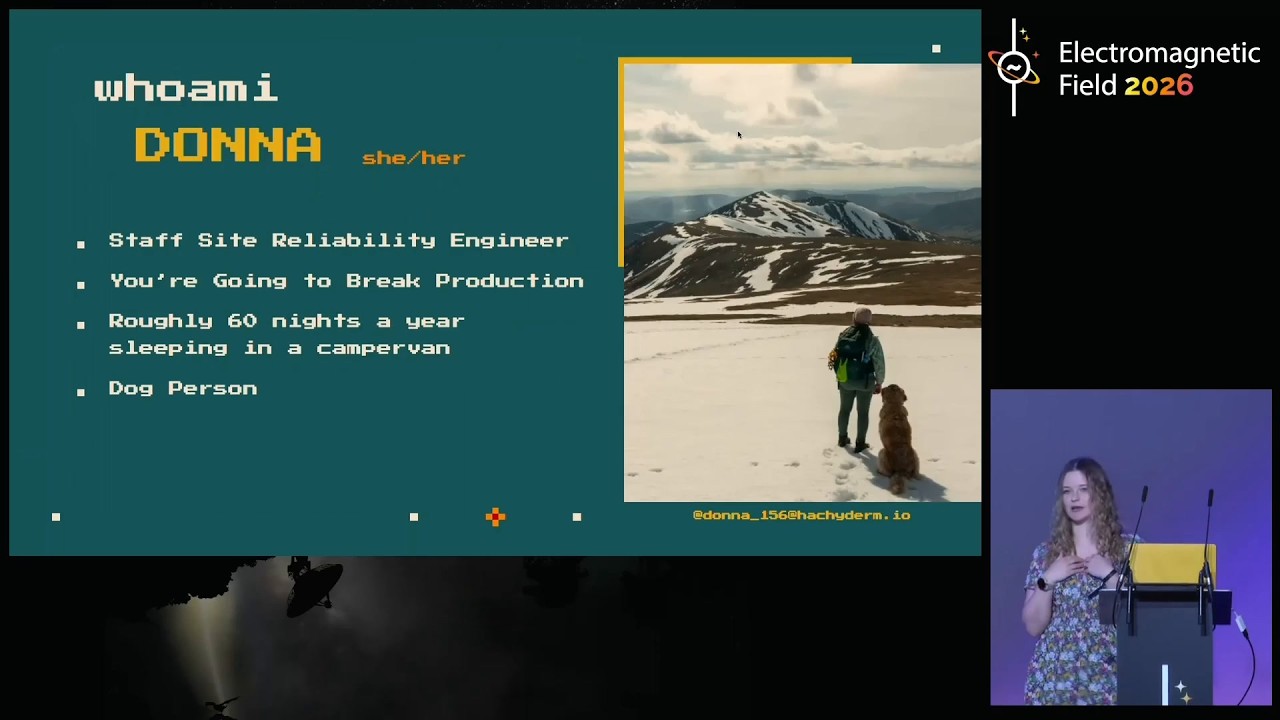
so who am I? My name is Donna. I'm a
staff site reliability engineer. And
what that basically means is it's my job
to make sure that the platforms stay
alive and people don't break it. So part
of what my job involves is educating
other people at the company on how to
break things safely. So one way I've
done this is by throwing in a calendar
invite for the entire company on a
Friday afternoon called you're going to
break production. Yes, you. uh mostly
just to get their attention uh and then
using that to share availability best
practices, talk about incidents that
we've learned from and basically where
we went from there. Uh and I do this
managing a lot of incidents, but also I
love camping. I spend roughly 60 nights
a year in our camper van from hacker
camps in the field in England to the
Austrian Alps and around Ireland and
mostly in the highlands of Scotland. and
I'm a dog person, so there will be dog
photos throughout this presentation.
So, what am I going to talk about?
First, a little bit about fan life and
the logistics of taking a camper van
from Scotland to the Austrian Alps in
January with two dogs. Uh, then I'm
going to cover a little bit around SRE
concepts. What does SLI, SLO, what do I
mean when I say incident management, uh,
escalations and all of the highlevel
pieces. I don't have long enough to go
into all the SRE concepts and then I'm
calling it the incident. There are many
incidents that we have had when camping.
So you can find me in the bar or the QA
tent afterwards if you want to hear more
stories.
So first of all, winter in mainland
Europe.
One of those ideas like, oh, wouldn't it
be really nice to take a camper van to
Europe in winter and we can have our
dogs with us and it'll be really cozy
and nice in the van. And we we prepared.
We were ready for this. I'm one of those
like narrators like no, they were not
ready. Uh things happened. So what did
we do to prepare? We insulated all of
the things. So they we took apart parts
of the door filled with insulation. All
of the water tanks covered in
insulation. We had heating pads. We were
ready. Or so we thought. We even have an
insulated windscreen cover which has
actually come in handy for the heat as
well. So it does work both ways. Uh
spare resources. Uh, we have a gas
heater in our van and if you're familiar
with camper vans, gas heaters are a bit
temperamental. You learn all the
runbooks and things that go wrong with
them very quickly. So, we had
redundancy. So, we had a backup heater.
We also have multiple power cables just
in case one cable stops working. And
also, you can daisy chain like some
people have probably done at camp today.
Also, snow chains. It's a legal
requirement in Switzerland and Austria
on some roads, but also you don't want
to get stuck in the snow or ice. Uh lots
and lots of layers, which is the
opposite of what I think people need
today, but you really just preparing so
that you can stay warm is the priority
of everything. Uh and then also dog
passports cuz a common question is but
how did you take the dogs with you? And
I'm from Northern Ireland and and my
dogs actually have had Irish passports
for the longest time. Uh recently
legislation's changed and I could spend
20 minutes talking about that alone. Uh
so if you want to know more about taking
dogs specifically, uh come ask questions
later. Uh and I just wanted to quickly
touch on some of the fun stuff cuz some
of my friends who are here today often
ask like why do you keep going to do
these things when there's so many things
that go wrong? Like it's very chaotic.
And I'm like, but look at all the cute
pictures we get with our dogs in a
blizzard in Switzerland. And you make
all these really lovely memories. So
before I talk about some of the chaos, I
just wanted to share some really cute
pictures on why we put ourselves through
some of these things.
Uh, and then SR concepts. So site
reliability concepts. And if you know an
SRE are an SRE, you'll be familiar with
the this is fine fire dog background
thing where you're like yeah
everything's fine as everything burns
down around you. So very much that vibe
is what I bring to SRE. Uh so I want to
talk about some of the terms that people
generally use when talking about SRE. Uh
so that's SLI and SLOs's. So service
level indicators, it's what is the data
are you measuring? Like how do you know
something's working? What do you care
about? Is it latency? Is it error rates?
What do your users of your system care
about? And then the objectives is what
is the target for those systems? Uh like
you'll often hear people talk about 59s
availability. What sort of availability
are you aiming for? Uh so how do you
know your users are happy and what's the
error budget to go with that? These
often come with a third term that I'll
not go into here because it's not
particularly relevant for my example,
but it's service level agreements where
basically people companies sign
documents that say if we don't meet our
objectives, we will pay you money
because we didn't meet your needs. Uh
but I didn't have to pay anyone for our
van breaking down. So it's not relevant
for this talk. Uh so I want to then
touch on incident timelines because
incidents are the one interesting thing
to talk about and also a big part of an
SRE is trying to fix things. So what
does the timeline of an instant look
like? So first piece uh identification.
How do you know that something is wrong?
In an ideal world an alert will fire and
tell you that something is going to
break or like you've got some symptoms
that something is a bit unhappy. Uh on
alternative things, people message you
like, "Hey, something's on fire. This
isn't working." And your customers start
yelling at you. Uh also a signal, not a
great signal, but still a signal. The
next piece is once you have that signal
is assessing the severity. How bad is
this situation? Is this a we need to
drop everything and we need all hands on
deck or is this uh it's a little bug
with this one part of the system and
we'll get to it later? like that
determines the next path forward. Uh and
then you have to triage what is actually
happening like what do I need to do? Who
do we need to get involved? What is
actually broken under the hood and
causing this problem?
Fourth is escalating. So you've
identified what the problem is and what
you need to fix. Uh a lot of the times
that may not be you in a widely
distributed system. So you need to call
in experts like oh I need to talk to the
person that knows more about the
databases. I need to talk to someone who
knows more about very specific part of
the system. So you escalate and
depending on the severity that's am I
going to wake someone up or am I going
to wait until tomorrow? Like the
severity feeds into all of that. And
then fix it. How do you get back to a
stable state? And I emphasize stable
state because I mean how do your
customers start using your system again
in a way that they are happy? That
doesn't necessarily mean the problem is
fully resolved under the hood, but it's
back to a state where customers can keep
going and keep working.
And then you have the follow-ups. So,
this is the tidying up, making sure
you've got everything back into the
perfectly stable state that you need to
be fully resolved. And then you consider
how do we do better next time. You have
those retrospectives. And these are
often the overlooked parts of an instant
timeline because it's admin. It's
boring. it's, oh, I really don't want to
bother doing that. It's fixed now. Not
my problem. But actually, these are the
important parts because it allows you to
do better next time. And this all feeds
into where I'm going next. So, the
incident uh again there were many. I
focused on one because of time
limitations, but I'll go through uh all
of these concepts for this incident. So,
what was the SLI and SLO that we cared
about? SLI temperature. It was cold and
we wanted to stay not cold. We wanted to
be warm. So the SLI, the indicator we
cared about was the temperature. The
SLO,
we wanted it to be over 15°. Like in an
ideal world, 20°. We want to be nice and
cozy in the van, but we're in a metal
box in winter. I'll accept 15° in the
van. And the goal is not to freeze to
death.
Uh so just to set the scene of what was
happening, it was 11:00 at night. Uh our
water pipes had frozen days ago because
as much as we had insulated all the
things, we did not insulate the water
pipes. So we had water tanks full of
water, but we did not have pipes that
would sufficiently transport said water.
Uh thankfully when they unfroze, nothing
broke, which was just pure luck. So
that's a near miss incident on itself.
Uh on this day we had also spent our day
skiing. Uh I had not skied in years and
I could not walk at this time. I was
just sore. Everything hurt. I cried cuz
I kept falling. My partner very kindly
looked after me. I was like, "There,
there, you'll get there." And your legs
weren't working. And the temperature I'm
very glad I took a screenshot of this
was real feelous 21°. You walked outside
and the insides of your nose were
freezing. the dogs are unhappy and
you're like, "Okay, yep, this is fine,
but at least the van is cozy because the
heater's working."
And then we have identification. So,
this is the start of our incident. So,
I'm just casually brushing my teeth. We
have a little toilet, bathroom, cubicle
in the van, brushing my teeth, and then
the lights go off, and I kind of mumble
through the door to to Elliot saying,
"Hey, did you turn the power off?" And
he's like, "No." Oh,
So that was our signal. That was our
identification. Something's gone wrong.
So this at this time the temperature was
still fine because the heater had only
died. But at that point we're like the
heater is no longer working. That's a
signal. So then we needed to assess the
severity of the situation.
So whenever we talk about incident
severity, uh we in in my company we talk
about severity four right up through
one. So4 is kind of like it's
inconvenient, but like it's fine. You
can have a coffee or a hot chocolate and
you will get to eventually solving the
problem. Uh but it's not urgent. You
don't need all hands on deck to fix it.
Severity 3 is like, "Oh yeah, it's it's
getting a bit cold, but like we we're
probably fine till the morning or we can
like wait a couple of hours. It's late.
We'll wrap up warm extra blankets. It'll
be fine." Severity too is when you're
like, "Oh, there's actual customer
impact." Uh, so for us, we're like,
we're at risk of pneumonia. If the
heater is actually dead, it's 11:00 at
night. It's going to be minus 21 down to
minus 24 all through the night. Without
a heater, we're probably in danger. So,
for this purposes, we say this is a
severity 2 incident we're dealing with.
Uh, and included severity one there as
well with my little skeleton that would
be we are in real danger. like this is
threat to life danger. Uh thankfully we
did not get there but it was very much
one of those depending on how the
instant played out this could become an
S1. Um so what did we do to triage the
issue? And as any good computer person
would do, we turned everything off and
on again and we unplugged and replugged
all the cables again and again and
again. And we're like it could not
possibly be our van. This is not our
problem. Like it's it's definitely the
campsite's problem. Maybe we need a
different power source. Maybe we need to
plug in somewhere else. Oh, and we have
a fuse box in the van. Like, let's go
iteratively one by one through all of
the fuses and see what's going wrong.
Which narrowed it down to there is a
problem between the fuse box and the
shore power going into the van. So
somewhere in that cable, uh, something's
gone wrong and we cannot get power into
the van and something with that's broken
and our leisure battery is probably not
going to survive the night in the cold
either. So that's not great. So we
escalated. Uh, so while uh while my
partner is very good with electronics
and things, uh, we're like we maybe need
to call in some experts. So, to start
with, I went and woke up the campsite
manager at 11:00 at night saying,
"Hello, this must be your problem with
your site. Please help us." Which, fun
fact, blaming someone else means they're
not really wanting to help you. So,
approaching it with a, "Hello, please
help us. We think there's a problem.
We'll get you much further." But I was
in a little bit of a panic and common
sense goes out the window. So, he was
rather unhappy with us. Came down and
checked. He's like, "No, it is your van.
It is the problem." And just walked
away. We're like, "Okay, that was
unsuccessful. We need to escalate to
someone else." So, we called our dads
because you can always rely on dads. So,
uh, so we were on the phone and he's
like, "Okay, we walk through all the
same troubleshooting again cuz that's
what you do. You're like, oh, just
confirming we've done this and this and
this. Okay, you've done that. Okay, it
must be the fuse box." So, now we
narrowed it down. We know what we're
doing. How do we fix it? So our fix in
this incident is that we basically
hardwired that spare cable that we had
that I told you about. Uh we hardwired
that direct. I say we Elliot did and I
was the incident manager managing the
situation which is why I'm talking about
it and not him. Uh but he hardwired the
cable directly into the fuse box and we
basically use the other end of that
cable as the inlet the shore power into
the van coming in through the window.
And the solution at that time was it was
a hack. It worked. We got and we had
little lights in the van that only work
when you're plugged into the mains. So
when they turned back on, we had a
little dance party because we're like,
"Yes, okay. We have electricity." But
the heater wouldn't turn on. Like, "Oh,
it still has a red warning light." Uh,
so then I turned to the runbooks, went
back and was like, "Okay, we need to
reset the heater. Where's the heater?"
and you're going through all the
processes to find, oh, I need to find a
very specific red button hidden under
under the seeds, which one of these
photos is me very happy when realized
that resetting the button actually
worked and we survived.
Uh, so then the follow-ups. So, I said
the retrospective like what can we do
better next time? Uh, immediately the
next day was tidying up our hack
solution so that we can continue our
trip. we still had another two weeks in
winter in mainland Europe and we really
didn't want to come home. Uh so it was
very much okay we we need to work out
how to do this. So it was rewired in a
way that meant we can continue working.
It's just a little bit awkward. And then
buy better tools cuz what I didn't
mention before is that we use a small
pedager duty uh Stanley knife or uh
Swiss Army knife kind of thing to uh to
fix things which is irony cuz it's pager
duty and I got it from a conference one
time but it came in handy. And then at
the time it was like future us problem.
We need to fix the power store socket
eventually but it can wait till we get
home. So that was our future us problem.
And because I promised you dog pictures,
uh there are always lurkers and
observers in incidents. People that join
the incidents but don't really
contribute. They're just there to see
what's happening. So the dogs enjoyed
hanging out on the bed while we continue
to debug and fix the problem. And
they're not usually allowed on the bed.
So they were delighted. They were having
a great time.
Uh, so I promised you a guide and I
realized on the way down I'm like, "Oh,
nothing about this is a guide. I'm just
telling a story." So I wanted to throw
in three final things before I finish
up. One is about life imitates art uh or
work in this case where at the time
we're like, "Oh, it feels like I'm in an
incident and I'm doing troubleshooting
as if I'm doing my day job. This would
be a cool talk sometime. I should tell I
should do this." Uh so it's really that
whole real life can be seen to mimic art
or work and you can always see those
parallels. Uh and hope is not a
strategy. Uh I've been in instance
before like oh we'll just wait and see
if it fixes itself. That will be fine.
Uh you need to actually do something
about the problem before it gets worse.
And finally iterate, iterate, iterate.
Go exploring, get it wrong, fix
something, learn, do better next time.
And then you can iterate and you can be
slightly more prepared. Uh for example,
we'll probably do additional justific
adjustments to our van because of the
heat because it's very warm. Uh so with
that, that's me. Uh thank you very much
for your time. If you have any
questions, you can find me run camp. I'm
on mastadon. Uh all the links here. Um
yeah, thank you. [applause]